
LEAD ANALYST
Utkarsh Khirodkar is a Lead Market Research Analyst at MetaStat Insight, specializing in market intelligence, technology sector assessments, and competitive strategy.

Global 999.9 Fine Gold Bars Market Size, Share, By Product Type (Cast Gold Bars and Minted Gold Bars), By Weight (Below 10 g, 10 g to Below 50 g, 50 g to Below 100 g, 100 g to Below 500 g, 500 g to Below 1 kg, 1 kg, Above 1 kg to 5 kg and Above 5 kg), By End User (Individual Buyers, Commercial Banks, Non-Bank Institutional Investors, Central Banks, Jewellery and Watch Manufacturers, Electronics and Electrical Manufacturers and Others (Dental Laboratories, Medical Device Manufacturers, Aerospace Manufacturers)), Industry Analysis, Growth, Trends, and Forecast, 2026-2033
MSI-5435
October, 2026
279 Pages
Historical
Base year
Forecast
Forecast period
Report Details
Comprehensive Market Analysis And Insights
Market Valuation: Valued at $25 Million in 2025, projected to reach $33 Million by 2033 at a 0.0% CAGR.
Dominant Segment: Cast gold bars lead the market, driven by demand from commercial banks, non-bank institutional investors, and central banks seeking cost efficiency and bulk storage for reserve management.
Geographic Lead: North America holds the largest share in 2025, supported by high purchasing power, established refining infrastructure, and mature investment demand, with the US leading in 2026.
Segment Growth: Institutional buyers are increasingly allocating to higher-weight bar categories, particularly 1 kg and above, to optimize reserve management and transaction efficiency.
What's Inside: The report provides in-depth segmentation by product type, weight, and end user, regional analysis, detailed discussion of market drivers and challenges, and competitive landscape, covering the forecast period from 2026 to 2033.
The global 999.9 Fine Gold Bars market was valued at USD 25 million in 2025 and is projected to reach USD 33 million by 2033, growing at a CAGR of 3.5% over the forecast period.
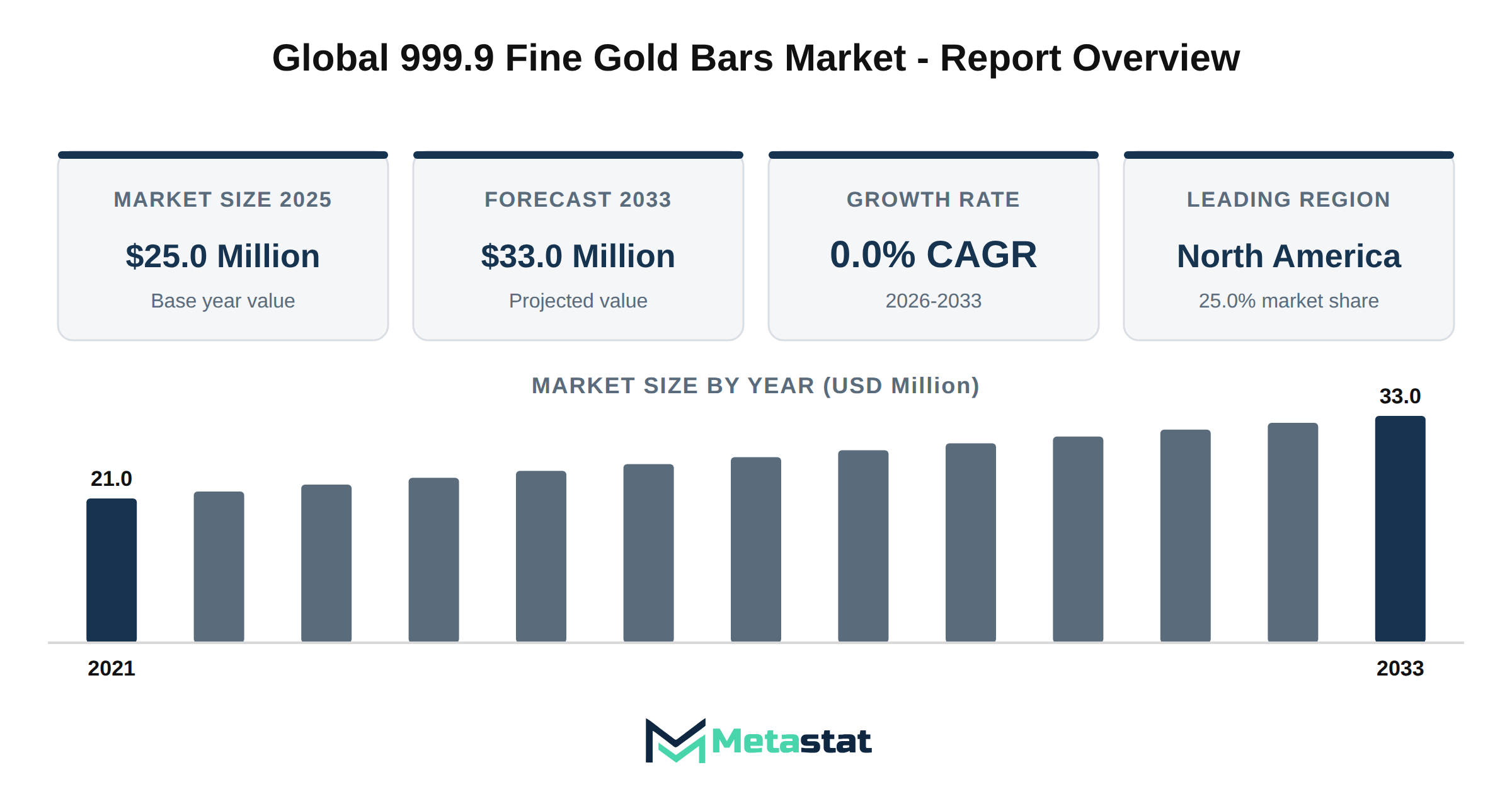
The 999.9 Fine Gold Bars market encompasses products refined to the highest purity, serving investment, reserve, and industrial applications where quality standards are critical. Buyers include individual investors, institutional entities, and manufacturing end users who require consistency and recognized value. Purchases are triggered by portfolio diversification, asset security, and steady demand from manufacturers in sectors including jewellery, electronics, and medical devices.
Investors and commercial banks drive the largest share of spending by seeking reliable stores of value and liquidity. The market’s segmentation highlights individual buyers, commercial banks, and non-bank institutional investors as significant demand generators, with commercial banks representing the segment with the most value. North America accounts for the largest share in 2025, with the US leading in 2026. This region’s high purchasing power and established refining infrastructure support sustained demand and reinforce its position.
The primary growth driver for the 999.9 Fine Gold Bars market is the increasing adoption by institutional investors aiming to hedge against market volatility and currency fluctuations. These buyers prioritize high-purity bars for their investment portfolios, reinforcing demand and underpinning stable volume requirements across global regions. Growing institutional adoption is expected to enable steady expansion in both developed and emerging economies.
Buyers in the 999.9 Fine Gold Bars market include individual investors, commercial banks, institutional entities, central banks, and manufacturers in sectors including jewellery, electronics, and medical devices. Purchase decisions in this sector often reflect a preference for asset security, tangible wealth preservation, and compliance with strict purity requirements. For institutional and retail investors, these bars deliver a recognized store of value, while manufacturers rely on their purity for reliable processing and consistent product quality. The market covers both cast and minted gold bars, each addressing distinct preferences for production scale, finish, and traceability.
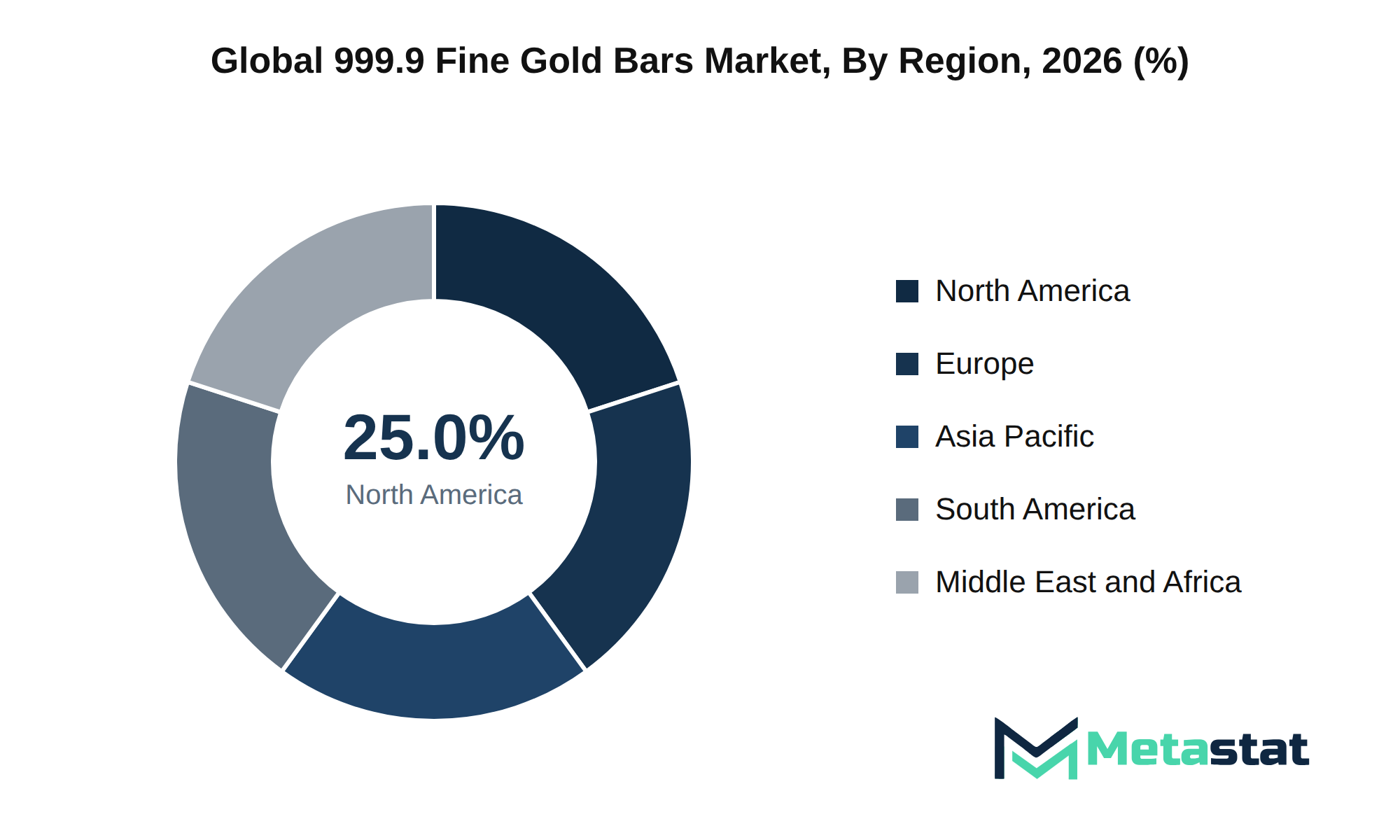
North America holds of the market in 2025, with the US leading in 2026. This region’s prominence reflects strong investment demand, a mature financial sector, and established distribution networks. Europe, Asia Pacific, South America, and Middle East and Africa each account for an equal share, highlighting the global appeal of high-purity gold bars for reserve management and manufacturing inputs. Central banks and institutional buyers in these regions sustain baseline demand, while regional nuances in consumer behavior and regulatory conditions further shape buying patterns.
Within the 999.9 Fine Gold Bars market, investment-driven purchases stand out as the primary growth driver. Institutional investors and individual buyers increase allocations to physical gold when seeking hedges against inflation or economic uncertainty, which increases both transaction volumes and average bar weights. The segment with the most value is cast gold bars, which attract buyers seeking large denominations and efficient acquisition for reserves or portfolio diversification. This dynamic supports a stable outlook for producers and distributors focused on purity and reliability.
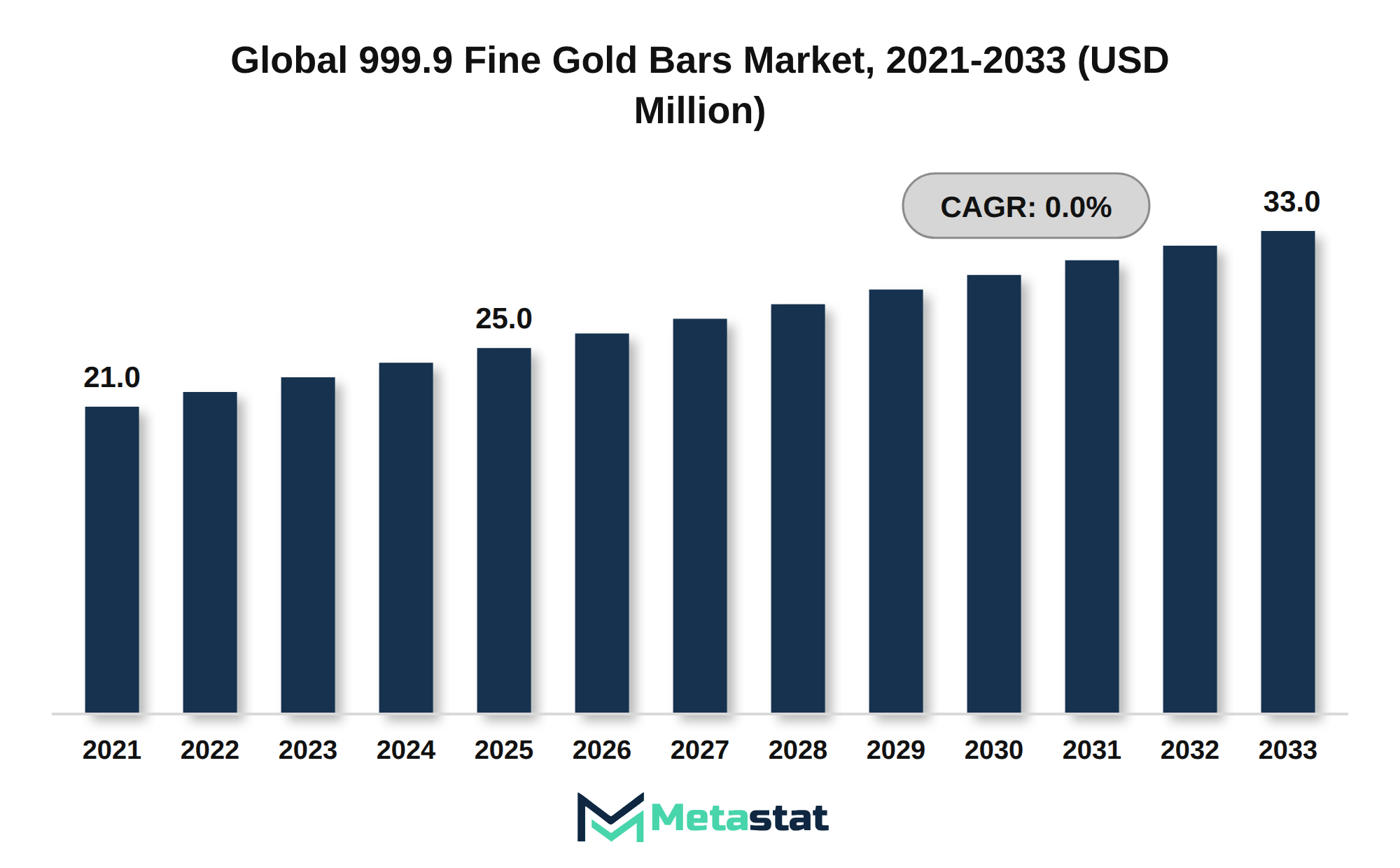
Retail and institutional demand in the 999.9 Fine Gold Bars market has shifted markedly toward products that guarantee traceability and authenticity. For individual buyers and non-bank institutional investors, verification technologies including advanced stamping and digital certificates influence purchasing decisions. This shift reflects rising concerns regarding counterfeit gold and the importance of transparent sourcing, especially among buyers who seek long-term wealth preservation or portfolio diversification. Individual buyers and non-bank institutional investors represent two of the most active buyer groups, with their purchases driven by a combination of investment security and growing digital engagement within financial products.
Commercial banks and central banks further reinforce this trend by prioritizing gold bars with high standardization and verifiable origin, aligning procurement criteria with international compliance requirements. The increasing integration of digital verification tools and secure packaging enhances both retail and institutional confidence. Within the 999.9 Fine Gold Bars market, this emphasis on technology-driven verification supports a premium pricing dynamic for certified bars, distinguishing them from uncertified alternatives. Suppliers that invest in such product features improve their appeal to a growing base of security-conscious buyers, strengthening their competitive position and influencing the market’s product mix.
Buyers in the 999.9 Fine Gold Bars market consistently encounter different premiums for cast and minted gold bars depending on the bullion hub and the prevailing demand for specific bar types. Individual buyers, commercial banks, and institutional investors often compare premiums between cast bars, which are produced with lower fabrication costs, and minted bars, which command higher premiums due to their refined finish and packaging. In major bullion centers including North America, Europe, and Asia Pacific, both bar types are widely available, with local pricing influenced by fabrication method, weight, and perceived liquidity.
Manufacturers and refineries in the 999.9 Fine Gold Bars market distinguish their offerings through branding and product quality, with cast bars favored by buyers prioritizing lower acquisition costs and minted bars preferred by those seeking secure packaging and recognized authenticity. The segmentation of demand by weight and bar type drives variations in premiums, especially in regions where retail investor activity is prominent. For instance, 1 kg and below 100 g bars attract different buyer groups and liquidity preferences, shaping how premiums are set in local markets.
Premium differentiation impacts transaction volumes and preferences in each bullion hub. Buyers seeking immediate resale value or institutional-grade products gravitate toward bars with the narrowest bid-ask spreads, while collectors and retail investors pay higher premiums for superior finish or brand reputation. This pricing structure in the 999.9 Fine Gold Bars market influences supplier strategies, with refineries and distributors adjusting production and marketing efforts to meet the evolving preferences of core buyer segments across global bullion hubs.
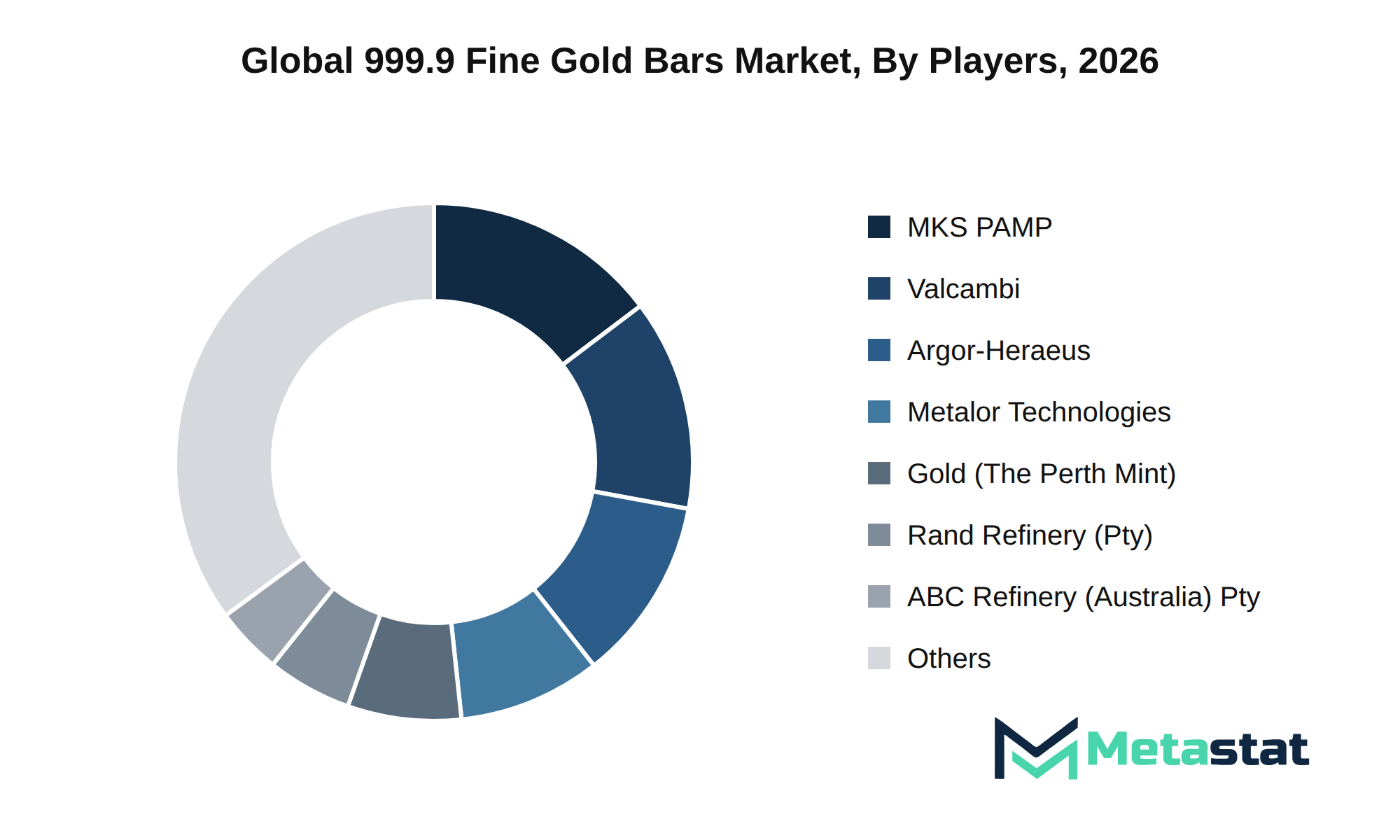
Institutional buyers in the 999.9 Fine Gold Bars market increasingly prioritize suppliers with accredited refining capacity, independent assay certification, and verifiable responsible sourcing. This shift reflects stronger risk management and compliance requirements among commercial banks, non-bank institutional investors, and central banks. These buyers demand documented traceability and adherence to ethical sourcing practices, driven by regulatory scrutiny and internal investment mandates. In this context, assay certification - carried out by recognized bodies - offers critical assurance regarding gold fineness and authenticity, reducing transaction risk in large-volume purchases and interbank settlements. Leading refiners serve these needs through advanced facilities, with companies including MKS PAMP SA and Valcambi SA operating integrated refineries that deliver 999.9 fine gold bars to institutional standards. Responsible sourcing, including conflict-free supply chains and environmental safeguards, further differentiates suppliers in procurement processes. The market’s international structure intensifies this effect, given that buyers in North America, Europe, and Asia Pacific require alignment with regional standards. Each region commands a 25% share by value. Institutional procurement policies influence global flows and pricing benchmarks. Suppliers delivering verified, ethically sourced products strengthen their access to high-value institutional contracts and sustain their competitive position amid tightening compliance expectations.
Asia Pacific leads demand in the 999.9 Fine Gold Bars market through a combination of sustained investor activity and dynamic manufacturing sectors. Institutional and individual investors in China and India drive continuous purchases of high-purity gold bars, with local wealth accumulation and risk diversification strategies supporting this trend. Jewellery and watch manufacturers increase this demand, sourcing 999.9 fine gold for premium products that appeal to domestic and export markets with strong cultural affinity for gold. Electronics and electrical manufacturers in countries including South Korea and Japan further drive consumption, integrating ultra-high-purity gold into advanced components where trace-level impurities cannot be tolerated.
All five major global regions - North America, Europe, Asia Pacific, South America, and Middle East and Africa - hold an identical 25% share of the 999.9 Fine Gold Bars market by revenue, according to the latest data. Despite this parity, Asia Pacific distinguishes itself through the intensity of its physical gold trade, its manufacturing activity, and the integration of gold into both industrial applications and consumer assets. These conditions attract international suppliers and stimulate local investment in refining and distribution infrastructure. Producers in Asia Pacific achieve efficient scale and a resilient buyer base, raising the region’s influence over product standards and shaping procurement preferences throughout the 999.9 Fine Gold Bars market.
Growing demand for wealth preservation among individual and institutional investors underpins the expansion of the 999.9 Fine Gold Bars market. Heightened economic uncertainties and fluctuating currency values reinforce gold’s role in a stable store of value. Investors diversify portfolios with physical gold holdings in response to inflationary pressures and geopolitical instability. This shift in capital allocation supports steady purchasing activity. Regions experiencing pronounced financial market volatility see particularly strong demand.
Rising participation from commercial banks and non-bank institutional investors further strengthens investment inflows. Gold bars refined to 999.9 standards consistently attract buyers seeking assets with high liquidity and universal recognition. This sustained influx of investment capital under conditions of risk aversion supports the long-term stability of the market’s volume and price levels.
Fluctuating gold prices introduce uncertainty for commercial banks and non-bank institutional investors, limiting their willingness to commit to large-volume or long-term purchases. Even though these buyers are traditionally active in the 999.9 Fine Gold Bars market for reserve diversification and hedging purposes, unpredictable price swings drive risk-averse procurement strategies. This behavior results in smaller, more frequent transactions instead of large, consolidated orders, which slows inventory accumulation and delays replacement cycles. While the market offers high purity, it experiences restrained demand from institutional buyers during periods of heightened price volatility, making budget planning and portfolio allocation more challenging. This restraint primarily affects volume-based growth projections and dampens momentum in wholesale and reserve-focused segments.
Producers in the 999.9 Fine Gold Bars market encounter persistent margin pressure stemming from elevated fabrication costs. Precision required for 999.9 purity imposes strict controls on refining, process validation, and equipment standards, increasing operational expenses for suppliers. These requirements impact both cast and minted bar production, where maintaining purity and consistency demands continuous investment in advanced technology and skilled labor. Intense competition among refiners further restricts their ability to pass higher costs on to buyers, compressing profit margins even during stable demand cycles. In response, suppliers invest in process automation and quality management systems to streamline production and minimize wastage, seeking to counteract rising input costs. These measures influence operating models across the 999.9 Fine Gold Bars market, shaping supplier strategy and pricing discipline.
Institutional buyers are increasing allocations to wider bar weight categories, including the 1 kg and above 1 kg to 5 kg segments, driven by their suitability for reserve management and transaction efficiency. The 999.9 Fine Gold Bars market presents a distinct growth pocket in these higher-weight classes, which support large-scale investments while minimizing storage and handling costs. The segmentation structure confirms a notable emphasis on these categories, aligning with the preferences of commercial banks, central banks, and non-bank institutional investors seeking cost efficiency and liquidity. Suppliers addressing this demand with consistent bar quality and provenance stand to benefit from expanding institutional purchase volumes. Adoption of 1 kg and larger bars differentiates this segment from smaller retail-focused units, supporting higher transaction values and reinforcing its role for buyers prioritizing operational scale and streamlined custodial requirements.
The 999.9 Fine Gold Bars market is segmented based on Product Type, Weight, and End User.
Cast gold bars are produced by pouring molten gold into molds, resulting in a solid, rectangular form that appeals to buyers seeking large-volume, lower-premium bullion. These bars attract commercial banks, non-bank institutional investors, and central banks operating in the 999.9 Fine Gold Bars market who prioritize bulk storage and cost efficiency over intricate finishes. Demand in this segment aligns with periods of heightened investment activity, reflecting shifts in asset allocation strategies and reserve management. Compared to minted gold bars, cast bars generally carry a lower fabrication cost and reduced premium, which supports their adoption in institutional portfolios where liquidity and minimization of acquisition costs are critical. Investors and official sector buyers in the 999.9 Fine Gold Bars market often favor cast bars for their ease of verification, larger size availability, and straightforward resale value, differentiating this segment from minted bars that tend to attract retail and gifting-driven purchases.
Minted gold bars are precision-manufactured products with distinct markings, packaging, and consistent sizing, often selected for personal investment, gifting, or branded retail programs. Individual buyers and non-bank institutional investors drive demand for minted bars, valuing their aesthetics, recognizability, and tamper-evident features, particularly in regions where gold ownership is widespread. The market sees these products favored in retail channels, where end users seek smaller denominations and higher perceived liquidity compared to cast bars. Premiums for minted bars trend higher than those for cast bars, reflecting the additional fabrication steps and brand value incorporated by producers. Within this segment, minted bars stand apart from cast bars by serving buyers who prioritize presentation, rapid resale, and product authentication, especially in mature gold investment markets. Suppliers emphasize advanced security packaging and serialized tracking to address these buyers’ concerns and facilitate confidence in secondary market transactions.
Bars weighing below 10 g are typically purchased by first-time retail investors, gift buyers, and those seeking to diversify holdings in a highly liquid form. This segment appeals to individuals who prioritize affordability, convenience, and the flexibility to buy in smaller increments rather than making large, single purchases. Buyers in this weight class value lower entry costs and ease of resale, which encourages wider participation by mass-market consumers. The segment experiences frequent demand cycles driven by seasonal gift-giving, shifts in investor sentiment during periods of currency volatility, and promotional campaigns by bullion retailers. Distinct from larger bar segments, below 10 g bars usually carry a higher premium per gram due to greater fabrication and packaging costs. These products are favored in regions with strong retail gold cultures, including parts of Asia and the Middle East, where small denominations are regularly exchanged for cultural and investment reasons.
Gold bars ranging from 10 g to below 50 g serve retail investors seeking flexibility in portfolio allocation and personal liquidity management. Buyers in this segment include individuals building regular savings positions, smaller-scale jewellery manufacturers requiring high-purity input, and gift purchasers drawn by affordability without sacrificing brand or certification. Demand for the 10 g to below 50 g segment is reinforced by the segment’s balance between accessibility and recognizability, making these bars attractive entry points for those upgrading from the below 10 g category. Compared to heavier segments, these bars present a lower total outlay per unit while retaining sufficient value density for cost-effective storage. Competition intensifies among mints and refineries offering custom packaging and tamper-proof designs, reflecting a growing preference for verifiable authenticity. This segment differs from larger weights by catering to buyers less sensitive to fabrication premiums and more motivated by unit flexibility, which influences both product design and distribution strategies among suppliers.
Weight categories between 50 g and below 100 g serve buyers seeking a balance between affordability and meaningful gold accumulation. Individual investors and jewellery manufacturers make up the largest share of demand in this segment, attracted by units that enable portfolio diversification without the high upfront cost of kilogram bars. Commercial banks supply these bars for retail gold savings plans and gifting, reflecting widespread preference for denominations that fit both investment and ornamental use. The 50 g to below 100 g segment is differentiated from lower weight categories by its greater appeal for periodic accumulation strategies, rather than one-time purchase events or gifting. Compared to heavier segments including 100 g to below 500 g or 1 kg, this range registers a higher number of transactions per unit of value, driven by steady retail participation and recurring smaller investments. Product innovation in security marking and packaging targets this segment, supporting its role in mainstream investor adoption and expanding the accessible entry points for buyers.
Weighting between 100 g and just under 500 g, this segment draws consistent attention from both individual investors and non-bank institutional buyers looking for balance between liquidity and value consolidation. Products in this range are widely adopted where buyers require a manageable denomination that enables both private storage and efficient resale, supporting their utility in wealth management portfolios and corporate treasury reserves. Compared with smaller bars, the 100 g to below 500 g range often appeals to investors who have progressed beyond entry-level purchases and now seek greater efficiency in premium per gram. In contrast to larger weight classes, these bars retain higher liquidity among retail and mid-sized institutional channels, with the price point remaining accessible while still offering material value. Growth in this segment arises from a shift in investment strategies favoring risk diversification and asset portability. While heavier bars attract bulk institutional investment, these mid-weight products enable flexible allocation for a broader array of buyers.
Gold bars in the 500 g to below 1 kg range attract attention from non-bank institutional investors and commercial banks looking for a compromise between liquidity and storage efficiency. This weight category is frequently selected by buyers seeking to optimize transaction costs while achieving a higher value per bar compared to smaller sizes. In the 999.9 Fine Gold Bars market, these bars appeal to institutional treasury departments and wealth managers seeking assets that facilitate both flexibility and bulk storage. Demand in this segment is shaped by price sensitivity and portfolio rebalancing, particularly during periods of heightened market volatility. Distinguishing itself from the 1 kg and above segments, the 500 g to below 1 kg range is more frequently traded and held for medium-term investment horizons, rather than strictly for long-term reserves. Supply is supported by established refiners in the 999.9 Fine Gold Bars market, who maintain production standards that align with both global investment protocols and regional client preferences.
One kilogram bars occupy a central position among weight categories in the 999.9 Fine Gold Bars market, anchored by their preference among high-net-worth individuals, family offices, and non-bank institutional investors consolidating gold assets. These bars provide a practical unit for bulk investment, portfolio hedging, and reserve diversification, particularly where buyers require significant value in a manageable physical format. Demand in this segment is strongly influenced by the trend of portfolio consolidation, with buyers shifting from multiple smaller bars to fewer, larger units to minimize storage costs and simplify custody. Compared with segments below 500 g, the 1 kg sub-segment appeals to buyers who place a premium on efficiency and lower per-ounce premiums, distinguishing it from lighter bars often chosen for divisibility. In the 999.9 Fine Gold Bars market, the 1 kg segment stands out for its alignment with institutional purchasing patterns and its relatively stable price premium, which supports steady interest even when price volatility affects lighter weights. The segment’s adoption reflects the market’s ongoing shift toward scalable, cost-driven investment strategies targeting long-term asset preservation.
Heavy gold bars weighing above 1 kg to 5 kg are most often acquired by commercial banks, central banks, and non-bank institutional investors with the objective of large-scale reserve management or high-value portfolio allocation. In the 999.9 Fine Gold Bars market, this weight segment addresses requirements for efficient storage, streamlined handling, and minimized premium relative to total gold content. Demand is supported by buyers prioritizing transactional efficiency and cost competitiveness over retail-oriented packaging or branding. Compared to smaller weight categories, bars in this range typically command lower premiums per gram and attract buyers focused on long-term holdings rather than liquidity or gifting. Adoption in this segment is shaped by institutional strategies and changes in reserve management practices, setting it apart from lighter categories that serve retail or first-time investors. These bars are less exposed to frequent trading and price-sensitive retail movements, drawing steady institutional interest instead.
Weights above 5 kg are primarily selected by central banks and non-bank institutional investors that focus on efficient storage and long-term holdings. This segment is defined by its appeal to buyers managing reserves or substantial asset portfolios, for whom low per-gram premiums and ease of bulk handling outweigh liquidity concerns. In this segment, bars of this size offer operational advantages in central bank vaulting and institutional custody, where maximizing value per cubic centimeter is a priority. Demand in this segment is influenced by the institutional drive to secure tangible reserves while minimizing fabrication and handling costs. Unlike smaller categories that appeal to retail or high-net-worth individual buyers, this segment involves infrequent but high-value transactions, often tied to macroeconomic reserve allocation cycles. Large bars are favored for their operational efficiency in national and supranational monetary strategies.
Private investors drive activity in this segment through direct acquisitions of gold bars for portfolio diversification, long-term wealth storage, and gifting. These buyers are typically motivated by a preference for physical assets in response to fluctuating financial market conditions. Demand in this segment rises when macroeconomic uncertainty leads individuals to prioritize tangible investments. Compared to commercial banks and institutional investors, individual buyers are more price sensitive and focus on lower-weight bars and products with accessible price points. In this segment, spikes in demand from private buyers tend to occur during periods of heightened inflation expectations or geopolitical risk, increasing transaction frequency and influencing product mix. This segment differs from the other end user groups by its reliance on retail distribution channels and a greater emphasis on product authenticity, packaging, and brand reputation among suppliers.
Commercial banks acquire high-purity gold bars to meet the requirements of their reserve management, client allocations, and liquidity operations. In the 999.9 Fine Gold Bars market, this segment is defined by the stringent standards and traceability demanded by banking institutions, which distinguish it from other end users including individual investors or manufacturers. Commercial banks are driven by the imperative to maintain robust collateral reserves and to support gold-backed financial products, especially during periods of heightened market uncertainty. Unlike non-bank institutional investors, commercial banks often transact in distinct bar weights and require compliance with global bullion standards, shaping procurement preferences across regions. The market sees commercial banks prioritizing consistent supply and operational transparency, factors that influence both sourcing decisions and premium structures compared to segments with less rigorous compliance needs. These banks regularly coordinate with major refiners and approved suppliers to ensure eligibility for international settlement and custody networks, which directly impacts pricing and product certification requirements in this segment.
Investment portfolios managed by pension funds, insurance companies, and asset managers drive institutional demand for high-purity gold bars. Non-bank institutional investors acquire 999.9 Fine Gold Bars market products to hedge market risk, diversify holdings, and gain exposure to physical assets that retain value during volatility. This segment is defined by rigorous compliance requirements, formalized procurement processes, and policies that favor fully traceable, certified gold. Purchases in the 999.9 Fine Gold Bars market by these organizations are typically structured for long-term investment horizons, contrasting with individual buyers and commercial banks that often transact for liquidity or reserve management needs. Key drivers for non-bank institutional investors include increasing regulatory scrutiny on asset quality and the strategic adoption of precious metals for portfolio resilience. Compared to other end users, this group demonstrates a preference for large bar formats and prioritizes suppliers with robust sourcing transparency and third-party certifications, setting their procurement apart in both scale and diligence.
Central banks acquire 999.9 Fine Gold Bars market products primarily for reserve diversification, foreign exchange stability, and risk mitigation during periods of geopolitical or economic uncertainty. Within the 999.9 Fine Gold Bars market, this segment is distinguished by sovereign buyers whose mandate is to underpin monetary systems and maintain liquidity buffers, rather than to pursue short-term returns or retail-driven objectives. Purchase decisions are triggered by macroeconomic pressures, shifts in global monetary policy, and the drive to reduce exposure to volatile assets. Compared to other end user groups, central banks’ procurement is characterized by a focus on purity, long-term holding horizons, and sensitivity to global reserve benchmarks. Regulatory frameworks for reserve management impose strict standards on product acceptance, creating higher barriers to entry for suppliers in the 999.9 Fine Gold Bars market. Unlike commercial or non-bank institutional buyers, central banks operate on longer cycles and larger transaction volumes, which influences supplier relationships and restricts flexibility in sourcing strategies.
Jewellery and watch manufacturers purchase 999.9 fine gold bars for fabrication of high-value luxury items, where purity and consistent bar quality directly affect production yields and finished product value. These buyers require traceable, certified bars to support branding, meet hallmarking standards, and ensure compliance with stringent industry regulations. Demand from this segment rises in tandem with global consumer interest in premium jewellery and luxury watches, particularly in Asia Pacific and Europe, where established design houses and heritage brands influence gold sourcing strategies. Compared to commercial banks and institutional investors, jewellery and watch manufacturers place greater emphasis on the practical usability of bar formats geared for remelting and precision casting, rather than on storage or liquidity benefits. Price sensitivity in this segment is shaped by margin pressures from fluctuating gold prices and the competitive nature of luxury goods markets. Product innovation, including customized or uniquely shaped bars, strengthens supplier relationships and supports differentiation for manufacturers in this segment.
Gold bar purchases by electronics and electrical manufacturers are driven by demand for high-purity material in critical components, including connectors, semiconductors, and circuit boards. Major players in this segment include multinational manufacturers sourcing directly from refiners to guarantee supply traceability and consistent quality. High purity enables reliable conductivity and corrosion resistance in mass-produced and specialty devices. Demand in this segment tracks advancements in miniaturization, higher-speed data transfer, and the proliferation of smart electronics, where lower-grade gold alternatives are unsuitable. Compared with other end users, electronics and electrical manufacturers are highly sensitive to fluctuations in gold prices due to narrow production margins and the large volume of gold used in high-throughput manufacturing. Suppliers adapt to evolving technology standards and material efficiency mandates, which influence both short-term procurement strategies and long-term adoption of gold alternatives in selected applications.
High-purity gold bars are essential input materials for dental laboratories, medical device manufacturers, and aerospace manufacturers. These buyers prioritize the product’s consistent composition and traceability to support biocompatibility, safety, and engineering performance, where failure or contamination introduces risks not present in general investment or jewelry applications. Demand in this segment largely reflects innovation in medical and aerospace component design, and regulatory scrutiny of materials used in patient-facing or high-reliability sectors. Dental laboratories rely on high-purity gold bars for alloys and restorative components, while medical device production leverages their purity for implantable and surgical products. Aerospace manufacturers select these bars for specialized connectors and precision electronics where purity and metallurgical consistency are critical. Compared to larger buyer groups, these users purchase smaller volumes but require stringent certification and provenance, which increases procurement costs and favors suppliers with advanced quality assurance processes.
Based on geography, the 999.9 Fine Gold Bars market is divided into North America, Europe, Asia-Pacific, South America, Middle East, and Africa.
Institutional buyers in North America direct consistent demand toward the 999.9 Fine Gold Bars market, supported by stable regulatory environments and established wealth management practices. The United States, Canada, and Mexico provide a mature financial ecosystem where commercial banks and non-bank institutional investors regularly allocate funds into gold assets within diversified reserve management and long-term asset preservation. A notable characteristic in this region is the prevalence of investment-driven purchases, with portfolio managers and private wealth advisors integrating physical gold bars to mitigate risk during periods of financial volatility. This region accounted for 25.00% of the global 999.9 Fine Gold Bars market share in 2025, highlighting its steady participation. Price sensitivity in North America reflects a preference for recognized refiner brands with transparent sourcing and certification, which strengthens buyer confidence and supports premium pricing relative to less regulated markets. The combination of regulatory stability, brand preference, and recurring institutional allocations drives recurring transaction volumes among institutional and high-net-worth clientele, reinforcing the region’s influence.
Institutional buyers in Europe sustain robust demand for the 999.9 Fine Gold Bars market, reflecting a mature investment culture and stable economic outlook in countries including Germany, France, and the UK. Central banks and non-bank institutional investors account for a consistent share of transactions, reinforced by the established role of gold within European portfolios for reserve asset and hedging purposes. Jewellery and watch manufacturing in Italy, Switzerland's neighboring region, and France further boosts purchases of high-purity bars for luxury fabrication, benefiting from a long tradition of craftsmanship. A 25.00% share of global value in 2025 demonstrates the region's balanced demand, with local refiners and mints supporting supply continuity and traceability expectations from buyers. Price sensitivity remains moderate, where portfolio diversification and quality assurance take precedence over short-term cost advantages. Regulatory clarity on gold provenance and transparency requirements distinguish the 999.9 Fine Gold Bars market in Europe from less harmonized jurisdictions.
China, India, and Japan anchor demand in the region, reflecting deep-rooted traditions of personal gold ownership and a growing affluent class. Jewellery manufacturers and private investors in these countries underpin steady purchasing, which supports a 25.00% share of the global 999.9 Fine Gold Bars market in 2025. Regulatory clarity around gold imports and standardization in India and China encourages formal sector growth, directing more investment toward high-purity bar categories. The expanding middle class in Southeast Asia broadens the investor base, increasing preference for standardized, small to medium weight bars. Regional refineries in Australia and South Korea sustain bar quality and supply reliability, which strengthens resilience against global price volatility. These dynamics reinforce the region’s role in stability for overall market value and volume.
Investor appetite in South America is shaped by both currency volatility and a search for stable, tangible assets, driving consistent inflows into the 999.9 Fine Gold Bars market. Brazil stands out, with high-net-worth individuals and institutional buyers turning to fine gold bars for portfolio diversification and capital protection during economic uncertainty. Argentina experiences similar demand patterns, with inflationary pressures and frequent shifts in monetary policy encouraging allocation to precious metals. Regional jewellers and watch manufacturers contribute to total demand, sourcing 999.9 fine gold bars for use in premium luxury products tailored to affluent urban consumers. In 2025, South America holds a 25.00% share of the global 999.9 Fine Gold Bars market, reflecting an established culture of gold ownership and investment across the region.
Distinct patterns of gold accumulation and luxury manufacturing characterize the Middle East and Africa, where the 999.9 Fine Gold Bars market accounts for 25.00% of global demand in 2025. Wealth preservation remains a priority among high-net-worth individuals and family offices in the UAE and Saudi Arabia, driving steady purchases of high-purity bars. In South Africa, a strong tradition of gold mining and refining underpins local sourcing for both investment and fabrication. Jewellery houses in the Gulf states favor 999.9 gold for its cachet and compliance with regional preferences for purity, while industrial use is limited compared to financial and personal storage. The region’s gold trade benefits from established free zones and bullion trading hubs, supporting cross-border activity and sustained inflows to the 999.9 Fine Gold Bars market. These dynamics reinforce the position of Middle East and Africa in contributing substantially to the market’s global footprint.
Competition in the 999.9 Fine Gold Bars market centers on brand reputation, product purity, certification credibility, and customization capabilities. Buyers, including individual investors, banks, and manufacturers, prioritize consistent fineness, regulatory-recognized hallmarks, and the assurance of traceable sourcing. Certification from accredited refineries remains a key purchase driver, particularly for institutional and central bank buyers, while individual consumers often compare recognized brands on purity, packaging, and after-sales support.
Several companies differentiate through their offering focus and regional strengths. MKS PAMP SA stands out for branding and recognized embossing, attracting investors seeking product authentication and liquidity. Gold Corporation (The Perth Mint) emphasizes global distribution and tailored products for both retail and institutional buyers. Rand Refinery (Pty) Limited highlights sourcing transparency and regional reliability, appealing to commercial and central banks seeking traceable origin. Umicore SA targets industrial buyers, supporting electronics and manufacturing segments with precision-cast and specialty formats. The market remains shaped by the breadth of product offerings and the ability of suppliers to meet strict purity standards and evolving customer requirements.
Market size is forecast to rise from USD in 2025 to over USD by 2033. The 999.9 Fine Gold Bars market depends most on sustained investment demand from institutional buyers, especially commercial banks and non-bank institutional investors. These groups increase their allocations during periods of global economic uncertainty, supporting price stability and consistent volume growth across North America and Europe. Growth in individual buyers, particularly in Asia Pacific, further contributes to uptake, with wealth preservation and portfolio diversification becoming priority strategies for retail investors in the region. Advancements in refining and bar manufacturing technologies support reliable supply and standardization, particularly in cast gold bars and minted gold bars segments, which remain the preferred choices for both institutional and retail end users.
The main risk to the 999.9 Fine Gold Bars market reaching USD 33 million by 2033 is a potential shift in global monetary policy or a prolonged period of currency stability, which would reduce gold’s perceived value for hedging. This risk is most pronounced in regions where central banks and institutional investors drive volume. If alternative investment vehicles or digital assets gain traction at the expense of physical gold, demand from these buyers could slow, particularly in North America and Europe.
By End User: Individual Buyers, Commercial Banks, Non-Bank Institutional Investors, Central Banks, Jewellery and Watch Manufacturers, Electronics and Electrical Manufacturers, Others (Dental Laboratories, Medical Device Manufacturers, Aerospace Manufacturers)
The report strategically identifies and profiles the key market players and analyses their core competencies in each sub-segment of the 999.9 Fine Gold Bars market.
|
Report Attributes |
Details |
|
Study Period |
2021-2033 |
|
Base Year |
2025 |
|
Estimated Year |
2026 |
|
Forecast Period |
2026-2033 |
|
Historical Period |
2021-2025 |
|
Growth Rate |
CAGR {CAGR} from 2026 to 2033 |
|
Revenue Unit |
USD {CUNT} |
|
Segmentation |
By Product Type, Weight, End User, and Region |
|
By Region |
North America (By Product Type, Weight, End User, and Country)
|
|
Europe (By Product Type, Weight, End User, and Country)
|
|
|
Asia Pacific (By Product Type, Weight, End User, and Country)
|
|
|
|
|
Middle East and Africa (By Product Type, Weight, End User, and Country)
|
Find answers to common questions about this report
The 999.9 Fine Gold Bars market size was valued at USD in 2025.
The growth rate for this market is not specified in the available data. No CAGR figure is provided for the forecast period from 2026 to 2033.
The North America 999.9 Fine Gold Bars market size is estimated to reach USD by 2033.
Growing demand for wealth preservation among individual and institutional investors is driving increased purchases of 999.9 purity gold bars for portfolio diversification and stability. Institutional buyers are expanding allocations to higher-weight bar categories, including 1 kg and above, to improve reserve management and transaction efficiency.
No region holds a dominant share, with North America, Europe, Asia Pacific, South America, and Middle East and Africa each accounting for 25 percent of the total market. The share is evenly distributed across all regions based on the latest available figures.
Fluctuating gold prices create uncertainty for commercial banks and non-bank institutional investors, limiting large-volume or long-term purchases. Producers face margin pressure from higher fabrication costs required to maintain 999.9 purity, which restricts their ability to pass costs on to buyers.
Adoption is favored by heightened demand for wealth preservation during economic uncertainty, increased portfolio diversification by institutional investors, and a shift toward higher-weight bars for reserve management and transaction efficiency. These trends support steady purchasing activity and higher transaction values, particularly among commercial banks and non-bank institutional investors.
The 999.9 Fine Gold Bars market is estimated to reach a valuation of USD by 2033.
Companies active in the 999.9 fine gold bars sector include MKS PAMP SA, Valcambi SA, Argor-Heraeus SA, Metalor Technologies SA, Gold Corporation (The Perth Mint), and ABC Refinery (Australia) Pty Ltd. Asahi Refining USA Inc. and Rand Refinery (Pty) Limited are present in the market. Nadir Metal Rafineri Sanayi ve Ticaret A.Ş. and Royal Canadian Mint are among the recognized producers.
Institutional buyers including commercial banks, central banks, and non-bank institutional investors are driving demand, particularly for higher-weight bar categories that support large-scale investments and efficient reserve management.
Choose Your License
Global 999.9 Fine Gold Bars Market
The analysts below cover Banking & Finance research at Metastat Insights.
LEAD ANALYST
Utkarsh Khirodkar is a Lead Market Research Analyst at MetaStat Insight, specializing in market intelligence, technology sector assessments, and competitive strategy.

PRINCIPAL CONSULTANT - ENTERPRISE AI & EMERGING TECHNOLOGIES
Banking & Finance · Electronics and Semiconductor · Energy and Power · Healthcare IT · Information & Technology · Professional Services
Vijay Gunti is a Principal Consultant at MetaStat Insight, bringing over two decades of experience across enterprise digital transformation, technology strategy, and intelligent systems.
Tracking ceramic matrix composite adoption in high-bypass aero engines requires strict attention to material qualification cycles and FAA airworthiness testing milestones. The MetaStat Insight team provided a detailed timeline of silicon carbide fiber manufacturing capacity and commercial foundry lead times. Having clear visibility into upstream thermal barrier coating supply helped us stress-test our long-term component procurement strategy.
Transitioning ultra-class mining haul trucks to alternative power requires concrete data on remote hydrogen refueling infrastructure economics. The report evaluated megawatt-scale electrolyzer installation expenses, onsite storage safety mandates, and heavy-duty fuel cell stack degradation under continuous duty cycles. That technical rigor helped our engineers benchmark realistic total operating cost horizons for off-highway fleet decarbonization.
Enterprise zero-trust network rollouts are often slowed down by multi-cloud transit latency and proprietary hardware retirement schedules. This study provided realistic total cost of ownership models comparing cloud-delivered security edge solutions against traditional hardware refreshes. The analysis of contract renewal lengths and software maintenance fees gave us clear visibility into enterprise replacement cycles over the next three to five years.
Explore related market intelligence reports worth reading alongside this one.