
LEAD ANALYST
Utkarsh Khirodkar is a Lead Market Research Analyst at MetaStat Insight, specializing in market intelligence, technology sector assessments, and competitive strategy.

U.S. Trade Finance Market Size, Share, By Service Type (Commercial Letters of Credit, Standby Letters of Credit and Bank Guarantees, Documentary Collections, Trade Loans and Pre-/Post-Shipment Finance, Supply Chain and Payables Finance, Receivables Finance, Factoring and Forfaiting, Export Credit Agency-Backed Finance, Structured Trade and Commodity Finance), By Trade Flow (Import Finance Services and Export Finance Services), By Enterprise Size (Small Businesses, Middle-Market Companies and Large Corporates), By End-Use Industry (Manufacturing and Industrials, Consumer and Retail, Food and Agribusiness, Energy and Natural Resources, Transportation and Logistics, Technology, Media and Telecommunications, Healthcare and Life Sciences, Construction and Infrastructure, Wholesale and Distribution), Industry Analysis, Growth, Trends, and Forecast, 2026-2033
Report ID
MSI-5364
Published
September, 2026
Pages
294 Pages
Format
Historical
Base year
Forecast
Forecast period
Report Details
Market Valuation: Valued at $14.2 Billion in 2025, projected to reach $24.7 Billion by 2033 at a 7.1% CAGR.
Dominant Segment: The Commercial Letters of Credit segment leads the U.S. Trade Finance market, driven by the need for secure payment methods in international trade transactions. Its projected growth reflects increasing globalization and the expansion of small and medium-sized enterprises.
Geographic Lead: The U.S. market is experiencing robust growth in import finance services, primarily due to rising international trade volumes and the participation of small businesses in global markets. This trend is supported by favorable economic conditions and infrastructure improvements.
What's Inside: The report provides a comprehensive analysis of the U.S. Trade Finance market, covering various service types, trade flows, enterprise sizes, and end-use industries. It includes competitive coverage, market dynamics, and forecasts through 2033.
Regulatory Compliance Challenges: Tighter regulations and complex compliance requirements pose significant challenges for businesses, particularly small and middle-market companies, impacting their ability to efficiently engage in trade finance.
Strategic Buffering Drives Investment Op: Investment in strategic buffering mechanisms is increasingly recognized as essential for companies to safeguard against supply chain disruptions, particularly in industries reliant on global supply chains.
Choose Your License
U.S. Trade Finance Market
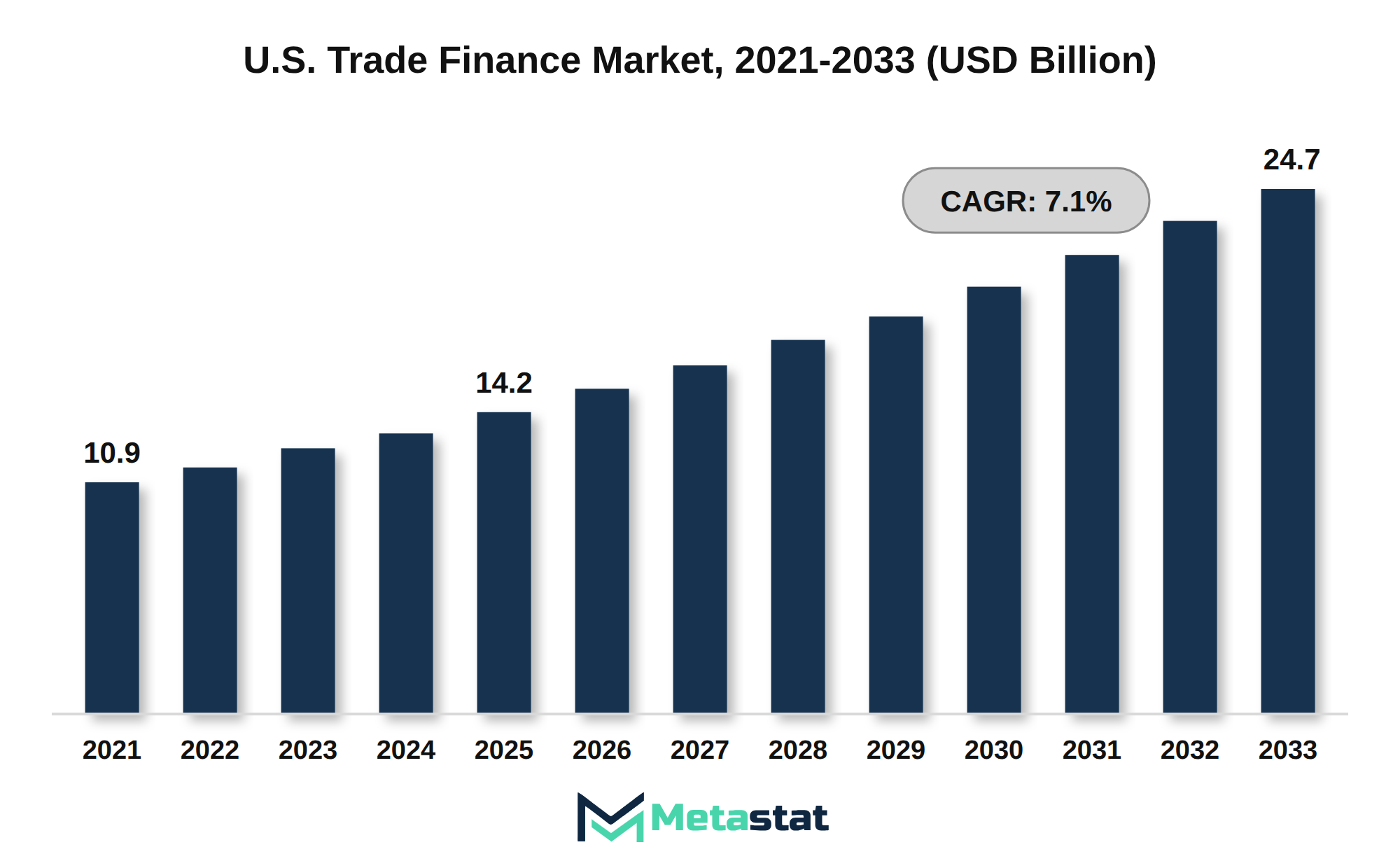
The U.S. Trade Finance market was valued at USD 14.2 billion in 2025 and is projected to reach USD 24.7 billion by 2033, growing at a CAGR of 7.1% over the forecast period.
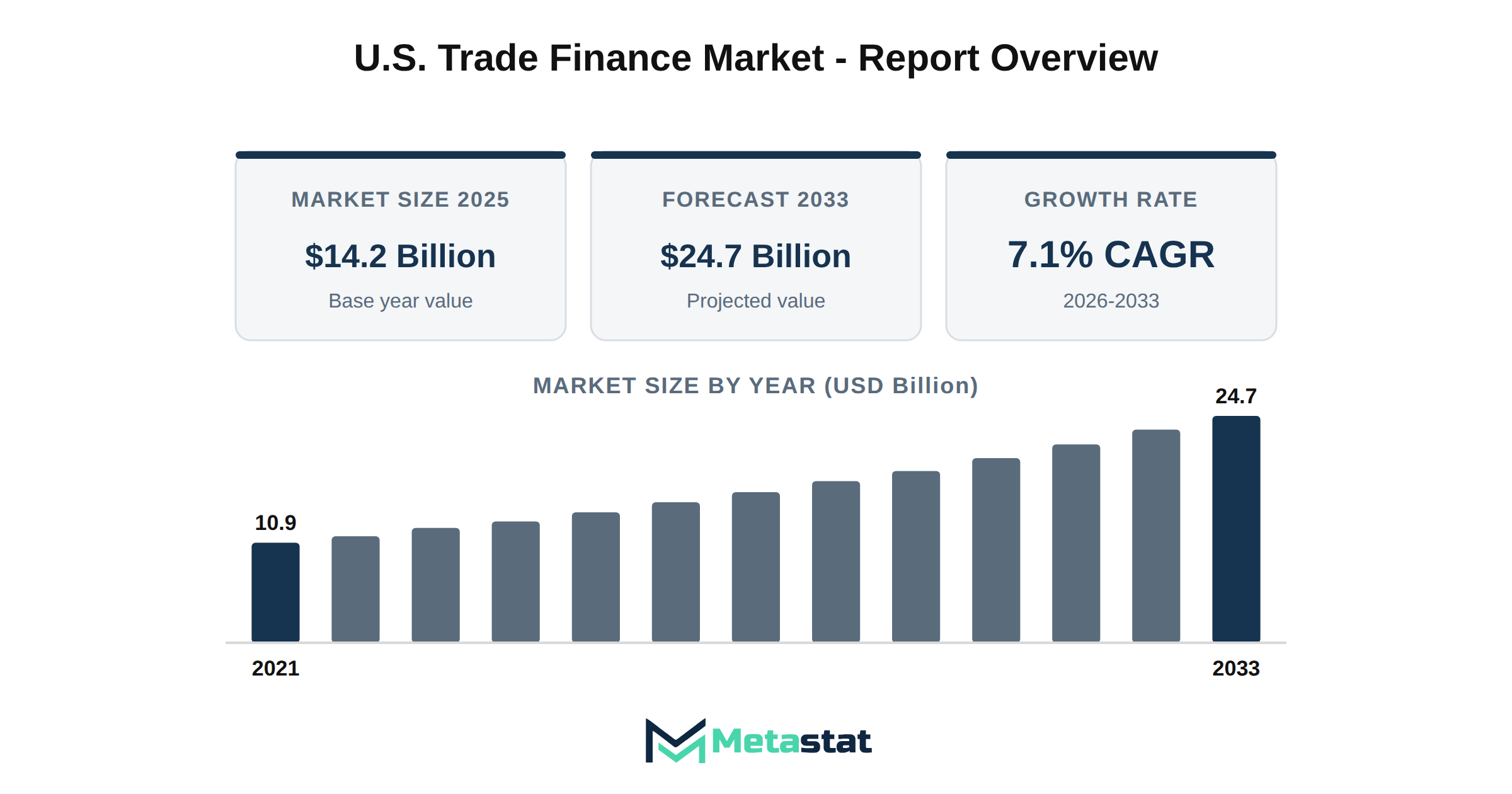
The U.S. Trade Finance market, valued at USD 14.2 billion in 2025, is projected to grow to USD 24.7 billion by 2033, reflecting a compound annual growth rate (CAGR) of 7.1%. This expansion stems from various factors influencing trade finance dynamics, including tariff and trade policy impacts that shape the overall market environment.
Trade finance pricing and fee dynamics play a significant role in determining the attractiveness of financial products for businesses. Competitive pricing strategies enhance access to financing solutions, thereby supporting market growth. Digital trade platform adoption is on the rise, streamlining processes and increasing efficiency for trade transactions. This technological shift encourages companies to adopt innovative solutions for managing trade-related activities.
Trade-based anti-money laundering (AML) and sanctions compliance remain critical focal points for financial institutions. Stringent regulations necessitate robust compliance measures, influencing the operational landscape of trade finance. Working capital and supply chain resilience are increasingly emphasized, because businesses seek to optimize their financial management through effective trade finance solutions.
Competitive benchmarking of bank trade platforms highlights the varying strengths among financial institutions in delivering trade finance services. The U.S. Trade Finance market shows strong growth drivers and demand trends, with increasing interest in import and export finance services. The outlook for U.S. import and export finance indicates a solid trajectory, fueled by economic recovery and rising global trade volumes.
Supply chain finance adoption across U.S. enterprises is gaining momentum, reflecting the need for efficient cash flow management. Letters of credit and bank guarantees exhibit notable trends, enhancing security and facilitating trade transactions. The growth of receivables finance, factoring, and forfaiting illustrates the evolving landscape of trade finance, providing businesses with essential liquidity solutions.
Demand for trade loans and pre-shipment financing continues to rise, driven by businesses seeking to mitigate risks associated with international trade. The presence of digital trade finance platforms and automation trends indicates a shift towards more streamlined and efficient processes. AI and data analytics play an important role in enhancing decision-making capabilities within the market, enabling institutions to assess risk and optimize service delivery.
Adoption of blockchain technology and electronic trade documentation is transforming the way transactions are executed, enhancing transparency and security. Pricing and fee trends in U.S. trade finance reflect market competitiveness, with institutions striving to offer attractive solutions to clients. Trade finance risk management and credit assessment trends highlight the importance of effective risk mitigation strategies in ensuring sustainable growth.
U.S. trade policy and tariff impacts on trade finance demand illustrate the significance of regulatory frameworks in shaping market dynamics. Developments in trade-based AML and sanctions compliance influence the operational strategies of financial institutions, ensuring adherence to evolving regulations. Export credit agency financing and support from the EXIM Bank are essential for supporting international trade, providing businesses with vital resources to expand their global reach.
Optimization of working capital through trade finance solutions remains a priority for businesses aiming to enhance financial stability. Trade finance adoption among small and middle-market businesses indicates a growing recognition of the benefits associated with these financial instruments. The demand for manufacturing and industrial trade finance reflects the sector's strategic importance in driving economic growth.
Energy, agribusiness, and commodity trade finance trends reveal opportunities for targeted investment and expansion. Bank competition in the U.S. Trade Finance market intensifies, with institutions seeking to differentiate their offerings. Partnerships between fintech companies and banks encourage innovation within trade finance, enhancing service delivery and improving customer experiences.
Supply chain resilience and supplier financing trends demonstrate the evolving priorities of businesses in managing risk and ensuring continuity. Cross-border trade finance digitalization in the United States highlights the shift towards more integrated and efficient trading practices. The U.S. Trade Finance market presents numerous growth opportunities, driven by technological advancements and changing regulatory landscapes.
The trade finance market continues to evolve, driven by U.S. tariff and trade policies that impact global trade flows. Regulatory changes and international agreements shape the financial ecosystem, influencing how institutions approach trade financing. Ongoing adjustments in tariffs create opportunities for financial institutions to reassess their offerings and optimize risk management strategies, ultimately affecting the demand for various trade finance products.
Pricing dynamics within trade finance reflect market conditions, competitive pressures, and operational costs. Institutions are implementing innovative pricing models to attract clients and enhance profitability. Fee structures for services including letters of credit and trade loans are under continuous evaluation, influencing the overall competitiveness of offerings in the U.S. Trade Finance market.
Digital trade platforms are gaining traction, providing enhanced efficiency and transparency in trade finance processes. The adoption of these platforms facilitates smoother transactions and improves access to financial services for businesses of all sizes. Institutions investing in digital solutions position themselves favorably in the market, responding to the growing demand for streamlined processes and real-time information.
The emphasis on trade-based anti-money laundering (AML) and sanctions compliance heightens due to increasing regulatory scrutiny. Financial institutions are enhancing their compliance frameworks to meet evolving requirements, which involves significant investment in technology and training. This focus on compliance impacts operational costs and influences the development of trade finance products.
Access to working capital remains a critical factor for businesses navigating supply chain challenges. Financial solutions that enhance working capital availability contribute to supply chain resilience, enabling firms to respond effectively to market fluctuations. The demand for trade finance products tailored for working capital optimization is expected to rise, driving growth within the market.
Competitive benchmarking of bank trade platforms reveals a shift toward collaboration between traditional banks and fintech companies. This partnership facilitates the integration of innovative technologies and improves service delivery. Banks that leverage fintech partnerships enhance their competitive position, meeting the evolving needs of clients in the U.S. Trade Finance market.
Growth drivers in the U.S. Trade Finance market highlight the increasing demand for import and export finance services. Businesses expanding their global reach require flexible financing solutions, leading to heightened interest in diverse trade finance products. This trend emphasizes the critical role that trade finance plays in supporting U.S. trade activities.
Supply chain finance adoption across U.S. enterprises continues to rise, driven by the need for enhanced liquidity and operational efficiency. Firms are increasingly recognizing the benefits of supply chain finance solutions, which improve cash flow and strengthen supplier relationships. This growing interest contributes to the overall expansion of the market.
Letters of credit and bank guarantees maintain a significant position in the trade finance landscape. These instruments provide security for both importers and exporters, promoting trust in cross-border transactions. Trends indicate a steady demand for these products, reflecting the importance of risk mitigation in international trade.
Receivables finance, factoring, and forfaiting exhibit notable growth, driven by businesses seeking to optimize cash flow. The demand for these financing options reflects a broader trend toward alternative funding solutions that enhance liquidity. While businesses prioritize cash management, growth in this segment strengthens overall market dynamics.
Trade loans and pre-shipment financing experience increased demand because businesses seek to manage production costs and improve cash flow. The growing reliance on these financing options illustrates the essential role they play in facilitating international trade. Institutions providing these services position themselves to capitalize on this upward trend.
Digital trade finance platforms are evolving, incorporating automation to streamline processes and reduce operational costs. The integration of AI and data analytics into these platforms enhances decision-making capabilities and risk assessment. Institutions adopting these technologies gain a competitive advantage in the U.S. Trade Finance market.
Blockchain technology and electronic trade documentation gain momentum, improving efficiency and security in trade transactions. Adoption rates are rising because businesses recognize the benefits of reducing paperwork and enhancing transaction transparency. This trend signals a significant shift in how trade finance operates, influencing future product development.
Pricing and fee trends in trade finance reflect a competitive environment, with institutions adapting to market changes. Financial product pricing strategies evolve in response to client needs and cost structures, impacting overall profitability. Continuous review of pricing models becomes essential for sustaining competitive advantages.
Risk management and credit assessment trends focus on enhancing the reliability of trade finance solutions. Institutions invest in advanced analytics and risk modeling to improve credit assessments, mitigating potential losses. This proactive approach to risk management contributes to the stability and growth of the market.
U.S. trade policy and tariff impacts remain significant factors influencing trade finance demand. Changes in trade agreements and tariffs prompt businesses to reassess their financing strategies, affecting demand patterns. Institutions that adapt to these shifts strengthen their positions within the market.
Compliance developments related to trade-based AML and sanctions shape the operational landscape for financial institutions. Ongoing adjustments to compliance frameworks and regulatory requirements necessitate strategic investments, influencing the development of trade finance products. Institutions that excel in compliance are better positioned to gain trust in the market.
Export credit agency financing and support from institutions like the EXIM Bank enhance access to trade finance for U.S. exporters. These agencies play a crucial role in mitigating risks associated with international trade, fostering growth opportunities. The collaboration between government-backed entities and financial institutions enhances the overall effectiveness of trade finance solutions.
Working capital optimization through trade finance solutions remains a priority for businesses seeking financial stability. Innovative financing options enable firms to enhance liquidity, supporting operational needs. The focus on working capital management drives growth within the U.S. Trade Finance market.
Trade finance adoption among small and middle-market businesses gains traction, reflecting the need for tailored financial solutions. These segments increasingly seek accessible financing options to support their growth initiatives. While adoption rates increase, the market experiences a broader expansion across various enterprise sizes.
Manufacturing and industrial trade finance demand continues to evolve, driven by sector-specific needs for financing solutions. Institutions offering specialized products tailored to this sector capture opportunities for growth. The increasing complexity of manufacturing operations necessitates financial solutions that address unique challenges.
Trends in energy, agribusiness, and commodity trade finance reflect shifts in global demand and market dynamics. Institutions focusing on these sectors position themselves to capitalize on emerging opportunities. The growing importance of these industries in the U.S. Trade Finance market influences product offerings and strategic investments.
Bank competition in the U.S. Trade Finance market intensifies because institutions strive to differentiate their offerings. The pursuit of innovative solutions and enhanced customer service becomes essential for maintaining competitive advantages. This competitive environment fosters growth and encourages the development of new products.
Partnerships between fintech companies and banks play a crucial role in reshaping trade finance solutions. Collaborations promote innovation and improve service delivery, enabling institutions to better meet client needs. This trend highlights the importance of strategic alliances in driving growth within the market.
Supply chain resilience and supplier financing trends emphasize the importance of robust financial solutions in mitigating risks. Institutions that provide innovative financing options contribute to strengthening supply chains, enhancing stability. The focus on resilience continues to drive growth in the U.S. Trade Finance market.
Cross-border trade finance digitalization in the United States enhances efficiency and accessibility for businesses engaged in global trade. Digital solutions facilitate smoother transactions and improve overall operational efficiency. This ongoing digital transformation significantly influences market dynamics and growth trajectories.
Innovation and product development trends within the U.S. Trade Finance market highlight the need for continuous adaptation. Institutions that prioritize product innovation respond effectively to evolving client needs and market conditions. This focus on innovation positions firms for sustained growth and competitiveness.
Future growth opportunities in the U.S. Trade Finance market arise from evolving client demands and regulatory changes. Institutions that identify and respond to these opportunities enhance their competitive positioning and drive market expansion. The ongoing evolution of the market emphasizes the importance of strategic foresight and adaptability.
Recent macro-economic factors, including GDP growth and venture funding, significantly impact the U.S. Trade Finance market. Increased public-private spending power enhances the financial health of enterprises, enabling them to invest in trade finance solutions. A strong economy encourages businesses to engage in international trade, thereby increasing the volume and complexity of financing needs.
While capital investment environments evolve, interest rates influence borrowing costs, affecting firms' decisions regarding trade finance. Lower interest rates typically lead to increased borrowing for investment in trade activities, enhancing liquidity and operational capacity. This financial flexibility supports the expansion of trade finance, allowing companies to pursue larger transactions and broaden their market reach.
Small businesses and middle-market companies benefit from favorable capital investment conditions, facilitating their entry into global markets. These enterprises require tailored financing solutions that trade finance products provide, promoting growth and competitiveness within the U.S. Trade Finance market.
The combination of favorable economic conditions, sustained capital investment, and a focus on international expansion drives significant growth in trade finance activities. Strong demand from various industries, including manufacturing and consumer goods, propels the market forward, highlighting the critical role that capital investment environments play in shaping the future of trade finance.
Investment in infrastructure development significantly influences the U.S. Trade Finance market, enabling smoother transactions and enhancing supply chain resilience. Improved infrastructure, including transportation networks and digital systems, provides businesses with better access to trade corridors and localized production strategies. Public and private investment efforts modernize facilities and upgrade network capabilities, resulting in a more efficient flow of goods and services.
Enhanced infrastructure directly impacts operational productivity, reducing delays and associated costs for companies engaged in trade finance. Businesses with streamlined logistics benefit from improved cash flow and increased access to capital, driving growth within the market. While infrastructure continues to develop, the U.S. Trade Finance market is projected to experience heightened demand driven by greater market access and reduced risk in supply chains.
Investment in infrastructure modernization aligns with broader economic goals, supporting growth across various sectors. Improved facilities and networks contribute to trade efficiency, enabling companies to respond swiftly to market changes and consumer demands. This dynamic supports the overall expansion of the U.S. Trade Finance market, attracting additional investments and encouraging innovation in financial services tailored to trade finance needs.
Regulatory compliance challenges present significant obstacles for the U.S. Trade Finance market. Tighter regulations and complex compliance requirements increase the operational burden on businesses, particularly small businesses and middle-market companies. These constraints often delay transaction processes and raise costs, affecting the competitive edge of smaller players in the market. Compliance with legal mandates typically consumes substantial resources, diverting funds from essential growth initiatives.
Inflationary pressures further complicate the landscape, eroding profit margins and impacting investment in trade finance solutions. Companies facing rising operational costs struggle to allocate capital towards innovative trade finance offerings, limiting their ability to adapt to changing market demands. Heightened geopolitical instability introduces additional uncertainties that disrupt supply chains and impact trade flows, creating a more volatile environment for trade financing.
Resource scarcity contributes to challenges in securing necessary materials and financing for trade transactions. Firms encounter difficulties in maintaining stable supply chains, which lead to inconsistent service availability. In this context, the U.S. Trade Finance market addresses these multifaceted challenges, creating a more robust and resilient environment that supports sustainable growth and encourages broader participation across various industry sectors.
Geopolitical fragmentation creates significant challenges for the U.S. Trade Finance market. Heightened tensions between nations lead to increased trade deficits and tariff friction, complicating international transactions. These conditions impact both import and export activities, causing delays and increasing costs for businesses reliant on trade finance solutions.
Technological disruptions further exacerbate these challenges by introducing complexities in R&D integrations and interoperability friction among different systems used for trade. This fragmentation hinders efficiencies that companies seek to achieve through automation and digital solutions, creating additional difficulties in managing cross-border transactions.
Logistics disruptions stemming from geopolitical tensions, including trade wars or sanctions, contribute to supply chain instability. Increased volatility in feedstock and component availability forces businesses to navigate an unpredictable environment, leading to rising input costs. Margin pressures challenge profitability and operational sustainability within the market.
Workforce skill gaps and talent retention pressures significantly impact companies attempting to adapt to these evolving conditions. A shortage of skilled professionals limits the ability to respond to market demands, further straining the already complex landscape. Consequently, the U.S. Trade Finance market experiences constraints that necessitate strategic adjustments to maintain competitive positioning.
Overall, geopolitical fragmentation presents a multifaceted challenge that requires companies within the U.S. Trade Finance market to develop innovative approaches to ensure resilience and long-term growth in an increasingly complex global environment.
Investment in strategic buffering mechanisms presents significant opportunities within the U.S. Trade Finance market. Companies increasingly recognize the importance of safeguarding against supply chain disruptions, prompting investments in risk mitigation strategies that enhance operational resilience. This trend is particularly prominent in industries heavily reliant on global supply chains, including manufacturing and consumer goods, where interruptions lead to substantial financial losses.
Organizations focus on optimizing their supply chains through local sourcing and diversified procurement strategies. This approach minimizes risk and aligns with evolving consumer preferences for sustainability and local sourcing initiatives. Consequently, businesses experience improved operational efficiency and reduced exposure to international market fluctuations, creating a favorable environment for trade finance solutions.
The surge in demand for strategic buffering mechanisms supports the growth of the U.S. Trade Finance market by encouraging partnerships among suppliers, financial institutions, and logistics providers. Companies pursue integrated financial products that facilitate smoother cash flows and enhance trade transactions. This shift enhances the competitiveness of firms and contributes to the overall expansion of the market.
The U.S. Trade Finance market is segmented based on Service Type, Trade Flow, Enterprise Size, and End-Use Industry.
Valued at USD 3.1 billion in 2026, the Commercial Letters of Credit segment is projected to reach USD 4.5 billion by 2033, at a CAGR of 5.6% during the forecast period. Demand for commercial letters of credit arises from their effectiveness in mitigating risks associated with international trade transactions. Growing globalization and increasing cross-border trade transactions drive the need for secure and reliable payment methods, positioning commercial letters of credit because a preferred financial instrument. Financial institutions play a crucial role in facilitating these instruments, creating a robust ecosystem that supports trade finance activities.
Expansion of small and medium-sized enterprises (SMEs) within the U.S. Trade Finance market contributes to the increasing adoption of commercial letters of credit. SMEs often encounter challenges in securing financing, and letters of credit provide a viable solution for ensuring payment to suppliers while enhancing their creditworthiness. The rise of digital platforms and technological advancements in trade finance streamline the processing of commercial letters of credit, facilitating a more efficient and transparent transaction environment.
End-use industries including manufacturing and consumer goods demonstrate significant reliance on commercial letters of credit to safeguard their financial transactions. In a rapidly changing economic environment, the need for robust trade finance solutions to address pricing volatility and margin pressures becomes evident. Consequently, financial institutions focus on developing tailored offerings that align with the evolving needs of businesses, ensuring competitiveness within the U.S. Trade Finance market.
Standby Letters of Credit & Bank Guarantees segment is estimated to reach USD 3.4 billion by 2033, at a CAGR of 6.3% during the forecast period. Growing international trade activities and increased demand for risk mitigation strategies drive adoption within this segment. Companies engaged in cross-border transactions recognize the need for secure payment mechanisms, increasing reliance on standby letters of credit and bank guarantees. This segment's growth reflects the broader trends within the U.S. Trade Finance market, where financial instruments that enhance security and trust among trading partners become increasingly essential.
Regulatory compliance standards further influence the market dynamics, driven by businesses seeking products that align with evolving legal frameworks. Companies operating in high-risk industries often prioritize standby letters of credit to safeguard against potential payment defaults, enhancing their overall creditworthiness. End-use industries including manufacturing and construction show a marked preference for these instruments, promoting stability in supply chain operations. Market stakeholders focus on developing innovative solutions that cater to the specific needs of these sectors, ensuring ongoing segment evolution and alignment with market demands.
Growth in the Documentary Collections segment reflects a notable shift in trade finance dynamics within the U.S. Trade Finance market. Driven by increasing cross-border trade activities and the need for secure payment methods, demand for documentary collections continues to rise. This service provides a level of security for exporters and importers, facilitating transactions by ensuring that payment occurs upon the presentation of specific documents. With the forecasted segment value reaching USD 2 billion by 2033, growth is anticipated through a combination of technological advancements and greater awareness of risk management strategies among businesses. The evolving nature of global trade, characterized by rising complexities and regulatory compliance demands, reinforces the importance of this service type. Industries including manufacturing and consumer goods, which rely heavily on documentation for cross-border transactions, contribute significantly to the demand for documentary collections. The increasing focus on supply chain resilience leads to heightened reliance on traditional financial mechanisms, including documentary collections, to mitigate risks associated with international trade. Pricing volatility within the global market further influences the attractiveness of this segment, reflecting businesses' pursuit of reliable methods to secure payments and manage cash flows. A strategic priority for many enterprises involves leveraging documentary collections to enhance financial stability, thereby supporting growth trajectories within the market. Overall, the upward trajectory of the Documentary Collections segment highlights its critical role in the broader context of the U.S. Trade Finance market.
Increasing global trade activities drive demand for Trade Loans & Pre-/Post-Shipment Finance, reflecting the ongoing need for businesses to manage liquidity and mitigate risks associated with transactions. This segment is projected to grow at a CAGR of 6.7% during the forecast period. While companies seek to optimize their supply chain operations, competition intensifies among financial institutions to offer flexible financing solutions tailored to the unique needs of different industries. Enhanced technological capabilities, including digital platforms and automated processing, facilitate quicker access to financing, further encouraging adoption in the U.S. Trade Finance market.
Emerging markets show a growing appetite for trade financing options, particularly driven by small businesses increasingly engaging in international trade. These enterprises often face challenges accessing traditional financing methods, prompting a shift towards specialized trade loans that provide tailored solutions. Consequently, the segment captures more attention from investors and financial institutions aiming to capitalize on this growing demand.
Such dynamics present strategic opportunities for stakeholders in the U.S. Trade Finance market, particularly in areas including risk management and transaction efficiency. Regulatory compliance influences the development of new products and services, addressing the evolving needs of the market. Continuous improvement in trade loan offerings aligns with broader economic trends, ensuring the segment remains relevant and competitive.
In the U.S. Trade Finance market, the Supply Chain & Payables Finance segment enhances working capital and improves cash flow for businesses. Increased globalization and the expansion of e-commerce create heightened demand for efficient supply chain solutions, prompting companies to seek reliable financing options. Adoption of advanced technologies, including artificial intelligence and blockchain, streamlines processes, increases transparency, and reduces transaction times, benefiting various industries.
Growing competition within markets drives businesses to optimize their supply chains, leading to a shift toward strategic partnerships with financial institutions that offer tailored solutions. In addition, heightened focus on sustainability and regulatory compliance influences firms to adopt finance solutions that align with responsible sourcing and environmental standards. This dynamic encourages innovation, resulting in the evolution of products within the segment.
End-use dynamics, particularly in manufacturing and retail, significantly impact demand for supply chain financing. These sectors increasingly require agile funding mechanisms to respond to fluctuations in consumer demand and supply chain disruptions. Consequently, businesses adapt their financing strategies to better align with these shifts, enhancing resilience and positioning themselves to capitalize on emerging opportunities in the market.
Receivables finance, factoring, and forfaiting experience steady demand from businesses seeking to optimize cash flow and enhance liquidity. The ongoing requirement for organizations to manage working capital effectively drives adoption across various sectors, including manufacturing, retail, and services. Companies leverage these financial solutions to convert receivables into immediate cash, thereby reducing the risk associated with delayed payments from clients.
Emerging trends emphasize technological maturation, with digital platforms streamlining the financing process. Increased integration of automated systems enhances efficiency, allowing businesses to access funds more rapidly. This trend aligns with the broader trajectory of the U.S. Trade Finance market, where digitalization plays a significant role in addressing the challenges of traditional financing methods.
In this segment, strategic opportunity windows arise from evolving end-use dynamics. Small businesses, particularly, experience growth in financing needs due to rising operational costs and fluctuating demand patterns. Enhanced focus on supply chain resilience prompts firms to seek flexible financing solutions, securing their positions during economic uncertainties.
Pricing volatility remains a concern, particularly in sectors heavily reliant on raw materials. Fluctuating commodity prices impact the cost structures associated with receivables finance. Companies face margin pressures, prompting them to explore innovative financial arrangements that mitigate risk while ensuring access to working capital. This adaptation contributes to a more dynamic market for receivables finance, shaping the competitive environment, driven by firms navigating increasing costs and consumer demands.
Export Credit Agency-Backed Finance remains a critical component of the U.S. Trade Finance market, influenced by various factors driving demand. The increasing need for risk mitigation in international trade transactions drives businesses to seek reliable financing options that safeguard against potential losses. Institutions providing these services focus on enhancing credit risk assessments and expanding access to financing solutions tailored for exporters. While companies engage in cross-border transactions, the significance of Export Credit Agency-Backed Finance is expected to grow, aligning with trends in global economic recovery and trade expansion.
Technological advancements play an important role in the evolution of this segment. Enhanced data analytics and artificial intelligence streamline the underwriting process, improving the accuracy of risk evaluations. This technological maturation encourages adoption among exporters seeking efficiency and reliability in financing arrangements. Consequently, businesses are likely to experience increased confidence regarding the security of their financing sources, prompting further investment in Export Credit Agency-Backed Finance solutions.
End-use dynamics demonstrate that industries including manufacturing and technology increasingly rely on Export Credit Agency-Backed Finance to support international sales growth. The financial backing provided by export credit agencies encourages companies, particularly small and middle-market enterprises, to engage in new markets, driving revenue diversification. While exporters face rising competition, these financial instruments become crucial for maintaining market presence and operational resilience.
Growth in the Structured Trade & Commodity Finance segment is propelled by rising global demand for commodity trading and financing solutions, driven by fluctuations in market prices and increasing production requirements. Companies engaged in commodity trading seek efficient financing mechanisms to mitigate risks associated with price volatility and supply chain disruptions. This segment aligns with the broader U.S. Trade Finance market, positioning participants to capitalize on opportunities arising from technological advancements and enhanced trade infrastructure.
Adoption of digital platforms and innovative solutions within this segment enhances transaction efficiency, reduces operational risks, and improves access to financing. Financial institutions invest in technology to streamline processes, enabling quicker decision-making and enhanced customer experiences. Competition intensifies among providers, creating an environment conducive to product evolution and service diversification.
End-use industries including energy, agriculture, and manufacturing demonstrate increasing reliance on Structured Trade & Commodity Finance to support their operational needs. The relationship of raw material sourcing, market demand, and regulatory compliance shapes the financing dynamics, influencing investment strategies and financial planning for businesses in these sectors. Consequently, stakeholders in the U.S. Trade Finance market focus on risk management and resilience strategies to navigate challenges effectively.
Cost structures and pricing dynamics within the segment reflect the underlying commodity market conditions, impacting margins and profitability for institutions involved. Increased collaboration across supply chains emphasizes the importance of maintaining transparency and adaptability to changing market conditions. Strategic opportunities arise for participants willing to invest in innovation and respond to the evolving needs of their clients.
Technological advancements drive the adoption of innovative financing solutions within the Others (Bankers' Acceptances, Inventory Finance, Purchase Order Finance) sub-segment of the U.S. Trade Finance market. The need for efficient and flexible financing options creates substantial demand among businesses seeking to optimize their operations. Companies increasingly leverage these financial instruments to manage inventory levels and enhance working capital, resulting in improved operational agility.
Supply chain resilience becomes a crucial factor influencing growth in this sub-segment. Businesses experiencing disruptions require reliable financing solutions to maintain inventory and meet demand. Increasing investment in inventory finance and purchase order finance solutions supports businesses in navigating market fluctuations effectively, strengthening their competitive positions.
Adoption of these financial products improves cash flow management, enabling businesses to finance their operations without straining their liquidity. This trend highlights the growing importance of flexibility in financing, allowing firms to respond swiftly to changes in market conditions. The U.S. Trade Finance market reflects this shift, with companies looking for customized solutions that align with their unique operational requirements.
Regulatory compliance standards impact the sub-segment owing to businesses adapting to evolving policies. Adherence to these standards enhances the credibility of financial products, thereby encouraging broader adoption. The ability to navigate regulatory complexities becomes a critical differentiator for financial institutions offering these solutions, positioning them favorably within the market.
Strategic partnerships among financial institutions and businesses enhance service offerings within the Others sub-segment. Collaboration leads to innovation, resulting in the development of tailored financial products that meet market demands. Such strategic alliances contribute to a more robust ecosystem, ultimately benefiting businesses across various industries and fueling growth in the U.S. Trade Finance market.
Import Finance Services segment is valued at USD 6.6 billion in 2026 and is projected to reach USD 10.3 billion by 2033, at a CAGR of 6.7% during the forecast period. Demand for import finance aligns with the increasing complexity of global supply chains and the heightened need for businesses to manage cash flow effectively. Companies engaged in international trade require reliable financing solutions to facilitate the importation of goods, mitigating risks related to payment and logistics.
Several catalysts drive segment expansion, including increased international trade volume and growing participation of small businesses in global markets. More enterprises seeking to expand their footprint beyond domestic borders elevate the prominence of financing solutions tailored for import transactions. This trend enhances competition among financial service providers, prompting innovation and the offering of diverse solutions that meet the evolving needs of importers.
Technological maturation shapes the market landscape. Digital platforms that streamline the financing process enhance accessibility for businesses, enabling quicker transactions and improved risk assessments. The integration of data analytics and artificial intelligence in import finance services provides valuable insights for decision-making, ultimately driving growth within the segment.
End-use dynamics indicate increased demand from manufacturing and industrial sectors, which rely heavily on imports for raw materials and components. The resilience of these industries, supported by effective financing solutions, positions the import finance segment favorably during fluctuating economic conditions. Fluctuations in global trade regulations and compliance requirements exert pressure on companies, necessitating robust financial strategies to navigate challenges.
Capital investment outlook remains positive, with financial institutions actively seeking opportunities to enhance their offerings in import finance services. The increasing focus on sustainability and responsible sourcing further influences financing decisions, shaping the strategies of financial providers in the U.S. Trade Finance market. While the segment evolves, stakeholders remain vigilant to capitalize on emerging opportunities while addressing potential risks and challenges within the evolving environment.
Growth in export activities drives demand for export finance services, which facilitates international trade for U.S. businesses. Companies pursuing global opportunities rely on these services to mitigate risks associated with cross-border transactions. Increased attention to securing financing options that enhance cash flow and reduce payment cycles serves because a primary demand driver in this segment.
This segment is projected to reach USD 8.8 billion by 2033, at a CAGR of 8% during the forecast period. Rising international competition compels businesses to adopt innovative financing solutions, further fueling growth. A focus on efficient supply chains influences the expansion of this segment, with companies seeking to enhance their operational capabilities.
Technological maturation enables the development of next-generation platforms that streamline the financing process. Many organizations invest in digital solutions to optimize their export financing activities. Enhanced visibility and control over transactions significantly impact operational efficiency, appealing to small businesses, middle-market companies, and large corporates within the market.
Various end-use industries, including manufacturing and consumer goods, increasingly adopt these financing solutions to support their international trade operations. Growing exports contribute to economic growth, creating strategic opportunity windows that stimulate further investment in export finance services. The evolving environment of the U.S. Trade Finance market reflects a dynamic context that adapts to the needs of businesses engaged in global trade.
Domestic Trade Finance Services contributes to the overall dynamics of the U.S. Trade Finance market, with a projected value of USD 5.5 billion by 2033. This segment experiences steady demand primarily driven by domestic economic activities, particularly among small and middle-market companies seeking efficient financing options for day-to-day operations.
Technological maturation plays an important role in enhancing service offerings within this segment. Innovations in fintech enable effective online platforms for managing transactions and accessing funds, appealing to businesses looking for quick solutions. Evolving consumer preferences shape the demand for tailored financial products, which encourage service providers to adapt and innovate.
The overall growth trajectory aligns with an increase in domestic trade, supported by favorable regulatory environments that promote local businesses. These factors create strategic opportunity windows for financial institutions aiming to capture this expanding market. Cost structures evolve owing to intensified competition, pushing players to optimize pricing strategies to maintain margins while catering to diverse customer needs.
Long-term sustainability of the Domestic Trade Finance Services segment relies on supply chain resilience. Companies investing in robust financial solutions position themselves to mitigate risks associated with market fluctuations, thus ensuring consistent service delivery to end-users. This adaptability significantly influences the growth outlook of the market.
Small businesses represent a significant portion of the U.S. Trade Finance market, valued at USD 3.5 billion in 2026 and projected to reach USD 6.2 billion by 2033, at a CAGR of 8.3% during the forecast period. This growth results from several primary demand drivers including increasing access to trade finance solutions tailored for smaller enterprises, which often face unique challenges in securing funding. Enhanced digital solutions and platforms simplify the financing process, providing smaller firms with better access to needed capital.
Adoption of trade finance products among small businesses accelerates due to rising international trade activities and a growing need for efficient cash flow management. By leveraging innovative financing options, small enterprises enhance their competitive edge in both domestic and global markets. Segment expansion catalysts include the increasing availability of tailored financial products that address the specific requirements of small businesses, driving greater engagement in trade finance activities.
Technological maturation continues to play a crucial role in shaping the U.S. Trade Finance market. Next-gen upgrades in payment processing and financing platforms streamline the process for smaller entities, enhancing operational efficiency and reducing the time required for transactions. Product evolution in this space focuses on more flexible financial solutions that adapt to the varied needs of small businesses, promoting widespread adoption.
Downstream applications of these finance solutions impact various end-use industries, including manufacturing, retail, and agribusiness. Shifts in consumption patterns reflect a growing preference for digital and accessible financing solutions. Regulatory compliance standards and certifications increasingly influence the strategic approaches of financial institutions catering to this segment, ensuring products meet necessary requirements and instilling confidence among small businesses seeking support.
Cost structures and pricing volatility remain critical considerations for small enterprises engaging in trade finance. Margin pressures compel these businesses to seek competitive financing options, prompting financial institutions to develop more attractive terms. Strategic opportunity windows emerge because small businesses recognize the value of integrating trade finance solutions into their operations, ultimately driving demand in the market.
Middle-Market Companies segment reaches an estimated USD 8.7 billion by 2033, at a CAGR of 7.3% during the forecast period. Demand for trade finance solutions in this segment stems from the increasing need for liquidity and cash flow management among mid-sized firms. These companies face challenges related to accessing traditional financing options, driving them toward innovative trade finance products that enhance financial flexibility.
Expansion catalysts include growth in domestic and international trade activities, which increase reliance on trade finance solutions. Mid-sized enterprises frequently engage in cross-border transactions requiring secure payment mechanisms, contributing to the adoption of commercial letters of credit and standby letters of credit. Enhanced risk management capabilities provided by trade finance instruments facilitate smoother transactions, allowing these companies to compete effectively in the global marketplace.
The U.S. Trade Finance market reflects a trend toward increased technological maturation, with digital solutions playing a crucial role. Implementation of digital platforms for trade finance expedites documentation processes and improves transparency, attracting middle-market companies seeking efficient operations. Innovations in fintech reshape the landscape, presenting strategic opportunities for technology providers focused on tailoring solutions for mid-sized enterprises.
Cost structures within this segment exhibit sensitivity to pricing volatility in global markets. Mid-sized companies experience margin pressures stemming from fluctuating interest rates and exchange rates. Understanding and managing these dynamics are critical for sustaining profitability and maintaining competitive positioning within the market, particularly in challenging economic climates.
Overall, the Middle-Market Companies segment represents a significant growth opportunity within the U.S. Trade Finance market, benefiting from evolving consumer demands and the necessity for robust financial solutions that support trade-related activities.
Demand from large corporates and multinational enterprises significantly influences the U.S. trade finance market, supporting expansion in this segment. Expected growth in this area arises from increased international business operations and complex supply chains, which require effective financial solutions to manage risk and enhance cash flow. This segment is projected to reach USD 9.7 billion by 2033, reflecting strong alignment with global trade dynamics.
Capital investment in digital infrastructure and next-generation financing technologies drives significant adoption among large enterprises. These organizations prioritize robust financial systems that facilitate efficient transactions and reduce operational costs. Compliance with evolving regulatory standards enhances credibility and supports long-term partnerships, creating a stable environment for trade finance.
Strategic opportunity windows, particularly in emerging markets, present avenues for growth through tailored financial products that cater to specific corporate needs. Enhanced collaboration between financial institutions and large enterprises enables innovative solutions that address unique challenges, including currency fluctuations and geopolitical risks. This alignment strengthens market positioning and positions enterprises competitively in a dynamic trade environment.
Increased focus on sustainability and ethical sourcing influences consumption shifts within this segment. Financial products that support environmentally responsible practices gain traction among multinational enterprises, aligning with broader corporate social responsibility goals. This trend contributes to the overall evolution of the U.S. trade finance market, reinforcing the importance of adaptable financial strategies in an interconnected global economy.
Valued at USD 2.8 billion in 2026, the Manufacturing & Industrials segment is projected to reach USD 4.2 billion by 2033, at a CAGR of 6% during the forecast period. Rising demand for efficient financing solutions within this segment stems from the need for robust supply chain management and capital investment in advanced manufacturing technologies. Increased production capabilities drive adoption of trade finance services, enabling manufacturers to optimize cash flow and mitigate risks associated with international trade.
Investment in next-generation technologies enhances operational efficiency, prompting manufacturers to seek innovative financing solutions. These advancements facilitate streamlined processes and improved risk management, aligning with the evolving needs of the U.S. Trade Finance market. Regulatory compliance standards and certifications influence financing strategies, emphasizing the importance of adhering to industry requirements to maintain competitiveness.
Cost structures impact decision-making in the segment. Manufacturers balance pricing volatility and margin pressures against the demand for quality and efficiency. The emphasis on sustainability drives manufacturers to explore alternative sourcing strategies, leading to potential disruptions in traditional supply chains. This shift creates strategic opportunity windows for finance providers who adapt their offerings to meet the needs of environmentally conscious manufacturers.
Manufacturers prioritize supply chain resilience, and the dynamics within the U.S. Trade Finance market reflect an increased demand for tailored financial solutions. Enhanced collaboration between financial institutions and manufacturers supports growth in the segment, facilitating smoother transactions and improved access to capital. These trends position the Manufacturing & Industrials segment for significant growth within the broader trade finance landscape.
Demand for trade finance within the Consumer & Retail segment reflects evolving consumer behaviors and retail dynamics. The segment is projected to reach USD 2.9 billion by 2033, at a CAGR of 6.6% during the forecast period. Rising e-commerce activities and digitalization of purchasing processes enhance the appeal of financing solutions tailored for retail needs. Retailers increasingly seek flexible financing options to support cash flow management, inventory purchasing, and import-export activities. This trend significantly influences growth in the market.
Increased consumer spending and shifting purchasing preferences drive the adoption of innovative financing methods. A competitive retail environment leads businesses to prioritize liquidity and financial efficiency. This results in heightened demand for trade finance products. Regulatory compliance standards and evolving market dynamics shape the financing landscape, necessitating tailored solutions for specific retail challenges.
Technological advancements in payment solutions and data analytics facilitate streamlined access to financing, enabling retailers to respond adeptly to market demands. Enhanced supply chain resilience and effective raw material sourcing strategies contribute to the growth of the Consumer & Retail segment. Financial institutions adapt their offerings to meet the unique needs of retailers, reinforcing their role within the U.S. Trade Finance market.
Overall, the Consumer & Retail segment represents a critical area of focus within the U.S. Trade Finance market, with significant opportunities for growth driven by consumer trends and financing innovations. Capital investment in this segment supports ongoing development and evolution of products designed to meet the diverse needs of retailers and enhance operational efficiency.
Food and Agribusiness holds a crucial position within the U.S. Trade Finance market, anticipating growth to USD 2.9 billion by 2033. The segment's expansion arises from increasing global demand for food products and agricultural goods, coupled with evolving supply chain dynamics. Rising consumer preferences for organic and locally sourced products enhance financing requirements, driving investment in agricultural trade finance solutions.
Technological maturation in the sector influences the adoption of digital financing solutions. Innovations including blockchain and smart contracts streamline transactions, providing greater transparency and efficiency for stakeholders. Financial institutions focus on upgrading their service offerings to meet the unique needs of agribusiness clients, ensuring competitive positioning within the market.
Compliance with regulatory standards in food safety and quality assurance significantly impacts financing strategies. Financial institutions align their offerings with evolving regulations, enhancing trust among consumers and businesses. Cost structures remain a focus, with financial institutions adapting to pricing volatility in raw materials, impacting margins within the sector.
Investment in sustainable practices contributes to the segment's resilience, enabling businesses to secure funding for eco-friendly initiatives. Capital investment outlook remains positive, with stakeholders recognizing opportunities to address supply chain vulnerabilities and expand financing options tailored to the unique challenges of the food and agribusiness landscape.
Investment in the Energy & Natural Resources sector drives significant growth in the U.S. Trade Finance market. Regulatory compliance standards, technological maturation, and a focus on sustainability create a dynamic environment for financing solutions. Energy companies increasingly adopt innovative financing options to support expansion and operational efficiency, which enhances overall market activity. The sector's projected growth at a CAGR of 8% during the forecast period highlights its importance within the trade finance landscape. Demand for financing options, including trade loans and standby letters of credit, reflects a strategic response to pricing volatility and margin pressures specific to this segment. Enhanced supply chain resilience remains critical, driven by raw material sourcing and logistics vulnerabilities that influence operational costs. The continued evolution of financing products will further align with the needs of the sector, reinforcing its role in the broader U.S. Trade Finance market.
Within the U.S. Trade Finance market, the Transportation & Logistics segment experiences heightened interest due to increasing international trade and the growing demand for efficient supply chain solutions. The surge in e-commerce has transformed logistics operations, prompting companies to seek innovative financing solutions to support their shipping and distribution networks.
Investment in technology enhances this segment. The integration of automation, big data analytics, and artificial intelligence improves operational efficiency, allowing firms to optimize their logistics processes. These advancements drive the need for financing products tailored to support technological upgrades, enabling smoother transactions and improved cash flow management.
Regulatory compliance poses challenges and opportunities within the market. Stricter regulations on shipping and transportation necessitate adherence to specific standards, consequently impacting financing requirements. Companies pursuing certifications require additional financial resources, creating a demand for specialized trade finance services that cater to regulatory obligations.
Fluctuations in global trade dynamics influence capital investment outlooks. Changes in import and export tariffs or shifts in trade agreements introduce price volatility, encouraging businesses in the Transportation & Logistics segment to secure financing options that mitigate these risks. Strategic opportunities arise for financial institutions to offer tailored solutions that align with the evolving landscape of international trade.
Overall, the Transportation & Logistics segment within the U.S. Trade Finance market reflects a complex relationship of demand drivers, technological evolution, and regulatory influences. This dynamic environment presents strategic openings for stakeholders to enhance their offerings and adapt to the changing needs of businesses operating in this vital sector.
Investment in the Technology, Media & Telecommunications sector drives the demand for trade finance solutions, driven by firms pursuing innovative financing mechanisms to support their growth ambitions. Rapid advancements in technology contribute to the sector's evolution, with companies seeking flexible financial products to adapt to changing market conditions. The transition towards digital platforms and services enhances the need for efficient financing options, allowing businesses to streamline their operations and optimize cash flow.
Challenges related to regulatory compliance standards impose additional pressures on companies within this segment, prompting them to seek financial solutions that ensure adherence while maximizing operational efficiency. The constant evolution of consumer preferences creates a need for businesses to innovate and adapt, which directly influences their financing requirements within the U.S. Trade Finance market.
The capital investment outlook remains positive, with firms focusing on next-generation upgrades and technological maturation to enhance their competitive positioning. Companies that successfully navigate these dynamics capitalize on strategic opportunity windows, driving growth and resiliency within the sector. Ongoing evolution in product offerings and services reinforces the importance of trade finance in supporting the financial health of businesses operating in the Technology, Media & Telecommunications segment.
Expansion within the Healthcare & Life Sciences sector significantly influences the U.S. Trade Finance market. Increasing investment in healthcare innovations, including pharmaceuticals and medical technologies, enhances financing requirements. Regulatory compliance standards surrounding healthcare financing necessitate robust trade finance solutions to support transactions, particularly in international markets.
Technological maturation within the industry drives the adoption of advanced healthcare solutions, increasing demand for trade finance products tailored to this sector. Next-gen upgrades in healthcare technologies create strategic opportunity windows for financial institutions to introduce specialized financing solutions. This dynamic environment encourages companies to seek efficient capital to support innovation and manage operational costs.
Consumption shifts towards personalized medicine and digital health platforms demand adaptable financing options. Regulatory frameworks and certifications dictate specific compliance requirements for health-related financial transactions, influencing cost structures and pricing volatility in the market. These factors create margin pressures that compel companies to optimize their financing strategies.
Supply chain resilience in the healthcare sector remains critical, particularly in response to global disruptions affecting raw material sourcing. Vulnerabilities in logistics lead to delays in product delivery, prompting organizations to enhance their trade finance capabilities to mitigate risks associated with substitution and technological obsolescence. Addressing these challenges positions stakeholders in the Healthcare & Life Sciences segment for growth and sustained investment in the evolving market landscape.
Investment in the Construction & Infrastructure segment reflects an ongoing trend toward modernization and expansion of facilities across various regions. Policymakers prioritize infrastructure development, prompting a surge in demand for trade finance solutions. This emphasis on construction projects results in heightened engagement with financial institutions specializing in trade finance to support these projects.
Technological advancements facilitate improved project management and efficiency, leading to a stronger appetite for innovative financing options. Developers and contractors actively seek tailored financial products that address specific project requirements, enhancing their capacity to execute large-scale construction initiatives effectively. The market's evolution highlights the significance of adapting financing strategies to align with project timelines and regulatory standards.
Regulatory compliance shapes financial practices within the sector. Adherence to established guidelines ensures that projects progress smoothly while mitigating risks associated with financing arrangements. Financial institutions that offer comprehensive support, including risk assessment and compliance advisory, gain a competitive edge in catering to the unique needs of construction and infrastructure projects.
Capital investments in this segment drive continuous growth and generate opportunities for strategic partnerships between financial service providers and construction firms. This dynamic creates a resilient supply chain capable of navigating fluctuations in raw material sourcing and pricing volatility. Participants in the market emphasize collaboration to enhance project delivery while maintaining cost-effectiveness.
Overall, the construction and infrastructure dynamics within the U.S. Trade Finance market reflect a complex relationship of demand drivers, regulatory influences, and technological maturation. Financial solutions specifically designed for this segment enable stakeholders to capitalize on emerging opportunities while addressing the challenges inherent in large-scale projects.
The wholesale and distribution sector within the U.S. Trade Finance market experiences distinct dynamics influenced by a range of factors. Growth in e-commerce and increasing demand for rapid delivery services drive the need for efficient financing solutions. Businesses within this sector require flexible financing options to manage inventory and cash flow effectively, particularly in a landscape characterized by fluctuating consumer demands.
Technological advancements, including digital trade finance platforms, contribute to enhancing transaction transparency and speeding up processing times. These innovations support companies in managing their financial operations more efficiently, leading to improved margins. Regulatory compliance standards impact cost structures and operational strategies, prompting firms to adapt to evolving requirements in trade finance practices.
These changes present challenges, including pricing volatility and margin pressures stemming from global economic fluctuations. Strategic opportunities arise because businesses seek to enhance supply chain resilience through diversified financing options. Investment in advanced technologies and robust financing solutions positions companies for growth within the market, addressing the unique needs associated with wholesale and distribution activities.
Trade finance solutions catering to the Others (Business Services, Government-Related Contractors) segment reflect a diverse and evolving landscape. Demand drivers encompass the need for efficient financial solutions that facilitate transactions across various business activities, particularly in the context of government contracts and service-oriented projects. This segment benefits from increasing reliance on trade finance to manage cash flow and mitigate risks associated with contract fulfillment, enhancing operational efficiency.
Adoption rates within this segment experience growth due to heightened awareness of financial products tailored to meet the unique requirements of service industries. Expansion catalysts include a growing portfolio of trade finance products, allowing businesses to optimize their financing strategies. Technological maturation plays a critical role, with advancements enabling faster processing of trade finance applications and the integration of digital tools that streamline operations.
Downstream applications of trade finance within this segment extend to various industries, including construction, consulting, and logistics, which require tailored financial strategies to support project execution. Regulatory compliance standards, alongside certifications specific to government contracts, shape the financing approaches adopted by businesses in this segment. Cost structures and pricing volatility associated with government projects necessitate specialized financial solutions to maintain competitive margins.
Investment outlooks remain positive, driven by strategic opportunities arising from increased government spending and infrastructure projects. Market participants recognize the potential within this segment, leading to capital investments aimed at enhancing service offerings and expanding customer reach. The U.S. Trade Finance market reflects this trend, highlighting the importance of the Others (Business Services, Government-Related Contractors) segment in driving overall growth and innovation.
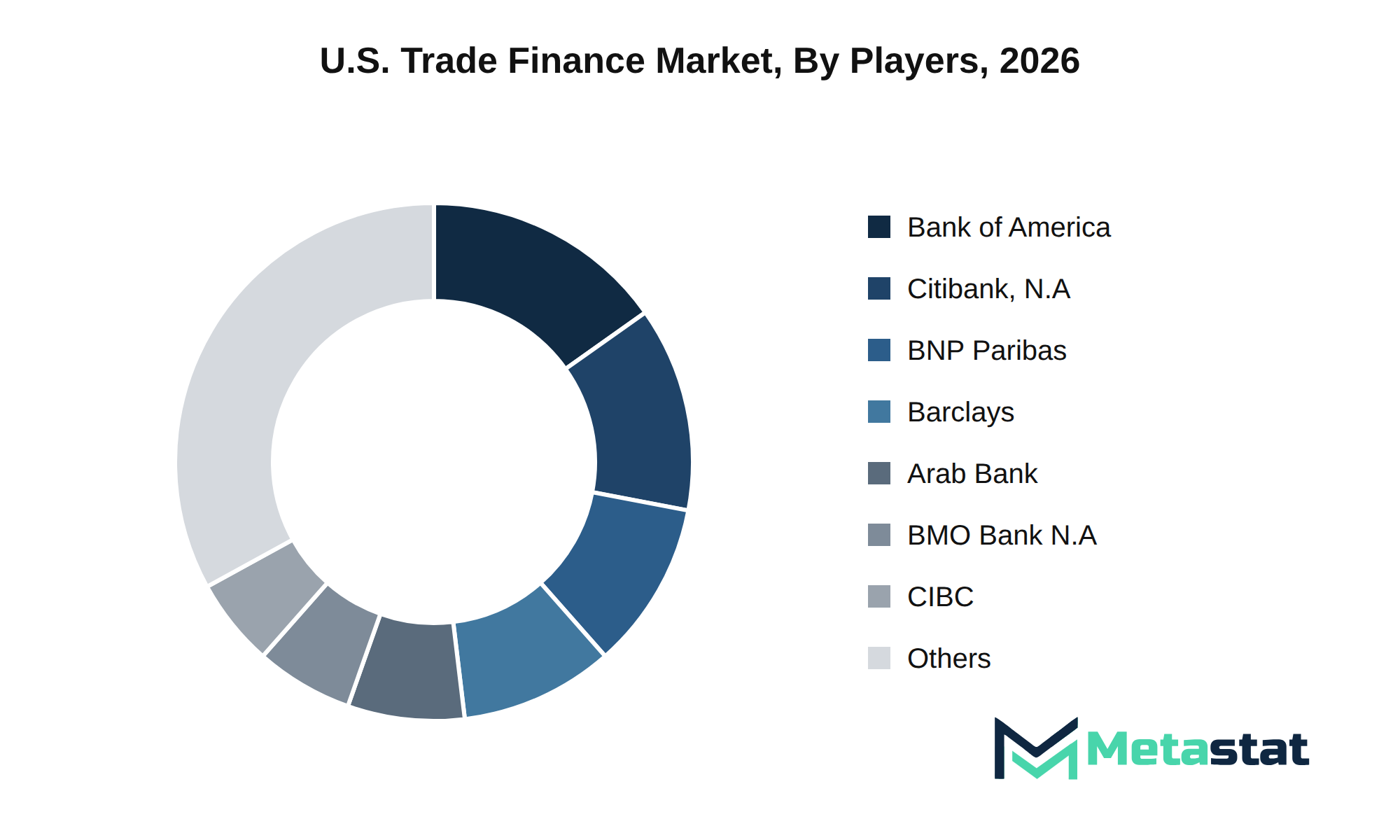
The U.S. Trade Finance market features intense competition among established financial institutions. Key players, including Bank of America Corp, JPMorgan Chase Bank, N.A., and HSBC Holdings plc, focus on enhancing service offerings through strategic partnerships and technological investments. This approach enables these firms to improve customer retention and address evolving market demands.
Pricing architectures reflect the competitive dynamic, with institutions including Citibank, N.A. and Barclays plc adopting flexible pricing strategies to attract diverse clientele. These strategies, coupled with strong brand equity, maintain their positions in the market.
Innovation plays a critical role in maintaining competitive advantages. Firms invest in research and development pipelines, creating proprietary technologies that differentiate services. Companies like BNP Paribas SA and Deutsche Bank AG leverage intellectual property portfolios to enhance market presence.
Future growth in the U.S. Trade Finance market relies on expanding service offerings and enhancing value chain integration. Strategic alliances and joint ventures among players contribute to a more robust ecosystem that reacts to new trends and challenges, facilitating sustained market expansion and development.
Market size is forecast to rise from USD 14.2 billion in 2025 to over USD 24.7 billion by 2033. The base case reflects a steady growth trajectory, driven by a compound annual growth rate (CAGR) of 7.1%. This growth results from various factors, including macroeconomic stability, evolving trade policies, and a surge in global trade activities.
The bull case scenario envisions accelerated growth, influenced by higher-than-expected demand for trade finance solutions in emerging markets and rapid technological advancements. Conversely, the bear case accounts for potential disruptions caused by geopolitical tensions, economic downturns, or regulatory challenges that could slow market expansion.
Underlying this growth, downstream demand changes emerge from shifts in core industries and structural consumption patterns. The integration of next-generation technologies enhances operational efficiencies, while ongoing research and development (R&D) commercialization supports innovation in trade finance products. Regulatory evolution ensures compliance and promotes confidence among stakeholders, enabling smoother transactions and supporting the U.S. Trade Finance market.
Strategic capital allocation directives alongside infrastructure commitments establish the foundation for long-term growth. Growing white-space opportunities and unmet enterprise needs highlight high-growth pockets within the market, emphasizing the necessity for participants to adapt to evolving conditions and align their strategies accordingly.
Overall, the outlook for the U.S. Trade Finance market remains positive, supported by a combination of economic stability, technological integration, and evolving trade dynamics. Organizations focusing on adaptability and innovation will position themselves favorably to capitalize on emerging opportunities.
The report strategically identifies and profiles the key market players and analyses their core competencies in each sub-segment of the Trade Finance market.
Report Attributes | Details |
Study Period | 2021-2033 |
Base Year | 2025 |
Estimated Year | 2026 |
Forecast Period | 2026-2033 |
Historical Period | 2021-2025 |
Growth Rate | CAGR 7.1% from 2026 to 2033 |
Revenue Unit | USD billion |
Segmentation | By Service Type, Trade Flow, Enterprise Size, End-Use Industry, and Region |
Find answers to common questions about this report
The U.S. Trade Finance market size was valued at USD 14.2 billion in 2025.
The U.S. Trade Finance market is projected to grow at a CAGR of 7.1% during the forecast period from 2026 to 2033.
The leading segment in the U.S. Trade Finance market is Commercial Letters of Credit, with a projected value of USD 4.5 billion by 2033. This segment holds the largest share based on service type.
Key drivers for the U.S. Trade Finance market include favorable economic conditions, increased public-private spending, and robust infrastructure investment. These factors enhance financial health, support international trade activities, and improve operational productivity, ultimately driving growth and competitiveness within the market.
Regulatory compliance challenges and geopolitical fragmentation significantly restrain growth in the U.S. Trade Finance market. Tighter regulations increase operational burdens for businesses, particularly smaller firms, while heightened tensions between nations lead to increased trade deficits and tariff friction, complicating international transactions and raising costs.
Favorable economic conditions, sustained capital investment, and a focus on international expansion significantly favor product adoption in the U.S. Trade Finance market. Enhanced infrastructure and increased public-private spending power further support the financial health of enterprises, facilitating their entry into global markets and promoting growth in trade finance activities.
The Trade Finance market is estimated to reach a valuation of USD 24.7 billion by 2033.
Key players operating in the U.S. Trade Finance market include Bank of America Corp, BNP Paribas SA, Citibank, N.A., Deutsche Bank AG, HSBC Holdings plc, JPMorgan Chase Bank, N.A., Standard Chartered Bank, and Wells Fargo & Company.
The U.S. Trade Finance market is projected to register a compound annual growth rate (CAGR) of 7.1% from 2026 to 2033.
The manufacturing and industrials sector shows significant demand, with a projected market size of USD 4.2 billion by 2033.
The analysts below cover Banking & Finance research at Metastat Insights.
LEAD ANALYST
Utkarsh Khirodkar is a Lead Market Research Analyst at MetaStat Insight, specializing in market intelligence, technology sector assessments, and competitive strategy.

PRINCIPAL CONSULTANT - ENTERPRISE AI & EMERGING TECHNOLOGIES
Banking & Finance · Electronics and Semiconductor · Energy and Power · Healthcare IT · Information & Technology · Professional Services
Vijay Gunti is a Principal Consultant at MetaStat Insight, bringing over two decades of experience across enterprise digital transformation, technology strategy, and intelligent systems.
Scaling antibody-drug conjugate manufacturing hinges on contract manufacturing availability for high-potency active ingredients. The MetaStat Insight analysis looked closely at global cleanroom slot constraints, bioconjugation batch failure rates, and supply chain redundancies between the US, Europe, and India. The supplier capability matrix proved genuinely useful for our team when mapping secondary source options across our clinical pipeline.
Floating offshore wind feasibility relies heavily on specialized installation vessel availability and port crane limits, which most broad renewable energy forecasts ignore. The report delivered a thorough analysis of dry dock capacity, mooring chain supply constraints, and raw material pricing trends for deepwater anchor installations. It served as a solid independent sanity check for our offshore project capital expenditure assumptions.
Assessing commercial microgrid software adoption requires looking past top-level installation numbers and examining utility interconnection queues. The research provided verifiable data on average permitting timelines, tariff structures, and battery storage integration costs across regional utility territories. That grounded perspective was valuable for our team when building five-year demand projections for industrial microgrid controllers.
Explore related market intelligence reports worth reading alongside this one.
Starting from
$2950