
LEAD ANALYST
Utkarsh Khirodkar is a Lead Market Research Analyst at MetaStat Insight, specializing in market intelligence, technology sector assessments, and competitive strategy.

Europe Transactional Banking (TB) Business Market Size, Share, By Type (Trade Finance, Cash Management, Trust Services, Securities Services, and Other), By Deployment Mode (On‑Premises, Cloud‑Based, and API‑Driven Platforms), By End User (Large Corporations, Small Enterprises, Medium Enterprises, Financial Institutions, and Government Entities ), Industry Analysis, Growth, Trends, and Forecast, 2026-2033
Report ID
MSI-4685
Published
April, 2026
Updated
Pages
312 Pages
Format
Report Details
Choose Your License
Europe Transactional Banking (TB) Business Market
Europe Transactional Banking (TB) Business market size is valued at USD 212.6 billion in 2025 and projected to grow at a CAGR of 3.3% during the forecast period, reaching USD 275.5 billion by 2033.
United Kingdom holds 19.9% market share in 2025.
Cash Management is the leading segment in the Europe Transactional Banking (TB) Business market with share of 43.14% in 2025.
Key trends driving growth: Real-time payments expansion and enterprise migration to ISO 20022 messaging along with treasury digitization via API connectivity and ERP and TMS integration.
Opportunities include API-led embedded treasury for platforms and SMEs across cross-border commerce corridors.
Key insight: Digital modernization and regulatory realignment reshape competitive positioning across Europe Transactional Banking Business Market.
The Europe Transactional Banking (TB) Business market within the financial services industry is reshaping how corporates manage liquidity, payments, and risk across a fragmented regulatory environment. The market extends well beyond domestic clearing and conventional cash management, evolving toward cross-border treasury orchestration, real-time reconciliation, and embedded financial capabilities integrated directly into enterprise resource planning systems. Banks and financial institutions across Europe are repositioning transactional banking services from operational utilities to strategic infrastructure, where payment rails, digital accounts, and API gateways form the foundation of long-term corporate client relationships.
Over the coming years, treasury departments across Germany, France, the Nordics, Spain, Italy, and other European markets will increasingly require integrated visibility across multicurrency positions, faster settlement capabilities, and automated compliance controls aligned with regional regulations. Institutions are continuing to modernize their transactional architecture through ISO 20022 adoption, enabling richer data capture, better interoperability, and improved liquidity forecasting. Digital identity verification, strong customer authentication under PSD2, and ongoing payment modernization initiatives are also influencing how corporates initiate, approve, and monitor transactions across borders.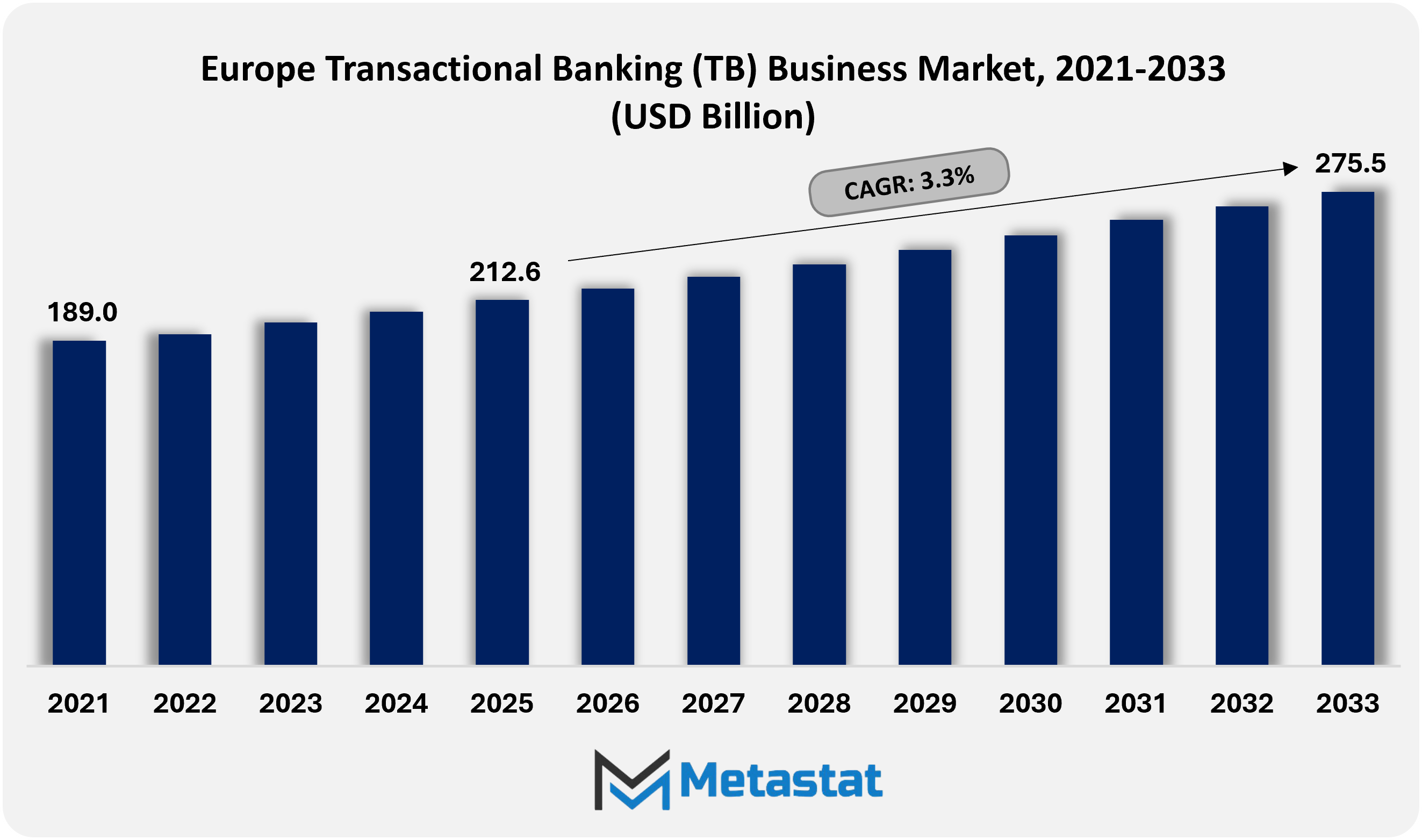
Real-time payments expansion and enterprise migration to ISO 20022 messaging.
The continued expansion of real-time payment infrastructure across major European economies is improving transaction speed, liquidity visibility, and settlement efficiency within the Europe Transactional Banking (TB) Business market. At the same time, enterprise migration to ISO 20022 messaging standards is enhancing data quality, interoperability, and reconciliation accuracy. These developments are enabling institutions to modernize payment rails, streamline transaction processing, and support more scalable cross-border payment ecosystems.
Treasury digitization via API connectivity and ERP and TMS integration
The growing adoption of API connectivity linked with ERP and treasury management systems is transforming treasury operations across the Europe Transactional Banking (TB) Business market. Integrated digital workflows are enabling automated cash positioning, stronger forecasting accuracy, and centralized visibility over liquidity across multiple business entities. These capabilities are helping corporates improve decision-making, reduce operational friction, and strengthen enterprise-wide financial control.
Fee compression from regulation, pricing transparency, and non-bank competition
Rising regulatory oversight and greater pricing transparency are placing sustained pressure on margins in the Europe Transactional Banking (TB) Business market. Increasing participation from non-bank financial service providers and fintech-led payment specialists is intensifying competitive pricing across several transactional banking functions. Traditional institutions are therefore being pushed to optimize their cost structures, strengthen their value proposition, and invest in service differentiation to preserve profitability.
Legacy payments infrastructure complexity and operational resilience requirements
Dependence on legacy payment infrastructure continues to create integration bottlenecks and reduce agility across the Europe Transactional Banking (TB) Business market. At the same time, stricter operational resilience requirements, including cyber risk management, system redundancy, and continuity planning, are increasing the burden on banks and financial institutions. Modernization programs often require significant capital allocation, governance upgrades, and phased transformation strategies to maintain uninterrupted service delivery.
API-led embedded treasury for platforms and SMEs across cross-border commerce corridors
API-led embedded treasury solutions are creating a strong growth opportunity in the Europe Transactional Banking (TB) Business market. Financial capabilities are increasingly being integrated into digital platforms serving SMEs involved in international trade, e-commerce, and cross-border business activity. This is opening new revenue streams for transactional banking providers, improving access to liquidity and payment services, and supporting more tailored treasury solutions for fast-growing business ecosystems.
The Europe Transactional Banking (TB) Business market is classified based on Type, Deployment Mode, and End User.
Trade Finance segment is valued at USD 55.9 billion in 2026 and is projected to reach USD 57.9 billion by 2033, at a CAGR of 0.5% during the forecast period.
Trade Finance in the Europe Transactional Banking (TB) Business market is advancing through digital documentation, automated compliance screening, and improved transaction traceability. Financial institutions are focusing on faster settlement cycles, risk mitigation, and greater transparency across multinational trade corridors. Blockchain-enabled validation tools, digital trade workflows, and real-time verification systems are supporting more efficient execution of trade-related banking services.
Cash Management segment is valued at USD 97.3 billion in 2026 and is projected to reach USD 134.3 billion by 2033, at a CAGR of 4.7% during the forecast period.
Cash Management represents the leading type segment in the Europe Transactional Banking (TB) Business market, supported by increasing demand for predictive liquidity analytics, centralized treasury dashboards, and integrated payment ecosystems. Corporates are prioritizing visibility across global cash positions, automated reconciliation, and stronger fraud monitoring capabilities. Artificial intelligence and analytics tools are also improving forecasting accuracy and supporting more effective capital allocation decisions.
Trust & Securities Services segment is valued at USD 44.3 billion in 2026 and is projected to reach USD 56.4 billion by 2033, at a CAGR of 3.5% during the forecast period.
Trust & Securities Services in the Europe Transactional Banking (TB) Business market are expanding through digital custody platforms, tokenized asset servicing, and automated corporate action processing. Institutions are investing in secure data environments and advanced processing capabilities to improve transparency, reduce manual intervention, and enhance investor servicing across capital markets. Ongoing digital transformation is supporting operational efficiency and strengthening confidence in asset servicing frameworks.
Others segment is valued at USD 21.9 billion in 2026 and is projected to reach USD 26.9 billion by 2033, at a CAGR of 3% during the forecast period.
Other service categories in the Europe Transactional Banking (TB) Business market are growing through specialized treasury solutions, escrow management, payment optimization services, and sector-specific transactional support. These offerings are helping institutions address niche enterprise requirements and expand service capabilities beyond core transactional banking functions.
On‑Premises segment is projected to reach USD 107.7 billion by 2033, at a CAGR of -0.8% during the forecast period.
On-Premises deployment continues to retain relevance in the Europe Transactional Banking (TB) Business market among institutions and enterprises that require direct infrastructure control, strict data governance, and customized internal integration. These deployments remain important in highly regulated environments where security, control, and compliance oversight are critical. Investment in cybersecurity, internal controls, and tailored system architecture continues to support this segment despite slower long-term growth.
Cloud‑Based segment is projected to reach USD 105.3 billion by 2033, at a CAGR of 6.1% during the forecast period.
Cloud-Based deployment is gaining strong traction in the Europe Transactional Banking (TB) Business market owing to its scalability, faster implementation, lower maintenance burden, and improved accessibility. Financial institutions are increasingly adopting cloud-enabled and hybrid environments to improve agility while maintaining strong security and compliance standards. Ongoing software upgrades, encryption improvements, and digital workflow flexibility are further supporting adoption.
API‑Driven Platforms segment is projected to reach USD 62.4 billion by 2033, at a CAGR of 8.4% during the forecast period.
API-Driven Platforms are expected to register the fastest growth in the Europe Transactional Banking (TB) Business market. These platforms enable seamless integration between banking systems and enterprise software, supporting real-time data exchange, automated payment initiation, and more customized service delivery. Open banking frameworks, modular architecture, and collaboration between banks, fintech providers, and corporate clients are accelerating the expansion of this segment.
Large Corporations segment is projected to reach USD 113.1 billion by 2033.
Large corporations in the Europe Transactional Banking (TB) Business market continue to require sophisticated treasury ecosystems, advanced liquidity tools, and cross-border payment optimization capabilities. Strategic priorities within this segment include centralized risk oversight, multicurrency transaction management, and improved financial visibility across geographically dispersed operations. Digital reporting and real-time treasury intelligence remain central to adoption.
Small and Medium Enterprises (SMEs) segment is projected to reach USD 80.3 billion by 2033.
Small and medium enterprises are increasingly adopting digital transactional banking services that simplify onboarding, improve working capital management, and support cross-border business expansion. Financial institutions are introducing more scalable platforms, user-friendly interfaces, and cost-efficient service models tailored to SME requirements. Broader access to treasury tools and international payment services is strengthening segment growth.
Financial Institutions segment is projected to reach USD 56.4 billion by 2033.
Financial institutions operating as end users within the Europe Transactional Banking (TB) Business market are strengthening their capabilities through embedded finance, advanced analytics, and compliance automation. Strategic partnerships with fintech firms and technology vendors are supporting innovation in liquidity management, payments, and transaction monitoring. These developments are helping institutions improve service agility and operational resilience.
Government Entities segment is projected to reach USD 25.7 billion by 2033.
Government entities are increasingly implementing secure digital payment infrastructure, centralized fund management systems, and transparent audit mechanisms within the Europe Transactional Banking (TB) Business market. Public-sector modernization initiatives are supporting faster disbursement, stronger financial oversight, and more efficient tax collection and public fund administration.
Based on geography, the Europe Transactional Banking (TB) Business market is divided into United Kingdom, Spain, Germany, Italy, and Rest of Europe.
United Kingdom Transactional Banking (TB) Business Market is set to expand at a CAGR of 3.3% within the forecast period, reaching a market size (TAM) of USD 51.8 billion by the end of 2033.
The UK’s advanced fintech ecosystem and open banking adoption are accelerating demand for revolutionary transactional banking solutions.
Regulatory emphasis on faster bills and real-time settlement infrastructures is driving an increase within the UK TB marketplace.
Digital transformation projects among Spanish corporates offer possibilities for next-generation cash management and go-border charge services.
Increasing adoption of cloud-primarily based treasury and API-driven banking systems creates openings for transactional banking innovation in Spain.
Germany remains a key market owing to its large corporate base, strong industrial economy, and extensive trade activity.
Italy is progressing through steady adoption of digital treasury platforms, payment modernization, and stronger banking support for SMEs and multinational businesses.
Rest of Europe holds the dominant regional share in the Europe Transactional Banking (TB) Business market, supported by broad-based demand across France, the Nordics, Benelux, Switzerland, Austria, and other European economies.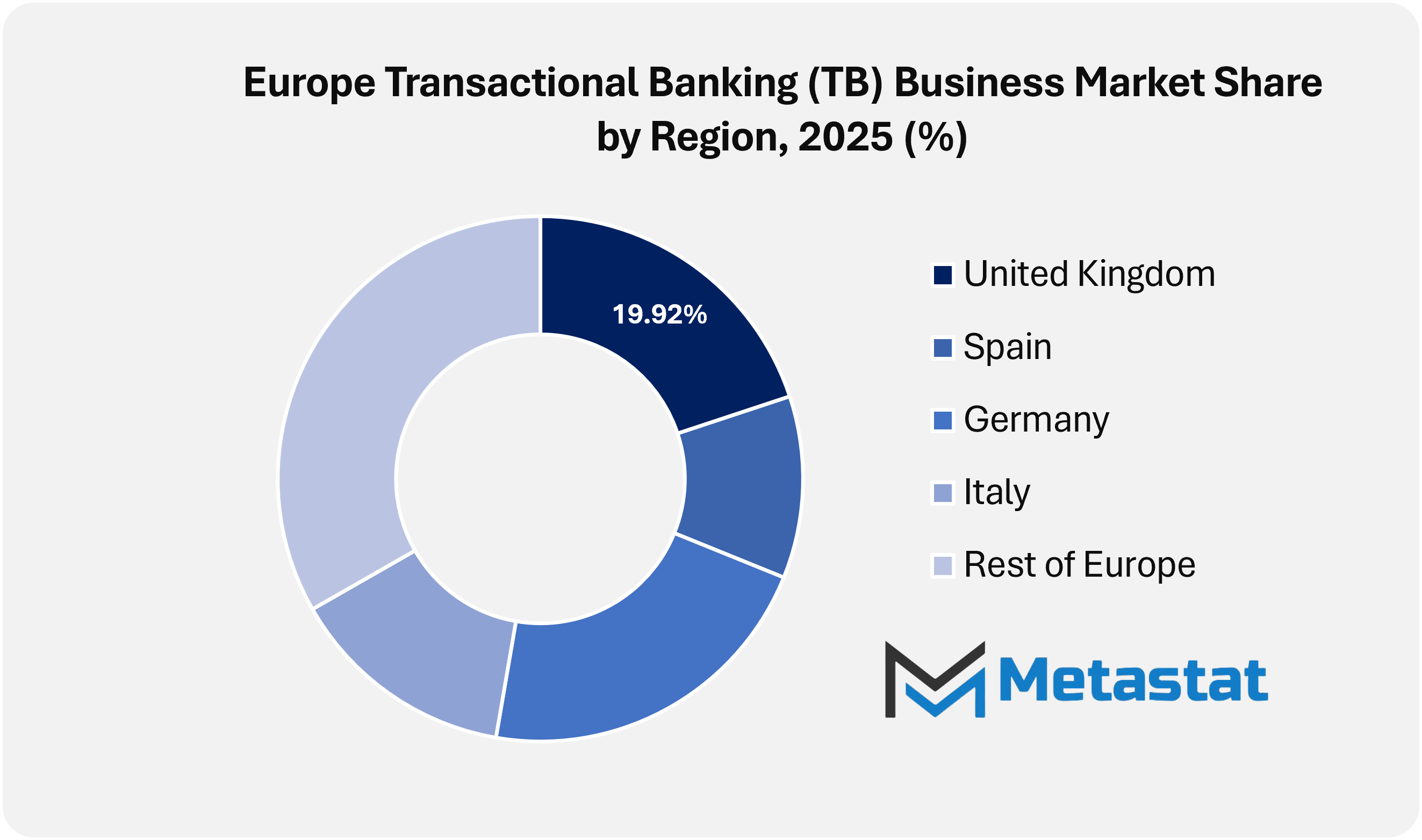
The Europe Transactional Banking (TB) Business market occupies a central position within corporate financial services, supporting payments, cash management, trade finance, liquidity solutions, and transaction processing for businesses across the region. Large enterprises, mid-sized firms, government bodies, and financial institutions depend on transactional banking services to manage daily operations, treasury visibility, and cross-border financial activity. As digital payment adoption continues to expand across Europe, banks are investing in advanced infrastructure to deliver faster settlements, improved transparency, and stronger risk controls. Regulatory frameworks across the region are also influencing service design, compelling institutions to maintain robust compliance while improving the client experience.
Competition within the market remains strong, driven by both established European banking groups and global financial institutions with significant regional presence. Leading European players include BNP Paribas SA, Société Générale SA, and Crédit Agricole Corporate and Investment Bank, each of which maintains a broad corporate banking footprint across the continent. Banco Santander, S.A. and Banco Bilbao Vizcaya Argentaria, S.A. continue to expand digital cash management and transaction banking capabilities, while CaixaBank, S.A. and Banco de Sabadell, S.A. are strengthening their domestic and regional corporate banking portfolios. In the United Kingdom, HSBC Holdings plc, Barclays PLC, and Standard Chartered PLC continue to serve multinational clients through integrated treasury and transaction banking platforms.
Germany and the Netherlands also hold an important position in the Europe Transactional Banking (TB) Business market. Deutsche Bank AG and Commerzbank AG maintain strong capabilities in trade finance, liquidity services, and corporate treasury solutions, particularly for exporters and industrial clients. ABN AMRO Bank N.V. and Coöperatieve Rabobank U.A. continue to support corporate, commercial, and sector-focused clients through established transaction banking networks. In Italy, UniCredit S.p.A. and Intesa Sanpaolo S.p.A. are investing in digital treasury tools and corporate banking infrastructure to support both SMEs and multinational enterprises.
Nordic institutions including Nordea Bank Abp, Danske Bank A/S, DNB Bank ASA, and Skandinaviska Enskilda Banken AB (publ) maintain strong regional coverage backed by advanced digital payment infrastructure and treasury services. Global banking groups such as The Goldman Sachs Group, Inc., Citigroup Inc., JPMorgan Chase & Co., Bank of America Corporation, and Wells Fargo & Company continue to participate in large-value transactions, international liquidity management, and cross-border corporate banking. Asian institutions including Mizuho Bank, Ltd., MUFG Bank, Ltd., Sumitomo Mitsui Banking Corporation, and DBS Bank Ltd. support transaction flows between Europe and Asia, while The Bank of Nova Scotia participates selectively across corporate banking and trade-related segments. Together, these institutions shape a competitive and technology-driven market that continues to advance through automation, digital payments, and integrated treasury solutions.
Market size is forecast to rise from USD 212.6 billion in 2025 to over USD 275.5 billion by 2033.
The Europe Transactional Banking (TB) Business Market will continue moving in the direction of platform-primarily based service shipping, in which speed, information transparency, and regulatory alignment will define patron retention. Transactional banking in Europe will consequently perform not merely as an aid function, but as a strategic financial conduit connecting corporates, regulators, and worldwide counterparties in a tightly regulated virtual economy.
This research report categorizes the Europe Transactional Banking (TB) Business market based on key segments and regions, forecasts revenue growth, and analyses trends in each submarket. The report analyses the key growth drivers, opportunities, and challenges influencing the Europe Transactional Banking (TB) Business market. Recent market developments and competitive strategies such as expansion, product launch, partnership, merger, and acquisition have been included to draw the competitive landscape in the market.
The report strategically identifies and profiles the key market players and analyses their core competencies in each sub-segment of the Europe Transactional Banking (TB) Business market.
|
Report Attributes |
Details |
|
Study Period |
2021-2033 |
|
Base Year |
2025 |
|
Estimated Year |
2026 |
|
Forecast Period |
2026-2033 |
|
Historical Period |
2021-2025 |
|
Growth Rate |
CAGR 3.3% from 2026 to 2033 |
|
Revenue Unit |
USD billion |
|
Segmentation |
By Type, Deployment Mode, End User and Region |
|
By Type |
|
|
By Deployment Mode |
|
|
By End User |
|
|
By Region |
|
Find answers to common questions about this report
Top players operating in the Europe Transactional Banking (TB) Business industry include BNP Paribas SA, Société Générale SA, Crédit Agricole Corporate and Investment Bank, Banco Santander S.A., HSBC Holdings plc, and Barclays PLC.
Europe Transactional Banking (TB) Business market is estimated to reach USD 275.5 billion by 2033.
Fee compression from regulation, pricing transparency, and non-bank competition will hamper the market growth within the forecast period.
Real-time payments expansion and enterprise migration to ISO 20022 messaging and Treasury digitization via API connectivity and ERP and TMS integration are key driving factors, boosting the market.
Rest of Europe region dominates the market.
The Cash Management is the leading type segment in the Europe market.
The Metastat Insights analysis shows that the United Kingdom Transactional Banking (TB) Business market size is estimated to be USD 51.8 billion by 2033.
The Europe Transactional Banking (TB) Business market is expected to grow at a CAGR of 3.3% over the forecast period (2026-2033).
The Metastat Insights study shows that the Europe Transactional Banking (TB) Business market size was USD 212.6 billion in 2025.
The analysts below cover Banking & Finance research at Metastat Insights.
LEAD ANALYST
Utkarsh Khirodkar is a Lead Market Research Analyst at MetaStat Insight, specializing in market intelligence, technology sector assessments, and competitive strategy.

PRINCIPAL CONSULTANT - ENTERPRISE AI & EMERGING TECHNOLOGIES
Banking & Finance · Electronics and Semiconductor · Energy and Power · Healthcare IT · Information & Technology · Professional Services
Vijay Gunti is a Principal Consultant at MetaStat Insight, bringing over two decades of experience across enterprise digital transformation, technology strategy, and intelligent systems.
Last Updated: August, 2026
Ambulatory surgical centers have very different purchasing cycles for robotic-assisted surgery platforms than major hospital networks. The MetaStat Insight study focused squarely on capital expenditure depreciation, procedural reimbursement pathways, and surgeon training overhead. That operational clarity made it much simpler to validate multi-year procedure growth forecasts against actual ambulatory center adoption patterns.
When planning edge sensor rollouts across refinery environments, generic IoT reports typically miss the harsh-environment certification bottlenecks. MetaStat Insight gave an objective evaluation of ATEX and Class 1 Division 2 hardware availability, along with realistic five-year maintenance cycle cost projections. The comparison of wireless mesh versus private cellular backhaul helped our team pressure-test network reliability models for remote processing facilities.
In the biological seed treatment space, registration timelines vary drastically between the European Union, Brazil, and North America. The MetaStat Insight research handled these cross-border regulatory barriers with genuine nuance, mapping commercialization pathways alongside historical field adoption rates. The segmentation between microbial strains and biochemical active ingredients was particularly well structured.
Explore related market intelligence reports worth reading alongside this one.