
LEAD ANALYST
Utkarsh Khirodkar is a Lead Market Research Analyst at MetaStat Insight, specializing in market intelligence, technology sector assessments, and competitive strategy.

Corporate Treasury Management Software Market Size, Share, By Deployment Model (Cloud‑based, On‑premises, and Hybrid), By Functionality (Cash Management, Liquidity Management, Risk Management, Hedge Management, Payments, Bank Connectivity, Forecasting, Analytics, and Others), By Organization Size (Small Enterprises, Medium‑Sized Enterprises, and Large Enterprises), By End‑User Industry (Manufacturing, Retail and Consumer Goods, Energy, Utilities, Technology, Telecommunications, Healthcare, Life Sciences, Transportation, Logistics, Construction, Real Estate, and Others), Industry Analysis, Growth, Trends, and Forecast, 2026-2033
Report ID
MSI-4708
Published
April, 2026
Pages
313 Pages
Format
Report Details
Choose Your License
Corporate Treasury Management Software Market
Global Corporate Treasury Management Software market size is valued at USD 6,964.9 million in 2025 and projected to grow at a CAGR of 5.6% during the forecast period, reaching USD 10,763.8 million by 2033.
North America holds 36.6% in 2025 with US leading the market share in 2025.
Cloud based segment account for a market share of 49.6% in 2025.
Key trends driving growth: Increased Real-Time Cash Visibility and Liquidity Control Requirements along with automation of Forecasting, Payments, and Treasury Controls to Reduce Manual Processing.
Opportunities include API-Led Corporate to Bank Connectivity and Real-Time Rails Supporting Faster Straight Through Treasury Operations.
Key insight: AI-integrated automation reshapes enterprise operations through cost efficiency, decision intelligence, and scalable digital workforce models.
Global Corporate Treasury Management Software market will expand beyond liquidity dashboards and payment scheduling, becoming a core layer of financial control for multinational enterprises operating in a digitally connected economy. Over the forecast period, treasury platforms will strengthen their role in unifying liquidity management, risk monitoring, capital allocation, and cross-border compliance within a centralized digital environment. Rather than serving only as back-office systems, these platforms will support executive decision-making through real-time visibility, structured financial intelligence, and improved control over global treasury operations.
Advanced data orchestration will enable treasury teams to evaluate currency exposure, counterparty concentration, and funding structures across multiple jurisdictions with greater precision. Machine learning capabilities will improve transaction analysis, cash forecasting, and liquidity positioning under changing trade and payment conditions. Integration with enterprise resource planning systems, banking networks, and capital markets infrastructure will position treasury software as a strategic bridge between internal finance functions and external financial institutions.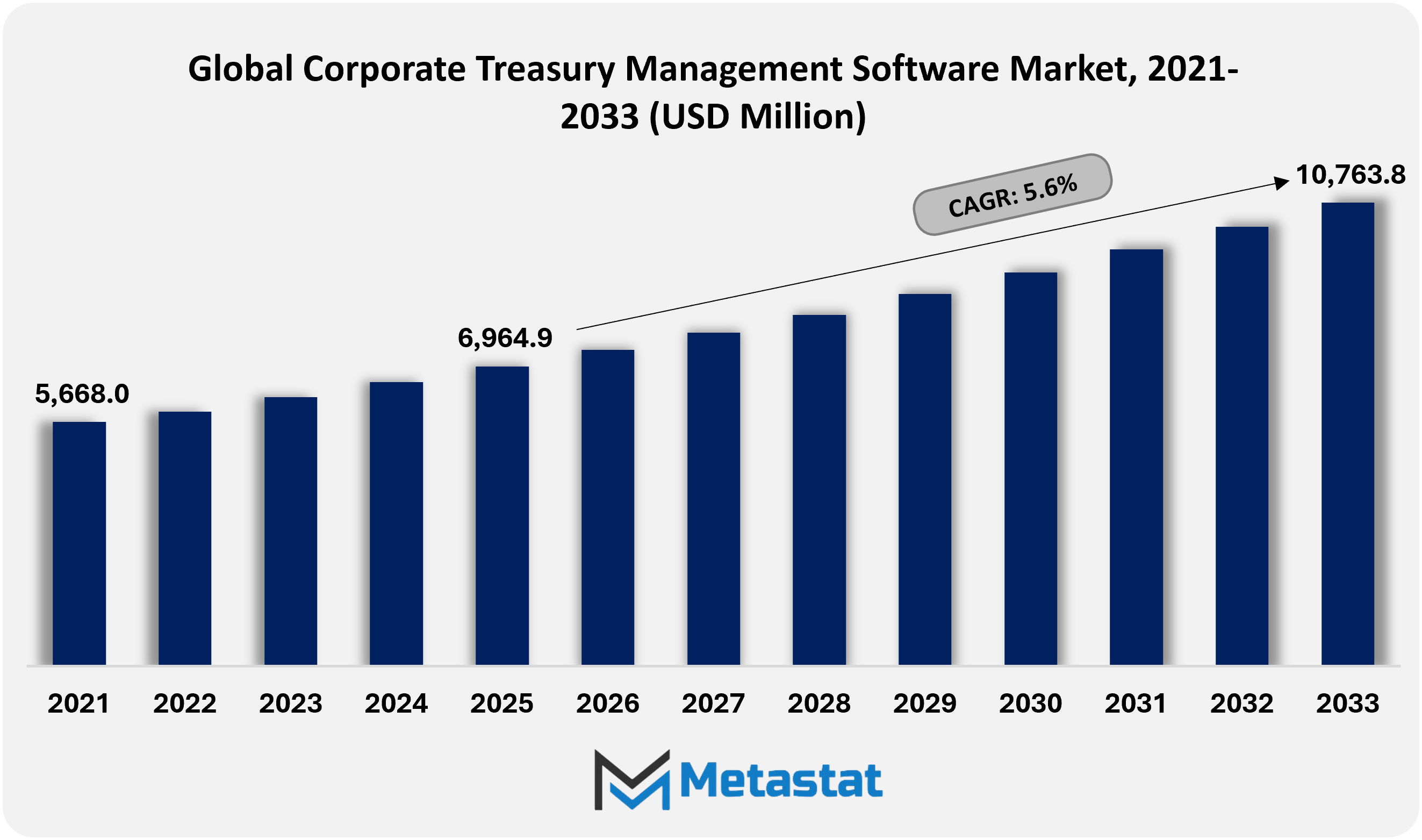
Increased Real-Time Cash Visibility and Liquidity Control Requirements.
Rising demand for accurate cash positioning across multiple geographies will encourage enterprises to adopt advanced treasury software. Centralized dashboards improve visibility into balances, exposures, and short-term investments across entities and banking partners. Predictive liquidity tools also support stronger funding decisions, tighter working capital control, and better capital allocation discipline.
Automation of Forecasting, Payments, and Treasury Controls to Reduce Manual Processing
Digital transformation initiatives are accelerating automation across cash forecasting, payment approvals, reconciliations, and treasury controls. Automated workflows reduce manual effort, improve processing speed, and strengthen audit readiness across treasury functions. Greater use of intelligent analytics also improves forecast accuracy and supports stronger governance across enterprise finance operations.
Complex ERP and Multi-Bank Integration, Including Data Mapping and Connectivity Setup
Implementation challenges will remain a key restraint in the Global Corporate Treasury Management Software market owing to the complexity of aligning ERP systems with multiple banking networks. Data mapping, file standardization, workflow configuration, and connectivity setup often require specialized expertise and long testing cycles. These factors increase deployment costs and extend implementation timelines, particularly for multinational enterprises.
Security, Compliance, and Payment Fraud Controls Creating Extended Procurement and Implementation Cycles
Heightened regulatory scrutiny and rising payment fraud risks will lengthen vendor assessment and implementation cycles in the Global Corporate Treasury Management Software market. Enterprises require strong encryption, role-based controls, multi-factor authentication, and audit validation before system rollout. Procurement therefore becomes more rigorous, slowing adoption despite strong demand for treasury digitization.
API-Led Corporate to Bank Connectivity and Real-Time Rails Supporting Faster Straight Through Treasury Operations
Open banking infrastructure, APIs, and real-time payment rails are creating a strong opportunity across the Global Corporate Treasury Management Software market. Direct connectivity between corporate systems and banking platforms supports faster balance updates, payment initiation, reconciliation, and visibility into cash positions. These capabilities improve straight-through processing, strengthen treasury efficiency, and support faster financial decision-making across global enterprises.
The Global Corporate Treasury Management Software market is classified based on Deployment Model, Functionality, Organization Size, and End‑User Industry.
Cloud‑based segment is valued at USD 3,646 million in 2026 and is projected to reach USD 6,560.5 million by 2033, at a CAGR of 8.8% during the forecast period.
Cloud-based deployment is gaining strong traction in the Global Corporate Treasury Management Software market owing to its scalability, lower implementation burden, and support for real-time treasury visibility. Subscription-based pricing improves budgeting flexibility, while centralized updates strengthen security, compliance, and product innovation. Greater integration with ERP systems and banking partners also supports better liquidity oversight across global operations.
On‑premises segment is valued at USD 2,586.9 million in 2026 and is projected to reach USD 2,401.4 million by 2033, at a CAGR of 1.1% during the forecast period.
On-premises deployment will remain relevant among enterprises that prioritize infrastructure control, internal data governance, and highly customized treasury environments. Large organizations in regulated sectors continue to value direct ownership of systems handling sensitive financial workflows. Although growth is slower than cloud-based models, on-premises solutions still support complex operational requirements in specific enterprise settings.
Hybrid segment is valued at USD 1,114.7 million in 2026 and is projected to reach USD 1,801.9 million by 2033, at a CAGR of 7.1% during the forecast period.
Hybrid deployment will support enterprises seeking a balanced approach between cloud scalability and internal control. Organizations can retain sensitive treasury functions within controlled environments while using cloud-based modules for analytics, reporting, and collaboration. This model supports operational resilience, phased modernization, and better alignment with enterprise-specific compliance needs.
Cash & Liquidity Management segment is projected to reach USD 2,565 million by 2033, at a CAGR of 4.4% during the forecast period.
Cash & Liquidity Management remains a core functionality area within the Global Corporate Treasury Management Software market owing to the need for real-time cash visibility and stronger working capital control. Treasury teams use these tools to monitor balances, automate reconciliations, and optimize intercompany cash movement across jurisdictions. Greater adoption of predictive liquidity models is also strengthening funding decisions and short-term investment planning.
Risk & Hedge Management segment is projected to reach USD 1,813.7 million by 2033, at a CAGR of 5% during the forecast period.
Risk & Hedge Management functionality is becoming increasingly important as enterprises navigate foreign exchange volatility, interest rate shifts, and commodity exposure. Advanced scenario modeling and hedge tracking tools support better evaluation of financial risk under changing market conditions. Integrated reporting and compliance capabilities also improve transparency and strengthen balance sheet protection strategies.
Payments & Bank Connectivity segment is projected to reach USD 2,918.1 million by 2033, at a CAGR of 6.5% during the forecast period.
Payments & Bank Connectivity functionality is expanding rapidly owing to the need for faster transaction execution, secure bank communication, and end-to-end treasury visibility. Standardized connectivity frameworks, APIs, and real-time rails improve payment processing accuracy and reduce operational friction. Stronger bank integration also helps treasury teams centralize workflows and manage global cash movement more efficiently.
Forecasting & Analytics segment is projected to reach USD 2,667.3 million by 2033, at a CAGR of 7.1% during the forecast period.
Forecasting & Analytics functionality is gaining importance as enterprises seek more accurate cash flow projections and stronger decision support. Data-driven dashboards, scenario analysis, and machine learning tools help treasury teams model liquidity outcomes under changing market and business conditions. These capabilities improve planning accuracy, capital allocation, and executive oversight across finance operations.
Others segment is projected to reach USD 799.8 million by 2033, at a CAGR of 3.2% during the forecast period.
Other functionality areas include debt management, compliance monitoring, investment tracking, and treasury reporting modules that support broader financial oversight. These tools improve audit readiness, reduce administrative delays, and help enterprises tailor treasury environments to specific operational needs. Continued modular expansion will strengthen the value proposition of integrated treasury software platforms.
Small and Medium‑Sized Enterprises (SMEs) segment is projected to reach USD 3,744.7 million by 2033.
Small and Medium-Sized Enterprises are increasingly adopting treasury software to improve cash visibility, automate finance workflows, and strengthen funding discipline. User-friendly platforms with modular deployment options are making treasury digitization more accessible for growing businesses. Greater adoption among SMEs is also supported by cloud-based pricing models and the need for stronger financial control in competitive markets.
Large Enterprises segment is projected to reach USD 7,019.1 million by 2033.
Large enterprises remain the primary adopters of advanced treasury software owing to their complex cash structures, multiple banking relationships, and global risk exposure. These organizations require centralized control over liquidity, payments, compliance, and hedge activities across jurisdictions. Continued investment in integrated treasury platforms will support stronger governance, faster decision-making, and more efficient multinational finance operations.
Manufacturing segment is projected to grow at a CAGR of 4.5% during the forecast period.
Manufacturing companies are using treasury software to improve working capital management, supplier payment control, and cash planning linked to production cycles. Integrated treasury platforms support better visibility into procurement funding, inventory financing, and cross-border settlements. These capabilities help manufacturers improve liquidity discipline and support long-term capital planning.
Retail and Consumer Goods segment is projected to grow at a CAGR of 4.9% during the forecast period.
Retail and Consumer Goods companies require treasury software to manage high transaction volumes, seasonal revenue swings, and multi-location cash visibility. Automated reconciliation and forecasting tools help improve payment accuracy, liquidity planning, and promotional budget control. These solutions are becoming increasingly important as retailers operate across more complex digital and physical sales environments.
Energy and Utilities segment is projected to grow at a CAGR of 3.6% during the forecast period.
Energy and Utilities companies rely on treasury software to manage commodity price exposure, long-cycle investments, and large-scale funding requirements. Treasury platforms support hedge monitoring, liquidity planning, and structured debt oversight across capital-intensive operations. Greater adoption in this segment is supported by the need for stronger financial control under volatile input and energy pricing conditions.
Technology and Telecommunications segment is projected to grow at a CAGR of 7.9% during the forecast period.
Technology and Telecommunications companies are adopting treasury software to manage subscription-based revenue flows, cross-border transactions, and rapid expansion funding needs. Advanced analytics and automated payment capabilities improve control over liquidity and support faster decision-making across global operations. Treasury digitization in this segment is further supported by high transaction velocity and international business exposure.
Healthcare and Life Sciences segment is projected to grow at a CAGR of 8.5% during the forecast period.
Healthcare and Life Sciences organizations are using treasury software to strengthen fund flow monitoring, research financing oversight, and compliance-related reporting. Cash forecasting tools support capital-intensive innovation cycles, while centralized platforms improve visibility into complex financial operations. Greater adoption is also linked to the need for tighter governance across regulated healthcare and research environments.
Transportation and Logistics segment is projected to grow at a CAGR of 7% during the forecast period.
Transportation and Logistics companies require treasury software to manage fuel-related cost exposure, fleet financing, and cross-border payment coordination. Real-time treasury visibility improves liquidity planning and supports better allocation of capital across routes, assets, and operating regions. Stronger banking connectivity also helps improve transaction efficiency in globally distributed logistics networks.
Construction and Real Estate segment is projected to grow at a CAGR of 3.7% during the forecast period.
Construction and Real Estate companies use treasury software to manage project-based cash cycles, long-term financing structures, and risk exposure across large assets. Centralized dashboards improve debt tracking, liquidity planning, and capital deployment across multiple developments and investment stages. Treasury automation also supports stronger financial discipline in sectors with long payment cycles and high capital commitments.
Others segment is projected to grow at a CAGR of 4.4% during the forecast period.
Other end-user industries are adopting treasury software to improve liquidity visibility, automate payment controls, and strengthen compliance across varied financial environments. Flexible and modular platforms support industry-specific treasury requirements without requiring full-scale legacy transformation. Broader adoption across these sectors will continue as enterprises prioritize control, efficiency, and digital finance modernization.
Based on geography, the Global Corporate Treasury Management Software market is divided into North America, Europe, Asia-Pacific, South America, Middle East, and Africa.
North America Corporate Treasury Management Software Market is set to expand at a CAGR of 5.6% within the forecast period, reaching a market size (TAM) of USD 3,504.7 million by the end of 2033.
North America leads the Corporate Treasury Management Software market owing to strong enterprise digitization, high adoption of integrated ERP environments, and mature banking connectivity infrastructure.
Europe maintains steady demand supported by regulatory compliance needs, treasury centralization, and ongoing modernization of finance functions across multinational corporations.
Asia Pacific presents strong growth opportunities owing to expanding enterprise activity, rising cross-border trade, and increasing adoption of automated treasury tools among mid-sized and large organizations.
South America and Middle East & Africa are gaining traction as banking digitization improves and enterprises increase investment in cloud-based treasury systems to strengthen governance and financial visibility.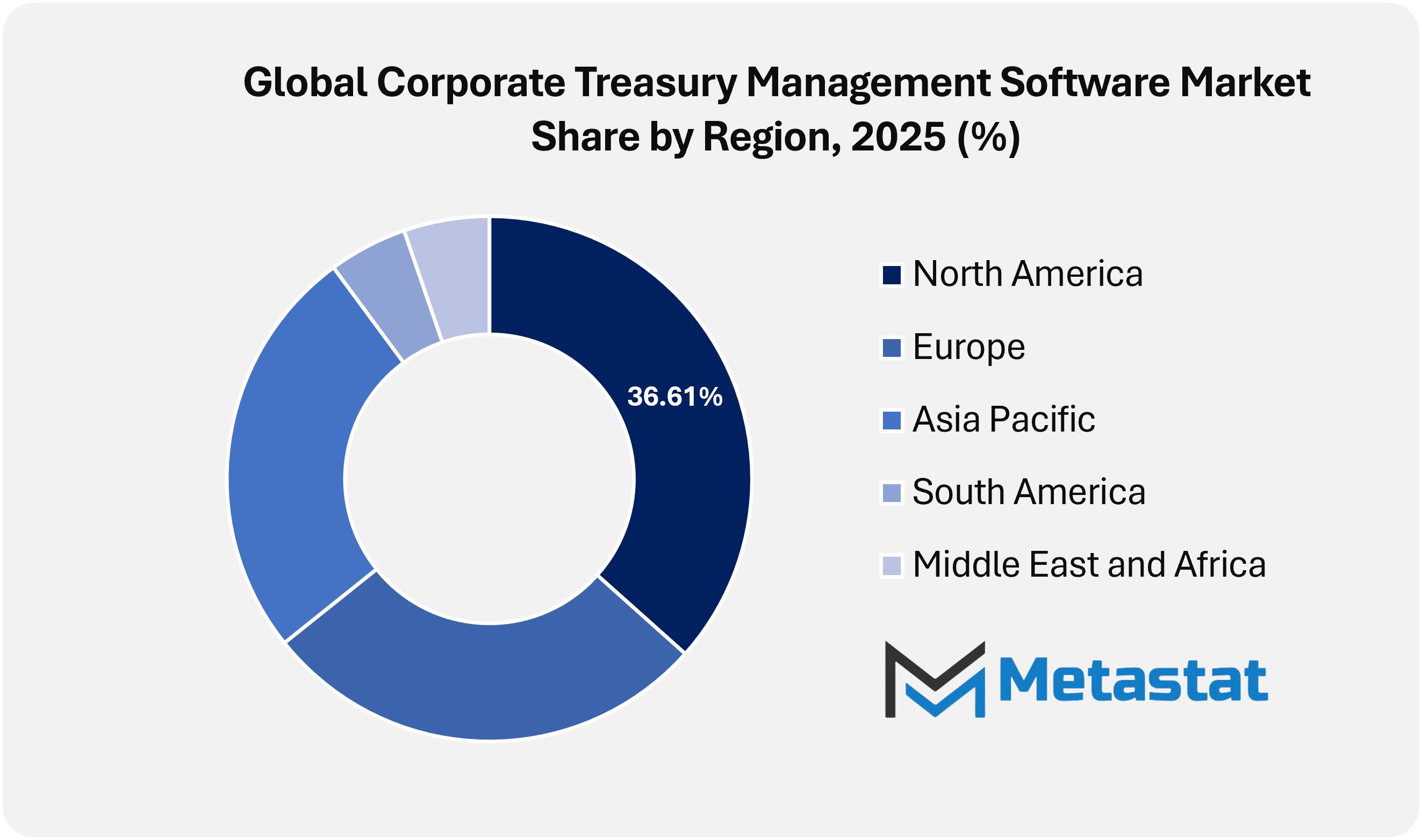
Global Corporate Treasury Management Software market is gaining steady momentum as enterprises seek stronger control over cash flow, risk exposure, and financial visibility. In a business environment shaped by currency volatility, interest rate shifts, and tightening regulatory requirements, treasury teams are prioritizing platforms that deliver real-time insight into liquidity positions, funding needs, and banking activity. Manual spreadsheets no longer provide the speed, accuracy, or scalability required by multinational organizations. With business operations becoming increasingly cross-border, treasury software is emerging as a critical tool for connecting banking networks, automating payments, and improving forecasting precision.
Large technology providers such as SAP SE and Oracle Corporation offer treasury modules that integrate with broader enterprise systems, enabling finance teams to manage treasury activities within a unified operational environment. At the same time, specialized treasury providers including Kyriba Corporation and GTreasury, Inc. focus on cash visibility, risk management, and bank connectivity, making them strong choices for organizations seeking treasury-specific capabilities. Their cloud-based platforms continue to attract mid-sized and large enterprises looking for flexible deployment and faster implementation. Companies are also adopting solutions from ION Group plc and Fidelity National Information Services, Inc. to connect treasury operations with capital markets infrastructure and payment ecosystems.
The market also includes a strong group of fintech-driven providers focused on automation, usability, and modern connectivity. Coupa Software Inc. links treasury capabilities with spend management, while Tipalti, Inc. supports global payables automation and compliance workflows. Companies such as HighRadius Corporation, Serrala Group GmbH, and Bottomline Technologies, Inc. strengthen receivables, payments, and cash application processes through intelligent workflow automation. Emerging players including Modern Treasury, Inc. and Trovata, Inc. are further advancing the market through API-led banking connectivity, real-time data access, and analytics-driven treasury management.
European and regional specialists add further depth to the competitive landscape. Sage Group plc supports treasury requirements for small and mid-sized enterprises, while Piteco S.p.A. and Nomentia Oy provide tailored treasury and cash management solutions for a wide range of business needs. Fides Treasury Services AG strengthens bank connectivity capabilities, and AccessPay Ltd. focuses on secure payment and cash management integration. Additional providers such as Embat Technologies, Inc., Treasury Intelligence Solutions Ltd., Planful, Inc., Datalog Finance SA, 3V Finance, Guava Treasury, Hedgebook Ltd, Treasury4 Inc., ICD Investment Technology, LLC, and Tradeweb Markets Inc. expand the ecosystem through solutions related to investment management, risk analytics, and liquidity optimization. As digital finance continues to evolve, competition will increasingly center on usability, real-time data visibility, and seamless integration with banks and enterprise systems, positioning treasury software as a core pillar of modern financial strategy.
Market size is forecast to rise from USD 6,964.9 million in 2025 to over USD 10,763.8 million by 2033.
Over the forecast period, Corporate Treasury Management Software market will advance through deeper analytics, interoperable system architecture, and secure cloud infrastructure. Treasury platforms are expected to play a more strategic role in enterprise finance by improving liquidity visibility, strengthening risk control, and enabling faster coordination across internal systems and external banking partners. Continued innovation in API connectivity, automation, and predictive analytics will position treasury software as a critical foundation for modern financial decision-making.
This research report categorizes the Corporate Treasury Management Software market based on key segments and regions, forecasts revenue growth, and analyses trends in each submarket. The report analyses the key growth drivers, opportunities, and challenges influencing the Corporate Treasury Management Software market. Recent market developments and competitive strategies such as expansion, product launch, partnership, merger, and acquisition have been included to draw the competitive landscape in the market.
The report strategically identifies and profiles the key market players and analyses their core competencies in each sub-segment of the Corporate Treasury Management Software market.
|
Report Attributes |
Details |
|
Study Period |
2021-2033 |
|
Base Year |
2025 |
|
Estimated Year |
2026 |
|
Forecast Period |
2026-2033 |
|
Historical Period |
2021-2025 |
|
Growth Rate |
CAGR 5.6% from 2026 to 2033 |
|
Revenue Unit |
USD million |
|
Segmentation |
By Deployment Model, Functionality, Organization Size, End‑User Industry, and Region |
|
By Region |
North America (By Deployment Model, Functionality, Organization Size, End‑User Industry, and Country)
|
|
Europe (By Deployment Model, Functionality, Organization Size, End‑User Industry, and Country)
|
|
|
Asia Pacific (By Deployment Model, Functionality, Organization Size, End‑User Industry, and Country)
|
|
|
South America (By Deployment Model, Functionality, Organization Size, End‑User Industry, and Country)
|
|
|
Middle East and Africa (By Deployment Model, Functionality, Organization Size, End‑User Industry, and Country)
|
Find answers to common questions about this report
Top players operating in the Corporate Treasury Management Software industry include Kyriba Corporation, GTreasury, Inc., SAP SE, Oracle Corporation, and Coupa Software Inc.
Global Corporate Treasury Management Software market is estimated to reach USD 10,763.8 million by 2033.
Increased Real-Time Cash Visibility and Liquidity Control Requirements and Automation of Forecasting, Payments, and Treasury Controls To Reduce Manual Processing are key driving factors, boosting the market.
The Metastat Insights analysis shows that the North America Corporate Treasury Management Software market size is estimated to be USD 3,504.7 million by 2033.
The On‑premises is the leading type segment in the Global market.
North America region dominates the market.
The Global Corporate Treasury Management Software market is expected to grow at a CAGR of 5.6% over the forecast period (2026-2033).
The Metastat Insights study shows that the Global Corporate Treasury Management Software market size was USD 6,964.9 million in 2025.
The analysts below cover Banking & Finance research at Metastat Insights.
LEAD ANALYST
Utkarsh Khirodkar is a Lead Market Research Analyst at MetaStat Insight, specializing in market intelligence, technology sector assessments, and competitive strategy.

PRINCIPAL CONSULTANT - ENTERPRISE AI & EMERGING TECHNOLOGIES
Banking & Finance · Electronics and Semiconductor · Energy and Power · Healthcare IT · Information & Technology · Professional Services
Vijay Gunti is a Principal Consultant at MetaStat Insight, bringing over two decades of experience across enterprise digital transformation, technology strategy, and intelligent systems.
When planning edge sensor rollouts across refinery environments, generic IoT reports typically miss the harsh-environment certification bottlenecks. MetaStat Insight gave an objective evaluation of ATEX and Class 1 Division 2 hardware availability, along with realistic five-year maintenance cycle cost projections. The comparison of wireless mesh versus private cellular backhaul helped our team pressure-test network reliability models for remote processing facilities.
In the biological seed treatment space, registration timelines vary drastically between the European Union, Brazil, and North America. The MetaStat Insight research handled these cross-border regulatory barriers with genuine nuance, mapping commercialization pathways alongside historical field adoption rates. The segmentation between microbial strains and biochemical active ingredients was particularly well structured.
Our team was tracking whether regional recycling infrastructure could realistically absorb the growing volume of lithium iron phosphate batteries over the next decade. The report did a solid job separating announced hydrometallurgical plant capacity from active, permitted operational throughput. That distinction made the feedstock availability projections and regional recovery rate models far more credible than standard commercial overviews.
Explore related market intelligence reports worth reading alongside this one.