
LEAD ANALYST
Utkarsh Khirodkar is a Lead Market Research Analyst at MetaStat Insight, specializing in market intelligence, technology sector assessments, and competitive strategy.

Alternative Lending Market Size, Share, By Type (Peer‑to‑Peer (P2P) Lending, Crowdfunding, Invoice Factoring, Financing, Merchant Cash Advance, and Others), By Collateral Requirement (Secured Loans and Unsecured Loans), By Loan Type (Personal Loans, Business Loans, Debt Consolidation Loans, Real Estate Loans, and Others), By End User (Individuals, Small-Medium Enterprises (SMEs), and Large Enterprises), Industry Analysis, Growth, Trends, and Forecast, 2026-2033
Report ID
MSI-4669
Published
April, 2026
Pages
315 Pages
Format
Report Details
Choose Your License
Alternative Lending Market
The Global Alternative Lending market size was valued at USD 381.4 billion in 2025 and projected to grow at a CAGR of 16.2% during the forecast period, reaching USD 1,267.2 billion by 2033.
North America held 37.6% of the global market in 2025, with the U.S. leading the regional market.
Peer-to-Peer (P2P) Lending accounted for a 38.4% market share in 2025.
Key trends driving growth include increasing demand for quick and convenient financing solutions and the expansion of digital platforms and fintech innovations.
Opportunities include expansion into underbanked and emerging markets.
Key insight: Digital credit ecosystems are reshaping capital access, positioning alternative lending platforms at the center of global financing transformation.
The global alternative lending market within the financial services industry is expanding beyond traditional peer-to-peer platforms and digital personal loans into a broader non-bank credit ecosystem. Over the coming years, capital allocation through alternative channels will become increasingly integrated with data-driven underwriting, embedded finance models, and platform-based transaction environments. Lending activity will be embedded across e-commerce checkouts, enterprise software platforms, and supply chain networks, creating seamless credit access within digital workflows.
Institutional capital will seek structured exposure through private credit funds, tokenized debt instruments, and cross-border digital syndication. Alternative underwriting models will expand their reliance on behavioral analytics, transactional metadata, and sector-specific performance indicators, enabling risk assessment frameworks that differ significantly from bank-driven scorecards. Credit disbursement will move closer to the operational ecosystem of borrowers, allowing dynamic limit adjustments linked to revenue flow, subscription volume, or verified production metrics.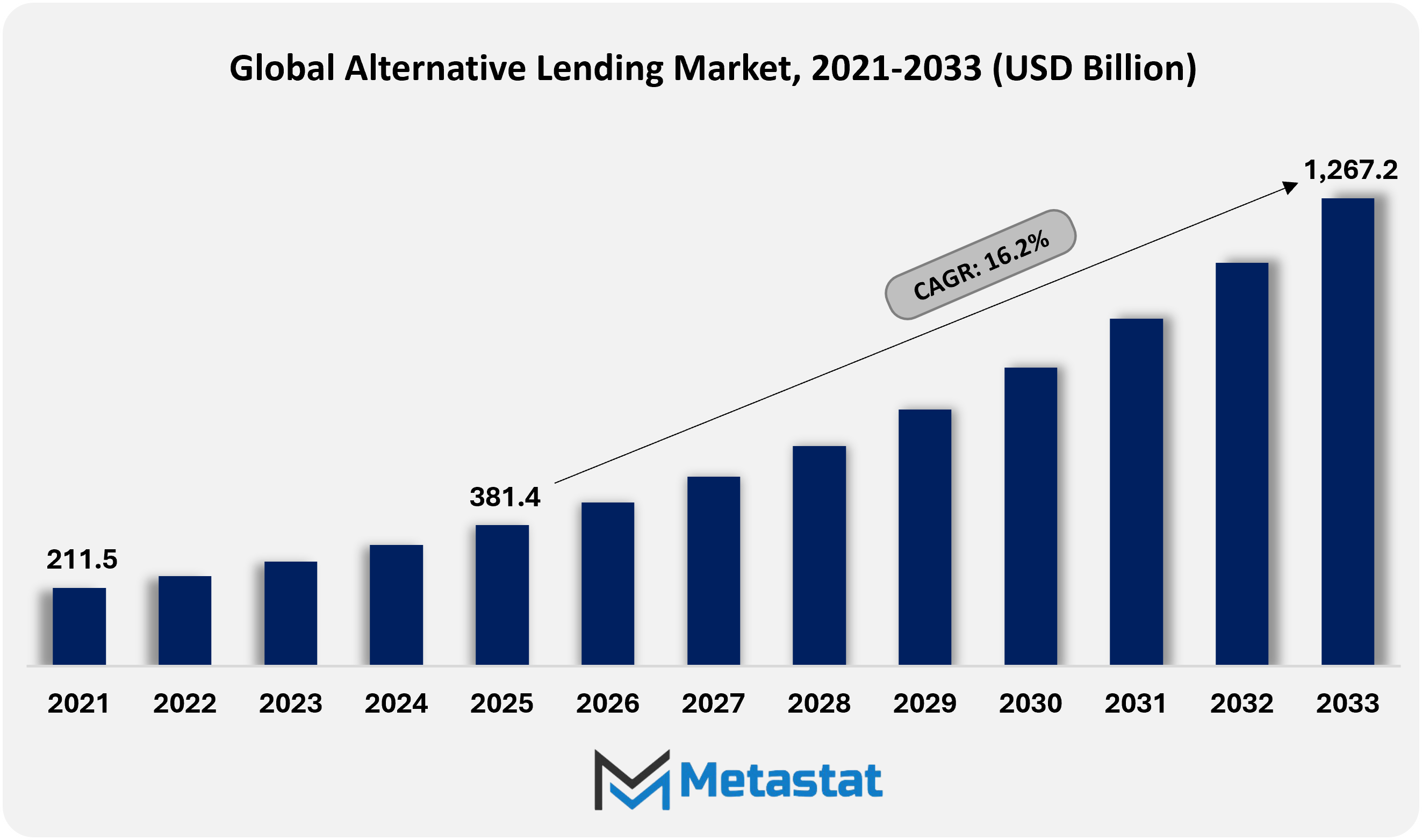
Increasing demand for quick and convenient financing solutions.
Rising preference for rapid approval cycles and simplified credit access will strengthen the Global Alternative Lending Market. Borrowers seeking minimal documentation, faster disbursement timelines, and digital onboarding will continue shifting away from conventional banking channels. Technology-enabled evaluation models will shorten turnaround time, creating efficient financing ecosystems aligned with modern borrower expectations. Accelerated urbanization, rising gig employment, and evolving business models will continue supporting demand for agile funding solutions.
Growth of digital platforms and fintech innovations
Continuous advances in artificial intelligence, machine learning, and data analytics will reshape operating models within the Global Alternative Lending Market. Automated underwriting systems, real-time credit scoring, and integrated payment infrastructure will improve risk assessment accuracy. Cloud-based platforms will enhance scalability, enabling lenders to reach broader borrower segments without extensive physical networks. Strategic collaborations between fintech companies and institutional investors will support product diversification and capital deployment efficiency.
Regulatory uncertainties in different regions
Diverse regulatory frameworks throughout jurisdictions will create compliance complexities for members within the Global Alternative Lending Market. Shifting coverage requirements, licensing necessities, and records safety mandates will require adaptive governance systems.
Higher risk of default compared to traditional lending
Elevated credit exposure associated with unsecured lending models will create risk management challenges in the Global Alternative Lending Market. Alternative credit scoring methods, while innovative, face volatility during economic downturns. Limited borrower credit history across certain segments will increase portfolio monitoring requirements. Stronger predictive analytics, diversified funding pools, and structured collection strategies will remain critical for maintaining sustainable portfolio performance.
Expansion into underbanked and emerging markets
Untapped borrower segments in growing economies will generate long-term expansion potential for the Global Alternative Lending Market. Growing phone penetration, digital identity structures, and mobile price adoption will help scalable outreach models. Microfinance integration, localized credit products, and inclusive lending frameworks will beautify monetary participation. Strategic investment in local partnerships and virtual literacy projects will release sustainable growth ability throughout rising economic corridors.
The Global Alternative Lending market is classified based on Type, Collateral Requirement, Loan Type, and End User.
Peer‑to‑Peer (P2P) Lending segment is estimated at USD 169.9 billion in 2026 and is projected to reach USD 381.3 billion by 2033, at a CAGR of 12.2% during the forecast period.
Peer-to-Peer (P2P) Lending in the Alternative Lending Market will strengthen through improved credit assessment models, digital identity verification, and automated compliance processes. Platform transparency, faster borrower screening, and broader investor participation will support efficient capital matching. Increased adoption across underserved borrower groups will reinforce the role of P2P platforms in expanding non-bank credit access.
Crowdfunding segment is estimated at USD 108.6 billion in 2026 and is projected to reach USD 285.9 billion by 2033, at a CAGR of 14.8% during the forecast period.
Crowdfunding in the Alternative Lending Market will advance through debt-based funding models, platform-led borrower evaluation, and stronger investor protection frameworks. Digital campaign management, payment integration, and transparent funding structures will improve capital access for small businesses and early-stage borrowers. Regulatory clarity and wider adoption of online funding channels will support segment expansion across emerging and developed markets.
Invoice Factoring and Financing segment is estimated at USD 84.5 billion in 2026 and is projected to reach USD 306.8 billion by 2033, at a CAGR of 20.2% during the forecast period.
Invoice Factoring and Financing in the Alternative Lending Market will benefit from real-time invoice verification, integrated accounting platforms, and faster receivables assessment systems. Automated monitoring of payment cycles will improve working capital access for businesses facing delayed collections. Broader use across supply chains and SME financing workflows will support segment expansion over the forecast period.
Merchant Cash Advance segment is estimated at USD 48.8 billion in 2026 and is projected to reach USD 190.6 billion by 2033, at a CAGR of 21.5% during the forecast period.
Merchant Cash Advance in the Alternative Lending Market will expand through tighter integration with point-of-sale systems, card settlement platforms, and revenue-based repayment models. Real-time transaction visibility will improve repayment tracking and funding efficiency for merchants with fluctuating cash flows. Rising usage among small retailers, restaurants, and service businesses will support continued segment growth.
Others segment is estimated at USD 31.1 billion in 2026 and is projected to reach USD 102.6 billion by 2033, at a CAGR of 18.6% during the forecast period.
Other financing models in the Alternative Lending Market will include microloans, revenue-based financing, and embedded credit solutions linked to digital platforms. Flexible underwriting supported by non-traditional data sources will widen borrower reach across niche and underserved segments. Platform partnerships across commerce, services, and software ecosystems will continue to support innovation in this category.
Secured Loans segment is projected to reach USD 337 billion by 2033, at a CAGR of 13.7% during the forecast period.
Secured Loans in the Alternative Lending Market will maintain relevance through asset-backed structures linked to property, inventory, equipment, and receivables. Digital documentation, faster collateral validation, and streamlined risk assessment will improve lender confidence and funding efficiency. Wider use among businesses seeking larger ticket financing will support steady segment development.
Unsecured Loans segment is projected to reach USD 930.3 billion by 2033, at a CAGR of 17.2% during the forecast period.
Unsecured Loans below Global Alternative Lending Market will rely upon behavioral analytics, alternative credit score data, and earnings forecasting structures. Machine learning credit score engines will refine borrower profiling without bodily collateral. Expansion of unsecured financing will guide financial inclusion projects across emerging economies and digitally lively populations.
Personal Loans segment is projected to reach USD 342.4 billion by 2033.
Personal Loans in the Alternative Lending Market will grow through digital onboarding, instant approval models, and flexible repayment structures suited to evolving consumer cash flow patterns. Platform-based lending will improve access for borrowers seeking quick financing for short-term needs, major purchases, and emergency expenses. Increased reliance on non-bank lenders will strengthen the segment across digitally active populations.
Business Loans segment is projected to reach USD 456.6 billion by 2033.
Business Loans in the Alternative Lending Market will expand through cash flow-based underwriting, API-linked financial data access, and faster decision-making systems. Small and medium-sized enterprises will increasingly use these platforms to secure working capital, expansion funding, and short-term liquidity support. Growing digital entrepreneurship and limited access to traditional bank credit will continue to support segment momentum.
Debt Consolidation Loans segment is projected to reach USD 128.7 billion by 2033.
Debt Consolidation Loans in the Alternative Lending Market will gain traction through structured repayment plans, personalized refinancing options, and improved borrower affordability analysis. Digital lenders will support individuals managing multiple liabilities through simplified loan comparison and quicker approval cycles. Rising consumer focus on repayment efficiency and financial restructuring will strengthen this segment.
Real Estate Loans segment is projected to reach USD 272.8 billion by 2033.
Real Estate Loans in the Alternative Lending Market will develop through faster underwriting, digital property assessment tools, and increased lender participation in non-bank property financing. Borrowers seeking flexible funding for residential, commercial, and investment assets will support broader segment adoption. Alternative platforms will play a larger role in serving borrowers that fall outside conventional mortgage criteria.
Others segment is projected to reach USD 66.7 billion by 2033.
Other loan categories in the Alternative Lending Market will include education financing, healthcare lending, and sector-specific credit solutions tailored to specialized borrower needs. Custom underwriting frameworks and digital servicing models will improve accessibility across these niche funding areas. Platform diversification will continue to support gradual expansion of this segment.
Individuals segment is projected to grow at a CAGR of 13.7% during the forecast period.
Individuals in the Alternative Lending Market will increasingly use digital lending platforms for faster access to personal credit, simplified application journeys, and flexible repayment options. Mobile-first interfaces, alternative credit evaluation, and reduced documentation requirements will improve accessibility across a broader consumer base. Continued demand for convenience-driven borrowing will support segment expansion.
Small & Medium Enterprises (SMEs) segment is projected to grow at a CAGR of 19.3% during the forecast period.
Small & Medium Enterprises (SMEs) in the Alternative Lending Market will remain a key borrower group owing to strong demand for quick working capital, invoice financing, and flexible business credit products. Digital underwriting supported by transaction history, accounting integration, and revenue visibility will improve funding access for firms with limited traditional credit support. Rising dependence on agile financing channels will sustain growth in this segment.
Large Enterprises segment is projected to grow at a CAGR of 16.3% during the forecast period.
Large Enterprises in the Alternative Lending Market will use non-bank financing platforms for specialized funding requirements, supply chain financing, and structured short-term liquidity support. Data-driven risk evaluation and faster execution will improve the attractiveness of alternative channels alongside conventional lending relationships. Broader participation from institutional capital providers will support this segment over the forecast period.
Based on geography, the Global Alternative Lending market is divided into North America, Europe, Asia-Pacific, South America, Middle East, and Africa.
North America Alternative Lending Market is set to expand at a CAGR of 16.2% within the forecast period, reaching a market size (TAM) of USD 427.7 billion by the end of 2033.
North America drives the Alternative Lending Market through strong fintech penetration, high digital adoption across consumer and SME segments, rising demand for short-term credit access, and expanding partnerships between banks and non-bank lenders.
Europe holds a significant position in the Alternative Lending Market, supported by mature fintech ecosystems, open banking adoption, regulatory modernization, and rising use of digital lending platforms across consumer and SME segments.
Asia-Pacific presents major opportunities in the Alternative Lending Market, supported by a large underbanked population, rapid expansion of mobile financial services, supportive regulatory developments, and rising investor interest in peer-to-peer and marketplace lending platforms.
Middle East, Africa, and South America contribute to the Alternative Lending Market through developing monetary inclusion projects, growing cell phone usage, and growing choice for non-conventional credit channels.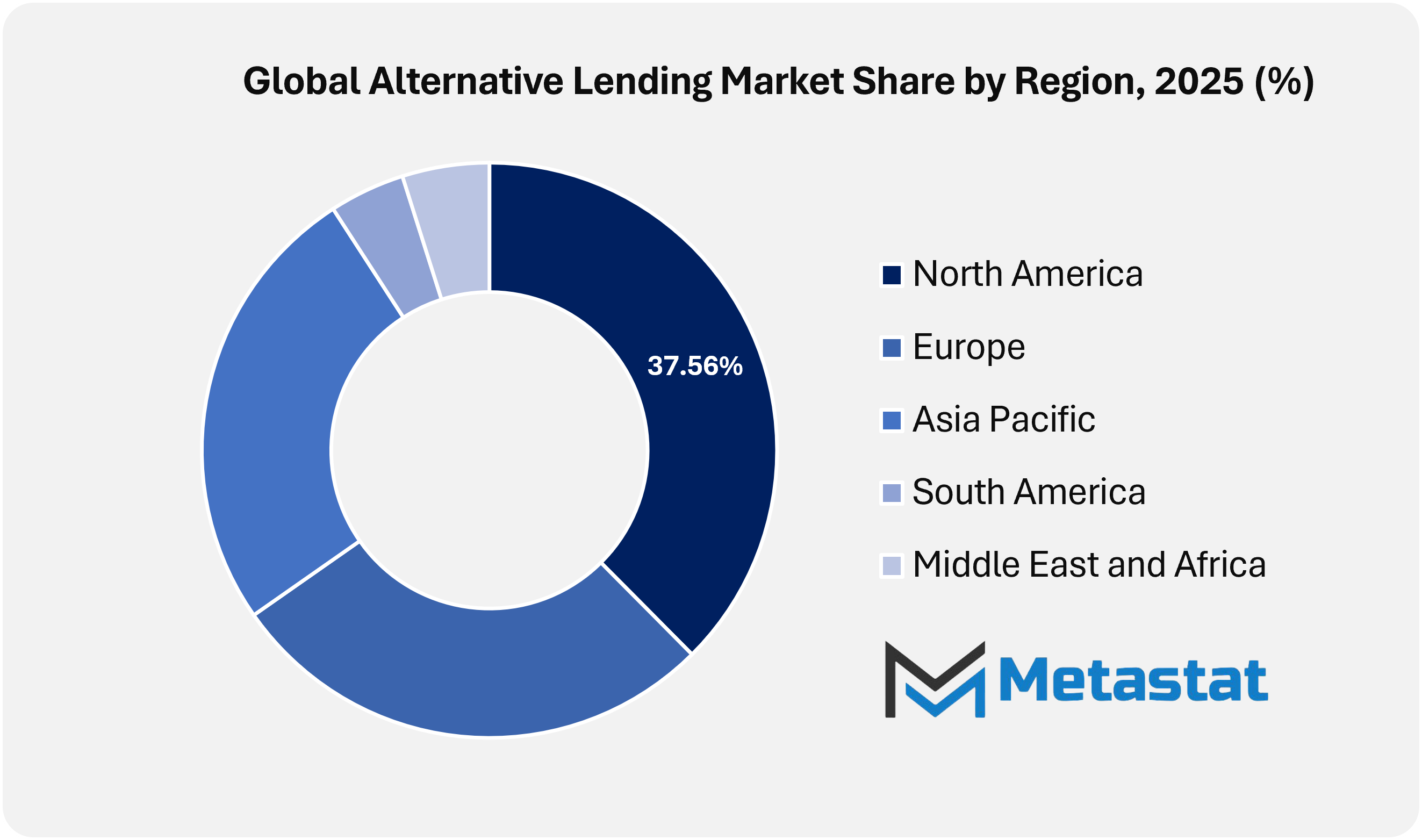
Competitive Landscape and Strategic Insights
The Global Alternative Lending Market has developed into a broad digital credit ecosystem serving consumers, small businesses, merchants, and underserved borrower groups through faster approvals, flexible underwriting, and platform-based loan distribution. Growth is being shaped by strong adoption of digital onboarding, data-led credit assessment, embedded finance integration, and expanding participation from institutional capital providers. Competitive intensity remains high as lenders differentiate through underwriting precision, distribution partnerships, product specialization, and borrower experience rather than branch-led origination models.
LendingClub Corporation, SoFi Technologies, Inc., Upstart Holdings, Inc., and Prosper Marketplace, Inc. are among the various early movers that formed peer-to-peer and online patron lending. Zopa Bank Limited and RateSetter helped popularize comparable models inside the UK, while Funding Circle and On Deck Capital, Inc. targeted strongly on small business financing. Bluevine Capital, Inc., Oportun Financial Corporation, and OppFi Inc. extended credit score access to segments that often face challenges with traditional banks. MoneyLion Inc. brought financial control gear alongside lending, developing a more integrated customer experience. Pagaya Technologies Ltd. reinforced the market through advanced analytics that support credit selections and threat management.
Buy now, pay later companies, together with Affirm Holdings, Inc. and Klarna Bank AB changed the way purchasers finance regular purchases, embedding credit score at once into checkout processes. Block, Inc. and Intuit Inc. leveraged their broader fintech ecosystems to provide lending merchandise that hook up with charge systems and accounting software. Amazon.Com, Inc. entered the gap with the aid of supporting merchants on its market, reinforcing the link between commerce and credit score. Capify, Credibly, Bond Street Servicing, LLC, and Crowd2Fund Limited addressed the funding desires of small and medium firms via tailor-made financing options. OakNorth Bank and iwoca Limited constructed strong reputations in business lending with a focus on records-led evaluation and sector information.
Nonprofit and community-driven models also play a significant role. Kiva increased access to microloans for entrepreneurs who lack formal credit histories, supporting financial inclusion across regions. The presence of such diverse participants highlights how alternative lending now spans patron finance, small business loans, factor-of-sale credit, and market investment. Competition amongst these firms will push innovation in underwriting models, patron engagement, and risk controls. As policies mature and virtual infrastructure improves, the market will possibly see deeper collaboration among fintech platforms and traditional financial establishments, shaping a more reachable and technology-driven credit score environment.
Market size is forecast to rise from USD 381.4 billion in 2025 to over USD 1,267.2 billion by 2033.
Beyond credit access, new use cases will emerge in climate change financing, intellectual property monetization, advancement of the maker economy, and token-backed infrastructure financing. These segments will expand the addressable borrower base while diversifying risk exposure across unconventional asset classes. The industry will move towards modular loan architecture capable of reaching micro-entrepreneurs, mid-market enterprises and institutional borrowers without replicating legacy banking models.
This research report categorizes the Alternative Lending market based on key segments and regions, forecasts revenue growth, and analyses trends in each submarket. The report analyses the key growth drivers, opportunities, and challenges influencing the Alternative Lending market. Recent market developments and competitive strategies such as expansion, product launch, partnership, merger, and acquisition have been included to draw the competitive landscape in the market.
The report strategically identifies and profiles the key market players and analyses their core competencies in each sub-segment of the Alternative Lending market.
|
Report Attributes |
Details |
|
Study Period |
2021-2033 |
|
Base Year |
2025 |
|
Estimated Year |
2026 |
|
Forecast Period |
2026-2033 |
|
Historical Period |
2021-2025 |
|
Growth Rate |
CAGR 16.2% from 2026 to 2033 |
|
Revenue Unit |
USD billion |
|
Segmentation |
By Type, Collateral Requirement, Loan Type, End User, and Region |
|
By Region |
North America (By Type, Collateral Requirement, Loan Type, End User, and Country)
|
|
Europe (By Type, Collateral Requirement, Loan Type, End User, and Country)
|
|
|
Asia Pacific (By Type, Collateral Requirement, Loan Type, End User, and Country)
|
|
|
South America (By Type, Collateral Requirement, Loan Type, End User, and Country)
|
|
|
Middle East and Africa (By Type, Collateral Requirement, Loan Type, End User, and Country)
|
Find answers to common questions about this report
Top players operating in the Alternative Lending industry include LendingClub Corporation, SoFi Technologies, Inc., Upstart Holdings, Inc., Prosper Marketplace, Inc., Zopa Bank Limited, and Capify.
Increasing demand for quick and convenient financing solutions and Growth of digital platforms and fintech innovations are key driving factors, boosting the market.
Regulatory uncertainties in different regions will hamper the market growth within the forecast period.
Global Alternative Lending market is estimated to reach USD 1,267.2 billion by 2033.
North America region dominates the market.
The Metastat Insights study shows that the Global Alternative Lending market size was USD 381.4 billion in 2025.
The Metastat Insights analysis shows that the North America Alternative Lending market size is estimated to be USD 427.7 billion by 2033.
The Peer‑to‑Peer (P2P) Lending is the leading type segment in the Global market.
The Global Alternative Lending market is expected to grow at a CAGR of 16.2% over the forecast period (2026-2033).
The analysts below cover Banking & Finance research at Metastat Insights.
LEAD ANALYST
Utkarsh Khirodkar is a Lead Market Research Analyst at MetaStat Insight, specializing in market intelligence, technology sector assessments, and competitive strategy.

PRINCIPAL CONSULTANT - ENTERPRISE AI & EMERGING TECHNOLOGIES
Banking & Finance · Electronics and Semiconductor · Energy and Power · Healthcare IT · Information & Technology · Professional Services
Vijay Gunti is a Principal Consultant at MetaStat Insight, bringing over two decades of experience across enterprise digital transformation, technology strategy, and intelligent systems.
Most industry reports on warehouse automation bundle autonomous mobile robots and fixed conveyor installations into the same top-level numbers, which complicates advisory work. This study split the market cleanly by payload tiers, navigation technology, and fleet management software layers. The regional forecast for Western Europe gave our team defensible adoption benchmarks when evaluating capital allocation for logistics clients, saving us days of secondary data scrubbing.
Analyzing the transition from natural gas to green hydrogen in iron ore reduction requires realistic infrastructure timelines. Meta stat insight supplied a detailed regional assessment of DRI plant conversion costs and scrap metal availability in North America and Western Europe. Their report carefully examined pellet quality specs and electrical grid access constraints without making oversimplified market assumptions. The research material served as a practical reference during internal technology roadmap discussions.
Integrating zero-trust access controls across legacy electronic health record systems involves complex compliance overhead. Team produced an analysis that clearly separated identity governance and administration tools from privileged access management platforms. Their evaluation of HIPAA and GDPR compliance features across cloud native solutions gave our architecture group clear baseline criteria. The custom data request regarding biometric authentication adoption in hospital networks was returned promptly with clear documentation.
Explore related market intelligence reports worth reading alongside this one.