
LEAD ANALYST
Utkarsh Khirodkar is a Lead Market Research Analyst at MetaStat Insight, specializing in market intelligence, technology sector assessments, and competitive strategy.

Global Revenue Management Market Size, Share, By Solutions (Risk Management, Price & Revenue Forecast Management, Revenue Analytics, Revenue Leakage Detection, and Channel Revenue Management), By Services (Managed Services and Professional Services), By Deployment (Cloud-based and On-premise), By Industry (IT & Telecom, Travel and Tourism, Hospitality, Retail and E-commerce, Healthcare, Insurance, Banking, Media & Entertainment, and Others), Industry Analysis, Growth, Trends, and Forecast, 2026-2033
Report ID
MSI-5436
Published
October, 2026
Pages
267 Pages
Format
Historical
Base year
Forecast
Forecast period
Report Details
Market Valuation: Valued at $796.7 Million in 2025, projected to reach $1,497 Million by 2033 at a 8.2% CAGR.
Dominant Segment: Risk Management leads the market, driven by strong demand from IT & Telecom enterprises for tools that identify and mitigate revenue vulnerabilities in complex billing environments.
Geographic Lead: North America holds 100.0% of the market in 2025, supported by early adoption of advanced solutions and the presence of major providers focused on configurable, enterprise-scale products.
Deployment Trend: Cloud-based deployment is the strongest pocket of growth, appealing to IT & Telecom buyers seeking scalability, rapid implementation, and recurring revenue models.
What's Inside: The report provides detailed segmentation by solutions, services, deployment, and industry, with competitive analysis, market dynamics, and forecasts through 2033.
Choose Your License
Global Revenue Management Market
The global Revenue Management market was valued at USD 796.7 million in 2025 and is projected to reach USD 1,497 million by 2033, growing at a CAGR of 8.2% over the forecast period.
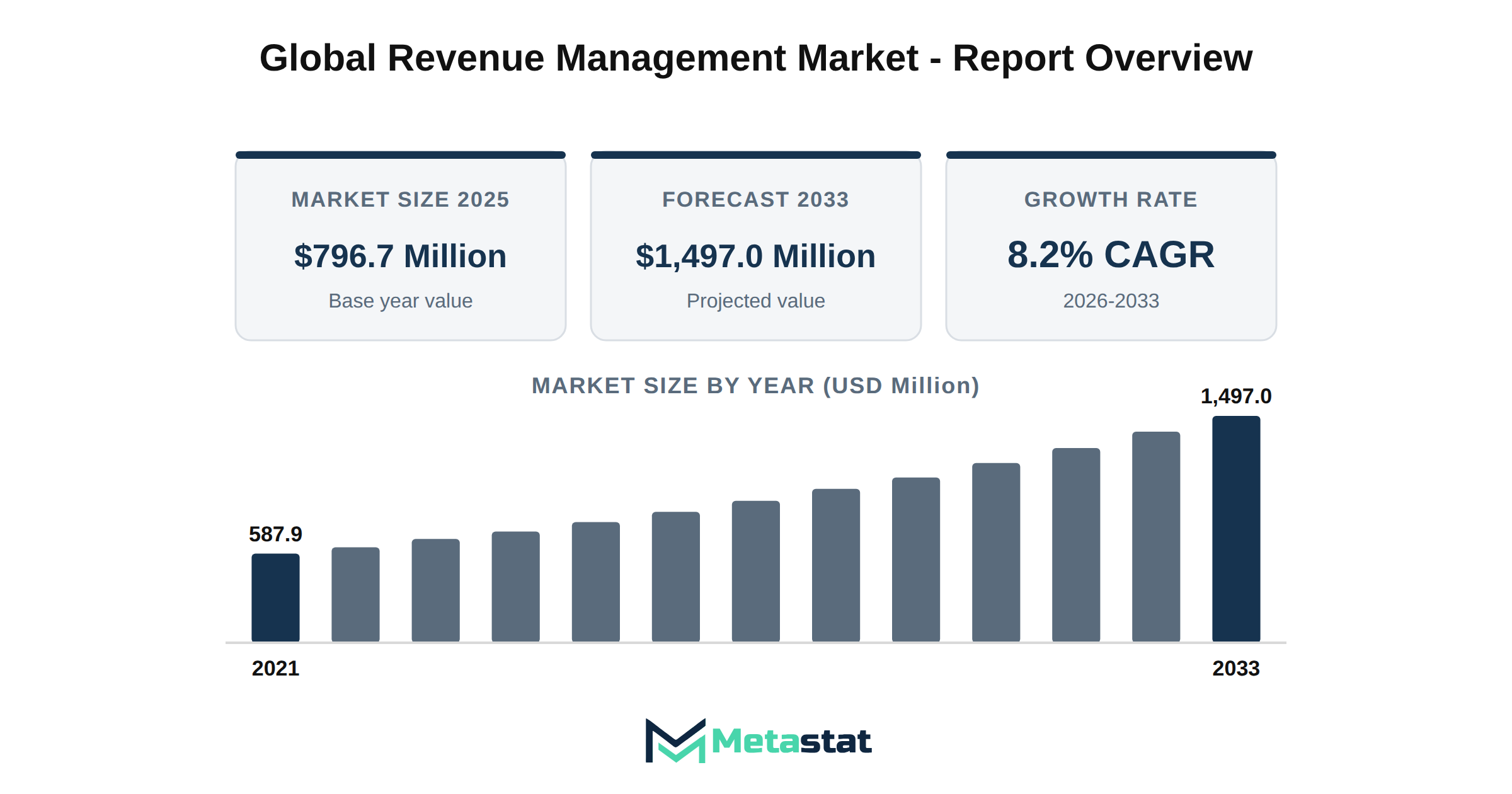
The Revenue Management market covers software and services that enable organizations to optimize pricing, forecasting, and financial outcomes across sectors. Buyers invest in these solutions to improve profitability, manage risk, and respond swiftly to market shifts. Enterprise buyers in IT & Telecom, hospitality, and retail are among the most significant adopters, seeking to replace manual or legacy systems with scalable, data-driven platforms. These platforms deliver dynamic pricing, real-time analytics, and automation that reduce revenue leakage and enhance strategic decision-making. Manual processes are replaced, and decision cycles shorten.
Growth in the Revenue Management market is driven primarily by the widespread adoption of cloud-based deployment models. Cloud-based solutions deliver rapid scalability and lower upfront investment compared to on-premise alternatives, attracting organizations undergoing digital transformation. Large enterprises aiming for global reach and continuous operational improvements have accelerated this shift. Integration with advanced analytics and AI further accelerates uptake, with buyers pursuing greater forecasting accuracy and competitive advantage. The combination of scalability and data-driven insight reshapes the value proposition for enterprise buyers.
Among solution types, Risk Management generates the most value, reflecting sustained demand for tools that identify and mitigate revenue vulnerabilities. In financial verticals, these practices intersect closely with specialized insurance analytics that quantify underwriting exposure and claims leakage. North America holds 100.0% of the market in 2025, with the US leading in 2026. Suppliers including Oracle Corporation, SAP SE, Infor Inc., Accenture, Salesforce, Zuora, Pricefx AG, and Model N, Inc. focus on developing configurable products for enterprise-scale implementation, supporting the region’s dominance in adoption and revenue generation.
Demand for revenue management solutions intensifies while organizations seek to improve profitability, streamline billing, and reduce revenue leakage across complex operations. Buyers invest in these platforms to gain real-time insights, automate pricing decisions, and ensure compliance with evolving business models. The market primarily attracts large enterprises in sectors with high transaction volumes, including IT and Telecom, hospitality, and travel, where precision in financial management directly influences margins.
Risk Management stands out, driven by its critical role in identifying, assessing, and mitigating financial risks. Organizations prioritize this functionality to prevent losses and respond rapidly to market fluctuations. Cloud-based deployment dominates, offering scalability and faster implementation for enterprises adapting to digital transformation. Early adoption of advanced solutions and a concentration of major providers distinguish North America in this sector.
The primary growth driver for the Revenue Management market is the rising demand for integrated, analytics-driven platforms that enable accurate forecasting and agile financial decision-making. Enterprises shift from legacy systems to advanced solutions that support dynamic pricing and personalized offers. This transition is particularly pronounced among IT and Telecom buyers, who require continuous adaptation to changing service models and customer expectations.
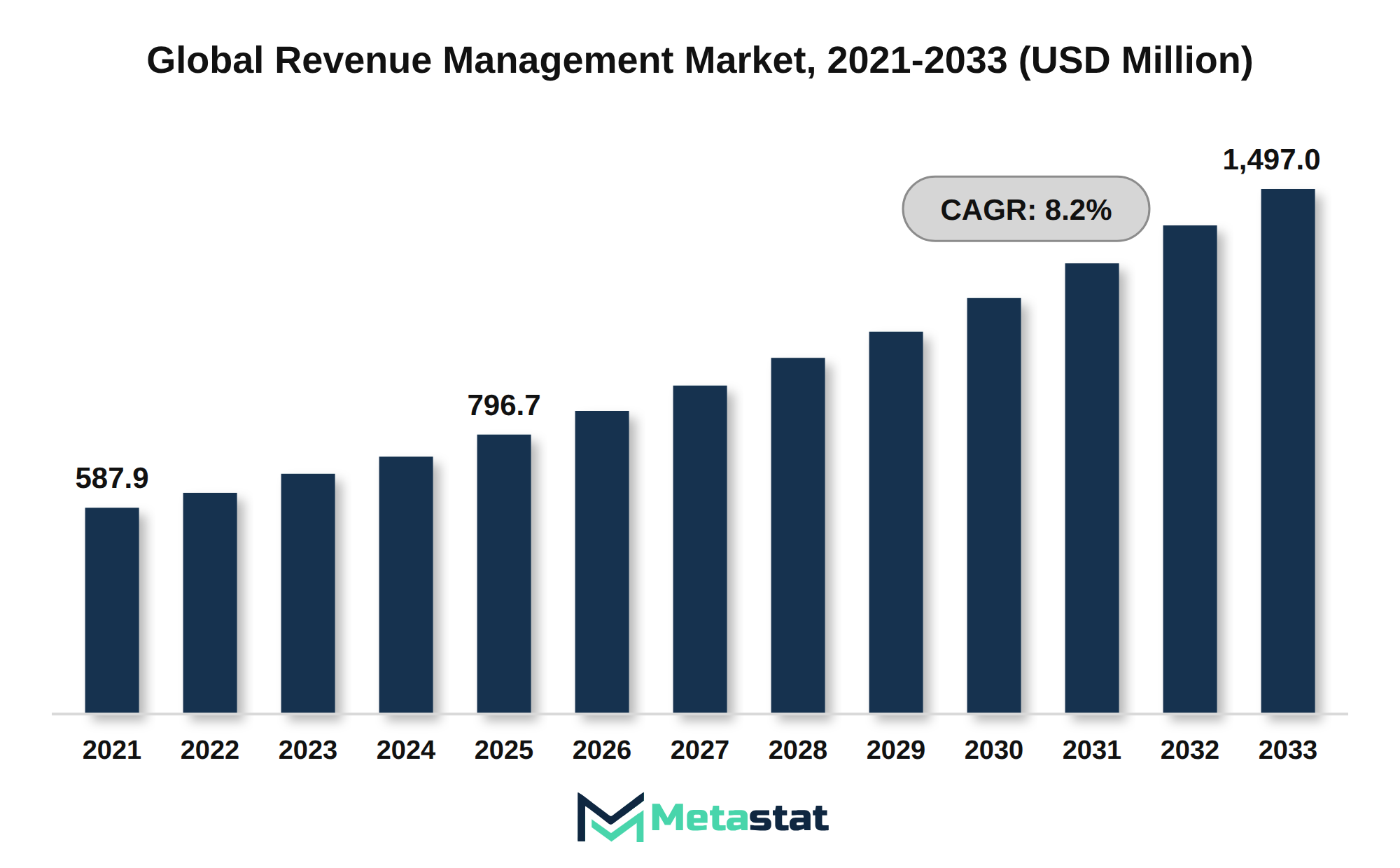
Enterprises across IT and telecom are shifting from static yield tactics toward autonomous dynamic pricing and elasticity modeling. This transition is driven by the growing requirement for real-time data analysis and the ability to adapt pricing strategies instantly in response to fluctuating demand and competitive behavior. In the IT and telecom segment, which is projected to reach USD 1,497 million by 2033, advanced algorithms now process large volumes of transactional and behavioral data to recommend or execute price changes automatically. These systems integrate with core operational platforms, ensuring alignment between forecast demand, inventory, and revenue targets without manual intervention.
Traditional yield management relied on periodic, rule-based price adjustments, often lagging behind market shifts. Autonomous dynamic pricing leverages machine learning and predictive analytics to continuously model demand elasticity, allowing providers to capture incremental revenue by identifying price points that maximize conversion while protecting margins. Organizations adopting these tools experience improved forecast accuracy, higher resource utilization, and reduced revenue leakage. Suppliers focusing on dynamic pricing solutions report stronger customer retention and longer contract values, reflecting buyer preference for adaptive, intelligence-driven revenue optimization. This technology-driven evolution is reshaping procurement criteria and creating a competitive advantage for solution providers with advanced modeling capabilities.
Enterprise adoption patterns in the Revenue Management market are shifting rapidly with subscription-based pricing models gaining traction across B2B sectors. Buyers in IT and Telecom, representing the leading industry segment, increasingly prioritize modular platforms that support flexible contract terms and recurring revenue streams. This shift reflects the demand for scalable solutions that align with evolving business models, particularly where multi-service offerings and complex pricing structures require ongoing adaptation. Traditional upfront licensing models are being replaced by usage-based and tiered subscription arrangements, which lower barriers to entry and optimize spend for buyers facing unpredictable demand cycles.
Within the Revenue Management market, cloud-based deployment has become the dominant approach, underlined by the segment’s projected rise from USD 864.3 million in 2026 to USD 1,497 million in 2033. This transition directly supports subscription-led procurement, enabling enterprises to select only the capabilities they require and expanding access to continuous upgrades and integration. Vendors including Oracle Corporation, SAP SE, Zuora, Inc., Pricefx AG, and Vendavo, Inc. have responded by offering highly modular, API-driven platforms that streamline onboarding and contract management. The commercial consequence is a broader enterprise customer base, higher customer retention rates, and a more predictable revenue profile for both buyers and suppliers, all of which reinforce the long-term growth trajectory for modular, subscription-enabled platforms in the market.
Enterprises in sectors including IT & Telecom along with omnichannel merchants engaging retail marketing consulting services increasingly seek to synchronize algorithmic pricing engines with cloud billing, configure-price-quote (CPQ), and ERP stacks to achieve real-time pricing accuracy and process automation. These organizations manage complex product portfolios and dynamic price structures, which introduces significant operational challenges when data remains siloed across different systems. The market responds to this pain point by enabling integration of pricing algorithms directly with cloud-based billing and transactional workflows, rather than relying on manual reconciliation or isolated spreadsheets. Aligning algorithmic pricing with cloud billing and ERP systems streamlines critical processes including automated discounting, revenue recognition, and dynamic contract management. Synchronizing these customer-facing billing workflows with accounts payable automation ensures end-to-end reconciliation across the entire financial ledger. In the IT & Telecom segment, which holds the leading position in the segment breakdown and is projected to reach USD 1,497 million by 2033, such architectural convergence supports high-frequency pricing adjustments and ensures compliance with evolving commercial terms.
For buyers, this integration reduces revenue leakage, accelerates quote-to-cash cycles, and supports agile go-to-market strategies. Maintaining low latency across these distributed cloud stacks requires resilient enterprise networking to carry real-time transactional data securely between platforms. Commercial teams gain the ability to apply real-time data insights from solutions directly into sales and billing processes, eliminating data lags and manual errors. Enterprises increase margin capture and strengthen governance over complex billing environments. Vendors increasingly differentiate by offering open APIs and pre-built connectors that facilitate alignment between pricing engines, CPQ modules, and ERP platforms, addressing a top requirement among large buyers managing multi-channel, multi-product portfolios.
Enterprise leaders quantifying return on investment from migrating to AI-driven revenue management systems are focusing on measurable improvements in decision accuracy, operational efficiency, and financial outcomes. Maintaining these mission-critical platforms against unexpected operational disruptions also drives investment in business continuity management software to safeguard systemic resilience. The shift to AI-driven solutions stems from performance gaps in legacy models, which often depended on manual data analysis and were slower to adapt to dynamic market environments. This spending reflects strong buyer confidence that AI-driven platforms enable faster, more granular forecasting and pricing, which translates to gains in realized revenue and reduced leakage.
IT and telecom enterprises, the top industry segment, have driven adoption due to their complex revenue streams and the necessity for real-time optimization. These organizations track ROI through metrics including increased yield per customer, improved forecast accuracy, and reduction in revenue loss events. Quantitative benchmarks include shortened revenue cycles and improved compliance with contractual terms. For decision-makers, proof of ROI often comes from pilot implementations that demonstrate efficiency gains and measurable improvements in revenue capture within months of deployment. This evidence-driven approach is reinforcing demand for AI-driven revenue management systems and is shaping procurement preferences in the market.
Telecommunications operators are investing in advanced risk management solutions to address the complexity of digital service offerings, real-time billing, and evolving fraud schemes. Higher demand is driven by telecoms seeking to improve revenue assurance and reduce exposure to leakages tied to rapid service innovation. Digitalization involves integrating risk analytics and automated controls into revenue workflows, which supports both compliance requirements and operational resilience. The shift from legacy manual checks to automated risk management enables providers to accelerate product launches while maintaining confidence in their revenue streams.
Telecom buyers are now prioritizing platforms that deliver end-to-end visibility across distributed systems, supporting detection and mitigation of new revenue risks. This trend is especially pronounced among large IT and Telecom enterprises, which drive the highest segment value in the Revenue Management market, forecast to reach USD 1,497 million by 2033. Suppliers that offer scalable, cloud-based risk management modules with real-time analytics are positioned to capture this demand, supporting both growth in volume and a willingness to invest in premium capabilities.
High upfront investment and integration costs present a significant barrier for mid-sized enterprises considering advanced solutions in this market. These buyers often operate with legacy financial systems that lack compatibility with newer cloud-based or AI-driven platforms. Implementation typically requires substantial IT resources and dedicated staff training, which stretches budgets and disrupts existing workflows. The result is a slower adoption curve among organizations outside the largest IT & Telecom groups, delaying technology refresh cycles and leading to smaller initial contracts for vendors. Budget-conscious enterprises postpone upgrades or restrict deployments to pilot phases while evaluating return on investment, which limits overall volume growth.
Rising adoption of bundled pricing models intensifies margin pressure for suppliers in the Revenue Management market. Enterprises in IT & Telecom and related sectors now demand integrated solutions that support complex bundles of products, services, and digital offerings under unified contracts. This shift compresses margins for vendors, who absorb additional development costs to enable cross-product analytics and dynamic discounting features. Suppliers report that clients expect customized reporting, granular profit visibility, and real-time adjustment of bundle components without additional licensing fees, which erodes traditional revenue streams. In response, vendors in the Revenue Management market are investing in configurable platforms, advanced analytics, and modular service offerings to support these bundled agreements while protecting profitability. Suppliers compete on their ability to deliver flexible configuration, rapid deployment, and scalable support for frequently changing product mixes. This approach lets them retain key enterprise accounts and stabilize recurring revenue, even though per-deal profit margins tighten.
Cloud-based deployment is emerging the strongest pocket of growth, driven by buyers in IT & Telecom and related industries shifting toward flexible, scalable platforms. Segment data shows the Cloud-based category is projected to expand from USD 864.3 million in 2026 to USD 1,497 million by 2033, delivering a CAGR of 8.2% and outpacing on-premise alternatives. This shift supports recurring revenue models and enables rapid feature updates, which attracts enterprises aiming to accelerate monetization cycles and reduce lifecycle costs. Providers responding to this trend offer modular, subscription-based delivery models that streamline integration with existing billing and analytics infrastructure. Suppliers focused on cloud-native solutions gain access to extended contract durations and increased customer retention, particularly among digital-first organizations and telco service providers.
The Global Revenue Management market is segmented based on Solutions, Services, Deployment, and Industry.
This segment centers on identifying, assessing, and mitigating revenue risks, including fraud, leakage, and compliance failures, for enterprises managing complex billing environments. Major buyers include IT and telecom firms with high volumes of transactional data and exposure to regulatory scrutiny. Demand in this segment is driven by the growing scale of digital transactions and an increased focus on protecting revenue streams against sophisticated fraud tactics. Compared to other solution segments in the market, Risk Management sees higher adoption among organizations prioritizing operational resilience and regulatory compliance. The segment’s growth trajectory is shaped by strengthened digital infrastructure and the requirement to safeguard financial outcomes in sectors undergoing rapid transformation. Vendors addressing this segment focus on real-time analytics, advanced anomaly detection, and fraud prevention tailored to the unique risk profiles of large enterprises.
Price & Revenue Forecast Management enables organizations to anticipate market demand, optimize price points, and forecast revenue outcomes by leveraging advanced analytics and predictive modeling. Buyers in IT & Telecom, retail, and travel and tourism rely on these systems to identify demand patterns, respond quickly to external shocks, and fine-tune strategies in highly competitive environments. Decision-makers prioritize solutions that integrate seamlessly with their existing billing and ERP infrastructure, supporting greater automation and improved forecast accuracy. Adoption in this segment is driven by the growing complexity of multi-channel pricing and the pressure to reduce revenue volatility. Compared with risk management and revenue leakage detection, this segment addresses forward-looking, optimization-focused use cases, appealing to commercial, finance, and pricing teams rather than fraud or compliance units. While industry-wide adoption continues, variation in data quality and system interoperability slows uptake for buyers with legacy IT stacks, shaping how quickly benefits from predictive revenue management materialize. Vendors in the segment differentiate through real-time data integration and AI-driven recommendations, supporting higher-value outcomes for enterprises adapting to shifting consumer behavior and revenue models.
Revenue Analytics segment is expected to reach USD 0 million by 2033. This segment delivers tools and dashboards that help organizations identify revenue patterns, forecast trends, and pinpoint leakage through advanced analytics. Adoption concentrates in buyer groups with high transaction volumes and complex pricing structures, particularly large enterprises in industries prioritizing real-time financial visibility and granularity in revenue breakdowns. Unlike Risk Management, which holds a projected total segment value of USD 1,497 million by 2033 and stands out for its focus on fraud, compliance, and exposure reduction, Revenue Analytics differentiates itself by enabling strategic decision-making and targeted revenue optimization. In the market, this segment faces slower growth relative to Risk Management, indicated by the absence of a dedicated CAGR or forecast value in the available data, reflecting limited or niche adoption. Product innovation and integration with artificial intelligence have propelled value for users interested in predictive modeling, yet pricing pressure persists when compared to broader, compliance-focused solutions in the market. Vendors continue to refine analytics capabilities to address evolving demands from finance, telecom, and digital commerce buyers.
Revenue Leakage Detection addresses the challenge of identifying and minimizing hidden or unintentional losses in billing, pricing, or contract management. Organizations in industries with complex transactions, including IT & Telecom, banking, and healthcare, deploy these solutions to ensure all entitled revenues are captured and to reduce financial exposure. In the market, demand for this segment is shaped by the increasing scale and complexity of digital service offerings and growing regulatory requirements for auditability and compliance. Large enterprises and regulated sectors often prioritize revenue leakage detection due to stricter oversight and higher transaction volume, distinguishing this segment from areas like Risk Management, which focuses on fraud and credit risk. Adoption of specialized detection technologies often requires integration with multiple internal systems, introducing challenges around data silos and interoperability. The segment stands out in the market for its direct impact on cash flow integrity, especially where recurring billing or bundled services create additional risk of missed or delayed revenue collection.
Channel Revenue Management centers on optimizing and controlling revenue streams across multiple distribution partners, platforms, and third-party resellers. Leading buyers include global hospitality groups, telecom operators, and retail chains with complex multi-channel sales structures. The segment attracts investment from organizations seeking to minimize channel conflicts, improve discount governance, and ensure revenue recognition compliance across diverse distribution agreements. The increasing volume of indirect sales and the expansion of third-party platforms drives demand, as these trends raise the risk of price erosion and margin dilution if channel activity is not effectively monitored. Channel Revenue Management differs from adjacent solution segments by focusing on policy enforcement and reconciliation between direct and indirect sales, rather than on predictive analytics or risk mitigation. Buyers in this segment frequently require integration with distributor or partner portals, demanding interoperability that sets the market apart from traditional, single-channel revenue optimization tools. This results in a preference for modular, API-driven solutions, with companies prioritizing flexibility to adapt to new channel arrangements and evolving partner networks.
This segment is adopted by enterprises seeking to outsource complex revenue management functions, particularly in IT & Telecom, Travel and Tourism, and Healthcare. Providers in the Managed Services segment deliver ongoing monitoring, optimization, and compliance support, appealing to organizations looking for specialized expertise without building teams in-house. Regulatory compliance requirements and pricing complexity are accelerating, prompting buyers to prioritize continuous operations and risk mitigation and driving demand for Managed Services. Compared to Professional Services, which focus on project-based implementation or advisory tasks, Managed Services commands recurring revenue streams and deeper customer integration. Enterprises selecting Managed Services reduce operational burden, access the latest technology through service partners, and address evolving revenue assurance challenges. The shift toward subscription and SaaS delivery further strengthens the appeal of Managed Services, attracting large enterprises with multi-region operations and stringent operational requirements.
Professional Services segment is expected to reach USD 0 million by 2033. This segment covers consulting, integration, and optimization services delivered to enterprises seeking to tailor Revenue Management market solutions to unique operational requirements. Buyers in IT & Telecom, travel, and retail frequently engage Professional Services when standard configurations do not align with existing business processes or when regulatory complexities introduce integration hurdles. While Managed Services in the Revenue Management market show strong recurring revenue profiles and predictable support, Professional Services tend to involve project-based contracts with variable scope and pricing. Demand for this segment often rises in response to system upgrades or digital transformation programs, especially where internal expertise is limited. A primary adoption barrier remains the high cost of specialized consulting, which often restricts uptake to large enterprises or those facing compliance mandates. Professional Services differ from Managed Services by focusing on solution design and implementation rather than ongoing operational support or system management.
Buyers in IT & Telecom and digital commerce sectors prioritize cloud-based solutions for their scalability, rapid implementation, and cost optimization compared with on-premise systems. The cloud-based segment is used to centralize pricing, revenue forecasting, and billing data, supporting real-time analytics and cross-region deployment for organizations with distributed operations. Flexible subscription pricing and integration ease with SaaS stacks in the Revenue Management market have accelerated demand, particularly where business models require agility in rate adjustment and product bundling. Compared with on-premise deployments, cloud-based adoption reduces capital expenditure and shortens deployment cycles. The segment’s appeal rises further with increasing digitalization in telecom, retail, and insurance, driven by businesses shifting toward operational models that depend on continuous access to real-time revenue intelligence and updates.
On-premise deployment is expected to reach USD 0 million by 2033. This segment is selected by enterprises that prioritize complete control over data, customization, and security, often in industries with stringent regulatory requirements or legacy infrastructure. Buyers include financial institutions, healthcare providers, and government agencies, where internal IT teams maintain proprietary systems to meet internal compliance or operational policies. While cloud-based solutions deliver flexibility and lower upfront costs, on-premise options incur higher ownership expenses and longer implementation cycles. This cost disadvantage, combined with increased demand for SaaS solutions, restricts adoption and results in a zero-value forecast for this segment. The shift toward scalable and easily upgradable cloud offerings diverts investment away from traditional on-premise deployments, with competitive pricing and reduced infrastructure burdens providing additional incentives for buyers to transition away from legacy platforms.
This segment is driven by large telecommunications providers and enterprise IT firms seeking to optimize recurring revenue streams and manage complex subscriber billing across converged digital and connectivity services. Buyers in this segment adopt advanced platforms to handle high transaction volumes, dynamic pricing, and strict regulatory compliance. Rapid digitization and deployment of 5G infrastructure are accelerating adoption of cloud-native solutions, giving IT & Telecom the highest absolute spend among all industries in the market. Compared to industries including Hospitality or Retail, IT & Telecom buyers focus on scalability and real-time analytics to gain competitive advantage. Investment in this segment reflects not only the size of the telecom sector but ongoing pressure to reduce fraud, minimize revenue leakage and respond faster to changing service models. The market benefits from this shift toward automated, data-driven decisioning in IT & Telecom.
Travel and tourism enterprises implement advanced revenue management solutions to respond to fluctuating demand, seasonality, and dynamic pricing pressures. Airlines, hotel chains, and tour operators in this segment apply real-time analytics and forecasting to optimize inventory, pricing, and distribution strategies. Digitalization of booking channels and the proliferation of online travel agencies have driven operators in travel and tourism to prioritize automated, scalable systems that enable personalized pricing and rapid response to market shifts. This segment differs from others in the market by its reliance on guest behavior analytics and flexible inventory controls, rather than static contract management or regulatory-driven billing. Buyers in travel and tourism select solutions based on the ability to integrate with reservation platforms and facilitate competitive pricing aligned with shifting consumer preferences. The experience-driven nature of the industry, along with persistent volatility in demand patterns, sets this segment apart and continues to steer solution development toward responsive, cloud-enabled platforms.
Hotel groups, resorts, and accommodation providers use revenue management systems to adjust rates dynamically, maximize occupancy, and improve yield across seasonal and event-driven demand cycles. Buyers in this segment focus on capturing fluctuating guest demand, especially during peak travel periods and local events, where small shifts in pricing strategies deliver outsized impact on top-line performance. Compared to IT & Telecom, where solution procurement aligns with technology refresh cycles and operational billing complexity, hospitality buyers prioritize integrations with booking engines and channel managers central to their operations. Suppliers operating in the market adapt their platforms for hospitality by offering modules tailored to address inventory perishability, direct distribution incentives, and high frequency of last-minute bookings. Despite strong interest in automation, adoption in hospitality often requires careful change management due to legacy processes and the diversity of property management systems in use. Vendors serving hospitality differentiate through flexible deployment models and responsive support for local revenue teams.
Retail and e-commerce enterprises deploy automated pricing tools and demand-sensing analytics to capture rapid shifts in shopper behavior and inventory cycles. Merchants and online platforms adopt these solutions to respond to flash sales, seasonal demand, and competitive price changes in real time. In the market, the retail and e-commerce segment is influenced by the adoption of AI-based pricing engines that track clickstream data, enabling dynamic price updates and personalized promotions. This level of automation distinguishes retail and e-commerce from segments like healthcare or insurance, where purchasing cycles are longer and service pricing less volatile. Regulatory scrutiny over fair pricing and consumer protection shapes solution design, with providers integrating compliance features to address transparency requirements. Expansion in retail and e-commerce is further supported by competitive differentiation among vendors, who integrate omnichannel capabilities and advanced analytics to drive higher conversion rates. Retail and e-commerce buyers prioritize speed and accuracy to maintain margin and customer loyalty in a highly transparent environment.
Healthcare organizations rely on the Revenue Management market to streamline billing, claims, and reimbursement processes while maximizing collections and compliance. Hospitals, clinics, and multi-specialty networks adopt these solutions to address complexities created by insurance contracts, regulatory mandates, and evolving payer mixes. Rising regulatory scrutiny drives demand for automated systems that minimize claim denials and reduce compliance risk, especially in regions where healthcare reimbursement rules shift frequently. Unlike retail and e-commerce buyers who target dynamic price adjustments and inventory optimization, healthcare decision-makers prioritize accuracy, audit trails, and integration with electronic health record systems. This focus on cost containment and compliance differentiates healthcare in the Revenue Management market, leading to unique requirements compared to industries including banking or media, where revenue cycles follow different triggers and regulatory environments. Industry-specific challenges - including fragmented billing channels and dense payer ecosystems - require tailored features not sought by most other segments in the Revenue Management market.
Insurers deploy advanced revenue management systems to improve premium pricing accuracy, support risk selection, and address regulatory compliance in a sector characterized by complex policy structures and frequent claims processing. Buyers in this segment include property and casualty insurers, health insurance providers, and reinsurance companies seeking to automate billing, streamline revenue recognition, and minimize leakage from manual reconciliation. In insurance, demand rises with tightening regulatory mandates and accelerating digital transformation, prompting a shift toward integrated data analytics and real-time reporting capabilities. Compared to industries like IT & Telecom, which prioritize scalability and speed, insurance buyers emphasize transparency, auditability, and integration with legacy core administration platforms. Adoption barriers for this segment include extensive regulatory oversight and the challenge of harmonizing disparate legacy systems with new digital tools. Suppliers in the market adapt their offerings to meet sector-specific compliance requirements and support integration with existing insurance platforms, supporting growth across insurance portfolios. Insurance providers increasingly seek solutions that increase operational efficiency and ensure revenue accuracy.
Commercial banks, investment banks, and digital banking platforms adopt revenue management solutions to enhance profitability and maintain compliance amid shifting regulatory expectations. This segment addresses highly regulated environments where accurate fee calculation, real-time transaction tracking, and margin optimization are critical for both operational efficiency and customer transparency. Rising pressure to optimize interest margins drives financial institutions to integrate advanced analytics and automation tools, particularly for loan portfolios, payment services, and wealth management products. Compared to other industry segments, banking faces complex regulatory scrutiny, which shapes demand for configurable and auditable solutions that stand out from less regulated sectors including media or entertainment. Digital transformation in banking accelerates the uptake of cloud-native revenue management platforms, enabling rapid adaptation to new product offerings, evolving risk profiles, and expanding payment channels. By focusing on precise reporting and risk-adjusted pricing, the banking segment demonstrates unique requirements that influence supplier strategies and technology investment across this segment.
Streaming platforms, film studios, and broadcasters use revenue management tools to adjust pricing models in response to audience shifts, advertising trends, and content distribution arrangements. In the media and entertainment segment, demand is driven by the transition to digital consumption models and the proliferation of direct-to-consumer services. Enterprises in this sector prioritize granular revenue tracking and billing automation to address growing complexity in licensing, syndication, and multi-platform rights management. Compared to other industries in the market, media and entertainment buyers focus more on dynamic pricing for content bundles and event-based revenue spikes rather than steady, recurring billing cycles. Regulatory scrutiny over advertising disclosures and digital royalties introduces adoption barriers, particularly where rights management systems require integration across multiple jurisdictions. The segment's requirements for real-time analytics and flexible pricing engines set it apart in technology preferences, with buyers seeking to optimize both audience engagement and monetization opportunities across digital and traditional channels. Solutions are tailored to the scale and volatility of media revenue streams in this industry.
Industries that fall outside the principal categories - including media production, logistics, utilities, and education - rely on specialized applications of the Revenue Management market to address their distinct revenue processes and compliance standards. Organizations in these sectors pursue tailored solutions to manage highly variable billing cycles, licensing fee structures, or grant-based funding models that differ from those in IT, telecom, or healthcare. The diversity of revenue sources and regulatory obligations drives this segment, requiring configurable systems and flexible integration with existing platforms. Compared to segments with higher transaction volumes or standardized processes, the “Others” segment often faces longer adoption cycles and unique customization costs. Vendors in the Revenue Management market supply modular platforms or vertical extensions to meet these requirements, supporting organizations that seek to optimize disparate income streams while maintaining auditability and transparency across non-traditional revenue channels.
Based on geography, the Global Revenue Management market is divided into North America, Europe, Asia-Pacific, South America, Middle East, and Africa.
Enterprises in the United States, Canada, and Mexico drive high adoption of advanced pricing and revenue optimization technologies, reflecting a region-wide focus on digital transformation and analytics-driven decision-making. Technology, telecommunications, and financial service providers in North America invest steadily in next-generation revenue management platforms, aiming to enhance operational efficiency and boost margin performance. Regulatory environments in these countries encourage transparent pricing and real-time compliance, prompting organizations to seek systems supporting granular audit trails and reporting. The Revenue Management market in North America is projected to reach USD 1,497 million by 2033, representing 100 percent of the global share in 2025. Competitive pressure pushes service providers and digital enterprises to implement scalable cloud solutions, supporting rapid integration with legacy infrastructure and customer-facing portals. Regional buyers demonstrate a willingness to adopt subscription-based and AI-enabled commercial models, accelerating innovation in revenue management solutions and influencing global product development priorities.
Rising complexity in cross-border commerce, coupled with digital transformation among enterprises, has accelerated the adoption of revenue optimization tools across Germany, France, and the UK. Enterprises in these countries face a patchwork of tax regimes and consumer protection regulations, supporting demand for sophisticated pricing, risk management, and compliance automation. Technology and media companies in major European economies prioritize analytics-rich solutions that address multicurrency pricing, VAT adjustments, and channel fragmentation. Organizations pursuing efficiency in multi-country invoicing and real-time adjustment to regulatory shifts are increasing their interest in these solutions. With EU data privacy requirements and transparency rules becoming more stringent, vendors tailor offerings to embed regulatory compliance and auditability. This results in increased investment by enterprises seeking to minimize revenue leakage and improve reporting accuracy while managing operations across several jurisdictions.
Chinese and Indian enterprises increase investment in advanced analytics to drive pricing optimization and support digital transformation across telecommunications, media, and retail applications. Competitive pressure in these economies accelerates the adoption of scalable, cloud-based tools that integrate real-time data from multiple channels, while large-scale e-commerce growth in Southeast Asia drives demand for flexible revenue optimization solutions. In Japan and South Korea, mature IT infrastructure and high digital literacy encourage early adoption of artificial intelligence in revenue processes, making both countries hubs for innovative deployments. Regional market participants respond to the need for localized features and multilingual support, which influences vendor strategies and product design. The market in Asia-Pacific demonstrates heightened demand for adaptive, technology-driven solutions that address price sensitivity, diverse regulatory contexts, and rapid digitalization. Local expertise in data science and software development strengthens the supplier base, with both domestic and global providers expanding solution portfolios to serve evolving buyer requirements. Digital transformation initiatives and the scaling of online platforms drive demand for revenue management solutions in this region.
Brazil and Argentina are seeing rising demand for advanced pricing and risk management tools among large telecommunications companies and emerging digital service providers. Local enterprises are investing in scalable revenue management solutions to address regulatory requirements and respond to competitive pressures in sectors including IT and telecom. Public and private organizations in Brazil increasingly seek to improve revenue assurance, particularly where complex tax regulations and currency fluctuations put pressure on margins. Regional growth in connected infrastructure and digital adoption is encouraging service providers to upgrade legacy systems for integrated analytics and real-time forecasting. Throughout South America, financial services and digital businesses are expanding their use of revenue management solutions to strengthen efficiency and compliance, reflecting the broader shift toward digital revenue optimization platforms. Demand in the region is shaped by the diversity of operating environments, with market participants balancing modernization with local regulatory considerations while pursuing growth and operational resilience.
Telecommunications and digital service providers in Saudi Arabia and the UAE drive substantial investment in predictive analytics and automated billing within the Revenue Management market. Ongoing public and private sector digitization initiatives in these countries support demand for scalable, cloud-based revenue solutions that streamline complex pricing and settlement processes. In South Africa, competitive pressures among financial services and insurance firms accelerate adoption of risk management and revenue leakage detection tools, reflecting a focus on optimizing profitability while navigating regulatory change. Local enterprises throughout the region seek solutions that integrate with legacy systems and support rapid growth in mobile and online services. Increased demand for advanced pricing optimization makes these solutions critical for industries facing fluctuating margins and evolving digital business models across the Middle East and Africa.
The Revenue Management market features a broad field of suppliers ranging from global consulting and enterprise software providers to specialized firms offering tailored revenue optimization solutions. Companies differentiate by focusing on either comprehensive platforms or specialized functions, including risk management or hospitality pricing. Buyers evaluate providers on several criteria, including integration capabilities with existing IT or telecom infrastructure, customization for industry-specific requirements, and the breadth of analytics and automation features offered. Price sensitivity remains pronounced among organizations in the hospitality and travel segments, driving competitive pricing strategies and modular service packaging.
Within the Revenue Management market, larger enterprise software and consulting firms including Oracle Corporation, SAP SE, and Accenture address demand from IT & Telecom and financial services clients seeking scalable, integrated solutions for risk and revenue optimization. Firms including Agilysys and Amadeus IT Group SA concentrate on vertical markets like hospitality and travel, offering sector-specific analytics and channel management tools. Meanwhile, providers including Pricefx AG and Vendavo, Inc. invest in advanced predictive analytics and dynamic pricing engines, targeting buyers prioritizing data-driven decision support. RoomPriceGenie AG and RateGain Travel Technologies Limited serve mid-sized hospitality and travel customers with cloud-based pricing automation and easy integration, reflecting the growing demand for flexible deployment models. The market rewards suppliers able to deliver measurable improvements in revenue capture and operational efficiency, particularly those supporting cloud adoption and industry-tailored functionality.
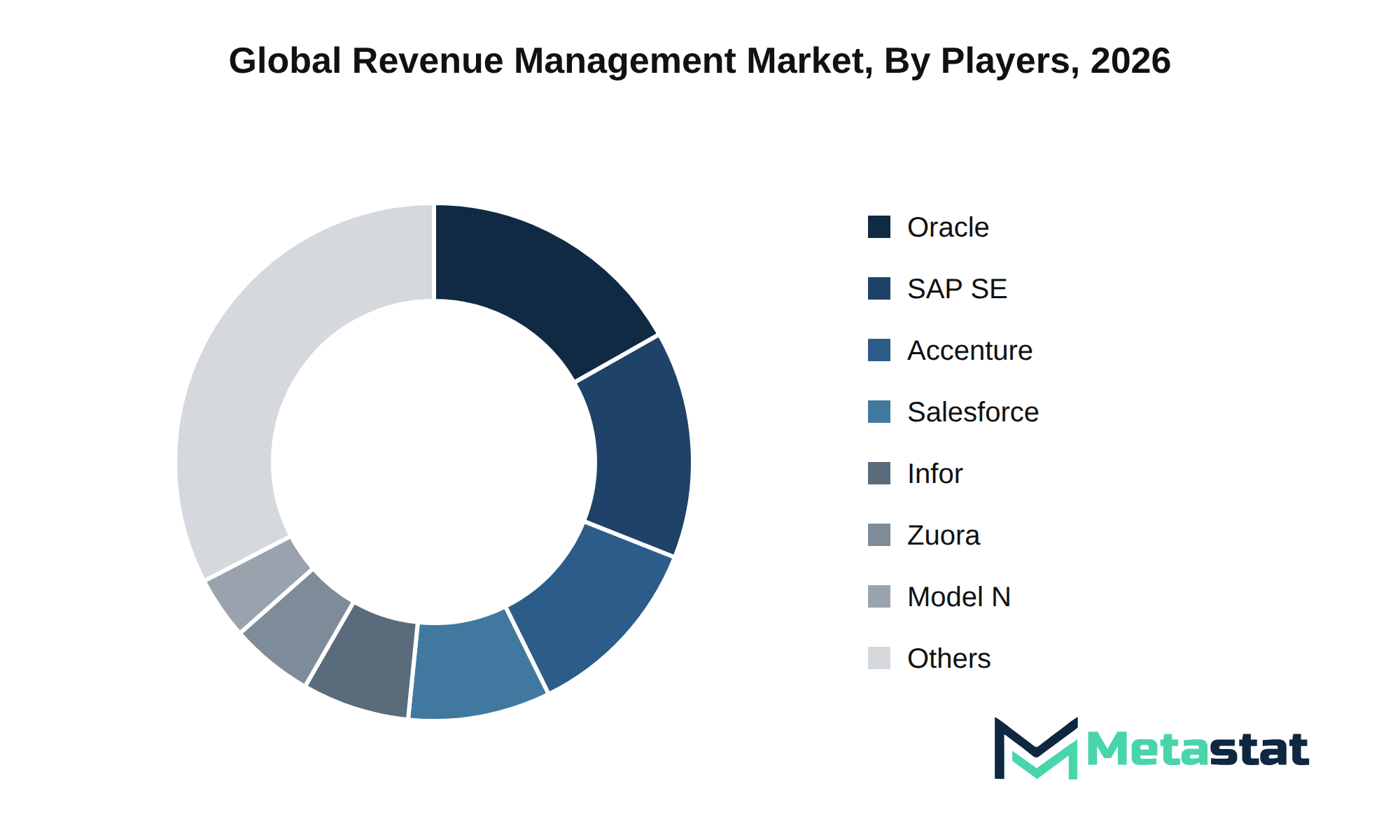
Achieving this growth depends on sustained demand from IT & Telecom, which is projected to lead among industries through the forecast period. Sector expansion relies on continuous adoption of cloud-based deployment, driven by buyers seeking scalable and cost-effective solutions over traditional on-premise alternatives. North American buyers are expected to account for all market value by 2033, underlining the region’s entrenched digital infrastructure and the presence of global technology and consulting suppliers. The forecast further depends on managed services, which are set to outpace professional services in value, reflecting businesses’ preference for outsourced, subscription-based offerings that reduce internal operational burdens.
The main risk to this outlook involves delays in transitioning from legacy on-premise systems to cloud-based solutions, particularly among late-adopting sectors and smaller enterprises. These delays restrict penetration in segments outside IT & Telecom, limiting the addressable market for suppliers and tempering overall volume growth. If these conversion challenges persist, the market could see slower adoption rates in both new verticals and emerging regions.
By Solutions: Risk Management, Price & Revenue Forecast Management, Revenue Analytics, Revenue Leakage Detection, Channel Revenue Management
By Services: Managed Services, Professional Services
By Deployment: Cloud-based, On-premise
By Industry: IT & Telecom, Travel and Tourism, Hospitality, Retail and E-commerce, Healthcare, Insurance, Banking, Media & Entertainment, Others
The report strategically identifies and profiles the key market players and analyses their core competencies in each sub-segment of the Revenue Management market.
|
Report Attributes |
Details |
|
Study Period |
2021-2033 |
|
Base Year |
2025 |
|
Estimated Year |
2026 |
|
Forecast Period |
2026-2033 |
|
Historical Period |
2021-2025 |
|
Growth Rate |
CAGR 8.2% from 2026 to 2033 |
|
Revenue Unit |
USD million |
|
Segmentation |
By Solutions, Services, Deployment, Industry, and Region |
|
By Region |
North America (By Solutions, Services, Deployment, Industry, and Country)
|
|
Europe (By Solutions, Services, Deployment, Industry, and Country)
|
|
|
Asia Pacific (By Solutions, Services, Deployment, Industry, and Country)
|
|
|
South America (By Solutions, Services, Deployment, Industry, and Country)
|
|
|
Middle East and Africa (By Solutions, Services, Deployment, Industry, and Country)
|
Find answers to common questions about this report
The Revenue Management market size was valued at USD 796.7 million in 2025.
The projected CAGR is 8.2% for the forecast period from 2026 to 2033.
The North America Revenue Management market size is estimated to reach USD 1,497 million by 2033.
Risk Management leads by type, reaching USD 1,497 million in 2033 based on segment values. This segment outpaces Revenue Analytics, which records no value for 2033.
Telecommunications operators are driving demand for advanced revenue management solutions to address digital service complexity, real-time billing, and evolving fraud risks. Rising adoption of bundled pricing models is increasing the need for integrated platforms that support complex contracts and cross-product analytics.
North America holds the dominant share with a projected value of USD 1,497 million in 2033. This region accounts for 100 percent of the market based on the available figures.
Rising demand for integrated solutions that support complex bundled offerings is favoring adoption, as enterprises seek unified contracts and real-time analytics across products and services. Suppliers investing in configurable, modular platforms are capturing this trend by enabling flexible deployment and rapid adaptation to changing business needs.
The Revenue Management market is estimated to reach a valuation of USD 1,497 million by 2033.
Companies active in this industry include Accenture, FinThrive Revenue Systems, LLC, Agilysys, Infor Inc., Oracle Corporation, SAP SE, Salesforce, Inc., Zuora, Inc., Model N, Inc., Vendavo, Inc., Pricefx AG, Zilliant Incorporated, Amdocs Limited, Netcracker Technology Corporation, Ericsson, CSG Systems International, Inc., PROS Holdings, Inc., Amadeus IT Group SA, Sabre Corporation, FLYR, Inc., IDeaS Revenue Solutions, Duetto Research, Inc., RateGain Travel Technologies Limited, Cendyn Group, LLC, Lighthouse, SiteMinder Limited, and RoomPriceGenie AG. These companies provide software and solutions for pricing optimization, billing, and revenue analytics across sectors including telecommunications, hospitality, travel, and enterprise services.
Telecom operators are increasing investment in advanced risk management solutions to address digital service complexity and evolving fraud schemes, which supports revenue assurance and operational resilience.
The analysts below cover Banking & Finance research at Metastat Insights.
LEAD ANALYST
Utkarsh Khirodkar is a Lead Market Research Analyst at MetaStat Insight, specializing in market intelligence, technology sector assessments, and competitive strategy.

PRINCIPAL CONSULTANT - ENTERPRISE AI & EMERGING TECHNOLOGIES
Banking & Finance · Electronics and Semiconductor · Energy and Power · Healthcare IT · Information & Technology · Professional Services
Vijay Gunti is a Principal Consultant at MetaStat Insight, bringing over two decades of experience across enterprise digital transformation, technology strategy, and intelligent systems.
Analyzing the transition from natural gas to green hydrogen in iron ore reduction requires realistic infrastructure timelines. Meta stat insight supplied a detailed regional assessment of DRI plant conversion costs and scrap metal availability in North America and Western Europe. Their report carefully examined pellet quality specs and electrical grid access constraints without making oversimplified market assumptions. The research material served as a practical reference during internal technology roadmap discussions.
Integrating zero-trust access controls across legacy electronic health record systems involves complex compliance overhead. Team produced an analysis that clearly separated identity governance and administration tools from privileged access management platforms. Their evaluation of HIPAA and GDPR compliance features across cloud native solutions gave our architecture group clear baseline criteria. The custom data request regarding biometric authentication adoption in hospital networks was returned promptly with clear documentation.
Evaluating calorific value requirements and air permit compliance across municipal waste facilities requires localized data. Metastat Insight structured their analysis around operational throughput capacity and feedstock composition variations in Latin America and Eastern Europe. Their competitive mapping of sorting equipment vendors helped clarify technology differences between optical separators and heavy media systems. The study provided an objective baseline during our capital expenditure reviews.
Explore related market intelligence reports worth reading alongside this one.