
LEAD ANALYST
Utkarsh Khirodkar is a Lead Market Research Analyst at MetaStat Insight, specializing in market intelligence, technology sector assessments, and competitive strategy.

Ambient Snack Vending Machine Market Size, Share, By Type (Full-size Machines, Slimline Machines, Countertop Machines, Combo Machines, and Others), By Payment Mechanism (Cash and Cashless), By Distribution Channel (Direct Sales, Distributors, and Online Platforms), By End User (Educational Institutions, Healthcare, Hospitality, Offices, Transportation Hubs, and Others), Industry Analysis, Growth, Trends, and Forecast, 2026-2033
Report ID
MSI-3572
Published
March, 2026
Pages
305 Pages
Format
Report Details
Choose Your License
Ambient Snack Vending Machine Market
The global ambient snack vending machine market size was valued at USD 12.4 billion in 2025. The market is projected to grow from USD 12.9 billion in 2026 to USD 17.3 billion by 2033, exhibiting a CAGR of 4.2% during the forecast period.
Global Ambient Snack Vending Machine Market: Comprehensive Data-Driven Market Analysis and Strategic Outlook
North America held 32.3% share in 2025, with the U.S. leading the regional share in 2026.
Full-size machines segment accounted for 44.0% share in 2025.
Key trends driving growth: Rising workplace automation and demand for unattended retail points drives broader adoption of ambient snack vending formats., Expansion of cashless, contactless, and telemetry-enabled systems propels deployment across offices, transport hubs, and educational facilities.
Opportunities include integration of smart inventory analytics and dynamic planogram optimization that enable revenue gains through data-driven product placement and reduced stockouts.
Key insight: Digital payments, smart machine integration, and shifting snack consumption habits are reshaping growth prospects within the global ambient snack vending machine market.
Within automated retail equipment, the ambient snack vending machine market is shifting from standalone distribution toward integrated micro-retail across public and semi-private locations. Future deployments will prioritize compact retail-style machines with clear branding, transparent pricing, and configurable merchandising aligned with brick-and-mortar retail standards. Manufacturers will emphasize modular architectures that support refresh of format, product mix, and user interface without replacing the entire machine.
Over the next few years, ambient snack vending machines will function as data-responsive endpoints rather than static revenue assets. Embedded analytics will track shopper interactions, purchase timing, and inventory movement, enabling operators to optimize assortments and replenishment with higher precision. Digital screens will support location-specific promotions, seasonal campaigns, and limited-edition launches, giving snack brands controlled visibility beyond traditional retail shelves.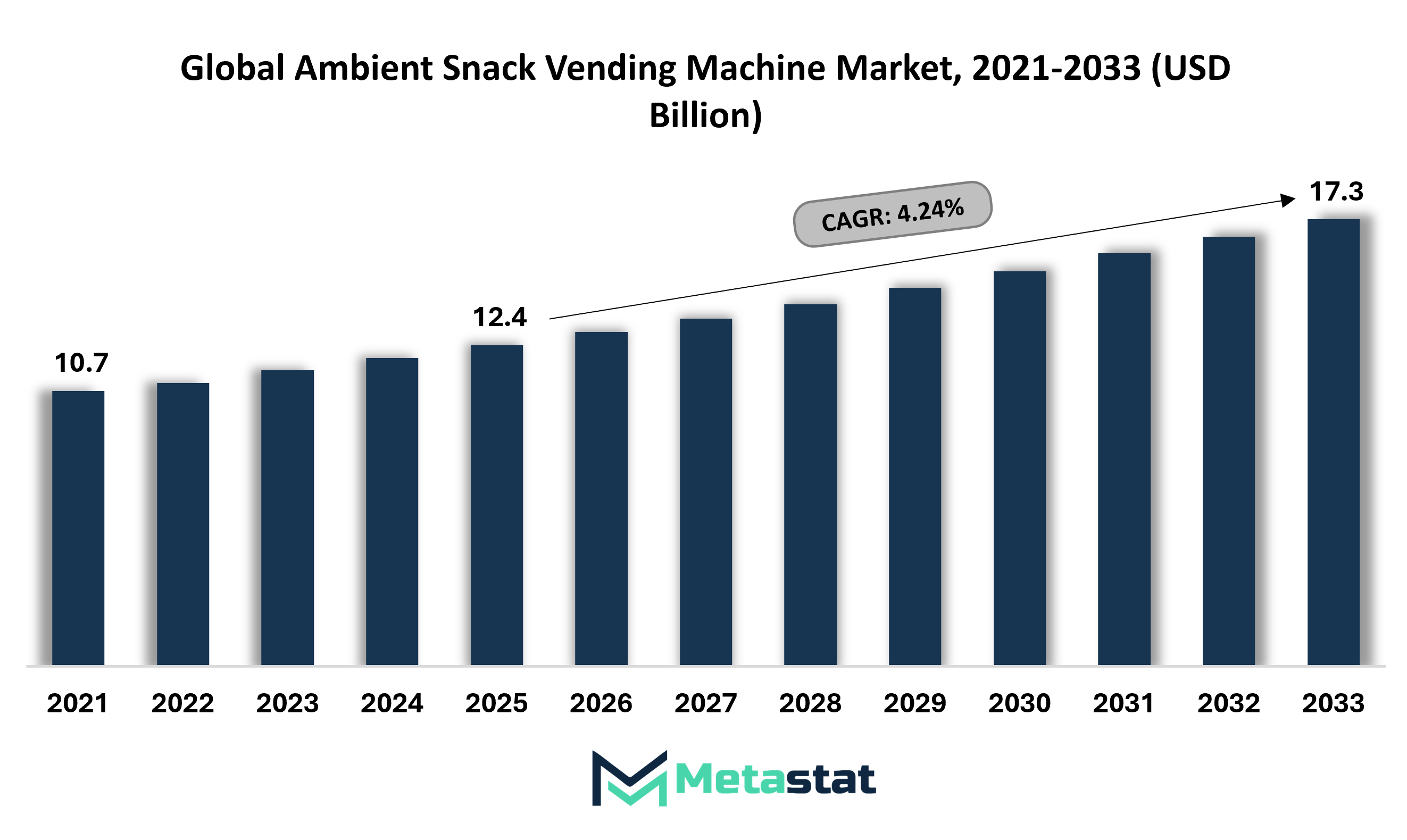
Increasing workplace automation and the call for unattended retail points will accelerate the adoption of significant snack vending codecs in company environments. Organizations will prioritize operational continuity, decreased workforce dependency, and spherical-the-clock get entry to packaged snacks, helping the strong placement of computerized units within contemporary workplace infrastructure and co-working ecosystems.
The growth of cashless, contactless, and telemetry-enabled systems will drive deployment in places of work, transportation hubs, and academic facilities. Digital payment reputation, remote monitoring, and real-time overall performance statistics will beef up operational controls, reduce downtime, and inspire operators to scale up installations inside densely populated business and institutional settings.
Limited product range in comparison to refrigerated or hybrid vending machines will limit flexibility in numerous snack offerings. Ambient-most effective configurations will hinder the inclusion of temperature-sensitive gadgets, impact customer choice patterns and limiting placement suitability within places demanding complete nutrients or top-class snack alternatives.
Higher servicing frequency for restocking and sanitation compliance will avoid operational performance issues in excessive-traffic locations. Frequent replenishment cycles, sanitation necessities, and exceptional tracking will boost upkeep prices, impacting profitability metrics for operators managing large system networks in transit-heavy environments.
The integration of smart inventory analytics and dynamic planogram optimization will drive sales gains through facts-driven product placement and reduced stockouts. Predictive call for modelling, income trend evaluation, and automatic collection changes will grow shelf efficiency, guide better turnover, and offer better returns on system-degree investments.
The global ambient snack vending machine market is segmented by Type, Payment Mechanism, Distribution Channel, and End User.
Full-size machines segment was valued at USD 5.7 billion in 2026 and is projected to reach USD 7.4 billion by 2033, at a CAGR of 3.8% during the forecast period.
Full-size machines within the global ambient snack vending machine market will reflect expansion driven by the demand for higher capacity in commercial environments. Strong storage, comprehensive product visibility and operational continuity will be prioritized in future placements. The development will be tailored to locations requiring continuous availability, encouraging manufacturers to integrate scalable designs that support long service cycles and consistent consumer access.
Slimline machines segment was valued at USD 2.3 billion in 2026 and is projected to reach USD 3.1 billion by 2033, at a CAGR of 3.9% during the forecast period.
Slimline machines will gain relevance in the global ambient snack vending machine market due to space-conscious deployment requirements. The compact footprint will support installation in corridors, small offices and retail expansions. The design focus will be on efficiency, streamlined product delivery and low power usage, helping to drive steady adoption where spatial limitations impact purchasing decisions.
Countertop machines segment was valued at USD 1.4 billion in 2026 and is projected to reach USD 1.9 billion by 2033, at a CAGR of 4.8% during the forecast period.
Countertop machines will represent controlled growth within the global ambient snack vending machine market, serving convenience-seeking environments without occupying the floor. Future development will focus on portability, simplified restocking, and curated snack assortments. Settings that prioritize accessibility, support short-term consumption patterns, and targeted placement strategies will drive demand.
Combo machines segment was valued at USD 2.9 billion in 2026 and is projected to reach USD 4.0 billion by 2033, at a CAGR of 5% during the forecast period.
Combo machines will support diversification within the global ambient snack vending machine market by offering snacks and beverages through integrated systems. Forward-looking demand will favor versatility, low installation effort, and broad consumer appeal. Builders will enhance modular layout and operational flexibility, enabling higher transaction volumes at mixed-use locations.
Others segment was valued at USD 0.6 billion in 2026 and is projected to reach USD 0.9 billion by 2033, at a CAGR of 4.4% during the forecast period.
Other machine formats within the global ambient snack vending machine market will emerge through customized solutions addressing specific placement requirements. Innovation will focus on customizability, specialized shelving, and tailored capacity options. Such formats will support emerging consumption behaviour while allowing operators to respond to location-specific needs.
Cash segment is projected to reach USD 3.2 billion by 2033, at a CAGR of 2.3% during the forecast period.
Cash-based payment mechanisms will maintain functional relevance in the global snack vending machine market, especially in areas with limited digital penetration. Future use will emphasize reliability, low maintenance and user familiarity. Operators will continue to support cash acceptance to maintain reach across diverse demographic and economic settings.
Cashless segment is projected to reach USD 14.1 billion by 2033, during the forecast period.
Cashless systems will accelerate adoption in the global ambient snack vending machine market through digital convenience and transaction transparency. The development will be in line with mobile payments, smart cards and contactless solutions. The integration will lead to operational data tracking, faster procurement cycles and improved user experience at technically receptive locations.
Direct sales segment is projected to reach USD 8.8 billion by 2033, with a share of 54% in 2025.
Direct sales channels will strengthen presence in the global ambient snack vending machines market by supporting controlled pricing and manufacturer-led distribution. Further momentum will come from close customer engagement, tailored solutions and after-sales support. Such channels will attract institutional buyers seeking long-term operational alignment.
Distributors segment is projected to reach USD 5.7 billion by 2033, with a share of 34.4% in 2025.
Distributor networks will remain influential in the global ambient snack vending machine market by expanding regional reach and logistics efficiency. Future expansion will depend on local expertise, inventory management and relationship-driven sales. Distributor-led growth will support entry into fragmented markets requiring adaptive supply coordination.
Online platforms segment is projected to reach USD 2.8 billion by 2033, with a share of 11.7% in 2025.
Online platforms will gradually reshape the purchasing activity within the global Ambient Snack Vending Machine Market. Digital listings, specification transparency and remote comparison tools will influence purchasing behaviour. The expansion will be in line with streamlined order processes, vendor reliability and growing acceptance of digital procurement among commercial buyers.
Educational Institutions segment is projected to grow at a CAGR of 3.8% during the forecast period.
Educational institutions will contribute to the sustained demand in the global ambient snack vending machine market through increased foot traffic and regulated consumption patterns. Future deployments will emphasize affordability, portion control, and nutritional alignment. Operators will focus on reliability and simplified maintenance that supports the educational program.
Healthcare segment is projected to grow at a CAGR of 3.3% during the forecast period.
Healthcare facilities will influence the measured growth within the global ambient snack vending machine market through continuous operational requirements. Future establishments will prioritize hygiene-focused design, quiet operation and reliable access. The product assortment will be tailored to a regulated environment supporting employees, visitors and extended operating hours.
Hospitality segment is projected to grow at a CAGR of 3.3% during the forecast period.
Hospitality venues will expand participation in the global ambient snack vending machine market by catering to the needs of guests round the clock. Future demand will support visually appealing machines, premium snack offerings and seamless payment options. Placement strategies will emphasize convenience in lobbies, corridors and ancillary spaces.
Offices segment is projected to grow at a CAGR of 4.6% during the forecast period.
Office environment will continue to be a stable contributor to the global snack vending machine market through workforce-driven consumption. Future adoption will lead to energy-efficient units, diverse snack selections and minimal servicing disruption. The demand will be in line with workplace wellness initiatives and productivity-focused infrastructure plans.
Transportation Hubs segment is projected to grow at a CAGR of 5.2% during the forecast period.
Transportation hubs, owing to frequent passenger movement, will drive high-volume engagement in the global ambient snack vending machine market. Sustainability, faster transaction flow, and wider product availability will be prioritized in future setups. The growth will be followed by extended operating hours and the expansion of infrastructure supporting different passenger preferences.
Others segment is projected to grow at a CAGR of 3.8% during the forecast period.
Other end-user segments will support adaptive growth within the global ambient snack vending machine market by introducing unconventional placement environments. Demand will be generated from mixed-use facilities, public spaces and temporary establishments. Flexibility, mobility, and rapid deployment will guide future adoption trends.
Based on geography, the Global Ambient Snack Vending Machine market is divided into North America, Europe, Asia-Pacific, South America, Middle East, and Africa.
North America Ambient Snack Vending Machine Market is set to expand at a CAGR of 4.2% within the forecast period, reaching a market size of USD 5.3 billion by the end of 2033.
In North America, greater adoption of cashless payment systems will drive widespread snack vending machine penetration in offices and educational institutions.
North America will see continued demand driven by time-efficient food access preferences within corporate campuses and transportation hubs.
Asia Pacific will present strong opportunities through rapid urban infrastructure expansion supporting vending establishments in metro stations and commercial complexes.
Asia Pacific will uncover new possibilities from the growing organized retail ecosystem, encouraging the deployment of smart vending solutions.
The Middle East, Africa and South America will progress through gradual vending machine integration based on urban modernization, improvement in retail formalization and selective investment in the UAE, Saudi Arabia, South Africa, Brazil and Chile.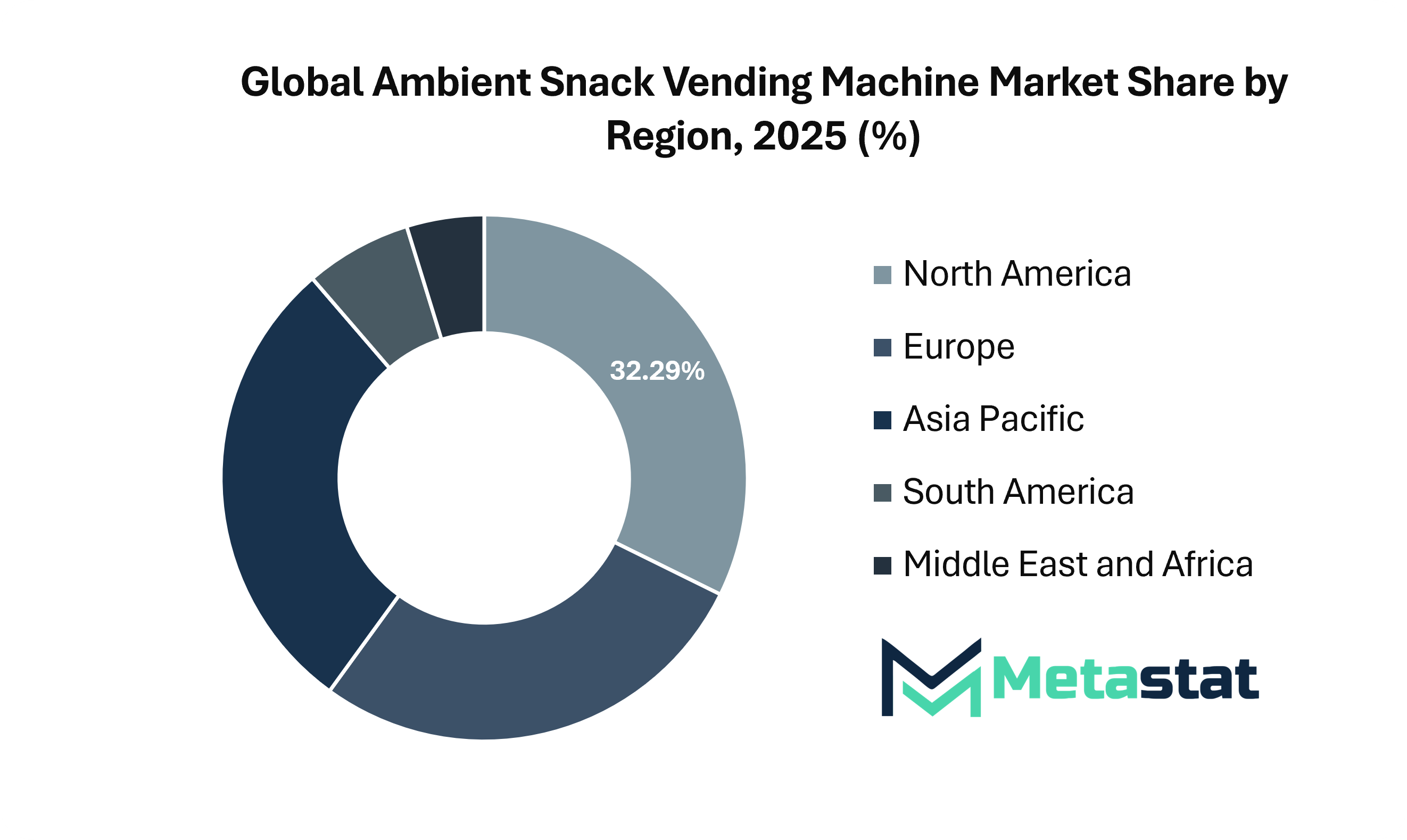
The global ambient snack vending machine market will continue to shape packaged snack access across offices, transit centers, educational campuses, hospitals, and public spaces. Growth will be supported by evolving work patterns, extended operating hours, and preference for unattended snack access. Ambient machines support longer shelf-life products, supporting simpler inventory handling while maintaining continuous availability. Manufacturers will emphasize durability, power efficiency, and compact footprints suited to diverse placement needs, supporting operator revenue per square foot.
Technology integration will play a central role in market evolution. Cashless payment systems, mobile wallet compatibility, remote monitoring, and data-driven restocking will strengthen operator control and improve user experience. Smart sensors and cloud dashboards will reduce downtime through predictive maintenance and real-time alerts. Configurable machine layouts will support optimization of product mix by consumption patterns, local preferences, and time-based purchase cycles, supporting improved operational stability and margin performance for operators.
Competition within the market will remain active, driven by innovation, regional expansion, and service flexibility. Major companies working on hardware, payment solutions, and vending platforms include Crane Payment Innovations, Inc. (CPI), IVM Micrologistics GmbH, Hunan TCN Vending Machine Co., Ltd., Royal Vendors, Inc., The Wittern Group, Inc., Vendnet USA, Inc., FastCorp, LLC, U-Select-It Corporation (USI), and Selectivend, Inc. These players will compete through product reliability, after-sales support, and flexible machine configuration.
Emerging and regional partners will strengthen market depth by targeting local needs and cost-sensitive deployment. Companies like Vendekin Technologies Pvt Ltd, Vendolight India Pvt Ltd, SmartQ, Vendiman, Int11 Technologies, Future Technologies India Pvt Ltd, Vendcraftz, and innovators focusing on software-based vending ecosystems will attract attention among corporate cafeterias and smart city projects. Partnerships with snack brands and facility management firms will further support growth, helping mass snack vending machines remain a trusted retail channel in both mature and developing markets.
Market size is forecast to rise from USD 12.4 billion in 2025 to over USD 17.3 billion by 2033.
Sustainability alignment will influence machine engineering choices. Energy optimization, recyclable housing materials and intelligent cooling regulation will become standard expectations rather than differentiators. Supply agreements will support packaged snacks developed for extended ambient sustainability without sacrificing perceived freshness or nutritional cues. From a strategic perspective, the global ambient snack vending machine market will act as a testing ground for micro-retail innovation, where brands will test new flavors, packaging formats and pricing psychology under controlled conditions. Situation allows the vending infrastructure to operate beyond transactional purposes and toward long-term brand intelligence generation.
By Type:
By Payment Mechanism:
By Distribution Channel:
By End User:
Key Global Ambient Snack Vending Machine Industry Players
This research report categorizes the Ambient Snack Vending Machine market based on key segments and regions, forecasts revenue growth, and analyses trends in each submarket. The report analyzes the key growth drivers, opportunities, and challenges influencing the Ambient Snack Vending Machine market. Recent market developments and competitive strategies such as expansion, product launch, development, partnership, merger, and acquisition have been included to outline the competitive landscape in the market.
The report strategically identifies and profiles the key market players and analyses their core competencies in each sub-segment of the Ambient Snack Vending Machine market.
|
Report Attributes |
Details |
|
Study Period |
2021-2033 |
|
Base Year |
2025 |
|
Estimated Year |
2026 |
|
Forecast Period |
2026-2033 |
|
Historical Period |
2021-2025 |
|
Growth Rate |
CAGR 4.2% from 2026 to 2033 |
|
Revenue Unit |
USD billion |
|
Sales Volume Unit |
Units |
|
Segmentation |
By Type, Payment Mechanism, Distribution Channel, End User, and Region |
|
By Region |
North America (By Type, Payment Mechanism, Distribution Channel, End User, and Country)
|
|
Europe (By Type, Payment Mechanism, Distribution Channel, End User, and Country)
|
|
|
Asia Pacific (By Type, Payment Mechanism, Distribution Channel, End User, and Country)
|
|
|
South America (By Type, Payment Mechanism, Distribution Channel, End User, and Country)
|
|
|
Middle East and Africa (By Type, Payment Mechanism, Distribution Channel, End User, and Country)
|
Find answers to common questions about this report
Top players operating in the Ambient Snack Vending Machine industry include Crane Payment Innovations, Inc. (CPI), Evoca S.p.A. (Necta), Sielaff GmbH & Co. KG Automatenbau Herrieden, FAS International S.p.A., and SandenVendo Europe S.p.A.
Limited product variety compared to refrigerated or hybrid vending machines restricts flexibility in diverse snack offerings to constrain market growth within the forecast period.
Rising workplace automation and demand for unattended retail points drives broader adoption of ambient snack vending formats. and Expansion of cashless, contactless, and telemetry-enabled systems propels deployment across offices, transport hubs, and educational facilities. are key driving factors, boosting the market.
The Full-size Machines is the leading type segment in the Global market.
North America region dominates the market.
Global Ambient Snack Vending Machine market is estimated to reach USD 17.3 billion by 2033.
The Metastat Insights study shows that the Global Ambient Snack Vending Machine market size was USD 12.4 billion in 2025.
The Global Ambient Snack Vending Machine market is likely to grow at a CAGR of 4.2% over the forecast period (2026-2033).
The Metastat Insights analysis shows that the North America Ambient Snack Vending Machine market size is estimated to be USD 5.3 billion by 2033.
The analysts below cover Machinery & Equipment research at Metastat Insights.
LEAD ANALYST
Utkarsh Khirodkar is a Lead Market Research Analyst at MetaStat Insight, specializing in market intelligence, technology sector assessments, and competitive strategy.

INDUSTRY CONSULTANT - CHEMICALS & ADVANCED MATERIALS
Chemicals and Materials · Machinery & Equipment · Packaging
Amit Gadhekar Consultant for Chemicals and Materials at MetaStat Insight, directing sector-specific intelligence, research, and strategic consulting across global chemical and processing markets.

PRINCIPAL CONSULTANT - QUALITY SYSTEMS & COMPLIANCE
Electronics and Semiconductor · Machinery & Equipment · Professional Services
Omkar Phadtare is an Industry Consultant at MetaStat Insight, specializing in quality systems, regulatory compliance, and standards benchmarking to drive data-driven market intelligence and strategic industry research.

ENERGY & INFRASTRUCTURE INDUSTRY CONSULTANT
Automotive and Transportation · Electronics and Semiconductor · Energy and Power · Machinery & Equipment
Saurabh Vasant Ganvir consults for Energy & Infrastructure Industry at MetaStat Insight, specializing in renewable energy, solar EPC, and electric vehicle (EV) infrastructure markets.

LEAD CONSULTANT - COMMUNICATION, TELECOM, AND IT
Electronics and Semiconductor · Information & Technology · Machinery & Equipment · Professional Services
Ravindra Sathe Consultants for Communication, Telecom, and IT at MetaStat Insight. He leads the firm's industry research initiatives across telecommunications infrastructure, digital connectivity, enterprise networking, and emerging information technology domains.
Replacing petrochemical surfactants with bio-based alternatives requires realistic timelines on industrial precision fermentation scaling. The market research broke down commercialization timelines, feedstock sugar price sensitivities, and regional cosmetic ingredient regulatory approvals in Europe and East Asia. That supplier readiness mapping gave our formulations team reliable context when comparing renewable chemical sourcing roadmaps.
Tracking ceramic matrix composite adoption in high-bypass aero engines requires strict attention to material qualification cycles and FAA airworthiness testing milestones. The MetaStat Insight team provided a detailed timeline of silicon carbide fiber manufacturing capacity and commercial foundry lead times. Having clear visibility into upstream thermal barrier coating supply helped us stress-test our long-term component procurement strategy.
Transitioning ultra-class mining haul trucks to alternative power requires concrete data on remote hydrogen refueling infrastructure economics. The report evaluated megawatt-scale electrolyzer installation expenses, onsite storage safety mandates, and heavy-duty fuel cell stack degradation under continuous duty cycles. That technical rigor helped our engineers benchmark realistic total operating cost horizons for off-highway fleet decarbonization.
Explore related market intelligence reports worth reading alongside this one.
Starting from
$2950