
LEAD ANALYST
Utkarsh Khirodkar is a Lead Market Research Analyst at MetaStat Insight, specializing in market intelligence, technology sector assessments, and competitive strategy.

Automotive Predictive Maintenance Market by Type (Solutions and Services), By Application (Passenger Cars and Commercial Vehicles), Industry Analysis, Size, Share, Growth, Trends, and Forecast, 2023-2030
Report ID
MSI-2415
Published
February, 2026
Pages
259 Pages
Format
Report Details
Choose Your License
Automotive Predictive Maintenance Market
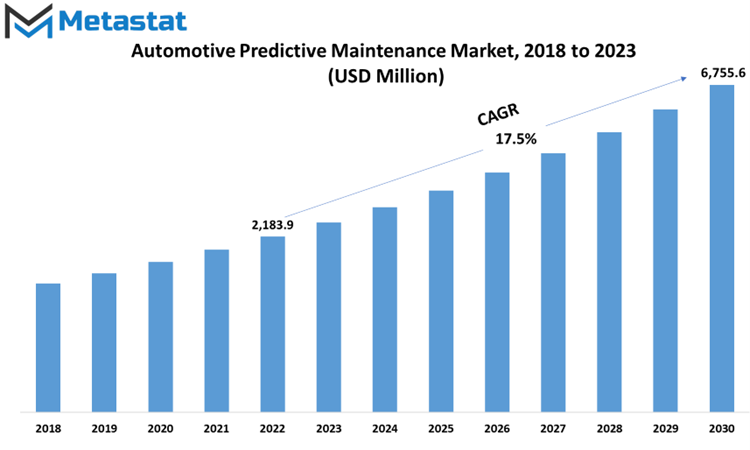
The automotive predictive maintenance market is estimated to reach USD 2,183.9 million by 2030, growing at a CAGR of 17.5% in forecast period.
Automotive Predictive Maintenance is driven by its mission to elevate vehicle dependability, curtail downtime, and, ultimately, curbside expenditure. It involves harnessing cutting-edge technology and dissecting data intricacies to forecast when an automobile might confront a critical malfunction or necessitate meticulous upkeep. Predictive maintenance has ascended to a paramount position within the automotive arena, courtesy of its adeptness in forestalling unforeseen vehicular mishaps. In lieu of adhering to a rigid maintenance timetable, vehicles fortified with predictive maintenance systems rely on real-time data streams to decipher moments when specific components beckon for attention. This proactive methodology bestows the gift of both time and financial savings, orchestrating maintenance with precision at the precise juncture it is warranted, thus diminishing the specter of colossal system breakdowns. Global Automotive Predictive Maintenance market is estimated to reach $2,183.9 Million by 2030; growing at a CAGR of 17.5% from 2023 to 2030.
The impetus behind the Automotive Predictive Maintenance Market is multifaceted. It is predominantly fueled by cost-effectiveness, a factor that propels its growth trajectory. Predictive maintenance, an intrinsic component of this domain, serves as a potent antidote to unforeseen downtime, thereby significantly curbing maintenance expenditures.
Diving into the crux of this approach, it leverages cutting-edge technologies such as Internet of Things (IoT) sensors and the prowess of machine learning algorithms to prophesize component failures with surgical precision. This proactive stance begets augmented operational efficiency and marks a substantial reduction in the financial outlays earmarked for maintenance activities.
Elevated security considerations loom large as a cornerstone driver within the ambit of Automotive Predictive Maintenance. The emphasis on bolstered safety mechanisms serves as a linchpin for this burgeoning market. Predictive maintenance, in its essence, equips stakeholders with a discerning eye for the premature identification of faults, effectively defusing the latent threat of mishaps stemming from component malfunctions.
The Automotive Predictive Maintenance market faces two substantial challenges. Primarily, the intricacy of vehicular data, encompassing its magnitude, heterogeneity, and caliber, presents intricacies in processing and precision. Secondly, the amalgamation of prophetic maintenance systems into preexistent automotive infrastructure is encumbered by compatibility conundrums, requisites for alterations, workforce instruction, and fiscal considerations. Surmounting these hindrances assumes paramount importance for actualizing the advantages of anticipatory maintenance within the automotive realm.
The Solutions segment has a range of sophisticated technologies and tools designed to facilitate predictive maintenance in the automotive market. These solutions leverage complex algorithms and data analytics to proactively identify potential issues in vehicles, thereby minimizing downtime and enhancing overall operational efficiency. In the year 2022, the Solutions segment held a substantial valuation of USD 1318.2 Million. Projections for this segment are equally promising, with an anticipated Compound Annual Growth Rate (CAGR) of 17.3% during the period spanning from 2023 to 2030. This growth trajectory is expected to culminate in a remarkable valuation by the year 2030.
The substantial market share held by this segment underscores its critical role in advancing the automotive sector's maintenance practices. By utilizing predictive maintenance solutions, automotive companies can effectively reduce unplanned downtime and maintenance costs. These solutions enable real-time monitoring of vehicle health, allowing for timely interventions before issues escalate. As vehicles become more technologically advanced, the demand for predictive maintenance solutions is on the rise, making this segment a driving force behind industry innovation.
Forecasts for the Service segment project a robust growth rate, with a predicted CAGR of 17.9% during the period from 2023 to 2030. By 2030, it is expected that the Services segment will attain a valuation of USD 2066.9 Million. The Services segment encompasses a wide array of support offerings, including maintenance consulting, training, and technical assistance. These services are instrumental in assisting automotive enterprises in implementing and optimizing predictive maintenance systems.
As vehicles become more technologically advanced, they generate an unprecedented amount of data. This data holds valuable insights into vehicle performance and maintenance needs. The Services segment plays an indispensable role in ensuring the seamless integration and operation of predictive maintenance within the automotive sector. Expert services are essential for managing and interpreting the wealth of data generated by modern vehicles. This, in turn, helps automotive companies make data-driven decisions, enhancing the efficiency and reliability of their operations.

Predictive maintenance in the Passenger Cars segment transcends mere conceptualization; it emerges as a tangible, revolutionary solution reshaping the landscape of vehicle upkeep and management. In this dynamic domain, we encounter an array of vital applications that include Engine Health Monitoring, Predictive Diagnostics, Battery Maintenance, and Tire Health Management.
The predictive maintenance systems whirl tirelessly, sifting through vast troves of data—engine performance metrics, temperature fluctuations, and the annals of maintenance history—all laid bare for scrutiny. This meticulous analysis birthed a remarkable capability—the foresight to anticipate the precise juncture at which components or systems might falter, thereby facilitating proactive intervention and repair. Tirelessly laboring in the background, predictive maintenance casts its protective mantle over tires as well. Smart sensors perched upon tires monitor not only pressure but also tread wear and temperature, endowing car owners with the prescience to replace tires at the opportune moment. This dual feat ensures not only the safety of passengers but also the extension of tire longevity—a win-win, by any measure.
As we synthesize these elements, the Passenger Cars segment emerges as a flourishing domain, primed for meteoric ascent. The crystal ball reveals that, by the year 2030, it will ascend to a valuation of USD 4345.9 Million.
However, the Commercial Vehicles segment casts its imposing shadow across the landscape of the Automotive Predictive Maintenance Market. In 2022, this segment assumed the mantle of prominence, accounting for a formidable 33.5% share and boasting a substantial valuation. Its significance lies not merely in numbers but in the profound impact it wields, ensuring the seamless operation of commercial fleets, thwarting disruptions, and unleashing a tidal wave of efficiency that propels the industry forward.
Predictive maintenance in the Commercial Vehicles segment is a dynamic and transformative approach to fleet management, route optimization, and cargo protection. It empowers businesses to operate at peak efficiency, comply with regulations, and deliver goods safely and on time. As the industry continues to evolve, embracing predictive maintenance will be crucial for staying competitive and achieving sustained growth. By leveraging data-driven insights, businesses can pave the way for a future where transportation is not just efficient but also highly reliable. Predictive maintenance in the Commercial Vehicles segment is tailored to the unique needs of businesses reliant on transportation. Here are some specific applications: - Fleet Management, Route Optimization, Cargo Protection.
On the other hand, the Commercial Vehicles segment is poised for rapid expansion, with a forecasted Compound Annual Growth Rate (CAGR) of 18.4% during the period from 2023 to 2030. By 2030, it is projected to reach a valuation of USD 2409.7 Million. This growth highlights the increasing recognition of predictive maintenance as an essential tool for optimizing commercial vehicle operations, reducing costs, and ensuring reliability.
North America's Automotive Predictive Maintenance market is not just a regional player; it's a global force to be reckoned with. Its rapid growth, significant market share, and innovative approach to predictive maintenance make it a key driver of industry transformation. What sets North America apart in the Automotive Predictive Maintenance arena is its staggering growth potential. Projections indicate that this market is poised to expand at an impressive CAGR of 17.3% over the forecast period, reaching a remarkable value of USD 2898.2 Million by the year 2030. In 2022, North America has firmly established itself as a powerhouse in the global Automotive Predictive Maintenance market. It currently holds a substantial 43.6% share of the total market, underlining its significance and influence.
Based on geography, the global Automotive Predictive Maintenance market is divided further into Europe, Asia-Pacific, South America, and Middle East & Africa. North America is further divided into the U.S., Canada, and Mexico, whereas Europe consists of the UK, Germany, France, Italy, and Rest of Europe. Asia-Pacific is segmented into India, China, Japan, South Korea, and Rest of Asia-Pacific. The South America region includes Brazil, Argentina, and the Rest of South America, while the Middle East & Africa is categorized into GCC Countries, Egypt, South Africa, and Rest of Middle East & Africa.
The automotive predictive maintenance Market is in a state of perpetual evolution. The key players such as Automotive Predictive Maintenance industry include Aptiv PLC which acquired 5.45% of the market in 2022, similarly Continental AG, GARRETT MOTION INC., Robert Bosch GmbH, SAP SE, Siemens AG, Teletrac Navman, Valeo Corporation, ZF Friedrichshafen AG, Uptake Technologies Inc., not only lead this transformation but also contribute to a safer, more efficient, and sustainable future of mobility. As vehicles become smarter and more connected, predictive maintenance will continue to play a pivotal role in keeping us moving forward.
In a world where innovation knows no bounds, these industry leaders are steering the automotive sector toward new horizons. As we ponder the questions raised at the beginning of this article, it becomes evident that predictive maintenance isn't just a trend; it's a revolution that is here to stay. With these market leaders at the helm, the road ahead looks promising, efficient, and safer than ever.
Find answers to common questions about this report
Global Automotive Predictive Maintenance market is valued $ 2,183.9 million in 2023.
Global Automotive Predictive Maintenance market is estimated grow with a CAGR of 17.5% from 2023 to 2030.
Global Automotive Predictive Maintenance market is estimated to reach $6,755.6 million by 2030.
Top players operating in the Automotive Predictive Maintenance industry includes Aptiv PLC, Continental AG, GARRETT MOTION INC., Robert Bosch GmbH, SAP SE, and others.
The analysts below cover Automotive and Transportation research at Metastat Insights.
LEAD ANALYST
Utkarsh Khirodkar is a Lead Market Research Analyst at MetaStat Insight, specializing in market intelligence, technology sector assessments, and competitive strategy.

ENERGY & INFRASTRUCTURE INDUSTRY CONSULTANT
Automotive and Transportation · Electronics and Semiconductor · Energy and Power · Machinery & Equipment
Saurabh Vasant Ganvir consults for Energy & Infrastructure Industry at MetaStat Insight, specializing in renewable energy, solar EPC, and electric vehicle (EV) infrastructure markets.
Evaluating sovereign cloud deployments for core banking platforms demands a clear view of data residency regulations and migration exit strategies. MetaStat Insight delivered an exhaustive review of regional latency tolerances, mainframe decommission milestones, and third-party vendor concentration risk. The regulatory compliance mapping across European and Asian financial jurisdictions gave our team a dependable baseline for multi-cloud infrastructure discussions.
Replacing petrochemical surfactants with bio-based alternatives requires realistic timelines on industrial precision fermentation scaling. The market research broke down commercialization timelines, feedstock sugar price sensitivities, and regional cosmetic ingredient regulatory approvals in Europe and East Asia. That supplier readiness mapping gave our formulations team reliable context when comparing renewable chemical sourcing roadmaps.
Tracking ceramic matrix composite adoption in high-bypass aero engines requires strict attention to material qualification cycles and FAA airworthiness testing milestones. The MetaStat Insight team provided a detailed timeline of silicon carbide fiber manufacturing capacity and commercial foundry lead times. Having clear visibility into upstream thermal barrier coating supply helped us stress-test our long-term component procurement strategy.
Explore related market intelligence reports worth reading alongside this one.