
LEAD ANALYST
Utkarsh Khirodkar is a Lead Market Research Analyst at MetaStat Insight, specializing in market intelligence, technology sector assessments, and competitive strategy.

Benefits Administration Outsourcing Services Market Size, Share, By Service Type (Core Benefits Administration, Ancillary Benefits Administration, Living Quarters Trailers, and Integrated Benefits Administration), By Benefit Type (Health, Medical, Dental, Vision, Life, Disability, Retirement, Savings, Flexible Spending Accounts (FSA), Health Savings Accounts (HSA), Health Reimbursement Arrangements (HRA), and Voluntary and Supplemental Benefits), By Deployment Type (Cloud-Based and On-Premises), By End-user (Employers, Insurance Companies, Government Agencies, Third-party Administrators (TPAs), Brokers, and Consultants), Industry Analysis, Growth, Trends, and Forecast, 2026-2033
Report ID
MSI-4583
Published
April, 2026
Pages
320 Pages
Format
Report Details
Choose Your License
Benefits Administration Outsourcing Services Market
The Global Benefits Administration Outsourcing Services market size is valued at USD 83.6 billion in 2025. The market is projected to grow from USD 89.6 billion in 2026 to USD 146.8 billion by 2033, exhibiting a CAGR of 7.3% during the forecast period.
The global benefits administration outsourcing services market was valued at USD 83.6 billion in 2025 and is projected to grow at a CAGR of 7.3% from 2026 to 2033, reaching USD 146.8 billion by 2033.
North America held a 43.4% share in 2025, with the United States leading regional revenue in 2026.
Core Benefits Administration segment accounted for a 53.0% share in 2025.
Key trends driving growth include increased complexity of benefits regulations that propels outsourcing of administrative functions, along with an increased focus on cost optimization and HR operational efficiency across organizations.
Opportunities include rising demand from small and mid-sized enterprises for scalable, technology-enabled benefits administration solutions.
Key insight: The Global Benefits Administration Outsourcing Services Market advances through compliance intensity and workforce diversification while digital HR expansion unlocks sustained service adoption potential.
The global benefits administration outsourcing services market within the enterprise human capital services industry is projected to expand beyond traditional enrollment, claims management, and vendor coordination toward a strategic operations layer for multinational employers. Service providers are expected to align closely with workforce planning functions, supporting benefit design decisions through predictive cost modeling, utilization forecasting, and employee behavior analysis linked to demographic shifts and labor mobility.
In the coming years, outsourcing partners are positioned to play a central role in harmonizing cross-border benefits for organizations managing distributed teams. Increased workforce fluidity, international assignments, and project-based employment structures are projected to propel integrated benefits governance models that align regional statutory needs with internal equity frameworks. Advisory capabilities tied to policy standardization, exception management, and country-specific benefit customization are expected to become embedded within longer-term contracts.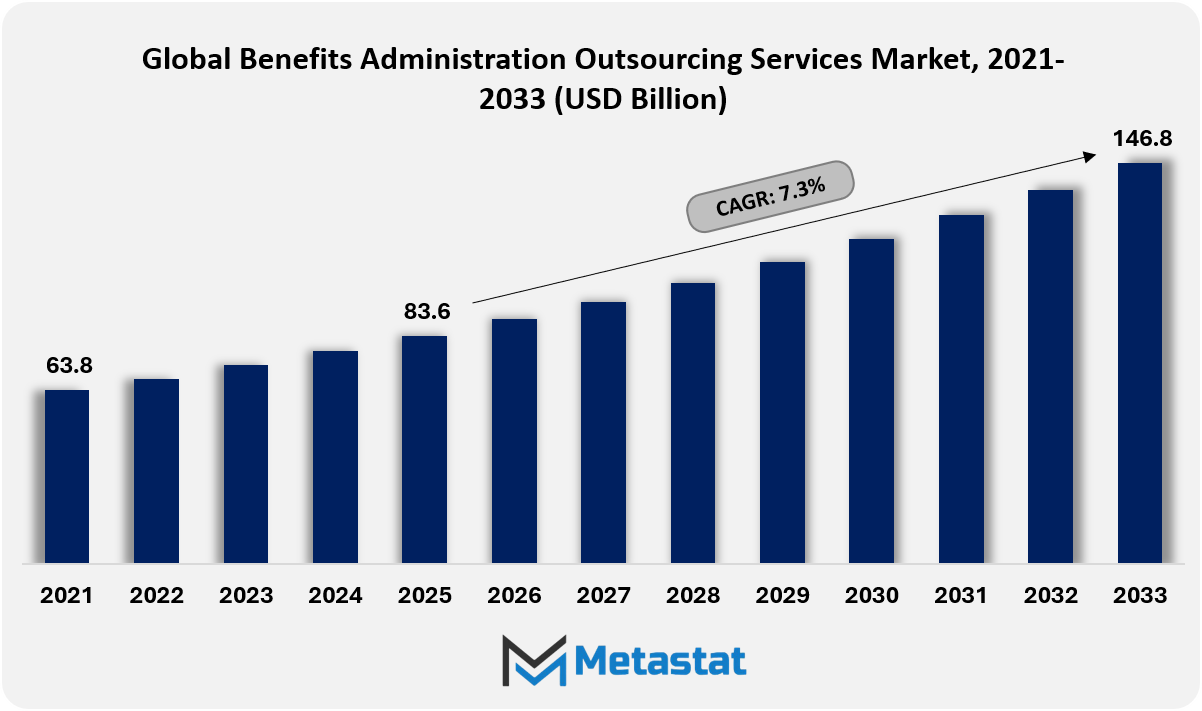
Increasing complexity of benefits regulations prompting companies to outsource administrative functions.
Regulatory frameworks governing employee benefits continue to expand across regions and sectors. Compliance management requires constant tracking, accurate reporting, and timely updates. External service providers deliver regulatory alignment, audit readiness, and standardized governance, positioning outsourced administration as a practical response to rising legal and procedural responsibilities within future-focused enterprises.
Growing focus on cost optimization and HR operational efficiency across organizations.
Human resources departments face pressure to streamline operations while maintaining service quality. Outsourcing allows access to automation, shared carrier models, and specialized information without huge internal investment. Such systems aid predictable expenditure styles and technique consistency, helping long-term performance goals aligned with digitally enabled organizational strategies.
Data security and employee privacy concerns associated with third-party service providers.
Sensitive worker statistics handled by outside administrators introduce publicity to cyber threats and regulatory penalties. Data protection standards, encryption protocols, and jurisdictional compliance stay vital evaluation elements. Risk perception around statistics governance continues to influence adoption pace, within industries where strict confidentiality and privacy enforcement norms are in place.
Limited customization and loss of direct control over employee benefits processes.
Standardized outsourcing frameworks may restrict flexibility in benefit design and process modification. Less operational oversight can challenge alignment with internal culture and workforce expectations. Organizations seeking tailored engagement models often face structural constraints that require careful vendor selection and contract design to balance efficiency with strategic control.
Rising demand from small and mid-sized enterprises for scalable, technology-enabled benefits administration solutions.
Small enterprises are increasingly looking for modular platforms that support growth without operational stress. Cloud-based administration, analytics integration, and compliance support enables rapid adoption. Such demand indicates scaling potential through simplified onboarding, usage-based pricing and digital-first service delivery aligned with future workforce management priorities.
The Global Benefits Administration Outsourcing Services market is classified based on Service Type, Benefit Type, Deployment Type, and End-user.
Core Benefits Administration segment was valued at USD 47.5 Million in 2026 and is projected to reach USD 70.4 Million by 2033, at a CAGR of 5.8% during the forecast period.
Key benefits administration within the global benefits administration outsourcing services market will grow through automation-driven enrollment management, payroll alignment, and compliance tracking. Service providers will prioritize accuracy, scalability, and regulatory alignment to support expanded workforce structures. Future demand will reflect organizational focus on efficiency, cost control, and consistent employee benefit delivery across all sectors.
Ancillary Benefits Administration segment was valued at USD 16.1 Million in 2026 and is projected to reach USD 24.9 Million by 2033, at a CAGR of 6.4% during the forecast period.
Ancillary benefits administration will gain importance through increasing demand for structured management of add-on benefits programs. The global benefits administration outsourcing services market will experience growth through outsourcing partners offering streamlined management of welfare, accident, and supplement coverage. The future framework will emphasize optimization, reporting clarity, and improved employee engagement outcomes.
Living Quarters Trailers segment was valued at USD 1.6 Million in 2026 and is projected to reach USD 1.5 Million by 2033, at a CAGR of -1.3% during the forecast period.
Living Quarters Trailers' services will emerge as a distinct administrative need within profitable outsourcing structures. The global benefits administration outsourcing services market will accommodate organizations that operate remote or project-based workforces. Future-oriented service models will support benefits coordination tied to temporary housing, mobility programs, and workforce protection compliance standards.
Integrated Benefits Administration segment was valued at USD 24.4 Million in 2026 and is projected to reach USD 49.9 Million by 2033, at a CAGR of 10.8% during the forecast period.
Integrated benefits administration will define advanced outsourcing strategies through integrated platforms handling multiple benefits categories. The global benefits administration outsourcing services market will shift toward centralized systems to improve data visibility and decision support. Forward-looking solutions will support seamless coordination, reduced administrative burden, and enhanced strategic workforce planning.
Health and Medical segment is projected to reach USD 49.5 Million by 2033, at a CAGR of 6.1% during the forecast period.
Health and medical benefits administration will continue to be the primary growth driver as health care complexity and compliance demands increase. The global benefits administration outsourcing services market will expand through specialized vendors managing claims processing, policy updates, and regulatory compliance. Future development will focus on analytics-driven cost optimization and better health care access management.
Dental and Vision segment is projected to reach USD 14 Million by 2033, at a CAGR of 6.6% during the forecast period.
Greater attention will be paid to dental and vision benefit administration through increased awareness of the importance of preventive care. The global benefits administration outsourcing services market will support structured enrollment, provider coordination, and claims monitoring. Future service delivery will focus on simplified access, transparent reporting, and improved participation metrics in employer-sponsored programs.
Life and Disability segment is projected to reach USD 12.5 Million by 2033, at a CAGR of 6.5% during the forecast period.
Life and disability benefits administration will progress through better risk management and employee safety planning. The global benefits administration outsourcing services market will rely on outsourcing partners for policy administration, claims accuracy, and compliance assurance. The future framework will emphasize reliability, timely processing, and alignment with long-term financial security.
Retirement and Savings segment is projected to reach USD 16.3 Million by 2033, at a CAGR of 6.4% during the forecast period.
Retirement and savings administration will expand through an increased focus on long-term workforce financial stability. The global benefits administration outsourcing service market will integrate contribution tracking, regulatory reporting, and plan customization. Future solutions will promote financial literacy alignment, secure data management, and scalable retirement program management.
Flexible Spending Accounts (FSA) segment is projected to reach USD 10.5 Million by 2033, at a CAGR of 5.7% during the forecast period.
Flexible spending account administration will increase through demand for tax-advantaged benefit optimization. The global benefits administration outsourcing service market will support compliance management, reimbursement processing and account monitoring. Future service models will increase user clarity, automation levels, and regulatory accuracy for employer-sponsored programs.
Health Savings Accounts (HSA) segment is projected to reach USD 17.6 Million by 2033, at a CAGR of 10.4% during the forecast period.
Adoption of consumer-directed health plans will strengthen health savings account administration. The global benefits administration outsourcing service marketplace will support account setup, contribution tracking, and compliance oversight. Future growth will depend on secure digital platforms, transparent reporting, and integration with comprehensive health care benefit systems.
Health Reimbursement Arrangements (HRA) segment is projected to reach USD 6.6 Million by 2033, at a CAGR of 8.8% during the forecast period.
Health reimbursement system administration will be accelerated through the employer's focus on controlled health care spending. The global benefits administration outsourcing services market will facilitate reimbursement management, eligibility tracking, and compliance alignment. Future services will prioritize flexibility, accuracy, and seamless coordination with Medicare benefit structures.
Voluntary and Supplemental Benefits segment is projected to reach USD 19.8 Million by 2033, at a CAGR of 10.6% during the forecast period.
Voluntary and supplemental benefits administration will expand through demand for personalized benefits portfolios. The global benefits administration outsourcing services market will enable efficient enrollment, premium reductions, and vendor coordination. Future developments will emphasize employee option expansion, administrative simplicity, and data-driven participatory analytics.
Cloud-Based Solutions segment is projected to reach USD 114.5 Million by 2033 with a share of 62.6% in 2025.
Cloud-based solutions will dominate outsourcing deployment strategies through scalability and remote accessibility. The global benefits administration outsourcing services market will adopt secure cloud infrastructure supporting real-time updates and analytics. Future adoption will reflect the demand for flexibility, cost efficiency, and rapid integration into enterprise systems.
On-Premises Solutions segment is projected to reach USD 32.3 Million by 2033 with a share of 37.4% in 2025.
On-premises solutions will maintain relevance among organizations that prioritize internal controls and data governance. Global Benefits Administration Outsourcing Services will support compliant on-site systems that meet market regulatory and security standards. Future demand will remain in a highly regulated environment requiring local infrastructure management.
Employers segment is projected to grow at a CAGR of 6.5% during the forecast period.
Employers continue to be the primary adopters of outsourced benefits administration to reduce operational complexity. The global benefits administration outsourcing services market will support workforce expansion, compliance requirements and cost efficiency objectives. Future engagement will reflect a strategic focus on employee satisfaction and administrative resource optimization.
Insurance Companies segment is projected to grow at a CAGR of 6.5% during the forecast period.
Insurance companies will use outsourcing services to increase policy administration efficiency and data accuracy. The Global Benefits Administration Outsourcing Services Market will assist insurers through claims coordination, regulatory reporting and customer service improvement. Dependency will increase in the future through demand for scalable and technology-enabled support systems.
Government Agencies segment is projected to grow at a CAGR of 6.2% during the forecast period.
Government agencies will increasingly turn to outsourced administration to manage complex benefit structures and public workforce programs. The global benefits administration outsourcing services market will support transparency, compliance and standardized service delivery. Its future adoption will be in line with modernization initiatives and operational efficiency targets of the public sector.
Third-party Administrators (TPAs) segment is projected to grow at a CAGR of 9.6% during the forecast period.
Third-party administrators will strengthen service capabilities through outsourced technology and process support. The Global Benefits Administration Outsourcing Services market will enhance TPA efficiency through automation, analytics and compliance tools. Future growth will reflect demand for scalable operations and diverse benefits management expertise.
Brokers and Consultants segment is projected to grow at a CAGR of 10.9% during the forecast period.
Brokers and advisors will rely on outsourced administration to deliver value-added advisory services. The global Benefits Administration Outsourcing Services market will support data-driven insights, reporting accuracy and increased customer engagement. Future collaboration will focus on strategic benefit design and long-term workforce planning support.
Based on geography, the Global Benefits Administration Outsourcing Services market is divided into North America, Europe, Asia-Pacific, South America, Middle East, and Africa.
North America Benefits Administration Outsourcing Services Market is set to expand at a CAGR of 7.3% within the forecast period, reaching a market size (TAM) of USD 59.4 billion by the end of 2033.
In North America, rising regulatory complexity throughout healthcare, retirement, and payroll programs pushes enterprises towards blessings management outsourcing offerings.
In North America, big-scale corporation attention on value optimization and compliance accuracy hurries up adoption of specialized advantages outsourcing providers.
In Asia Pacific, expanding formal employment and multinational team of workers growth create strong call for scalable advantages administration outsourcing services.
In Asia Pacific, increasing virtual HR adoption among mid-sized establishments opens opportunities for cloud-based blessings administration outsourcing answers.
Across the Middle East, Africa, and South America, slow employer formalization and developing cognizance of established worker benefits support steady uptake of outsourced blessings management services.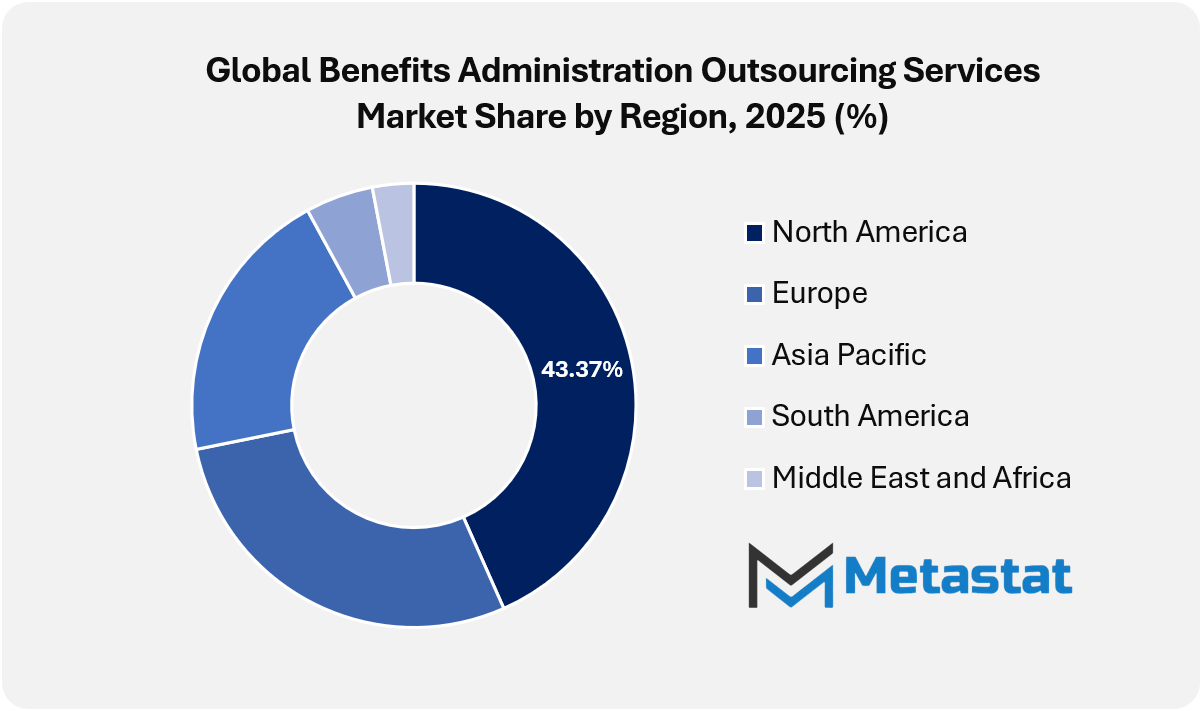
The global benefits administration outsourcing services market has received robust attention, owing to increased pressure on organizations to manage employee benefits efficiently while keeping internal workloads under control. Many organizations rely on external service providers to manage enrollment, compliance, and ongoing benefits support, allowing internal teams to focus on people management and growth objectives. Adoption continues to rise, owing to workforce expansion, policy changes, and increased employee expectations tied to transparency and access to benefits information.
Technology-driven platforms play a prime function in shaping provider pleasant in the marketplace. Providers focus on user-friendly dashboards, automated workflows, and real-time reporting to support employers and employees across multiple benefit plans. Cloud-based delivery models support consistency across locations while improving data security and administrative accuracy. These answers assist smoother communique among employers, insurers, and personnel, decreasing errors and administrative delays.
Several set up players outline aggressive electricity within the enterprise thru service intensity and virtual capability. ADP, Inc., Alight Solutions LLC, bswift LLC, PlanSource Benefits Administration, Inc., Businessolver.Com, Inc., Benefitfocus.Com, Inc., WEX Inc., Paychex Inc., TriNet Group, Inc., Justworks, Inc., Rippling People Center, Inc., Gusto, Inc., Paylocity Corporation, Paycom, Paycor, Inc., UKG Inc., and Dayforce, Inc. continue to expand platform capabilities and client reach. Employee Navigator, HealthEquity, Inc., Optum, Inc., Alegeus Technologies, LLC, Flores & Associates, LLC, Total Administrative Services Corporation (TASC), Navia Benefit Solutions, Inc., Ameriflex, Soteria HR, WTW (Willis Towers Watson), and PuzzleHR in addition beef up marketplace diversity through specialised offerings.
Competition in the market stays active, pushed by call for flexibility, compliance aid, and stepped forward employee experience. Providers focus on customization options, integration with payroll and HR structures, and responsive customer support to retain long-term clients. Market growth reflects a clean shift toward outsourced advantages management, supported by way of generation adoption and the need for dependable administration across complicated benefit structures.
Market size is forecast to rise from USD 83.6 billion in 2025 to over USD 146.8 billion by 2033.
Technology integration is expected to redefine service boundaries. Platforms that support benefits administration are positioned to evolve into a secure data environment where benefits data connects to payroll, talent analytics, finance systems, and risk management tools. There is anticipated to be a greater emphasis on data privacy engineering, consent tracking, audit preparation and cyber resilience, particularly for employers operating under multiple regulatory regimes.
By Service Type:
By Benefit Type:
By Deployment Type:
By End-user:
The research report categorizes the benefits administration outsourcing services market by key segments and regions, forecasts revenue growth, and analyzes trends in each submarket. The report analyzes key growth drivers, opportunities, and challenges influencing the benefits administration outsourcing services market. Recent market developments and competitive strategies such as expansion, type launch, development, partnership, merger, and acquisition have been included to draw the competitive landscape in the market.
The report strategically identifies and profiles the key market players and analyses their core competencies in each sub-segment of the Benefits Administration Outsourcing Services market.
|
Report Attributes |
Details |
|
Study Period |
2021-2033 |
|
Base Year |
2025 |
|
Estimated Year |
2026 |
|
Forecast Period |
2026-2033 |
|
Historical Period |
2021-2025 |
|
Growth Rate |
CAGR 7.3% from 2026 to 2033 |
|
Revenue Unit |
USD billion |
|
Segmentation |
By Service Type, Benefit Type, Deployment Type, End-user, and Region |
|
By Service Type |
Core Benefits Administration Ancillary Benefits Administration Living Quarters Trailers Integrated Benefits Administration |
|
By Region |
North America (By Service Type, Benefit Type, Deployment Type, End-user, and Country)
|
|
Europe (By Service Type, Benefit Type, Deployment Type, End-user, and Country)
|
|
|
Asia Pacific (By Service Type, Benefit Type, Deployment Type, End-user, and Country)
|
|
|
South America (By Service Type, Benefit Type, Deployment Type, End-user, and Country)
|
|
|
Middle East and Africa (By Service Type, Benefit Type, Deployment Type, End-user, and Country)
|
Find answers to common questions about this report
Global Benefits Administration Outsourcing Services market is estimated to reach USD 146.8 billion by 2033.
The Core Benefits Administration is the leading type segment in the Global market.
The Metastat Insights analysis shows that the North America Benefits Administration Outsourcing Services market size is estimated to be USD 59.4 billion by 2033.
Top players operating in the benefits administration outsourcing services industry include ADP, Inc., Alight Solutions LLC, bswift LLC, PlanSource Benefits Administration, Inc., and Businessolver.com, Inc.
Data security and employee privacy concerns associated with third-party service providers will hamper the market growth within the forecast period.
North America region dominates the market.
The Metastat Insights study shows that the Global Benefits Administration Outsourcing Services market size was USD 83.6 billion in 2025.
Increasing complexity of benefits regulations prompting companies to outsource administrative functions. and Growing focus on cost optimization and HR operational efficiency across organizations. are key driving factors, boosting the market.
The Global Benefits Administration Outsourcing Services market is likely to grow at a CAGR of 7.3% over the forecast period (2026-2033).
The analysts below cover Professional Services research at Metastat Insights.
LEAD ANALYST
Utkarsh Khirodkar is a Lead Market Research Analyst at MetaStat Insight, specializing in market intelligence, technology sector assessments, and competitive strategy.

PRINCIPAL CONSULTANT - ENTERPRISE AI & EMERGING TECHNOLOGIES
Banking & Finance · Electronics and Semiconductor · Energy and Power · Healthcare IT · Information & Technology · Professional Services
Vijay Gunti is a Principal Consultant at MetaStat Insight, bringing over two decades of experience across enterprise digital transformation, technology strategy, and intelligent systems.

PRINCIPAL CONSULTANT - QUALITY SYSTEMS & COMPLIANCE
Electronics and Semiconductor · Machinery & Equipment · Professional Services
Omkar Phadtare is an Industry Consultant at MetaStat Insight, specializing in quality systems, regulatory compliance, and standards benchmarking to drive data-driven market intelligence and strategic industry research.

LEAD CONSULTANT - COMMUNICATION, TELECOM, AND IT
Electronics and Semiconductor · Information & Technology · Machinery & Equipment · Professional Services
Ravindra Sathe Consultants for Communication, Telecom, and IT at MetaStat Insight. He leads the firm's industry research initiatives across telecommunications infrastructure, digital connectivity, enterprise networking, and emerging information technology domains.
Integrating zero-trust access controls across legacy electronic health record systems involves complex compliance overhead. Team produced an analysis that clearly separated identity governance and administration tools from privileged access management platforms. Their evaluation of HIPAA and GDPR compliance features across cloud native solutions gave our architecture group clear baseline criteria. The custom data request regarding biometric authentication adoption in hospital networks was returned promptly with clear documentation.
Evaluating calorific value requirements and air permit compliance across municipal waste facilities requires localized data. Metastat Insight structured their analysis around operational throughput capacity and feedstock composition variations in Latin America and Eastern Europe. Their competitive mapping of sorting equipment vendors helped clarify technology differences between optical separators and heavy media systems. The study provided an objective baseline during our capital expenditure reviews.
Decarbonizing industrial thermal processes hinges on refrigerant regulations and compressor efficiency limits. Metastat Insights delivered a thorough market analysis that evaluated natural refrigerants like CO2 and hydrocarbons against synthetic low-GWP alternatives. The breakdown of utility incentives and grid capacity constraints across key European manufacturing hubs offered valuable perspective. The follow-up conversation with their sector analysts addressed our specific questions on mechanical vapor recompression systems efficiently.
Explore related market intelligence reports worth reading alongside this one.