
LEAD ANALYST
Utkarsh Khirodkar is a Lead Market Research Analyst at MetaStat Insight, specializing in market intelligence, technology sector assessments, and competitive strategy.

Bidirectional DC Power Supply Market By Power Rating (Low Power (up to 1kW), Medium Power (1kW to 10kW), and High Power (above 10kW)), By Product Type (Programmable DC Power Supply, Non-Programmable DC Power Supply, and Smart DC Power Supply), By Application (Industrial Equipment, Research, Development, Telecommunications, Consumer Electronics, and Electric Vehicles), By End-User Industry (Aerospace, Defense, Automotive, Healthcare, Energy, Utilities, and Consumer Appliances), Industry Analysis, Size, Share, Growth, Trends, and Forecast, 2033
Report ID
MSI-4218
Published
October, 2025
Pages
255 Pages
Format
Report Details
Choose Your License
Bidirectional DC Power Supply Market
The global bidirectional dc power supply market in the energy and electronics sector will take a dramatic route as it expands in the coming years. The history of the Bidirectional DC Power Supply began when the first progress was made in power electronics in the mid-20th century, when engineers were looking for methods of converting and controlling electric power effectively to be used in industry and laboratories. In the beginning, the technology was limited to simple power supply units that either supplied or drew current, but with industries demanding more sophisticated energy management systems, the concept of bidirectional flow gained prominence.
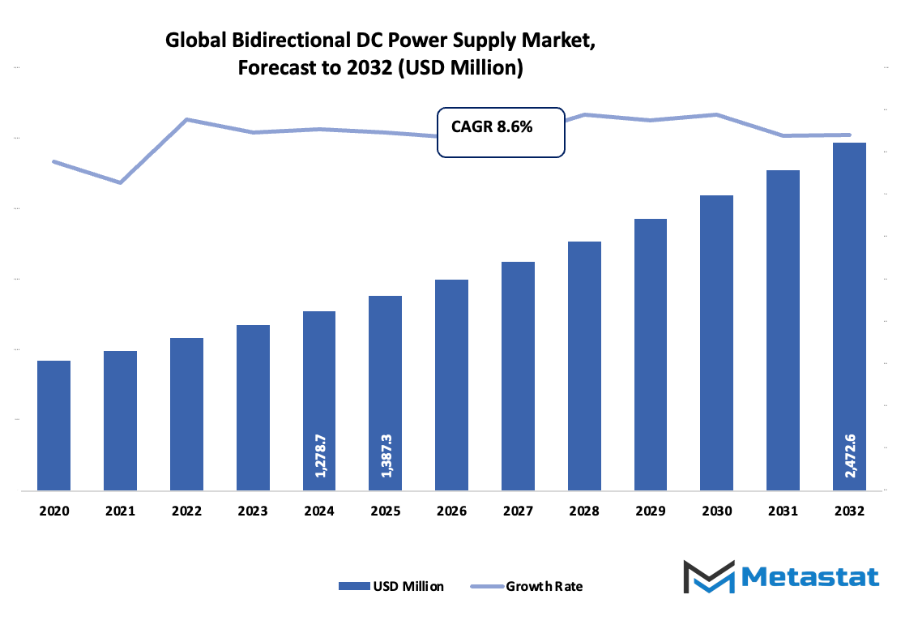
Global bidirectional dc power supply market valued at approximately USD 1387.3 million in 2025, recorded a CAGR of approximately 8.6% from 2032 and having potential to cross USD 2472.6 million.
Low Power (1kW or less) account for nearly 18.3% of market share, leading innovation and expanding usage through extensive research.
Key trends driving growth: Increase in the adoption of electric vehicles and battery testing products, Increase in renewable energy integration and energy storage system demand
Opportunities include: Expanded adoption of bidirectional power supplies in smart grids and microgrid applications
Key takeaway: The industry is anticipated to grow exponentially in value in the coming decade, which is indicative of spectacular growth opportunities.
By the early 1990s and late 1980s, the use of semiconductor devices such as IGBTs and MOSFETs enabled these power systems to perform more accurately and efficiently.
The application of modern digital control methods in the 2000s revolutionized the industry once more, enabling real-time monitoring and adaptive response to load fluctuations. These developments not only heightened the reliability of testing and storing energy systems but also laid the groundwork for potential uses in electric vehicles and renewable energy in the future. Consumer and industrial needs will continue to frame the market. Since industrial plants, laboratories, and renewable energy technologies demand equipment that responds faster, is more efficient, and safer, Bidirectional DC Power Supply functionality and design will shift to meet such demands. Improvements in technology, like advanced battery storage management and grid smart integration, will allow these power supplies to deal with more complex energy flow more effectively. The regulatory environment will dictate the market as well. Governments around the world are going to enforce tougher criteria for efficiency and safety, particularly for application in electric vehicles and grid stabilization. The companies will respond by investing in research for offering solutions meeting regulatory compliance while offering flexibility across operating conditions.
From its humble beginning as a one-way power device to its future position in helping the energy infrastructure of the future, the world's Bidirectional DC Power Supply industry will continue to grow. It will be an important part of the dynamic among the generation, storage, and use of energy, deciding how industries, labs, and emerging technologies manipulate and deliver power efficiently and reliably.
The global bidirectional dc power supply market is mainly classified based on Power Rating, Product Type, Application, End-User Industry.
Low Power (up to 1kW): The global bidirectional dc power supply market under the low power category will witness extensive usage as smaller sized equipment and miniaturized devices require maximum energy transfer. Such devices will find themselves in a wide range of applications where energy optimization and precise control are required.
Medium Power (1kW-10kW): The medium power segment of the global bidirectional dc power supply market will cater to industries that need balanced delivery of energy. The products will provide flexibility in applications involving moderate loads, ensuring efficiency and reliability of processes across various industries.
High Power (above 10kW): In the high power category, the global bidirectional dc power supply market will drive performance for high-end applications. Large-capacity systems will find application in heavy industry and critical infrastructures, with advanced control and reliable energy supply for high-demand applications.
Programmable DC Power Supply: Programmable units in the global bidirectional dc power supply market will allow end-users to programmatically set voltage and current profiles with precision. These units will be vital in test and automation applications, ensuring performance in industrial and research environments.
Non-Programmable DC Power Supply: Non-programmable products in the global bidirectional dc power supply market will continue to be utilized for routine energy supply applications. The equipment will provide reliable output for those applications with no routine adjustments required, supporting stable operation in critical loads.
Smart DC Power Supply: Smart solutions in the global bidirectional dc power supply market will have advanced monitoring and control capabilities. Software and IoT integration will help improve energy efficiency, predictive maintenance, and general operational intelligence for applications that are future-proof.
Industrial Equipment: High scalability and reliability solutions will have applications in the industrial sector of the global bidirectional dc power supply market. The equipment will ensure effective operation of equipment, production lines, and automation processes with reduced energy loss.
Research and Development: R&D solutions for the global bidirectional dc power supply market will be founded on flexible and precise units. These supplies will allow researchers to model many conditions, test prototypes, and innovate with regulated power control.
Telecommunications: Telecommunications devices in the global bidirectional dc power supply market will require stable and consistent energy sources for network utilization. These devices will maintain ongoing communication infrastructure and offer consistent data transmission in modern systems.
Consumer Electronics: Consumer electronics in the global bidirectional dc power supply market will gain from smart and compact solutions. Such systems will enable control of energy consumption in devices to provide longevity, performance, and cost-effective running in future home and office applications.
Electric Vehicles: The use of electric vehicles in the global bidirectional dc power supply market will be made possible by fast charging, energy recovery, and bidirectional energy transfer. The supplies will act as an essential component of EV infrastructure, making it efficient while encouraging sustainable transport solutions.
Aerospace and Defense: Aerospace and defense sectors in the global bidirectional dc power supply market will require highly reliable and precise units. These solutions will support mission-critical operations, testing, and simulation environments for advanced aircraft and defense systems.
Automotive: Automotive applications in the global bidirectional dc power supply market will focus on vehicle testing, battery management, and charging solutions. These systems will enhance vehicle performance, support electric mobility, and improve energy efficiency in automotive production and operation.
Healthcare: Healthcare applications in the global bidirectional dc power supply market will ensure safe and stable power delivery for sensitive medical devices. These systems will support diagnostic equipment, laboratory testing, and hospital operations, maintaining reliability and patient safety.
Energy and Utilities: Energy and utilities sectors in the global bidirectional dc power supply market will adopt these systems for power conversion, storage, and grid management. Efficient bidirectional energy flow will help manage renewable sources, improve stability, and optimize energy distribution.
Consumer Appliances: Consumer appliances in the global bidirectional dc power supply market will gain from efficient and compact power systems. These units will improve the performance, energy efficiency, and lifespan of household and commercial appliances in future smart homes.
|
Forecast Period |
2025-2032 |
|
Market Size in 2025 |
$1387.3 Million |
|
Market Size by 2032 |
$2472.6 Million |
|
Growth Rate from 2025 to 2032 |
8.6% |
|
Base Year |
2025 |
|
Regions Covered |
North America, Europe, Asia-Pacific, South America, Middle East & Africa |
By Region:
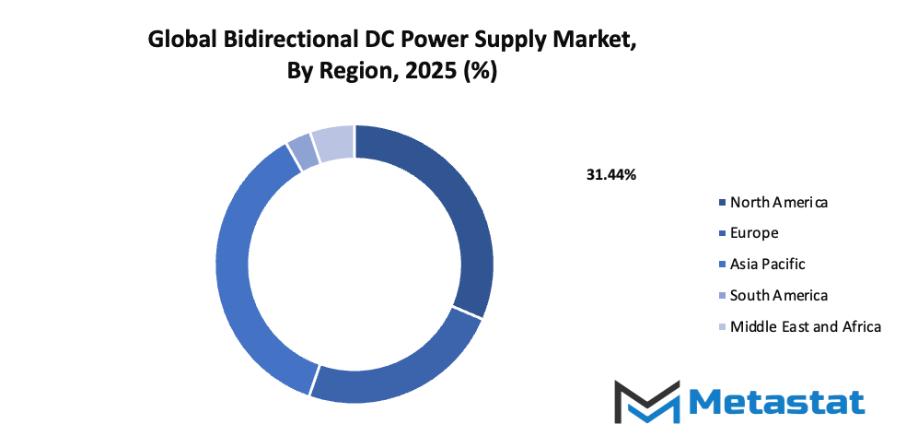
Based on geography, the global bidirectional dc power supply market is divided into North America, Europe, Asia-Pacific, South America, and the Middle East & Africa.
North America is further divided into the U.S., Canada, and Mexico, whereas Europe consists of the UK, Germany, France, Italy, and the Rest of Europe.
Asia-Pacific is segmented into India, China, Japan, South Korea, and the Rest of Asia-Pacific.
The South America region includes Brazil, Argentina, and the Rest of South America, while the Middle East & Africa is categorized into GCC Countries, Egypt, South Africa, and the Rest of the Middle East & Africa.
Rising adoption of electric vehicles and battery testing applications: The rise in electric vehicle production and battery testing needs will create strong demand for bidirectional DC power supplies. These systems will enable faster charging, battery condition monitoring, and safe energy flow management. Industries will invest in these solutions to support electric mobility and enhance battery life in the coming years.
Increasing demand for renewable energy integration and energy storage systems: The integration of renewable energy sources such as solar and wind into power networks will require bidirectional DC power supplies. These systems will allow energy storage and efficient power flow between storage units and the grid, ensuring stability and flexibility. Future energy strategies will depend on these technologies for sustainable growth.
High initial investment and equipment cost: The high cost of equipment and installation will limit adoption for smaller enterprises. Investments in research and development, along with advanced manufacturing processes, will be essential for cost reduction. Over time, scaling production and technological improvements will make bidirectional DC power supplies more accessible, supporting long-term market expansion.
Complexity in design and control for stable bidirectional operation: Designing systems that can safely manage bidirectional power flow is challenging. Maintaining voltage stability, preventing overload, and ensuring precise control will demand sophisticated solutions. As technology progresses, automated control systems and intelligent monitoring will help overcome these design challenges, enabling broader application in future energy networks.
Growing use of bidirectional power supplies in smart grids and microgrid applications: Smart grids and microgrids will adopt bidirectional DC power supplies to optimize energy flow and support local energy generation. These systems will allow seamless integration of renewable sources, energy storage, and demand response mechanisms, promoting efficient and flexible power networks for future energy needs.
The global bidirectional dc power supply market will continue to expand as technological needs grow and energy management solutions become increasingly critical. The industry is a mix of both international industry leaders and emerging regional competitors, creating a competitive landscape that drives innovation and efficiency. Important competitors include EA Elektro-Automatik, Keysight, Chroma Systems Solutions, Itech Electronics, Kewell Technology, Ainuo Instrument, Delta Electronics, Wocen, Action Power, Matsusada Precision, Shenzhen Faithtech, ET System Electronic, Adaptive Power Systems, RECOM Power, ETPS, B&K Precision Corporation, AMETEK Programmable Power, Teledyne LeCroy, and TDK-Lambda Corporation. These companies will shape the market by introducing advanced features, higher precision, and more reliable performance in their products.
Looking ahead, the market will be influenced by increasing demand for energy-efficient systems and renewable energy integration. As industries shift toward sustainable operations, bidirectional DC power supplies will become essential in applications such as energy storage, electric vehicle infrastructure, and smart grids. Leading companies will focus on developing solutions that can handle higher power levels, faster response times, and improved system intelligence. Regional competitors will also push innovation, offering cost-effective solutions that meet local market needs while gradually gaining a share of the global market.
The future will likely see enhanced connectivity and automation, enabling bidirectional DC power supplies to communicate seamlessly with other devices and systems. This will support more sophisticated energy management strategies, such as dynamic load balancing and real-time energy flow optimization. Companies that invest in research and development, especially in adaptive and programmable power technologies, will gain a strategic advantage in a market that is becoming increasingly complex and technology-driven.
Market size is forecast to rise from USD 1387.3 million in 2025 to over USD 2472.6 million by 2032. Bidirectional DC Power Supply will maintain dominance but face growing competition from emerging formats.
Overall, the global bidirectional dc power supply market will evolve through a combination of cutting-edge technology from established leaders and innovative solutions from emerging regional competitors. The continuous push for efficiency, reliability, and smart integration will ensure that this industry remains central to the future of energy and power management worldwide.
This research report categorizes the global bidirectional dc power supply market based on various segments and regions, forecasts revenue growth, and analyzes trends in each submarket. The report analyses the key growth drivers, opportunities, and challenges influencing the global bidirectional dc power supply market. Recent market developments and competitive strategies such as expansion, type launch, development, partnership, merger, and acquisition have been included to draw the competitive landscape in the market. The report strategically identifies and profiles the key market players and analyses their core competencies in each sub-segment of the global bidirectional dc power supply market.
Find answers to common questions about this report
Global Bidirectional DC Power Supply market is valued at $1387.3 million in 2025.
Global Bidirectional DC Power Supply market is estimated to grow with a CAGR of 8.6% from 2025 to 2032.
Global Bidirectional DC Power Supply market is estimated to reach $2472.6 million by 2032.
Top players operating in the Bidirectional DC Power Supply industry includes EA Elektro-Automatik, Keysight, Chroma Systems Solutions, Itech Electronics, and Others.
The analysts below cover Energy and Power research at Metastat Insights.
LEAD ANALYST
Utkarsh Khirodkar is a Lead Market Research Analyst at MetaStat Insight, specializing in market intelligence, technology sector assessments, and competitive strategy.

PRINCIPAL CONSULTANT - ENTERPRISE AI & EMERGING TECHNOLOGIES
Banking & Finance · Electronics and Semiconductor · Energy and Power · Healthcare IT · Information & Technology · Professional Services
Vijay Gunti is a Principal Consultant at MetaStat Insight, bringing over two decades of experience across enterprise digital transformation, technology strategy, and intelligent systems.

ENERGY & INFRASTRUCTURE INDUSTRY CONSULTANT
Automotive and Transportation · Electronics and Semiconductor · Energy and Power · Machinery & Equipment
Saurabh Vasant Ganvir consults for Energy & Infrastructure Industry at MetaStat Insight, specializing in renewable energy, solar EPC, and electric vehicle (EV) infrastructure markets.
Evaluating secondary resin quality across post-consumer packaging streams requires reliable technical segmentation. MetaStat Insight delivered an objective assessment that distinguished between extrusion-grade flake pricing and optical sorting throughput limitations across Western Europe. The competitive positioning breakdown for licensed depolymerization technology providers answered several questions during our feedstock feasibility audit. Their team clarified regional trade restrictions on mixed plastic scrap quickly when our team submitted follow-up requests.
Evaluating sovereign cloud deployments for core banking platforms demands a clear view of data residency regulations and migration exit strategies. MetaStat Insight delivered an exhaustive review of regional latency tolerances, mainframe decommission milestones, and third-party vendor concentration risk. The regulatory compliance mapping across European and Asian financial jurisdictions gave our team a dependable baseline for multi-cloud infrastructure discussions.
Replacing petrochemical surfactants with bio-based alternatives requires realistic timelines on industrial precision fermentation scaling. The market research broke down commercialization timelines, feedstock sugar price sensitivities, and regional cosmetic ingredient regulatory approvals in Europe and East Asia. That supplier readiness mapping gave our formulations team reliable context when comparing renewable chemical sourcing roadmaps.
Explore related market intelligence reports worth reading alongside this one.