
LEAD ANALYST
Utkarsh Khirodkar is a Lead Market Research Analyst at MetaStat Insight, specializing in market intelligence, technology sector assessments, and competitive strategy.

Global Small-Scale Battery Energy Storage Market Size, Share, By Battery Type (Lithium-Ion Batteries, Lead-Acid Batteries, Flow Batteries and Others), By Energy Capacity (Below 100 kWh, 100 kWh to below 500 kWh, 500 kWh to below 1,000 kWh and 1,000 kWh to 2,000 kWh), By Connection Type (Grid-Connected and Off-Grid), By End User (Residential, Commercial and Institutional, Industrial and Utilities), Industry Analysis, Growth, Trends, and Forecast, 2026-2033
Report ID
MSI-5693
Published
November, 2026
Pages
251 Pages
Format
Historical
Base year
Forecast
Forecast period
Report Details
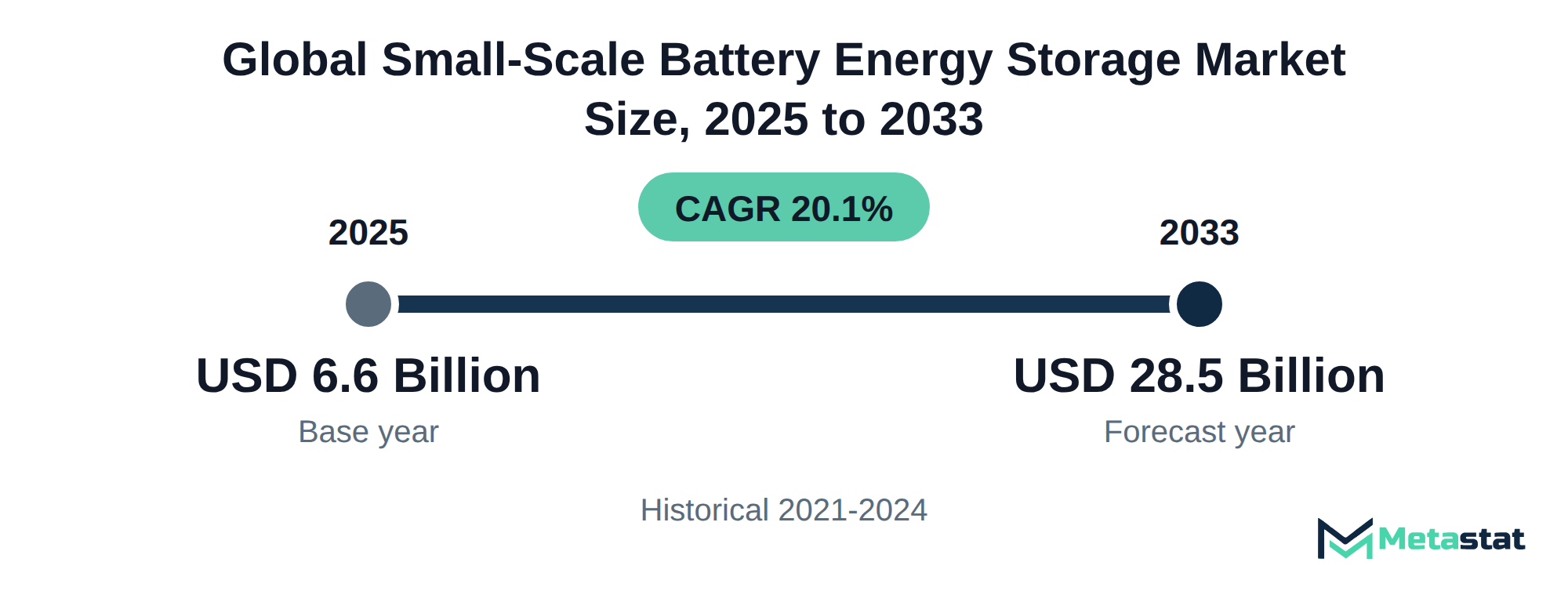
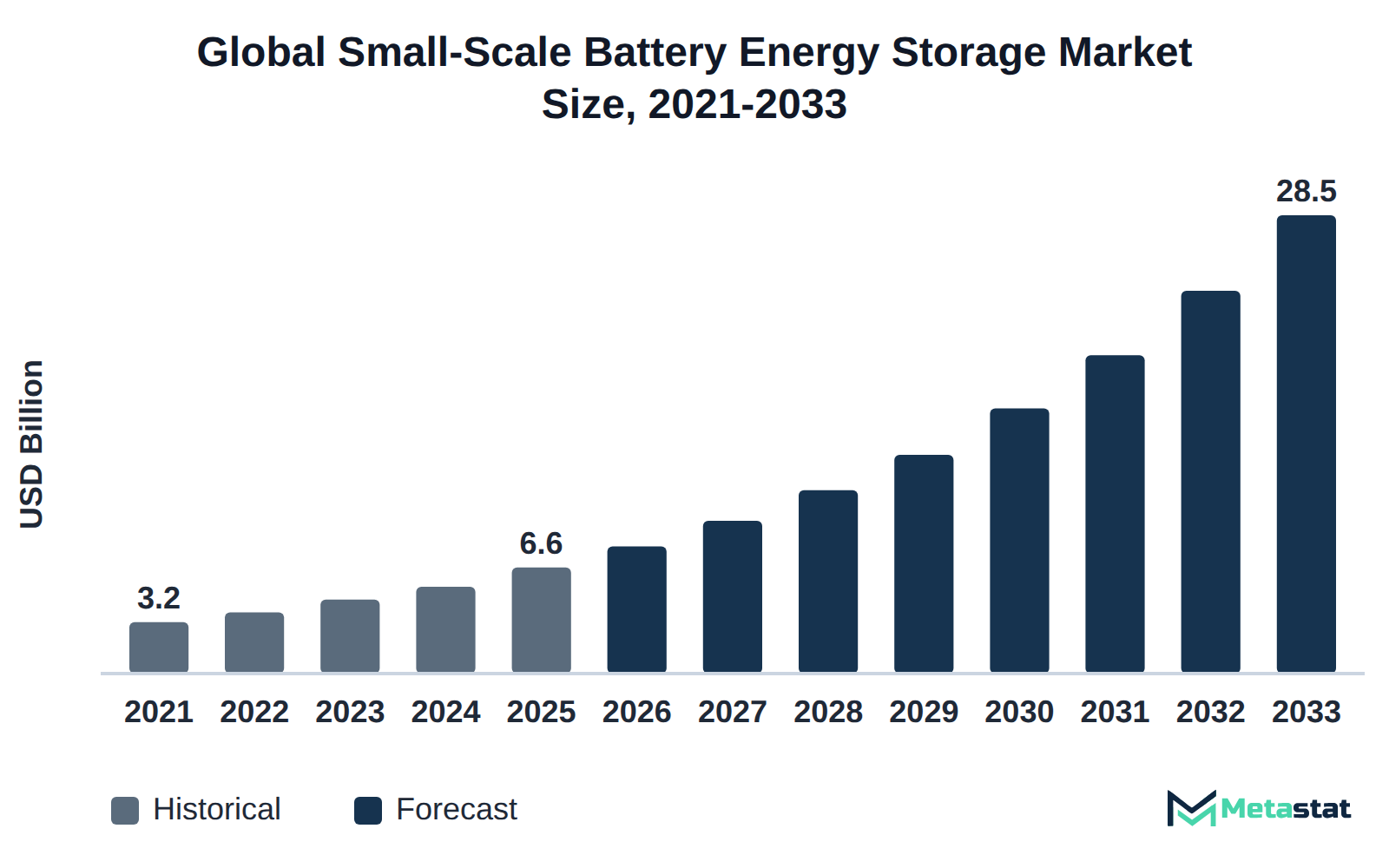
Market Valuation: Valued at $6.6 Billion in 2025, projected to reach $28.5 Billion by 2033 at a 20.1% CAGR.
Dominant Segment: Lithium-Ion Batteries lead the market, driven by their efficiency and versatility, with a projected value of USD 26.2 billion by 2033.
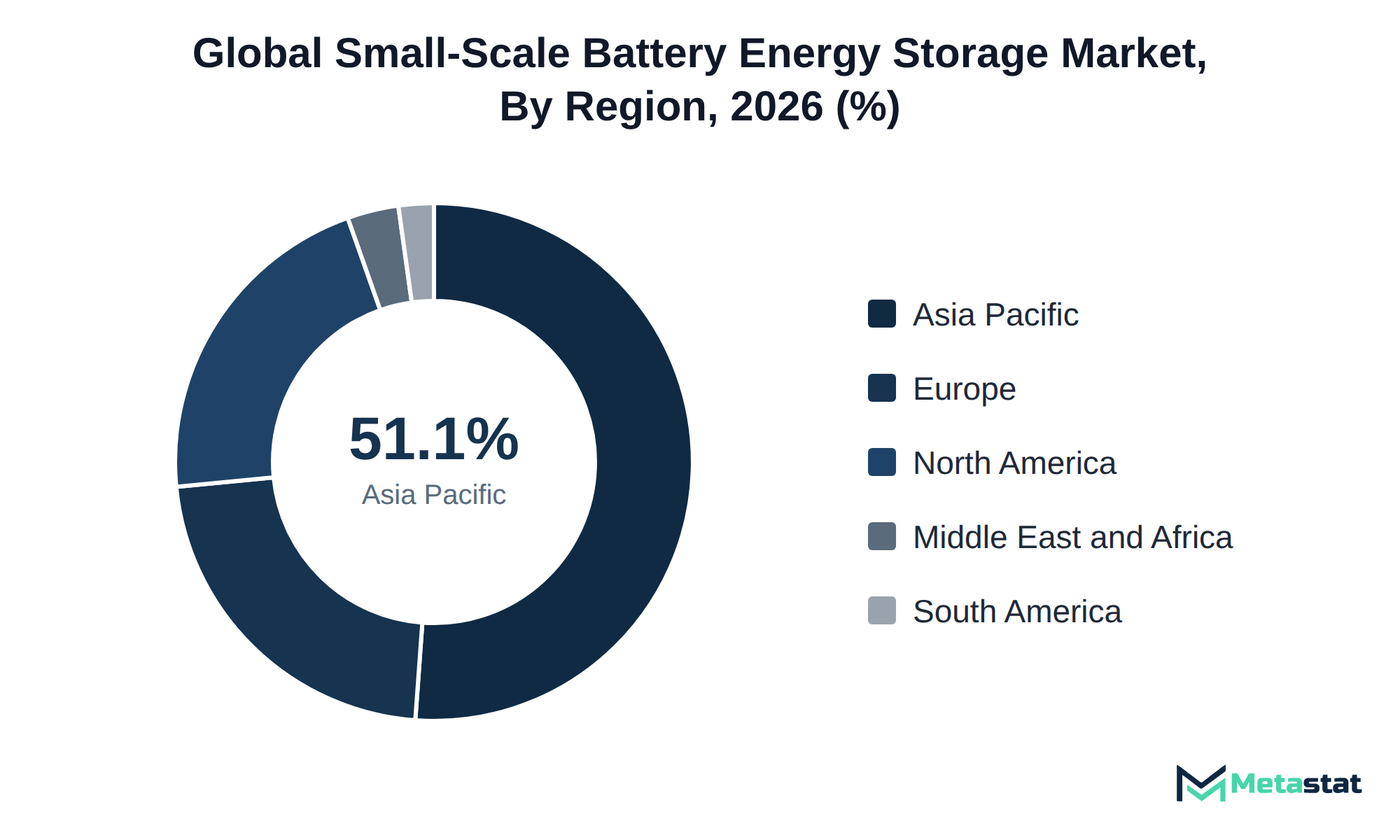
Geographic Lead: Asia Pacific holds the largest market share at 51.1%, fueled by the rise of renewable energy installations and the need for energy storage solutions.
What's Inside: The report provides a comprehensive analysis of market dynamics, competitive landscape, and forecasts from 2026 to 2033, covering various battery types and end-user segments.
Rising Demand from Residential Users: The residential segment is expected to grow significantly, reaching USD 13.5 billion by 2033, as homeowners prioritize energy independence and cost savings.
Growth in Others Battery Segment: The Others segment, including sodium-ion and nickel-based batteries, is projected to grow at a CAGR of 28.3%, reflecting increasing demand for alternative energy storage solutions.
Choose Your License
Global Small-Scale Battery Energy Storage Market
The global Small-Scale Battery Energy Storage market was valued at USD 6.6 billion in 2025 and is projected to reach USD 28.5 billion by 2033, growing at a CAGR of 20.1% over the forecast period.
The Small-Scale Battery Energy Storage market encompasses various technologies designed to store energy on a smaller scale, making it suitable for residential, commercial, and industrial applications. Buyers invest in these systems to enhance energy reliability, reduce dependency on the grid, and capitalize on renewable energy sources. The growing awareness of climate change and the transition to sustainable energy solutions drives adoption across multiple sectors.
Significant growth in the market is fueled by the increasing demand for efficient energy storage solutions. Lithium-Ion Batteries represent the segment with the highest value, driven by their efficiency and versatility. In terms of regional distribution, Asia Pacific commands the largest share, accounting for 51.1% of the market. North America holds 21.1% of the market in 2025, with the US leading in 2026.
Rising renewable energy installations and the need for storage systems drive market expansion. The ongoing shift towards decentralized energy models encourages investment in small-scale battery energy storage technologies. This trend enhances operational efficiency and supports the integration of renewable sources, positioning the market for growth in the coming years.
The Small-Scale Battery Energy Storage market includes a diverse range of battery technologies, including lithium-ion, lead-acid, and flow batteries, catering to various applications across different sectors. Buyers invest in these systems mainly for reliable and sustainable energy solutions. This trend is evident in residential and commercial segments, where the ability to store energy for later use enhances energy independence and reduces reliance on traditional power sources.
Growth in the market is propelled by several factors, with a significant driver being the increasing adoption of renewable energy sources. This transition encourages consumers and businesses to invest in storage solutions that maximize the benefits of solar, wind, and other renewable technologies. Among the segments, lithium-ion batteries hold the largest market value, while Asia Pacific stands out with a share of 51.1%. The market in North America is projected to account for 21.1% in 2025, with the US leading in 2026.
The expansion of electric vehicles and the need for energy efficiency further fuel demand for small-scale battery systems. These storage solutions not only support grid resilience but provide backup power during outages, enhancing their appeal across various end-user segments. Ongoing battery innovation and falling costs position the Small-Scale Battery Energy Storage market for significant growth.
Adoption of Lithium Iron Phosphate (LFP) batteries in the Small-Scale Battery Energy Storage market moves the segment towards safer and more efficient storage. LFP batteries offer higher thermal stability and a longer lifecycle compared to traditional lithium-ion options. While the market develops, the expected growth rate for LFP batteries stands at a compound annual growth rate (CAGR) of 20.4% from 2026 to 2033, indicating robust demand from various sectors.
The modular design inherent in many small-scale systems enhances installation flexibility and scalability, catering to diverse user needs. Systems employing modular LFP batteries allow for easy expansion, enabling users to increase storage capacity incrementally. This modularity appeals to residential and commercial applications, where energy requirements fluctuate over time. The market's growth trajectory aligns with increasing awareness of energy independence and sustainability initiatives, driving investments in advanced energy storage technologies.
LFP batteries and modular designs improve the performance and reliability of energy storage systems, giving stakeholders a competitive edge in the Small-Scale Battery Energy Storage market.
The payback period for commercial battery storage systems under time-of-use tariffs reflects significant financial implications for businesses. Time-of-use tariffs incentivize energy usage during off-peak hours when electricity rates are lower, allowing companies to store energy and use it when demand peaks and prices increase. In the Small-Scale Battery Energy Storage market, the anticipated shift towards higher adoption rates necessitates an understanding of economic models that influence these investments.
In 2026, energy storage systems including lithium-ion batteries, which represent a key technology in the sector, are expected to generate substantial savings through reduced energy costs. The market projects a revenue increase from USD 7.1 billion in 2026 to USD 26.2 billion by 2033 for lithium-ion batteries. This growth highlights the potential for businesses investing in commercial battery storage to realize significant returns tied to optimized energy consumption patterns.
Effective contract models, including leasing and power purchase agreements, enhance accessibility for buyers looking to invest in these systems. By negotiating terms that align with their operational needs, businesses achieve greater financial flexibility and cost predictability. In this context, time-of-use tariffs make battery storage more viable for energy-conscious businesses, supporting sustained growth and competitiveness.
Participation in virtual power plants (VPPs) offers significant advantages for residential battery systems, driving increased adoption among homeowners. By integrating these systems into VPPs, users contribute to energy management and grid stability while benefiting from compensation for their participation. In the Small-Scale Battery Energy Storage market, residential users are increasingly drawn to this concept, given the anticipated value of USD 13.5 billion for the residential segment by 2033.
This financial incentive encourages households to invest in battery energy storage solutions, facilitating a transition towards cleaner energy sources. Participation in VPPs improves the economics of residential energy storage by letting homeowners sell excess energy back to the grid. With the residential sector projected to grow at a compound annual growth rate (CAGR) of 18.2% between 2026 and 2033, the integration of battery systems into VPPs represents a crucial opportunity for expansion.
Residential users who want to maximize the benefits of their storage find VPP participation attractive. This trend supports the financial objectives of individual homeowners and aligns with broader energy sustainability goals. Increased demand for residential battery systems contributes to the overall growth of the market.
A precise sizing of battery storage systems is essential in optimizing solar self-consumption and backup capabilities. For residential applications, a crucial metric involves the energy capacity of the battery system. In the Small-Scale Battery Energy Storage market, the segment categorized as "Below 100 kWh" is anticipated to grow from USD 4.2 billion in 2026 to USD 13.5 billion by 2033, reflecting a compound annual growth rate of 18.2%. This segment primarily attracts homeowners seeking to match their energy storage needs with solar generation capacity, thus maximizing their return on investment.
When sizing battery storage for solar self-consumption, users should consider their daily energy consumption patterns alongside peak solar generation periods. A properly sized system enables homeowners to store energy during periods of high demand or low solar generation, resulting in significant energy savings. The increasing adoption of battery systems within this energy capacity segment demonstrates a growing awareness among buyers of the value of optimizing self-consumption. Investment in appropriately sized battery systems enhances energy independence and contributes positively to overall financial performance.
Residential users increasingly invest in small-scale battery energy storage systems to enhance energy independence and manage costs associated with electricity consumption. This shift stems from rising electricity prices and a greater focus on sustainability. While these users prioritize energy efficiency and self-consumption, demand for storage solutions grows significantly. In 2025, the market recorded a value of USD 6.6 billion, reflecting strong interest from residential buyers seeking reliable energy storage options. This trend is projected to continue, with the sector expected to reach USD 13.5 billion by 2033, driven by escalating demand and a more favorable purchasing landscape.
Buyers emphasize the benefits of energy storage systems in mitigating peak demand charges and effectively using renewable energy sources. These factors contribute to the sustained growth of the market, enhancing the attractiveness of small-scale battery energy storage solutions for residential applications.
Technological improvements in battery systems drive significant growth within the Small-Scale Battery Energy Storage market. Innovations in lithium-ion batteries enhance energy density and lifespan, enabling more efficient energy storage solutions. The development of sodium-ion and nickel-based batteries presents alternative options that cater to diverse applications, contributing to market expansion. Improved manufacturing techniques reduce production costs, allowing suppliers to offer competitive pricing. This shift attracts more consumers, particularly in residential and commercial sectors, where energy efficiency and sustainability remain priorities. Energy storage systems become more affordable and accessible, leading to rising adoption rates, particularly among users seeking reliable backup power and integration with renewable energy sources. These advancements support growth, sharpen competition, and encourage further investment in research and development within the energy storage sector. Ultimately, battery technology evolution is expected to shape future demand in the market.
High initial costs associated with Small-Scale Battery Energy Storage systems present a significant barrier for residential and commercial buyers. The price of advanced battery technologies, particularly lithium-ion and sodium-ion batteries, remains high, resulting in slower uptake among potential adopters. Buyers often face challenges in justifying the upfront investment, especially in regions with limited financial incentives or awareness of long-term savings. Consequently, smaller orders and delayed replacements arise, impacting overall market growth. While several segments, including utilities, possess the capital to invest, many residential users prioritize lower-cost alternatives or defer purchases altogether. This price sensitivity restricts market expansion and limits opportunities for innovative battery technologies to penetrate the broader consumer base.
Fluctuating input costs significantly challenge suppliers within the market. Variations in raw material prices, particularly for lithium and other essential components, lead to unpredictable profit margins. Suppliers face pressure to maintain competitive pricing while ensuring quality and performance standards in their products. These factors create a complex environment for pricing strategies and overall profitability.
In response, many suppliers focus on vertical integration to mitigate raw material costs and secure supply chains. This strategy enables firms to control production processes and reduce reliance on external suppliers. Investment in alternative materials and battery technologies helps diversify input sources, potentially lowering costs over time. Adopting these strategies positions suppliers to enhance competitive advantage while addressing profitability concerns inherent in the Small-Scale Battery Energy Storage market.
The segment of Others, which includes sodium-ion and nickel-based batteries, presents a notable opportunity within the market. This category is projected to experience a compound annual growth rate (CAGR) of 28.3% through 2033, driven by increasing demand for alternative battery technologies that address specific application needs. Adoption of these batteries is prevalent among innovative companies seeking to enhance energy storage solutions while diversifying their offerings. The rising interest in sustainable and efficient energy storage options aligns with the broader push toward renewable energy sources and carbon reduction initiatives. Consequently, the market is poised for significant expansion in the Others segment, appealing to both emerging startups and established players aiming to capture a share of this expanding market. Meeting the needs of residential and commercial end users will also support this growth.
The Global Small-Scale Battery Energy Storage market is segmented based on Battery Type, Energy Capacity, Connection Type, and End User.
Lithium-Ion Batteries segment is valued at USD 7.1 billion in 2026 and is projected to reach USD 26.2 billion by 2033, at a CAGR of 20.4% during the forecast period. This battery type serves a variety of applications, primarily in residential and commercial energy storage systems. The increasing demand for energy efficiency and renewable energy integration drives growth in this segment, particularly among consumers focused on reducing energy costs and enhancing energy independence. Compared to lead-acid and flow batteries, lithium-ion batteries exhibit a faster growth trajectory due to their higher energy density and longer lifespan, making them the preferred choice for residential users. In contrast to lead-acid batteries, which hold a CAGR of 10%, the lithium-ion battery segment outpaces others, highlighting its significant position in the market.
Lead-Acid Batteries segment is estimated to reach USD 1.1 billion by 2033, at a CAGR of 10% during the forecast period. This type of battery primarily serves in applications requiring reliable energy storage at a lower cost, often used by residential users and small commercial setups. Demand for Lead-Acid Batteries is supported by established technology and lower initial investment compared to alternatives. However, growth remains slower than other segments, with Lithium-Ion Batteries showing a higher CAGR of 20.4%. The preference for lithium-ion technology stems from greater energy density and longer lifespan, making it more appealing for larger-scale installations. In contrast, Lead-Acid Batteries maintain relevance due to affordability and adequate performance for less demanding applications, sustaining their position in the market despite competitive pressures.
Flow batteries are projected to reach USD 0.7 billion by 2033. This technology serves various applications, primarily in commercial and utility-scale settings, due to its scalability and longer discharge durations. Demand for flow batteries is driven by the growing need for energy storage solutions that enable integration of renewable energy sources into the grid. Compared to other battery types, flow batteries exhibit slower growth, focusing on specific use cases where their unique characteristics, including longer cycle life and flexibility in system design, provide advantages. This segment stands apart from lithium-ion and lead-acid batteries, which show higher growth rates and broader adoption across residential and commercial sectors. The market recognizes the potential of flow batteries in meeting energy storage needs, particularly in large-scale projects requiring reliable and durable solutions.
Others (Sodium-Ion and Nickel-Based Batteries) segment is projected to grow at a CAGR of 28.3% during the forecast period. This segment serves various applications, particularly in energy storage systems for residential and commercial use, where the focus on sustainable energy sources prevails. Increased interest in alternative battery technologies drives this growth, reflecting a shift toward lower-cost and environmentally friendly solutions. Compared to lithium-ion batteries, this segment offers a distinct advantage in terms of pricing and resource availability. While lithium-ion batteries experience a CAGR of 20.4%, sodium-ion batteries stand out with a more rapid expansion, appealing to cost-sensitive buyers aiming for efficient energy storage solutions. The market recognizes the potential of sodium-ion and nickel-based technologies to address specific needs within the energy storage ecosystem, contributing to the overall innovation trajectory.
Systems in this capacity range primarily serve residential users, facilitating energy storage for self-consumption and backup during outages. The increasing emphasis on energy independence drives demand, particularly in regions with unstable power supply or high energy costs. In comparison to other segments, the Below 100 kWh segment exhibits a higher growth rate due to its affordability and versatility, appealing to a broader customer base. The ongoing transition towards renewable energy sources further supports growth, with smaller systems integrating more seamlessly with solar and wind installations, enhancing the appeal of this segment.
The 100 kWh to below 500 kWh segment is estimated to reach USD 8.9 billion by 2033, at a CAGR of 21.3% during the forecast period. This capacity range primarily serves commercial and institutional users seeking to balance energy costs and improve efficiency. Demand in this segment is driven by increasing adoption of energy storage systems to support renewable energy integration and manage peak loads. Compared to the below 100 kWh segment, which holds a lower market value, this segment benefits from a higher average price point and attracts larger-scale buyers. The greater energy capacity allows for more substantial energy savings and operational benefits, distinguishing it from other segments within the market. Enhanced energy management and reduced reliance on grid power enhance the segment's appeal among consumers seeking sustainable energy solutions.
USD 3.6 billion is the anticipated value of the 500 kWh to below 1,000 kWh segment by 2033. This capacity range is often employed by commercial and industrial sectors seeking to balance energy supply and demand efficiently. Key drivers influencing this segment include rising energy costs and the push for sustainability. The adoption of larger battery systems within this capacity range allows users to store excess energy generated during peak production times and use it during high-demand periods, thereby optimizing operational efficiency. Compared to the Below 100 kWh and 100 kWh to below 500 kWh segments, this segment typically commands a higher price point due to the advanced technology involved and the scale of applications. Growth in this segment contributes significantly to the expanding Small-Scale Battery Energy Storage market, reflecting a broader trend toward energy independence and reliability.
The 1,000 kWh to 2,000 kWh segment is projected to grow at a CAGR of 23.2% during the forecast period. This segment targets large residential users and commercial entities seeking substantial energy storage solutions for increased energy independence and reliability. The segment's growth is driven by the increasing demand for high-capacity storage systems capable of supporting renewable energy integration and enhancing grid stability. Compared to other segments, including those with lower energy capacities, this segment shows faster growth due to its ability to meet the specific needs of industrial and commercial applications. The higher initial investment reflects the advanced technology and greater energy output associated with these systems, aligning with the broader trends of the Small-Scale Battery Energy Storage market. Investment in renewable energy sources continues to drive demand for larger energy capacity solutions.
Grid-Connected segment is valued at USD 6.7 billion in 2026 and is projected to reach USD 24.8 billion by 2033, at a CAGR of 20.6% during the forecast period. This segment primarily serves residential and commercial users, facilitating energy management and supporting renewable energy integration. Increased adoption of renewable energy sources, alongside heightened energy security concerns, drives growth in this segment. In contrast to the Off-Grid connection type, which typically experiences slower growth, Grid-Connected systems benefit from established infrastructure and regulatory incentives that promote energy efficiency. This segment's growth trajectory reflects a 20.6% CAGR, outpacing others, and highlights its attractiveness for investors and energy providers aiming to capitalize on the evolving energy landscape in the market.
Off-Grid segment is estimated to reach USD 3.6 billion by 2033, at a CAGR of 16.9% during the forecast period. Off-grid systems provide energy solutions for remote locations lacking reliable access to the electrical grid, catering primarily to residential and commercial users seeking energy autonomy. Increasing demand for sustainable energy sources and the need for backup power during outages drive growth in this segment. Compared to grid-connected systems, off-grid solutions often involve higher initial costs due to energy storage and renewable generation components. The lower penetration of off-grid storage aligns with a slower growth trajectory compared to grid-connected systems, which are projected to reach USD 24.8 billion by 2033 at a CAGR of 20.6%. The growth of the off-grid segment influences the overall dynamics of the small-scale battery energy storage market.
The residential segment is valued at USD 4.2 billion in 2026 and is projected to reach USD 13.5 billion by 2033, at a CAGR of 18.2% during the forecast period. This segment serves homeowners looking to optimize energy use, reduce reliance on the grid, and mitigate energy costs. Increasing concerns regarding energy reliability and sustainability strongly influence residential adoption. Compared to other segments, this category experiences growth driven by heightened consumer interest in renewable energy solutions and energy independence. The segment's growth rate surpasses that of commercial and industrial users, which face stricter regulatory challenges and higher initial investments. Residential users prioritize lower upfront costs and potential long-term savings, increasing demand for accessible energy storage solutions. The Small-Scale Battery Energy Storage market continues to evolve, with technological advancements and improving economics supporting broader adoption of these systems.
Commercial and Institutional segment is estimated to reach USD 8.4 billion by 2033, at a CAGR of 21.9% during the forecast period. This segment primarily serves businesses and organizations seeking to enhance energy efficiency and reduce operational costs through reliable energy storage solutions. Growing demand for sustainable energy practices and the shift towards renewable energy sources compels these users to adopt small-scale battery systems. Compared to other segments, including Residential, the Commercial and Institutional segment experiences faster growth, driven by higher energy consumption rates and a greater emphasis on sustainability. The escalating focus on energy independence further stimulates investment in these systems, ensuring a stable and efficient energy supply for various commercial applications.
The industrial segment is expected to reach USD 4.5 billion by 2033. This segment serves various industries that rely on substantial energy for production processes, including manufacturing and heavy industry. Increasing energy efficiency and reducing operational costs significantly drive demand for small-scale battery energy storage among industrial users. Compared to other segments, this sub-segment presents moderate growth, characterized by a different pricing structure and distinct operational requirements. The CAGR for this segment is not the highest among its counterparts; however, it remains essential for enhancing energy reliability and supporting sustainability goals. The market expands as industrial players seek to stabilize energy supply while managing costs effectively. The focus on energy transition and regulatory mandates continues to influence investments in energy storage technologies, ensuring that this sub-segment remains essential in the evolution of the small-scale battery energy storage market.
Utilities and Community Energy Operators segment is projected to grow at a CAGR of 22.3% during the forecast period. This segment serves energy providers and community organizations focused on enhancing energy reliability and supporting renewable integration. Growing investments in renewable energy sources drive demand, prompting utilities to implement utility-scale energy storage solutions for peak shaving and load shifting. The adoption of advanced battery technologies allows these operators to manage energy supply more efficiently. Compared to other end-user segments, this segment exhibits faster growth, driven by increasing regulatory support and infrastructure development aimed at supporting sustainable energy solutions. In contrast, sectors including residential and commercial users face more barriers related to upfront costs and technology adoption, influencing their growth rates in the market.
Based on geography, the Global Small-Scale Battery Energy Storage market is divided into North America, Europe, Asia-Pacific, South America, Middle East, and Africa.
Strong growth characterizes the Small-Scale Battery Energy Storage market in North America, driven by increasing demand from residential, commercial, and utility sectors. The regulatory environment supports adoption through incentives for renewable energy integration and energy independence. The United States, Canada, and Mexico play significant roles in advancing energy storage technologies, with a notable focus on lithium-ion batteries. North America is projected to reach USD 6.6 billion by the end of 2033, reflecting a robust compound annual growth rate of 20.1%. The region holds a significant share of the global market for small-scale energy storage in 2025. With advancements in grid-connected solutions, the market continues to evolve, addressing both energy efficiency and sustainability goals.
Europe holds a share of the Small-Scale Battery Energy Storage market, projected at 22.3% in 2025. The region's commitment to renewable energy transitions and policies promoting sustainable practices drive demand, particularly in countries like Germany, France, and the UK. The presence of advanced manufacturing capabilities and substantial investments in energy technology enhance growth prospects. Germany stands out with its ambitious energy transition strategy, while France focuses on nuclear integration alongside renewable sources. The market evolves rapidly in Italy and Spain due to rising residential adoption. Russia's market is influenced by governmental initiatives aimed at increasing energy independence. Overall, the region's diverse end users, including residential and commercial sectors, support a robust market environment.
Asia-Pacific dominates the small-scale battery energy storage market, capturing 51.1% of global share in 2025. Countries including China, Japan, and India lead demand due to rapid industrialization and increasing energy needs. Significant investments in renewable energy infrastructure drive the adoption of energy storage solutions, particularly in grid-connected applications. Government initiatives in these nations focus on enhancing energy efficiency and promoting sustainable practices, creating a conducive environment for market growth. The region's diverse economies contribute to varied demand dynamics, with Australia and Southeast Asia experiencing notable shifts toward residential and commercial energy storage solutions. This market experiences strong growth, reflecting the region's important role in advancing energy storage technologies.
Demand for small-scale battery energy storage in South America primarily originates from residential and commercial sectors, with Brazil and Argentina leading in adoption. The market benefits from increased interest in renewable energy solutions, particularly solar power. Regional initiatives focusing on energy independence contribute to market growth, although infrastructure challenges persist. Price sensitivity among consumers drives interest in cost-effective solutions, further influencing market dynamics. By 2025, South America holds a projected share of 2.2% in the global market, reflecting growing engagement with energy storage solutions.
Demand for the Small-Scale Battery Energy Storage market in the Middle East and Africa is driven by increasing adoption in residential and commercial sectors. Key countries in this region, including Saudi Arabia, UAE, and South Africa, focus on enhancing energy security and integrating renewable sources. The region's unique infrastructure challenges and varying access to grid services create opportunities for off-grid and residential energy storage solutions. The market share for this region is projected at 3.2% in 2025, reflecting a gradual increase in awareness and investment in energy storage technologies over the forecast period. Local manufacturers and international players collaborate to meet the emerging needs of the market, aligning with global trends toward sustainable energy solutions.
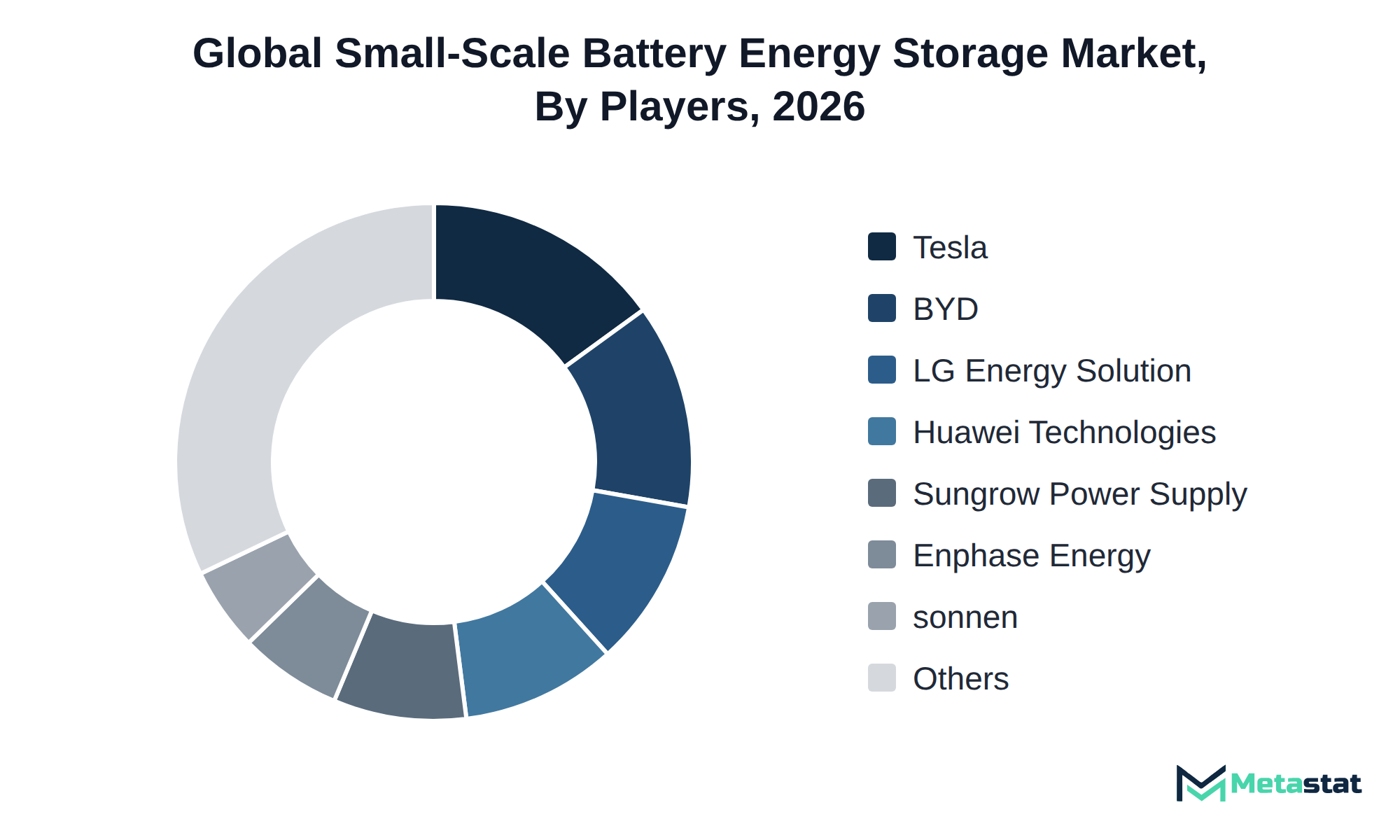
The Small-Scale Battery Energy Storage market exhibits diverse competitive strategies among key players, categorized primarily by technology focus and customer engagement. Companies like Tesla, Inc. and LG Energy Solution, Ltd. concentrate on lithium-ion batteries, emphasizing high efficiency and long lifespans. In contrast, BYD Company Limited and Huawei Technologies Co., Ltd. leverage their extensive experience in manufacturing and technological innovation to cater to both residential and commercial sectors.
Buyers in the market prioritize factors including price, certification, customization, and service quality when selecting battery energy storage solutions. Companies like sonnen GmbH focus on creating integrated energy ecosystems that enhance user experience, while firms including Generac Power Systems, Inc. and Schneider Electric SE emphasize providing reliable support and maintenance services. This buyer-centric approach influences market dynamics, driving competition among manufacturers while seeking to differentiate their offerings within the Small-Scale Battery Energy Storage market.
The growth trajectory relies on several developments within the Small-Scale Battery Energy Storage market. First, adoption of lithium-ion batteries drives demand, with a projected CAGR of 20.4% from 2026 to 2033. Growth in the residential sector, where the energy capacity below 100 kWh will see significant uptake, represents another critical factor, with a CAGR of 18.2% anticipated. Expansion in the Asia Pacific region, which holds the largest market share at 51.1%, supports the overall growth potential. Challenges exist; supply chain disruptions hinder progress, leading to delays in product availability and increased costs. Such risks impact the projected growth rate across segments, particularly in grid-connected applications, where the market faces heightened competition. Overall, the combination of advancing technology, regional growth, and market dynamics shapes the future of the Small-Scale Battery Energy Storage market.
By Battery Type: Lithium-Ion Batteries, Lead-Acid Batteries, Flow Batteries, Others (Sodium-Ion and Nickel-Based Batteries)
By Connection Type: Grid-Connected, Off-Grid
By End User: Residential, Commercial and Institutional, Industrial, Utilities and Community Energy Operators
The report strategically identifies and profiles the key market players and analyses their core competencies in each sub-segment of the Small-Scale Battery Energy Storage market.
Report Attributes | Details |
Study Period | 2021-2033 |
Base Year | 2025 |
Estimated Year | 2026 |
Forecast Period | 2026-2033 |
Historical Period | 2021-2025 |
Growth Rate | CAGR 20.1% from 2026 to 2033 |
Revenue Unit | USD billion |
Segmentation | By Battery Type, Energy Capacity, Connection Type, End User, and Region |
By Region | North America (By Battery Type, Energy Capacity, Connection Type, End User, and Country)
|
Europe (By Battery Type, Energy Capacity, Connection Type, End User, and Country)
| |
Asia Pacific (By Battery Type, Energy Capacity, Connection Type, End User, and Country)
| |
South America (By Battery Type, Energy Capacity, Connection Type, End User, and Country)
| |
Middle East and Africa (By Battery Type, Energy Capacity, Connection Type, End User, and Country)
|
Find answers to common questions about this report
The Small-Scale Battery Energy Storage market size was valued at USD 6.6 billion in 2025.
The market is projected to grow at a CAGR of 20.1% during the forecast period from 2026 to 2033.
The North America Small-Scale Battery Energy Storage market size is estimated to reach USD 6.6 billion by 2033.
Lithium-Ion Batteries lead the Small-Scale Battery Energy Storage market with a projected value of USD 26.2 billion by 2033, reflecting the highest growth rate among battery types at a CAGR of 20.4%.
Rising electricity prices and a greater focus on sustainability drive demand for small-scale battery energy storage systems. Technological advancements in battery systems, particularly lithium-ion innovations, enhance energy density and lifespan, contributing to market expansion.
High initial costs associated with small-scale battery energy storage systems present a significant barrier for residential and commercial buyers. Fluctuating input costs create challenges for suppliers, leading to unpredictable profit margins and complicating pricing strategies.
Several factors favor adoption in the Small-Scale Battery Energy Storage industry, including rising electricity prices and a growing emphasis on sustainability. Technological advancements in battery systems enhance energy efficiency and reduce costs, making these solutions more attractive to residential and commercial users.
The Small-Scale Battery Energy Storage market is estimated to reach a valuation of USD 28.5 billion by 2033.
Key players operating in the Small-Scale Battery Energy Storage market include Tesla, Inc., BYD Company Limited, Huawei Technologies Co., Ltd., LG Energy Solution, Ltd., Enphase Energy, Inc., sonnen GmbH, and Panasonic Holdings Corporation.
The Lead-Acid Batteries segment is expected to reach a value of USD 1.1 billion by 2033.
The analysts below cover Energy and Power research at Metastat Insights.
LEAD ANALYST
Utkarsh Khirodkar is a Lead Market Research Analyst at MetaStat Insight, specializing in market intelligence, technology sector assessments, and competitive strategy.

PRINCIPAL CONSULTANT - ENTERPRISE AI & EMERGING TECHNOLOGIES
Banking & Finance · Electronics and Semiconductor · Energy and Power · Healthcare IT · Information & Technology · Professional Services
Vijay Gunti is a Principal Consultant at MetaStat Insight, bringing over two decades of experience across enterprise digital transformation, technology strategy, and intelligent systems.

ENERGY & INFRASTRUCTURE INDUSTRY CONSULTANT
Automotive and Transportation · Electronics and Semiconductor · Energy and Power · Machinery & Equipment
Saurabh Vasant Ganvir consults for Energy & Infrastructure Industry at MetaStat Insight, specializing in renewable energy, solar EPC, and electric vehicle (EV) infrastructure markets.
Integrating zero-trust access controls across legacy electronic health record systems involves complex compliance overhead. Team produced an analysis that clearly separated identity governance and administration tools from privileged access management platforms. Their evaluation of HIPAA and GDPR compliance features across cloud native solutions gave our architecture group clear baseline criteria. The custom data request regarding biometric authentication adoption in hospital networks was returned promptly with clear documentation.
Evaluating calorific value requirements and air permit compliance across municipal waste facilities requires localized data. Metastat Insight structured their analysis around operational throughput capacity and feedstock composition variations in Latin America and Eastern Europe. Their competitive mapping of sorting equipment vendors helped clarify technology differences between optical separators and heavy media systems. The study provided an objective baseline during our capital expenditure reviews.
Decarbonizing industrial thermal processes hinges on refrigerant regulations and compressor efficiency limits. Metastat Insights delivered a thorough market analysis that evaluated natural refrigerants like CO2 and hydrocarbons against synthetic low-GWP alternatives. The breakdown of utility incentives and grid capacity constraints across key European manufacturing hubs offered valuable perspective. The follow-up conversation with their sector analysts addressed our specific questions on mechanical vapor recompression systems efficiently.
Explore related market intelligence reports worth reading alongside this one.
Starting from
$2950