
LEAD ANALYST
Utkarsh Khirodkar is a Lead Market Research Analyst at MetaStat Insight, specializing in market intelligence, technology sector assessments, and competitive strategy.

Biosafety Cabinet Market By Type (Class I Biosafety Cabinets, Class II Biosafety Cabinets, and Class III Biosafety Cabinets), By End-Users (Pharmaceuticals, Biopharmaceuticals Companies, Research, Academic Institutions, Diagnostic and Testing Laboratories), Industry Analysis, Size, Share, Growth, Trends, and Forecast, 2024-2031
Report ID
MSI-2554
Published
February, 2026
Pages
254 Pages
Format
Report Details
Choose Your License
Biosafety Cabinet Market
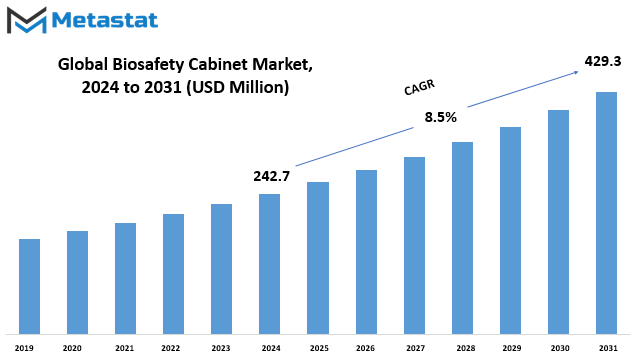
The Global Biosafety Cabinet market is estimated to reach $429.3 Million by 2031; growing at a CAGR of 8.5% from 2024 to 2031.
In laboratory safety, the Global Biosafety Cabinet market emerges as a critical component, safeguarding both scientific endeavors and human health. As science advances at an unprecedented pace, the biosafety cabinet industry plays a pivotal role in ensuring the secure handling of hazardous materials, thus contributing to the overall safety and integrity of laboratory environments worldwide.
The Global Biosafety Cabinet market, intricately woven into the fabric of laboratory safety, represents a diverse spectrum of products designed to shield researchers and scientists from potential biohazards. These cabinets are not mere tools; they are the unsung heroes in laboratories where breakthroughs and innovations take shape. The industry encapsulates an array of cutting-edge solutions, each meticulously crafted to cater to the unique needs and challenges posed by various laboratory settings. Global Biosafety Cabinet market lies a commitment to creating a haven for researchers engaged in activities that involve the handling of infectious agents or potentially harmful materials. These cabinets function as an impermeable barrier, preventing the escape of harmful substances and ensuring that laboratory personnel can work with confidence, knowing that their well-being is prioritized.
In the multifaceted landscape of the biosafety cabinet industry, diverse players converge, contributing to the development and innovation of these critical safety apparatuses. Manufacturers, driven by a collective dedication to excellence, continuously refine and enhance biosafety cabinet designs, integrating state-of-the-art technologies to meet the evolving demands of modern laboratories.
The global biosafety cabinet market is not confined to a specific region; rather, it permeates across continents, responding to the universal need for heightened safety measures in laboratories worldwide. From research institutions to pharmaceutical companies, the demand for reliable biosafety cabinets transcends borders, highlighting the global significance of this indispensable industry.
Moreover, the industry operates in a realm where regulatory compliance is paramount. Governments and international organizations set stringent standards to ensure the efficacy of biosafety cabinets in mitigating risks associated with laboratory work. Manufacturers, in turn, navigate this regulatory landscape with precision, aligning their products with global safety standards to provide laboratories with compliant and effective solutions.
The Global Biosafety Cabinet market and its industry stand as guardians of laboratory safety, fostering an environment where scientific exploration can thrive without compromising the well-being of those on the frontlines. Beyond being a market, it is an integral part of the scientific community's commitment to excellence, safety, and progress, symbolizing a collective dedication to advancing knowledge while safeguarding humanity from the potential hazards that come with scientific discovery.
The global Biosafety Cabinet market is influenced by various factors that contribute to its growth. Two prominent drivers are the increasing emphasis on laboratory safety and the expansion in biotechnology and pharmaceutical research. These aspects underscore the importance of biosafety cabinets in ensuring a secure and controlled environment for various laboratory activities.
The heightened awareness and prioritization of laboratory safety have become pivotal in driving the demand for biosafety cabinets worldwide. As scientific advancements continue, the need for stringent safety measures in laboratories becomes more apparent. Biosafety cabinets play a crucial role in creating a secure workspace, preventing contamination, and safeguarding both researchers and the environment.
Simultaneously, the growth in biotechnology and pharmaceutical research amplifies the demand for biosafety cabinets. These cabinets are integral to maintaining the integrity of experiments and protecting valuable research materials. As the global focus on advancements in these fields intensifies, the market for biosafety cabinets is propelled forward.
However, despite these positive aspects, challenges exist that could impede the market's growth trajectory. One such obstacle is the high initial cost associated with acquiring biosafety cabinets. The financial investment required can be a deterrent for laboratories, particularly those with limited budgets. Additionally, stringent regulatory requirements add another layer of complexity, potentially slowing down the adoption of biosafety cabinets.
Looking forward, the Asia-Pacific region emerges as a promising arena for the biosafety cabinet market. The burgeoning biotechnology and pharmaceutical industries in this region present lucrative opportunities for growth. As economies in Asia-Pacific continue to evolve, the demand for advanced laboratory equipment, including biosafety cabinets, is anticipated to rise, contributing significantly to the market's expansion in the coming years.
The global Biosafety Cabinet market witness's growth propelled by the increasing emphasis on laboratory safety and the expanding biotechnology and pharmaceutical research sector. While challenges such as high initial costs and regulatory requirements persist, the outlook remains optimistic, with the Asia-Pacific region poised to become a key player in driving market opportunities.
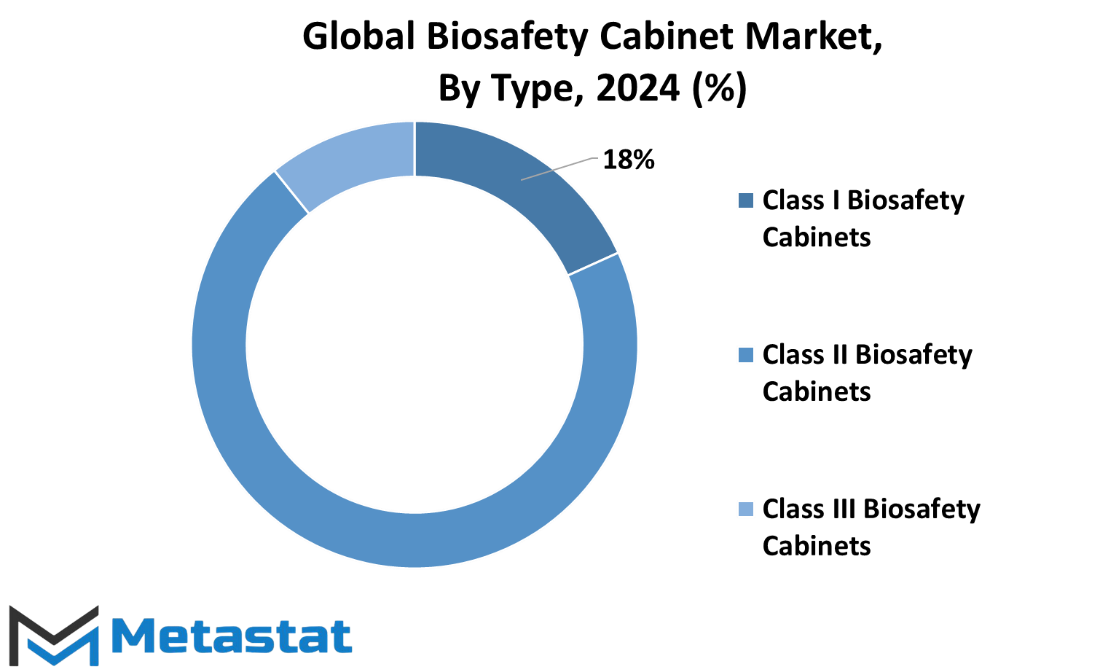
The global Biosafety Cabinet market is a dynamic landscape, presenting a variety of options for consumers. The market is divided into different types, namely Class I Biosafety Cabinets, Class II Biosafety Cabinets, and Class III Biosafety Cabinets.
These classifications play a crucial role in meeting the diverse needs of users. Class I Biosafety Cabinets, for instance, are designed to protect the environment and the user, making them suitable for low to moderate-risk agents. However, Class II Biosafety Cabinets offer a higher level of protection by shielding the user and maintaining a sterile work environment. This makes them suitable for working with moderate to high-risk agents.
In contrast, Class III Biosafety Cabinets are the pinnacle of containment, providing maximum protection to both the user and the environment. They are typically used in situations involving highly hazardous materials and ensure complete isolation from the surrounding atmosphere.
Understanding these distinctions is vital for users looking to make informed decisions based on their specific requirements. The diversity within the Biosafety Cabinet market allows for a tailored approach to safety, ensuring that users can choose the level of protection that aligns with their work environment and the nature of the materials they handle.
As the market continues to evolve, the availability of these distinct types of Biosafety Cabinets reflects an industry that is responsive to the varied needs of users. This adaptability ensures that researchers and professionals in different fields can access the appropriate safety measures, contributing to a safer and more efficient working environment.
The global Biosafety Cabinet market's segmentation into Class I, Class II, and Class III Biosafety Cabinets offers users a spectrum of options. This diversity empowers individuals to select the level of protection that best suits their specific requirements, highlighting the market's commitment to providing effective and tailored safety solutions.
In biosafety cabinets, various end-users play a pivotal role in shaping the market landscape. One significant category comprises Pharmaceuticals and Biopharmaceuticals Companies, collectively contributing a substantial value of 131.6 USD Million in the year 2023. This segment represents a key player in the utilization of global biosafety cabinets, emphasizing the importance of safety measures within pharmaceutical and biopharmaceutical settings.
Another noteworthy group influencing the market is Research and Academic Institutions, which held a value of 68.9 USD Million in 2023. These institutions, deeply engaged in scientific exploration and educational endeavors, contribute significantly to the demand for biosafety cabinets. Their role in maintaining a secure environment aligns with the broader objective of ensuring safety and adherence to standards in laboratory practices.
Diagnostic and Testing Laboratories form yet another integral sector, with a valuation of 25.4 USD Million in 2023. These laboratories, focused on critical diagnostic processes and testing procedures, underscore the diverse applications of biosafety cabinets. Their contribution reflects the broader spectrum of biosafety measures, extending beyond the pharmaceutical and academic domains.
As we assess the market dynamics, it becomes evident that these distinct end-user segments represent diverse facets of biosafety cabinet utilization. From pharmaceutical advancements to academic research and diagnostic pursuits, the demand for these cabinets underscores a shared commitment to safety across various sectors. This intricate interplay of end-users not only drives market growth but also highlights the essential role biosafety cabinets play in maintaining secure environments conducive to scientific progress and diagnostic accuracy.
In examining the global Biosafety Cabinet market, it's essential to conduct a regional analysis to understand its distribution across various parts of the world. Geographically, this market is segmented into North America, Europe, and Asia-Pacific.
Firstly, North America plays a significant role in the Biosafety Cabinet market. The region's advanced healthcare infrastructure and stringent safety regulations contribute to the demand for these cabinets. As research and development activities continue to thrive in North America, the need for effective biosafety measures becomes paramount, driving the market for biosafety cabinets.
Moving on to Europe, a notable presence is observed in the Biosafety Cabinet market. European countries, with their well-established pharmaceutical and biotechnology sectors, exhibit a consistent demand for biosafety cabinets. The emphasis on maintaining a secure environment in laboratories and healthcare facilities further fuels the market growth across the continent.
In the Asia-Pacific region, the Biosafety Cabinet market showcases dynamic growth. The increasing awareness of biosafety protocols and the expansion of healthcare infrastructure in countries like China and India contribute to the market's upward trajectory. As these nations witness a surge in research and development activities, the demand for biosafety cabinets rises proportionally.
The global Biosafety Cabinet market's regional analysis reveals distinctive trends across North America, Europe, and Asia-Pacific. While North America benefits from its advanced healthcare system, Europe thrives on a well-established pharmaceutical sector, and Asia-Pacific experiences robust growth due to increasing awareness and expanding healthcare infrastructure. Understanding these regional dynamics is crucial for stakeholders and businesses navigating the diverse landscape of the Biosafety Cabinet market.
The global Biosafety Cabinet industry is marked by the presence of several key players, each contributing to the advancement and innovation within the sector. These companies play a crucial role in shaping the landscape of Biosafety Cabinet technologies and solutions.
Among the notable participants in the industry are Air Science USA LLC, Azbil Telstar, Berner International GmbH, Biobase Biodusty (Shandong), Co., Ltd., Biolab Scientific Limited, Cruma S.A., Erlab - Noroit, Esco Micro Pte. Ltd., Faster S.R.L, Germfree Laboratories, Inc., Haier Biomedical, Kewaunee Scientific Corporation, Labconco Corporation, LaboGene A/S., Lamsystems GmbH, NuAire, Inc., The Baker Company, Inc., and Thermo Fisher Scientific, Inc.
These competitive players bring diverse expertise and technological capabilities to the table, driving innovation and meeting the evolving needs of the Biosafety Cabinet market. Their collective efforts contribute to the continuous improvement and development of biosafety solutions, ensuring a high standard of safety and protection in various laboratory settings.
In navigating the Biosafety Cabinet industry, it is evident that these companies operate in a dynamic and competitive environment. The presence of such diverse players fosters healthy competition, encouraging the continual enhancement of Biosafety Cabinet technologies. As a result, end-users benefit from a range of options and solutions tailored to their specific requirements.
The Biosafety Cabinet industry thrives on the contributions of these key players, each playing a vital role in shaping the trajectory of biosafety technologies. Their collective efforts contribute to the overall advancement and reliability of Biosafety Cabinets, ensuring a safer and more efficient working environment for laboratories worldwide.
Find answers to common questions about this report
Global Biosafety Cabinet market is valued at $242.7 million in 2024.
Global Biosafety Cabinet market is estimated to grow with a CAGR of 8.5% from 2024 to 2031.
Global Biosafety Cabinet market is estimated to reach $429.3 million by 2031.
Top players operating in the Biosafety Cabinet industry includes Air Science USA LLC, Azbil Telstar, Berner International GmbH, Biobase Biodusty (Shandong), Co., Ltd., and others.
The analysts below cover Medical Devices research at Metastat Insights.
LEAD ANALYST
Utkarsh Khirodkar is a Lead Market Research Analyst at MetaStat Insight, specializing in market intelligence, technology sector assessments, and competitive strategy.

LEAD PRINCIPAL ANALYST, PHARMA AND HEALTHCARE
Food and Beverages · Healthcare · Healthcare IT · Medical Devices
Ajay Devgire is the Lead Healthcare Analyst at MetaStat Insight, leading strategic research and market intelligence initiatives across the global healthcare domain.

SENIOR RESEARCH ANALYST
Biotechnology · Food and Beverages · Medical Devices · Packaging
Snehal Pasalkar is a Research Analyst at MetaStat Insight, operating at the intersection of life sciences research, competitive strategy, and market intelligence.
Assessing commercial microgrid software adoption requires looking past top-level installation numbers and examining utility interconnection queues. The research provided verifiable data on average permitting timelines, tariff structures, and battery storage integration costs across regional utility territories. That grounded perspective was valuable for our team when building five-year demand projections for industrial microgrid controllers.
Ambulatory surgical centers have very different purchasing cycles for robotic-assisted surgery platforms than major hospital networks. The MetaStat Insight study focused squarely on capital expenditure depreciation, procedural reimbursement pathways, and surgeon training overhead. That operational clarity made it much simpler to validate multi-year procedure growth forecasts against actual ambulatory center adoption patterns.
When planning edge sensor rollouts across refinery environments, generic IoT reports typically miss the harsh-environment certification bottlenecks. MetaStat Insight gave an objective evaluation of ATEX and Class 1 Division 2 hardware availability, along with realistic five-year maintenance cycle cost projections. The comparison of wireless mesh versus private cellular backhaul helped our team pressure-test network reliability models for remote processing facilities.
Explore related market intelligence reports worth reading alongside this one.