
LEAD ANALYST
Utkarsh Khirodkar is a Lead Market Research Analyst at MetaStat Insight, specializing in market intelligence, technology sector assessments, and competitive strategy.

Global BiPAP Machines Market Size, Share, By Type (Auto BiPAP and BiPAP ST), By Application (Chronic Obstructive Pulmonary Disease (COPD), Sleep Apnea, Asthma, and Others), By Age Group (Adult and Pediatric), By End User (Hospitals, Ambulatory Surgical Centers, and Home Care), Industry Analysis, Growth, Trends, and Forecast, 2026-2033
Report ID
MSI-2392
Published
February, 2026
Pages
310 Pages
Format
Report Details
Choose Your License
BiPAP Machines Market
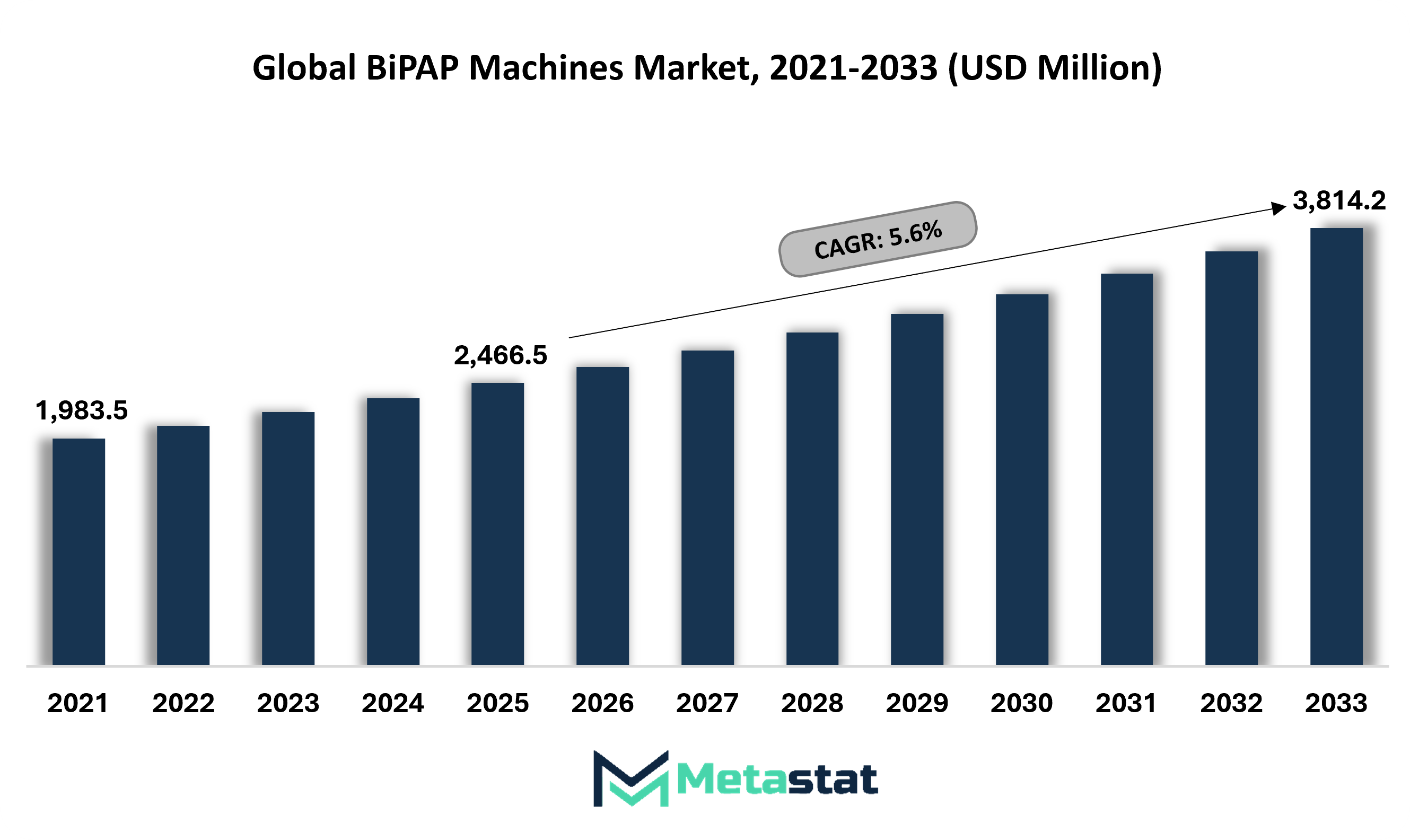
Global BiPAP Machines market size is valued at USD 2466.5 million in 2025 and projected to grow at a CAGR of 5.6% during the forecast period, reaching USD 3814.2 million by 2033.
North America holds 36.8% in 2025 with US leading the market share in 2026.
BiPAP machine is a non-invasive therapy for patients suffering from sleep apnea, chronic obstructive pulmonary disease (COPD), asthma, and others. BiPAP machine provides pressurized air through a mask to the patient's airways. The air pressure helps the throat muscles from collapsing and reducing obstructions. BiPAPs can also be helpful for cardiopulmonary disorders such as congestive heart failure.
Rising prevalence of COPD, asthma, sleep apnea and other respiratory diseases is a key driving factor of the market. According to the World Health Organization (WHO), globally, there are more than 251 million cases of COPD in 2018. Globally, 3.17 million died due to COPD in 2018. More than 90% of COPD deaths occur in low and middle-income countries. According to the World Health Organization (WHO), in 2019, more than 339 million people are living with asthma, with 80% of deaths occur in low and lower middle-income countries. According to the World Health Organization (WHO), in 2018, more than 936 million are affected by sleep apnoea globally. In 2018, more than 175 million people in Europe had sleep apnoea. BiPap help to improve breathing problem. BiPap are used for the following conditions such as chronic obstructive pulmonary disorder (COPD), obstructive sleep apnea, asthma, obesity hypoventilation syndrome, pneumonia, poor breathing after an operation, and others. However, the side effects of the BiPAP machines might hamper market growth. The most common side effects of BiPAP therapy are the dry nose, nasal congestion, rhinitis, general discomfort, claustrophobia and in some most serious cases worsening lung function or injury. Moreover, government initiatives and support for respiratory devices that aid breathing would provide lucrative opportunities for the market in the coming years.
The global BiPAP machines market is mainly classified based on type, application, and end user. Type is further segmented into Auto BiPAP and BiPAP ST. By application, the market is divided into Chronic Obstructive Pulmonary Disease (COPD), Sleep Apnea, Asthma, and Others. By end user, the market is further divided into Hospitals, Ambulatory Surgical Centers, and Home Care.
Based on application sleep apnea was dominating the global BiPAP machines market in 2019, owing to the rising number of patients using breathing aid for sleep apnea, research and development activities to develop BiPAP machines for sleep apnea, and commercialization of new BiPAP machines for sleep apnea. For instance, Medequip Healthcare Solutions, manufacturer and importer of healthcare products, has introduced Hypnus Oxymed CPAP and BiPAP devices for sleep apnea therapy. Hypnus Oxymed automatically adjusts supply pressure to provide natural breathing. Hypnus Oxymed monitors the patients breathing to ensure effective exhalation and inhalation using an algorithm.
Based on geography, the global BiPAP machines market is divided into North America, Europe, Asia-Pacific, South America, and Middle East & Africa. North America is further divided in the U.S., Canada, and Mexico, whereas Europe consists of the UK, Germany, France, Italy, and Rest of Europe. Asia-Pacific is segmented into India, China, Japan, South Korea, and Rest of Asia-Pacific. The South America region includes Brazil, Argentina, and the Rest of South America, while the Middle East & Africa is categorized into GCC Countries, Egypt, South Africa, and Rest of Middle East & Africa.
North America was dominating the global BiPAP machines market in 2019, due to the commercialization of new BiPAP machines and partnership between companies to distribute BiPAP machines at the global scale and rising incidents of sleep apnea in North American countries. For instance, According to the National Sleep Foundation, 50-70 million US adults have a sleep disorder and obstructive sleep apnea. In 2018, an estimate of 22 million Americans suffered from moderate to severe sleep apnea. According to the Public Health Agency of Canada, more than 5.4 million Canadian adults have obstructive sleep apnea.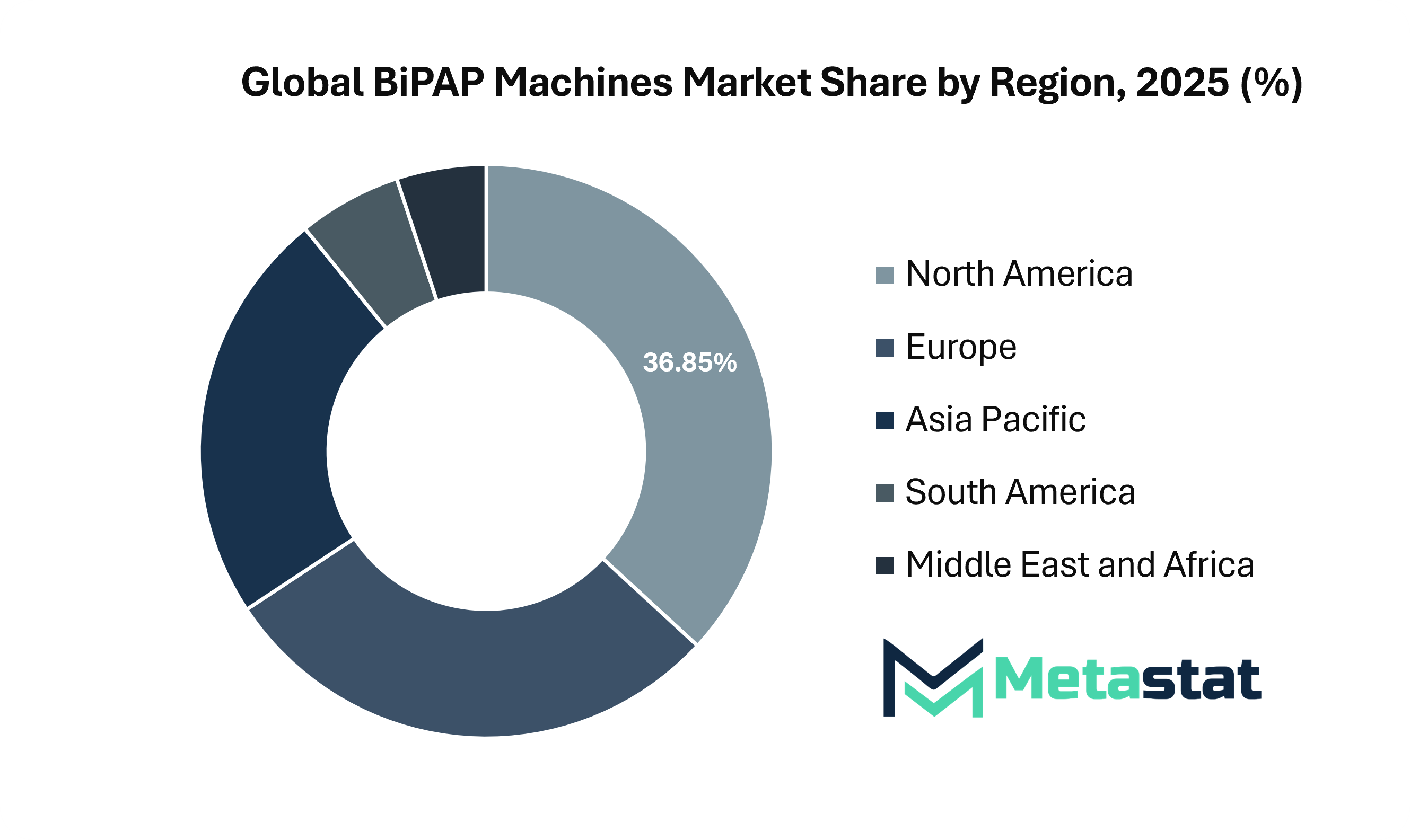
Key players operating in the BiPAP machines industry include ResMed, Philips, DeVilbiss Healthcare, Lowenstein Medical, 3B Medical, Hunan Beyond Medical, Respro India, and Nanotronics Imaging.
The increasing regulatory approval for BiPAP machines, the partnership between companies to develop and distribute BiPAP machines at the global scale, increasing studies on BiPAP machines by the companies, and commercialization of new BiPAP machines are some of the strategies adopted by the major companies. For instance, on June 11, 2020, Nanotronics has introduced nHale, a bi-level positive air pressure (BIPAP) device to support breathing adults weighing over 30 kg. The device has received Emergency Use Authorization (EUA) from the U.S. Food & Drug Administration (FDA) to assist patients suffering from COVID-19 disease. nHale is a noninvasive approach designed for patients in need of breathing assistance.
|
Report Attributes |
Details |
|
Study Period |
2021-2033 |
|
Base Year |
2025 |
|
Estimated Year |
2026 |
|
Forecast Period |
2026-2033 |
|
Historical Period |
2021-2025 |
|
Growth Rate |
CAGR 5.6% from 2026 to 2033 |
|
Revenue Unit |
USD million |
|
Sales Volume Unit |
Thousand Units |
|
Segmentation |
By Type, Application, Age Group, End User, and Region |
|
By Region |
North America (By Type, Application, Age Group, End User, and Country)
|
|
|
Europe (By Type, Application, Age Group, End User, and Country)
|
|
|
Asia Pacific (By Type, Application, Age Group, End User, and Country)
|
|
|
South America (By Type, Application, Age Group, End User, and Country)
|
|
|
Middle East and Africa (By Type, Application, Age Group, End User, and Country)
|
Find answers to common questions about this report
Global BiPAP Machines market is estimated to reach USD 3814.2 million by 2033.
The Metastat Insights analysis shows that the North America BiPAP Machines market size is estimated to be USD 1315.5 million by 2033.
The Metastat Insights study shows that the Global BiPAP Machines market size was USD 2466.5 million in 2025.
The Global BiPAP Machines market is expected to grow at a CAGR of 5.6% over the forecast period (2026-2033).
The analysts below cover Healthcare research at Metastat Insights.
LEAD ANALYST
Utkarsh Khirodkar is a Lead Market Research Analyst at MetaStat Insight, specializing in market intelligence, technology sector assessments, and competitive strategy.

LEAD PRINCIPAL ANALYST, PHARMA AND HEALTHCARE
Food and Beverages · Healthcare · Healthcare IT · Medical Devices
Ajay Devgire is the Lead Healthcare Analyst at MetaStat Insight, leading strategic research and market intelligence initiatives across the global healthcare domain.
Evaluating secondary resin quality across post-consumer packaging streams requires reliable technical segmentation. MetaStat Insight delivered an objective assessment that distinguished between extrusion-grade flake pricing and optical sorting throughput limitations across Western Europe. The competitive positioning breakdown for licensed depolymerization technology providers answered several questions during our feedstock feasibility audit. Their team clarified regional trade restrictions on mixed plastic scrap quickly when our team submitted follow-up requests.
Evaluating sovereign cloud deployments for core banking platforms demands a clear view of data residency regulations and migration exit strategies. MetaStat Insight delivered an exhaustive review of regional latency tolerances, mainframe decommission milestones, and third-party vendor concentration risk. The regulatory compliance mapping across European and Asian financial jurisdictions gave our team a dependable baseline for multi-cloud infrastructure discussions.
Replacing petrochemical surfactants with bio-based alternatives requires realistic timelines on industrial precision fermentation scaling. The market research broke down commercialization timelines, feedstock sugar price sensitivities, and regional cosmetic ingredient regulatory approvals in Europe and East Asia. That supplier readiness mapping gave our formulations team reliable context when comparing renewable chemical sourcing roadmaps.
Explore related market intelligence reports worth reading alongside this one.