
LEAD ANALYST
Utkarsh Khirodkar is a Lead Market Research Analyst at MetaStat Insight, specializing in market intelligence, technology sector assessments, and competitive strategy.

CMOS Image Sensor Used in Laser Triangulation Market By Resolution (Below 2M, 2M-10M, and Above 10M), By Application (Laser Pointing Device and Camera), Industry Analysis, Size, Share, Growth, Trends, and Forecast, 2025-2032
Report ID
MSI-2471
Published
February, 2026
Pages
258 Pages
Format
Report Details
Choose Your License
CMOS Image Sensor Used in Laser Triangulation Market
The Global CMOS image sensor used in laser triangulation market size is expected to grow at a CAGR of 7.9% from 2025 and 2032 to reach $3,392.9 Million.
The global CMOS image sensor used in laser triangulation market is growing and evolving. As a truly revolutionary and state-of-the-art technology in the imaging and measurement industry, CMOS image sensors are now an integral part of laser triangulation systems to enable accurate 3D scanning and measurement across multiple applications. This article will examine the applications and significance of CMOS image sensors in the laser triangulation market, highlighting how they enable highly accurate, efficient 3D scanning. For laser triangulation, CMOS (Complementary Metal-Oxide-Semiconductor) image sensors have been selected as the best sensor because of their improved specifications. Besides lower power consumption, faster readout speeds, and the capability to merely put more features on the same chip, CMOS image sensors also enjoy numerous advantages over conventional CCD (Charge-Coupled Device) sensors. Such specifications are critical in laser triangulation, wherein real-time data acquisition and processing are critical.
The most common use of CMOS image sensors in laser triangulation is in 3D scanning systems, whose application cuts across various industries, including industrial, automotive, medical, and robotics industries, among others.
In manufacturing companies, the sensors are utilized for quality checking and inspection. They facilitate fast, efficient, and precise measurement of complicated surfaces and parts, guaranteeing that products achieve the highest standard of quality. In addition to this, CMOS image sensors also find their application in maintaining the efficiency and accuracy of automated robotic systems, including assembly line-based systems and material handling. A remarkable application of CMOS image sensors in laser triangulation is also the use of these sensors in autonomous cars as part of LiDAR (Light Detection and Ranging) systems. LiDAR technology is based on laser triangulation to produce high-resolution 3D maps of the environment around, allowing autonomous cars to move safely and make decisions in real time.
CMOS image sensors' ability to capture high-definition images at high frame rates is a key factor in the success of LiDAR systems and therefore in the innovation in the field of autonomous vehicles. Furthermore, the medical sector significantly improves with CMOS image sensors being utilized in laser triangulation systems. In minimally invasive surgery, these sensors provide accurate depth information, which allows for accurate guidance and navigation. They are also key in the manufacture of advanced medical imaging equipment, which assist in detecting and diagnosing a number of medical conditions at an early stage. The global CMOS image sensor used in laser triangulation market is expanding rapidly due to the growing adoption of CMOS image sensors in applications across various industries with benefits that include low power consumption, fast image capture, and integration make them the best solution for the laser triangulation applications. CMOS image sensors allow high accuracy 3D measurements, scanning, and navigation across a range of industries, from manufacturing and automotive to national defense and healthcare. Further advancements in CMOS technology support and enhance future sophistication and multi-purpose sensors that will help to further ensure CMOS image sensors will be a critical component in the ever-advancing world of laser triangulation solutions. As progress in technology increases, CMOS image sensors will continue to be at the forefront of new innovations that reshuffle our understanding and relationship to the 3D world.
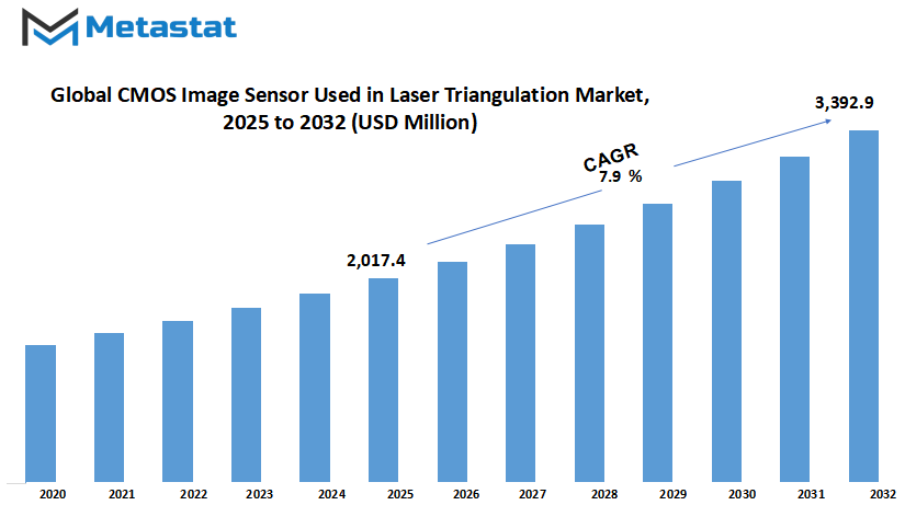
The global CMOS image sensor used in laser triangulation market is in growing demand across several industries such as automotive, aerospace, and construction. These industries are looking for the latest technologies to enhance product quality, shorten production time, and enhance efficiency. The driving force behind this demand is mainly the requirement for accurate measurements and quality control during manufacturing operations such as defect inspection, reliable part measurement, and tolerance checking. CMOS Image Sensors play a significant role in reverse engineering, during which objects are scanned in order to produce CAD models to use in manufacturing. The sensors are becoming increasingly popular as they can record precise and high-definition 3D images at high speeds and low costs. Evolution of CMOS technology, including greater sensitivity and less noise, has further increased demand for them. The automotive and aerospace industries have been early adopters to utilize CMOS Image Sensors for higher speed and precision measurements of key components. The construction sector also depends on 3D measurement systems for utilization in building information modeling. This increasing demand for 3D measurement systems will keep pushing the global CMOS image sensor used in laser triangulation market in the coming years. CMOS technology advancements have brought with them increased resolution and increased data processing speed, which make CMOS Image Sensors an appealing option for many applications.
These developments have introduced sensors with higher resolution, better image quality, and higher signal-to-noise ratios even in low-light conditions. Faster data processing enables real-time capturing and analysis of data, finding uses in manufacturing, medicine, and transportation sectors. The falling price of CMOS technology is also increasing its adoption, through efficiency increases in manufacturing processes, which reduce the cost of production. Since the demand for high-quality imaging and 3D scanning keeps increasing, the global CMOS image sensor used in laser triangulation market will further grow with continuous development in CMOS technology to meet this demand. One major constraint in front of the CMOS Image Sensor Utilized in Laser Triangulation market is the high price of CMOS image sensors in relation to other sensor types used in 3D measurement systems. Despite the high improvements, the intricate manufacturing process and raw material cost involved make CMOS Image Sensors comparatively costly.
This restricts their application in those areas where cost is a prime consideration, and alternative sensor technologies such as CCD, ToF sensors, and structured light sensors are used even though they have less resolution and slower data processing. Additionally, for applications demanding huge arrays of sensors, the expense associated with CMOS Image Sensors can render the entire system too costly. While the ongoing technology advances in CMOS and expanding need for high-resolution 3D scanning and imaging are likely to propel the market, cost factors will continue to remain a major consideration in choosing sensor technology. The limited precision of CMOS Image Sensors in certain applications, particularly in gauging shiny or transparent surfaces, is another limitation. Bouncing of light on reflective surfaces can cause inaccuracies in data capture, and transparent surfaces are problematic because light goes right through without bouncing. In such cases, alternative sensor technologies are used, including ToF sensors and structured light sensors.
The compromised accuracy of CMOS Image Sensors in certain applications may increase expenses and lower efficiency, as extra steps might be necessary to adjust for inaccuracies. In spite of these shortcomings, CMOS Image Sensors are in use because of their high resolution, high-speed data processing, and capacity to read precise data from a host of surfaces. Researchers and manufacturers are constantly striving to improve CMOS Image Sensor accuracy in difficult applications. More use of 3D printing technology creates new opportunities for the CMOS Image Sensor Applied to Laser Triangulation industry. The 3D printing technology is revolutionizing many industries by enabling the manufacture of complicated forms and components. Accurate measurement and scanning are vital to 3D printing success, and CMOS Image Sensors enable high-quality and accurate 3D images. 3D printing is increasingly found in the aerospace, automotive, health, and consumer products industries with the need for customized parts, fastened production cycles, and economical manufacturing methods.
In healthcare, 3D printing is used for prosthetics and implants that are patient-specific, for which CMOS Image Sensors ensure a precise fit and improved patients' outcomes. The requirement of accurate measurement and scanning for 3D printing use cases will give rise to new growth opportunities for the global CMOS image sensor used in laser triangulation market. In addition, the adoption of Industry 4.0 and intelligent manufacturing solutions will further utilize the technology to provide accurate and real-time information to increase efficiency and reduce costs in production. Overall, the growth of application for 3D printing technology and the broadened need for accurate measurement and scanning in all industries bring new opportunities for the global CMOS image sensor used in laser triangulation market with continuous CMOS technology innovation sure to match the broadened need.
In the global CMOS image sensor used in laser triangulation market, there arises a segmentation by type. The segmentation sets out the sensor's resolution, a critical feature determining its value and use.
Resolution Below 2M segment, a segment worth 427.7 USD Million in 2025. Simply put, this segment refers to sensors that have resolutions less than 2 megapixels. Such sensors have their applications in situations where the resolution is not as important and less detail is needed, performing well in many circumstances ranging from simple image capture to some measurement applications.
Continuing on, the Resolution 2M-10M segment is a major contender, worth 740.6 USD Million in 2025. In this segment, the sensors take a step up in quality, offering 2 to 10 megapixel resolutions. The value of this segment indicates the need for greater accuracy in image and measurement applications across industries, where clearness and finer details are the requirements.
Lastly, the Resolution Above 10M segment comes into view, symbolizing the top rung as far as resolution is concerned. This segment had a value of 849.1 USD Million in 2025. These sensors, whose resolutions are above 10 megapixels, are used by applications requiring the finest possible level of detail, accuracy, and crispness. Their application cuts across a range of fields, such as industrial and scientific environments, where the requirement for faultless image quality is critical.
In the constantly growing global CMOS image sensor used in laser triangulation market, the segmentation by resolution type highlights the wide range of needs across industries and applications. All segments are distinguished with their own role and value, fitting the unique demands of different spheres, ranging from the simple to the highly detailed, forming the dynamic market for these sensors.
The global CMOS image sensor used in laser triangulation market multiple segments of application. The segment for Laser Pointing Device has a projected value of 670.1 million dollars in 2025. Camera is another essential application segment that has a total with a 2025 value of 936.6 million dollars, and so on.
Here are the primary uses of CMOS image sensors in laser triangulation. The Laser Pointing Device section can perform very precise pointing and measuring distances, among other things, which is why it is used across multiple industries. It is used for surveying and alignment, two applications that really benefit from being high precision.
While one component of the Camera is very important, another is equally important. It is a platform for an amazing range of applications, which are all from industrial automations to 3D scanning. These cameras provide images and data at a very high level of accuracy, and these can be very useful in the production of detailed 3D models and in high precision measuring.
The two segments, Laser Pointing Device and Camera, drive the global CMOS image sensor used in laser triangulation market. They are two of the most vital instruments in every sector, where accuracy in measurements, imaging and 3D modeling, is mandatory. The values for each segment for 2025 are presented, showing their market share, which reflects the value they provide to the market. Therefore, these applications will certainly provide greater value to the industries in the future as technology develops.
|
Forecast Period |
2025-2032 |
|
Market Size in 2025 |
$2,017.4 Million |
|
Market Size by 2032 |
$3,392.9 Million |
|
Growth Rate from 2025 to 2032 |
7.9% |
|
Base Year |
2024 |
|
Regions Covered |
North America, Europe, Asia-Pacific Green, South America, Middle East & Africa |
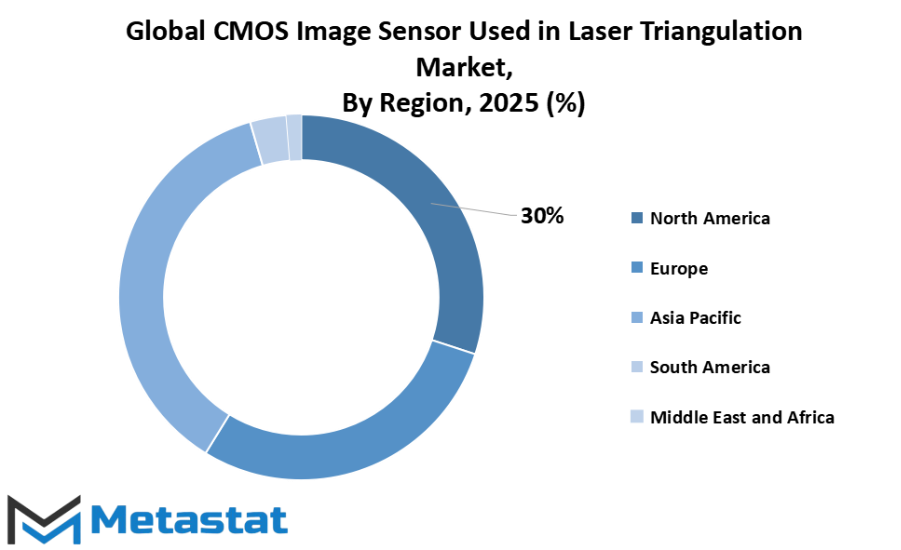
The global CMOS image sensor used in laser triangulation market is; it is the segmentation of the market according to the geographical areas. These geographical divisions are among the major aspects that determine the market dynamics there.
North America which includes countries like the United States and Canada is the manager of a large share of the worldwide market. The existence of leading technology companies along with a sturdy manufacturing sector in North America basically leads to the market's expansion. Furthermore, the region's strong emphasis on innovation, R&D, and technology transfer to the market also contributes to the overall advancement of the global CMOS image sensor industry, thus helping it maintains its position as a prominent player.
Meanwhile, Europe consisting of countries like Germany and the United Kingdom is also a major player in the global CMOS image sensor market. The industrial development and automotive sector boom in that area are the main factors that make the demand for CMOS image sensors increase drastically. The commitment of Europe to sustainability and the introduction of very rigid quality standards for products in the sector are giving the Continent more market influence as well.
All those geographical segments do not exist separately. They are linked with each other through global trade and partnerships, from which they draw the biggest part of their power to the production, distribution, and acceptance of CMOS image sensors used in laser triangulation systems.
Realizing the conditions in North America and Europe is the key for companies in the CMOS image sensor used in laser triangulation marketto be able to tailor their strategies to the specific requirements and trends of each region, which is really necessary for them. In fact, understanding the dynamics of those two regions is probably the main thing companies need to do if they want to remain competitive in the market landscape.
In the global CMOS image sensor used in laser triangulation market, there are leading players contributing a lot. Teledyne Technologies Inc. and SK Hynix Inc. are worth mentioning among them. These two have a major presence and impact on the production and development of CMOS image sensors for the applications of laser triangulation.
Teledyne Technologies Inc. has built itself into a leader in its field. Teledyne offers extensive experience and knowledge of imaging technology. Teledyne CMOS image sensors are reputable for their accuracy and dependability, and they are the first choice in most laser triangulation applications. They have a good history of providing high-quality sensors that live up to the stringent requirements of industries that use laser triangulation technology.
SK Hynix Inc., in contrast, has cornered a substantial position in the CMOS image sensor market for laser triangulation. SK Hynix's strong focus on research and development has resulted in the innovation of advanced image sensor technology. SK Hynix sensors are characterized by high reliability and efficiency and thus are used in different industrial branches that apply laser triangulation for measuring or imaging.
Currently, a large part of the progress in sensor technology is due to both Teledyne Technologies Inc. and SK Hynix Inc. Their efforts are essential for the precision and the range of the laser triangulation systems. These companies are still very powerful players in the global CMOS image sensor used in laser triangulation market and keep offering innovations that satisfy the needs of the modern application field.
Find answers to common questions about this report
Global CMOS Image Sensor Used in Laser Triangulation market is valued at $2,017.4 million in 2025.
Global CMOS Image Sensor Used in Laser Triangulation market is estimated to grow with a CAGR of 7.9% from 2025 to 2032.
Global CMOS Image Sensor Used in Laser Triangulation market is estimated to reach $3,392.9 million by 2032.
Top players operating in the CMOS Image Sensor Used in Laser Triangulation industry includes Teledyne Technologies Inc., SK Hynix Inc., ams-OSRAM AG, and others.
The analysts below cover Electronics and Semiconductor research at Metastat Insights.
LEAD ANALYST
Utkarsh Khirodkar is a Lead Market Research Analyst at MetaStat Insight, specializing in market intelligence, technology sector assessments, and competitive strategy.

PRINCIPAL CONSULTANT - ENTERPRISE AI & EMERGING TECHNOLOGIES
Banking & Finance · Electronics and Semiconductor · Energy and Power · Healthcare IT · Information & Technology · Professional Services
Vijay Gunti is a Principal Consultant at MetaStat Insight, bringing over two decades of experience across enterprise digital transformation, technology strategy, and intelligent systems.

PRINCIPAL CONSULTANT - QUALITY SYSTEMS & COMPLIANCE
Electronics and Semiconductor · Machinery & Equipment · Professional Services
Omkar Phadtare is an Industry Consultant at MetaStat Insight, specializing in quality systems, regulatory compliance, and standards benchmarking to drive data-driven market intelligence and strategic industry research.

ENERGY & INFRASTRUCTURE INDUSTRY CONSULTANT
Automotive and Transportation · Electronics and Semiconductor · Energy and Power · Machinery & Equipment
Saurabh Vasant Ganvir consults for Energy & Infrastructure Industry at MetaStat Insight, specializing in renewable energy, solar EPC, and electric vehicle (EV) infrastructure markets.

LEAD CONSULTANT - COMMUNICATION, TELECOM, AND IT
Electronics and Semiconductor · Information & Technology · Machinery & Equipment · Professional Services
Ravindra Sathe Consultants for Communication, Telecom, and IT at MetaStat Insight. He leads the firm's industry research initiatives across telecommunications infrastructure, digital connectivity, enterprise networking, and emerging information technology domains.
Tracking capacity expansion in single-use bioprocessing requires dependable data on raw material availability and cleanroom-grade polymer supply chains. The competitive landscape chapter gave a grounded evaluation of secondary component suppliers across North America and Asia-Pacific rather than simply reprinting press releases. Having that level of supplier benchmarking helped clarify dual-sourcing considerations for our clinical pipeline planning.
When evaluating distributed energy resource management systems, standard research summaries tend to gloss over the operational differences between front-of-the-meter utility deployments and behind-the-meter industrial sites. The MetaStat Insight report addressed those distinctions directly, especially regarding software interoperability standards and grid interconnection backlogs. The five-year market sizing across regional transmission organizations provided actionable context for our grid modernization strategy.
Most industry reports on warehouse automation bundle autonomous mobile robots and fixed conveyor installations into the same top-level numbers, which complicates advisory work. This study split the market cleanly by payload tiers, navigation technology, and fleet management software layers. The regional forecast for Western Europe gave our team defensible adoption benchmarks when evaluating capital allocation for logistics clients, saving us days of secondary data scrubbing.
Explore related market intelligence reports worth reading alongside this one.