
LEAD ANALYST
Utkarsh Khirodkar is a Lead Market Research Analyst at MetaStat Insight, specializing in market intelligence, technology sector assessments, and competitive strategy.

Global Mechanical Gaming Keyboard Market Size, Share, By Switch Technology (Linear Mechanical Switches, Tactile Mechanical Switches, Clicky Mechanical Switches, Optical Mechanical Switches, Hall Effect and Magnetic Switches), By Connectivity (Wired, 2.4 GHz Wireless, Bluetooth Wireless, Tri-Mode Wireless), By Form Factor (Full-Size, Tenkeyless, 75% Layout, 65% Layout, 60% Layout), By Sales Channel (Online Retail, Specialty Gaming and Electronics Stores, Brand-Owned Stores and Websites, Hypermarkets and Supermarkets), Industry Analysis, Growth, Trends, and Forecast, 2026-2033
Report ID
MSI-5728
Published
November, 2026
Pages
301 Pages
Format
Historical
Base year
Forecast
Forecast period
Report Details
Market Valuation: Valued at $1,598.7 Million in 2025, projected to reach $3,738.9 Million by 2033 at a 11.2% CAGR.
Dominant Segment: Linear Mechanical Switches lead the market, driven by a strong preference for smooth key presses among gamers seeking enhanced performance.
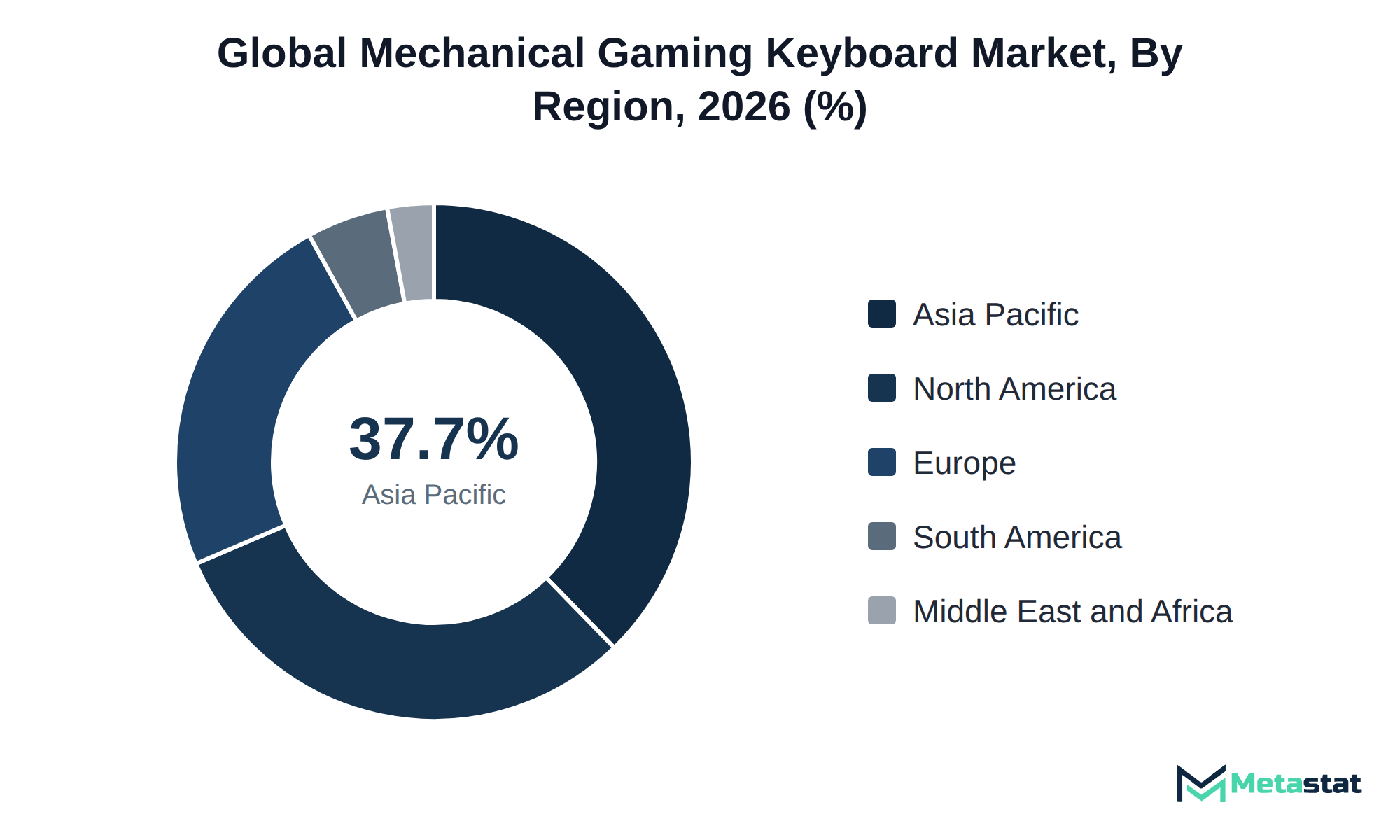
Geographic Lead: Asia Pacific dominates the market with a 37.7% share, attributed to its robust gaming culture and high consumer demand.
What's Inside: The report includes detailed competitive coverage, market analyses, and forecasts from 2026 to 2033, focusing on key trends and drivers.
Emerging Trends: The shift towards wireless connectivity, particularly in the 2.4 GHz segment, is projected to grow at a CAGR of 13.8%, reflecting gamers' preferences for untethered experiences.
Customization Appeal: Customization options are increasingly influencing buyer preferences, with a notable growth in demand for tailored gaming setups that enhance user experience.
Choose Your License
Global Mechanical Gaming Keyboard Market
The global Mechanical Gaming Keyboard market was valued at USD 1,598.7 million in 2025 and is projected to reach USD 3,738.9 million by 2033, growing at a CAGR of 11.2% over the forecast period.
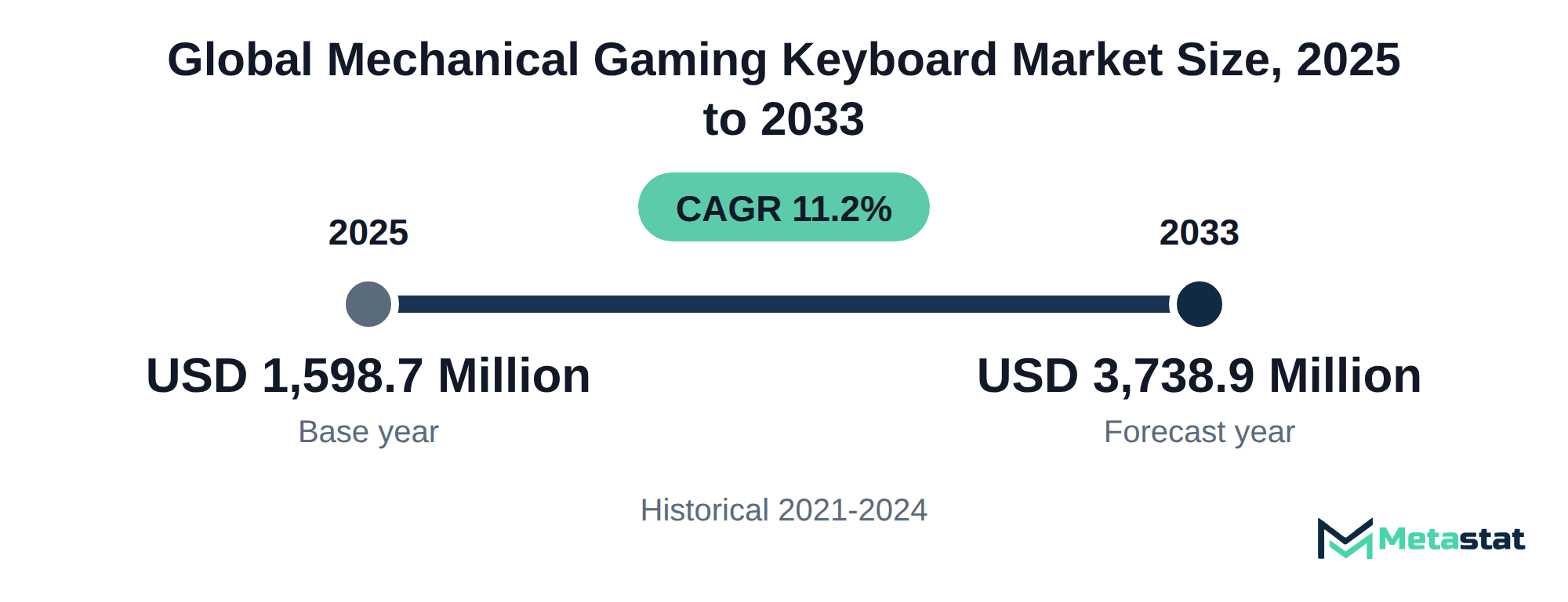
The Mechanical Gaming Keyboard market covers high-performance keyboards tailored for gamers and enthusiasts. Buyers invest in these products primarily due to enhanced performance, durability, and customizable features, which significantly improve the gaming experience. Factors including the increasing popularity of esports and competitive gaming drive demand, prompting consumers to seek advanced equipment that meets their gaming needs.
The growth of the market is supported by the rising adoption of mechanical keyboards, which offer superior tactile feedback and response times compared to traditional alternatives. Linear Mechanical Switches represent the highest value segment, reflecting a strong preference among users for smooth key presses. In terms of regional shares, Asia Pacific dominates with a 37.7% share, highlighting its significance in the global market. North America holds 30.8% of the market in 2025, with the US leading in 2026.
One main growth driver is the shift toward wireless connectivity, driven by increasing consumer preference for untethered gaming experiences. The demand for 2.4 GHz Wireless options is rising, reflecting a broader trend toward flexibility and convenience. This transition reinforces the importance of innovation within the Mechanical Gaming Keyboard market, with manufacturers striving to meet evolving consumer expectations.
The Mechanical Gaming Keyboard market features various high-performance keyboards designed specifically for gaming and competitive usage. Buyers invest in these products to enhance their gaming experience, improve performance, and benefit from the durability and customization options offered by mechanical switches. This market appeals to a wide range of consumers, including casual gamers, professional esports players, and tech enthusiasts who prioritize precision and tactile feedback in their peripherals.
Growth within the market is driven by the increasing popularity of gaming across demographics, with the rise of esports and streaming contributing significantly to this trend. Among the segments, Linear Mechanical Switches represent the highest value, reflecting a robust preference among users for smooth and uninterrupted keystrokes. North America holds 30.8% of the market in 2025, with the US leading in 2026, reflecting strong consumer demand and a well-established gaming culture.
Ongoing advancements in technology and the introduction of innovative features in mechanical keyboards enhance their appeal. Gamers actively seek out customizable options, including programmable keys and RGB lighting, which enable personalized gameplay experiences. Together, these factors position the market for sustained growth through the forecast period.
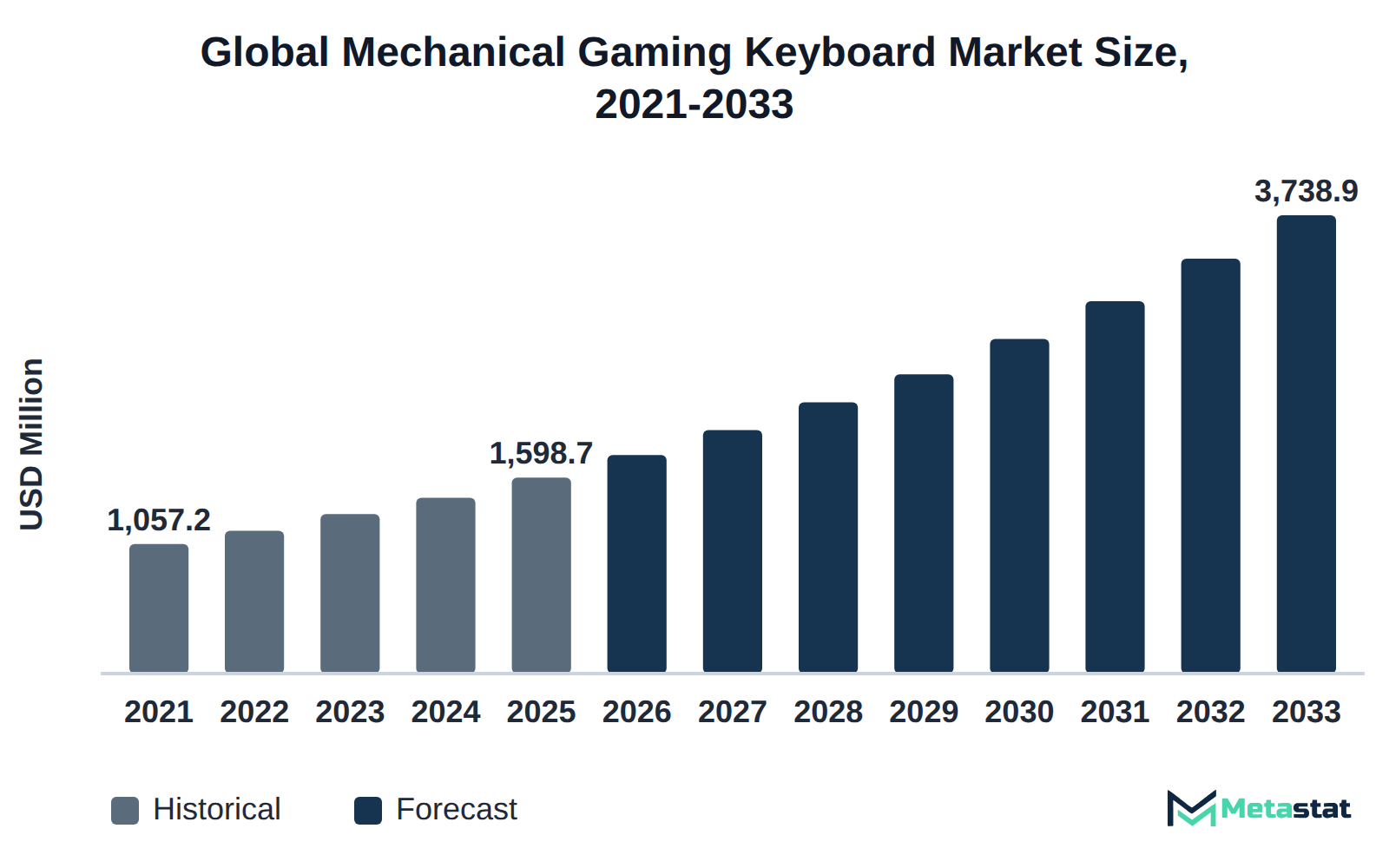
Hall effect switches increasingly influence purchasing decisions in the Mechanical Gaming Keyboard market. This technology offers enhanced durability and responsiveness, leading to a competitive edge for gamers and professionals. Equipped with a non-contact sensing mechanism, hall effect switches generate a more reliable and consistent key press experience compared to traditional switch types.
In the Connectivity segment, optical mechanical switches are projected to achieve a compound annual growth rate (CAGR) of 12.7% through 2033. This growth indicates rising interest in advanced switch technologies that deliver superior performance. The emergence of hall effect switches aligns with this trend, appealing to consumers seeking innovative solutions for their gaming needs.
The adoption of hall effect switches has significant commercial implications. Manufacturers integrating this technology into their mechanical gaming keyboards differentiate their products, attracting a growing demographic of serious gamers willing to invest in high-performance equipment. This shift in technology enhances user satisfaction and contributes to overall revenue growth in the market.
Compact layouts and wireless connectivity increasingly attract esports players in the Mechanical Gaming Keyboard market. The growing preference for portable and versatile keyboards reflects the needs of competitive gamers who travel frequently and participate in tournaments. The 2.4 GHz Wireless segment is projected to reach USD 1,078.3 million by 2033, with a compound annual growth rate of 13.8%.
This rising demand for compact, wireless options has led manufacturers to innovate with features that enhance performance while maintaining convenience. Gamers favor keyboards that offer responsive switches, customization options, and efficient battery life, driving brands to compete aggressively in this segment. With the rapid evolution of gaming technology, many players prioritize purchasing keyboards that meet their performance and aesthetic requirements.
The emphasis on wireless connectivity and compact designs enhances user experience and influences pricing strategies. Players seek value in their purchases, leading retailers to adopt competitive pricing and promotional offers. Such pricing dynamics create opportunities for manufacturers within the Mechanical Gaming Keyboard market to expand their customer base and increase market penetration.
Customization options in the Mechanical Gaming Keyboard market influence buyer preferences significantly. Gamers increasingly seek tailored solutions that offer both aesthetic appeal and enhanced performance. The ongoing shift towards linear mechanical switches exemplifies this trend, with projected growth from USD 629.2 million in 2026 to USD 1,260.8 million by 2033, reflecting a compound annual growth rate (CAGR) of 10.4%. This emphasis on customization allows players to create setups that match their unique play styles and personal tastes. This mirrors broader interest in personalized products.
Rapid trigger features have emerged as another critical demand driver. These features facilitate quicker response times, essential in competitive gaming environments. Manufacturers focus on incorporating advanced technologies that enhance key actuation, providing gamers with a competitive edge. As the market expands, manufacturers need to keep innovating to meet the changing demands of enthusiasts. Overall, these trends indicate a strong commercial consequence for suppliers, who align their product offerings with the distinct needs of the gaming community to capture market share.
Mechanical gaming keyboards significantly enhance esports performance by providing faster response times and greater precision compared to traditional keyboards. The adoption of linear mechanical switches, projected to grow from USD 629.2 million in 2026 to USD 1,260.8 million by 2033, supports demand from competitive gamers who prioritize speed and accuracy. This switch technology allows players to execute commands with minimal resistance, resulting in improved gameplay during high-stakes matches. Gaming mice serve the same competitive players as the pointing device.
Connectivity options in the mechanical gaming keyboard market are central to esports. Wired models, expected to rise from USD 1,003.5 million in 2026 to USD 1,902.3 million by 2033, offer a stable connection that eliminates latency issues, a critical factor during competitive play. Gamers favor these wired options for their reliability, ensuring that every keystroke translates into immediate action on-screen.
Advancements in switch technology and connectivity within the mechanical gaming keyboard market contribute to enhanced gaming experiences, influencing purchasing decisions among esports athletes and enthusiasts. These upgrades drive market growth and improve performance in competitive gaming.
Increasing demand for linear mechanical switches drives growth in the Mechanical Gaming Keyboard market. Gamers and enthusiasts favor these switches for their smooth keystroke experience, allowing faster and more precise actions during gameplay. The popularity of linear switches reflects a broader trend toward performance-oriented keyboards, particularly among competitive gamers. Players prioritize speed and accuracy, positioning the market for sustained growth driven by this switch technology. The transition emphasizes the need for manufacturers to innovate and adapt to evolving preferences.
In parallel, tactile mechanical switches appeal to a significant portion of gamers, reinforcing the diverse preferences present in the market. Tactile feedback enhances user experience, and this segment is projected to reach USD 994.9 million by 2033 at a CAGR of 10.2%. These preferences show how buyer choices shape the future of mechanical gaming keyboards.
The shift toward optical mechanical switches significantly influences the development of the Mechanical Gaming Keyboard market. This technology employs light-based actuation, providing faster response times and increased durability compared to traditional mechanical switches. Gamers, particularly in competitive environments, favor these keyboards for their reduced actuation force and enhanced performance metrics. The growing emphasis on precision and speed in gameplay fuels demand for optical switches, propelling manufacturers to innovate and expand their product offerings.
Gaming enthusiasts and professional players seek these advanced solutions to maintain a competitive edge. By integrating optical switches into their designs, manufacturers enhance the appeal of their products, capturing a larger share of the market. The growth trajectory for optical mechanical switches is expected to create new opportunities for suppliers, stimulating further investment in research and development within this segment. This technological evolution aligns with broader trends in gaming hardware, driving the adoption of high-performance solutions in the market.
Price sensitivity remains a significant restraint in the Mechanical Gaming Keyboard market, particularly affecting gamers and casual users. The premium pricing of high-quality mechanical keyboards discourages potential buyers from making purchases, resulting in slower uptake within the consumer segment. Many consumers, especially those new to gaming or on tight budgets, hesitate to invest in these keyboards despite their advantages. This hesitation leads to smaller order sizes and delayed replacements among existing users, who opt for more affordable alternatives.
Manufacturers face challenges in expanding their customer base, especially in price-sensitive regions. The impact of price sensitivity places pressure on producers to balance quality and affordability, influencing market dynamics. Companies that offer competitive pricing strategies capture larger shares of the market, while those that maintain high prices encounter limited growth opportunities.
Rising input costs for components significantly challenge suppliers in the Mechanical Gaming Keyboard market. Current supply chain disruptions and inflationary trends have increased prices for essential materials including plastics, metals, and electronic components. Suppliers respond by seeking alternative materials and optimizing production processes to maintain profitability. Several manufacturers invest in localized supply chains to reduce reliance on vulnerable global logistics networks, which further enhances production resilience. Collaboration with material suppliers aims to achieve cost efficiencies through economies of scale and improved procurement strategies. This focus on cost management directly impacts the market's ability to provide competitive pricing, thereby influencing buyer decisions and overall market growth. The ongoing pressure on margins requires continuous adaptation to market conditions while ensuring product quality and performance standards remain intact.
The demand for 2.4 GHz wireless connectivity represents a notable growth opportunity within the Mechanical Gaming Keyboard market. This segment is projected to achieve a compound annual growth rate (CAGR) of 13.8% through 2033, reflecting the increasing preference among gamers for wireless options that minimize cable clutter while maintaining performance. Enhanced flexibility offered by wireless connectivity attracts competitive gamers, who prioritize a clean setup and mobility during gaming sessions. Growth in this segment is driven by advancements in wireless technology, which have significantly improved latency and response times, making wireless models more appealing to professional and amateur players alike. Addressing this demand requires manufacturers to develop reliable wireless solutions that meet the specific needs of gamers. The anticipated growth in this segment indicates a shift in buyer preferences, allowing the market to expand further into untapped regions and demographics.
The Global Mechanical Gaming Keyboard market is segmented based on Switch Technology, Connectivity, Form Factor, and Sales Channel.
These switches attract serious gamers and professionals seeking smooth and consistent keystrokes, making them a popular choice for high-performance gaming setups. The growth of this segment is driven by the increasing popularity of gaming and the demand for responsive and reliable equipment. Compared to other switch types, including Tactile and Clicky Mechanical Switches, Linear Mechanical Switches experience a higher growth rate, offering a more straightforward typing experience without tactile feedback. This feature distinguishes them from competitive switches and appeals particularly to gamers who prioritize speed and precision in gameplay. The segment's growth aligns with broader trends observed in the Mechanical Gaming Keyboard market, where performance and user experience remain significant.
These switches are favored by gamers seeking a balance between tactile feedback and noise levels, making them suitable for both gaming and typing scenarios. The growing interest in tactile switches is driven by their ability to provide a satisfying typing experience without being overly loud, appealing to a broad audience, including professionals and casual users. In comparison to Linear Mechanical Switches, which have a CAGR of 10.4%, Tactile Mechanical Switches experience slightly slower growth but are priced significantly lower, enhancing their attractiveness to budget-conscious buyers. This segment is expected to thrive due to the increased preference for mechanical keyboards that offer tactile feedback, particularly among gamers who require precision and responsiveness in their equipment.
Clicky Mechanical Switches segment is expected to reach USD 403.1 million by 2033. This segment appeals to gamers who prioritize tactile feedback and an audible click sound during typing, enhancing the overall gaming experience. The demand for Clicky Mechanical Switches chiefly stems from competitive gamers and typists who prefer the distinct sound and feel of these switches. This segment features a slower growth rate compared to linear and tactile mechanical switches, with a compound annual growth rate (CAGR) of 10.2%, positioning it differently within the Switch Technology category. While competitors including linear switches attract users seeking quieter options, Clicky Mechanical Switches maintain a loyal following among enthusiasts who value auditory and tactile responsiveness, securing a unique place in the market.
Optical Mechanical Switches segment is projected to grow at a CAGR of 12.7% during the forecast period. These switches employ light-based actuation, providing distinct tactile feedback and faster actuation times, which appeal to competitive gamers and enthusiasts focused on performance. The growing preference for precision and speed among esports athletes significantly drives demand for optical switches, facilitating rapid response times during gameplay. Compared to other switch types, optical switches maintain a higher growth trajectory, driven by innovations in design and technology. This segment's appeal to a tech-savvy audience ensures its higher price point relative to traditional mechanical switches, further enhancing its market position. The advantages of optical switches in terms of durability and speed create a competitive advantage, supporting their expansion in the market.
Hall Effect and Magnetic Switches employ magnetic fields to register keystrokes, enhancing performance for both casual and competitive gamers. The same sensing principle appears in other magnetic sensor applications. This technology appeals to gamers seeking durability and responsiveness, providing an innovative alternative to traditional mechanical switches. The shift toward gaming peripherals that support customizable features and performance improvements drives interest in these switches. Differentiating from other switch technologies, Hall Effect and Magnetic Switches typically feature longer lifespans and lower actuation force, catering to a niche audience focused on responsiveness. This segment's appeal lies in its ability to deliver consistent performance, a critical factor for high-stakes gaming environments. In the market, increasing emphasis on performance-driven features fuels demand for this technology, distinguishing it from standard mechanical switches that dominate broader segments.
Others (Low-Profile and Hybrid Switches) consist of innovative switch technologies appealing to gamers seeking versatility and comfort. These switches are popular among users who prefer a compact design without sacrificing performance. A rise in hybrid switch adoption reflects a growing preference for keyboards that combine mechanical and membrane features, offering a unique typing experience. This segment attracts casual gamers and professionals alike, differentiating itself with ergonomic designs that enhance prolonged usage. The demand for low-profile options is driven by the increasing trend of minimalistic game setups and mobile gaming environments. Compared to linear, tactile, and clicky switches, this segment experiences slower growth due to specific user preferences leaning toward traditional mechanical sensations. However, its unique value proposition positions it well within the evolving dynamics of the Mechanical Gaming Keyboard market.
Wired connectivity is valued at USD 1,003.5 million in 2026 and is projected to reach USD 1,902.3 million by 2033, at a CAGR of 9.6% during the forecast period. This segment serves gamers who prioritize low latency and reliable connections, making wired keyboards essential for competitive gaming environments. The increasing emphasis on response time and performance among gamers fuels demand, distinguishing wired connectivity from wireless alternatives. While the wired segment experiences steady growth, wireless options, particularly those with 2.4 GHz technology, present faster growth at a CAGR of 13.8%. The higher performance and consistent connectivity of wired keyboards continue to appeal to serious gamers, reinforcing their position in the Mechanical Gaming Keyboard market. Price competitiveness remains crucial, as advancements in technology add features at lower costs and support broader adoption among casual and professional users.
This connectivity option appeals to gamers who prioritize mobility and flexibility in their setup, allowing for a clutter-free workspace. The segment experiences growth driven by increasing demand for wireless gaming peripherals, particularly among competitive gamers seeking greater freedom of movement without sacrificing performance. Compared to other connectivity options, 2.4 GHz Wireless offers a faster response time, making it preferable in high-stakes gaming scenarios. In the market, it outpaces traditional wired connections, which face limitations related to cable management and space constraints. The evolution of wireless technology continues to enhance reliability and signal strength, further encouraging adoption.
Bluetooth Wireless segment is expected to reach USD 439.7 million by 2033. This segment serves users who prioritize mobility and convenience, allowing gamers to enjoy a wireless experience without sacrificing performance. Demand for this segment is driven by the increasing adoption of wireless technology in gaming, appealing to both casual and competitive gamers. Bluetooth connectivity provides flexibility and freedom, differentiating it from wired options, which often experience limitations in movement. Compared to 2.4 GHz Wireless, which is projected to grow at a CAGR of 13.8%, Bluetooth Wireless offers a slower growth trajectory, yet maintains strong interest due to its compatibility with various devices. Overall, evolving preferences of gamers toward wireless solutions and advancements in Bluetooth technology position this sub-segment for continued growth in the Mechanical Gaming Keyboard market.
Tri-Mode Wireless segment is projected to grow at a CAGR of 10.9% during the forecast period. This connectivity option targets gamers seeking flexibility and reliability across various devices, including PCs and consoles. The growing trend of wireless technology adoption drives this segment, with users favoring the convenience of switching between devices. Compared to other connectivity types, Tri-Mode Wireless offers a unique advantage of combining wired, 2.4 GHz wireless, and Bluetooth connectivity, catering to diverse user preferences. This adaptability enables the segment to appeal to a broader range of buyers, including casual gamers and professional players. In contrast, the Wired connectivity segment, projected to reach USD 1,902.3 million by 2033, offers stability but lacks the versatility that Tri-Mode Wireless provides. The Mechanical Gaming Keyboard market benefits from this differentiation, with consumers increasingly prioritizing multi-device compatibility.
Full-Size keyboards are valued at USD 510.8 million in 2026 and are projected to reach USD 945.9 million by 2033, at a CAGR of 9.2% during the forecast period. These keyboards serve a diverse user base, including gamers and professionals requiring extensive functionality and key layouts. Demand for Full-Size keyboards is driven by a growing preference for a full set of input options, which lets users perform complex tasks efficiently. Compared to Tenkeyless and compact layouts, Full-Size keyboards offer additional features including dedicated numeric keypads, enhancing productivity for data entry and gaming. While Tenkeyless keyboards are anticipated to grow at a CAGR of 10.8%, the Full-Size segment maintains steady appeal due to its familiarity among users. This segment significantly influences the Mechanical Gaming Keyboard market, tailoring to those who prioritize a complete typing experience.
Tenkeyless segment is estimated to reach USD 929.5 million by 2033, at a CAGR of 10.8% during the forecast period. This form factor, characterized by the absence of a numeric keypad, is favored by gamers and professionals seeking more desk space and portability. The growing emphasis on streamlined setups in gaming and office environments drives demand for this segment. Tenkeyless keyboards typically appeal to competitive gamers who prioritize speed and responsiveness, differentiating them from full-sized keyboards. Price competitiveness contributes to its attractiveness, with many consumers drawn to the balance of functionality and affordability. The segment's growth trajectory surpasses other layouts, including full-size keyboards, reflecting a shift in user preferences within the market.
75% Layout segment is expected to reach USD 763.1 million by 2033. This form factor appeals to gamers seeking a compact design while retaining essential functionality. Users in competitive gaming and casual environments favor this layout due to its space-saving characteristics, promoting a more organized setup. The segment experiences growth driven by rising demand for compact gaming solutions and increasing popularity of esports. Compared to other form factors, the 75% Layout stands out with a higher growth rate, projected to expand at a CAGR of 13.9%. This growth reflects a shift toward versatility, allowing users to optimize their gaming spaces without sacrificing performance. Its pricing structure often positions it competitively against other layouts, enhancing its appeal among budget-conscious consumers. Overall, the 75% Layout segment represents a significant contributor to the dynamics of the Mechanical Gaming Keyboard market.
65% Layout segment is projected to grow at a CAGR of 13.9% during the forecast period. This layout appeals predominantly to gamers and professionals seeking a compact design that retains essential functionality. Users favor this segment for its enhanced portability while maintaining a full array of keys for efficient gaming and productivity. The rapid adoption of 65% Layout keyboards is driven by increasing demand for space-saving solutions without sacrificing performance. Compared to other form factors, the 65% Layout provides a faster growth trajectory due to its suitability for diverse environments, distinguishing it in a competitive market. The higher growth rate contrasts with the slower expansion observed in Full-Size and Tenkeyless keyboards, which cater to users prioritizing additional features and key availability. The segment's focus on minimalist design highlights a shift in consumer preferences toward functional yet compact gaming solutions.
60% Layout keyboards provide a compact design, appealing to gamers and professionals who prioritize desk space and portability. These keyboards are especially favored by enthusiasts who appreciate the minimalist aesthetic and functionality. Growth in this segment is driven by the increasing popularity of gaming and eSports, where compact form factors enhance mobility and ease of use in various environments. Compared to other form factors, including Full-Size and Tenkeyless, the 60% Layout offers a unique compromise between size and functionality, catering to a niche market of users who value efficiency and style. This segment's differentiation lies in its ability to deliver essential features while minimizing space, aligning with trends in the Mechanical Gaming Keyboard market where users seek both performance and design.
Others (96%, Split, and Low-Profile) incorporates various keyboard configurations that cater to specific user preferences and gaming environments. This segment appeals to gamers and professionals who value compactness and versatility. The demand for unique layouts arises from a growing trend among gamers seeking space-saving solutions and customizable experiences. Differentiation within the segment lies in its ability to offer alternative designs that are not covered by more traditional options like Full-Size or Tenkeyless keyboards. The unique selling proposition attracts both casual users and dedicated enthusiasts, creating a loyal customer base focused on personalizing their gaming setup. Factors including evolving ergonomic designs and advanced switch technologies continuously influence the segment's development. The Mechanical Gaming Keyboard market recognizes these diverse user needs, driving innovations in layouts and features aimed at enhancing overall user experience.
The Online Retail segment is valued at USD 847.6 million in 2026 and is projected to reach USD 1,915.1 million by 2033, at a CAGR of 12.3% during the forecast period. This segment provides consumers access to a wide variety of mechanical gaming keyboards, catering to casual gamers and professionals seeking convenience and comprehensive product information. The growth of online retailing is primarily driven by the increasing preference for e-commerce platforms, which allow consumers to compare prices and read reviews before making a purchase. Compared to other sales channels, the Online Retail segment exhibits faster growth, propelled by the convenience it offers. In contrast, specialty gaming and electronics stores exhibit a slower growth trajectory, focusing on in-person shopping experiences and customer service.
Specialty Gaming and Electronics Stores segment is estimated to reach USD 846.5 million by 2033, at a CAGR of 9.6% during the forecast period. This segment caters to gamers and tech enthusiasts, providing a dedicated environment for in-person purchases and expert guidance. A key demand driver for this segment involves the increasing interest in gaming, where consumers seek quality and performance in their equipment. This growth contrasts with online retail, which experiences a faster CAGR of 12.3%. Specialty stores typically offer a higher level of customer service and product demonstration, appealing to buyers who prioritize hands-on experiences over online shopping. While online retail focuses on convenience and accessibility, the Specialty Gaming and Electronics Stores segment thrives on immersive shopping experiences that emphasize brand engagement and product knowledge. This approach aligns closely with the evolving preferences of the gaming community within the Mechanical Gaming Keyboard market.
Brand-Owned Stores and Websites segment is expected to reach USD 678.6 million by 2033. This segment caters primarily to consumers seeking branded products directly from manufacturers, ensuring authenticity and potentially exclusive offerings. Anti-counterfeiting solutions address the same concern about product authenticity. The growth in online shopping facilitates this segment by providing consumers easy access to brand-specific products. Competitive pricing and promotions from manufacturers drive demand, enabling shoppers to perceive better value. In contrast to other sales channels, the growth rate for Brand-Owned Stores and Websites is notable, yet it remains slower than the Online Retail segment, which is projected to reach USD 1,915.1 million by 2033 with a CAGR of 12.3%. This slower growth reflects the established nature of brand loyalty and consumer preferences, with several customers opting for the broader selections available through dedicated online retailers rather than brand-specific outlets. The mechanical gaming keyboard market evolves, emphasizing direct engagement between brands and consumers.
Hypermarkets and Supermarkets segment is projected to grow at a CAGR of 8.1% during the forecast period. This segment caters to consumers seeking direct access to gaming products in physical retail environments, appealing to casual gamers and those who prefer in-person shopping experiences. The availability of gaming keyboards in these venues often facilitates impulse purchases, driven by promotions and displays. Compared to other sales channels, including Online Retail, which is expected to experience a higher growth rate at a CAGR of 12.3%, the Hypermarkets and Supermarkets segment sees slower growth due to stiff competition from e-commerce platforms. Price sensitivity among buyers in this segment influences purchasing decisions, with consumers often seeking value deals and discounts. Despite the slower growth trajectory, the presence of gaming products in hypermarkets and supermarkets remains significant for reaching a broader audience, contributing to the overall dynamics of the Mechanical Gaming Keyboard market.
This sub-segment encompasses distribution channels including distributors and event sales, which serve niche markets and specific consumer engagements. Gamers and enthusiasts seek special editions or unique products through these channels, enhancing their gaming experience and collection. The growing trend of esports events and gaming conventions drives demand in this segment, with brands using these platforms for direct sales and promotional activities. Compared to online retail, which experiences rapid growth, this sub-segment exhibits slower growth patterns, focusing on personalized interactions and exclusive offerings. Event sales cater to dedicated gaming communities, differentiating them from broader retail channels. This diversity in sales channels gives brands more ways to reach consumers in the Mechanical Gaming Keyboard market.
Based on geography, the Global Mechanical Gaming Keyboard market is divided into North America, Europe, Asia-Pacific, South America, Middle East, and Africa.
Demand for mechanical gaming keyboards in North America derives primarily from the gaming and technology sectors. The presence of major gaming companies in the United States, Canada, and Mexico drives significant interest in high-performance PC peripherals. High internet penetration supports online retailing, enhancing accessibility for consumers. The market benefits from a consumer base that prioritizes quality and performance, particularly among esports enthusiasts and casual gamers. North America is projected to reach USD 1,116.1 million by the end of 2033, reflecting continued investment in gaming infrastructure and advancements in related technologies. The mechanical gaming keyboard market stands to gain from ongoing trends in customization and personalization, with users seeking unique solutions that align with their gaming styles.
Significant interest in the Mechanical Gaming Keyboard market arises from various industries, including gaming, eSports, and content creation. Countries including Germany, France, and the UK demonstrate strong demand for high-performance keyboards, driven by an increasing number of gamers and professionals seeking enhanced user experiences. The European market benefits from advanced retail infrastructure, promoting online and in-store purchases. Growth in eSports events and tournaments further supports keyboard sales, with enthusiasts investing in superior equipment to gain a competitive edge.
The Asia Pacific region holds a share of 37.7% in the global mechanical gaming keyboard market for 2025. Demand is driven by a growing gaming culture in countries like China, Japan, and India, alongside an increasing number of eSports events. Technological advancements in switch technology and connectivity options cater to diverse consumer preferences. Enhanced internet infrastructure facilitates online retail channels, contributing to market growth. In addition, the rising popularity of gaming in Southeast Asia, particularly among younger demographics, increases demand. Regional manufacturers and international brands continue to expand their product offerings while focusing on competitive pricing strategies, enabling them to capture a larger share of the market.
Demand for mechanical gaming keyboards in South America primarily stems from gaming enthusiasts and eSports communities in Brazil and Argentina, where gaming culture thrives. The developing infrastructure within these countries supports growth in the market, with increased access to high-speed internet and gaming facilities. Pricing remains a critical factor, with affordability influencing purchasing decisions among consumers. The market is projected to capture a share of 5.1% of the global market in 2025. While the gaming segment expands, brands focus on enhancing user experience through innovative features and technology, driving demand for advanced gaming keyboards.
In the Middle East and Africa, the Mechanical Gaming Keyboard market experiences unique dynamics driven by the growing gaming community and eSports industry. Countries including Saudi Arabia, UAE, and South Africa exhibit increasing interest in gaming peripherals, resulting in rising demand. Local infrastructure improvements, including expanding internet access and gaming facilities, enhance accessibility for consumers. The region's share of the global market stands at 2.9% in 2025. Retail strategies focusing on online sales have gained momentum, facilitating the distribution of gaming keyboards. Local suppliers and international brands respond to the increasing preferences for advanced switch technologies, ensuring a competitive market environment.
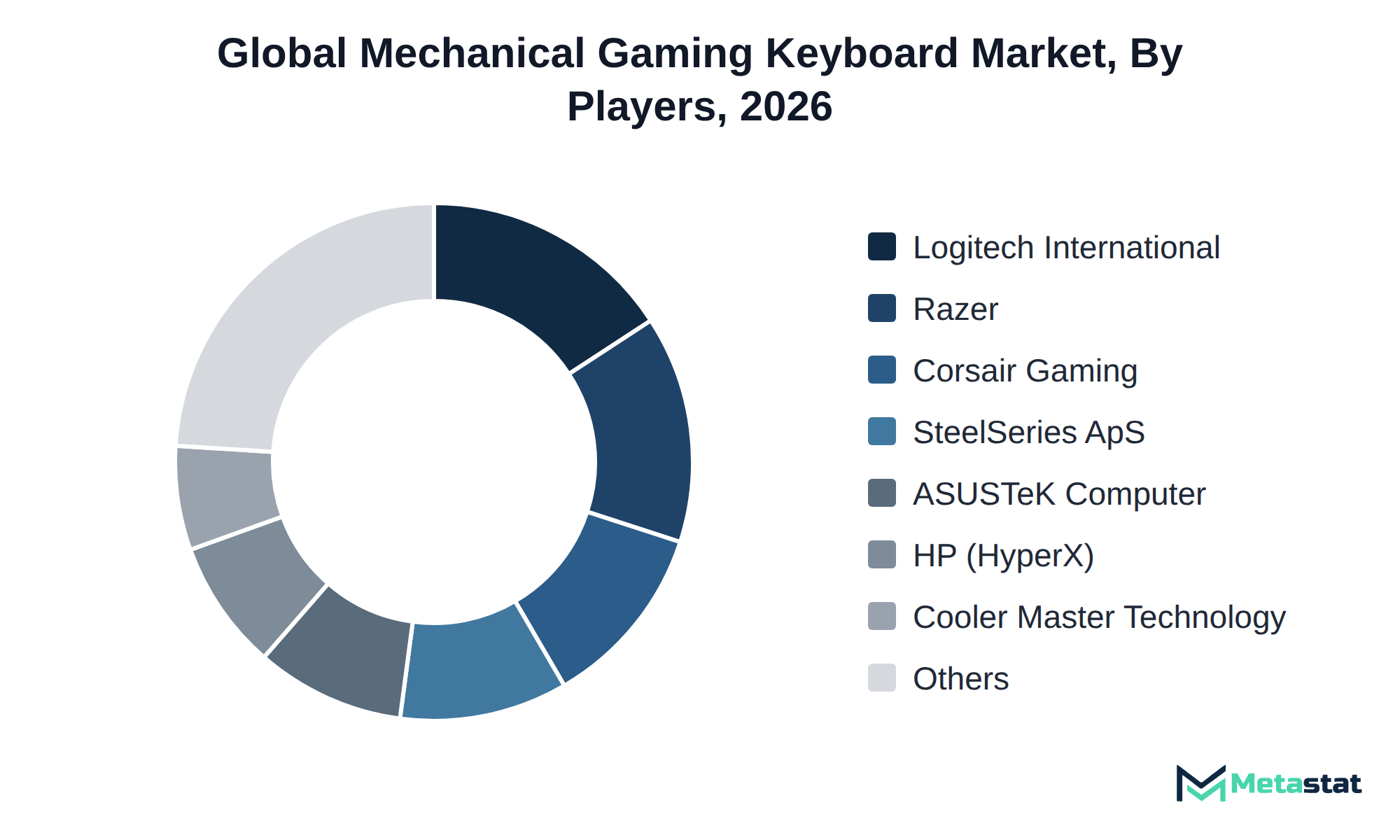
Competition in the Mechanical Gaming Keyboard market revolves around product differentiation, pricing strategies, and consumer preferences for features including customization and connectivity options. Companies apply various switch technologies, including linear, tactile, and optical mechanical switches, to attract different buyer segments. The choice between wired and wireless connectivity influences purchasing decisions, with consumers prioritizing performance and convenience.
Razer Inc. and Corsair Gaming, Inc. emphasize high-performance gaming products, appealing to competitive gamers who value precision and durability. Logitech International S.A. builds on its extensive ecosystem by integrating software and peripherals, which improves the user experience through cross-product compatibility. Cooler Master Technology Co., Ltd. focuses on customization options, allowing users to personalize their keyboards to better fit their gaming style and preferences.
The growth of the Mechanical Gaming Keyboard market relies on several key developments. Increasing adoption of linear mechanical switches is projected to enhance user experience, driving demand particularly among gaming enthusiasts and professionals. The rise of 2.4 GHz wireless connectivity is anticipated to capture significant consumer interest, with expectations for this segment to reach USD 1,078.3 million by 2033. Conversely, challenges including supply chain disruptions and rising component costs could hinder growth. In North America, where the market is expected to reach USD 1,116.1 million by 2033, these risks pose potential barriers to achieving forecasted figures. Competitive pricing and continued innovation will be needed to reach the projected market size.
By Switch Technology: Linear Mechanical Switches, Tactile Mechanical Switches, Clicky Mechanical Switches, Optical Mechanical Switches, Hall Effect and Magnetic Switches, Others (Low-Profile and Hybrid Switches)
By Form Factor: Full-Size, Tenkeyless, 75% Layout, 65% Layout, 60% Layout, Others (96%, Split, and Low-Profile)
By Sales Channel: Online Retail, Specialty Gaming and Electronics Stores, Brand-Owned Stores and Websites, Hypermarkets and Supermarkets, Others (Distributors and Event Sales)
The report strategically identifies and profiles the key market players and analyses their core competencies in each sub-segment of the Mechanical Gaming Keyboard market.
Report Attributes | Details |
Study Period | 2021-2033 |
Base Year | 2025 |
Estimated Year | 2026 |
Forecast Period | 2026-2033 |
Historical Period | 2021-2025 |
Growth Rate | CAGR 11.2% from 2026 to 2033 |
Revenue Unit | USD million |
Segmentation | By Switch Technology, Connectivity, Form Factor, Sales Channel, and Region |
By Region | North America (By Switch Technology, Connectivity, Form Factor, Sales Channel, and Country)
|
Europe (By Switch Technology, Connectivity, Form Factor, Sales Channel, and Country)
| |
Asia Pacific (By Switch Technology, Connectivity, Form Factor, Sales Channel, and Country)
| |
South America (By Switch Technology, Connectivity, Form Factor, Sales Channel, and Country)
| |
Middle East and Africa (By Switch Technology, Connectivity, Form Factor, Sales Channel, and Country)
|
Find answers to common questions about this report
The Mechanical Gaming Keyboard market size was valued at USD 1,598.7 million in 2025.
The market is projected to grow at a CAGR of 11.2% during the forecast period from 2026 to 2033.
The North America Mechanical Gaming Keyboard market size is estimated to reach USD 1,116.1 million by 2033.
Linear Mechanical Switches lead the Mechanical Gaming Keyboard market with a projected value of USD 1,260.8 million by 2033, based on the highest growth rate among the switch technology segments.
Increasing demand for linear mechanical switches drives growth in the market, reflecting a trend toward performance-oriented keyboards among competitive gamers. The demand for 2.4 GHz wireless connectivity represents a notable growth opportunity, highlighting gamers' preference for wireless options that minimize cable clutter while maintaining performance.
Price sensitivity remains a significant restraint, discouraging potential buyers from purchasing high-quality mechanical keyboards. Rising input costs for components challenge suppliers, impacting their ability to provide competitive pricing and influencing overall market growth.
The demand for 2.4 GHz wireless connectivity is driving adoption in the Mechanical Gaming Keyboard market, with a projected CAGR of 13.8% through 2033. Advancements in wireless technology enhance performance and attract gamers seeking flexibility and a clutter-free setup.
The Mechanical Gaming Keyboard market is estimated to reach a valuation of USD 3,738.9 million by 2033.
Key players operating in the Mechanical Gaming Keyboard market include Razer Inc., Logitech International S.A., Corsair Gaming, Inc., SteelSeries ApS, ASUSTeK Computer Inc., HP Inc. (HyperX), and Cooler Master Technology Co., Ltd.
Linear mechanical switches are projected to increase from USD 629.2 million in 2026 to USD 1,260.8 million by 2033, reflecting a CAGR of 10.4%.
The analysts below cover Electronics and Semiconductor research at Metastat Insights.
LEAD ANALYST
Utkarsh Khirodkar is a Lead Market Research Analyst at MetaStat Insight, specializing in market intelligence, technology sector assessments, and competitive strategy.

PRINCIPAL CONSULTANT - ENTERPRISE AI & EMERGING TECHNOLOGIES
Banking & Finance · Electronics and Semiconductor · Energy and Power · Healthcare IT · Information & Technology · Professional Services
Vijay Gunti is a Principal Consultant at MetaStat Insight, bringing over two decades of experience across enterprise digital transformation, technology strategy, and intelligent systems.

PRINCIPAL CONSULTANT - QUALITY SYSTEMS & COMPLIANCE
Electronics and Semiconductor · Machinery & Equipment · Professional Services
Omkar Phadtare is an Industry Consultant at MetaStat Insight, specializing in quality systems, regulatory compliance, and standards benchmarking to drive data-driven market intelligence and strategic industry research.

ENERGY & INFRASTRUCTURE INDUSTRY CONSULTANT
Automotive and Transportation · Electronics and Semiconductor · Energy and Power · Machinery & Equipment
Saurabh Vasant Ganvir consults for Energy & Infrastructure Industry at MetaStat Insight, specializing in renewable energy, solar EPC, and electric vehicle (EV) infrastructure markets.

LEAD CONSULTANT - COMMUNICATION, TELECOM, AND IT
Electronics and Semiconductor · Information & Technology · Machinery & Equipment · Professional Services
Ravindra Sathe Consultants for Communication, Telecom, and IT at MetaStat Insight. He leads the firm's industry research initiatives across telecommunications infrastructure, digital connectivity, enterprise networking, and emerging information technology domains.
Evaluating sensor fusion reliability across harsh operating environments can be tricky without field-validated data. The study on agricultural autonomous guidance systems clearly separated stereo vision setups from automotive-grade solid-state LiDAR. We appreciated the regional infrastructure analysis, specifically around RTK network density across North America and South America. During our follow-up consultation, the MetaStat Insight team walked through tier-two perception software partnerships, giving our engineering leads a practical basis for vendor shortlisting.
Analyzing the transition from natural gas to green hydrogen in iron ore reduction requires realistic infrastructure timelines. Meta stat insight supplied a detailed regional assessment of DRI plant conversion costs and scrap metal availability in North America and Western Europe. Their report carefully examined pellet quality specs and electrical grid access constraints without making oversimplified market assumptions. The research material served as a practical reference during internal technology roadmap discussions.
Integrating zero-trust access controls across legacy electronic health record systems involves complex compliance overhead. Team produced an analysis that clearly separated identity governance and administration tools from privileged access management platforms. Their evaluation of HIPAA and GDPR compliance features across cloud native solutions gave our architecture group clear baseline criteria. The custom data request regarding biometric authentication adoption in hospital networks was returned promptly with clear documentation.
Explore related market intelligence reports worth reading alongside this one.