
LEAD ANALYST
Utkarsh Khirodkar is a Lead Market Research Analyst at MetaStat Insight, specializing in market intelligence, technology sector assessments, and competitive strategy.

Global Cinematographic Camera Market Size, Share, By Camera Type (Digital Cinema Cameras, Digital Single-Lens Reflex Cameras, Mirrorless Cameras, Camcorders, Action Cameras), By Sensor Type (Full-Frame Sensors, Super 35mm Sensors, Micro Four Thirds Sensors, 1-Inch Sensors, Compact Sensors), By Resolution (4K, 8K, HD and Others), By Application (Feature Films, Documentaries, Commercials and Television Production), Industry Analysis, Growth, Trends, and Forecast, 2026-2033
Report ID
MSI-2436
Published
November, 2026
Pages
310 Pages
Format
Historical
Base year
Forecast
Forecast period
Report Details
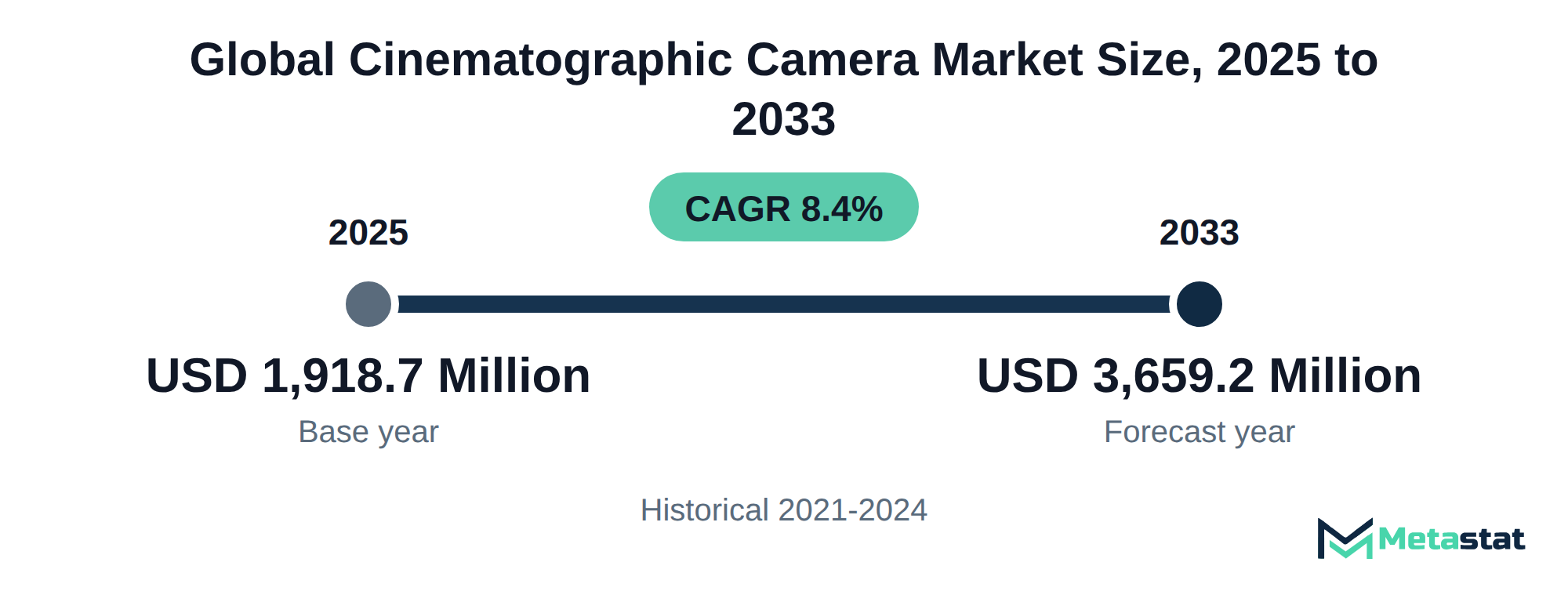
Market Valuation: Valued at $1,918.7 Million in 2025, projected to reach $3,659.2 Million by 2033 at a 8.4% CAGR.
Dominant Segment: Digital Cinema Cameras lead the market, driven by their adoption in professional filmmaking, which demands high-quality production capabilities. This segment is projected to reach USD 1,176.8 million by 2033, reflecting a CAGR of 8.5%.
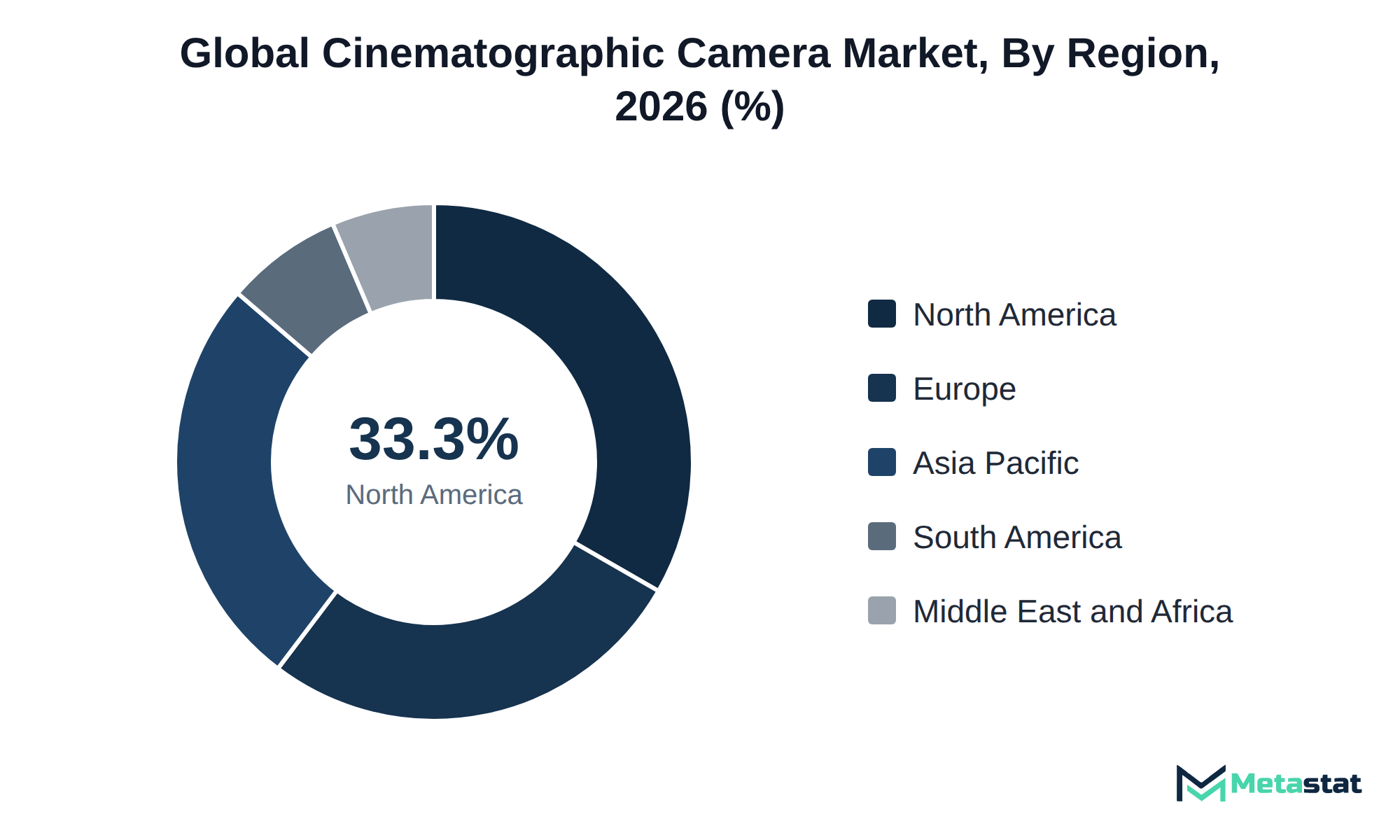
Geographic Lead: North America is the leading region, holding 33.3% of the market in 2025, with the US expected to maintain this position into 2026 due to its strong presence in filmmaking technology.
What's Inside: The report includes a comprehensive analysis of market dynamics, competitive landscape, and detailed forecasts from 2026 to 2033, covering various camera types, sensor technologies, and resolutions.
Emerging Trends: The rise of 8K capture and full-frame sensors is reshaping professional filmmaking, enhancing image quality and storytelling capabilities, thus driving demand for advanced cinematographic cameras.
Market Dynamics: Increased investment in streaming content is pushing demand for high-quality cinematographic cameras, as content creators seek to deliver superior visual experiences to attract audiences.
Choose Your License
Global Cinematographic Camera Market
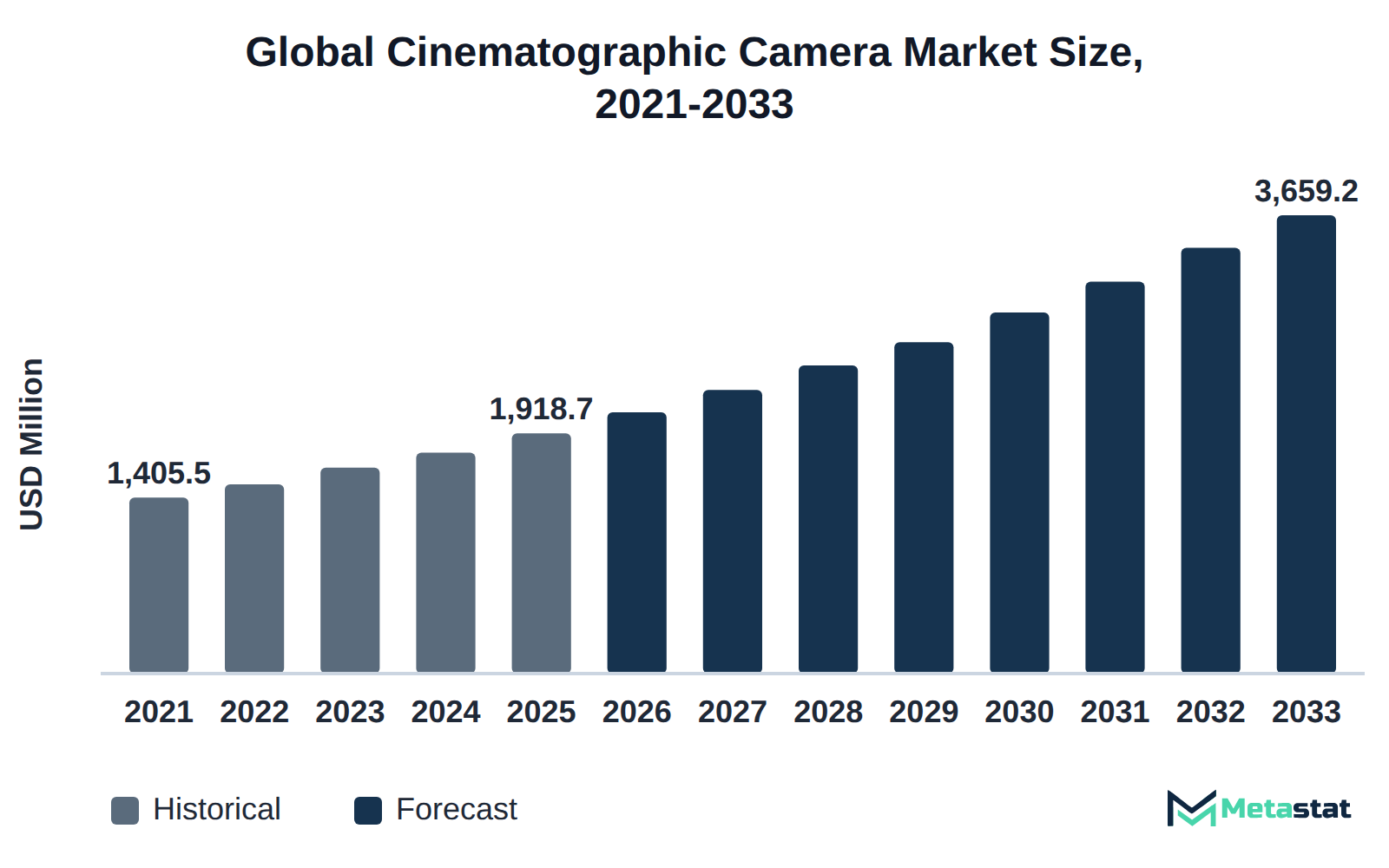
The global Cinematographic Camera market was valued at USD 1,918.7 million in 2025 and is projected to reach USD 3,659.2 million by 2033, growing at a CAGR of 8.4% over the forecast period.
The market encompasses a range of cinematographic cameras designed for various applications including feature films, documentaries, and commercials. Buyers invest in these cameras to achieve high-quality visual storytelling, driven by advancements in technology and increased content creation across platforms. Superior image quality and versatile filming capabilities influence purchasing decisions, particularly among filmmakers and production companies seeking to enhance creative output.
Growth within the market is propelled by the increasing shift towards digital cinema technologies and the demand for high-resolution filming. Among the segments, Digital Cinema Cameras represent the largest share, benefiting from their adoption in professional and independent filmmaking. North America holds 33.3% of the market in 2025, with the US leading in 2026. This region's strong presence supports significant advancements in cinematography and filmmaking technology.
Investment in cinematographic technology reflects broader trends in the entertainment and media industries, where high production values remain essential. Demand for innovative solutions drives market expansion and gives producers and content creators tools that meet changing industry standards. The growing popularity of streaming services and the need for diverse content further augment the appeal of high-quality cinematographic cameras.
The demand for cinematographic cameras reflects a broad interest in high-quality visual storytelling across various sectors, including film production, television, and commercial enterprises. Buyers invest in these cameras to enhance production quality, improve viewer engagement, and adapt to the rising standards of visual media. The market responds with advanced technology and features suited to the specific needs of different applications, which gives buyers a competitive edge in content creation.
Digital Cinema Cameras represent the segment with the most value, driven by their ability to produce cinematic-quality footage that meets the expectations of filmmakers and producers. Growing adoption of 4K and 8K resolution cameras is a major contributor to market growth, as creators seek to deliver visually striking content that holds audience attention and raises production standards.
Key technological advancements, including improved sensor capabilities and enhanced image processing, support the market's expansion. The integration of features including better low-light performance and advanced autofocus systems assists filmmakers in achieving their creative visions. As the market evolves, these innovations will keep shaping cinematography and open new applications.
The introduction of 8K capture and full-frame sensors significantly transforms professional filmmaking. This advancement enables filmmakers to achieve high image quality, resulting in incredibly detailed visuals that improve storytelling. Full-frame image sensors, in particular, provide a wider field of view and superior low-light performance, enhancing production quality for various applications including feature films and commercials.
The full-frame sensor segment is projected to grow from USD 653.9 million in 2026 to USD 1,226.6 million by 2033, reflecting a compound annual growth rate (CAGR) of 9.4%. This growth reflects the industry's increasing preference for advanced imaging technology. Filmmakers and production companies recognize the competitive edge offered by 8K resolution, compelling them to invest in cinematographic cameras that support these features.
The rising demand for higher resolution and enhanced sensor technology in the cinematographic camera market drives significant investment from manufacturers. Companies are motivated to innovate and deliver cameras equipped with these advanced capabilities, directly impacting the quality and creativity of film projects. Consequently, 8K capture and full-frame sensors are influencing production standards and shaping the future of professional filmmaking.
Virtual production workflows significantly influence purchasing decisions in the Cinematographic Camera market, particularly for gen-lock-ready cinema cameras. The rise of virtual production techniques, which rely on synchronized camera movements and real-time 3D rendering software, necessitates equipment that integrates seamlessly with existing digital environments. This demand reflects a shift toward advanced technology that enhances production efficiency and quality.
In 2023, the market reached a valuation of USD 1,643.8 million, demonstrating increasing investment in innovative filming techniques. Buyers prioritize cameras equipped with gen-lock capabilities to facilitate complex productions, ensuring synchronization between multiple video feeds and virtual environments. This technological requirement drives higher price points for these specialized cameras, leading to the emergence of varied pricing models.
Renting equipment has become a prevalent practice among buyers seeking flexibility or testing equipment before committing to purchase. Consequently, rental companies expand their inventories to include the latest gen-lock-ready models, catering to demand from film studios and production companies. This evolution in purchasing behavior leads to more competitive offerings, ultimately benefiting buyers and enhancing overall market growth.
The emergence of streaming originals significantly drives the adoption of mirrorless and digital cinema cameras. The demand for high-quality video content has surged within video on-demand streaming services, compelling producers to upgrade their filming equipment. In response, the market for mirrorless cameras is projected to reach USD 1,020.2 million by 2033. This growth reflects the increasing need for versatile and compact options that deliver professional-level results.
Content creators in the streaming sector prioritize innovative features including superior autofocus, high frame rates, and strong low-light performance. These capabilities enhance the production quality of originals, helping to attract larger audiences. The shift toward digital cinema cameras aligns with the industry's objective of maintaining a competitive edge, particularly as viewers increasingly seek cinematic experiences from home entertainment audio and video content.
The implications for the market extend beyond simple equipment upgrades. Producers adopting advanced camera technology position themselves to improve content quality, which in turn enhances viewer engagement and loyalty. This shift translates into added revenue opportunities for creators and a matching expansion of the cinematographic camera market.
Within the cinematographic camera market, Digital Cinema Cameras are an excellent choice for feature film and documentary production, thanks to their superior image quality and advanced features. By 2033, the segment is projected to reach a value of USD 1,176.8 million, reflecting a compound annual growth rate (CAGR) of 8.5% from 2026. This growth indicates increasing adoption among filmmakers and production companies prioritizing high-quality visual storytelling.
For feature films, cameras that capture intricate details and rich colors are essential, which leads production teams to treat Digital Cinema Cameras as a fundamental investment. These cameras offer high dynamic range and 4K resolution capabilities, which are critical for meeting contemporary viewing standards. The segment's growth emphasizes a shift towards more sophisticated equipment in the cinematographic camera market.
In the documentary sector, where capturing realism and nuanced moments matters, Digital Cinema Cameras provide the flexibility and quality required for various shooting environments. Continuous advancements in this segment contribute to filmmakers' need for reliable equipment, further enhancing the market's stature in professional cinematography.
Increased investment in streaming content directly influences the demand for cinematographic cameras. Content creators seek high-quality visual experiences to attract viewers, resulting in a shift toward professional-grade equipment. This trend primarily involves production companies and independent filmmakers who strive to enhance their output quality. The introduction of advanced technologies, including 8K resolution and full-frame sensors, drives this transition by providing superior imaging capabilities. The market experiences heightened competition among producers for better equipment, leading to increased spending. This growth highlights how much high-definition content now matters for attracting audiences and raises the relevance of the cinematographic camera market.
Streaming platforms' expansion into original content continues to increase demand for high-quality cameras, reshaping production strategies and equipment purchases across the industry.
Advancements in sensor technology significantly impact the cinematographic camera market. Emerging technologies, specifically full-frame and Super 35mm sensors, enhance image quality and dynamic range, appealing to content creators pursuing high production values. The integration of larger sensors in cameras enables filmmakers to capture stunning visuals, a factor that consistently attracts investments in cinematography equipment.
The growing focus on capturing high-resolution content fuels demand across various applications, particularly feature films and documentaries. In response, manufacturers develop innovative sensor solutions that improve performance in low-light conditions and enhance color accuracy. Color accuracy at capture also matters downstream, where color grading monitors are used to review footage in post-production. This evolution in sensor technology directly influences purchasing decisions for cinematographic cameras, positioning suppliers favorably in a competitive landscape.
Advances in sensor technology drive the market toward cameras that let users achieve cinematic quality in diverse environments. Filmmakers increasingly prioritize equipment that delivers superior results, prompting suppliers to refine their offerings and expand their product lines to meet these evolving needs.
High pricing presents a notable restraint within the cinematographic camera market, particularly affecting small production companies and independent filmmakers. These buyers operate under tight budgets, hindering their ability to invest in premium camera technologies. Consequently, this situation leads to slower uptake of advanced models, resulting in smaller orders as they opt for lower-cost alternatives or delay upgrading their existing equipment. The shift towards higher resolution formats, including 8K, increases the financial burden, prompting buyers to carefully evaluate their investments. Pressure to achieve high production quality against budget constraints creates challenges, ultimately influencing purchasing decisions. This price sensitivity affects market dynamics by reducing potential revenue growth from higher-end camera segments.
Innovations in sensor technology and resolution enhancements improve production standards, yet the high costs associated with such advancements continue to deter broader adoption, especially among less affluent segments. In this context, the focus on cost-effective solutions prevails, potentially stunting overall market expansion.
Suppliers in the cinematographic camera market face significant challenges due to rising input costs. Factors driving these increases include fluctuations in raw material prices and supply chain disruptions, which impact production expenses. The surge in demand for high-quality components further exacerbates these pressures, creating a difficult environment for suppliers seeking to maintain profit margins.
In response, many suppliers implement cost control measures and enhance operational efficiencies to mitigate the effects of rising costs. Investment in automated production technologies and strategic sourcing helps reduce reliance on volatile materials. Suppliers explore partnerships and collaborations to share resources and ensure more stable pricing structures. These strategies aim to sustain competitiveness as input costs rise.
Digital cinema cameras represent a significant growth opportunity within the cinematographic camera market, driven by increasing adoption among filmmakers seeking high-quality production capabilities. This expansion highlights a shift in preference towards digital solutions that offer enhanced versatility and performance in various filming conditions.
The rising demand for high-resolution content, particularly in feature films, fuels this trend, with filmmakers prioritizing superior image quality and advanced features offered by digital cinema cameras. This segment stands out due to its ability to meet the evolving needs of content creators while providing a competitive edge in an increasingly crowded marketplace. The growth trajectory indicates a strong future for digital cinema cameras, positioning them as a focal point for investment and innovation within the market.
The Global Cinematographic Camera market is segmented based on Camera Type, Sensor Type, Resolution, and Application.
This segment primarily serves filmmakers and production companies focusing on feature films, documentaries, and high-quality commercials. The increasing shift toward digital production and the growing demand for high-resolution content drive this segment. Compared to other camera types including Digital Single-Lens Reflex Cameras and Mirrorless Cameras, Digital Cinema Cameras exhibit a faster growth rate, partly due to their specialized features tailored for cinematic production. Investment in advanced technology, including superior sensors and robust lenses, enhances their appeal, ultimately supporting broader adoption in the market.
Digital Single-Lens Reflex Cameras segment is estimated to reach USD 692.3 million by 2033, at a CAGR of 6.9% during the forecast period. This segment serves primarily filmmakers and content creators who require high-quality image capture with versatility in lens options. The demand for these cameras is increasing due to the growing trend of independent filmmaking and the need for professional photography. Unlike Digital Cinema Cameras, which exhibit a higher growth rate, the Digital Single-Lens Reflex Cameras segment experiences slower growth driven by its established market presence and value-oriented pricing. The affordability of these cameras compared to higher-priced alternatives allows a broader range of buyers, including amateur filmmakers and photography enthusiasts, to enter the market.
The Mirrorless Cameras segment is expected to reach USD 1,020.2 million by 2033. This segment typically attracts independent filmmakers, content creators, and professionals seeking portability without compromising on image quality. Growth is driven by advancements in technology and a growing preference for lightweight equipment. The CAGR for mirrorless cameras reflects an increasing shift towards versatile filming solutions, resulting in heightened demand among entry-level and mid-range buyers. Compared to Digital Single-Lens Reflex Cameras, which project a CAGR of 6.9%, the mirrorless segment has a stronger appeal due to its compact design and advanced features, enhancing creative possibilities for users. Such dynamics contribute to the overall expansion of the cinematographic camera market.
Camcorders segment is projected to grow at a CAGR of 7.1% during the forecast period. These devices serve various purposes, particularly in television production, event videography, and sports broadcasting. Demand primarily arises from broadcast companies and independent filmmakers, driven by the need for efficient, portable recording options that deliver quality video. The segment distinguishes itself from others in the Camera Type category through its pricing and user base, appealing to both professionals and amateurs seeking affordability and ease of use. While digital cinema cameras and mirrorless cameras experience higher growth rates due to advanced technology adoption, camcorders maintain relevance due to their targeted applications and accessibility, ensuring steady demand in the market.
Action cameras serve a distinct role in the cinematographic camera landscape, catering primarily to adventure seekers and content creators who prioritize portability and durability. These cameras excel in extreme conditions, capturing high-quality footage in scenarios including sports, outdoor activities, and travel vlogs. The increasing popularity of social media platforms encourages enthusiasts and influencers to adopt action cameras, further driving demand. However, intense competition in the market leads to pricing pressures, affecting margins for producers. Unlike digital cinema and mirrorless cameras, which target professional filmmakers, action cameras attract a different buyer demographic focused on versatility and ease of use. This segment experiences unique growth dynamics compared to other categories, with innovations in compact designs and user-friendly features appealing to a broader audience.
This sensor type is frequently used in high-end cinematographic applications, including feature films and documentaries, where superior image quality is essential in storytelling. The segment's growth is driven by the increasing demand for high-resolution content, which requires advanced sensor technologies to capture intricate details. Compared to other sensor types, Full-Frame Sensors demonstrate a higher growth rate, reflecting their popularity among professional filmmakers. The pricing of these sensors tends to be higher due to their advanced capabilities and the market's focus on quality, distinguishing them from lower-cost alternatives like Micro Four Thirds Sensors. Further investment in equipment that enhances production value and visual storytelling is expected.
Super 35mm Sensors segment is estimated to reach USD 876 million by 2033, at a CAGR of 7.5% during the forecast period. This sensor type finds extensive use in feature films and high-quality video production, appealing to filmmakers who seek a balance between cost and performance. Growing interest in cinematic storytelling and advancements in filmmaking technology significantly drive demand for Super 35mm Sensors. Compared to other sensor types, including Full-Frame Sensors, which are expected to grow at a CAGR of 9.4%, Super 35mm Sensors exhibit slower growth while maintaining competitive pricing, attracting mid-range production companies. Steady demand allows this segment to attract a diverse clientele, including independent filmmakers and larger studios aiming for high-quality results without the inflated costs associated with larger sensors. The focus on budget-conscious production continues to enhance the segment's relevance in the market.
Micro Four Thirds Sensors segment is expected to reach USD 572.3 million by 2033. This sensor type is favored by independent filmmakers and content creators seeking a balance between quality and portability. The growing demand for compact and lightweight cinematographic solutions fuels this segment, enabling easier maneuverability during shoots. Increased affordability compared to full-frame sensors attracts a broader customer base, particularly among new entrants in the production field. In contrast to Full-Frame Sensors, which project a CAGR of 9.4%, Micro Four Thirds Sensors experience a slower growth rate, reflecting a more established presence in the market. The competitive landscape encourages manufacturers to innovate within this segment, enhancing features including autofocus capabilities and low-light performance. The market continues to evolve, driven by technological advancements and shifting consumer preferences.
1-Inch Sensors segment is projected to grow at a CAGR of 8.2% during the forecast period. This segment finds applications primarily in compact cameras, catering to users requiring high-quality video recording in a smaller form factor, including independent filmmakers and content creators. The rise in demand for portable, lightweight cameras that maintain excellent image quality significantly drives growth in this segment. Compared to other sensor types, 1-Inch Sensors offer a balance between size and performance, positioning them differently in the market. Enhanced image quality and functionality contribute to the competitive edge of 1-Inch Sensors, appealing to users prioritizing flexibility without compromising on quality.
Compact Sensors represent a specific category within the sensor type segmentation, catering to a diverse range of applications. These sensors find utility in projects that prioritize size and weight efficiency, appealing primarily to independent filmmakers and content creators who require a portable solution without sacrificing quality. Demand for compact sensors is driven by the growing trend toward mobile filmmaking and vlogging, where equipment versatility is essential. Compared to other sensor types, compact sensors generally feature a lower price point, attracting budget-conscious users. This accessibility contrasts with the higher price of Full-Frame or Super 35mm sensors, which target professional filmmakers seeking advanced capabilities. The Compact Sensors segment contributes to the overall growth of the market by addressing the needs of users prioritizing mobility and convenience in cinematographic projects.
Valued at USD 880.9 million in 2026, the 4K segment is projected to reach USD 1,470.3 million by 2033, at a CAGR of 7.6% during the forecast period. This segment finds extensive use in feature films, television production, and live events, appealing to filmmakers and content creators who prioritize high-resolution imaging. The increasing preference for high-definition content drives demand, with filmmakers seeking to enhance visual quality. Compared to other segments, the 4K segment experiences significant growth, supported by technological advancements in camera capabilities, making it more appealing than lower-resolution options. This trend highlights the market's shift towards higher quality standards, positioning the 4K resolution as a standard in professional cinematography.
The 8K segment is estimated to reach USD 920.7 million by 2033, at a CAGR of 12.9% during the forecast period. This segment primarily caters to high-end filmmaking and professional video production, where superior image quality enhances visual storytelling. On set, high-resolution footage is typically checked on video production monitors. Demand for 8K resolution is driven by the increasing need for high-definition content in both streaming platforms and broadcast television. Compared to other segments, including HD and 4K, the 8K segment experiences a higher growth rate, reflecting a shift towards advanced technology among content creators. The competitive landscape features manufacturers focusing on delivering advanced features and enhanced performance in 8K cameras, further influencing adoption rates. Investment in technology and the growing trend of cinematic storytelling significantly impact this segment's trajectory, distinguishing it from lower resolution alternatives.
HD segment is expected to reach USD 758.9 million by 2033. This resolution level primarily serves filmmakers and content creators seeking quality visuals for various applications, including television production and commercials. The growing demand for high-definition content across platforms drives adoption within this segment, with significant interest from production companies focused on meeting viewer expectations. HD technology offers a balance between cost and quality, positioning it as a competitive option compared to 4K and 8K resolutions, which are more expensive and technically demanding. While the 4K segment shows a CAGR of 7.6%, the HD segment is projected to experience slower growth, indicating a potential preference shift among budget-conscious producers. The enduring popularity of HD is influenced by its established presence in the market and the ongoing requirement for accessible production technology.
Valued at USD 758.9 million by 2033, the Others (6K, 5.7K) segment is projected to grow at a CAGR of 8.6% during the forecast period. This segment caters to various applications, including event videography and sports broadcasting, appealing to independent filmmakers and content creators seeking higher-resolution options. The growth of this segment is primarily driven by increasing demand for high-quality video content, particularly among streaming platforms and online content producers. Compared to other resolution segments, the Others (6K, 5.7K) segment exhibits a more niche market appeal, focusing on specific content creation needs that require enhanced visual fidelity. Unlike traditional HD, segments including Others (6K, 5.7K) benefit from technological advancements that facilitate more accessible production methods while providing enhanced viewing experiences.
Valued at USD 596.7 million in 2026, this segment is projected to reach USD 1,065.2 million by 2033, reflecting a CAGR of 8.6% during the forecast period. Feature films employ cinematographic cameras to create high-quality visual storytelling for theatrical releases, appealing to both filmmakers and production companies. The increasing demand for high-definition content and advanced visual effects drives growth in this segment, with filmmakers seeking cameras that offer superior image quality and flexibility. Compared to other applications, including commercials and documentaries, feature films often involve larger budgets and more complex production processes, enhancing the demand for premium camera systems. Such characteristics distinguish this segment, positioning it for significant growth within the market.
Documentaries segment is estimated to reach USD 783.8 million by 2033, at a CAGR of 9.3% during the forecast period. This segment finds application in the production of non-fiction films, often presenting real-life events, cultures, or personal stories, appealing to audiences seeking authentic narratives. The demand for high-quality documentary films drives growth, with filmmakers increasingly adopting advanced cinematographic cameras to capture stunning visuals and sound. Compared to other applications, the Documentaries segment displays a faster growth rate, reflecting growing interest in streaming platforms that prioritize documentary content. Pricing dynamics influence this segment, with competitive offerings from various manufacturers aiming to meet diverse budget requirements. This segment's expansion contributes positively to the overall market for cinematographic cameras, supporting continued innovation and technological advancements.
The commercials segment is expected to reach USD 728.2 million by 2033. This segment serves the advertising services industry, attracting buyers from various sectors seeking to promote their brands and products through visual storytelling. The push for high-quality content drives demand in this segment, with businesses increasingly prioritizing professional production values in advertisements. Compared to other segments, including feature films, which are projected to grow at a CAGR of 8.6%, commercials experience a slightly slower growth trajectory. Anticipated evolving media consumption patterns and the integration of advanced technologies, including 8K resolution, support the overall expansion of the market. Advertisers aim to leverage innovative cinematic techniques, resulting in heightened competition among production companies to deliver effective commercial content.
The Television Production segment is projected to grow at a CAGR of 8.1% during the forecast period. This segment focuses on creating scripted and unscripted content for television networks and streaming platforms, appealing to production companies and broadcasters. The increasing demand for high-quality content, driven by the rise in streaming services, supports the segment's growth. Innovations in camera technology enhance production quality, attracting more investment in this segment. Compared to other applications, including Feature Films, the Television Production segment experiences a steadier growth rate, reflecting ongoing demand for episodic content. This segment's specific requirements for versatility and efficiency differentiate it from others within the market.
Event videography and sports broadcasting require specialized cinematographic equipment that captures high-quality footage in dynamic environments. This segment serves professionals in broadcasting and live events who prioritize clarity and detail in their recordings. Strong demand within this sub-segment stems from the growing popularity of streaming and video services, particularly live streaming, and increasing quality expectations from audiences. Unlike feature films and documentaries, this segment typically requires faster acquisition of equipment due to tighter production schedules and the need for real-time editing. The market for event videography and sports broadcasting features a diverse range of buyers that differ from those purchasing for narrative films, emphasizing practicality and immediate functionality in their selections.
Based on geography, the Global Cinematographic Camera market is divided into North America, Europe, Asia-Pacific, South America, Middle East, and Africa.
With a projected value of USD 1,170.2 million by the end of 2033, North America is a key player in the cinematographic camera market. The United States, Canada, and Mexico contribute to the growing demand driven by industries including film production and commercial advertising. The region's well-established infrastructure supports the rapid adoption of advanced camera technologies, enhancing production quality. Government initiatives promoting film and media production encourage investments and innovation within the sector. North America holds a strong position in the overall market for cinematographic cameras.
The European market accounts for 27.00% of the global cinematographic camera market in 2025. Demand stems primarily from the feature film and documentary industries, driven by high production values and advanced visual storytelling techniques. Countries including Germany, the UK, and France serve as key hubs for film production, supported by strong infrastructure and a skilled workforce. Increasing investments in film projects across Europe contribute to market growth. The region benefits from strong artistic heritage and innovation, enhancing its competitive edge in global cinematography. European cinematographers frequently adopt high-resolution cameras, particularly those equipped with full-frame sensors, to meet the demands of modern filmmaking.
Asia-Pacific represents a significant segment within the Cinematographic Camera market, accounting for 26.0% of the global market share in 2025. The region benefits from a rapidly growing film and television industry, with countries like China and India pushing for enhanced production capabilities. Increased investment in digital content and advancements in camera technologies drive demand for high-quality cinematographic equipment. Favorable government initiatives supporting local film industries further enhance market growth. Specific attention on infrastructure improvements, including high-speed internet access, influences the adoption of streaming services and increases demand for high-resolution cameras. Emerging trends in video content creation among influencers and independent filmmakers position the region for expanding market opportunities.
In South America, the cinematographic camera market shows a growing interest driven by increasing demand for content creation across various sectors. Notable countries include Brazil and Argentina, which host strong film industries and are experiencing an upsurge in documentary and commercial productions. The market benefits from enhanced digital infrastructure initiatives that support filmmakers, creating a favorable environment for investment in advanced cinematographic technologies. South America reflects significant potential for growth. Increased accessibility to high-quality cinematographic equipment supports local filmmakers and production companies in delivering superior content, contributing to the overall expansion of the market.
In the Middle East and Africa, the cinematographic camera market reflects a growing interest in high-quality video production, driven primarily by the expansion of the entertainment and media industries. Countries like Saudi Arabia and the UAE have actively invested in developing their film and television sectors, promoting local content creation. South Africa stands out for its established film industry and increasingly attracts international productions. The region's market share highlights its emerging potential within the global landscape. Demand for advanced equipment continues to rise among filmmakers, supported by a focus on producing content that meets international standards. The market's growth is influenced by investments in state-of-the-art production facilities and technological advancements.
The competitive arena for the Cinematographic Camera market divides primarily by camera type, sensor type, resolution, and application. Digital cinema cameras are expected to experience significant growth, driven by demand from feature film productions and high-end commercial projects. Mirrorless cameras appeal to a different segment of buyers, focusing on versatility and portability, making them popular among independent filmmakers and content creators.
Key players in the market include ARRI, Sony Group Corporation, and Canon Inc., each emphasizing unique strengths. ARRI focuses on innovation in digital cinema cameras, building on its industry reputation for high-quality production tools. Sony Group Corporation prioritizes advancements in sensor technology, enhancing its mirrorless camera offerings to capture a broader audience. Canon Inc. balances its product range across various segments, appealing to both professional filmmakers and casual users.
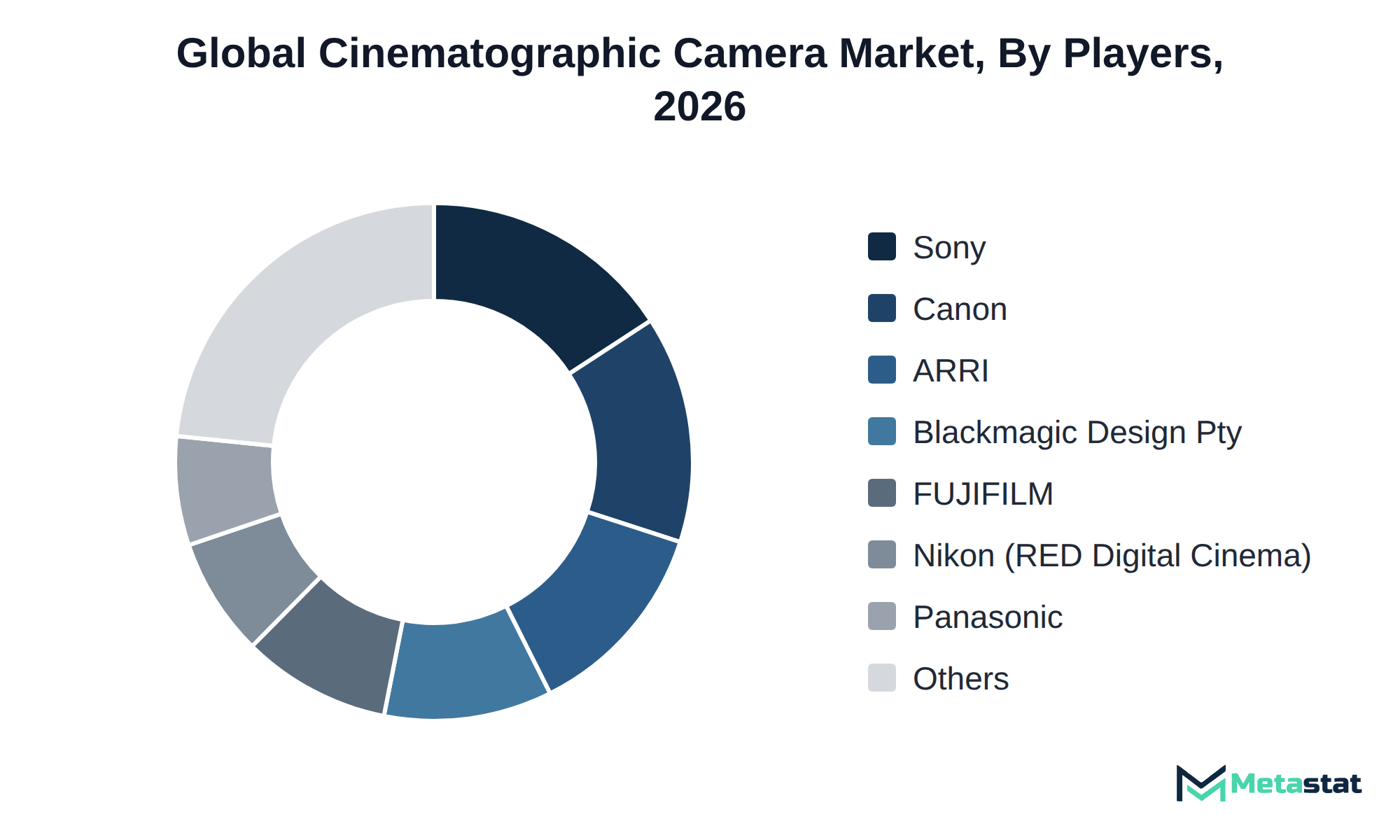
Growth in the cinematographic camera market hinges on several key developments. First, the increasing adoption of Digital Cinema Cameras, projected to grow at a CAGR of 8.5%, will drive significant investment in high-quality video production across various applications. This trend particularly influences the feature film segment, where demand for advanced filming technology remains strong. Second, the rising popularity of 8K resolution, anticipated to grow at a CAGR of 12.9%, signals a shift towards ultra-high-definition content creation, particularly in the Asia Pacific region, where technological advancements further facilitate this transition. Lastly, robust market performance relies on continuous innovation and competition among major players, including ARRI and Sony Group Corporation, which influences pricing and product offerings.
However, potential risks exist that could impede growth. Economic downturns or disruptions in supply chains could cause delays in production and product availability, particularly affecting the North American market, where the highest revenue is concentrated. The interaction of these factors will significantly shape the future of the cinematographic camera market.
By Camera Type: Digital Cinema Cameras, Digital Single-Lens Reflex Cameras, Mirrorless Cameras, Camcorders, Action Cameras
By Sensor Type: Full-Frame Sensors, Super 35mm Sensors, Micro Four Thirds Sensors, 1-Inch Sensors, Compact Sensors
By Resolution: 4K, 8K, HD, Others (6K, 5.7K)
By Application: Feature Films, Documentaries, Commercials, Television Production, Others (Event Videography, Sports Broadcasting)
The report strategically identifies and profiles the key market players and analyses their core competencies in each sub-segment of the Cinematographic Camera market.
|
Report Attributes |
Details |
|
Study Period |
2021-2033 |
|
Base Year |
2025 |
|
Estimated Year |
2026 |
|
Forecast Period |
2026-2033 |
|
Historical Period |
2021-2025 |
|
Growth Rate |
CAGR 8.4% from 2026 to 2033 |
|
Revenue Unit |
USD million |
|
Segmentation |
By Camera Type, Sensor Type, Resolution, Application, and Region |
|
By Region |
North America (By Camera Type, Sensor Type, Resolution, Application, and Country)
|
|
Europe (By Camera Type, Sensor Type, Resolution, Application, and Country)
|
|
|
Asia Pacific (By Camera Type, Sensor Type, Resolution, Application, and Country)
|
|
|
South America (By Camera Type, Sensor Type, Resolution, Application, and Country)
|
|
|
Middle East and Africa (By Camera Type, Sensor Type, Resolution, Application, and Country)
|
Find answers to common questions about this report
The Cinematographic Camera market size was valued at USD 1,918.7 million in 2025.
The market is projected to grow at a CAGR of 8.4% during the forecast period from 2026 to 2033.
The North America Cinematographic Camera market size is estimated to reach USD 1,170.2 million by 2033.
Digital Cinema Cameras lead the market with a projected value of USD 1,176.8 million by 2033, reflecting the highest growth rate among the camera type segments.
Key drivers for the cinematographic camera market include increased investment in streaming content, which influences demand for high-quality visual experiences. Advancements in sensor technology, particularly full-frame and Super 35mm sensors, enhance image quality and dynamic range, attracting filmmakers pursuing high production values.
North America holds the dominant share of the Cinematographic Camera market, with a projected value of USD 1,170.2 million in 2033, representing 33.3 percent of the total market. This figure surpasses the shares of other regions, including Europe and Asia Pacific.
High pricing presents a notable restraint within the cinematographic camera market, particularly affecting small production companies and independent filmmakers operating under tight budgets. Rising input costs, driven by fluctuations in raw material prices and supply chain disruptions, create challenges for suppliers in maintaining profit margins.
Digital cinema cameras are gaining traction due to their superior production capabilities and increasing adoption among filmmakers. The segment's growth reflects a strong demand for high-resolution content, particularly in feature films, positioning it as a key focus for investment and innovation in the cinematographic camera market.
The Cinematographic Camera market is estimated to reach a valuation of USD 3,659.2 million by 2033.
Key players operating in the Cinematographic Camera market include ARRI, Sony Group Corporation, Canon Inc., Blackmagic Design Pty. Ltd., Panasonic Holdings Corporation, FUJIFILM Holdings Corporation, and GoPro, Inc.
The analysts below cover Electronics and Semiconductor research at Metastat Insights.
LEAD ANALYST
Utkarsh Khirodkar is a Lead Market Research Analyst at MetaStat Insight, specializing in market intelligence, technology sector assessments, and competitive strategy.

PRINCIPAL CONSULTANT - ENTERPRISE AI & EMERGING TECHNOLOGIES
Banking & Finance · Electronics and Semiconductor · Energy and Power · Healthcare IT · Information & Technology · Professional Services
Vijay Gunti is a Principal Consultant at MetaStat Insight, bringing over two decades of experience across enterprise digital transformation, technology strategy, and intelligent systems.

PRINCIPAL CONSULTANT - QUALITY SYSTEMS & COMPLIANCE
Electronics and Semiconductor · Machinery & Equipment · Professional Services
Omkar Phadtare is an Industry Consultant at MetaStat Insight, specializing in quality systems, regulatory compliance, and standards benchmarking to drive data-driven market intelligence and strategic industry research.

ENERGY & INFRASTRUCTURE INDUSTRY CONSULTANT
Automotive and Transportation · Electronics and Semiconductor · Energy and Power · Machinery & Equipment
Saurabh Vasant Ganvir consults for Energy & Infrastructure Industry at MetaStat Insight, specializing in renewable energy, solar EPC, and electric vehicle (EV) infrastructure markets.

LEAD CONSULTANT - COMMUNICATION, TELECOM, AND IT
Electronics and Semiconductor · Information & Technology · Machinery & Equipment · Professional Services
Ravindra Sathe Consultants for Communication, Telecom, and IT at MetaStat Insight. He leads the firm's industry research initiatives across telecommunications infrastructure, digital connectivity, enterprise networking, and emerging information technology domains.
The technical breakdown of ISO 20022 migration readiness across correspondent banking corridors was remarkably thorough. Rather than treating cross-border corporate payments as a single block, the report drew a useful distinction between multilateral netting platforms and domestic instant payment rails across ASEAN economies. MetaStat Insight highlighted regulatory constraints on foreign exchange liquidity management that many publications gloss over. The research material offered practical clarity for our platform development roadmap.
Our group needed clearer visibility into out-of-autoclave processing timelines for high-temperature thermoplastic composites. MetaStat Insight delivered an objective assessment that contrasted automated fiber placement scrap rates with traditional thermoset prepreg layup cycles. The supplier landscape mapped out primary resin suppliers and tape slitting capacity across France, Germany, and Japan with solid technical accuracy. Their analyst handled our questions on precursor supply risks during an unscheduled inquiry call, providing clear, unembellished context.
Evaluating sensor fusion reliability across harsh operating environments can be tricky without field-validated data. The study on agricultural autonomous guidance systems clearly separated stereo vision setups from automotive-grade solid-state LiDAR. We appreciated the regional infrastructure analysis, specifically around RTK network density across North America and South America. During our follow-up consultation, the MetaStat Insight team walked through tier-two perception software partnerships, giving our engineering leads a practical basis for vendor shortlisting.
Explore related market intelligence reports worth reading alongside this one.