
LEAD ANALYST
Utkarsh Khirodkar is a Lead Market Research Analyst at MetaStat Insight, specializing in market intelligence, technology sector assessments, and competitive strategy.

Global Gaming Wireless Keyboard Market Size, Share, By Switch Technology (Mechanical Switches, Optical Switches, Magnetic and Hall Effect Switches, Membrane Switches), By Keyboard Layout (Full-Size, Tenkeyless, 75% Layout, 65% Layout, 60% Layout), By Price Tier (Entry-Level, Mid-Range, Premium, Ultra-Premium), By Sales Channel (Brand-Owned Online Stores, E-Commerce Marketplaces, Consumer Electronics Retailers, Specialty Gaming Retailers), Industry Analysis, Growth, Trends, and Forecast, 2026-2033
Report ID
MSI-5727
Published
November, 2026
Pages
292 Pages
Format
Historical
Base year
Forecast
Forecast period
Report Details
Market Valuation: Valued at $503.2 Million in 2025, projected to reach $1,135.7 Million by 2033 at a 10.7% CAGR.
Dominant Segment: Mechanical switches lead the Gaming Wireless Keyboard market, driven by their popularity among gamers who value performance and tactile feedback.
Geographic Lead: North America is the leading region, holding 32.3% of the market in 2025, fueled by a strong gaming culture and significant investments in gaming infrastructure.
What's Inside: The report provides a comprehensive analysis of market segmentation by switch technology, keyboard layout, price tier, and sales channel, along with competitive coverage and growth forecasts.
Emerging Trends: The rise of low-latency 2.4 GHz and tri-mode connectivity is reshaping gaming setups, enhancing responsiveness and flexibility for users.
Price Sensitivity: Price sensitivity among entry-level gamers influences market dynamics, with many consumers hesitant to invest in higher-priced options, affecting overall adoption rates.
Choose Your License
Global Gaming Wireless Keyboard Market
The global Gaming Wireless Keyboard market was valued at USD 503.2 million in 2025 and is projected to reach USD 1,135.7 million by 2033, growing at a CAGR of 10.7% over the forecast period.
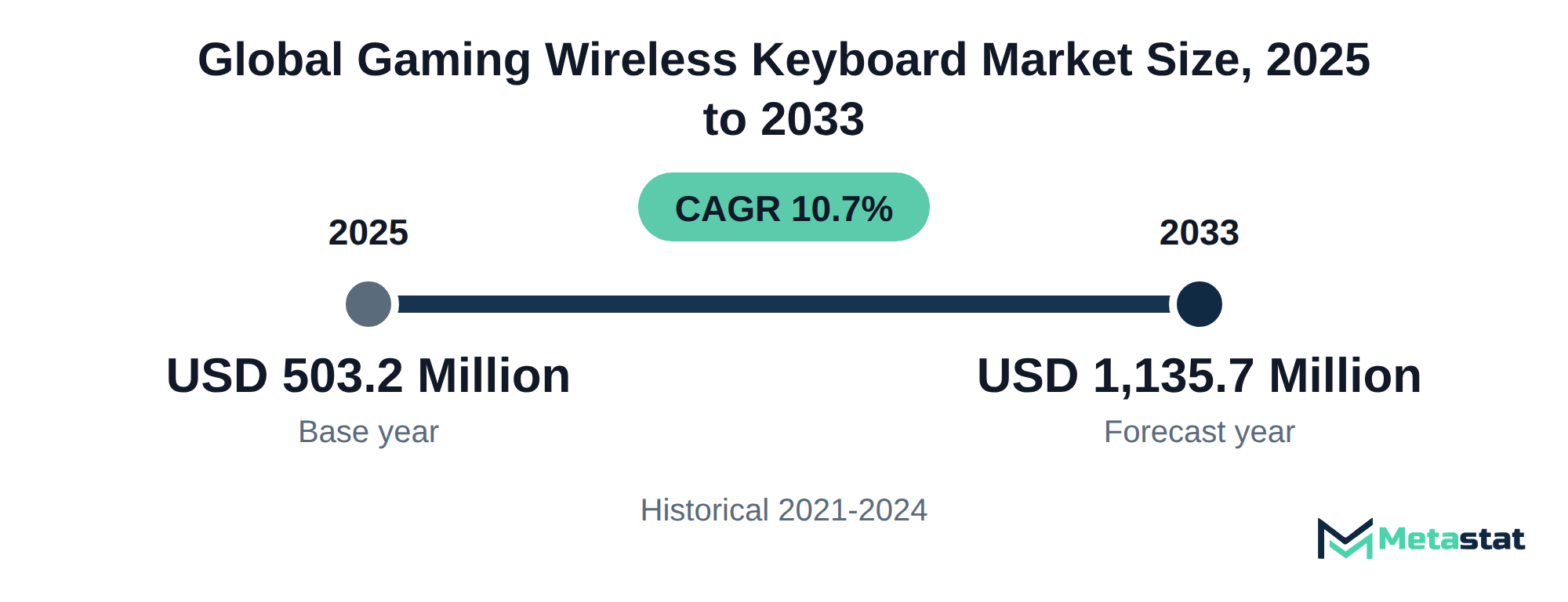
The Gaming Wireless Keyboard market covers products built to improve the gaming experience through advanced technologies and user-friendly features. Buyers invest in these keyboards to achieve improved responsiveness, customization options, and ergonomic designs that cater to prolonged gaming sessions. The demand for high-performance keyboards is driven by the increasing popularity of gaming across various demographics, creating a competitive landscape that encourages innovation and quality improvements.
Growth in the market is propelled by the rising number of gamers and the continuous advancements in switch technology. The segment of mechanical switches represents the largest share, appealing to both casual and professional gamers who prioritize performance and tactile feedback. North America holds 32.3% of the market in 2025, with the US leading in 2026. This region's dominance stems from a strong gaming culture and substantial investments in gaming infrastructure.
Technological advancements shape market dynamics by letting manufacturers introduce features that improve the user experience. The integration of customizable lighting, programmable keys, and wireless connectivity further attracts buyers, ensuring sustained interest in the gaming wireless keyboard segment. Competitive pricing strategies and ongoing product launches contribute to the strong growth potential anticipated in the coming years.
Products in this market serve a variety of gaming preferences, offering customizable experiences through different switch technologies and keyboard layouts. Buyers invest in these keyboards to enhance gameplay, improve comfort during extended sessions, and access advanced features that support competitive gaming. The increasing demand for high-performance gaming peripherals drives spending, reflecting a growing recognition of the importance of quality equipment in achieving optimal gaming performance. Keyboards form part of the broader PC peripherals category, which also includes mice and other input devices.
Growth in the market stems from several factors, including the rising popularity of esports and the increasing number of gamers worldwide. The segment contributing the most value to the market is Mechanical Switches, which are favored for their responsiveness and durability. This significant share reflects the strong gaming culture and continued investment in gaming technology by consumers.
Technological advancements continue to drive demand for innovative features in gaming wireless keyboards. The trend towards wireless connectivity and customizable lighting options enhances user experience, appealing to both casual and competitive gamers. This ongoing evolution in product offerings supports market growth by attracting a wider audience seeking improved gaming performance and aesthetic appeal.
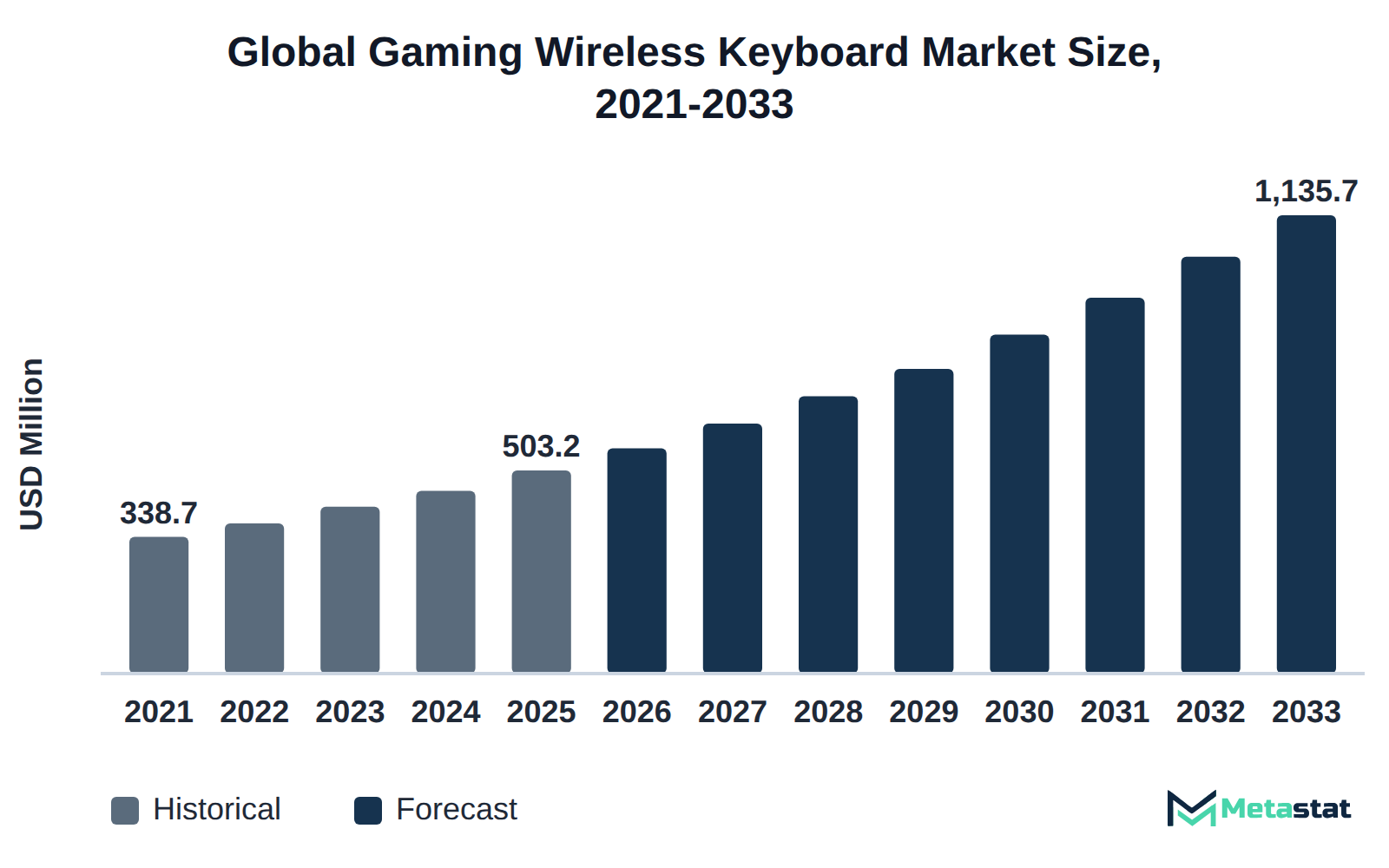
Low-latency 2.4 GHz and tri-mode connectivity are transforming the Gaming Wireless Keyboard market by enhancing responsiveness and flexibility in wireless gaming setups. The introduction of tri-mode connectivity allows devices to connect via Bluetooth, wired USB, or the 2.4 GHz wireless band, catering to diverse user preferences and gaming scenarios. This adaptability keeps latency low during gameplay, which matters most to competitive gamers seeking an edge.
Data indicates that the segment of mechanical switches within the market is projected to grow from USD 321.6 million in 2026 to USD 597.5 million by 2033, reflecting a compound annual growth rate of 9.3%. The rising adoption of mechanical switches in gaming keyboards coincides with the demand for low-latency performance. Gamers increasingly prioritize devices that provide swift and accurate input, a feature that tri-mode connectivity significantly enhances.
This shift supports a more immersive gaming experience by letting gamers change modes without losing performance. Consequently, brands focusing on developing advanced connectivity options are likely to gain a competitive advantage, positioning themselves favorably within the market.
Competitive pricing models significantly impact purchasing decisions in the Gaming Wireless Keyboard market. Buyers evaluate options based on the value provided relative to cost, with a notable preference for mechanical switches due to their durability and performance advantages. This trend indicates a clear consumer preference for high-quality components, which manufacturers build into their value-based pricing strategies.
The adoption of subscription-based or financing options enhances market accessibility, allowing buyers to spread costs over time. Payment tools such as buy now pay later plans work on the same principle. This approach appeals to gamers seeking premium features without significant upfront investments. Companies including Logitech International S.A. and Razer Inc. are increasingly offering bundled packages that include peripherals, thereby providing added value and encouraging volume sales. With premium pricing strategies in play, brands focusing on mechanical and optical switches are likely to experience increased sales, reinforcing competitive positioning within the market.
Compact keyboard layouts, specifically 60% to 75%, attract significant interest within the esports and PC gaming communities. These layouts optimize desk space and enhance portability, aligning with the preferences of gamers who attend competitions and events. The growing demand for these compact designs reflects a shift in user requirements toward more efficient and space-saving solutions.
Market data indicates that the 65% layout segment is projected to experience a compound annual growth rate (CAGR) of 13.1%, highlighting the increasing acceptance of these compact configurations among gamers. This trend is driven by the need for enhanced maneuverability and a streamlined setup, which directly supports more immersive gaming experiences. Gamers prioritize efficiency in their gear, leading to an expanding market for compact layouts.
The rise of compact layouts within the Gaming Wireless Keyboard market significantly impacts manufacturers and retailers. Companies that offer these specialized designs attract a broader range of customers, including casual players and professional esports athletes. Focusing on compact keyboard options presents an opportunity to enhance market share and drive revenue growth through targeted marketing and product development strategies.
When purchasing a wireless gaming keyboard, the type of switch technology significantly influences user experience. Mechanical switches dominate the Gaming Wireless Keyboard market, projected to generate USD 597.5 million by 2033, with a CAGR of 9.3% during the forecast period. Mechanical switches provide tactile feedback and durability, enhancing performance in intense gaming scenarios, attracting competitive gamers and enthusiasts alike.
Keyboard layout significantly influences user preference. The tenkeyless layout, which eliminates the number pad for a more compact design, is expected to reach a market value of USD 293.5 million by 2033, with a CAGR of 9.5%. This layout appeals to gamers seeking additional desk space and portability without sacrificing essential features. Choosing the right layout ensures comfort and efficiency, enhancing overall gameplay.
Price tier impacts buying decisions. The entry-level tier, anticipated to grow from USD 127.4 million in 2026 to USD 220.6 million by 2033, attracts budget-conscious gamers. Users seeking high-performance features without a premium price tag often gravitate toward mid-range and premium options, influencing the pricing strategies of manufacturers within the market.
Increased interest in mechanical switch keyboards among gamers drives spending in the market. Gamers seek enhanced tactile feedback and durability, prompting a shift from traditional membrane keyboards to mechanical options. This transition generates higher volumes of purchases, supporting growth trends. Enhanced gaming experiences and perceived performance improvements contribute to this increase, making mechanical switch keyboards a preferred choice. Buyers prioritizing performance and customization fuel this demand, leading to a competitive landscape in the gaming segment. The market expands as manufacturers innovate and offer diverse mechanical options to meet evolving gamer preferences.
Innovations in wireless keyboard technologies enhance user engagement, driving growth in the Gaming Wireless Keyboard market. Advanced features, including customizable RGB lighting and programmable macros, increase the appeal of these products among gamers. Integration with gaming software creates an immersive experience, allowing users to tailor their keyboards to specific gaming scenarios and preferences. This personalization aspect attracts a wider range of buyers, from casual players to competitive gamers, all seeking to improve in-game performance. Gaming mice serve a similar buyer base and share this focus on in-game performance.
The rise of ergonomic designs focuses on user comfort during extended gaming sessions. Enhanced keycap materials and layouts contribute to a more enjoyable gaming experience, reducing strain on users. Ergonomic mice address similar comfort needs during extended sessions. Manufacturers prioritizing these features position themselves more favorably in the market, gaining competitive advantages. The heightened focus on user experience and engagement drives greater demand and investment in the development of advanced gaming wireless keyboards.
Price sensitivity remains a significant factor affecting the adoption of gaming wireless keyboards. Many consumers, particularly entry-level gamers, exhibit hesitation towards high-priced options, leading to slower uptake within this buyer segment. The availability of numerous alternatives at lower price points contributes to this restraint, resulting in smaller orders or delayed replacements for existing equipment. This trend particularly impacts the entry-level and mid-range buyer groups that prioritize affordability over premium features or brand name recognition. In the competitive environment of the gaming wireless keyboard market, manufacturers balance quality and performance with cost to enhance appeal to price-sensitive consumers. Strategies that effectively address this price sensitivity could lead to improved sales performance and broader market acceptance.
Rising input costs exert significant pressure on suppliers within the market. The increasing price of raw materials, including electronic components and plastic, impacts overall production expenses. Suppliers face challenges in maintaining profit margins while striving to deliver high-quality products that meet consumer expectations. In response, many manufacturers focus on optimizing their supply chains and exploring alternative sourcing strategies. Collaborations with component suppliers and investments in technology-driven solutions enhance operational efficiency, enabling cost control without compromising product quality. This proactive approach supports the competitive positioning of suppliers and strengthens resilience in a market characterized by fluctuating costs. Suppliers continue to adapt as consumer demand for innovative gaming wireless keyboards grows.
The segment of mechanical switches within the Gaming Wireless Keyboard market presents a significant opportunity for growth. This growth stems from the rising preference among gamers for enhanced tactile feedback and performance reliability that mechanical switches provide. Gamers, particularly in competitive environments, prioritize precision and durability, leading to sustained demand for these products.
While manufacturers focus on developing advanced mechanical switch technologies, the market attracts diverse consumer segments seeking high-quality gaming peripherals. Market expansion provides opportunities for brands to innovate and differentiate their product offerings. A targeted approach to marketing mechanical switches could further engage specific buyer groups, enhancing profitability within the sector.
The Global Gaming Wireless Keyboard market is segmented based on Switch Technology, Keyboard Layout, Price Tier, and Sales Channel.
This segment caters primarily to gamers who prioritize tactile feedback and durability in their gaming experience. The rising preference for mechanical keyboards among serious gamers drives growth, fueled by demand for enhanced performance and customization options. Compared to other segments, including membrane switches, mechanical switches attract higher prices and offer superior gaming responsiveness. This segment is expected to keep growing, driven by continuous advancements in switch technology and a gaming culture that seeks premium products with competitive advantages during gameplay. This trend positions mechanical switches as a central focus in the Gaming Wireless Keyboard market.
The Optical Switches segment is estimated to reach USD 154 million by 2033, at a CAGR of 9.2% during the forecast period. Optical switches provide enhanced responsiveness and speed, appealing primarily to competitive gamers who prioritize performance. This segment's growth is driven by the increasing adoption of advanced gaming peripherals, with gamers seeking superior precision and faster response times. Compared to mechanical switches, which are expected to reach USD 597.5 million by 2033 with a CAGR of 9.3%, optical switches feature a unique actuation mechanism that distinguishes them from traditional alternatives. The demand for optical switches aligns with the broader trend towards innovation and customization in gaming hardware, positioning it as a strong contender among other switch technologies. Enhanced gaming experiences fueled by optical switches contribute significantly to the overall dynamics of the Gaming Wireless Keyboard market.
Magnetic and Hall Effect Switches segment is expected to reach USD 255.1 million by 2033. These switches are employed primarily in high-performance gaming keyboards, providing enhanced responsiveness and durability that appeals to competitive gamers and enthusiasts. They register keystrokes through magnetic sensing, the same principle used in other magnetic sensor applications. Growth in this segment is driven by rising demand for precision and reliability in gaming equipment, significantly influencing purchasing decisions. Unlike other switch technologies, including mechanical switches which exhibit a CAGR of 9.3%, Magnetic and Hall Effect Switches present a unique selling proposition due to their capacity for quicker actuation and improved longevity. The trend toward customizable gaming setups further boosts interest in this technology, leading buyers to seek keyboards that offer advanced features and enhanced gameplay experiences. These distinct characteristics set Magnetic and Hall Effect Switches apart from other segments, enabling a unique niche within the market.
The Membrane Switches segment is projected to grow at a CAGR of 8.2% during the forecast period. This technology is widely used in gaming keyboards due to its cost-effectiveness and reliability, appealing primarily to casual gamers and budget-conscious buyers. The growing preference for affordable gaming accessories drives demand for this segment, allowing it to maintain a competitive edge against premium alternatives. Membrane switches typically feature lower pricing compared to mechanical switches, attracting consumers seeking functional and economical solutions without sacrificing performance. Advancements in membrane switch technology enhance user experience, further reinforcing its position in the market. Unlike higher-priced switch types, including mechanical and optical switches, which focus on advanced performance, membrane switches emphasize accessibility and value, ensuring a steady growth trajectory.
Products in the Others category under the Switch Technology segmentation serve various niche applications, appealing to users with specific preferences or requirements. Typically, these products attract gamers seeking alternative input methods or specialized functionalities that standard switch technologies do not offer. Unique buyer preferences for customization and versatility drive demand within this segment. Competitive pricing and emerging technologies further influence growth dynamics, making these products appealing to cost-sensitive consumers. Compared to Mechanical and Optical Switches, the Others segment tends to attract a different audience, primarily focused on functionality and price sensitivity rather than performance metrics alone. The gaming community's diverse requirements facilitate exploration into innovative switch technologies beyond the mainstream offerings, enhancing overall consumer choice in the market.
Full-Size segment is valued at USD 134.5 million in 2026 and is projected to reach USD 235.3 million by 2033, at a CAGR of 8.3% during the forecast period. This layout appeals to a wide range of users, particularly gamers who prefer the traditional key arrangement for enhanced typing and gaming experiences. A primary driver for this segment is the increasing demand for versatile keyboards that handle both gaming and productivity tasks, letting users move between applications easily. Compared to Tenkeyless and compact layouts, the Full-Size segment experiences steady growth, although it remains slightly slower than the Tenkeyless segment, which holds a CAGR of 9.5%. The Full-Size layout's familiarity and expanded functionality cater to a diverse audience, making it a preferred choice for many consumers in the gaming wireless keyboard market.
This configuration caters primarily to gamers and professionals who value a compact design without sacrificing essential functionality. Tenkeyless keyboards appeal to users prioritizing desk space, portability, and ergonomic design. Growth in this segment is driven by increasing demand for streamlined gaming setups and the rising popularity of esports, where efficiency and quick access to controls are vital. Compared to other keyboard layouts, Tenkeyless keyboards typically offer a more favorable price point while delivering strong performance, which sets them apart within the broader Keyboard Layout segmentation. The market experiences a competitive edge in product diversity, catering to evolving user preferences for high-quality gaming experiences.
75% Layout segment is expected to reach USD 279.8 million by 2033. This layout is designed for users who prefer a balance between compactness and functionality, appealing to gamers and professionals who value desk space without sacrificing essential keys. Demand for this layout is driven by the increasing popularity of gaming and productivity-focused devices that accommodate smaller workspaces. Compared to other layouts, the 75% Layout exhibits a higher growth rate, reflecting a CAGR of 13.1%. This growth is attributed to a shift toward more ergonomic designs and the desire for portability. Unlike the Tenkeyless segment, which targets those who prioritize a compact form factor with fewer keys, the 75% Layout retains more functionality, making it attractive to a wider range of users and fueling its appeal in the market.
This layout appeals to gamers seeking a compact design without sacrificing essential keys. Primarily used by enthusiasts and competitive gamers, the segment offers a balance between functionality and portability. Increased demand for space-saving solutions drives growth, with users appreciating the minimalist approach that enhances the gaming experience. Compared to other keyboard layouts, the 65% Layout stands out by providing a more agile design, while the Tenkeyless segment, with a CAGR of 9.5%, offers a larger footprint. The combination of aesthetics and practicality enhances the attractiveness of the 65% Layout, positioning it favorably against its competitors in the gaming wireless keyboard market.
A 60% Layout keyboard features a compact design, appealing to users who prioritize desk space and portability. This layout is popular among gamers and professionals who require a minimalistic setup without sacrificing essential keys. Key drivers for this segment include the growing trend of streamlined setups in gaming environments and the increasing demand for portable accessories among content creators and gamers. This layout differs from larger configurations like Full-Size and Tenkeyless keyboards, which offer more keys but occupy more space. While Full-Size keyboards provide additional functionality, the 60% Layout targets users seeking efficiency and simplicity in their gaming and work experiences. The market's diverse buyer base reflects a shift towards functionality and aesthetics, emphasizing efficient designs that appeal to both casual and competitive gamers.
Products in the Others category under the Keyboard Layout segmentation include various unique configurations that cater to specific user preferences in gaming and computing environments. This segment appeals to niche markets, including casual gamers and professionals seeking specialized layouts that enhance their experience. Customization and personalization drive interest in this segment, with users seeking to express their individuality through unique keyboard designs. This mirrors interest in personalized products more broadly. The Others segment features lower market visibility compared to Full-Size and Tenkeyless layouts, which dominate the consumer segment due to widespread adoption. Despite its smaller size, it captures a dedicated user base, differentiating itself through unique layouts that do not conform to traditional standards. This approach attracts users prioritizing aesthetics or specific functionality over mainstream options, ultimately contributing to the diverse offerings within the Gaming Wireless Keyboard market.
Entry-Level segment is valued at USD 127.4 million in 2026 and is projected to reach USD 220.6 million by 2033, at a CAGR of 8.2% during the forecast period. This segment appeals primarily to budget-conscious consumers, including casual gamers and first-time buyers. A significant driver of growth stems from the increasing accessibility of gaming peripherals, allowing more individuals to engage in gaming experiences. This wider participation also supports the broader gaming industry. Compared to higher-priced segments, Entry-Level keyboards offer essential features at lower price points, catering to consumers prioritizing cost-effectiveness over advanced functionalities. While competing segments like Premium and Ultra-Premium present faster growth rates due to their enhanced features and branding, Entry-Level remains crucial for expanding the overall market, generating steady demand from those seeking affordable gaming solutions.
Mid-Range segment is estimated to reach USD 396.5 million by 2033, at a CAGR of 9.7% during the forecast period. This segment appeals to serious gamers who desire a balance between performance and affordability, offering features that enhance gameplay without reaching premium price levels. Demand for Mid-Range keyboards is driven by the increasing popularity of eSports and competitive gaming, attracting both casual and professional players. Compared to Entry-Level keyboards, which see slower growth at a CAGR of 8.2%, Mid-Range keyboards provide better build quality and more advanced features. Competition within this segment remains robust, with several players focusing on delivering value-added features while maintaining cost-effectiveness. Innovations in switch technology and ergonomic design further differentiate this segment, making it an attractive option for gamers aiming for an optimal gaming experience.
Premium segment is expected to reach USD 372.9 million by 2033. This segment attracts gamers and professionals seeking superior performance and advanced features, distinguishing itself with higher price points compared to entry-level and mid-range alternatives. Demand stems from the growing preference for high-quality peripherals, driven by an expanding gaming community and increasing interest in eSports. Product differentiation is significant, with premium keyboards offering enhanced durability, customizable keys, and superior switch technology. The premium segment experiences a CAGR of 13.7%, outpacing both the entry-level and mid-range segments, reflecting strong consumer willingness to invest in quality hardware that enhances gaming experiences and professional productivity. Buyers in this segment prioritize performance and brand reputation, often seeking products from reputable manufacturers known for innovation and reliability.
Ultra-Premium segment is projected to grow at a CAGR of 13.7% during the forecast period. This segment attracts high-end gamers and professional users seeking superior performance and advanced features in their gaming experience. The increasing demand for premium gaming peripherals, driven by the rise of competitive gaming and eSports, significantly influences this segment's growth. Compared to other price tiers, the Ultra-Premium segment typically commands higher prices, reflecting the investment in quality materials and technology. While Entry-Level and Mid-Range segments appeal to budget-conscious consumers, the Ultra-Premium segment caters to enthusiasts willing to invest for enhanced functionality. The requirement for advanced technology, including customizable RGB lighting and high-performance switches, differentiates Ultra-Premium offerings from lower tiers, further contributing to its growth in the market.
Brand-Owned Online Stores segment is valued at USD 158.9 million in 2026 and is projected to reach USD 359.7 million by 2033, at a CAGR of 12.4% during the forecast period. This segment primarily serves gamers and tech enthusiasts who prefer purchasing directly from brands for exclusive offers and personalized experiences. A significant driver for this segment stems from the growing trend of online shopping, influenced by convenience and access to a broader range of products. Compared to other sales channels, Brand-Owned Online Stores exhibit faster growth, driven by targeted marketing strategies and brand loyalty programs. In contrast, E-Commerce Marketplaces, while growing, face more competition, which influences pricing dynamics and customer engagement. The Gaming Wireless Keyboard market evolves with a strong online presence, further enhancing the appeal of this sales channel.
E-Commerce Marketplaces segment is estimated to reach USD 430.3 million by 2033, at a CAGR of 10.1% during the forecast period. This segment serves consumers seeking a wide selection of gaming wireless keyboards, providing convenience and competitive pricing. The growing trend of online shopping drives demand in this area, with consumers favoring the ease of purchasing from various platforms. Compared to other sales channels, the E-Commerce Marketplaces segment is projected to grow faster than traditional retail avenues, reflecting a shift in buying behavior. Enhanced product information and customer reviews on e-commerce platforms contribute to informed purchasing decisions. This segment attracts diverse buyer demographics, including casual gamers and dedicated enthusiasts, who appreciate the transparent pricing and broad availability that e-commerce channels offer. The market expansion aligns with the increasing integration of technology into purchasing habits.
Consumer Electronics Retailers segment is expected to reach USD 163.7 million by 2033. This segment caters to a diverse group of consumers seeking gaming wireless keyboards for personal use and professional gaming. Factors driving this segment include the increasing popularity of gaming and the growing trend of online shopping, which enables consumers to conveniently access a wide variety of products. Compared to other sales channels, including Brand-Owned Online Stores and E-Commerce Marketplaces, this segment typically experiences slower growth. The CAGR for Consumer Electronics Retailers stands lower than that of Brand-Owned Online Stores, projected at 12.4%, highlighting a significant difference in retail dynamics within the market. This varying growth trajectory reflects distinct purchasing behaviors and price sensitivities of consumers in different channels.
Specialty Gaming Retailers segment is projected to grow at a CAGR of 10.4% during the forecast period. This channel serves dedicated gaming enthusiasts who seek specialized products that enhance their gaming experience. The increasing demand for unique gaming peripherals drives growth in this segment, with customers prioritizing high-quality, performance-oriented keyboards. Specialty retailers offer a curated selection of gaming keyboards, differentiating themselves from general consumer electronics retailers that provide a wider array of products but often lack specialized knowledge. This focused approach results in a higher price point compared to mainstream retail channels. By 2033, this segment is anticipated to reach an estimated USD 163.7 million, reflecting strong interest in tailored gaming solutions within the gaming wireless keyboard market.
Others includes various sales channels that cater to unique consumer needs, often serving niche markets. This segment appeals to specialized buyers seeking tailored options not covered by mainstream retail methods. Factors influencing this segment include the growing trend of direct-to-consumer sales and the expansion of personalized shopping experiences. Compared to other sales channels, this category faces slower growth due to limited availability and visibility but attracts dedicated enthusiasts willing to invest in exclusive products. The Gaming Wireless Keyboard market benefits from this diversification, enhancing overall competition and innovation, which encourages players to explore unique offerings.
Based on geography, the Global Gaming Wireless Keyboard market is divided into North America, Europe, Asia-Pacific, South America, Middle East, and Africa.
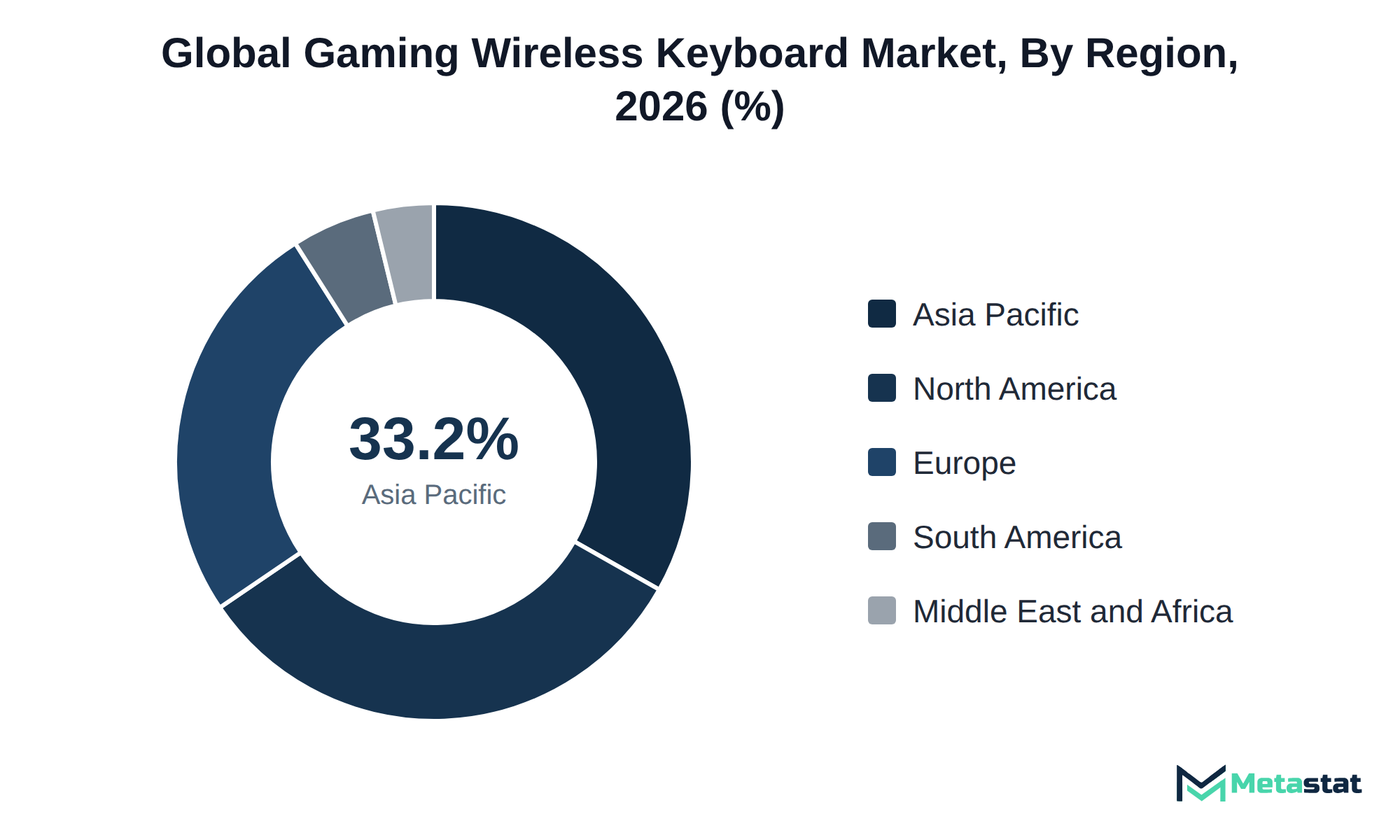
Demand for gaming peripherals in North America benefits from a strong gaming culture, driven by a large population of gamers across the United States, Canada, and Mexico. This region contributes 32.3% of the global market share in 2025, reflecting the extensive engagement of consumers with gaming activities. Key industries, including eSports and streaming, significantly influence the market, prompting increased sales of high-performance gaming wireless keyboards. North America is projected to reach USD 351.1 million by the end of 2033, supported by growing interest in advanced gaming technology and high-quality peripherals. The increasing penetration of e-commerce platforms facilitates accessibility to a wide range of options, enabling consumers to easily purchase the latest models. Strategic investments in marketing and distribution channels by major players enhance competition and reinforce the region's position in the gaming wireless keyboard market.
The European market holds a share of 25.5% in the global landscape of gaming wireless keyboards. Germany, France, the UK, Italy, and Spain contribute to the increasing demand, driven primarily by the growing interest in eSports and competitive gaming. Many consumers in these countries seek high-performance keyboards that enhance their gaming experience, leading to higher sales in the premium and mid-range segments. The evolving retail infrastructure, characterized by expanding e-commerce platforms and dedicated gaming retailers, further supports accessibility for consumers. Several market participants favor specialized products that cater to their specific requirements, influencing purchasing decisions and driving market growth. The market evolves, with manufacturers innovating to meet these changing preferences.
Asia-Pacific represents a significant portion of the Gaming Wireless Keyboard market, accounting for 33.2% of the global share in 2025. The region's demand is driven by a growing gaming community in countries including China, Japan, and India, where technological advancements and a strong inclination towards gaming culture support market growth. In South Korea and Australia, high disposable incomes enable consumers to invest in premium gaming peripherals, further stimulating sales. The prevalence of e-sports and competitive gaming events generates robust demand for advanced gaming keyboards. Infrastructure improvements in the e-commerce sector facilitate easier access to these products, enhancing distribution channels. By 2033, the market in this region is projected to continue expanding, responding to the evolving preferences of gamers and the increasing integration of gaming into mainstream entertainment.
Brazil and Argentina show increasing interest in the Gaming Wireless Keyboard market, driven primarily by a growing gaming community and rising disposable incomes. The market benefits from a substantial influx of e-commerce platforms, facilitating easier access to gaming peripherals. A unique aspect of this region includes a heightened emphasis on local gaming events, stimulating demand for high-performance keyboards. Estimated at 5.2% of the global market share in 2025, South America is projected to grow, particularly in the premium and mid-range segments. Infrastructure improvements in digital payment systems enhance consumer confidence, supporting market expansion. The gaming culture continues to thrive, propelling demand for innovative solutions in gaming peripherals.
In the Middle East and Africa, limited consumer purchasing power and a relatively small gaming community constrain growth in the Gaming Wireless Keyboard market. However, countries like Saudi Arabia, UAE, and South Africa display a rising interest in gaming, driven by an increasing number of young consumers engaging in e-sports and gaming activities. The demand for gaming peripherals in this region faces challenges related to inadequate infrastructure and distribution networks. Despite these obstacles, the market is projected to grow, reflecting an emerging consumer trend towards higher-quality gaming products, indicating potential for future expansion within the market.
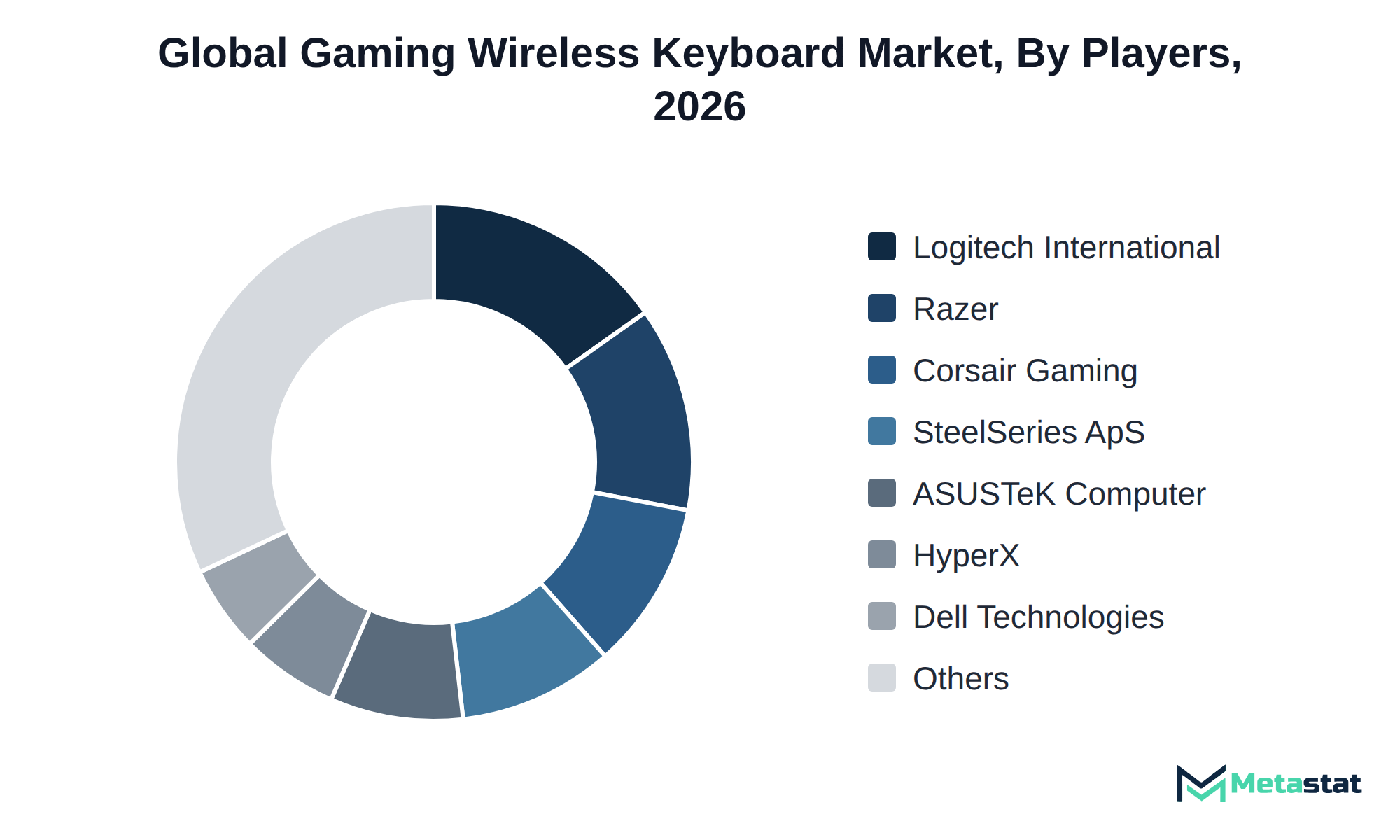
The Gaming Wireless Keyboard market features a competitive field divided among manufacturers focusing on various segments, including switch technology, keyboard layout, price tier, and sales channels. Buyers select products based on price, customization options, brand reputation, and the overall ecosystem offered by suppliers.
Logitech International S.A. emphasizes high-quality mechanical switches and robust online sales strategies that enhance customer engagement. Razer Inc. targets gamers with specialized features tailored for performance, leveraging brand loyalty and community engagement. Corsair Gaming, Inc. integrates advanced technology across its product range, focusing on premium pricing and superior build quality.
SteelSeries ApS positions its products within the mid-range segment, appealing to competitive gamers through customizable options and a strong service network. HyperX offers value-driven products with premium features, catering to entry-level and mid-range buyers. Keychron focuses on providing versatile keyboards with aesthetic appeal, targeting both casual and professional users seeking unique layouts.
Key developments driving this growth include increasing demand for Mechanical Switches within the Switch Technology segment, projected to grow from USD 321.6 million in 2026 to USD 597.5 million by 2033. The popularity of Tenkeyless layouts, expected to reach USD 293.5 million by 2033 under the Keyboard Layout segment, is another driver. The rise in online gaming and the growing preference for wireless peripherals contribute to this demand in regions including North America and Asia Pacific, where consumer engagement remains high.
However, supply chain disruptions and rising component costs pose significant risks that could hinder growth. If manufacturers face challenges in sourcing materials or experience delays in production, the market's projected trajectory may not be achieved. Competition from alternative input devices threatens market expansion, particularly in segments targeting casual gamers. Overall, while the Gaming Wireless Keyboard market shows robust potential, external factors will significantly influence its ability to reach USD 1,135.7 million by 2033.
By Switch Technology: Mechanical Switches, Optical Switches, Magnetic and Hall Effect Switches, Membrane Switches, Others
By Keyboard Layout: Full-Size, Tenkeyless, 75% Layout, 65% Layout, 60% Layout, Others
By Price Tier: Entry-Level, Mid-Range, Premium, Ultra-Premium
By Sales Channel: Brand-Owned Online Stores, E-Commerce Marketplaces, Consumer Electronics Retailers, Specialty Gaming Retailers, Others
The report strategically identifies and profiles the key market players and analyses their core competencies in each sub-segment of the Gaming Wireless Keyboard market.
Report Attributes | Details |
Study Period | 2021-2033 |
Base Year | 2025 |
Estimated Year | 2026 |
Forecast Period | 2026-2033 |
Historical Period | 2021-2025 |
Growth Rate | CAGR 10.7% from 2026 to 2033 |
Revenue Unit | USD million |
Segmentation | By Switch Technology, Keyboard Layout, Price Tier, Sales Channel, and Region |
By Region | North America (By Switch Technology, Keyboard Layout, Price Tier, Sales Channel, and Country)
|
Europe (By Switch Technology, Keyboard Layout, Price Tier, Sales Channel, and Country)
| |
Asia Pacific (By Switch Technology, Keyboard Layout, Price Tier, Sales Channel, and Country)
| |
South America (By Switch Technology, Keyboard Layout, Price Tier, Sales Channel, and Country)
| |
Middle East and Africa (By Switch Technology, Keyboard Layout, Price Tier, Sales Channel, and Country)
|
Find answers to common questions about this report
The Gaming Wireless Keyboard market size was valued at USD 503.2 million in 2025.
The market is projected to grow at a CAGR of 10.7% during the forecast period from 2026 to 2033.
The North America Gaming Wireless Keyboard market size is estimated to reach USD 351.1 million by 2033.
Mechanical Switches lead the Gaming Wireless Keyboard market with a projected value of USD 597.5 million by 2033, reflecting the highest demand among the switch technology segments.
Increased interest in mechanical switch keyboards among gamers drives spending in the market. Price sensitivity remains a significant factor affecting the adoption of gaming wireless keyboards, particularly among entry-level gamers who prioritize affordability over premium features.
Asia Pacific holds the dominant share of the Gaming Wireless Keyboard market, accounting for 33.2% in 2025. This region surpasses North America, which holds a share of 32.3%.
Price sensitivity remains a significant factor affecting adoption, particularly among entry-level gamers who hesitate towards high-priced options. Rising input costs exert pressure on suppliers, challenging their ability to maintain profit margins while delivering high-quality products.
Rising preference for mechanical switches among gamers drives adoption due to their enhanced tactile feedback and performance reliability. This trend supports market expansion, providing opportunities for manufacturers to innovate and differentiate their offerings.
The Gaming Wireless Keyboard market is estimated to reach a valuation of USD 1,135.7 million by 2033.
Key players operating in the Gaming Wireless Keyboard market include Logitech International S.A., Razer Inc., Corsair Gaming, Inc., SteelSeries ApS, ASUSTeK Computer Inc., and Turtle Beach Corporation.
The analysts below cover Electronics and Semiconductor research at Metastat Insights.
LEAD ANALYST
Utkarsh Khirodkar is a Lead Market Research Analyst at MetaStat Insight, specializing in market intelligence, technology sector assessments, and competitive strategy.

PRINCIPAL CONSULTANT - ENTERPRISE AI & EMERGING TECHNOLOGIES
Banking & Finance · Electronics and Semiconductor · Energy and Power · Healthcare IT · Information & Technology · Professional Services
Vijay Gunti is a Principal Consultant at MetaStat Insight, bringing over two decades of experience across enterprise digital transformation, technology strategy, and intelligent systems.

PRINCIPAL CONSULTANT - QUALITY SYSTEMS & COMPLIANCE
Electronics and Semiconductor · Machinery & Equipment · Professional Services
Omkar Phadtare is an Industry Consultant at MetaStat Insight, specializing in quality systems, regulatory compliance, and standards benchmarking to drive data-driven market intelligence and strategic industry research.

ENERGY & INFRASTRUCTURE INDUSTRY CONSULTANT
Automotive and Transportation · Electronics and Semiconductor · Energy and Power · Machinery & Equipment
Saurabh Vasant Ganvir consults for Energy & Infrastructure Industry at MetaStat Insight, specializing in renewable energy, solar EPC, and electric vehicle (EV) infrastructure markets.

LEAD CONSULTANT - COMMUNICATION, TELECOM, AND IT
Electronics and Semiconductor · Information & Technology · Machinery & Equipment · Professional Services
Ravindra Sathe Consultants for Communication, Telecom, and IT at MetaStat Insight. He leads the firm's industry research initiatives across telecommunications infrastructure, digital connectivity, enterprise networking, and emerging information technology domains.
Our group needed clearer visibility into out-of-autoclave processing timelines for high-temperature thermoplastic composites. MetaStat Insight delivered an objective assessment that contrasted automated fiber placement scrap rates with traditional thermoset prepreg layup cycles. The supplier landscape mapped out primary resin suppliers and tape slitting capacity across France, Germany, and Japan with solid technical accuracy. Their analyst handled our questions on precursor supply risks during an unscheduled inquiry call, providing clear, unembellished context.
Evaluating sensor fusion reliability across harsh operating environments can be tricky without field-validated data. The study on agricultural autonomous guidance systems clearly separated stereo vision setups from automotive-grade solid-state LiDAR. We appreciated the regional infrastructure analysis, specifically around RTK network density across North America and South America. During our follow-up consultation, the MetaStat Insight team walked through tier-two perception software partnerships, giving our engineering leads a practical basis for vendor shortlisting.
Analyzing the transition from natural gas to green hydrogen in iron ore reduction requires realistic infrastructure timelines. Meta stat insight supplied a detailed regional assessment of DRI plant conversion costs and scrap metal availability in North America and Western Europe. Their report carefully examined pellet quality specs and electrical grid access constraints without making oversimplified market assumptions. The research material served as a practical reference during internal technology roadmap discussions.
Explore related market intelligence reports worth reading alongside this one.