
LEAD ANALYST
Utkarsh Khirodkar is a Lead Market Research Analyst at MetaStat Insight, specializing in market intelligence, technology sector assessments, and competitive strategy.

Global ePayment System Market Size, Share, By Solutions (Payment Gateway, Payment Processing, Payment Wallet, Payment Security and Fraud Management, Point of Sale (POS)), By Services (Consulting and Advisory, Integration and Implementation, Support and Maintenance, Managed Services), By Deployment (Cloud Deployment and On Premises Deployment), By End-Use Industry (Retail and Consumer Goods, Foodservice and Restaurants, Travel and Hospitality, Media, Gaming and Digital Content, Financial Services and Fintech, Healthcare, Transportation and Mobility, Telecommunications, Public Sector and Utilities, Others), Industry Analysis, Growth, Trends, and Forecast, 2026-2033
Report ID
MSI-5313
Published
September, 2026
Pages
301 Pages
Format
Historical
Base year
Forecast
Forecast period
Report Details
Market Valuation: Valued at $72.4 Billion in 2025, projected to reach $189.8 Billion by 2033 at a 12.8% CAGR.
Dominant Segment: The Payment Gateway segment leads the market, driven by the increasing adoption of online shopping and digital transactions. This growth is fueled by consumer preference for convenience and speed in payment methods.
Geographic Lead: The Asia Pacific region is experiencing significant ePayment market expansion, driven by rising smartphone penetration and digital transaction adoption. This growth is further supported by rapid urbanization and an expanding eCommerce sector.
What's Inside: The report provides comprehensive competitive coverage, including detailed analyses of market segments, growth trends, and forecasts from 2026 to 2033. It also examines key drivers and challenges affecting the ePayment System market.
Emerging Market Opportunities: Emerging markets present substantial opportunities for digital payment acceptance, as infrastructural improvements facilitate easier access to payment solutions. This trend encourages local businesses to adopt ePayment systems, leading to increased competition and market growth.
Payment Security Trends: The growing emphasis on payment security, including tokenization and advanced authentication methods, strengthens confidence in digital transactions. These measures protect sensitive information and reduce fraud, driving higher adoption rates among consumers and businesses.
Choose Your License
Global ePayment System Market
The global ePayment System market was valued at USD 72.4 billion in 2025 and is projected to reach USD 189.8 billion by 2033, growing at a CAGR of 12.8% over the forecast period.
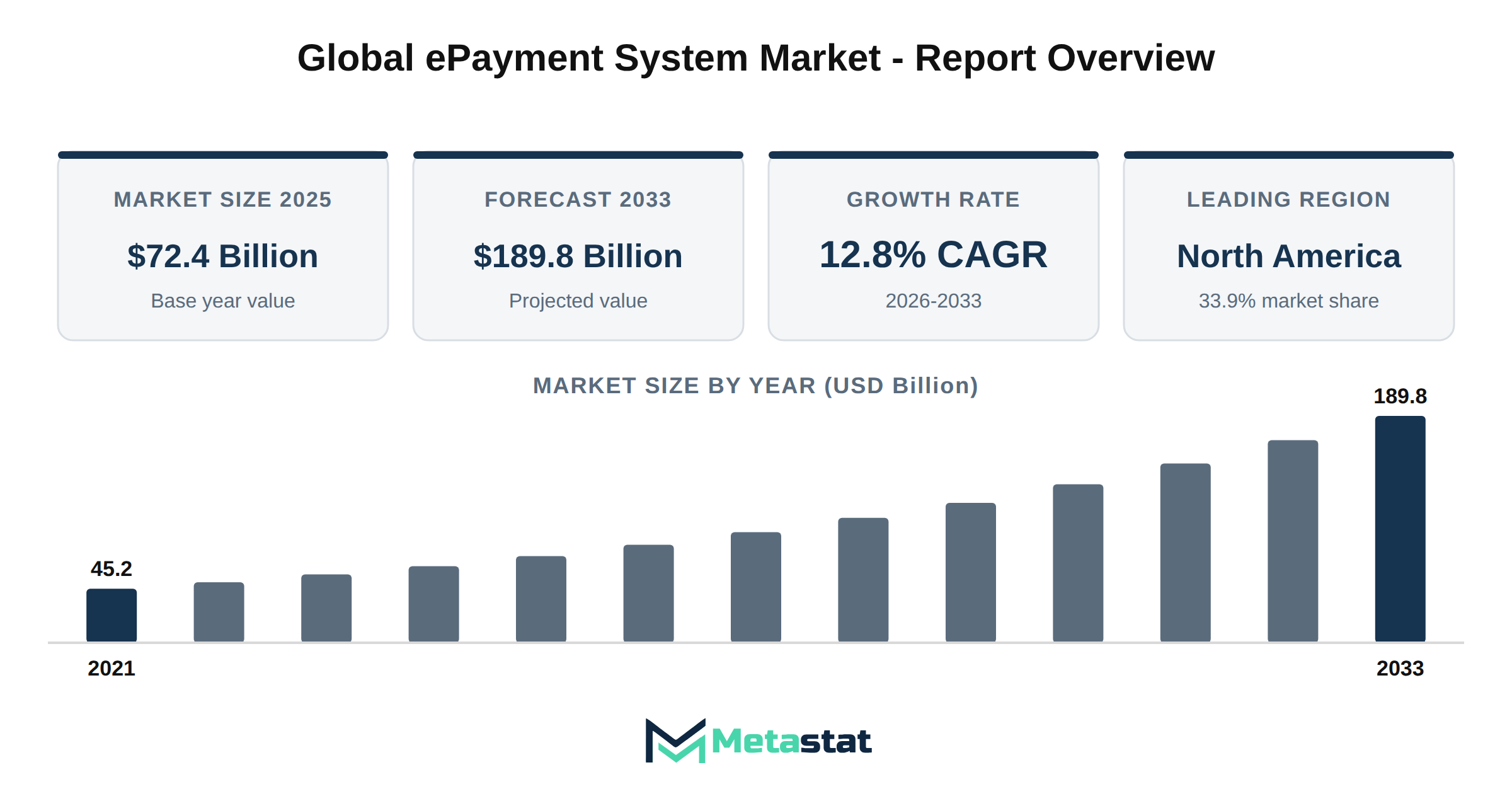
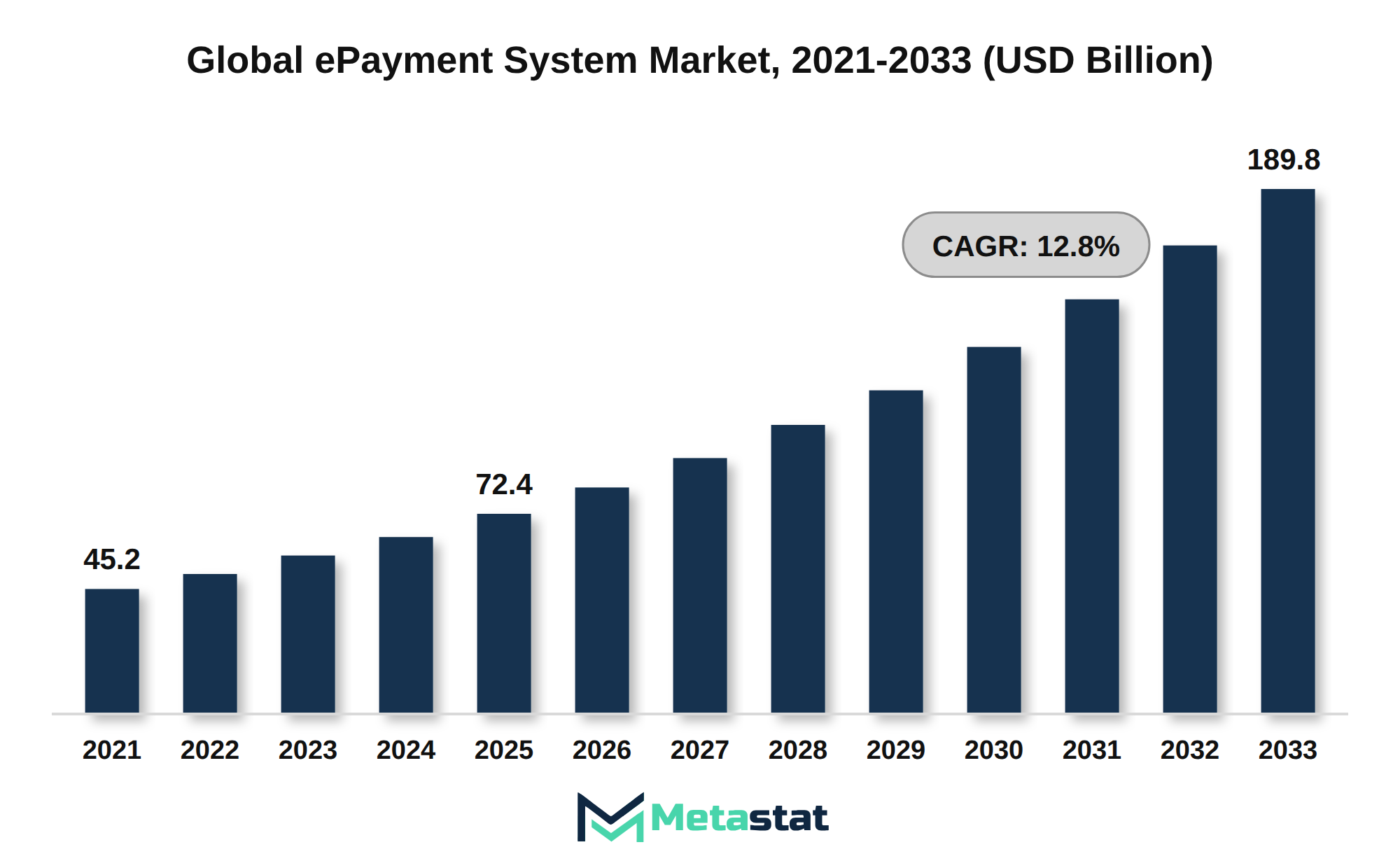
The ePayment System market reached a valuation of USD 72.4 billion in 2025, with a projected growth trajectory that anticipates reaching USD 189.8 billion by 2033. This growth corresponds to a compound annual growth rate (CAGR) of 12.8% over the forecast period from 2026 to 2033. Historical data highlights a steady increase in market value, starting from USD 45.2 billion in 2021 and growing to USD 64 billion in 2024.
Factors driving this expansion include the rising adoption of digital transactions, which reflects a global shift toward cashless payment solutions. The increasing demand for real-time payments significantly reshapes the ePayment System market, enhancing transaction speed and efficiency for consumers and businesses alike. Mobile wallet adoption continues to gain momentum, fueled by the expansion of contactless payment methods. This trend enhances convenience for users and facilitates transactions across various platforms.
Innovations in payment gateway and processing platforms contribute to the market's growth. The emergence of cloud-based ePayment infrastructure enhances scalability and reliability, attracting businesses seeking flexible payment solutions. Advancements in AI-driven fraud detection and payment security innovation increase consumer confidence in digital transactions, addressing concerns around safety and security.
Cross-border ePayment growth exemplifies the increasing international merchant expansion, allowing businesses to tap into global markets. The transformation of merchant acquiring and payment acceptance processes further supports this trend, enabling smoother transactions across borders. Embedded payments and API-driven payment ecosystems streamline user experiences, integrating payment solutions directly into various applications and platforms.
Omnichannel payment adoption across retail and services ensures that consumers enjoy a consistent experience, regardless of the payment method used. Modernization of point-of-sale systems enhances payment acceptance, integrating software-based solutions that cater to diverse consumer preferences. Digital payment adoption among SMEs and micro-merchants highlights a significant market segment, driven by these businesses seeking efficient payment solutions to compete in an increasingly digital economy.
Regulatory developments shape the global ePayment Systems landscape, influencing compliance requirements and operational frameworks for payment service providers. Trends in payment security, tokenization, and authentication create a more secure environment for users, essential for maintaining trust in digital transactions. Open banking initiatives present opportunities for account-to-account payments, facilitating transactions between financial institutions.
Pricing dynamics, including processing fees and merchant costs, directly impact the competitiveness of payment solutions in the market. Partnerships between fintech companies and traditional financial institutions drive investments and consolidate payment platforms, enhancing service offerings and market reach. Competitive strategies employed by global payment service providers further define the market, influencing innovation and customer engagement.
The Asia Pacific region presents significant ePayment market expansion and growth opportunities, driven by increasing smartphone penetration and internet accessibility. Emerging market opportunities in digital payment acceptance highlight the potential for growth in regions previously underserved by traditional banking systems. Retail and e-commerce demand for ePayment solutions continues to rise, reflecting changing consumer behaviors and preferences.
Digitalization in travel, hospitality, and mobility payment sectors highlights the importance of efficient payment infrastructures. Financial services and fintech industries exhibit heightened demand for robust payment solutions to support their evolving needs. Growth in managed payment services and outsourced processing highlights a shift toward specialized solutions that allow businesses to focus on core operations while leveraging expert payment capabilities.
Future outlook for the global ePayment System market remains optimistic, supported by ongoing technological advancements and shifts in consumer payment preferences.
The expansion of digital transactions, driven by heightened consumer demand for convenience and efficiency, significantly influences the ePayment System market. Growing smartphone penetration and internet accessibility facilitate the adoption of various digital payment methods across diverse sectors, including retail and services. This trend creates opportunities for vendors to improve their offerings and capture a broader customer base.
Real-time payment systems are reshaping the market by enabling instantaneous transactions, which enhance customer experiences. The implementation of these systems appeals to both consumers and businesses, because it reduces transaction times and increases operational efficiency. This shift supports the overall growth of the ePayment System market, allowing for increased transaction volumes.
The rapid adoption of mobile wallets and contactless payment solutions significantly impacts the market. These technologies provide consumers with convenient and secure payment options, driving higher transaction volumes. Retailers benefit from increased customer satisfaction and loyalty, leading to enhanced revenues and profitability.
Ongoing innovation in payment gateway and processing platforms enhances transaction efficiency and security. Providers continuously develop advanced features that simplify integration and improve user experiences. This innovation attracts more merchants to adopt ePayment solutions, contributing to market growth.
Cloud technology adoption facilitates scalable and flexible ePayment infrastructures, allowing businesses to adapt to changing market demands. This shift reduces costs associated with traditional payment processing methods, enabling smaller businesses to participate more actively in the market, thus broadening its reach.
Increased focus on payment security, particularly through AI-driven fraud detection solutions, boosts consumer trust in digital transactions. Enhanced security measures protect both consumers and merchants, promoting wider acceptance of ePayment systems across various industries. This heightened security environment strengthens the overall market position.
The growth of cross-border ePayments enables merchants to expand their reach into international markets. This trend opens new revenue streams and allows vendors to cater to a more diverse customer base. Consequently, the overall market experiences accelerated growth because more businesses adopt solutions that facilitate international transactions.
Transformations in merchant acquiring and payment acceptance strategies create opportunities for market expansion. Evolving consumer preferences demand efficient payment experiences, prompting merchants to adopt advanced payment solutions. This shift enhances transaction efficiency and stimulates market growth.
Embedded payment solutions and API-driven ecosystems streamline payment processes, allowing businesses to offer integrated payment experiences. This trend promotes greater adoption of ePayment systems, because businesses seek to improve customer interactions and reduce friction in the payment process.
Omnichannel payment adoption provides consumers with a unified payment experience, regardless of the platform used. This approach enhances customer satisfaction and loyalty, encouraging repeat business and driving growth within the market. Retailers and service providers benefit from this trend by improving their payment acceptance capabilities.
Point of Sale (POS) modernization is essential in the evolution of payment acceptance. Retailers are increasingly adopting software-based solutions that offer enhanced functionality and flexibility. This modernization supports the overall growth of the ePayment System market by enabling smooth transactions and improved customer experiences.
The adoption of digital payment solutions among small and micro-merchants significantly contributes to market expansion. Lower barriers to entry and the availability of user-friendly platforms enable these businesses to participate in the digital economy. This trend encourages competition and innovation in the market.
Regulatory developments continue to shape the ePayment System market, influencing compliance requirements and operational practices. Adapting to these regulations ensures that payment service providers maintain trust and security in their operations, which is crucial for consumer adoption and market stability.
The growing emphasis on payment security, including tokenization and advanced authentication methods, strengthens confidence in digital transactions. These measures protect sensitive information and reduce fraud, driving higher adoption rates among consumers and businesses alike, ultimately supporting market growth.
Open banking initiatives create opportunities for account-to-account payment solutions, enhancing transaction speed and reducing costs. This trend allows consumers and businesses to conduct transactions directly, fostering competition and innovation in the ePayment System market.
Pricing structures and processing fees play a significant role in influencing merchant adoption of ePayment solutions. Competitive pricing and transparent fee structures enhance market appeal, attracting a diverse range of businesses to participate in the evolving payment ecosystem.
Strategic partnerships and investments among fintech firms and payment service providers drive platform consolidation and innovation. These collaborations enable enhanced service offerings and improved customer experiences, contributing positively to the overall growth of the ePayment System market.
Global payment service providers employ diverse competitive strategies to enhance market positioning. These strategies include technological advancements, customer-centric innovations, and aggressive marketing efforts. Such actions contribute to strengthened market share and sustained growth.
The Asia Pacific region exhibits significant growth opportunities within the ePayment System market, driven by increasing smartphone penetration and digital transaction adoption. Rapid urbanization and expanding eCommerce sectors further enhance market potential, attracting both local and global players.
Emerging markets present substantial opportunities for digital payment acceptance, because infrastructural improvements and technological advancements facilitate easier access to payment solutions. These developments encourage local businesses to adopt ePayment systems, leading to increased competition and market growth.
Growing demand for ePayment solutions within retail and e-commerce sectors drives significant market growth. Consumers increasingly prefer efficient payment experiences, prompting businesses to adopt advanced digital payment solutions to enhance customer satisfaction and loyalty.
The digitalization of payment processes in travel, hospitality, and mobility sectors enhances customer experiences and operational efficiency. This trend supports market growth by enabling businesses to streamline transactions and offer convenient payment options, attracting more consumers.
The financial services and fintech sectors exhibit rising demand for robust payment infrastructure. This demand drives investments in innovative payment solutions, facilitating the development of a more integrated and efficient ePayment System market.
Managed payment services and outsourced processing solutions are gaining traction among businesses seeking to enhance operational efficiency. This trend enables companies to focus on core activities while leveraging specialized payment expertise, thereby contributing to market growth.
The future outlook for the global ePayment System market remains optimistic, driven by technological advancements, increased consumer acceptance, and evolving payment preferences. Continued investment in innovative solutions and infrastructure development will support sustained growth and expansion in the coming years.
The acceleration of digital transformation significantly influences the ePayment System market. Businesses increasingly adopt advanced technologies to streamline operations and enhance customer experiences. This shift aligns with rising consumer expectations for efficient and secure digital payment options, fueling demand across various sectors.
Investment in automation, artificial intelligence, and software solutions contributes to the market's expansion. Companies integrating these technologies experience improved operational productivity and cost efficiency, directly affecting their competitive positioning. The ongoing digitization of legacy processes facilitates the transition to modern payment systems, promoting higher transaction volumes and more robust security measures.
Organizations embracing digital solutions are expected to drive substantial growth in the ePayment System market. This trend highlights the importance of technology in shaping consumer behaviors and purchasing preferences, further driving market demand.
Investment in digital infrastructure significantly contributes to the growth of the ePayment System market. Increased capital flow into technology upgrades, digital platforms, and payment processing systems creates a conducive environment for enhanced transaction efficiency. Financial institutions, retailers, and service providers leverage these advancements to improve customer experiences and streamline operations. A robust digital infrastructure facilitates higher transaction volumes, reduces latency, and enhances security, driving overall market growth.
In the context of macro-economic factors, higher GDP growth alongside increased public-private spending power promotes investment in ePayment solutions. Enhanced economic conditions encourage businesses to adopt advanced payment technologies, aligning with consumer preferences for fast and secure transactions. The growing focus on cost-efficiency initiatives, including process streamlining and labor optimization, further drives investments in automation and software adoption, which are crucial for maintaining competitiveness in the evolving marketplace.
Shifting demographic patterns and changing consumer behaviors play a vital role in driving investment in the ePayment System market. An aging population increasingly embraces digital payment methods, while urbanization and lifestyle changes push younger generations toward mobile wallets and online payment solutions. This shift creates a demand for scalable and flexible payment systems that accommodate diverse consumer needs, prompting companies to invest in innovative technologies.
Overall, investment in digital infrastructure and the resulting improvements in operational productivity position the ePayment System market for sustained growth. Organizations prioritizing technological integration and adapting to evolving consumer preferences enhance their competitive edge and capture a larger market share in the coming years.
The ePayment System market faces significant challenges stemming from regulatory compliance and legal mandates. Stringent regulations require organizations to invest heavily in compliance frameworks, diverting resources from innovation and operational efficiency. The complexity of navigating diverse regulatory environments across regions deters market entry, particularly for smaller firms lacking the necessary legal expertise and financial backing.
Inflationary pressures exacerbate operational costs for participants in the market. Rising expenses related to labor, technology, and infrastructure limit the ability of companies to scale effectively. Supply chain disruptions hinder the timely rollout of new solutions and services, creating bottlenecks that impact customer satisfaction and retention.
High capital investment requirements associated with advanced technologies and systems contribute to a cautious approach among potential entrants. Economic headwinds slow the market's growth trajectory, resulting in decreased funding for innovative solutions. Data security vulnerabilities and privacy concerns related to ePayment solutions create apprehension among consumers, impacting adoption rates.
Market fragmentation and varying cultural attitudes toward digital payment solutions hinder widespread acceptance and integration. These regional adoption resistors complicate efforts to establish a unified market presence, ultimately restricting the growth potential of the ePayment System market.
The ePayment System market encounters challenges stemming from geopolitical fragmentation, which disrupts international trade relationships. Trade deficits and tariff friction contribute to increased costs for businesses operating across borders. Such conditions hinder market players, raising operational costs and complicating pricing strategies. Technological disruptions introduce complexities that challenge integration efforts across various platforms, creating interoperability issues that delay service delivery.
Market players face supply chain instability due to feedstock and component volatility resulting from geopolitical tensions. Logistics disruptions further exacerbate this instability, leading to potential delays in product availability. These factors contribute to rising input costs, constraining profit margins and creating pressure on pricing strategies throughout the market.
Workforce skill gaps present another challenge, driven by competition for talent equipped with the necessary expertise in new technologies. Automation displacements lead to reduced workforce stability, creating concerns for talent retention. Environmental lifecycle footprints and decarbonization mandates introduce additional compliance overhead, demanding more resources for companies trying to adhere to tightening global regulatory standards.
Intellectual property protection deficits pose risks for innovation within the ePayment System market. Cybersecurity risks and data vulnerabilities present ongoing threats, necessitating robust measures to safeguard customer information and maintain trust. Changing downstream demands, market saturation, and pressures from substitution vectors further complicate the competitive environment, prompting companies to adapt swiftly to maintain market relevance.
The ePayment System market stands to benefit significantly from emerging technological innovations that enhance transaction processes and improve user experiences. Advancements in artificial intelligence, blockchain, and biometric authentication streamline payment methods, reduce fraud risks, and build customer trust. The integration of these technologies into existing platforms supports efficiency and security, appealing to both businesses and consumers.
Geographical expansion contributes to the market's growth momentum, with developing regions increasingly adopting digital payment solutions. Urbanization and rising internet penetration in Asia Pacific and South America create new opportunities for ePayment System providers. This regional demand aligns with the global trend toward cashless transactions, where consumers seek convenience and speed in financial interactions.
Sustainability imperatives drive organizations to seek eco-friendly payment solutions, aligning with environmental, social, and governance (ESG) standards. This alignment positions companies favorably among environmentally conscious consumers and prioritizes sustainable business practices. The demand for green transformations influences product development, encouraging service providers to innovate and enhance their offerings.
Strategic consolidation among market players encourages collaboration, enabling enhanced technological capabilities and broader service portfolios. Mergers and acquisitions facilitate the integration of niche applications, strengthening market presence and providing customers with comprehensive solutions. These movements expand the competitive landscape and create new avenues for growth within the ePayment System market.
The evolution of buying behaviors and digital procurement shifts further influences market dynamics. Businesses increasingly favor digital solutions that provide efficient experiences, driving demand for upgraded systems that support these changes. While organizations transition to more sophisticated commercial models, the need for efficient payment solutions grows, integrating effectively with existing enterprise frameworks.
Operational yield maximization through process automation enhances the market's potential. Improving transaction efficiency and minimizing human error, automation technologies significantly reduce operational costs for businesses. The focus on value-chain optimization enables firms to deliver innovative solutions and maintain a competitive edge in the evolving ePayment System market.
The Global ePayment System market is segmented based on Solutions, Services, Deployment, and End-Use Industry.
Valued at USD 19 billion in 2026, the Payment Gateway segment is projected to reach USD 41.6 billion by 2033, reflecting a CAGR of 11.8% during the forecast period. This growth is fueled by the increasing adoption of online shopping and digital transactions, driven by consumer preference for convenience and speed in payment methods. Retail and consumer goods sectors lead the demand, where effective payment experiences enhance customer satisfaction and loyalty.
Technological advancements play a crucial role in segment expansion. The integration of artificial intelligence and machine learning into payment gateways enhances security and fraud detection, addressing growing concerns among consumers and businesses. Regulatory compliance standards further influence the market, owing to the necessity of adherence to data protection and cybersecurity regulations for service providers. The trend towards cloud-based solutions contributes to growth, offering scalability and flexibility in payment processing.
Investment in next-generation upgrades and product evolution remains vital. Providers focus on enhancing user experience through features like one-click payments, multi-currency support, and integration with mobile wallets. These developments cater to the evolving expectations of consumers and businesses alike, ensuring the payment gateway segment remains competitive within the broader ePayment System market.
Pricing volatility and margin pressures challenge stakeholders. Fluctuations in transaction fees and competitive pricing strategies necessitate constant adaptation among providers, impacting profitability. Strategic opportunity windows arise through partnerships with fintech companies and collaborations with eCommerce platforms, enabling enhanced service offerings and market penetration.
Overall, the Payment Gateway segment experiences significant growth dynamics, driven by technological maturation, regulatory compliance, and evolving consumer preferences. The ePayment System market continuously evolves, with emerging trends and innovations shaping its future.
Growth in the Payment Processing segment is driven by the increasing adoption of digital payment solutions across various industries. Businesses recognize the need for efficient transaction processing to enhance customer experiences, leading to heightened demand. Retail and consumer goods sectors, in particular, fuel this demand due to their need for effective payment solutions to cater to tech-savvy customers.
Technological maturation plays an important role in expanding the segment, with advancements in payment processing technologies enabling faster and more secure transactions. Integration of Artificial Intelligence and machine learning in payment systems enhances fraud detection, instilling confidence among users. This evolution supports businesses in managing their payment operations efficiently, thus encouraging further adoption.
Payment Processing segment is estimated to reach USD 56.4 billion by 2033, at a CAGR of 11.9% during the forecast period. While organizations transition to digital platforms, the market experiences significant shifts in consumption patterns. Consumers increasingly prefer digital wallets and contactless payments, necessitating robust processing capabilities to handle diverse payment methods.
Regulatory compliance standards impact the segment, with evolving frameworks requiring payment processors to maintain high levels of security and transparency. Adhering to these regulations involves investment in technology and training, influencing pricing structures and operational costs. Despite these challenges, the segment's resilience remains strong, driven by ongoing demand for innovative payment solutions.
Strategic opportunity windows arise because businesses increasingly seek to enhance their payment infrastructures. Companies that invest in next-generation upgrades and solutions position themselves advantageously within the ePayment System market. This proactive approach not only meets consumer expectations but aligns with industry trends toward digital transformation.
Rapid adoption of digital payment solutions drives the growth of the Payment Wallet segment within the ePayment System market. Consumer preferences shift towards contactless transactions, influencing businesses to integrate mobile wallet solutions. Enhanced security features and technological advancements in biometric authentication promote user confidence, further accelerating market growth.
Payment wallets enable users to store multiple payment methods, facilitating transactions across various platforms. The integration of loyalty programs and rewards within these wallets enhances customer engagement and retention. This strategic alignment with consumer behavior positions the segment for substantial growth, projected to reach USD 41.1 billion by 2033.
Investment in next-generation technologies, including blockchain and artificial intelligence, enhances the capabilities of payment wallets. These upgrades improve processes, reduce transaction times, and enhance fraud detection systems. While the market evolves, businesses that adopt these innovations capture more significant market share, responding effectively to the increasing demand for efficient and secure payment solutions.
Regulatory compliance remains crucial owing to governments implementing stricter data protection laws and financial regulations. Adherence to these standards ensures consumer trust and maintains competitive advantage within the ePayment System market. Companies that prioritize compliance experience stronger brand loyalty and improved market positioning.
Strong growth in the Payment Security And Fraud Management segment reflects rising concerns over online security and payment fraud. The increasing frequency of data breaches and cyberattacks prompts businesses to prioritize robust security measures, thus driving market demand. Organizations across various industries invest in advanced technologies to enhance their payment security frameworks, contributing to segment expansion.
Technological maturation shapes the market landscape. Innovations in artificial intelligence and machine learning enable more effective fraud detection and prevention strategies. These advancements facilitate real-time transaction monitoring and analysis, positioning businesses to respond swiftly to potential threats. The integration of next-gen security solutions enhances customer trust and loyalty, stimulating demand for payment security services.
Regulatory compliance standards, including the Payment Card Industry Data Security Standard (PCI DSS), compel organizations to adopt stringent security protocols. Compliance requirements drive investments in security solutions, because non-compliance results in substantial fines and reputational damage. Consequently, the market experiences heightened activity, with firms seeking to align with evolving regulatory frameworks.
Pricing volatility and margin pressures remain pertinent in this segment, influenced by fluctuating technology costs and the increasing complexity of security solutions. Businesses strive to balance investment in advanced security features with maintaining competitive pricing strategies. Despite these pressures, the segment is projected to grow at a CAGR of 14.4% during the forecast period, reflecting robust demand and strategic investments in effective fraud management systems.
Recent technological advancements in payment processing significantly impact the Point Of Sale (POS) sub-segment of the ePayment System market. Increased demand for contactless payment solutions has prompted retailers to adopt innovative POS systems that enhance customer experience and improve transactions. The rise of mobile payment applications and digital wallets contributes to evolving consumer preferences, with more customers opting for convenience and speed during their shopping experiences.
Technological maturation presents opportunities for retailers to incorporate advanced features including inventory management and customer analytics into POS systems. These enhancements support data-driven decision-making and improve overall operational efficiency. Integration with eCommerce platforms allows for effective omnichannel experiences, catering to consumer expectations for flexibility in payment options.
Regulatory compliance standards continue to shape the market, with heightened focus on payment security measures to combat fraud and enhance consumer trust. Adherence to these standards requires investment in sophisticated security protocols within POS systems, further driving upgrades and innovations in the sub-segment. While regulatory frameworks evolve, businesses face pressures to maintain compliance, influencing their strategic investments in technology.
Cost structures associated with POS systems vary based on the deployment model. Cloud-based systems offer scalability and lower upfront costs, appealing to small and medium-sized enterprises. Conversely, on-premises solutions incur higher initial costs but provide greater control over data security and system customizations. Pricing volatility linked to technological advancements and regulatory compliance influences purchasing decisions and market entry strategies for new players.
Strategic opportunity windows arise from shifts in consumer behavior toward digital transactions, with a growing emphasis on contactless payments. Retailers investing in next-generation POS solutions stand to capture increased market share, leveraging consumer trends towards convenience and speed. The market for Point Of Sale (POS) systems thrives amid these dynamics, with ongoing innovation and adaptation to meet the needs of changing end-users.
Valued at USD 14.8 billion in 2026, the Consulting and Advisory segment is projected to reach USD 31.2 billion by 2033, at a CAGR of 11.2% during the forecast period. Growth is driven by increasing demand for specialized expertise in navigating the complexities of ePayment systems. Businesses seek guidance on regulatory compliance, security measures, and integration of innovative technologies, enhancing operational efficiency and market competitiveness. Evolving consumer expectations for secure and efficient digital payment solutions further influence the need for comprehensive consulting services.
Technological maturation enhances service offerings, enabling consultants to provide insights into next-generation upgrades and product evolution. The emergence of new payment technologies creates opportunities for consulting firms to assist clients in adapting their strategies effectively. End-use dynamics, particularly in sectors including retail and foodservice, drive the need for tailored solutions that align with shifts in consumer behavior. These trends indicate strong potential for growth within the segment, contributing to the overall expansion of the ePayment System market.
Growth in the Integration and Implementation segment reflects the increasing complexity of ePayment System deployments. Businesses increasingly require tailored solutions that incorporate various payment platforms, resulting in heightened demand for integration services. Transitioning to cloud-based solutions and the growing focus on interoperability of systems drive the adoption of these services. The segment is estimated to reach USD 57.2 billion by 2033, at a CAGR of 11.7% during the forecast period.
Technological maturation significantly influences the expansion of this segment. Enhanced digital capabilities facilitate integration of payment solutions, ultimately improving customer experiences. Companies investing in advanced integrations enjoy competitive advantages through improved operational efficiencies. Regulatory compliance standards shape the landscape, driven by organizations seeking to align with evolving regulations governing data protection and transaction security.
End-use industries including retail, foodservice, and hospitality increasingly prioritize efficient payment processing. These sectors benefit from integration services that streamline operations and enhance transaction speed. The growing emphasis on contactless payments further accelerates demand for integration and implementation services, ensuring businesses remain competitive in the dynamic ePayment System market.
Strategic opportunities abound for firms offering integration and implementation services. Organizations pursuing next-generation upgrades and innovative solutions capture market share by addressing evolving consumer preferences. Capital investment outlooks for this segment remain robust, attributed to companies recognizing the importance of investing in effective payment experiences. Ongoing advancements and competitive pressures drive continuous improvements in service offerings, reinforcing the segment's significance within the broader ePayment System market.
Investment in the Support and Maintenance segment of the ePayment System market derives from the increasing reliance on digital payment platforms across various industries. Organizations prioritize maintaining system reliability and performance to enhance customer experience, which drives demand for maintenance services. This focus on system integrity emphasizes the role of support services in ensuring operational continuity and compliance with evolving regulatory standards.
The segment is projected to reach USD 46.9 billion by 2033, reflecting a trend toward greater investment in comprehensive support solutions. Factors contributing to this growth include the rising complexity of payment systems and the need for continual updates to security protocols. In addition, the emergence of new technologies necessitates ongoing support, creating opportunities for service providers to expand their offerings and capabilities.
End-use industries, particularly Retail & Consumer Goods and Foodservice & Restaurants, increasingly recognize the importance of robust support and maintenance services. These industries rely on efficient transaction processing to meet consumer expectations and remain competitive. The shift toward integrated digital solutions encourages businesses to invest in ongoing support to manage these complex systems effectively.
Technological maturation continues to influence the segment, with advancements in automation and artificial intelligence streamlining support functions. Providers adopt innovative tools to improve service delivery, resulting in enhanced efficiency and reduced operational costs. This evolution in service capabilities positions the Support and Maintenance segment because a critical component of the broader ePayment System market.
Growth in the Managed Services segment stems from increasing demand for comprehensive support solutions in the ePayment System market. Organizations prioritize outsourcing to enhance operational efficiency, allowing them to concentrate on core business activities while leveraging expert services for payment systems. This shift results from a need for improved service delivery and the evolving expectations of end-users requiring effective transaction experiences.
Investment in advanced technologies fuels growth in this segment, with businesses seeking to incorporate next-generation upgrades and solutions. Integration of artificial intelligence and machine learning within managed services enhances fraud detection and security measures, critical factors in maintaining trust in digital transactions. The segment is projected to grow at a CAGR of 16.2% during the forecast period, reflecting the increasing focus on technological maturation and the adoption of innovative solutions.
Adoption across various industries, including retail and hospitality, drives the demand for managed services. These sectors increasingly rely on tailored payment solutions to meet specific regulatory compliance standards and improve overall customer satisfaction. Consequently, the market anticipates robust expansion, aligning with evolving consumer preferences and regulatory requirements.
Strategic opportunities emerge within the managed services segment because businesses seek solutions that guarantee flexibility and scalability. Companies recognize the advantages of managed services to navigate the complexities of payment processing while addressing cost structures and pricing volatility. This growing trend contributes to the overall resilience of the supply chain associated with ePayment systems.
Valued at USD 57.7 billion in 2026, the Cloud Deployment segment is projected to reach USD 145.8 billion by 2033, at a CAGR of 14.2% during the forecast period. Increasing adoption of cloud services across various industries fuels demand for efficient ePayment solutions, enabling flexibility and scalability for businesses. Organizations seek to enhance operational efficiency, reduce costs, and improve customer experience, driving the shift towards cloud-based payment systems.
Technological advancements in cloud computing play a critical role in the evolution of the ePayment System market. Innovations including artificial intelligence and machine learning streamline transaction processing and enhance fraud detection capabilities. These advancements enable the deployment of next-generation payment solutions, allowing organizations to remain competitive in a rapidly changing market.
Regulatory compliance standards significantly impact the cloud deployment sector. Adherence to data protection regulations, including GDPR and PCI DSS, shapes the operational frameworks of payment service providers. Organizations prioritize compliance to mitigate risks and maintain customer trust, influencing their choice of cloud deployment models.
Cost structures in the Cloud Deployment segment reflect the ongoing transition to subscription-based pricing models. Organizations benefit from predictable costs associated with cloud services that eliminate substantial upfront investments in infrastructure. This shift encourages wider adoption of cloud-based solutions, contributing to the segment's strong growth throughout the forecast period.
Strategic opportunity windows in the Cloud Deployment segment arise from the increasing need for digital transformation in various end-use industries. Retail, foodservice, and hospitality sectors actively pursue cloud-based ePayment solutions to enhance payment efficiency and customer engagement. This trend supports market expansion, driven by organizations prioritizing investments in cloud infrastructure to meet evolving consumer demands.
Investment in the On Premises Deployment segment reflects a strong inclination among businesses to maintain control over their payment processing systems. Organizations benefit from this model, particularly in sectors requiring stringent data security and compliance measures. These operational needs drive demand for robust in-house solutions that offer direct oversight and customization. Increasing complexities of regulatory compliance standards prompt companies to prioritize solutions that align with their operational frameworks, ensuring adherence and mitigating risks.
Valued at USD 44 billion by 2033, the segment demonstrates a compound annual growth rate (CAGR) of 8.9% during the forecast period. This growth reflects advancements in technology and the need for continuous upgrades to existing systems. Businesses adopting these technologies experience improved efficiency and reduced transaction costs, enhancing their competitive positioning within the market.
Strategic investments in On Premises Deployment solutions significantly impact end-use dynamics across various industries, including retail, healthcare, and finance. The need for efficient transaction processing and customer engagement drives demand for advanced systems tailored to specific industry requirements. Evolving customer expectations compel businesses to recognize the importance of integrating next-generation technologies that enhance user experience and operational effectiveness.
While organizations navigate shifting consumption patterns, the On Premises Deployment segment adapts to meet new demands, presenting opportunities for growth within the ePayment System market. Companies focusing on technological maturation and product evolution strengthen their offerings, positioning themselves favorably in a competitive environment.
Valued at USD 20.8 billion in 2026, the Retail & Consumer Goods segment is projected to reach USD 45.1 billion by 2033, at a CAGR of 11.7% during the forecast period. Primary demand drivers in this sector include the increasing shift toward digital transactions and consumer preference for convenience, which significantly influence purchasing behaviors. Retailers increasingly adopt advanced payment solutions to enhance customer experiences and streamline transactions, creating a competitive environment where technological maturation and next-gen upgrades play crucial roles.
Segment expansion is driven by growing penetration of eCommerce platforms, increasing the demand for secure, efficient payment systems. The rise of mobile wallets and contactless payments provides further impetus, enabling retailers to offer diverse payment options that align with evolving consumer expectations. Regulatory compliance standards and certifications surrounding data protection and transaction security increasingly dictate operational practices, prompting investments in robust payment security and fraud management solutions.
Cost structures within this segment reflect the competitive landscape, with pricing volatility and margin pressures affecting profitability. Retailers navigate these challenges by optimizing payment processing fees and leveraging integrated payment solutions. The ongoing evolution of consumer preferences toward efficient payment experiences necessitates continuous investment in technology, driving the capital investment outlook for the ePayment System market upwards.
Consumption shifts toward digital solutions indicate a strategic opportunity window for innovative players willing to invest in next-gen technologies. Retail and consumer goods companies recognize the importance of supply chain resilience and the ability to adapt to disruptive alternatives in payment processing. The integration of advanced analytics and machine learning into payment systems enhances operational efficiency and customer satisfaction, supporting the segment's growth trajectory in the dynamic ePayment System market.
Growth in the Foodservice & Restaurants segment is driven by the increasing preference for digital payment methods among consumers. This shift towards convenience and speed in transactions results in heightened demand from consumers prioritizing efficient payment processes while dining out or ordering food online. The integration of advanced technologies, including mobile payment solutions, enhances customer experience and reinforces adoption across restaurants and foodservice establishments.
The Foodservice & Restaurants segment is projected to reach USD 20.7 billion by 2033, growing at a CAGR of 13.3% during the forecast period. This growth reflects a broader trend in the ePayment System market, where digitization significantly reshapes consumer interactions and operational efficiencies. Restaurants leverage payment platforms to streamline operations, improve transaction security, and enhance data collection processes, leading to informed decision-making and targeted marketing strategies.
Technological maturation within payment systems contributes to the segment's expansion, enabling providers to offer innovative solutions tailored to specific industry needs. The emergence of next-generation upgrades, including contactless payments and loyalty rewards integration, proves essential in meeting evolving consumer expectations. Regulatory compliance standards support the adoption of secure payment solutions, enhancing trust and confidence in digital transactions.
Travel and hospitality experiences significant transformation driven by the increasing demand for efficient payment solutions. The growing preference for contactless payments and digital transactions among consumers shapes this shift. Businesses within this sector prioritize integrating advanced ePayment solutions to enhance customer experiences. Such integration improves efficiency, boosts customer satisfaction, and fosters loyalty.
Investment in this segment focuses on leveraging emerging technologies, including mobile wallets and biometric authentication. These innovations facilitate faster and more secure transactions, aligning with consumer expectations for convenience. The market for travel and hospitality is projected to reach USD 18.6 billion by 2033, reflecting strong growth driven by these technological advancements.
Adoption of advanced ePayment systems aligns with a broader shift toward digitalization across industries, where efficiency and user experience remain critical. Companies investing in these solutions position themselves strategically to capture a larger market share, appealing to tech-savvy travelers. This momentum establishes a competitive advantage within the ePayment System market.
Increased digital content consumption and gaming popularity drive growth in the Media, Gaming & Digital Content segment of the ePayment System market. Rising numbers of gamers and consumers engaging with streaming services create substantial demand for efficient payment solutions, influencing market dynamics. Technological advancements facilitate the integration of payment systems into various platforms, enabling quick and secure transactions, which appeal to consumers' expectations for convenience.
Market players invest in next-generation upgrades to enhance user experience and maintain competitive advantage. The segment is projected to grow at a CAGR of 14% during the forecast period, indicating strong expansion potential. Increased regulatory compliance standards necessitate robust payment solutions that ensure secure transactions and protect consumer data, driving adoption among industry stakeholders.
Emerging trends in subscription-based models for gaming and digital content consumption lead to a shift in payment structures, increasing demand for flexible payment options. The market benefits from evolving consumer preferences, with digital wallets and alternative payment methods gaining traction among users seeking convenient payment solutions. These shifts contribute to a favorable environment for further growth and innovation in the segment.
Growth in the Financial Services & Fintech segment derives from the rising demand for secure payment solutions. This demand is fueled by the increasing adoption of digital financial services, driven by consumer preferences for convenience and efficiency. The segment experiences expansion due to the ongoing digital transformation across various financial institutions, which prioritize improving customer experiences through innovative payment methods.
Technological maturation enhances the market, particularly with advancements in blockchain and AI-driven fraud detection systems. These technologies improve transaction security and streamline processes, attracting more users to digital payment solutions. Regulatory compliance standards, including PSD2 in Europe and other local regulations, drive financial institutions to adopt comprehensive ePayment systems to ensure compliance while optimizing operations.
Consumption shifts toward digital-first experiences further influence the segment, resulting from consumers increasingly expecting instant payments and personalized services. The introduction of next-gen upgrades, including biometric authentication and real-time payment systems, enhances transaction speed and security, building greater customer trust in digital financial platforms.
Strategic opportunity windows emerge owing to traditional financial institutions partnering with fintech firms to leverage innovative solutions. This collaboration enhances service offerings and expands market reach, significantly altering the competitive environment within the ePayment System market. Capital investment outlook remains strong, with increased funding directed toward fintech startups, creating an environment ripe for innovation and continued growth.
Growing demand for efficient payment solutions drives adoption in the healthcare sector. Increased digitization of healthcare services, alongside the need for faster transaction processing, leads to greater reliance on ePayment systems. The sector faces rising patient expectations for digital payment options, prompting healthcare providers to enhance their payment infrastructures.
Technological advancements in ePayment solutions contribute to market evolution. Innovations including mobile payment wallets and advanced security features allow healthcare organizations to offer efficient and secure transactions. The focus on reducing fraud risks through enhanced security measures influences the implementation of payment systems in healthcare settings.
Regulatory compliance plays a critical role in shaping the adoption of ePayment solutions. Healthcare providers navigating complex regulations and standards in payment processing ensure that their systems comply with industry requirements. This compliance is essential for maintaining operational integrity and protecting sensitive patient information.
Investment in next-generation payment technologies highlights the strategic opportunity for healthcare providers. Allocating capital towards modern payment solutions enhances patient experience and streamlines financial operations within healthcare organizations. The market's evolution reflects the ongoing shift towards digital transactions, emphasizing the importance of embracing innovative payment systems in the healthcare sector.
Ultimately, the healthcare segment within the ePayment System market represents a sector influenced by technological changes, regulatory demands, and evolving consumer expectations. This sector stands poised for continued expansion driven by organizations adapting to meet the needs of a digital-first healthcare environment.
Rapid advancements in technology drive the adoption of ePayment systems within the Transportation & Mobility segment. Increased demand for efficient and secure payment solutions reflects the evolving landscape of consumer behavior and expectations. The integration of mobile payment options into transportation services enhances user experience and convenience, increasing higher customer engagement.
Regulatory compliance standards influence the operational framework for payment solutions in this sector. Organizations adhere to stringent regulations, ensuring secure transactions while maintaining user data privacy. This compliance not only safeguards stakeholders but strengthens trust in digital payment methods.
Next-generation upgrades, including AI-driven fraud detection and blockchain technologies, enhance payment security and minimize operational risks. By adopting innovative solutions, companies achieve a competitive edge, positioning themselves favorably within the ePayment System market.
Consumption shifts towards contactless payment methods accelerate growth in this segment. Increasing consumer preference for efficiency and speed during transactions drives investment in digital payment infrastructures, enabling sustained market expansion. Strategic opportunity windows arise from companies adapting to changing consumer expectations, allowing them to capture emerging market segments.
Ongoing enhancements in product evolution contribute to the resilience of the supply chain within the Transportation & Mobility sector. By optimizing logistics and refining operational processes, firms successfully navigate challenges associated with raw material sourcing and pricing volatility. This adaptability ensures consistent service delivery and positions market players for future growth.
Significant demand in the telecommunications sector stems from the ongoing shift toward digital payment solutions. This transition arises from increasing smartphone penetration, improved internet connectivity, and consumer preference for convenient payment methods. Telecom companies integrate ePayment systems into their services, enhancing customer interaction and satisfaction. The rising adoption of mobile wallets and contactless payments demonstrates how the market aligns with evolving consumer behaviors.
Investments in next-generation infrastructure, including 5G, further support the expansion of ePayment systems. Enhanced network capabilities enable faster and more secure transactions, driving greater consumer trust and usage. Telecommunications firms strategically position themselves to leverage these advancements, capturing a share of the growing digital economy.
Regulatory compliance plays a critical role in shaping the telecommunications sector's approach to ePayment systems. Adherence to data protection regulations and payment security standards influences operational strategies and investment decisions. Companies in this sector face challenges in navigating this compliance landscape while aiming to innovate and expand their service offerings in the market.
Technology evolution presents both opportunities and challenges for telecommunications firms. The constant need for technological upgrades necessitates capital investment, impacting margin pressures and overall profitability. Partnerships with fintech companies enhance the potential for innovation and expansion of service portfolios within the telecommunications sector.
Investment in the Public Sector & Utilities segment reflects increased demand for efficient and transparent payment solutions. Governments and utility providers pursue modernized financial transactions to enhance service delivery and customer satisfaction. Adoption of ePayment systems in this segment supports faster processing times and reduces administrative burdens associated with traditional payment methods.
Regulatory compliance standards drive the integration of advanced payment technologies within government and utility sectors. Compliance with stringent regulations enhances trust and security, further encouraging the shift toward digital payment solutions. This transition eliminates inefficiencies and aligns operations with contemporary consumer expectations.
Technological maturation plays a significant role in the evolution of payment systems in the Public Sector & Utilities segment. Emerging technologies, including blockchain and artificial intelligence, facilitate improved security and fraud management. These innovations enhance the overall effectiveness of payment solutions while addressing critical industry challenges.
Strategic opportunity windows arise due to public sector entities increasingly prioritizing sustainability and efficiency. Investments in green initiatives and digital infrastructure provide avenues for ePayment system providers to expand their offerings. This focus on sustainable practices aligns with broader societal goals and positions the market for strong growth.
Consumption shifts indicate a growing preference for contactless and mobile payment solutions among consumers. The convenience offered by these methods aligns with the evolving expectations of the public, encouraging adoption within government services and utility payments. This trend signifies a broader movement toward digitization across various sectors.
In addition to payment solutions, downstream applications, including data analytics and customer engagement tools, enhance the overall value proposition for end users. These tools provide insights into consumer behavior and preferences, enabling tailored service offerings that improve loyalty and satisfaction. Consequently, the ePayment System market stands to benefit from these developments.
Growing interest in educational technology and professional services drives the adoption of ePayment systems within the Others (Education, Professional Services) segment. Institutions increasingly require efficient payment solutions to facilitate transactions for tuition, course fees, and professional services. Enhanced digital infrastructure and greater reliance on online platforms create opportunities for effective transaction processes.
Further developments in technology contribute to segment expansion. Institutions seek integrated payment solutions that improve operations, ensuring efficient financial transactions. The shift toward digital learning environments and online professional service offerings accelerates demand for secure and user-friendly payment systems.
Regulatory compliance standards play a crucial role in shaping the market. Educational institutions and professional service providers adhere to various regulations regarding financial transactions, emphasizing the importance of secure and compliant payment solutions. This creates significant demand for ePayment systems that meet these standards, driving growth within the segment.
Price volatility and margin pressures specific to the Others (Education, Professional Services) segment pose challenges. Institutions require cost-effective solutions that do not compromise on security or functionality. Strategic partnerships with technology providers enhance service delivery, ultimately improving profitability.
The evolving landscape of payment technology presents strategic opportunity windows for players targeting this sub-segment. Companies focused on innovation and user experience are likely to capture a larger share of the growing ePayment System market. This dynamic environment highlights the importance of continuous improvement and adaptation to meet the changing needs of educational institutions and professional services.
Based on geography, the Global ePayment System market is divided into North America, Europe, Asia-Pacific, South America, Middle East, and Africa.
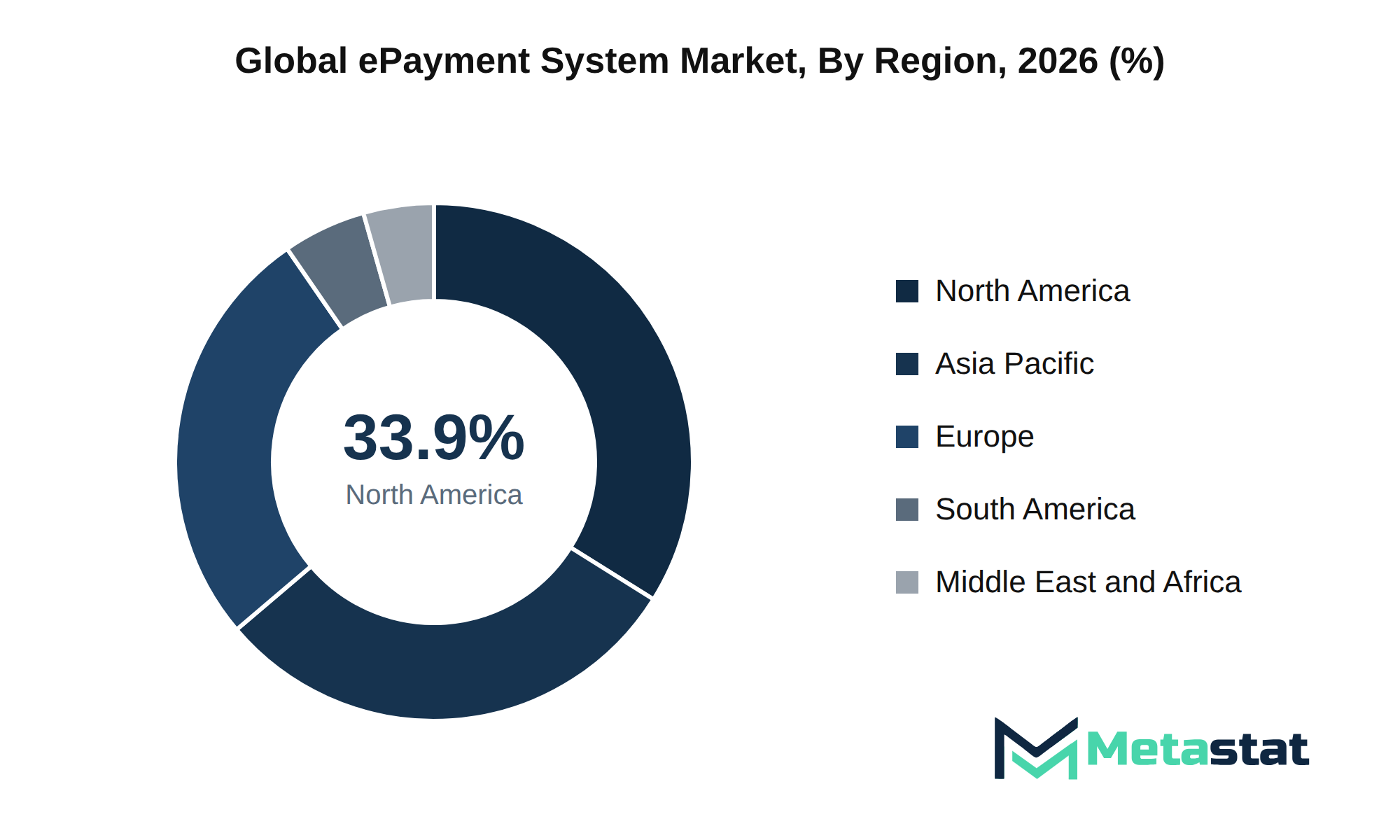
North America plays an important role in the ePayment System market, projected to expand at a CAGR of 12.8% within the forecast period, reaching a market size of USD 60 billion by the end of 2033. The region holds a substantial share of the global market in 2025, driven by strong consumer preferences for digital payment methods and increasing smartphone penetration.
The adoption of ePayment systems in North America reflects robust technological infrastructure, offering integration across various platforms. Enterprises across the retail, foodservice, and travel sectors push forward with digital payment solutions to enhance customer experiences. Emerging fintech companies and established financial institutions alike contribute to the competitive environment, encouraging competition and innovation.
Regional dynamics further influence the market, including localized procurement practices and cultural nuances that shape B2B buying behaviors. The region benefits from a well-established regulatory framework that supports secure and efficient transaction processes. Strategic entry barriers present opportunities for foreign direct investment, driving geographic expansion for key players in the market.
Investment in infrastructure modernization and localized manufacturing densities enhances the region's capacity to support further ePayment system adoption. While businesses navigate the evolving environment, continued growth in the ePayment System market remains evident across diverse industries.
The ePayment System market in Europe is poised for substantial growth, driven by increasing adoption and modernization of infrastructure. Key countries including Germany, France, the UK, Italy, Spain, and Russia contribute significantly to this expansion. Digital payment solutions receive strong support from regional compliance mandates and regulatory frameworks that enhance security and consumer confidence.
Localized procurement dynamics exhibit distinct cultural nuances, influencing B2B buying behaviors. The emergence of domestic market leaders strengthens competition, while vendor consolidation trends enable streamlined offerings to meet diverse consumer needs. Strategic entry barriers and foreign direct investment (FDI) flows further facilitate market penetration and growth opportunities within the region.
Incremental growth vectors, including high-value replacement cycles and the demand for innovative solutions, continue to shape the market landscape. With an emphasis on cross-border trade corridors, geopolitical fragmentation impacts supply chain regionalization, enhancing localized manufacturing densities. These factors collectively position Europe because a front-runner in the global ePayment System market.
The Asia-Pacific region holds a significant 29.9% share of the global ePayment System market in 2025, driven by rapid digitalization and an expanding middle class. Countries including China, India, and Southeast Asia exhibit increasing adoption rates due to a robust push for cashless transactions and government initiatives promoting financial inclusion. Infrastructure modernization plays a crucial role, with advancements in internet connectivity and mobile payment platforms enhancing user experiences.
Emerging market front-runners like India and China experience strong growth in payment processing solutions, reflecting consumer preferences for convenience and security. The rising prevalence of smartphones contributes to the expansion of payment wallets, enabling users to make transactions seamlessly. Local compliance mandates and regulatory frameworks in these countries influence market dynamics, resulting from companies navigating varied requirements across jurisdictions.
In the competitive landscape, domestic market leaders including Alipay and WeChat Pay in China drive innovation while encouraging vendor consolidation trends. Strategic entry barriers persist in markets with established players, necessitating foreign direct investment flows to penetrate these territories effectively. Cultural nuances significantly affect B2B buying behaviors, attributed to businesses adapting to local preferences and regional resource availability.
The Asia-Pacific market presents incremental growth vectors through localized manufacturing densities and nearshoring initiatives, allowing companies to enhance their service offerings. Cross-border trade corridors and geopolitical fragmentation drive collaboration among regional players, further enriching the market. Overall, the ePayment System market in Asia-Pacific is poised for sustained growth, supported by ongoing technological advancements and evolving consumer demands.
In South America, the ePayment System market benefits from increasing digital payment adoption driven by consumers' growing preference for online transactions. Countries like Brazil and Argentina lead this shift, influenced by a rising middle class and enhanced internet connectivity. Investment in infrastructure modernization supports the development of digital payment solutions, creating a more favorable environment for market growth.
Argentina's regulatory framework supports efforts to enhance payment systems, facilitating local compliance mandates that streamline operations for businesses. Brazil presents significant expansion potential, propelled by a youthful population eager for innovative payment methods. The focus on localized manufacturing densities enhances the competitiveness of domestic players, ensuring relevance in a changing market.
Emerging market front-runners benefit from cross-border trade corridors that expand access to international markets, driving demand for efficient ePayment solutions. Domestic market participants, including major fintech firms, contribute to the competitive landscape, reinforcing market dynamics through strategic partnerships and localized procurement strategies. Overall, the market's incremental growth vectors signal a strong trajectory with substantial long-term potential.
The Middle East and Africa region displays unique dynamics within the ePayment System market. A share of 4.4% in 2025 highlights the region's potential for growth. Countries including Saudi Arabia and the UAE demonstrate increasing adoption rates driven by a surge in digital transactions and mobile payment preferences. South Africa's expanding infrastructure and technological advancements further contribute to the rising demand for ePayment solutions.
Emerging market front-runners in this region focus on modernizing payment infrastructures, ensuring that offerings align with local consumption patterns. The adoption of localized manufacturing and procurement strategies addresses regional compliance mandates and cultural nuances, enhancing the competitive landscape. Various domestic market participants drive consolidation trends, optimizing service delivery through strategic partnerships.
Regional resource availability, including resilient energy grids, supports ongoing digital payment initiatives. The market experiences incremental growth vectors from geopolitical fragmentation that encourages cross-border trade corridors in the area. While businesses increasingly pursue foreign direct investment opportunities, the ePayment System market in the region is anticipated to evolve, presenting robust opportunities for players aiming to capitalize on the growing demand for efficient payment solutions.
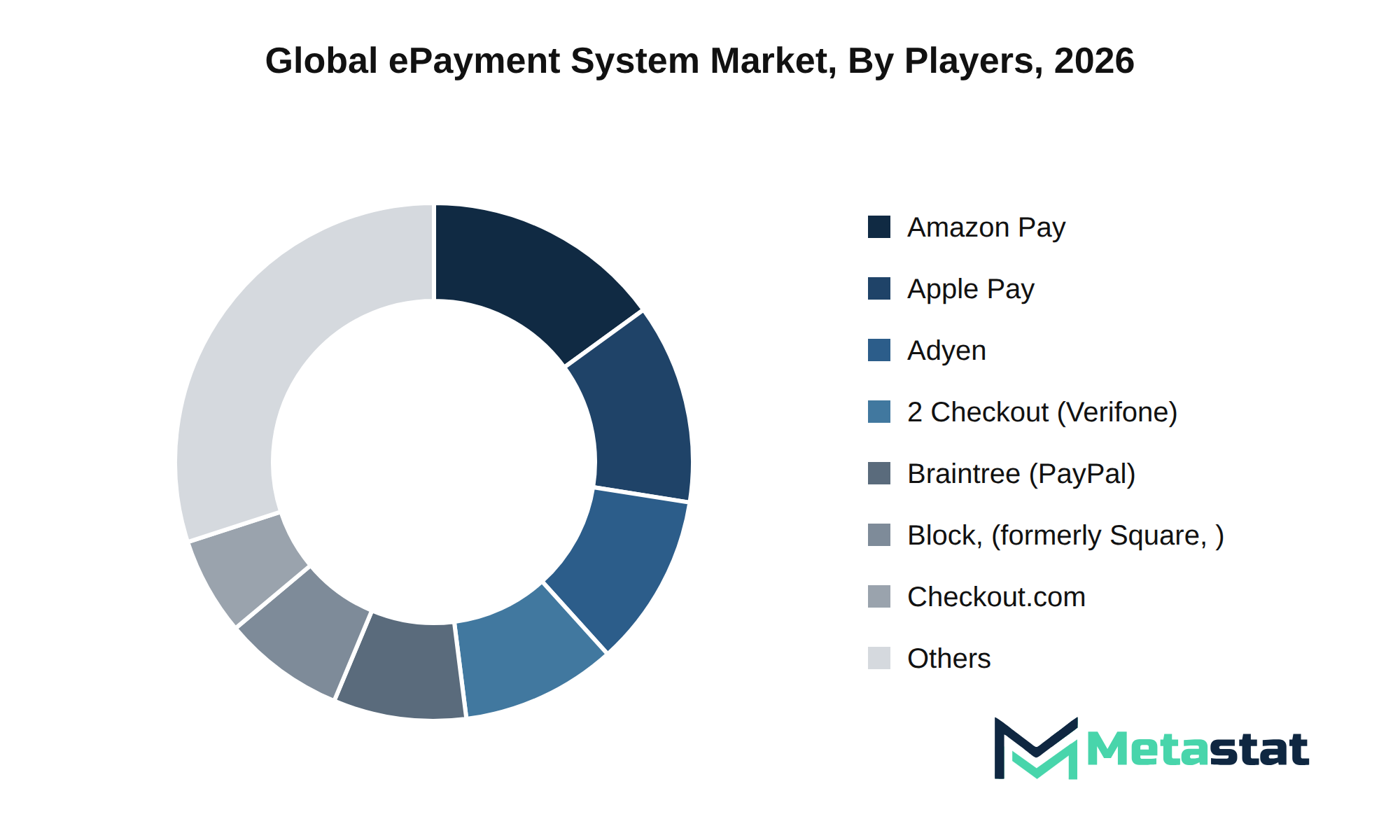
The ePayment System market experiences significant strategic activity driven by mergers and acquisitions, joint ventures, and alliances among key players. Companies including ACI Worldwide, Inc., Adyen N.V., and PayPal Holdings, Inc. actively pursue strategic consolidation to enhance market positioning and customer reach. Partnerships with financial institutions and technology firms create robust ecosystems that support innovation and product differentiation.
Commercial models in the market vary, with firms like Apple Pay and Amazon Pay focusing on integrating payment solutions into their existing platforms, thereby enhancing user convenience and driving customer retention. Competitive pricing architectures, along with promotional strategies, remain crucial for attracting and maintaining clients in a changing environment.
Research and development efforts demonstrate a commitment to technological advancement, with players investing in proprietary technologies that establish significant barriers to entry for new competitors. Companies including Stripe, Inc. and Block, Inc. leverage intellectual property to defend their market positions while driving innovation that addresses evolving consumer needs.
Overall, the market's competitive outlook suggests continued growth, driven by established players refining their strategies and new entrants challenging the status quo, contributing to a dynamic environment influenced by technological advancements and changing consumer preferences.
Market size is forecast to rise from USD 72.4 billion in 2025 to over USD 189.8 billion by 2033. The base case anticipates a compound annual growth rate (CAGR) of 12.8%, reflecting growing adoption of digital payment solutions across various sectors. A bull case scenario envisions even stronger demand, driven by rapid technological advancements and increasing consumer preference for cashless transactions. A bear case scenario could emerge from regulatory challenges and economic downturns that hinder investment in the market.
Key factors influencing the ePayment System market include macroeconomic shifts, evolving consumer behaviors, and the integration of next-generation technologies. Strategic capital allocation toward infrastructure development and compliance with new regulations plays a critical role in shaping market trajectories. Significant opportunities exist for enterprises to innovate and address unmet needs in the evolving landscape, driving substantial growth in high-demand sectors.
The market faces structural changes resulting from geopolitical realignments and global supply chain adjustments. Companies prioritizing defensibility roadmaps and adapting to changing trade corridors position themselves favorably for future growth. Continuous investment in research and development facilitates the commercialization of emerging technologies, sustaining the momentum of market expansion throughout the forecast period.
The report strategically identifies and profiles the key market players and analyses their core competencies in each sub-segment of the ePayment System market.
Report Attributes | Details |
Study Period | 2021-2033 |
Base Year | 2025 |
Estimated Year | 2026 |
Forecast Period | 2026-2033 |
Historical Period | 2021-2025 |
Growth Rate | CAGR 12.8% from 2026 to 2033 |
Revenue Unit | USD billion |
Segmentation | By Solutions, Services, Deployment, End-Use Industry, and Region |
By Region | North America (By Solutions, Services, Deployment, End-Use Industry, and Country)
|
Europe (By Solutions, Services, Deployment, End-Use Industry, and Country)
| |
Asia Pacific (By Solutions, Services, Deployment, End-Use Industry, and Country)
| |
South America (By Solutions, Services, Deployment, End-Use Industry, and Country)
| |
Middle East and Africa (By Solutions, Services, Deployment, End-Use Industry, and Country)
|
Find answers to common questions about this report
The ePayment System market size was valued at USD 72.4 billion in 2025, according to the Metastat Insights study.
The ePayment System market is projected to grow at a CAGR of 12.8% during the forecast period from 2026 to 2033.
The North America ePayment System market size is estimated to reach USD 60 billion by 2033.
The Payment Processing segment leads the ePayment System market, projected to reach USD 56.4 billion by 2033. This segment's growth reflects its significant role in the overall market expansion.
Investment in digital infrastructure, rising consumer expectations for efficient and secure payment options, and the ongoing digitization of legacy processes drive the ePayment System market. Companies adopting advanced technologies experience improved operational productivity and cost-efficiency, enhancing their competitive positioning and facilitating market expansion.
North America holds the dominant share of the ePayment System market, with a projected value of USD 60 billion in 2033, representing 33.9 percent of the total market.
The ePayment System market growth faces significant challenges from regulatory compliance, inflationary pressures, and data security concerns. Stringent regulations divert resources from innovation, while rising operational costs limit scalability. consumer apprehension regarding data privacy impacts adoption rates, complicating market expansion efforts.
Investment in digital infrastructure and the integration of advanced technologies significantly favor product adoption in the ePayment System market. Enhanced operational productivity, improved transaction efficiency, and rising consumer expectations for secure digital payment options drive demand across various sectors. shifting demographic patterns and changing consumer behaviors further contribute to the adoption of innovative payment solutions.
The ePayment System market is estimated to reach a valuation of USD 189.8 billion by 2033.
Top players operating in the ePayment System industry include ACI Worldwide, Inc., Adyen N.V., Amazon Pay, Apple Pay, Block, Inc. (formerly Square, Inc.), Mastercard Incorporated, PayPal Holdings, Inc., and Google Pay.
The analysts below cover Banking & Finance research at Metastat Insights.
LEAD ANALYST
Utkarsh Khirodkar is a Lead Market Research Analyst at MetaStat Insight, specializing in market intelligence, technology sector assessments, and competitive strategy.

PRINCIPAL CONSULTANT - ENTERPRISE AI & EMERGING TECHNOLOGIES
Banking & Finance · Electronics and Semiconductor · Energy and Power · Healthcare IT · Information & Technology · Professional Services
Vijay Gunti is a Principal Consultant at MetaStat Insight, bringing over two decades of experience across enterprise digital transformation, technology strategy, and intelligent systems.
Evaluating calorific value requirements and air permit compliance across municipal waste facilities requires localized data. Metastat Insight structured their analysis around operational throughput capacity and feedstock composition variations in Latin America and Eastern Europe. Their competitive mapping of sorting equipment vendors helped clarify technology differences between optical separators and heavy media systems. The study provided an objective baseline during our capital expenditure reviews.
Decarbonizing industrial thermal processes hinges on refrigerant regulations and compressor efficiency limits. Metastat Insights delivered a thorough market analysis that evaluated natural refrigerants like CO2 and hydrocarbons against synthetic low-GWP alternatives. The breakdown of utility incentives and grid capacity constraints across key European manufacturing hubs offered valuable perspective. The follow-up conversation with their sector analysts addressed our specific questions on mechanical vapor recompression systems efficiently.
Assessing 200mm wafer transition schedules and substrate supply bottlenecks requires precise technical intelligence. MetaStat Insight supplied an actionable breakdown comparing planar and trench MOSFET architectures across automotive and industrial drive markets. The regional capacity estimates for Asia-Pacific foundries helped clarify lead-time uncertainties during our strategic planning session. When we needed additional clarification on high-purity raw material sourcing, their analyst team responded with helpful context within twenty-four hours.
Explore related market intelligence reports worth reading alongside this one.