
LEAD ANALYST
Utkarsh Khirodkar is a Lead Market Research Analyst at MetaStat Insight, specializing in market intelligence, technology sector assessments, and competitive strategy.

Concentrated Solar Power Market Size, Share, By Technology (Parabolic Trough, Linear Fresnel, Dish, and Power Tower), By Application (Utilities, Enhanced Oil Recovery (EOR), Desalination, and Others), By Capacity (Less than 50 MW, 50 MW to 99 MW, and above 100 MW), By Operation Type (Stand-alone Systems and With Storage), Industry Analysis, Growth, Trends, and Forecast, 2026-2033
Report ID
MSI-4794
Published
June, 2026
Pages
313 Pages
Format
Report Details
Choose Your License
Concentrated Solar Power Market
Global Concentrated Solar Power market size is valued at USD 7.5 billion in 2025 and projected to grow at a CAGR of 11.1% during the forecast period, reaching USD 17.3 billion by 2033.
North America accounts for 20.7% of the market in 2025, with the U.S. leading the regional market.
The Parabolic Trough segment accounts for a market share of 66.20% in 2025.
Key trends driving growth: Rising government investments in renewable energy infrastructure are accelerating utility-scale CSP deployments and increasing demand for long-duration energy storage is strengthening adoption of CSP with molten salt technology.
Opportunities include hybrid renewable projects combining CSP, battery storage, and photovoltaic systems are opening new revenue streams and growing industrial demand for sustainable process heat is creating opportunities for CSP integration in manufacturing sectors.
Key insight: Thermal energy storage integration is becoming the defining advantage of CSP systems in delivering round-the-clock renewable electricity.
The Global Concentrated Solar Power (CSP) Market is gaining momentum owing to rising demand for reliable renewable power technologies with integrated energy storage capabilities. Unlike conventional solar photovoltaic systems, CSP technology uses mirrors and lenses to concentrate sunlight and generate thermal energy, which will be stored and converted into electricity after sunset. Growing concerns regarding carbon emissions, grid stability, and energy diversification are encouraging governments and utilities to invest in large-scale CSP projects. Technologies such as parabolic troughs, power towers, and linear Fresnel systems are witnessing increased adoption across utility-scale power plants, desalination facilities, and industrial heat applications. The market is also benefiting from supportive renewable energy policies, tax incentives, and investments in long-duration energy storage infrastructure.
Utility companies are increasingly integrating CSP with thermal energy storage systems to ensure continuous power supply during peak demand hours. Hybrid renewable projects combining CSP with photovoltaic and battery technologies are further enhancing performance and operational flexibility. In addition, CSP is gaining relevance in industrial applications, including desalination, enhanced oil recovery, food processing, and chemical manufacturing, where high-temperature heat is required. Technological advancements in molten salt storage, heliostat efficiency, and tower-based systems are supporting reduced operational costs and improved project viability across international markets.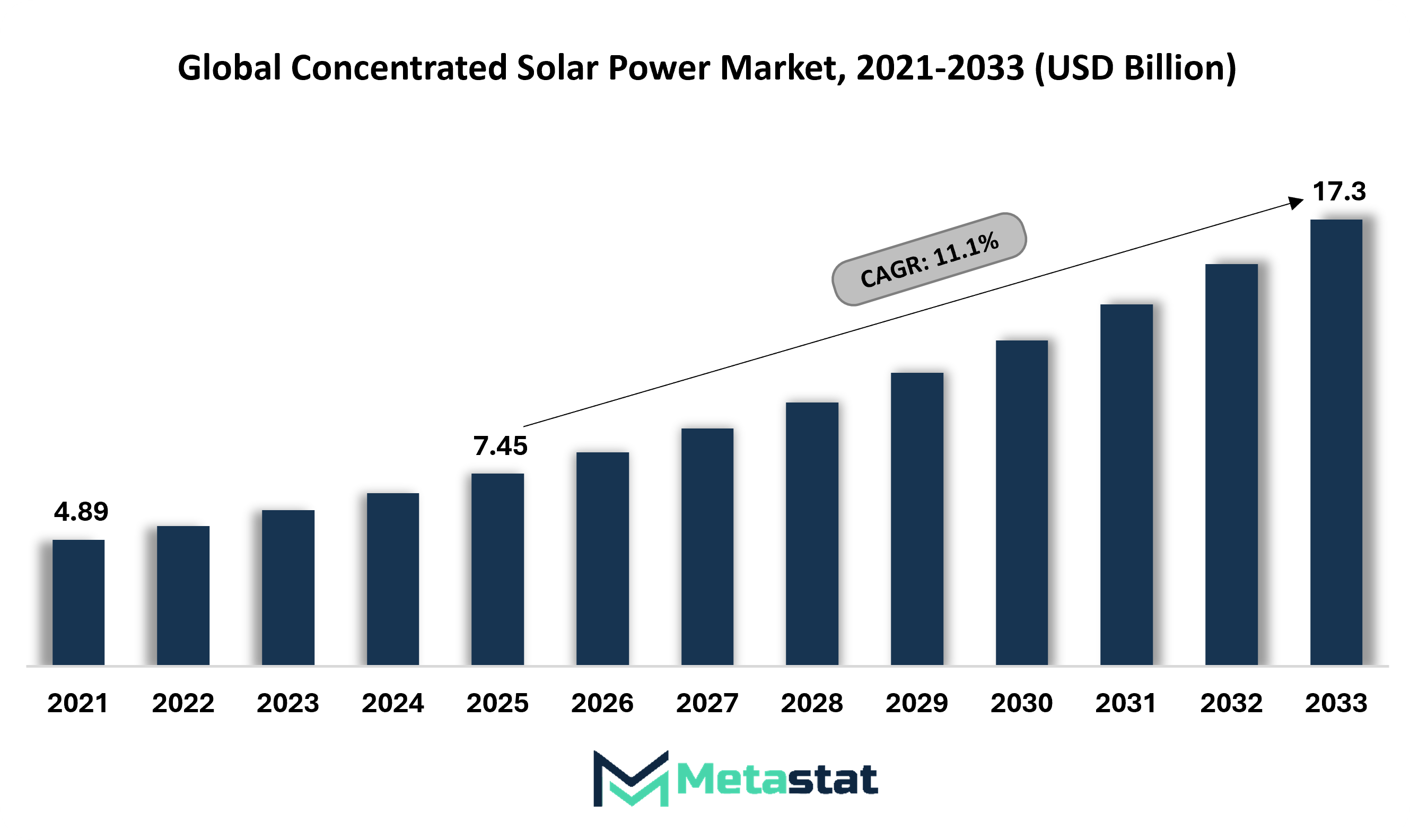
Rising government investments in renewable energy infrastructure are accelerating utility-scale CSP deployments.
Rising government investments in renewable energy infrastructure are accelerating utility-scale CSP deployment. Public sector funding across multiple economies is encouraging the development of large concentrated solar power plants supported by grid modernization programs. Financial incentives, policy reforms, clean energy mandates, and global sustainability targets are encouraging utility providers to adopt advanced solar thermal power generation. Strong institutional backing will improve transmission connectivity, project financing access, and operational stability for future utility-scale installations within the concentrated solar power market.
Increasing demand for long-duration energy storage is strengthening adoption of CSP with molten salt technology.
Increasing demand for long-duration energy storage is strengthening the adoption of CSP with molten salt technology. Industrial operators, utility companies, and national energy organizations are focusing on stable renewable power generation during peak consumption periods. Molten salt systems are improving thermal storage duration, enabling continuous electricity supply during night-time operations and variable weather conditions. Future energy planning strategies will support large-scale thermal storage integration, creating stronger business interest across the concentrated solar power market.
High initial capital investment continues to limit large-scale CSP project expansion.
High initial capital investment continues to restrict large-scale CSP project expansion. Construction costs associated with solar fields, thermal storage units, advanced mirrors, and power block systems are creating financial pressure for developers. Several emerging economies continue facing challenges linked with infrastructure investment and private funding participation. Long project development timelines are also increasing investment uncertainty.
Competition from lower-cost solar photovoltaic systems is creating pricing pressure on CSP adoption.
Competition from lower-cost solar photovoltaic systems is creating pricing pressure on CSP adoption. Rapid technological progress in photovoltaic manufacturing has substantially reduced equipment costs across utility-scale renewable projects. Lower installation costs and simplified deployment processes are encouraging power providers to adopt photovoltaic solutions across several regions. Market competition will intensify with falling battery storage costs and increasing photovoltaic efficiency. Pricing imbalance will continue influencing investment decisions across the concentrated solar power market.
Hybrid renewable projects combining CSP, battery storage, and photovoltaic systems are opening new revenue streams.
Hybrid renewable projects combining CSP, battery storage, and photovoltaic systems are opening new revenue streams. Energy companies are increasingly exploring integrated renewable projects capable of supporting continuous power generation, improved grid reliability, and stronger energy diversification. Hybrid infrastructure models will strengthen operational flexibility across commercial, industrial, and utility applications. Growing emphasis on carbon reduction strategies and resilient electricity networks will create long-term business growth opportunities across the concentrated solar power market.
The Global Concentrated Solar Power Market is classified based on technology, application, capacity, and operation type.
Parabolic Trough segment is valued at USD 5.4 billion in 2026 and is projected to reach USD 10.2 billion by 2033, at a CAGR of 9.5% during the forecast period.
Parabolic trough technology continues gaining traction owing to reliable thermal energy generation and advanced heat transfer systems. Future investments indicate stronger adoption across large-scale solar projects in desert and high-irradiance regions. Advanced mirror designs, improved tracking accuracy, and lower maintenance requirements support higher operational performance across the concentrated solar power market.
Linear Fresnel segment is valued at USD 0.6 billion in 2026 and is projected to reach USD 1.3 billion by 2033, at a CAGR of 12% during the forecast period.
Linear Fresnel systems will witness stronger demand owing to lower installation costs and simplified structural requirements. Industrial sectors seeking stable renewable heat generation are encouraging future deployment across developing economies. Compact land utilization, simpler construction methods, and improved reflector technologies create long-term growth opportunities in the concentrated solar power market.
Dish segment is valued at USD 0.2 billion in 2026 and is projected to reach USD 0.4 billion by 2033, at a CAGR of 13.9% during the forecast period.
Dish technology presents strong future potential through high power conversion efficiency and suitability for remote energy generation. Research activities focused on compact solar systems are encouraging wider commercial acceptance in isolated areas. Technological development linked with automated operations and lower component costs strengthens future expansion prospects across the concentrated solar power market.
Power Tower segment is valued at USD 2.1 billion in 2026 and is projected to reach USD 5.4 billion by 2033, at a CAGR of 14.3% during the forecast period.
Power tower systems are projected to witness rapid growth owing to large-scale electricity generation capabilities and advanced thermal storage integration. Government-sponsored renewable energy targets are encouraging the development of utility-scale projects using tower technology. Improved molten salt storage systems, stronger operational stability, and rising clean energy investments support future demand across the concentrated solar power market.
Utilities segment is projected to reach USD 14.5 billion by 2033, at a CAGR of 11.4% during the forecast period.
Utility applications remain highly significant owing to rising electricity consumption and the accelerating transition toward renewable energy infrastructure. Future electricity policies across several countries are encouraging large concentrated solar installations for grid stability. Enhanced storage integration, reduced dependency on fossil fuels, and long-duration power supply create sustained expansion opportunities in the concentrated solar power market.
Enhanced Oil Recovery (EOR) segment is projected to reach USD 1.1 billion by 2033, at a CAGR of 8.6% during the forecast period.
Enhanced oil recovery applications will expand steadily with rising demand for sustainable extraction processes across oil-producing economies. Solar-generated steam reduces gas consumption during recovery operations, supporting environmental goals across energy industries. Future technological partnerships between solar developers and petroleum companies strengthen long-term opportunities across the concentrated solar power market.
Desalination segment is projected to reach USD 1.0 billion by 2033, at a CAGR of 15.1% during the forecast period.
Desalination applications are projected to gain momentum owing to growing freshwater scarcity across arid and coastal regions. Concentrated solar systems support energy-efficient water treatment processes while reducing operational costs linked with conventional power sources. Future infrastructure development programs focused on water security contribute to consistent demand growth across the concentrated solar power market.
Others segment is projected to reach USD 0.7 billion by 2033, at a CAGR of 6.2% during the forecast period.
Other applications, including industrial heating, mining operations, and district energy systems, continue creating diverse growth opportunities. Rising interest in sustainable thermal solutions supports adoption across production sectors seeking reduced carbon emissions. Future technological improvements linked with hybrid renewable systems will encourage broader industrial utilization across the concentrated solar power market.
Less than 50 MW segment is projected to reach USD 1.4 billion by 2033.
Projects below 50 MW will witness steady expansion owing to their suitability for remote communities and decentralized power requirements. Smaller installations offer flexibility for commercial facilities seeking independent renewable power generation. Future upgrades in compact thermal storage technologies and project financing models support demand growth across the concentrated solar power market.
50 MW to 99 MW segment is projected to reach USD 3.5 billion by 2033.
Capacity ranges between 50 MW and 99 MW continue attracting investments through balanced operational efficiency and manageable infrastructure development. Medium-scale projects support regional energy supply while reducing pressure on traditional power networks. Future policy incentives and rising renewable procurement programs are encouraging wider deployment across the concentrated solar power market.
100 MW and above segment is projected to reach USD 12.5 billion by 2033.
Large-scale projects exceeding 100 MW are projected to dominate future investments owing to strong power generation capabilities and long-term cost advantages. National renewable energy strategies are encouraging the development of mega solar thermal plants across high-radiation areas. Advancements in storage duration, grid integration, and transmission infrastructure are strengthening future growth across the concentrated solar power market.
Stand-alone Systems segment is projected to grow at a CAGR of 6.7% during the forecast period.
Stand-alone systems continue attracting attention through independent renewable power generation for remote and off-grid locations. Future rural electrification programs and commercial power diversification strategies support wider deployment across developing areas. Improved operational reliability, lower diesel dependency, and technological development linked with compact thermal systems create long-term growth opportunities across the concentrated solar power market.
With Storage segment is projected to grow at a CAGR of 13.8% during the forecast period.
Systems integrated with storage will experience significant growth owing to rising demand for uninterrupted renewable electricity supply. Thermal storage technologies support energy generation during non-daylight hours, enhancing grid reliability and operational flexibility. Future energy transition targets, rising investments in clean infrastructure, and technological advancements support growth prospects across the concentrated solar power market.
Based on geography, the Global Concentrated Solar Power market is divided into North America, Europe, Asia-Pacific, South America, Middle East, and Africa.
Strong renewable energy objectives and tax incentives in the United States are encouraging CSP investments.
Rising interests in grid-stable renewable strength solutions is helping hybrid CSP-storage initiatives across barren North America regions.
European countries, especially Spain, continue to strengthen CSP deployment through renewable transition programs and advanced thermal storage integration initiatives focused on grid reliability and carbon neutrality goals.
China’s large-scale renewable infrastructure investments are creating major opportunities for CSP tower projects and thermal storage systems in Asia Pacific.
India’s rising power demand and solar project initiatives are supporting new CSP installations in high-radiation regions.
The Middle East and Africa remain attractive CSP markets owing to abundant solar resources, growing desalination demand, and strong government-backed clean energy projects. South America, especially Chile, is witnessing growing CSP investments driven by mining sector energy requirements and favourable solar irradiation conditions.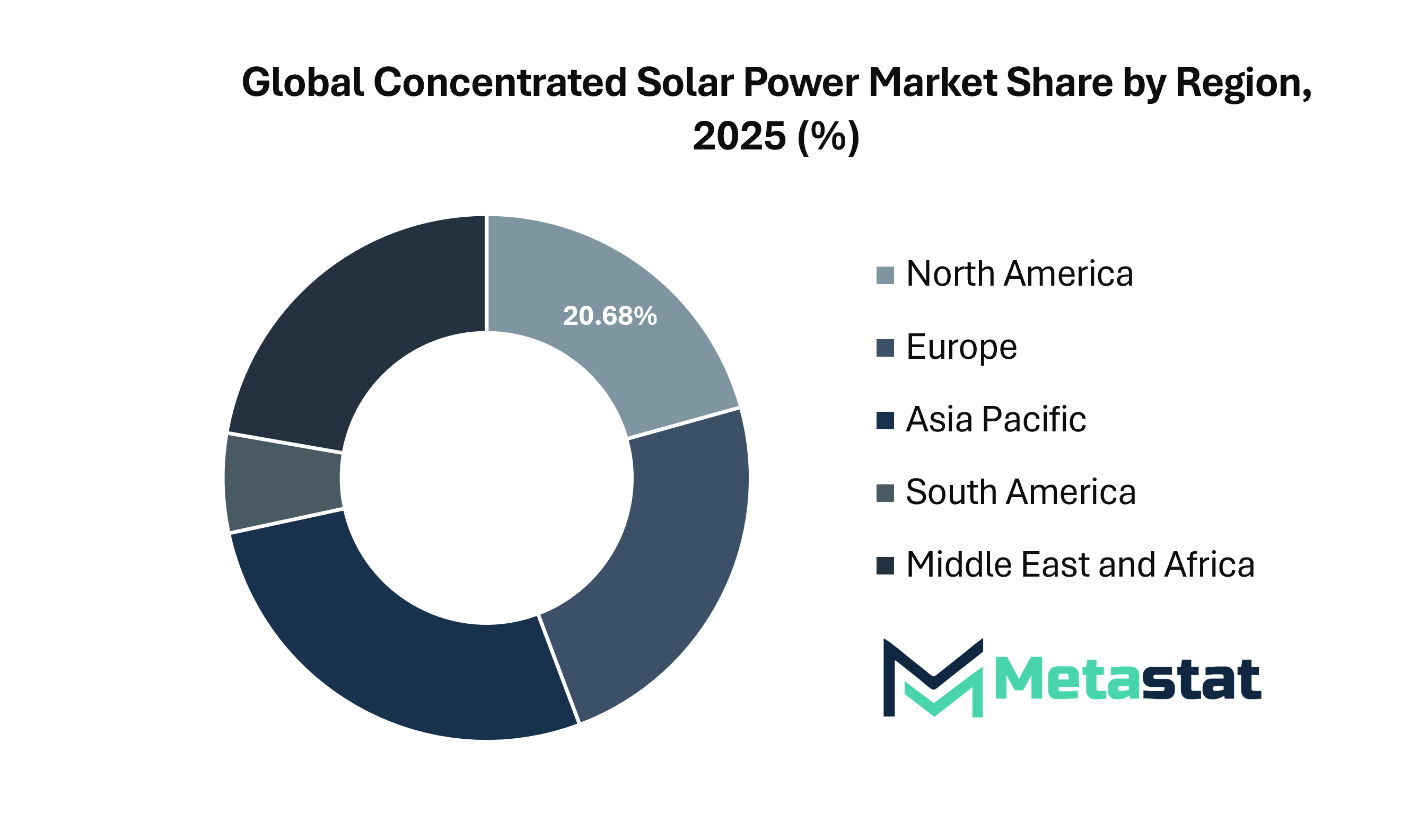
The growth of clean energy initiatives has increased interest in thermal-based solar technologies across many countries. The Global Concentrated Solar Power Market has gained attention owing to its ability to store heat and deliver electricity after sunset. Such capability provides an advantage in regions where stable energy generation is critical for industrial operations and urban electricity demand. Governments are supporting solar-based infrastructure through funding programs, tax benefits, and renewable energy targets, encouraging companies to expand their activities. Several countries in the Middle East, Europe, Asia, and North America are investing in large-scale projects to reduce dependence on fossil fuels and improve long-term energy security. Growing awareness regarding carbon emissions and climate issues is also pushing utilities and private companies toward cleaner energy generation methods.
Many organizations are focusing on advanced systems that improve power output and reduce operational costs. Companies such as 247Solar, Aalborg CSP, Abengoa Solar, Absolicon Solar Collector AB, Acciona Energy, and ACWA POWER are working on initiatives that support efficient heat storage and improved solar collection methods. Firms including BrightSource Energy, Inc., Chiyoda Corporation, Clique Solar, Cosin Solar, and CSP Services are contributing through engineering support and plant development activities. At the same time, companies such as Enel Green Power, ENGIE, Flowserve Corporation, and GE Vernova are strengthening partnerships to improve project execution and power performance. Rising investment in research and plant modernization is supporting the industry in improving reliability and expanding commercial adoption across regions with strong sunlight availability.
The market is also receiving support from companies involved in equipment manufacturing, thermal systems, and infrastructure development. GlassPoint, Grün leben GmbH, Heliogen, Industrial Solar GmbH, INITEC Energía, and John Cockerill Energy are increasing their focus on industrial heat applications and sustainable energy use. Companies such as Lanzhou Dacheng Technology Co., Ltd., MAN Energy Solutions, POWERCHINA, Rioglass Solar, and Royal Tech CSP Limited are supporting large utility projects with advanced technology and manufacturing capabilities. SENER Group, Shams Power, Shanghai Electric, and Shouhang High-Tech Energy continue strengthening their presence through international partnerships and plant development activities. The involvement of global engineering and technology providers is helping improve the efficiency of solar thermal projects while supporting energy transition goals.
Future growth will remain positive, supported by increasing power demand and stronger climate commitments from governments worldwide. Siemens Energy, SolarReserve, Soltigua, Sulzer Ltd., Sunrise CSP, Suntrace, Synhelion, Therminol, Torresol Energy, Trivelli Energia srl, TSK Group, Turboden S.p.A., and Vast Renewables are focusing on innovation, energy storage development, and cost reduction strategies. Better integration with commercial heating systems and hybrid renewable projects will create additional business opportunities in the coming years. The Global Concentrated Solar Power Market will benefit from rising public and private funding, particularly across desert regions and countries with high solar exposure. Continuous technological development and supportive policy measures will strengthen market expansion and improve the commercial value of solar thermal energy worldwide.
Market size is forecast to rise from USD 7.5 billion in 2025 to over USD 17.3 billion by 2033.
Future growth of the Concentrated Solar Power Market is expected to be supported by the global transition toward decarbonized energy systems and the increasing requirement for stable renewable power generation. Expanding investments in energy storage, rising electricity consumption from industrialization and AI-driven infrastructure, and the growing focus on grid resilience are expected to create favorable conditions for CSP deployment. Emerging economies with high solar irradiance and rising energy demand are likely to become key investment hubs over the next decade.
This research report categorizes the Concentrated Solar Power market based on key segments and regions, forecasts revenue growth, and analyses trends in each submarket. The report analyses the key growth drivers, opportunities, and challenges influencing the Concentrated Solar Power market. Recent market developments and competitive strategies such as expansion, product launch, partnership, merger, and acquisition have been included to draw the competitive landscape in the market.
The report strategically identifies and profiles the key market players and analyses their core competencies in each sub-segment of the Concentrated Solar Power market.
|
Report Attributes |
Details |
|
Study Period |
2021-2033 |
|
Base Year |
2025 |
|
Estimated Year |
2026 |
|
Forecast Period |
2026-2033 |
|
Historical Period |
2021-2025 |
|
Growth Rate |
CAGR 11.1% from 2026 to 2033 |
|
Revenue Unit |
USD billion |
|
Segmentation |
By Technology, Application, Capacity, Operation Type, and Region |
|
By Region |
North America (By Technology, Application, Capacity, Operation Type, and Country)
|
|
Europe (By Technology, Application, Capacity, Operation Type, and Country)
|
|
|
Asia Pacific (By Technology, Application, Capacity, Operation Type, and Country)
|
|
|
South America (By Technology, Application, Capacity, Operation Type, and Country)
|
|
|
Middle East and Africa (By Technology, Application, Capacity, Operation Type, and Country)
|
Find answers to common questions about this report
Top players operating in the Concentrated Solar Power industry includes 247Solar, Aalborg CSP, Abengoa Solar, Absolicon Solar Collector AB, Acciona Energy, ACWA POWER, and Atlantica Sustainable Infrastructure.
Global Concentrated Solar Power market is estimated to reach USD 17.3 billion by 2033.
High initial capital investment continues to limit large-scale CSP project expansion will hamper the market growth within the forecast period.
Rising government investments in renewable energy infrastructure are accelerating utility-scale CSP deployments and increasing demand for long-duration energy storage is strengthening adoption of CSP with molten salt technology are key driving factors, boosting the market.
Asia Pacific region dominates the market.
The Metastat Insights analysis shows that the North America Concentrated Solar Power market size is estimated to be USD 3.0 billion by 2033.
The Global Concentrated Solar Power market is expected to grow at a CAGR of 11.1% over the forecast period (2026-2033).
The Metastat Insights study shows that the Global Concentrated Solar Power market size was USD 7.5 billion in 2025.
The analysts below cover Energy and Power research at Metastat Insights.
LEAD ANALYST
Utkarsh Khirodkar is a Lead Market Research Analyst at MetaStat Insight, specializing in market intelligence, technology sector assessments, and competitive strategy.

PRINCIPAL CONSULTANT - ENTERPRISE AI & EMERGING TECHNOLOGIES
Banking & Finance · Electronics and Semiconductor · Energy and Power · Healthcare IT · Information & Technology · Professional Services
Vijay Gunti is a Principal Consultant at MetaStat Insight, bringing over two decades of experience across enterprise digital transformation, technology strategy, and intelligent systems.

ENERGY & INFRASTRUCTURE INDUSTRY CONSULTANT
Automotive and Transportation · Electronics and Semiconductor · Energy and Power · Machinery & Equipment
Saurabh Vasant Ganvir consults for Energy & Infrastructure Industry at MetaStat Insight, specializing in renewable energy, solar EPC, and electric vehicle (EV) infrastructure markets.
Assessing commercial microgrid software adoption requires looking past top-level installation numbers and examining utility interconnection queues. The research provided verifiable data on average permitting timelines, tariff structures, and battery storage integration costs across regional utility territories. That grounded perspective was valuable for our team when building five-year demand projections for industrial microgrid controllers.
Ambulatory surgical centers have very different purchasing cycles for robotic-assisted surgery platforms than major hospital networks. The MetaStat Insight study focused squarely on capital expenditure depreciation, procedural reimbursement pathways, and surgeon training overhead. That operational clarity made it much simpler to validate multi-year procedure growth forecasts against actual ambulatory center adoption patterns.
When planning edge sensor rollouts across refinery environments, generic IoT reports typically miss the harsh-environment certification bottlenecks. MetaStat Insight gave an objective evaluation of ATEX and Class 1 Division 2 hardware availability, along with realistic five-year maintenance cycle cost projections. The comparison of wireless mesh versus private cellular backhaul helped our team pressure-test network reliability models for remote processing facilities.
Explore related market intelligence reports worth reading alongside this one.