
LEAD ANALYST
Utkarsh Khirodkar is a Lead Market Research Analyst at MetaStat Insight, specializing in market intelligence, technology sector assessments, and competitive strategy.

Global Construction Management Software Market Size, Share, By Deployment Model (Cloud and On-premises), By Application (Project Planning and Scheduling, Cost Estimation and Control, Document Management and Collaboration, Quality Management, Safety Management, Field Operations and Resource Management, BIM Coordination), By End User (General Contractors, Owners and Developers, Specialty and Trade Contractors, Architects and Engineers), By Construction Sector (Residential Buildings, Commercial and Institutional Buildings, Civil Infrastructure, Industrial and Energy Facilities), Industry Analysis, Growth, Trends, and Forecast, 2026-2033
Report ID
MSI-5596
Published
October, 2026
Pages
269 Pages
Format
Historical
Base year
Forecast
Forecast period
Report Details
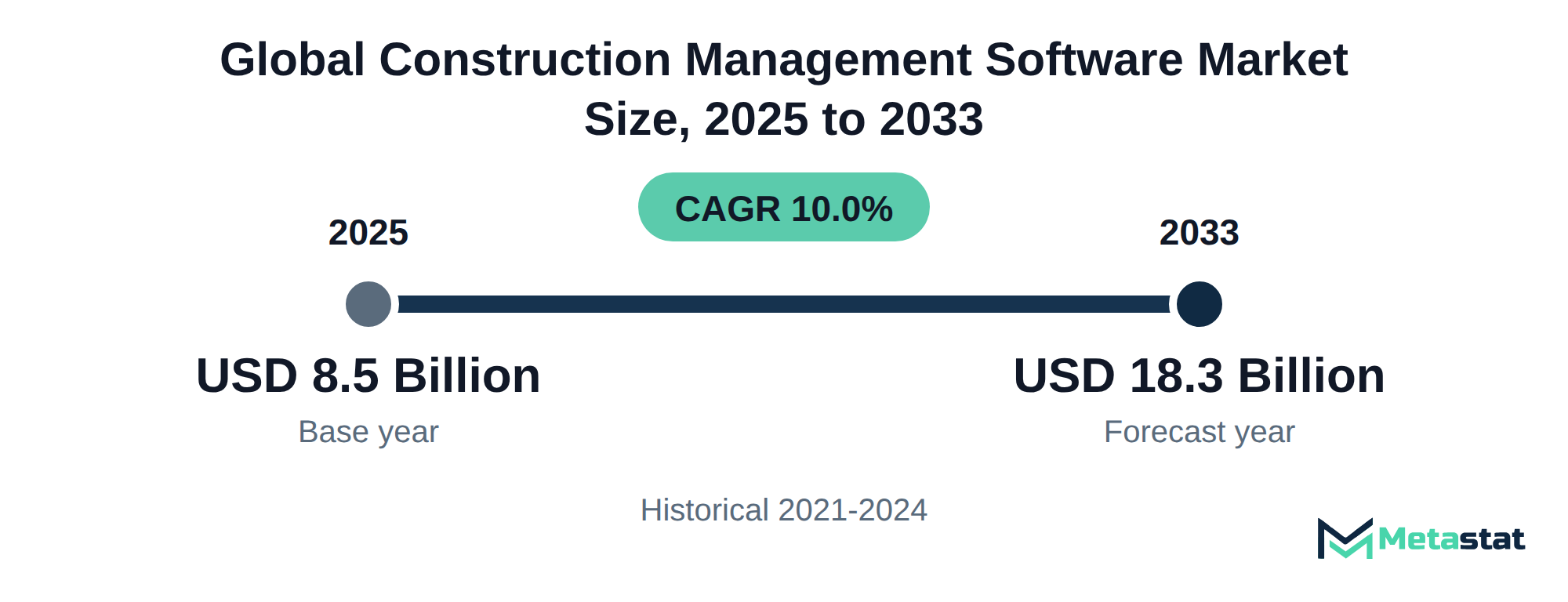
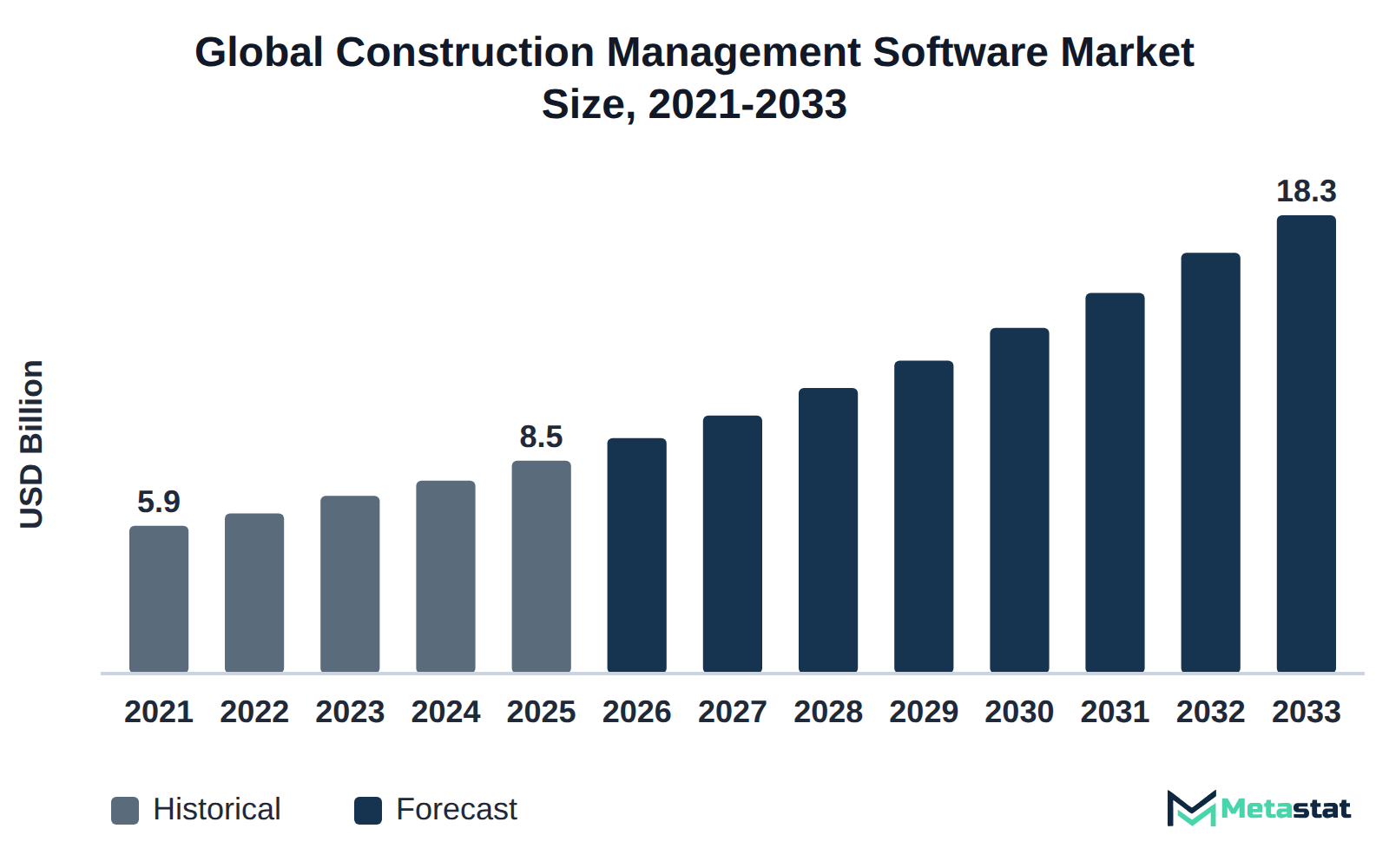
Market Valuation: Valued at $8.5 Billion in 2025, projected to reach $18.3 Billion by 2033 at a 10.0% CAGR.
Dominant Segment: Project Planning and Scheduling leads the market, driven by the increasing complexity of construction projects that necessitate effective timeline management.
Geographic Lead: North America holds the largest market share, with the US expected to lead in growth due to robust construction activities and significant infrastructure investments.
What's Inside: The report provides a comprehensive analysis of market dynamics, competitive landscape, and detailed forecasts covering the period from 2026 to 2033.
Cloud Adoption: The cloud deployment model is projected to grow significantly, highlighting a shift towards flexible and scalable solutions that enhance project management efficiency.
Quality Management Growth: Quality Management applications are set to expand at a CAGR of 12.3%, reflecting the rising importance of compliance and safety standards in construction.
Choose Your License
Global Construction Management Software Market
The global Construction Management Software market was valued at USD 8.5 billion in 2025 and is projected to reach USD 18.3 billion by 2033, growing at a CAGR of 10.0% over the forecast period.
The Construction Management Software market encompasses a range of software solutions designed to streamline and enhance the planning, execution, and management of construction projects. Buyers invest in these solutions primarily to improve project efficiency, reduce costs, and facilitate better collaboration among stakeholders. The growing complexity of construction projects and the need for real-time data and analytics drive demand for these advanced software tools.
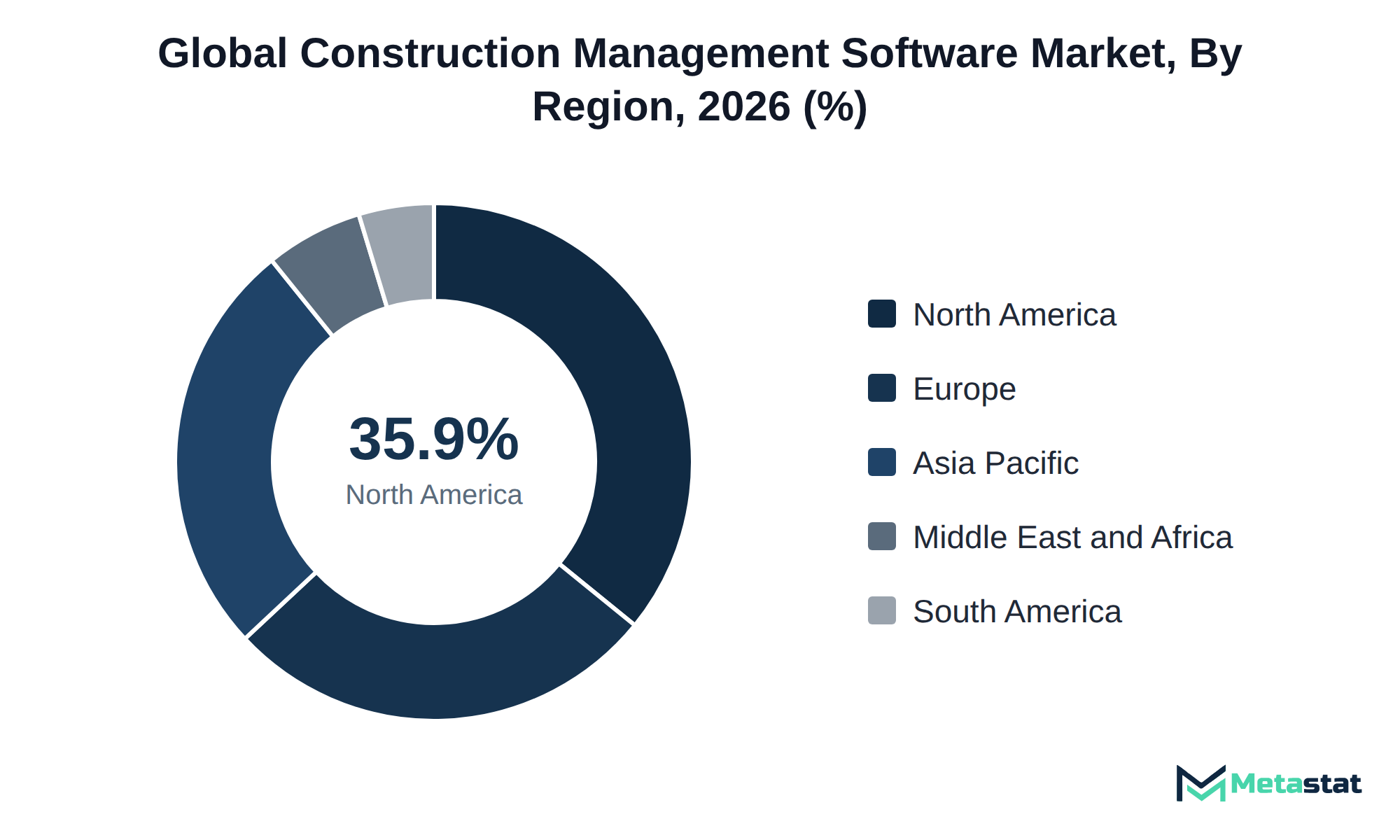
Growth in the market is fueled by the increasing adoption of cloud-based solutions, which offer flexibility and scalability for users. The cloud segment stands out, expected to grow significantly and become the most valuable within the market by 2033. North America holds 35.9% of the market in 2025, with the US leading in 2026. This regional advantage stems from strong construction activity and significant investment in infrastructure development.
The market expands due to the rising number of general contractors and developers investing in software solutions to enhance project management capabilities. The demand for effective project planning and scheduling applications is particularly strong, aligning with the increasing complexity of construction projects. This focus on efficiency and accuracy in project execution contributes significantly to the market's overall growth trajectory.
The Construction Management Software market supports a variety of applications that enhance project management efficiencies and cost control across the construction lifecycle. Buyers invest in these solutions to improve collaboration, streamline workflows, and ensure compliance with regulations. This trend is evident among general contractors, owners, and developers, whose purchasing decisions hinge on the increasing complexity of construction projects and the necessity for precise project planning and execution.
Growth in the market is primarily driven by the adoption of cloud-based deployment models, which offer scalable solutions and greater flexibility for users. North America is projected to account for a significant share of the market in 2025, with the US anticipated to lead in 2026. Among the various application segments, Project Planning and Scheduling commands the most significant value, reflecting the critical need for effective timeline management in construction projects.
Construction projects evolve, driving demand for advanced software solutions that will likely continue to rise. The increasing emphasis on digitization and automation further accelerates growth, driven by firms seeking to enhance operational efficiency and reduce overall project costs. This trend positions the Construction Management Software market for strong expansion in the coming years.
Cloud construction platforms increasingly connect project controls with jobsite execution, enhancing overall project efficiency and management. This approach aligns with the wider smart construction trend toward digitally connected job sites. The shift towards cloud-based solutions reflects a significant trend within the Construction Management Software market. This transformation allows real-time collaboration and data sharing among stakeholders, facilitating improved decision-making and streamlined processes. For instance, the cloud segment is projected to grow from USD 6.4 billion in 2026 to USD 14.5 billion by 2033, representing a compound annual growth rate (CAGR) of 12.4%. This growth highlights the demand for agile and scalable solutions in construction management.
The integration of cloud technology within construction management systems simplifies access to critical project data from remote locations, ensuring teams remain aligned on objectives and timelines. The adoption of these platforms reduces dependency on traditional on-premises solutions, which often entail higher infrastructure costs and maintenance challenges. Companies within the market increasingly recognize the potential for operational efficiency gains through cloud adoption.
By embracing cloud construction platforms, organizations enhance project delivery timelines and reduce overall project costs, positioning themselves favorably against competitors. This strategic shift is essential in a market where timely execution and resource management directly impact profitability. Cloud adoption in the Construction Management Software market is projected to keep accelerating, supporting more integrated and responsive project management methods.
Investment in mobile quality inspections and safety workflows significantly influences spending in the Construction Management Software market. The shift toward digital solutions enhances operational efficiency while mitigating risks associated with construction projects. This trend aligns with the anticipated growth of USD 18.3 billion by 2033, up from USD 8.5 billion in 2025, reflecting the commercial value of these technologies.
Contractors typically engage in purchasing based on a variety of pricing structures and contract models. Subscription-based pricing, common in cloud deployment, allows for predictable budgeting and easier scaling of services. This model appeals to contractors seeking flexibility and the latest updates without large upfront costs.
The demand for mobile solutions, particularly in quality management applications, highlights the importance of integrating safety workflows. Contractors adopting these tools experience enhanced compliance with safety regulations and improved project outcomes. Such investments ultimately influence competitive positioning, as organizations use these innovations to better meet client needs and adhere to industry standards.
General contractors in the Asia Pacific region increasingly prioritize construction management software solutions to improve project delivery and efficiency. The region's rapid urbanization and significant infrastructure investments drive demand for software that supports complex project management requirements. The construction management software market in Asia Pacific is projected to reach USD 4.7 billion by 2033, reflecting growth in this sector.
One distinct need for general contractors involves effective project planning and scheduling functionalities. Demand for these capabilities is expected to grow, with an estimated increase from USD 2.6 billion in 2026 to USD 4.9 billion by 2033, exhibiting a compound annual growth rate of 9.3%. This growth results from contractors seeking to optimize resource allocation and timeline management across multiple projects.
The integration of cloud-based solutions further enhances the attractiveness of construction management software. This shift enables real-time collaboration and data accessibility, ultimately enhancing project execution and reducing delays. The evolving needs of general contractors significantly shape the demand landscape for construction management software in the Asia Pacific region.
Choosing the right Construction Management Software for scheduling and field compliance hinges on functionality that directly addresses project management challenges. General contractors increasingly seek solutions that facilitate project planning and scheduling, evidenced by a projected growth in this area from USD 2.6 billion in 2026 to USD 4.9 billion by 2033, reflecting a compound annual growth rate of 9.3%. This rising demand signals a shift towards tools that enhance operational efficiency and compliance monitoring on job sites.
Factors including user interface, integration capabilities, and mobile accessibility significantly influence contractor decisions. A software solution that offers real-time updates and collaborative features enables teams to respond swiftly to on-site changes, ensuring adherence to schedules and safety regulations. The market continues to evolve, with companies investing in advanced functionalities to meet these requirements. Consequently, contractors prioritize solutions that improve scheduling accuracy and enhance overall compliance with safety standards, ultimately driving profitability and project success.
Investment trends in residential construction reflect a significant shift among general contractors, driven by rising consumer demand for new homes. This change prompts contractors to seek efficient management tools to streamline project execution and cost control. The expected growth in the number of housing units pushes contractors towards adopting advanced Construction Management Software solutions to enhance productivity and ensure timely project delivery. The integration of cloud-based systems optimizes workflows, reduces overheads, and improves communication on construction sites. From 2026 to 2033, the residential buildings sector within the market is projected to grow from USD 2.7 billion to USD 5.1 billion, highlighting the increasing reliance on software solutions for managing complex residential projects. This trend reinforces the importance of technology investment among contractors looking to capitalize on the expanding housing market.
In response to evolving market demands, investment among owners and developers is rising, resulting in an increased emphasis on cost estimation and control applications. These solutions enhance operational efficiencies while contributing to sustained growth within the market.
Investment in cloud-based solutions represents a prominent growth driver for the Construction Management Software market. The shift towards cloud technology enables enhanced collaboration and accessibility for project teams, streamlining communication between contractors and stakeholders. This technology allows real-time updates, improving project transparency and reducing delays. General contractors and owners increasingly embrace cloud solutions due to their ability to integrate various project management functions, including scheduling, budgeting, and resource allocation, into a single platform.
Cloud solutions lower initial IT infrastructure costs, promoting broader adoption among small to mid-sized construction firms. These companies benefit from reduced maintenance requirements and the flexibility of subscription-based pricing models. Cloud solutions gain traction, and the market is projected to expand significantly, with an anticipated compound annual growth rate of 12.4% between 2026 and 2033. Improved deployment options and user experiences further drive market growth, resulting in higher demand for construction management software solutions.
Price sensitivity presents a notable restraint on the Construction Management Software market. General contractors frequently face budget constraints, leading to slower uptake of advanced software solutions. This price sensitivity particularly affects smaller firms, which operate with tighter financial margins. Higher initial costs associated with comprehensive software solutions hinder many buyers from making full-scale investments, resulting in smaller orders and delayed upgrades. The presence of lower-cost alternatives complicates decision-making, with several buyers opting for less effective solutions that compromise project efficiency. Challenges arise in achieving broader adoption and sustained growth, especially among budget-conscious end users.
Margin pressure challenges suppliers within the market, driven by rising costs associated with talent acquisition and retention. The demand for skilled professionals continues to increase, leading to heightened competition among firms trying to attract and maintain qualified personnel. This situation forces firms to allocate significant budgets for salaries and training, impacting overall profitability.
In response, many suppliers are investing in automation technologies to streamline operations and reduce dependency on manual labor. By integrating advanced software solutions, firms enhance efficiency and minimize labor costs. Several companies focus on improving employee satisfaction and retention through enhanced work environments and professional development opportunities. These strategies aim to balance operational expenses while delivering high-quality services in the Construction Management Software market.
Quality management solutions within the Construction Management Software market experience significant growth, driven by heightened demand for efficient processes and compliance in construction projects. The projected CAGR of 12.3% for quality management applications reflects growing recognition of the need to maintain high standards throughout project lifecycles. General contractors increasingly rely on these solutions to ensure safety and compliance, particularly in regions facing stringent regulatory environments. This growing emphasis on quality management aligns with broader trends in the construction sector that prioritize operational excellence and risk mitigation. Investment in quality management software enhances firms' abilities to deliver projects on time and within budget, which subsequently boosts competitiveness in a dynamic market. By focusing on these solutions, stakeholders benefit from improved project outcomes and reduced costs associated with rework and non-compliance.
The Global Construction Management Software market is segmented based on Deployment Model, Application, End User, and Construction Sector.
This segment primarily supports project planning, scheduling, and real-time collaboration, largely employed by general contractors and project managers seeking to optimize workflows. The increasing adoption of cloud services stems from the need for enhanced accessibility and flexibility in project management tools, driving a shift away from traditional on-premises software. Unlike the on-premises segment, which experiences a slower growth rate of 3.6%, the cloud segment attracts a diverse range of buyers, with strong emphasis on cost-effective solutions and scalability. This differentiating factor significantly enhances competitiveness in the market, making cloud-based offerings vital for contractors aiming to stay ahead in a changing construction environment.
On-premises segment is estimated to reach USD 3.8 billion by 2033, at a CAGR of 3.6% during the forecast period. This segment primarily facilitates local installation of software applications tailored for construction project management. General contractors, owners, and specialty contractors apply these solutions for enhanced control over project data and operational processes. Demand for on-premises solutions arises from organizations prioritizing data security and compliance with stringent regulations. This segment exhibits slower growth compared to cloud solutions, which are projected to grow at a CAGR of 12.4%. The distinct preference for on-premises software often stems from the need for customization and integration with existing legacy systems, resulting in higher initial investments compared to cloud counterparts. While cloud solutions increasingly dominate due to their flexibility and scalability, the on-premises segment retains relevance for specific users focused on rigorous data protection and local control.
This segment of the Construction Management Software market focuses on organizing tasks, allocating resources, and scheduling timelines, which project managers and general contractors rely on. The increasing complexity of construction projects drives demand for advanced planning tools that enhance visibility and coordination. General contractors and project managers benefit significantly from efficient project scheduling to ensure timely completions and cost management. This segment exhibits a higher growth rate than others, driven by the rising need for strategic planning solutions that improve project outcomes. The growing emphasis on optimizing resources and reducing delays positions this segment as a critical area of investment within the market.
Cost Estimation and Control segment is estimated to reach USD 3.1 billion by 2033, at a CAGR of 9.1% during the forecast period. This segment focuses on providing solutions for accurate cost forecasting, budgeting, and financial management throughout construction projects. General contractors and owners predominantly use cost-estimating software to manage budgets effectively, minimizing cost overruns and enhancing project financial performance. Demand for this segment is driven by the increasing complexity of construction projects and the need for precise financial oversight. Compared to the Project Planning and Scheduling segment, which has a CAGR of 9.3%, Cost Estimation and Control exhibits slightly slower growth. The focus on financial efficiency presents distinct opportunities for companies investing in advanced analytics and automation technologies to streamline cost management processes.
Document Management and Collaboration segment is expected to reach USD 2.3 billion by 2033. This segment encompasses tools that facilitate the organization, storage, and sharing of project documents in the manner of enterprise content management, promoting collaboration among stakeholders in construction projects. General contractors and project managers primarily employ these solutions to enhance communication and information flow. Increasing demand for streamlined workflows and effective document sharing drives growth in this area. Compared to other segments, Document Management and Collaboration exhibits a slower growth rate, supported by a CAGR of 9.1%. This contrasts with the Project Planning and Scheduling segment, which is projected to achieve a CAGR of 9.3% during the same period. While both segments focus on improving efficiency, the specific emphasis on document handling and collaboration differentiates this segment from the other segments in this group.
Quality Management segment is projected to grow at a CAGR of 12.3% during the forecast period. This segment focuses on ensuring construction projects meet quality standards and regulatory compliance throughout their lifecycle. General contractors, owners, and developers apply these solutions to enhance oversight and minimize the risk of defects, which lead to costly delays and rework. Demand for Quality Management solutions is driven by stringent regulatory requirements and an increasing emphasis on safety and quality assurance in the construction sector. Unlike other applications, including Cost Estimation and Control, this segment experiences higher growth due to the rising focus on quality compliance, with investments expected to reflect a more robust commitment to standards over time. By 2033, the Quality Management segment is expected to establish its position as a critical component of the Construction Management Software market.
Safety Management involves the implementation of processes and tools designed to enhance safety on construction sites. This segment is critical for companies focused on minimizing risks and ensuring compliance with safety regulations. General contractors, specialty contractors, and project managers leverage safety management solutions to streamline safety inspections, incident reporting, and compliance tracking. Increased regulatory scrutiny surrounding occupational health and safety drives demand for enhanced safety features in construction management software. Unlike other segments, including quality management, which experiences faster growth at a CAGR of 12.3%, Safety Management solutions cater to specific compliance needs and situational requirements. Continuous software enhancements are essential for meeting industry standards and improving overall site safety.
Field Operations and Resource Management encompasses systems designed to enhance the efficiency of on-site operations and optimize resource allocation in construction projects. General contractors, owners, and developers apply these solutions to coordinate tasks, manage labor, and track equipment usage effectively. Equipment usage tracking in this segment relates closely to construction equipment fleet management. Demand for improved field coordination and resource efficiency drives growth in this segment. This application differs from others due to its focus on real-time data and operational insights, which are critical for on-site decision-making. The segment experiences competition from other applications that prioritize project planning and scheduling, reflecting diverse buyer needs and workflow management preferences. Investment in advanced technologies, including mobile applications and IoT devices, further influences this segment, enhancing the overall effectiveness of field operations. Greater emphasis on operational efficiency and productivity among construction firms highlights the importance of this application in the broader market.
BIM Coordination streamlines the integration of various design and operational processes within the construction lifecycle. This application serves architects and engineers by facilitating collaborative workflows, ensuring that project teams remain aligned on design specifications and implementation strategies. The increasing complexity of construction projects drives demand for BIM Coordination solutions, allowing stakeholders to efficiently manage and visualize project data. Among the application segments, this particular category experiences a competitive edge due to its ability to enhance project outcomes through improved collaboration and communication. Compared to other segments, BIM Coordination stands out due to its focus on integration and real-time data sharing, which sets it apart from traditional project management tools. The growing emphasis on technological advancements in construction further supports the adoption of this application, ensuring that organizations remain agile in meeting project demands.
Bid and Contract Administration encompasses processes that facilitate the management of contracts and bids throughout the lifecycle of a construction project. Typically used by construction managers, contractors, and project owners, this segment streamlines workflows, enhances collaboration, and promotes accuracy in contract management. Demand within this segment is influenced by increasing project complexity and the necessity for compliance with regulatory standards. Unlike other application segments that focus on specific aspects including project scheduling or cost estimation, Bid and Contract Administration experiences moderate growth driven by ongoing digital transformation across the construction industry. This segment provides crucial support functions that differ in scope and impact compared to more specialized applications, ensuring that all contractual obligations and bidding processes are managed effectively.
Valued at USD 4.1 billion in 2026, the General Contractors segment is projected to reach USD 7.8 billion by 2033, at a CAGR of 9.5% during the forecast period. This segment primarily serves general contractors who manage construction projects, overseeing aspects including scheduling, resource allocation, and compliance. Increased investment in residential and commercial construction significantly drives demand for this segment, reflecting a strong push for enhanced project efficiency. Compared to other end-user segments, general contractors exhibit a strong growth trajectory, fueled by a growing emphasis on project management software. This segment differentiates itself with its focus on delivering integrated solutions that streamline operations, ensuring timely project completion and cost management. Adoption of advanced technologies enhances the operational capabilities of general contractors, contributing to the segment's expansion within the overall Construction Management Software market.
Owners and Developers segment is estimated to reach USD 4.6 billion by 2033, at a CAGR of 11.4% during the forecast period. This segment encompasses stakeholders involved in real estate development, including property owners, developers, and investors who require effective management tools for project oversight and coordination. The increasing focus on project efficiency and cost management drives demand for tailored software solutions. Compared to other user segments, Owners and Developers exhibit a higher growth rate due to the expanding residential and commercial real estate markets. Enhanced project visibility and control cater to this group's specific needs, distinguishing it from general contractors, who experience a CAGR of 9.5%. The focus on maximizing returns drives investment in advanced technologies, ensuring that the segment aligns with broader trends influencing the Construction Management Software market.
The Specialty and Trade Contractors segment is expected to reach USD 3.3 billion by 2033. This segment includes subcontractors who specialize in specific areas including electrical, plumbing, or HVAC systems. They use construction management software to streamline project workflows, enhance communication, and improve overall project delivery. Demand for these solutions stems from the increasing complexity of construction projects, which necessitates specialized expertise and efficient collaboration among various trades. The growth rate for this segment is expected to align closely with that of General Contractors, but the CAGR of 9.5% indicates a slightly faster growth trajectory. This reflects a heightened focus on operational efficiency and project management practices that help mitigate risks associated with project delays and cost overruns in the market.
Architects and Engineers segment is projected to grow at a CAGR of 8.2% during the forecast period. This segment primarily focuses on providing design and engineering solutions to construction projects, catering to professionals responsible for creating architectural plans and specifications. Demand for advanced architecture, engineering and construction software arises from the increasing need for precise project designs and streamlined workflows. Enhanced collaboration and document management features particularly influence this segment, facilitating communication among stakeholders. Compared to other segments, Architects and Engineers experience moderate growth, positioned between rapid adopters including General Contractors and slower sectors like Specialty Contractors. This segment's adoption of technology emphasizes the demand for innovative solutions that integrate design efficiency with project execution. While the construction industry evolves, the adoption of Construction Management Software among Architects and Engineers is expected to contribute significantly to overall market growth.
This sub-segment includes Independent Construction Managers and Public Agencies using Construction Management Software for various oversight and project coordination tasks. These users focus on efficient project execution, compliance with regulations, and resource allocation. Demand in this segment is driven by the increased complexity of construction projects and the need for enhanced collaboration among stakeholders. Independent Construction Managers and Public Agencies often face challenges related to budget constraints and regulatory compliance, impacting their software choices. Compared to other end-user segments, this sub-segment does not experience rapid growth, largely due to its specialized needs and slower adoption of new technologies. In contrast to General Contractors and Owners, this group typically prioritizes cost efficiency and regulatory adherence over extensive software functionalities, influencing their purchasing decisions. The Construction Management Software market evolves to address these unique challenges for Independent Construction Managers and Public Agencies.
This segment of the Construction Management Software market encompasses solutions tailored for managing the construction of residential properties, primarily by developers and general contractors. Demand for this segment is driven by increasing residential construction activities worldwide, spurred by population growth and urbanization trends. Compared to other segments, Residential Buildings exhibit a relatively strong growth trajectory, supported by the ongoing shift toward smart home technologies and sustainable building practices. This segment differentiates itself with a focus on user-friendly applications that enhance project planning and resource allocation, ensuring timely delivery and budget adherence in a competitive market. The market evolves to meet these demands, reflecting the dynamic nature of the residential sector.
Commercial and Institutional Buildings segment is estimated to reach USD 6 billion by 2033, at a CAGR of 9.5% during the forecast period. This segment serves multiple stakeholders, including developers, owners, and contractors, facilitating the planning, execution, and management of buildings designed for commerce and institutional purposes. Growth in this segment is driven by increasing urbanization and the need for modern infrastructure. Compared to other sub-segments, including Residential Buildings, this segment experiences a relatively higher price point due to the complexity and scale of projects involved. While the broader market shows diverse growth rates, the 9.5% CAGR for Commercial and Institutional Buildings highlights robust demand driven by ongoing investments and regulatory support aimed at improving building standards and sustainability. Integration of advanced technologies further enhances efficiency, positioning this segment as a vital component of the Construction Management Software market.
Civil Infrastructure segment is expected to reach USD 4.7 billion by 2033. This segment encompasses the planning, design, and management of infrastructure projects, including roads, bridges, and public transportation systems. General contractors, government agencies, and engineering firms typically apply construction management software for these purposes. Demand within this segment is driven by increasing urbanization and the necessity for improved infrastructure to accommodate growing populations. Regulatory frameworks and funding allocations from governments play a significant role in shaping project timelines and scope. Compared to other segments, Civil Infrastructure experiences steady growth, focusing on long-term projects that require careful planning and coordination, distinguishing it from faster-growing segments like Residential Buildings.
Industrial and Energy Facilities segment is projected to grow at a CAGR of 10.5% during the forecast period. This segment is used by companies involved in energy production and industrial operations, focusing on efficient project execution and resource management. Key drivers include the increasing demand for energy, which spurs investment in infrastructure development and facility upgrades. Unlike other segments, including Residential Buildings, growth in Industrial and Energy Facilities depends heavily on regulatory changes and sustainability initiatives that affect operational practices. The emphasis on advanced technologies to enhance energy efficiency further differentiates this segment, leading to higher average spending on software solutions compared to others. Construction management software enables effective project planning and execution in this high-value sector.
Based on geography, the Global Construction Management Software market is divided into North America, Europe, Asia-Pacific, South America, Middle East, and Africa.
Demand for construction management software in North America stems from an active construction sector, particularly in residential and commercial building projects. The region's emphasis on technological integration fuels adoption among general contractors, owners, and developers. Infrastructure investment programs and regulatory frameworks in countries like the United States, Canada, and Mexico promote the use of advanced software solutions that enhance project efficiency and accountability. The market in North America is projected to reach USD 6.1 billion by the end of 2033, reflecting continued growth driven by increasing project complexities and the necessity for better project management tools. With a 35.9% share of the global market in 2025, this region remains a key player, demonstrating strong potential for future expansion.
Demand within the Construction Management Software market in Europe is driven primarily by the construction sectors of Germany, France, and the UK, which have seen significant investments in infrastructure and residential projects. Regulatory frameworks that encourage digital transformation and operational efficiency in construction processes contribute to the growing adoption of software solutions. Countries including Spain and Italy reflect an increasing awareness of the importance of collaborative project management tools. The market in Europe holds a 27.2% share of global value in 2025, reflecting its weight in shaping construction methodologies. Competition in this region is marked by established software providers who enhance their offerings to meet the specific needs of local markets while addressing evolving project complexities.
The region stands out in the Construction Management Software market due to rapid urbanization and increasing infrastructure investments. Countries like China and India drive significant demand, focusing on enhancing project efficiency and cost management. Infrastructure projects in these nations often employ innovative technologies, prompting stakeholders to adopt advanced software solutions. Japan's emphasis on quality management in construction processes further influences market growth, while South Korea prioritizes digital transformation initiatives that improve project delivery timelines. Australia demonstrates a growing trend in adopting cloud-based solutions, enhancing collaboration across various construction sectors. The market's share in Asia-Pacific is projected at 26.2% in 2025, reflecting the region's strategic importance in the global market.
The growing demand for the Construction Management Software market in South America primarily stems from rising construction activities in Brazil and Argentina. Infrastructure development projects, driven by government initiatives, contribute significantly to the increasing adoption of software solutions. Implementation of advanced technologies in project management enhances operational efficiency and compliance with local regulations. The market share for South America in 2025 is projected at 4.7%. While the region's construction sectors evolve, the focus on digitalization and streamlined processes drives the need for comprehensive management software. Growth results from increasing emphasis on safety management and quality control across various construction projects.
Growth in the Construction Management Software market within the Middle East and Africa is influenced by substantial investments in construction and infrastructure development, particularly in Saudi Arabia and the UAE. These countries focus on diversifying their economies away from oil dependency, leading to increased construction activities. South Africa's growing urban population drives demand for housing and commercial projects, further contributing to market expansion. The region accounts for 6.1% of the global market share in 2025, with significant opportunity for software solutions that enhance project efficiency and collaboration. Over the forecast period, increased digitalization in construction processes is expected to support investment in advanced management solutions, fueling demand across various construction sectors.
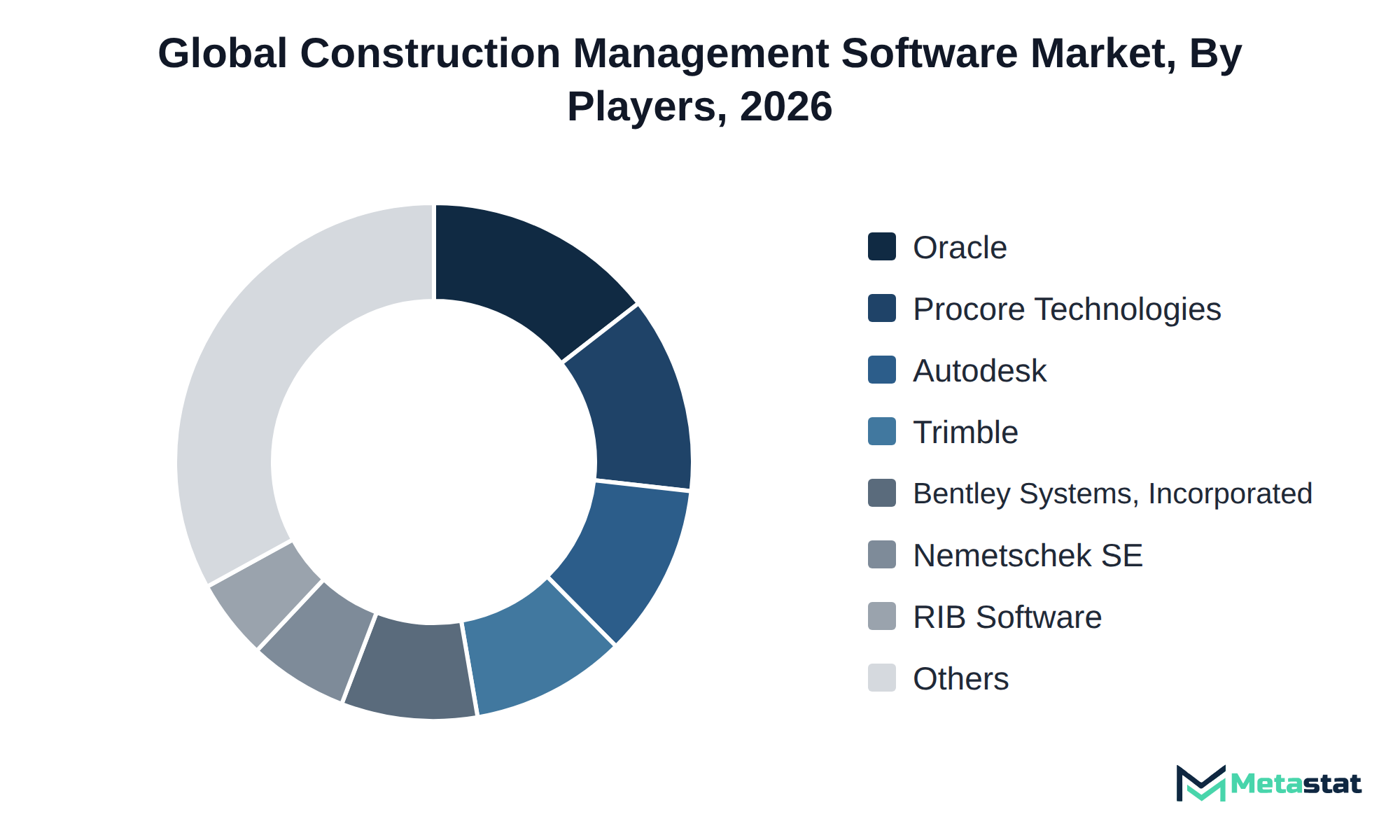
The competition within the Construction Management Software market relies on various factors including product offerings, pricing strategies, and customer support. Companies differentiate themselves through deployment models, application capabilities, and end-user targeting, allowing them to cater to specific needs within the industry.
Cloud-based solutions dominate the market, with companies like Procore Technologies, Inc. and Autodesk, Inc. focusing on developing scalable platforms that enhance project management and collaboration. On-premises solutions remain viable, particularly for organizations prioritizing data control and security, with providers like Oracle Corporation and Trimble Inc. offering tailored options in this segment.
General contractors emerge as a significant user group, with Procore Technologies, Inc. and Buildertrend Solutions, Inc. crafting solutions that streamline project planning and scheduling. Owners and developers benefit from platforms developed by firms like RIB Software GmbH, which enhance cost estimation and control. Specialty contractors find value in offerings from Hilti Corporation and InEight Inc., which provide specialized tools to manage their unique requirements.
For the Construction Management Software market to reach USD 18.3 billion by 2033, several developments will occur. The significant adoption of cloud-based deployment models will drive growth, particularly in North America, where demand from general contractors is substantial. With a projected CAGR of 12.4%, cloud solutions will enhance efficiency and collaboration in project management.
Simultaneously, growth in applications including project planning and scheduling will contribute to this expansion. The increase in investments towards residential and commercial building projects in Europe and Asia Pacific highlights this trend. However, potential risks could impede this growth trajectory. Economic fluctuations and regulatory challenges in key regions, particularly in developing markets, could slow adoption rates. The construction management software market relies on consistent investment and innovation to mitigate these risks and ensure growth through 2033.
By Deployment Model: Cloud, On-premises
By Application: Project Planning and Scheduling, Cost Estimation and Control, Document Management and Collaboration, Quality Management, Safety Management, Field Operations and Resource Management, BIM Coordination, Others (Bid and Contract Administration)
By End User: General Contractors, Owners and Developers, Specialty and Trade Contractors, Architects and Engineers, Others (Independent Construction Managers, Public Agencies)
By Construction Sector: Residential Buildings, Commercial and Institutional Buildings, Civil Infrastructure, Industrial and Energy Facilities
The report strategically identifies and profiles the key market players and analyses their core competencies in each sub-segment of the Construction Management Software market.
Report Attributes | Details |
Study Period | 2021-2033 |
Base Year | 2025 |
Estimated Year | 2026 |
Forecast Period | 2026-2033 |
Historical Period | 2021-2025 |
Growth Rate | CAGR 10.0% from 2026 to 2033 |
Revenue Unit | USD billion |
Segmentation | By Deployment Model, Application, End User, Construction Sector, and Region |
By Region | North America (By Deployment Model, Application, End User, Construction Sector, and Country)
|
Europe (By Deployment Model, Application, End User, Construction Sector, and Country)
| |
Asia Pacific (By Deployment Model, Application, End User, Construction Sector, and Country)
| |
South America (By Deployment Model, Application, End User, Construction Sector, and Country)
| |
Middle East and Africa (By Deployment Model, Application, End User, Construction Sector, and Country)
|
Find answers to common questions about this report
The Construction Management Software market size was valued at USD 8.5 billion in 2025.
The market is projected to grow at a CAGR of 10.0% during the forecast period from 2026 to 2033.
The North America Construction Management Software market size is estimated to reach USD 6.1 billion by 2033.
The leading segment in the Construction Management Software market is the Cloud deployment model, projected to reach USD 14.5 billion by 2033, significantly surpassing the On-premises segment, which is expected to reach USD 3.8 billion in the same year.
Key drivers for the Construction Management Software market include investment in cloud-based solutions, which enhances collaboration and accessibility for project teams. Rising consumer demand for new homes prompts general contractors to seek efficient management tools for streamlined project execution and cost control.
North America holds the dominant share of the Construction Management Software market, with a projected value of USD 6.1 billion in 2033, representing 35.9 percent of the total market. This figure surpasses the shares of other regions, including Europe and Asia Pacific.
Price sensitivity presents a notable restraint on market growth, as general contractors face budget constraints that hinder the uptake of advanced software solutions. Margin pressure challenges suppliers due to rising costs associated with talent acquisition and retention, impacting overall profitability.
Investment in cloud-based solutions significantly drives adoption in the Construction Management Software market, enhancing collaboration and accessibility for project teams. The integration of various project management functions into a single platform improves operational efficiencies and project transparency, promoting broader use among contractors.
The Construction Management Software market is estimated to reach a valuation of USD 18.3 billion by 2033.
Key players operating in the Construction Management Software market include Procore Technologies, Inc., Autodesk, Inc., Oracle Corporation, Trimble Inc., Bentley Systems, Incorporated, and ALICE Technologies, Inc.
The analysts below cover Professional Services research at Metastat Insights.
LEAD ANALYST
Utkarsh Khirodkar is a Lead Market Research Analyst at MetaStat Insight, specializing in market intelligence, technology sector assessments, and competitive strategy.

PRINCIPAL CONSULTANT - ENTERPRISE AI & EMERGING TECHNOLOGIES
Banking & Finance · Electronics and Semiconductor · Energy and Power · Healthcare IT · Information & Technology · Professional Services
Vijay Gunti is a Principal Consultant at MetaStat Insight, bringing over two decades of experience across enterprise digital transformation, technology strategy, and intelligent systems.

PRINCIPAL CONSULTANT - QUALITY SYSTEMS & COMPLIANCE
Electronics and Semiconductor · Machinery & Equipment · Professional Services
Omkar Phadtare is an Industry Consultant at MetaStat Insight, specializing in quality systems, regulatory compliance, and standards benchmarking to drive data-driven market intelligence and strategic industry research.

LEAD CONSULTANT - COMMUNICATION, TELECOM, AND IT
Electronics and Semiconductor · Information & Technology · Machinery & Equipment · Professional Services
Ravindra Sathe Consultants for Communication, Telecom, and IT at MetaStat Insight. He leads the firm's industry research initiatives across telecommunications infrastructure, digital connectivity, enterprise networking, and emerging information technology domains.
Our team was tracking whether regional recycling infrastructure could realistically absorb the growing volume of lithium iron phosphate batteries over the next decade. The report did a solid job separating announced hydrometallurgical plant capacity from active, permitted operational throughput. That distinction made the feedstock availability projections and regional recovery rate models far more credible than standard commercial overviews.
Tracking capacity expansion in single-use bioprocessing requires dependable data on raw material availability and cleanroom-grade polymer supply chains. The competitive landscape chapter gave a grounded evaluation of secondary component suppliers across North America and Asia-Pacific rather than simply reprinting press releases. Having that level of supplier benchmarking helped clarify dual-sourcing considerations for our clinical pipeline planning.
When evaluating distributed energy resource management systems, standard research summaries tend to gloss over the operational differences between front-of-the-meter utility deployments and behind-the-meter industrial sites. The MetaStat Insight report addressed those distinctions directly, especially regarding software interoperability standards and grid interconnection backlogs. The five-year market sizing across regional transmission organizations provided actionable context for our grid modernization strategy.
Explore related market intelligence reports worth reading alongside this one.
Starting from
$2950