
LEAD ANALYST
Utkarsh Khirodkar is a Lead Market Research Analyst at MetaStat Insight, specializing in market intelligence, technology sector assessments, and competitive strategy.

Global Enterprise Agile Transformation Services Market Size, Share, By Service Type (Agile Development and Implementation, Agile Consulting and Advisory, Agile Coaching and Training), By Methodology (Scrum, Scaled Agile Framework (SAFe), Custom Hybrid Agile, Kanban, Large-Scale Scrum (LeSS) and Others (Disciplined Agile, Extreme Programming)), By Organization Size (Large Enterprises and Small and Medium-Sized Enterprises), By End-Use Industry (IT and Telecommunications, Banking, Financial Services and Insurance, Manufacturing, Retail and E-Commerce, Healthcare and Life Sciences, Government and Public Sector, Media and Entertainment and Others (Energy, Education, Transportation)), Industry Analysis, Growth, Trends, and Forecast, 2026-2033
Report ID
MSI-5791
Published
November, 2026
Pages
276 Pages
Format
Historical
Base year
Forecast
Forecast period
Report Details
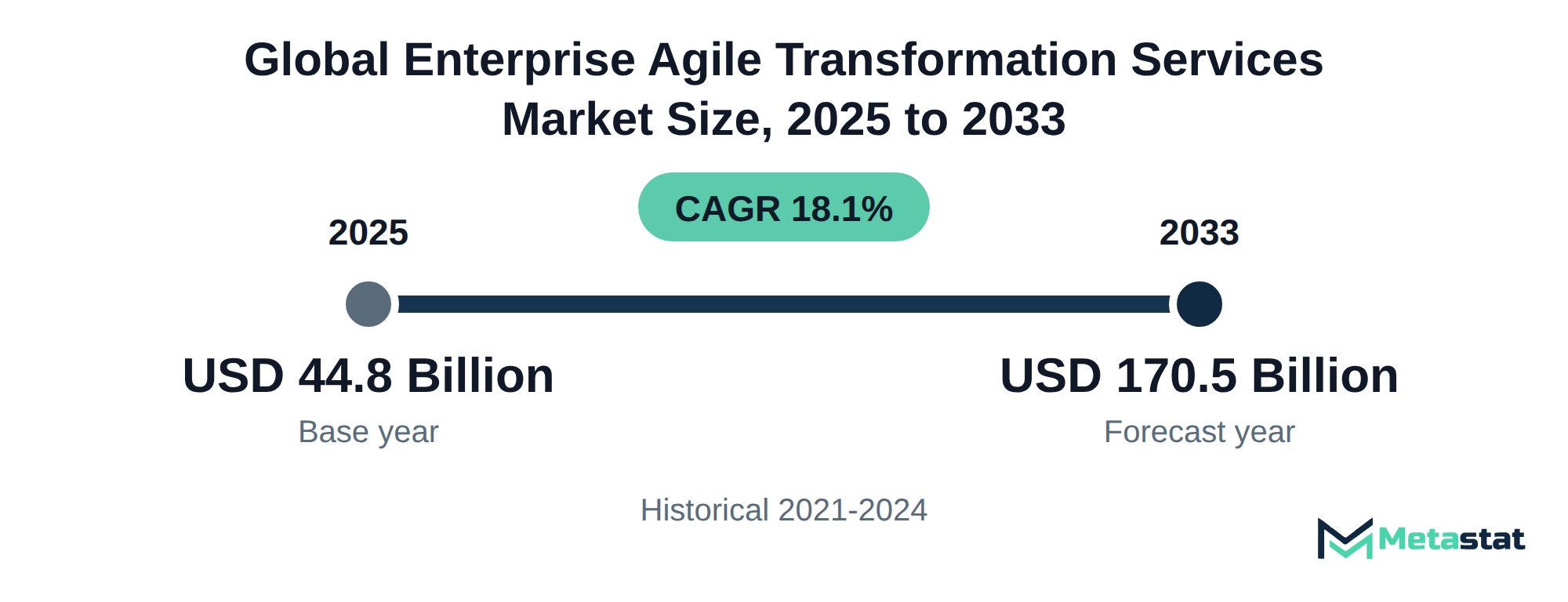
Market Valuation: Valued at $44.8 Billion in 2025, projected to reach $170.5 Billion by 2033 at a 18.1% CAGR.
Dominant Segment: Agile Development and Implementation leads the market, driven by a strong preference for practices that enable faster delivery and iterative development.
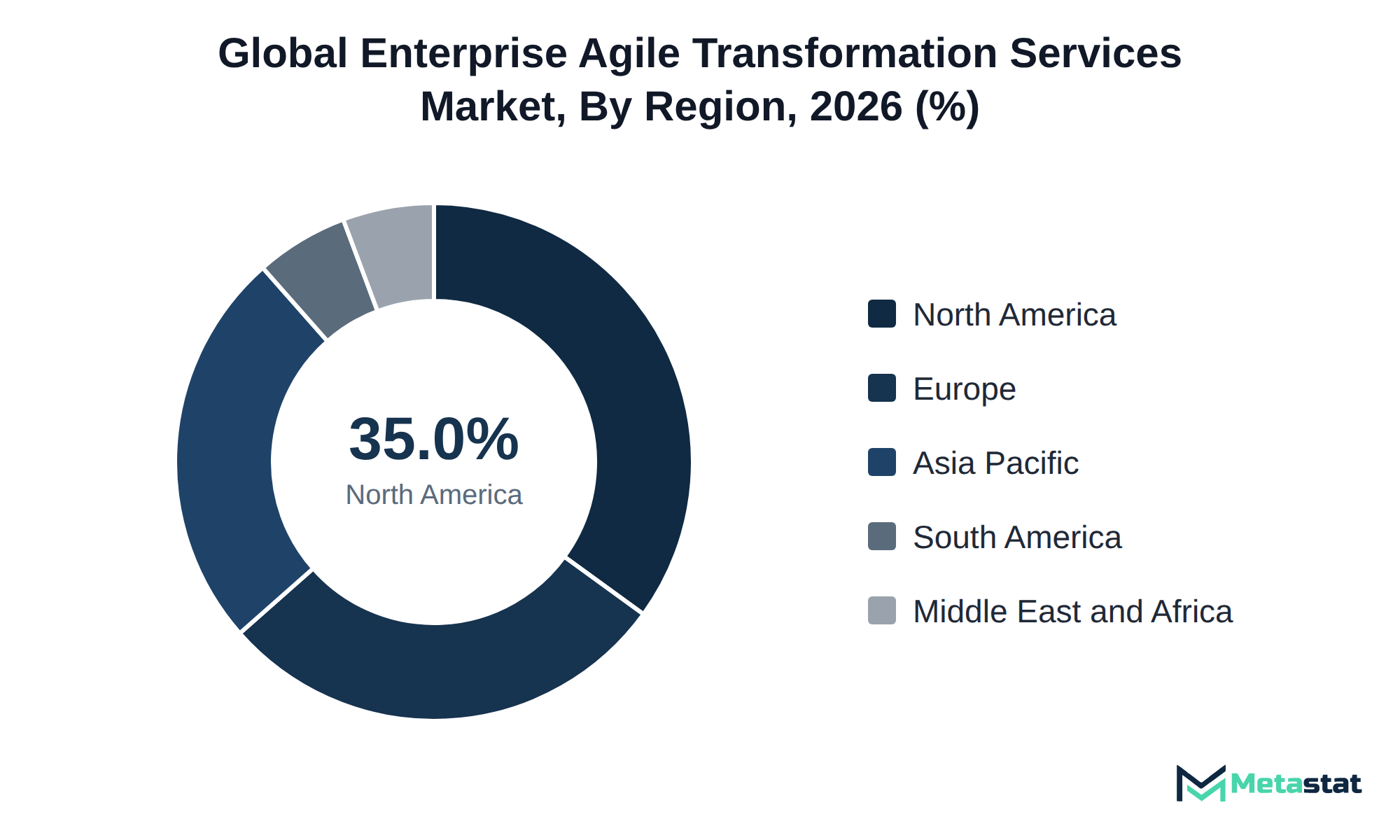
Geographic Lead: North America is the leading region, projected to hold 35.0% of the market in 2025, benefiting from robust technological infrastructure and a high concentration of firms seeking operational enhancements.
What's Inside: The report includes comprehensive competitive coverage, detailed analyses of service types, methodologies, and organization sizes, along with a forecast window extending from 2026 to 2033.
Emerging Opportunities: Small and Medium-Sized Enterprises (SMEs) are poised for significant growth, with a projected CAGR of 20% through 2033, as they increasingly recognize the value of Agile methodologies.
Market Dynamics: Key drivers of growth include increased investment in digital transformation and the rising adoption of Agile methodologies across various industries.
Choose Your License
Global Enterprise Agile Transformation Services Market
The global Enterprise Agile Transformation Services market was valued at USD 44.8 billion in 2025 and is projected to reach USD 170.5 billion by 2033, growing at a CAGR of 18.1% over the forecast period.
The Enterprise Agile Transformation Services market encompasses a range of services aimed at enhancing organizational agility through various methodologies and frameworks. Buyers invest in these services to adapt to the rapidly changing business environment and to improve operational efficiency. Key buyer groups include large enterprises and small to medium-sized businesses, driven by the need for increased responsiveness to market demands and improved project outcomes.
Growth in the market is propelled by the increasing adoption of Agile methodologies across diverse industries. The segment of Agile Development and Implementation stands out with significant value, reflecting a strong preference for practices that enable faster delivery and iterative development. North America holds 35.0% of the market in 2025, with the US leading in 2026. This region benefits from a robust technological infrastructure and a high concentration of firms seeking to enhance their operational frameworks.
Among the various factors influencing growth, the emphasis on digital transformation stands out prominently. Organizations increasingly recognize the need for Agile transformation to adopt new technologies and strengthen their competitive edge. The integration of Agile practices drives innovation and efficiency, aligning business strategies with evolving market dynamics and customer expectations.
Organizations invest in Enterprise Agile Transformation Services to enhance operational efficiency and adapt to changing market dynamics. Demand arises from the necessity to improve collaboration, increase responsiveness to customer needs, and accelerate time to market. Companies across sectors recognize the value of adopting agile methodologies to drive innovation and stay competitive as business becomes more digital.
The growth of the market is primarily fueled by rising adoption of Agile Development and Implementation services, projected to generate substantial revenue. This region benefits from robust technology infrastructure and a higher concentration of agile practices compared to other regions, contributing to its leading position in the market.
Demand for agile transformation is particularly strong among large enterprises, which seek to streamline processes and enhance project management capabilities. This trend reflects a broader shift towards agile and flexible business models across multiple industries, including IT and Telecommunications, which significantly influences spending patterns in the enterprise agile transformation sector.
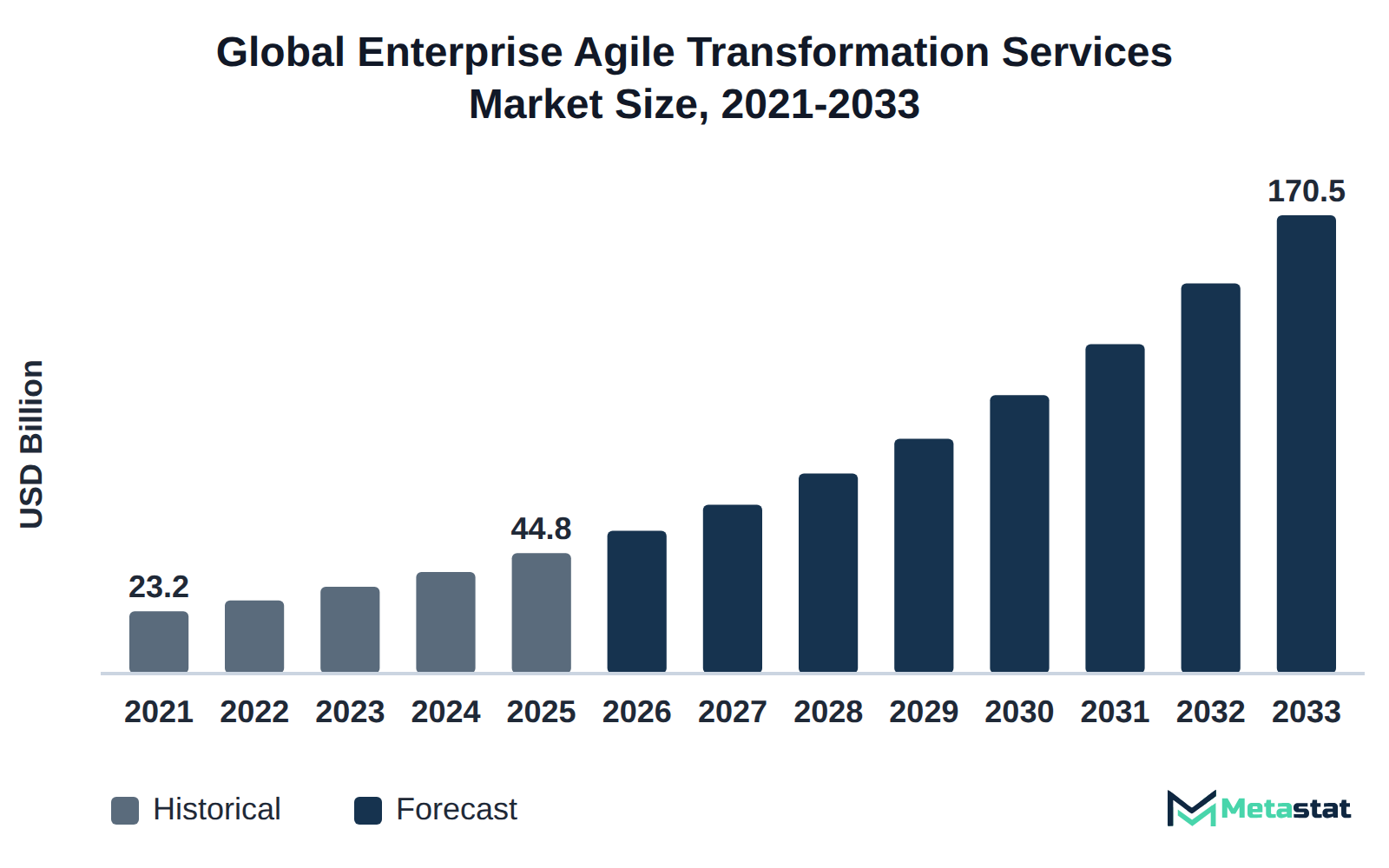
The transition from traditional project funding to product-centric funding represents a significant evolution within the Enterprise Agile Transformation Services market. This shift emphasizes the need for continuous delivery and value realization over discrete project completions. By 2033, the Agile Development and Implementation segment is projected to reach USD 85.7 billion, reflecting a compound annual growth rate (CAGR) of 18.3%. This growth highlights the increasing adoption of Agile methodologies across various sectors.
This transformation in funding models results in a greater focus on product lifecycle management, encouraging organizations to invest in ongoing product development rather than isolated projects. The adoption of Agile practices, including Scrum and the Scaled Agile Framework (SAFe), enhances collaboration and cross-functional teams, driving improved responsiveness to market demands. The Agile Consulting and Advisory segment is expected to reach USD 56.1 billion by 2033, indicating strong demand for expert guidance during this transition.
The emphasis on agile operating models promotes enhanced innovation and quicker time-to-market for new products, benefiting organizations that adopt this approach. This strategic shift enables companies to allocate resources more effectively, aligning development efforts with customer needs and market trends. Businesses positioned within the Enterprise Agile Transformation Services market are likely to experience increased competitiveness and revenue growth.
The adoption of Lean-Agile methodologies in manufacturing and operations experiences significant growth with an increasing focus on efficiency and responsiveness. Agile Development and Implementation, a key service type within the Enterprise Agile Transformation Services market, shows a projected increase from USD 26.4 billion in 2026 to USD 85.7 billion by 2033, reflecting a CAGR of 18.3%. This growth stems from manufacturers seeking to streamline processes, reduce waste, and enhance collaboration across teams.
Flexible pricing models shape how organizations engage with Agile service providers. Many firms opt for subscription-based contracts, allowing for scalability and adaptability to changing business needs. This approach encourages long-term partnerships and supports continuous improvement in operations. Organizations frequently allocate budgets for Agile Transformation Services, with large enterprises driving a substantial portion of the demand. In 2033, large enterprises are anticipated to reach USD 89.3 billion within this segment, indicating a growing commitment to Agile practices.
The focus on Lean-Agile approaches in manufacturing sets the foundation for increased competitiveness and innovation. By investing in Agile services, companies position themselves to respond swiftly to market changes, thereby gaining a significant edge in an evolving environment. The Enterprise Agile Transformation Services market offers organizations a route to stronger operational capabilities and sustained relevance in a dynamic environment.
Agile coaching enhances internal capabilities during enterprise rollouts of Agile methodologies. This coaching develops a deep understanding of Agile principles and practices within organizations, leading to better adoption rates and improved project outcomes. The Agile Coaching and Training segment in the Enterprise Agile Transformation Services market is projected to reach USD 28.6 billion by 2033, demonstrating significant growth potential.
Organizations seeking to implement Agile methodologies effectively often face challenges in aligning their teams and processes. Agile coaching addresses these issues by equipping internal teams with the skills necessary to drive the transformation independently. The IT training industry reflects a similar focus on building workforce skills. By investing in Agile coaching, firms in various sectors, including IT and Telecommunications, benefit from tailored guidance that aligns with their specific operational contexts and goals.
The increasing demand for Agile coaching reflects a broader trend toward self-sufficiency in organizations. Companies prioritizing the development of internal Agile capabilities experience enhanced agility and adaptability, leading to improved performance in dynamic markets. Emphasizing Agile coaching strengthens teams and contributes to long-term success, positioning organizations for sustained growth within the market.
Enterprises increasingly prioritize selecting an appropriate Agile scaling framework to enhance efficiency and adaptability. The Agile Consulting and Advisory segment, valued at USD 56.1 billion by 2033, highlights the growing demand for expert guidance in this area. Companies encounter various frameworks, including Scrum, Scaled Agile Framework (SAFe), and Custom Hybrid Agile, each catering to unique organizational needs.
The choice of framework often hinges on the specific characteristics of an enterprise, including size, industry, and existing processes. Large enterprises, in particular, gravitate toward frameworks like SAFe that support scaling across teams and departments. The Agile Development and Implementation segment, projected to reach USD 85.7 billion by 2033, indicates that organizations recognize the value of enabling swift project delivery and enhanced collaboration.
Ultimately, informed decisions about Agile frameworks drive operational efficiency and competitive advantage within the Enterprise Agile Transformation Services market. Organizations that align their framework selection with strategic objectives realize improved responsiveness to market changes and customer demands, supporting sustainable growth.
Enterprises are increasingly investing in Agile methodologies to enhance adaptability and responsiveness to market changes. This shift arises from the need to remain competitive in a digital landscape that is constantly changing. A significant driver of this trend includes large organizations, which allocate more resources toward Agile Development and Implementation services, reflecting a growing recognition of their benefits. The focus on digital transformation stimulates demand for Agile Consulting and Advisory services, which help organizations manage complex projects effectively. The market continues to draw heightened interest from various industries, particularly IT and Telecommunications, with businesses aiming to use Agile frameworks to improve operational efficiencies and reduce time to market.
Growing reliance on Agile methodologies transforms project execution and collaboration. This shift arises from increasing demand for faster and more efficient delivery of products and services. Organizations across various sectors, including IT and telecommunications, seek to enhance adaptability and responsiveness, driving investments in Agile frameworks. Specific approaches, including the Scaled Agile Framework (SAFe) and Scrum, promote alignment among teams and stakeholders, resulting in improved project outcomes. The Enterprise Agile Transformation Services market anticipates significant growth in Agile development and implementation, fueled by the need for organizations to remain competitive in a changing environment.
Investments in Agile consulting and advisory services strengthen enterprises' ability to adopt best practices and optimize Agile processes. The rise of remote work and distributed teams further accelerates demand for robust Agile methodologies. Distributed teams also depend on unified communications and collaboration tools to coordinate daily work. Market players focus on delivering tailored solutions that address unique organizational challenges, leading to enhanced collaboration and productivity. This competitive environment drives innovation and growth within the market as organizations pursue continuous improvement and higher performance.
The Enterprise Agile Transformation Services market faces constraints due to price sensitivity among potential buyers. Many organizations, especially small and medium-sized enterprises, hesitate to invest significantly in transformation services, leading to slower uptake and smaller orders. This reluctance arises from budgetary constraints and the perception that initial investments do not yield immediate returns. Consequently, several enterprises delay necessary replacements or enhancements to their Agile practices, opting for more cost-effective solutions in the short term. The market's pricing strategies become critical, with organizations seeking assurance that investments translate into tangible improvements in efficiency and productivity. Firms in the banking, financial services, and insurance sectors demonstrate caution in committing to larger budgets for transformation services. This cautious approach affects overall market growth and stifles innovation within Agile methodologies, ultimately limiting the potential for widespread adoption.
Talent shortages represent a significant challenge in the Enterprise Agile Transformation Services market. The demand for skilled professionals in Agile methodologies outpaces supply, resulting in heightened recruitment and staffing costs. This situation pressures service providers to enhance compensation packages and benefits to attract qualified talent, thereby impacting operational margins. Organizations are adapting by investing in training and development programs to upskill existing employees and retain talent. By creating a culture of continuous learning, companies aim to mitigate reliance on external hiring while ensuring sufficient expertise in delivering Agile transformation services. This approach addresses immediate talent shortages and supports long-term growth and innovation within the market. Service providers navigating these challenges find ways to balance costs while maintaining quality and responsiveness, which is essential for sustaining competitive advantage.
Small and Medium-Sized Enterprises (SMEs) represent a significant growth opportunity within the market, driven by increasing investments in Agile methodologies. The segment is projected to achieve a compound annual growth rate (CAGR) of 20% through 2033, indicating strong demand for Agile Transformation Services tailored to the unique needs of SMEs. These organizations require flexible and cost-effective solutions to enhance operational efficiency and adaptability in competitive environments.
SMEs often operate with limited resources, and Agile Consulting and Advisory services provide essential insights and frameworks that facilitate efficient implementation. This accessibility and support allow smaller organizations to utilize Agile approaches effectively. The anticipated expansion in this segment highlights the importance of addressing the specific challenges faced by SMEs to realize their full potential in the evolving digital landscape.
The Global Enterprise Agile Transformation Services market is segmented based on Service Type, Methodology, Organization Size, and End-Use Industry.
This segment primarily serves organizations seeking to enhance their software development processes, enabling rapid delivery and flexibility in response to changing business requirements. The push for faster time-to-market and improved collaboration between IT and business units drives demand for Agile Development and Implementation services. Compared to other service types in the market, this segment experiences higher growth, fueled by the increasing adoption of Agile methodologies across varied industries. While Agile Consulting and Advisory services emphasize strategic guidance, Agile Development and Implementation focuses on practical application, appealing to organizations seeking immediate results.
Agile Consulting and Advisory segment is estimated to reach USD 56.1 billion by 2033, at a CAGR of 17.5% during the forecast period. This segment provides strategic guidance on implementing Agile methodologies, enabling organizations to improve efficiency and adaptability in their processes. This advisory work forms part of the wider management consulting services industry. Primarily used by larger enterprises and organizations undergoing digital transformation, Agile consulting helps align teams, optimize workflows, and promote a culture of continuous improvement. The growing demand for enhanced operational agility drives this segment, with companies seeking expertise to navigate complex Agile transformations. Compared to Agile Development and Implementation services, this segment experiences slower growth, reflecting the more strategic nature of consulting engagements. While Agile Development focuses on hands-on implementation, Agile Consulting and Advisory emphasizes planning and strategy, catering to clients seeking tailored solutions to their unique challenges. The market continues to evolve with firms investing in advisory services to apply Agile methodologies effectively.
This segment focuses on enhancing the skills and knowledge of teams and individuals in Agile methodologies, facilitating their ability to implement Agile principles effectively. Organizations across various sectors, including IT, manufacturing, and retail, engage this segment to improve their project management and delivery capabilities. Demand for Agile Coaching and Training experiences growth driven by the increasing adoption of Agile frameworks, including Scrum and SAFe, which promote continuous improvement and adaptive planning. Compared to other service types, including Agile Development and Implementation, this segment shows a moderate growth rate, reflecting a growing emphasis on workforce development. The CAGR for Agile Coaching and Training is expected to match broader market trends, indicating strategic investments in human capital to support Agile practices.
Scrum segment is valued at USD 18.5 billion in 2026 and is projected to reach USD 55.4 billion by 2033, at a CAGR of 17% during the forecast period. This methodology primarily serves teams looking to implement Agile practices, enhancing project management efficiency and team collaboration. Demand for Scrum is driven by organizations aiming to accelerate project delivery and improve flexibility in responding to changes. Compared to other methodologies, including the Scaled Agile Framework (SAFe), which is anticipated to grow at a CAGR of 18.7%, Scrum experiences slightly slower growth. However, its widespread adoption among small and medium-sized enterprises (SMEs) provides a solid foundation for future expansion. While the Agile Consulting and Advisory segment focuses on strategy development, Scrum emphasizes practical execution, differentiating itself in terms of operational application and approach. The growth of the Scrum segment highlights its significance in the broader context of the Enterprise Agile Transformation Services market.
Scaled Agile Framework (SAFe) segment is estimated to reach USD 42.8 billion by 2033, at a CAGR of 18.7% during the forecast period. This methodology focuses on aligning complex organizations around Agile principles, enabling teams to deliver solutions in a more efficient manner. Primarily adopted by large enterprises seeking to enhance productivity and responsiveness, this segment continues to expand due to increasing demands for improved project coordination. The growth of the segment outpaces others within its group, driven by a strong emphasis on effective scaling practices. Compared to Agile Development and Implementation, which targets USD 85.7 billion by 2033 at a CAGR of 18.3%, SAFe offers a structured approach that appeals to enterprises requiring comprehensive frameworks for large-scale projects. Organizations increasingly adopt SAFe, leading to rising demand for specialized training and certification programs, influencing market dynamics significantly.
Custom Hybrid Agile segment is expected to reach USD 31.4 billion by 2033. This methodology combines elements from various Agile frameworks, allowing organizations to tailor their approach based on specific needs and project requirements. Custom Hybrid Agile serves diverse industries seeking flexibility while implementing Agile principles. Demand for this segment is driven by the necessity for businesses to adapt quickly to changing environments while ensuring efficient project delivery. Compared to other methodologies, Custom Hybrid Agile experiences a median growth rate, appealing to organizations that require a unique blend of Agile strategies. The segment's approach contrasts with more rigid frameworks, emphasizing a customized path to agility that aligns with the operational goals of companies across sectors. Organizations pursuing this method benefit from improved collaboration and increased responsiveness to market dynamics, enhancing their competitive advantage in the market.
Kanban segment is projected to grow at a CAGR of 17.7% during the forecast period. This methodology is used for visualizing workflows and enhancing process efficiency, appealing to organizations aiming to optimize their production and operational processes. Enterprises in various sectors, including IT and telecommunications, use Kanban to improve team collaboration and productivity. Key demand drivers include the increasing need for streamlined processes and real-time visibility into work progress. Compared to other methodologies, Kanban offers more flexibility, allowing teams to adjust workflows dynamically. The focus on continuous delivery and minimizing work in progress distinguishes Kanban from frameworks including Scrum, which emphasizes structured iterations. This variability permits organizations to adopt Kanban at their own pace, enabling a more gradual transformation within the broader Enterprise Agile Transformation Services market.
Large-Scale Scrum (LeSS) is a scaling framework aimed at enabling multiple teams to collaborate on complex project deliverables. Large organizations that require coordinated efforts across various teams apply this methodology. A significant force driving demand in this segment involves the increasing complexity of projects, which necessitates structured frameworks for effective team collaboration. Enterprises prioritize LeSS for its ability to maintain agility while managing larger teams and projects, differentiating it from other methodologies that focus on single teams or smaller scopes. The emphasis on streamlined processes and accountability supports improved delivery timelines, ensuring that organizations remain competitive. The Enterprise Agile Transformation Services market experiences growth through the adoption of methodologies like LeSS, reflecting a shift toward more collaborative and cross-functional operational strategies.
Others, including Disciplined Agile and Extreme Programming methodologies, focus on providing alternative approaches to Agile practices, emphasizing adaptability and tailored solutions. These methodologies support various organizations seeking to implement Agile principles with flexibility in mind, particularly in industries like IT and telecommunications. Demand for these methodologies is driven by the need for organizations to address unique challenges and project requirements that standard frameworks do not fully satisfy. Compared to more established segments, this sub-segment experiences slower growth, as enterprises often gravitate toward widely recognized frameworks including Scrum and SAFe, which provide more structured and widely accepted practices. The Enterprise Agile Transformation Services market continues to evolve to accommodate diverse methodologies, catering to the varying needs of its buyers, thereby enhancing overall market dynamism.
Large Enterprises segment is valued at USD 30.4 billion in 2026 and is projected to reach USD 89.3 billion by 2033, at a CAGR of 16.6% during the forecast period. This segment primarily serves large organizations focused on implementing Agile practices to increase operational efficiency and improve project outcomes. Key drivers include the growing demand for enhanced agility in project management, enabling these enterprises to respond quickly to market changes. The segment distinguishes itself from Small and Medium-Sized Enterprises due to its larger scale of investment and more complex implementation processes. While other segments, including Agile Development and Implementation, experience rapid growth, this segment shows steady expansion driven by established budgets and long-term strategic planning. Ultimately, the increasing need for sophisticated collaboration and project management tools significantly influences the growth trajectory of the segment, positioning it for continued success in the Enterprise Agile Transformation Services market.
Small and Medium-Sized Enterprises segment is estimated to reach USD 81.2 billion by 2033, at a CAGR of 20% during the forecast period. This segment focuses on delivering Agile transformation services tailored to smaller organizations, which seek to enhance operational efficiency and agility. Factors driving demand include the increasing recognition of Agile methodologies as effective tools for improving project outcomes and responsiveness to market dynamics. Compared to larger enterprises, SMEs typically operate with tighter budgets, influencing their purchasing decisions and leading to greater sensitivity toward pricing. This segment exhibits faster growth than its counterparts, reflecting an expanding awareness of the benefits Agile practices bring to smaller organizations aiming for competitive advantage. The Enterprise Agile Transformation Services market continues to evolve, supporting these enterprises in their pursuit of flexible and efficient operational frameworks.
The IT and Telecommunications segment is valued at USD 15.4 billion in 2026 and is projected to reach USD 47.1 billion by 2033, at a CAGR of 17.3% during the forecast period. This segment serves organizations focused on technology development, network infrastructure, and telecommunications services, leveraging Agile methodologies to enhance project delivery and responsiveness to customer needs. Key growth drivers include increasing demand for rapid software deployment and digital transformation, with businesses aiming to remain competitive in a changing environment. Compared to other segments, this sector exhibits faster growth, highlighting the urgency for IT and telecommunications companies to adopt Agile practices. Investment in Agile Consulting and Advisory services becomes crucial for these firms to navigate complex project requirements and improve operational efficiency through enhanced collaboration and adaptability.
Banking, Financial Services and Insurance segment is estimated to reach USD 34.8 billion by 2033, at a CAGR of 17.4% during the forecast period. This segment serves various institutions including banks, insurance companies, and financial service providers, focusing on enhancing operational efficiency and customer engagement through Agile methodologies. Increasing regulatory requirements drive the need for Agile transformation, allowing firms to adapt quickly to changing regulations and market dynamics. RegTech solutions address similar regulatory requirements from a technology angle. Compared to other segments, this one exhibits significant growth due to the high demand for digital transformation in finance. Firms adopting Agile practices respond more effectively to customer needs and regulatory changes, distinguishing this segment from others experiencing different growth rates and challenges. The market continues to evolve rapidly, emphasizing the importance of Agile strategies in maintaining competitiveness.
The manufacturing segment is expected to reach USD 24.5 billion by 2033. This segment focuses on implementing Agile methodologies to enhance productivity, reduce lead times, and improve product quality in manufacturing processes. Key players within this segment include large manufacturing firms that adopt Agile practices to enhance their operational efficiency. Increasing demand for faster production and the need for flexibility in responding to market changes drive growth in this sector. Unlike other segments, including IT and telecommunications, manufacturing experiences a distinct operational environment characterized by complex supply chains and stringent quality controls. The CAGR of 17.3% for this segment reflects strong adoption of Agile principles tailored to the unique challenges manufacturers face. The Enterprise Agile Transformation Services market supports this transformation, enabling manufacturers to remain competitive in an evolving industry.
The Retail and E-Commerce segment is projected to grow at a CAGR of 18.5% during the forecast period. This segment is employed by online retailers and e-commerce platforms to enhance operational efficiency and customer engagement. The increasing demand for effective digital shopping experiences drives growth within this segment, reflecting a broader trend toward digital transformation in the retail sector. Retailers also invest in e-commerce personalization software to tailor these shopping experiences to individual customers. Companies in this space pursue Agile methodologies to adapt quickly to market changes, ensuring quicker response times to consumer preferences. Compared to other segments, the Retail and E-Commerce sector experiences faster growth due to the rising number of online consumers and the continuous evolution of technology shaping shopping behaviors. With a growing emphasis on customer-centric practices, organizations seek ways to implement Agile practices that streamline operations and improve service delivery. Investment in Agile transformation services provides a competitive edge in an increasingly crowded market.
Healthcare and Life Sciences encompasses services aimed at enhancing operational efficiency and patient care through Agile methodologies. Organizations within this segment, including hospitals, pharmaceutical companies, and healthcare providers, employ these services to streamline processes, improve project management, and enhance responsiveness to patient needs. Demand in this segment is influenced by the increasing emphasis on digital transformation and the need for improved collaboration across multidisciplinary teams. Unlike other segments, the Healthcare and Life Sciences sector often faces stringent regulations that impact adoption rates, leading to a more cautious approach compared to sectors including IT and Telecommunications. The segment's growth trajectory is characterized by tailored approaches, focusing on compliance and quality assurance, differentiating it from other Agile implementations in the market.
Government and Public Sector entities incorporate Agile Transformation Services to enhance operational efficiency and responsiveness. These services enable organizations to adapt to changing regulations and public demands while improving service delivery. The segment primarily caters to government agencies, public institutions, and non-profit organizations seeking to implement Agile methodologies for project management and service execution. Agencies seeking outside guidance on such programs can draw on public sector consulting and advisory services. Key drivers include increasing pressure for transparency and efficiency in public spending, alongside the growing need for digital transformation. Compared to other segments, the Government and Public Sector segment experiences slower growth due to budget constraints and bureaucratic decision-making processes. Adoption of Agile practices in this sector often faces additional challenges related to legacy systems and workforce training, limiting the pace of transformation compared to sectors including IT and Telecommunications. The Enterprise Agile Transformation Services market reflects a diverse landscape, with various industry players focusing on tailored solutions for government clients.
The Media and Entertainment segment focuses on delivering agile methodologies tailored to the unique demands of content creation and distribution. This segment finds extensive application in film production, broadcasting, and digital streaming services. Companies within this sector leverage agile transformation to enhance collaboration, accelerate project delivery, and improve adaptability to changing market trends. Growing consumer expectations for high-quality, on-demand content drive the demand for agile practices, resulting in innovation and responsiveness in service delivery. Unlike sectors including IT and Telecommunications, which exhibit a higher growth rate, the Media and Entertainment segment faces unique challenges including fluctuating audience preferences and technological advancements that require continuous adjustment. This segment emphasizes creative processes and cross-functional teams, distinguishing it from more traditional agile implementations.
This segment encompasses industries including energy, education, and transportation that leverage Agile methodologies to enhance project delivery and operational efficiency. Companies within these sectors adopt Agile practices to respond to rapid changes and improve collaboration among teams. The increasing demand for efficient project management drives growth in this segment, especially in a landscape where innovation and responsiveness are critical. Unlike IT and Telecommunications, which experience strong growth, this segment reflects varied adoption rates across industries. While several organizations in energy and education adopt Agile practices to streamline processes, others remain hesitant due to traditional structures. The overall trend of digital transformation supports the momentum of Agile practices, making them increasingly relevant in sectors prioritizing efficiency and adaptability.
Based on geography, the Global Enterprise Agile Transformation Services market is divided into North America, Europe, Asia-Pacific, South America, Middle East, and Africa.
Demand for Enterprise Agile Transformation Services in North America reflects strong growth driven by the high presence of technology firms and financial institutions. The United States, Canada, and Mexico remain key players, with substantial investments in digital transformation initiatives. Regulatory frameworks supporting innovation in these countries enhance the adoption of agile practices across various sectors. By the end of 2033, North America is projected to reach USD 55.4 billion, accounting for 35.0% of the global market after holding a 35.0% share in 2025. The ongoing emphasis on enhancing operational efficiencies and responsiveness significantly impacts organizations' operational strategies, particularly in IT and telecommunications, banking, financial services, and insurance. The market in North America is characterized by a competitive ecosystem, with numerous service providers focused on delivering tailored agile solutions.
Demand for Enterprise Agile Transformation Services in Europe stems primarily from the IT and Telecommunications, Banking, Financial Services and Insurance, and Manufacturing sectors. Countries like Germany, France, the UK, Italy, and Spain exhibit significant investments in agile methodologies to enhance operational flexibility and project delivery. The region's share of the global market in 2025 stands at 28.5%, reflecting robust interest in agile practices. Ongoing digital transformation initiatives within European enterprises drive spending on agile consulting and implementation services. Regulatory frameworks in the region promote innovation and adaptability, facilitating growth within the market. Rising adoption of agile practices creates a dynamic environment for service providers and increases competition among them.
The Asia-Pacific region accounts for 25.0% of the global market in 2025. Demand arises primarily from industries including IT and Telecommunications, and Banking, Financial Services and Insurance, which increasingly adopt agile methodologies for improved operational efficiency. In China and India, rapid technological advancements and a growing emphasis on digital transformation drive the need for Enterprise Agile Transformation Services. The increasing adoption of Agile practices across Small and Medium-Sized Enterprises fuels growth within the region. The robust increase in agile consulting, coaching, and training initiatives highlights a strong commitment to enhancing project delivery and organizational adaptability. By 2033, the market is projected to expand further, driven by evolving business needs and a focus on agile frameworks.
The South American market for Enterprise Agile Transformation Services shows significant potential for growth, particularly in Brazil and Argentina. The increasing focus on digital transformation across various sectors drives demand for agile methodologies. Organizations seek to enhance operational efficiencies and responsiveness to market changes, leading to a growing interest in agile coaching and consulting services. The market in this region is characterized by limited adoption of advanced technological infrastructure, which impacts the pace of growth. Nevertheless, the value of the market in South America is expected to reach USD 170.5 billion by 2033. The integration of agile practices within industries including IT and telecommunications and banking highlights the evolving needs of companies striving to remain competitive in a challenging economic environment.
In the Middle East and Africa, the market experiences a steady increase in demand driven by the IT and Telecommunications sector, particularly within Saudi Arabia and the UAE. Key players in these countries focus on implementing Agile methodologies to enhance project delivery and operational efficiency. South Africa contributes to growth in this market, with both public and private sectors investing in Agile Transformation Services to improve responsiveness and adaptability to changing market conditions. A share of 5.7% of the global market in 2025 highlights the region's growing importance. The engagement of organizations in adopting Agile frameworks reflects increasing recognition of the value of flexibility and collaboration in project management. The Enterprise Agile Transformation Services market is expected to expand as companies seek to remain competitive in the evolving digital landscape.
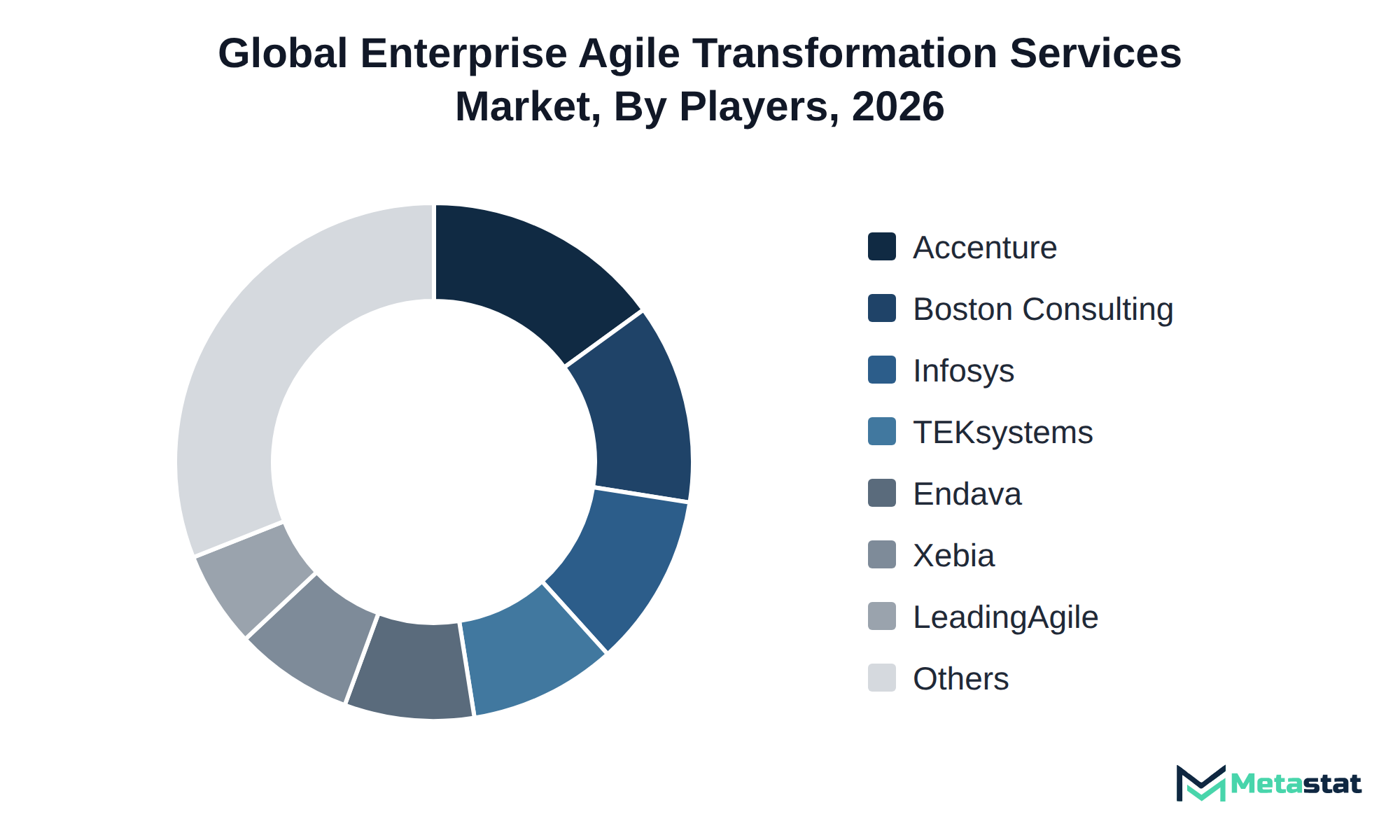
The Enterprise Agile Transformation Services market features a diverse competitive landscape, with firms competing primarily through service type, methodology, and organizational size. Companies focus on delivering tailored solutions that meet the specific needs of their clients, emphasizing factors including pricing, certification, and customization.
A group of companies, including Accenture plc and Boston Consulting Group, emphasizes Agile Consulting and Advisory services, leveraging their expertise to guide organizations in adopting Agile methodologies. Other firms, including Xebia and LeadingAgile, specialize in Agile Development and Implementation, focusing on practical execution and integration of Agile practices into client operations.
In the domain of Agile Coaching and Training, organizations like Scrum.org and agile42 prioritize enhancing team capabilities and promoting a culture of continuous improvement. These companies position themselves to support clients through Agile transformation, with a focus on operational excellence and improved project outcomes.
The growth of the Enterprise Agile Transformation Services market relies on several key developments. Strong demand for Agile Consulting and Advisory services, with a forecast value of USD 56.1 billion by 2033, will drive revenue growth. Lastly, rising uptake of Agile methodologies, particularly the Scaled Agile Framework (SAFe), is expected to lift that framework's segment to USD 42.8 billion by 2033, strengthening the overall market. However, the main risk that could impede growth involves economic downturns impacting corporate investments in Agile transformation initiatives, particularly in regions including Europe and South America, where economic stability influences technology spending. Addressing these challenges while maximizing opportunities from emerging markets will shape the trajectory of the market, ensuring sustainable growth in the coming years.
By Service Type: Agile Development and Implementation, Agile Consulting and Advisory, Agile Coaching and Training
By Methodology: Scrum, Scaled Agile Framework (SAFe), Custom Hybrid Agile, Kanban, Large-Scale Scrum (LeSS), Others (Disciplined Agile, Extreme Programming)
By Organization Size: Large Enterprises, Small and Medium-Sized Enterprises
By End-Use Industry: IT and Telecommunications, Banking, Financial Services and Insurance, Manufacturing, Retail and E-Commerce, Healthcare and Life Sciences, Government and Public Sector, Media and Entertainment, Others (Energy, Education, Transportation)
The report strategically identifies and profiles the key market players and analyses their core competencies in each sub-segment of the Enterprise Agile Transformation Services market.
Report Attributes | Details |
Study Period | 2021-2033 |
Base Year | 2025 |
Estimated Year | 2026 |
Forecast Period | 2026-2033 |
Historical Period | 2021-2025 |
Growth Rate | CAGR 18.1% from 2026 to 2033 |
Revenue Unit | USD billion |
Segmentation | By Service Type, Methodology, Organization Size, End-Use Industry, and Region |
By Region | North America (By Service Type, Methodology, Organization Size, End-Use Industry, and Country)
|
Europe (By Service Type, Methodology, Organization Size, End-Use Industry, and Country)
| |
Asia Pacific (By Service Type, Methodology, Organization Size, End-Use Industry, and Country)
| |
South America (By Service Type, Methodology, Organization Size, End-Use Industry, and Country)
| |
Middle East and Africa (By Service Type, Methodology, Organization Size, End-Use Industry, and Country)
|
Find answers to common questions about this report
The Enterprise Agile Transformation Services market size was valued at USD 44.8 billion in 2025.
The market is projected to grow at a CAGR of 18.1% during the forecast period from 2026 to 2033.
The North America Enterprise Agile Transformation Services market size is projected to reach USD 55.4 billion by 2033.
Agile Development and Implementation leads the Enterprise Agile Transformation Services market, with a projected value of USD 85.7 billion by 2033. This segment outpaces others in growth potential, reflecting a compound annual growth rate of 18.3%.
Increasing investments in Agile methodologies by large organizations drive the market's growth. the rising demand for faster and more efficient delivery of products and services enhances adaptability and responsiveness across various sectors.
North America holds the dominant share of the Enterprise Agile Transformation Services market, accounting for 35 percent of the total market in 2025. This region's significant share reflects its advanced adoption of agile methodologies across various industries.
Price sensitivity among potential buyers restrains market growth, as many organizations, especially small and medium-sized enterprises, hesitate to invest significantly in transformation services. Talent shortages create a challenge, leading to heightened recruitment costs and impacting operational margins for service providers.
Growing investments in Agile methodologies among Small and Medium-Sized Enterprises (SMEs) create significant adoption opportunities. The segment is projected to expand at a compound annual growth rate (CAGR) of 20% through 2033, driven by the demand for flexible and cost-effective solutions that enhance operational efficiency.
The Enterprise Agile Transformation Services market is estimated to reach a valuation of USD 170.5 billion by 2033.
Key players operating in the Enterprise Agile Transformation Services market include Xebia, Boston Consulting Group, Accenture plc, Endava plc, LeadingAgile, and Scrum.org.
The analysts below cover Professional Services research at Metastat Insights.
LEAD ANALYST
Utkarsh Khirodkar is a Lead Market Research Analyst at MetaStat Insight, specializing in market intelligence, technology sector assessments, and competitive strategy.

PRINCIPAL CONSULTANT - ENTERPRISE AI & EMERGING TECHNOLOGIES
Banking & Finance · Electronics and Semiconductor · Energy and Power · Healthcare IT · Information & Technology · Professional Services
Vijay Gunti is a Principal Consultant at MetaStat Insight, bringing over two decades of experience across enterprise digital transformation, technology strategy, and intelligent systems.

PRINCIPAL CONSULTANT - QUALITY SYSTEMS & COMPLIANCE
Electronics and Semiconductor · Machinery & Equipment · Professional Services
Omkar Phadtare is an Industry Consultant at MetaStat Insight, specializing in quality systems, regulatory compliance, and standards benchmarking to drive data-driven market intelligence and strategic industry research.

LEAD CONSULTANT - COMMUNICATION, TELECOM, AND IT
Electronics and Semiconductor · Information & Technology · Machinery & Equipment · Professional Services
Ravindra Sathe Consultants for Communication, Telecom, and IT at MetaStat Insight. He leads the firm's industry research initiatives across telecommunications infrastructure, digital connectivity, enterprise networking, and emerging information technology domains.
Assessing commercial microgrid software adoption requires looking past top-level installation numbers and examining utility interconnection queues. The research provided verifiable data on average permitting timelines, tariff structures, and battery storage integration costs across regional utility territories. That grounded perspective was valuable for our team when building five-year demand projections for industrial microgrid controllers.
Ambulatory surgical centers have very different purchasing cycles for robotic-assisted surgery platforms than major hospital networks. The MetaStat Insight study focused squarely on capital expenditure depreciation, procedural reimbursement pathways, and surgeon training overhead. That operational clarity made it much simpler to validate multi-year procedure growth forecasts against actual ambulatory center adoption patterns.
When planning edge sensor rollouts across refinery environments, generic IoT reports typically miss the harsh-environment certification bottlenecks. MetaStat Insight gave an objective evaluation of ATEX and Class 1 Division 2 hardware availability, along with realistic five-year maintenance cycle cost projections. The comparison of wireless mesh versus private cellular backhaul helped our team pressure-test network reliability models for remote processing facilities.
Explore related market intelligence reports worth reading alongside this one.