
LEAD ANALYST
Utkarsh Khirodkar is a Lead Market Research Analyst at MetaStat Insight, specializing in market intelligence, technology sector assessments, and competitive strategy.

Global E-commerce Personalization Software Market Size, Share, By Application (Product Recommendations, Search Personalization, Content Personalization and Offer Personalization), By Deployment Model (Cloud-Based and On-Premises), By Organization Size (Large Enterprises and Small and Medium Enterprises), By End-Use Industry (Fashion and Apparel, Consumer Electronics, Food and Grocery, Beauty and Personal Care, Home and Furniture, Sports and Outdoor Goods and Others), Industry Analysis, Growth, Trends, and Forecast, 2026-2033
Report ID
MSI-5557
Published
October, 2026
Pages
302 Pages
Format
Historical
Base year
Forecast
Forecast period
Report Details
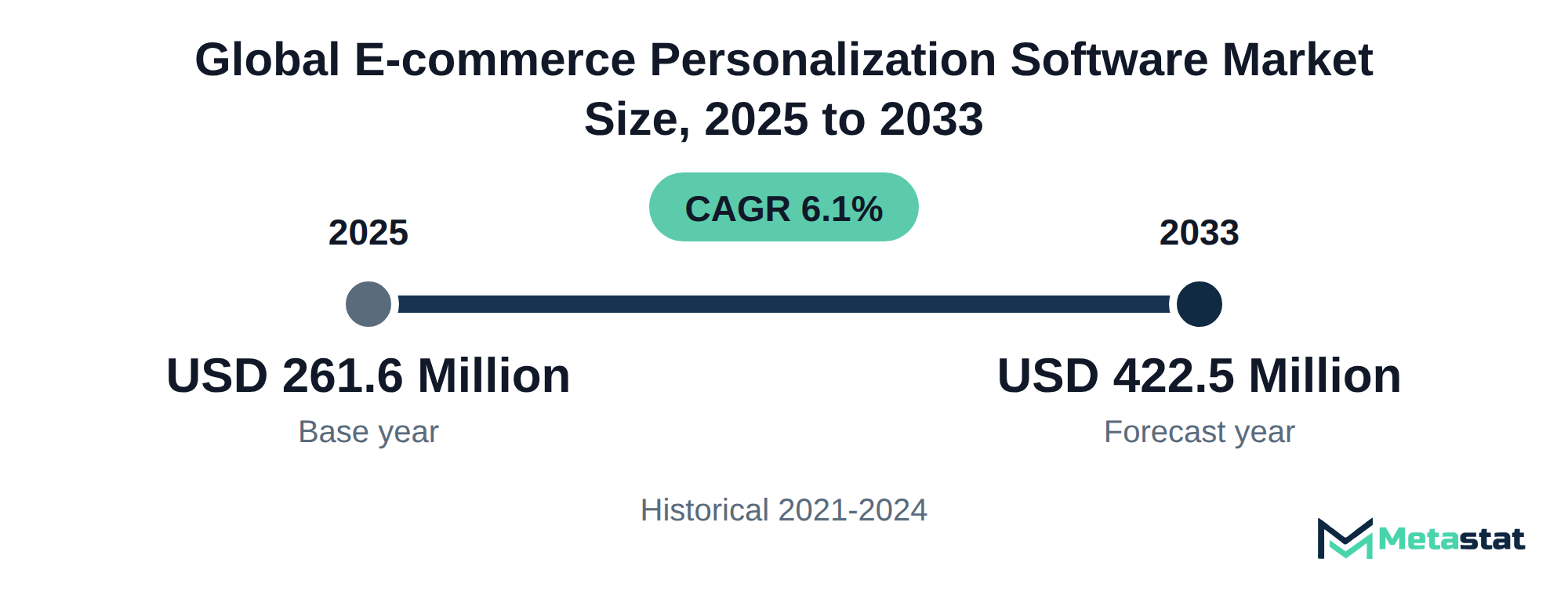
Market Valuation: Valued at $261.6 Million in 2025, projected to reach $422.5 Million by 2033 at a 6.1% CAGR.
Dominant Segment: Product Recommendations lead the market, driven by strong consumer preference for personalized suggestions that enhance shopping experiences.
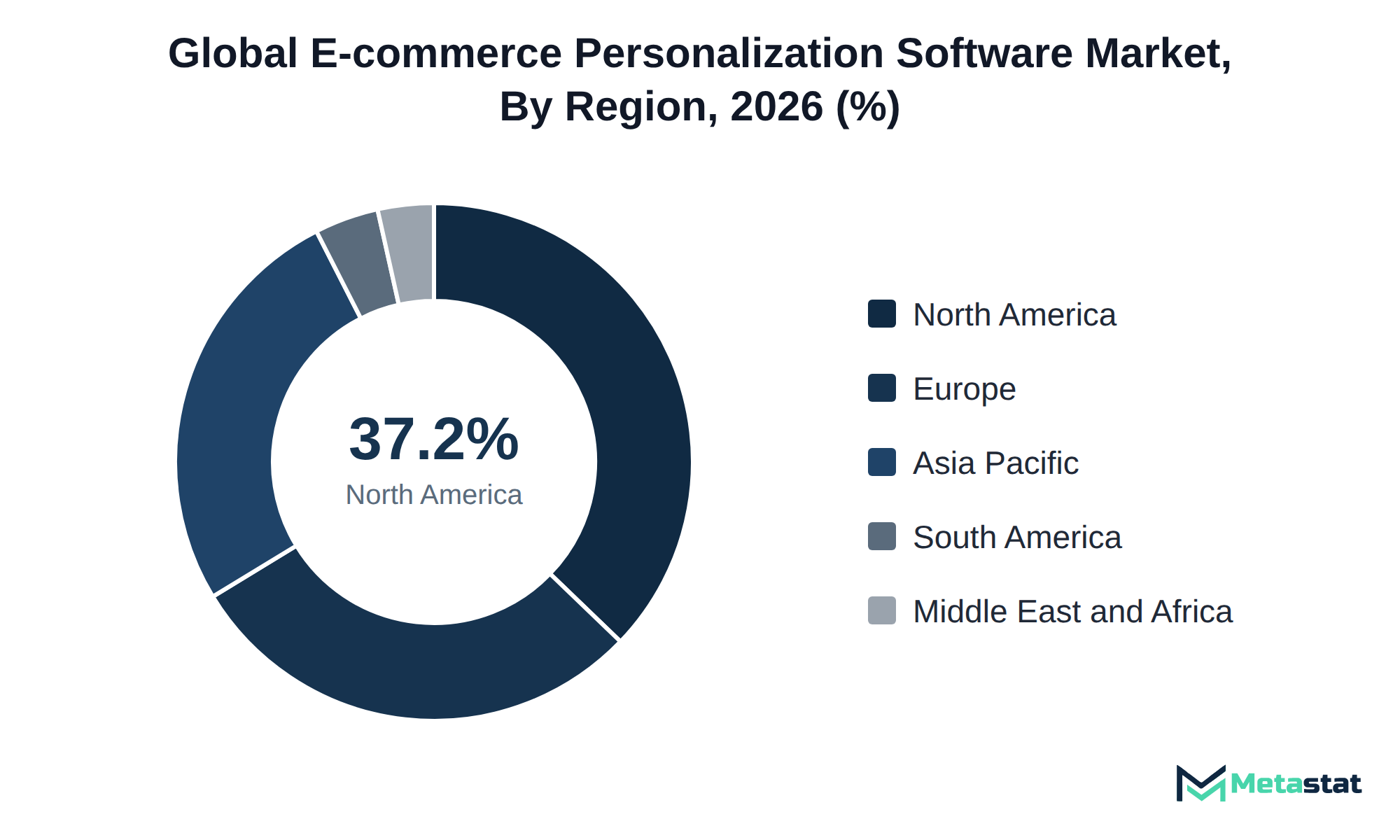
Geographic Lead: North America holds the largest market share at 37.2% in 2025, with the US projected to continue leading due to high demand for personalized shopping solutions.
What's Inside: The report provides comprehensive coverage of market dynamics, competitive landscape, and detailed segment analyses across various applications and deployment models.
Emerging Trends: The shift towards cloud-based deployment models is accelerating, offering businesses greater flexibility and scalability in implementing personalization strategies.
Growth Opportunities: The Fashion and Apparel segment is poised for significant growth, with a projected CAGR of 5.2%, reflecting the increasing demand for tailored shopping experiences.
Choose Your License
Global E-commerce Personalization Software Market
The global E-commerce Personalization Software market was valued at USD 261.6 million in 2025 and is projected to reach USD 422.5 million by 2033, growing at a CAGR of 6.1% over the forecast period.
The E-commerce Personalization Software market encompasses solutions that enhance online shopping experiences through tailored recommendations, personalized content, and targeted promotions. Buyers invest in these solutions to improve customer engagement and drive sales growth. Market participants include large enterprises and small to medium-sized businesses across various industries, each using personalization strategies to meet changing consumer expectations.
Growth in the market is primarily driven by increasing demand for personalized shopping experiences and the necessity for businesses to differentiate themselves in a competitive landscape. Among the diverse segments, Product Recommendations holds the largest value, reflecting strong consumer preference for customized suggestions. North America holds 37.2% of the market in 2025, with the US leading in 2026.
Companies focus on expanding their capabilities in cloud-based deployment models, which offer greater flexibility and scalability for organizations of all sizes. This shift toward cloud solutions aligns with the ongoing trend of digital transformation across industries. The growing popularity of mobile commerce supports demand for sophisticated personalization software, enabling brands to reach consumers through various digital touchpoints effectively.
The E-commerce Personalization Software market features applications designed to improve customer engagement and increase conversion rates across various online platforms. Buyers also adopt these solutions to enhance user experience, refine marketing strategies, and drive sales growth. The increasing focus on customer-centric approaches in digital commerce has heightened demand for tailored solutions that meet specific consumer preferences.
Among the various segments within this market, Product Recommendations holds the largest value, significantly contributing to overall revenue growth. The growing emphasis on data analytics and machine learning technologies fuels this expansion, enabling businesses to create more effective personalized marketing strategies.
Trends including the shift towards cloud-based deployment models further enhance the market's growth potential, facilitating easier access to advanced personalization tools for both large enterprises and small to medium-sized businesses. The E-commerce Personalization Software market continues to evolve, driven by the need for enhanced consumer insights and the ability to adapt offerings to changing customer expectations.
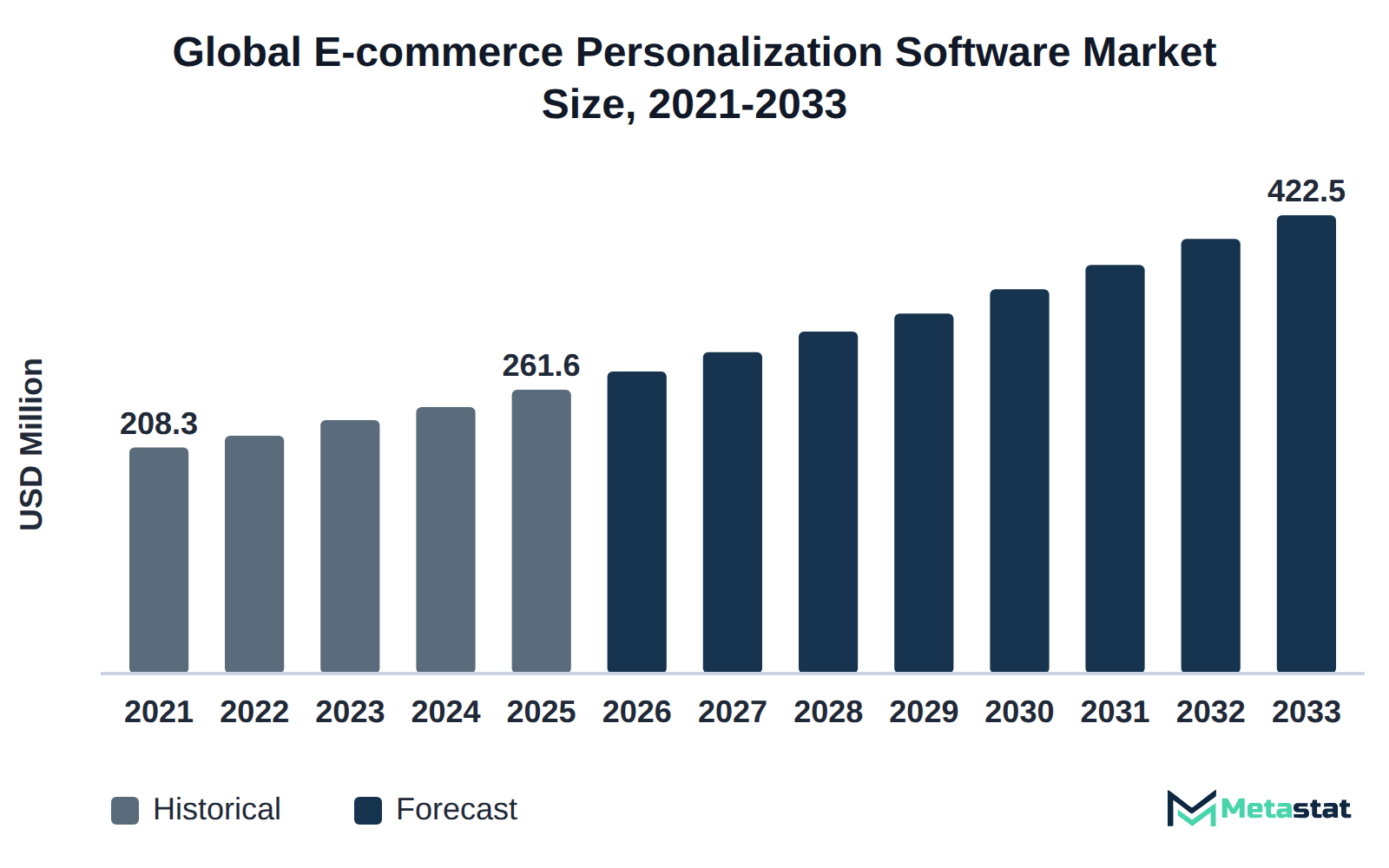
AI-driven product recommendation systems address the unique challenges presented by long-tail e-commerce catalogues. These catalogues, which hold many niche products, often struggle to provide visibility and personalized shopping experiences to consumers. In the E-commerce Personalization Software market, the segment focused on product recommendations is projected to reach USD 203.9 million by 2033, reflecting a compound annual growth rate (CAGR) of 6.7% from 2026. This growth highlights the increasing reliance on advanced algorithms to optimize the shopping experience for diverse product ranges.
The integration of AI technologies enables e-commerce platforms to analyze customer behavior and preferences, facilitating tailored product suggestions that enhance user engagement. This approach boosts conversion rates and encourages repeat purchases by creating a more satisfying shopping journey. Retailers with long-tail catalogues benefit from adopting AI product recommendation systems, which help them connect with consumers and drive sales.
Buyers of E-commerce Personalization Software increasingly prefer flexible pricing and contract models that align with their operational needs. The projected growth of the market, from USD 261.6 million in 2025 to USD 422.5 million by 2033 at a compound annual growth rate (CAGR) of 6.1%, is a significant factor in this shift. This growth results from rising demand for personalized consumer experiences, compelling suppliers to offer adaptable pricing structures.
Subscription-based software-as-a-service (SaaS) models have gained traction, providing businesses with predictable expenses while minimizing upfront investments. Such models often include tiered pricing, allowing organizations to select packages that fit their size and personalization needs. Within the Application segment, Product Recommendations are projected to grow from USD 129.3 million in 2026 to USD 203.9 million by 2033, indicating the rising importance of tailored solutions. Suppliers offering solutions with value-based pricing effectively address varying buyer requirements, enhancing customer satisfaction and loyalty.
In addition, contract lengths and terms have evolved, with many providers now offering shorter commitments. This strategy allows buyers to evaluate software performance before committing to long-term agreements. Flexible pricing and contract options position suppliers favorably within the E-commerce Personalization Software market, ultimately driving higher adoption rates and revenue growth.
Autonomous email personalization helps businesses encourage repeat purchases while safeguarding profit margins. This approach allows companies to tailor communications based on customer behavior, preferences, and purchase history, leading to increased engagement and higher conversion rates. In the E-commerce Personalization Software market, businesses using this capability see significant performance improvements in campaigns delivered through email marketing software.
Data from the market indicates that the cloud-based deployment model is projected to reach USD 388.1 million by 2033, reflecting a compound annual growth rate of 7.2%. This growth reflects the increasing shift toward cloud solutions, which provide flexibility and scalability for organizations seeking to implement effective email personalization strategies. The adoption of cloud-based systems facilitates integration with existing e-commerce platforms, enabling businesses to execute personalized email campaigns efficiently.
By investing in autonomous email personalization tools, companies enhance customer loyalty and optimize marketing expenditures. The ability to deliver relevant content directly to consumers increases the likelihood of repeat purchases and protects margins through reduced customer acquisition costs. Personalized communication helps businesses compete in the e-commerce sector.
Effective utilization of E-commerce personalization significantly enhances sell-through rates for high-SKU inventory. Personalization engages customers by providing tailored experiences, which boosts conversion rates and encourages repeat purchases. This growth indicates strong demand for solutions that enable personalized product suggestions.
Retailers use E-commerce Personalization Software to improve inventory sell-through by aligning product offerings with customer preferences and purchase behavior. Enhanced product recommendations drive immediate sales and increase customer loyalty and retention. The competitive advantage gained through such strategies positions companies to better manage their diverse inventories, ultimately leading to improved operational efficiency and increased revenue.
Retailers increasingly adopt tailored shopping experiences, responding to evolving consumer expectations for individualized interactions. This shift occurs particularly among fashion and apparel retailers, who prioritize engagement through personalized product recommendations and curated content. Enhanced customer insights drive this trend, enabling brands to present relevant offerings that align with specific shopper preferences. The rise in demand for E-commerce Personalization Software reflects a broader recognition of personalization as a key factor in enhancing customer satisfaction and loyalty. Retailers invest in these technologies to differentiate themselves in a competitive landscape, ultimately driving higher conversion rates and improved sales performance.
Accelerated digital transformation initiatives are driving investments in E-commerce Personalization Software. This trend is particularly evident among large enterprises that seek to enhance online engagement and streamline operations. The shift towards cloud-based solutions supports scalability and flexibility, allowing businesses to efficiently integrate personalization tools. By adopting advanced technologies, companies improve their ability to deliver personalized experiences, driving customer loyalty and retention.
Advancements in cloud technology significantly influence the adoption of E-commerce Personalization Software. Businesses increasingly favor cloud-based solutions due to their scalability, flexibility, and cost-effectiveness. By using cloud infrastructure and cloud services, companies quickly implement personalization strategies without heavy upfront investments in hardware or software. This shift attracts various organizations, particularly small and medium enterprises that seek to optimize their operations with lower operational costs and reduced maintenance burdens. The deployment model enhances collaboration and data sharing across teams, resulting in improved customer insights and more effective personalization strategies. The market is projected to expand as cloud-based solutions gain traction, driven by the ability to integrate advanced analytics and machine learning capabilities. Such developments make cloud-based personalization a critical component of competitive advantage in e-commerce.
Enterprises increasingly recognize the importance of offering tailored experiences, and cloud-based deployment models will play a significant role in expanding the reach and functionality of personalization software. This trend contributes to the overall growth of the market, creating opportunities for vendors to deliver innovative solutions that meet the diverse needs of businesses across different sectors.
Cost considerations significantly impact the adoption of E-commerce Personalization Software among small and medium enterprises. These businesses operate within tighter budget constraints, leading to slower uptake of advanced solutions. High software costs deter decision-makers, resulting in smaller orders or delayed investments in necessary technology. The need for competitive pricing in this segment creates challenges for vendors, who struggle to offer attractive subscription models that appeal to budget-conscious buyers. Consequently, these pricing pressures restrict market growth, particularly among smaller retailers seeking effective personalization but lacking the financial resources to implement such software. The market experiences these dynamics while competition intensifies and vendors strive to meet diverse pricing expectations while maintaining service quality.
Innovative talent acquisition presents a significant challenge for suppliers in the E-commerce Personalization Software market. Competing for skilled professionals in a landscape where technological advancements accelerate demand creates pressure on operational costs. Suppliers focus on enhancing recruitment strategies, including offering competitive salaries and benefits, to attract qualified personnel. The increasing necessity for software expertise drives talent costs higher, impacting overall profitability.
Companies invest in training programs to upskill existing employees and reduce reliance on external hiring. By creating a culture of continuous learning, suppliers aim to enhance team capabilities while managing talent-related expenses effectively. This approach helps suppliers maintain a competitive edge despite rising talent costs.
Consequently, suppliers in the market adapt by reallocating resources toward talent development initiatives, allowing them to sustain growth while addressing the financial implications of talent acquisition. Such strategies enable organizations to align with evolving market demands while securing a skilled workforce for future advancements.
The demand for personalized content within the fashion and apparel segment presents a significant market opportunity. This sector is positioned for substantial growth, driven by consumer preferences for tailored shopping experiences, with a projected CAGR of 5.2%. Brands increasingly focus on offering customized content to engage shoppers, improving brand loyalty and conversion rates. The rising desire for unique and personalized fashion choices compels retailers to adopt advanced software solutions for content personalization. By leveraging these capabilities, businesses enhance customer interactions and optimize marketing strategies.
The application of sophisticated algorithms within the E-commerce Personalization Software market ensures that retailers effectively deliver relevant content to their target audiences. This approach boosts engagement and supports increased revenue streams. Fashion retailers that implement personalization strategies effectively position themselves for competitive advantages in a rapidly changing marketplace.
The Global E-commerce Personalization Software market is segmented based on Application, Deployment Model, Organization Size, and End-Use Industry.
This segment enhances user experience by delivering personalized product suggestions tailored to individual shopping behaviors, benefiting retailers in various industries, especially fashion and consumer electronics. The rising emphasis on personalized shopping experiences drives demand for product recommendation solutions, aligning with consumer expectations for tailored interactions. Compared to other segments, this category exhibits a stronger growth trajectory, with a CAGR of 6.7%, outpacing the growth of Content Personalization and Search Personalization segments. The capacity to leverage data analytics and machine learning technologies optimizes product recommendations, further enhancing customer engagement and conversion rates across the market.
Search Personalization segment is estimated to reach USD 125.5 million by 2033, at a CAGR of 6.6% during the forecast period. This segment focuses on enhancing the search experience for customers by providing tailored search results based on user behavior, preferences, and context. Retailers and online businesses apply this functionality to boost customer satisfaction and engagement. Demand for advanced search capabilities drives this segment, with increasing consumer expectations for relevant results. Compared to other segments, including Product Recommendations, which has a higher CAGR of 6.7%, Search Personalization experiences relatively slower growth. Nevertheless, it optimizes user experience and conversion rates, directly impacting revenue generation for businesses. The integration of artificial intelligence and machine learning technologies further enhances the effectiveness and accuracy of search personalization efforts.
Content Personalization segment is expected to reach USD 55.7 million by 2033. This segment focuses on delivering tailored content to users based on their preferences and behaviors, enhancing user experience across e-commerce platforms. Retailers apply content personalization to engage customers more effectively, driving conversions and retention. Demand for this segment is fueled by the increasing emphasis on individualized shopping experiences, particularly in industries including fashion and consumer electronics. The segment exhibits a stronger growth rate compared to others, with a CAGR of 6.6%, reflecting the ongoing shift towards personalization in marketing strategies. Content personalization differentiates itself through its focus on user engagement rather than just product recommendations, leading to higher customer satisfaction and loyalty. The competitive landscape features key players investing in advanced algorithms and user data analytics to optimize content delivery.
Offer Personalization segment is projected to grow at a CAGR of 5.3% during the forecast period. This segment focuses on delivering tailored offers to consumers based on their previous interactions and preferences, enhancing the likelihood of conversion. Retailers within industries including fashion and consumer electronics apply this strategy to engage customers effectively. The increasing demand for personalized shopping experiences drives growth in this segment. Compared to other segments, Offer Personalization experiences slower growth, with its CAGR of 5.3% being lower than that of Product Recommendations and Search Personalization. Offer Personalization supports businesses in creating targeted marketing campaigns, thereby improving customer retention rates and overall sales performance, goals that customer loyalty and retention software also targets. In 2033, the segment is expected to contribute significantly to the overall market, reinforcing its importance in e-commerce strategies.
This segment primarily addresses the needs of online retailers seeking to deliver personalized shopping experiences through advanced analytics and machine learning algorithms. The growing demand for real-time data processing and scalability drives the acceleration of this segment, attracting large enterprises and small to medium businesses focused on enhancing customer engagement. Compared to the On-Premises segment, which holds a more static value, the Cloud-Based segment exhibits higher growth potential, encouraging innovation by lowering barriers to entry for smaller players. With cloud solutions offering cost-effective scalability, organizations efficiently leverage resources for targeted marketing efforts.
The On-Premises segment is estimated to reach USD 34.4 million by 2033, at a CAGR of -2.4% during the forecast period. This segment includes software deployed on local servers, offering enhanced control and security for organizations concerned about data privacy. Large enterprises often prefer this deployment model, particularly in industries requiring compliance with strict regulations. The On-Premises segment experiences declining growth due to the increasing shift toward cloud-based solutions, which offer greater scalability and lower operational costs. Organizations transitioning to cloud-based models seek the flexibility and efficiency that on-premises solutions cannot provide. While the market pushes forward with innovative cloud technologies, the On-Premises segment faces challenges in maintaining relevance among buyers prioritizing cost-effectiveness and adaptability.
Large Enterprises segment is valued at USD 169.1 million in 2026 and is projected to reach USD 246.1 million by 2033, at a CAGR of 5.5% during the forecast period. This segment primarily serves large businesses seeking advanced customization features to enhance customer engagement and drive sales. The push for personalized shopping experiences drives demand for these solutions, with large enterprises investing significantly in technology to meet consumer expectations. Compared to Small and Medium Enterprises, which are expected to grow at a CAGR of 7.1%, the growth rate in this segment reflects a more mature adoption phase. Pricing structures typically differ, with larger enterprises facing higher upfront investments due to more extensive requirements. The unique needs and purchasing power of this segment shape its growth trajectory and the strategies vendors pursue to capture market share.
Small and Medium Enterprises segment is estimated to reach USD 176.4 million by 2033, at a CAGR of 7.1% during the forecast period. This segment is used by smaller retailers seeking cost-effective solutions to enhance customer engagement and drive sales. The demand for personalized experiences in E-commerce increasingly influences this segment, driven by growing consumer expectations for tailored interactions. Compared to other segments, this group exhibits faster growth due to rising digitalization among small and medium enterprises, which often seek affordable and scalable solutions. These enterprises prioritize budget-friendly options while adapting to changing market trends. The focus on innovative personalization strategies helps improve conversion rates and customer loyalty. Such dynamics set this segment apart from larger enterprises, which have different budgetary constraints and varying levels of technological adoption.
Fashion and Apparel segment is valued at USD 98.6 million in 2026 and is projected to reach USD 140.5 million by 2033, at a CAGR of 5.2% during the forecast period. This segment targets retailers specializing in clothing and accessories, applying personalization software to create tailored shopping experiences. The increasing consumer demand for customized product offerings drives growth in this segment, leading businesses to leverage data analytics for improved customer engagement. Compared to other segments, the Fashion and Apparel segment experiences moderate growth, influenced by trends and seasonality unique to the industry. The emphasis on fashion-oriented personalization differentiates it from other end-use industries, which prioritize different customer interaction strategies or product types. The ongoing evolution of consumer expectations continues to shape the landscape for e-commerce personalization software, supporting its expansion and relevance in retail.
Consumer Electronics segment is estimated to reach USD 73.6 million by 2033, at a CAGR of 5.3% during the forecast period. This segment serves retailers focusing on providing tailored shopping experiences for tech-savvy consumers. The increasing shift toward personalized recommendations drives demand, allowing businesses to cater to individual preferences effectively. Compared to other segments, including Fashion and Apparel, which anticipates a CAGR of 5.2%, the Consumer Electronics segment exhibits significant growth. The unique nature of consumer electronics, characterized by rapid technological advancements and high competitive rivalry, differentiates it from segments that experience slower growth or lower price sensitivity. Retailers in this space actively seek software solutions that align with consumer expectations, fueling overall E-commerce Personalization Software market growth.
The Food and Grocery segment is expected to reach USD 66.2 million by 2033. This segment caters to retailers selling food items and grocery products, such as supermarkets, and focuses on enhancing customer experiences through personalized recommendations and tailored marketing strategies. Increasing consumer demand for convenience and personalized shopping experiences drives growth in this sector. The unique nature of food and grocery purchases, characterized by frequent transactions, differentiates this segment from others like Fashion and Apparel, which has a higher average transaction value. The CAGR for the Food and Grocery segment is 7.1%, lower than that of Small and Medium Enterprises, but it remains a crucial area for investment in the E-commerce Personalization Software market, driven by retailers seeking to optimize engagement and customer loyalty.
The Beauty and Personal Care segment is projected to grow at a CAGR of 7.8% during the forecast period. This segment addresses the specific needs of beauty retailers and e-commerce platforms, including online cosmetics sellers, aiming to enhance customer experiences through personalized offerings. The demand for tailored product recommendations and content drives growth within this segment. Increasing consumer preferences for customized beauty solutions highlight the importance of e-commerce personalization in this industry. Unlike other segments, the Beauty and Personal Care segment exhibits a higher growth rate compared to many peers. The focus on innovative marketing strategies and consumer engagement distinguishes this segment, aligning with trends in health, wellness, and beauty, and contributing to its robust expansion. The market continues to evolve, accommodating diverse consumer preferences and enhancing engagement through targeted digital experiences.
Home and Furniture encompasses various products related to household furnishing and decor, including online ready-to-assemble (RTA) furniture, catering to a diverse consumer base seeking personalized shopping experiences. Retailers employ E-commerce Personalization Software to enhance customer engagement through tailored recommendations, improving overall satisfaction and increasing conversion rates. Adoption of technology within this segment is driven by shifting consumer preferences toward customized solutions that enhance the online shopping experience. This segment distinguishes itself through its focus on lifestyle-oriented offerings, differing from other segments including Fashion and Apparel, which emphasize different consumer needs and buying behaviors. Retailers specific to the Home and Furniture sector prioritize innovative technology to meet the demand for bespoke customer interactions, reflecting a significant trend in the evolving E-commerce Personalization Software market.
The segment focuses on the sales and distribution of sports goods and outdoor products, including equipment, apparel, and accessories. Retailers in this segment leverage E-commerce personalization software to enhance customer engagement through tailored recommendations and targeted marketing strategies. Key drivers for growth in this segment involve increasing consumer interest in health and outdoor activities, supported by the rise of digital shopping platforms. Compared to other segments, the sports and outdoor goods sector exhibits a unique buying behavior, characterized by a strong inclination toward personalized shopping experiences. Retailers emphasize dynamic inventory management and targeted promotions, resulting in higher conversion rates. Strategies that enhance user experience through customized product recommendations significantly differentiate this segment from others, ensuring sustained engagement and loyalty among consumers. The E-commerce Personalization Software market supports these initiatives, enabling businesses in the sports and outdoor goods sector to achieve operational efficiencies and enhanced customer satisfaction.
This segment encompasses a variety of products, including books, pet supplies, and automotive parts. Businesses in this category use e-commerce personalization software to enhance customer engagement and improve purchasing experiences. The demand for tailored recommendations is significant in this segment, driven by consumers' desire for personalized shopping experiences that cater to their specific interests. Compared to other segments, including fashion and apparel, this segment faces unique challenges, including a less dynamic market driven by trends, resulting in slower growth. Competition within this segment focuses on price sensitivity, impacting how companies implement personalization strategies. The E-commerce Personalization Software market evolves, reflecting the shifting preferences of consumers across various industries, including this diverse sub-segment.
Based on geography, the Global E-commerce Personalization Software market is divided into North America, Europe, Asia-Pacific, South America, Middle East, and Africa.
Demand for E-commerce Personalization Software market in North America experiences strong growth, driven by large enterprises seeking enhanced customer engagement and conversion rates. The United States, Canada, and Mexico represent key markets where technological advancements support personalized online experiences. A focus on cloud-based deployment models prevails, enabling organizations to leverage scalable solutions that adapt to evolving consumer preferences. North America is projected to reach USD 147.5 million by the end of 2033, reflecting continued investment in advanced personalization strategies. The integration of data analytics and artificial intelligence enhances the effectiveness of personalization tools, benefiting businesses in various sectors, including retail and ecommerce.
Strong demand in the E-commerce Personalization Software market arises from various industries within Europe, particularly from fashion and consumer electronics. Countries including Germany, France, and the UK exhibit significant growth potential due to their advanced digital infrastructure and high online retail penetration. Regulatory initiatives promoting data privacy and consumer protection impact how companies apply personalization software, shaping customer engagement strategies. The market share for Europe stands at 29.1% in 2025, highlighting its vital role in the global landscape. Investment in innovative technologies enhances user experiences, driving further adoption among enterprises focused on optimizing online sales and customer retention.
Asia-Pacific holds a 26.2% share of the E-commerce Personalization Software market in 2025. The region's diverse consumer landscape, driven by rapid digital transformation, fuels demand from industries including fashion and consumer electronics. Countries like China and India experience considerable growth, supported by increasing internet penetration and mobile device usage. The growing population of online shoppers in South Korea and Australia further enhances market opportunities. Innovative technologies and platforms allowing businesses to deliver personalized experiences significantly influence the competitive environment. Local companies increasingly adopt cloud-based solutions, streamlining their operations and enhancing customer engagement. The emergence of small and medium enterprises in Southeast Asia contributes to accelerated market growth, resulting in evolving consumer preferences and expectations.
In South America, the E-commerce Personalization Software market experiences distinct demand driven by retail expansion and the growing adoption of digital technologies. Brazil and Argentina stand out as key countries in this region, with a notable focus on enhancing online customer experiences. Local businesses increasingly seek to implement advanced software solutions that support personalized marketing strategies, improving customer engagement and sales conversion. The market benefits from the region's increasing internet penetration and smartphone usage, which contribute to higher online shopping rates. With a global market share of 4.00% anticipated in 2025, the region's growth prospects remain promising, highlighting potential for further investment and innovation in the E-commerce Personalization Software market.
Growth in the E-commerce Personalization Software market in the Middle East and Africa hinges on increasing digitalization within key sectors including retail and consumer goods. Countries including Saudi Arabia and the UAE exhibit substantial investments in e-commerce, creating a conducive environment for software adoption. Rising smartphone penetration and improved internet connectivity facilitate personalized shopping experiences, enhancing customer engagement. South Africa shows promise, with a growing retail landscape seeking advanced solutions to meet consumer expectations. The market share for this region indicates potential for future expansion, driven by regional players adopting innovative technologies to compete in the evolving marketplace.
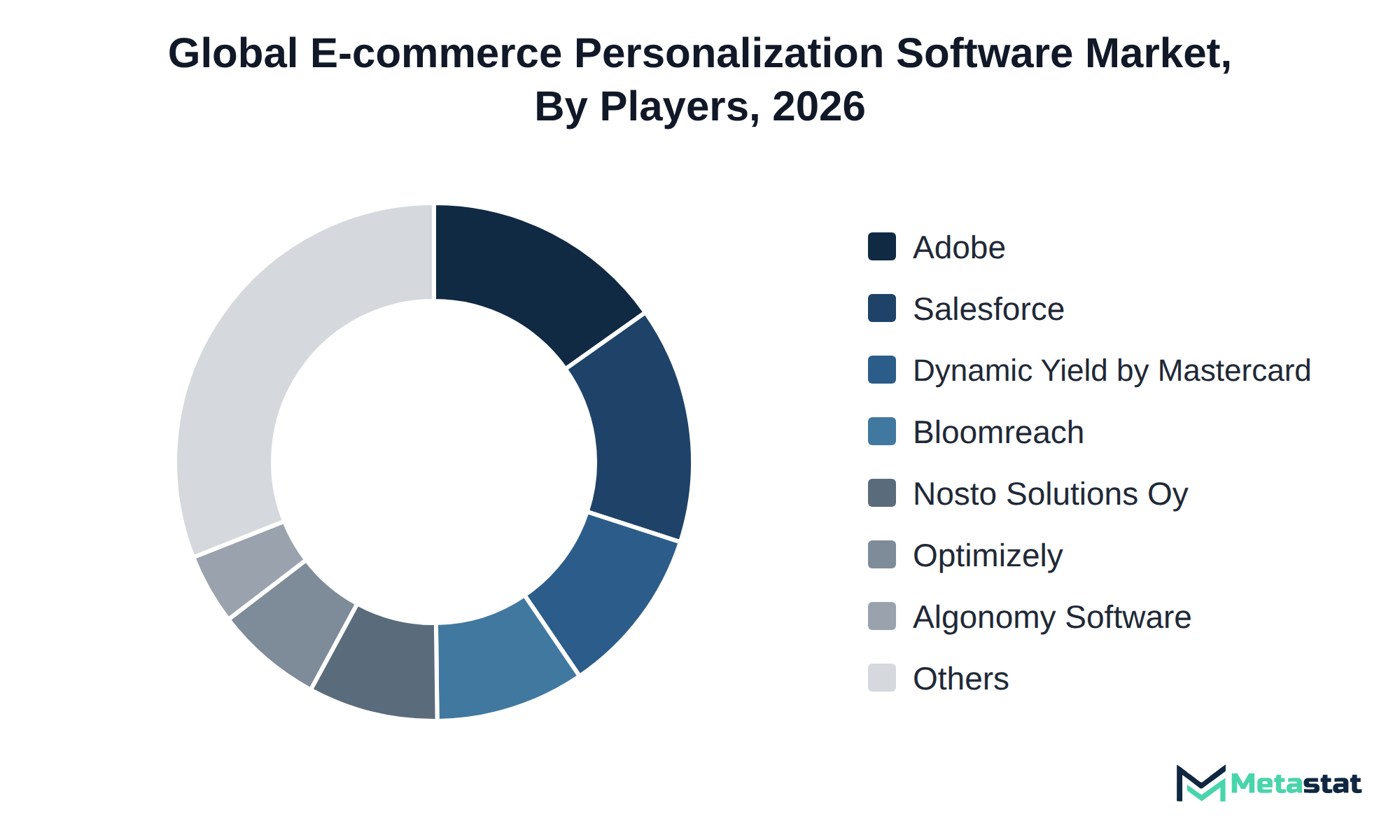
The E-commerce Personalization Software market features a range of companies competing through diverse strategies and product offerings. Distinctions exist among service types, including cloud-based and on-premises deployment models. Buyers prioritize factors including price, customization, service quality, and the overall ecosystem provided by vendors. This competitive environment reflects the demand for tailored solutions in e-commerce.
Bloomreach, Inc. emphasizes enhancing customer engagement through personalized product recommendations. Adobe Inc. focuses on providing comprehensive solutions that integrate with marketing efforts, leveraging extensive data analytics capabilities. Salesforce, Inc. concentrates on a customer relationship management platform that enables businesses to personalize effectively and improve user experiences.
This growth relies on several key developments within the E-commerce Personalization Software market. First, increasing adoption of cloud-based solutions drives significant expansion, particularly among large enterprises. Cloud deployment is anticipated to exhibit a CAGR of 7.2%, highlighting its critical role in facilitating scalability and efficiency. Second, the rise of product recommendation systems, projected to reach USD 203.9 million by 2033, serves as a major driver as businesses aim to enhance customer experience and engagement. In contrast, a primary risk to achieving the forecasted growth lies in potential economic downturns, which could prompt reduced spending in technology investments. This risk could particularly affect small and medium enterprises, limiting their adoption of advanced personalization tools. Overall, the trajectory of the market hinges on technological advancements and economic conditions, shaping its ability to meet the projected figures through 2033.
By Application: Product Recommendations, Search Personalization, Content Personalization, Offer Personalization
By Deployment Model: Cloud-Based, On-Premises
By Organization Size: Large Enterprises, Small and Medium Enterprises
By End-Use Industry: Fashion and Apparel, Consumer Electronics, Food and Grocery, Beauty and Personal Care, Home and Furniture, Sports and Outdoor Goods, Others (Books, Pet Supplies, Automotive Parts)
The report strategically identifies and profiles the key market players and analyses their core competencies in each sub-segment of the E-commerce Personalization Software market.
Report Attributes | Details |
Study Period | 2021-2033 |
Base Year | 2025 |
Estimated Year | 2026 |
Forecast Period | 2026-2033 |
Historical Period | 2021-2025 |
Growth Rate | CAGR 6.1% from 2026 to 2033 |
Revenue Unit | USD million |
Segmentation | By Application, Deployment Model, Organization Size, End-Use Industry, and Region |
By Region | North America (By Application, Deployment Model, Organization Size, End-Use Industry, and Country)
|
Europe (By Application, Deployment Model, Organization Size, End-Use Industry, and Country)
| |
Asia Pacific (By Application, Deployment Model, Organization Size, End-Use Industry, and Country)
| |
South America (By Application, Deployment Model, Organization Size, End-Use Industry, and Country)
| |
Middle East and Africa (By Application, Deployment Model, Organization Size, End-Use Industry, and Country)
|
Find answers to common questions about this report
The E-commerce Personalization Software market size was valued at USD 261.6 million in 2025.
The market is projected to grow at a CAGR of 6.1% during the forecast period from 2026 to 2033.
The North America E-commerce Personalization Software market size is estimated to reach USD 147.5 million by 2033.
Product Recommendations leads the E-commerce Personalization Software market with a value of USD 129.3 million in 2026. This segment shows the highest growth potential compared to others in the application category.
Key drivers for the E-commerce Personalization Software market include retailers adopting tailored shopping experiences to meet evolving consumer expectations for individualized interactions. Investments in E-commerce Personalization Software increase, particularly among large enterprises seeking to enhance online engagement and streamline operations.
North America holds the dominant share of the E-commerce Personalization Software market, with a value of USD 147.5 million projected for 2033. This region accounts for 37.2 percent of the total market share.
Cost considerations significantly impact the adoption of E-commerce Personalization Software among small and medium enterprises, leading to slower uptake of advanced solutions. High software costs deter decision-makers, resulting in smaller orders or delayed investments in necessary technology.
The demand for personalized content within the fashion and apparel segment presents a significant opportunity, driven by consumer preferences for tailored shopping experiences. Brands increasingly focus on offering customized content to engage shoppers, improving brand loyalty and conversion rates, which supports the adoption of E-commerce Personalization Software.
The E-commerce Personalization Software market is estimated to reach a valuation of USD 422.5 million by 2033.
Key players operating in the E-commerce Personalization Software market include Bloomreach, Inc., Dynamic Yield by Mastercard, Nosto Solutions Oy, Adobe Inc., Salesforce, Inc., and Silver Egg Technology Co., Ltd.
The analysts below cover Information & Technology research at Metastat Insights.
LEAD ANALYST
Utkarsh Khirodkar is a Lead Market Research Analyst at MetaStat Insight, specializing in market intelligence, technology sector assessments, and competitive strategy.

PRINCIPAL CONSULTANT - ENTERPRISE AI & EMERGING TECHNOLOGIES
Banking & Finance · Electronics and Semiconductor · Energy and Power · Healthcare IT · Information & Technology · Professional Services
Vijay Gunti is a Principal Consultant at MetaStat Insight, bringing over two decades of experience across enterprise digital transformation, technology strategy, and intelligent systems.

LEAD CONSULTANT - COMMUNICATION, TELECOM, AND IT
Electronics and Semiconductor · Information & Technology · Machinery & Equipment · Professional Services
Ravindra Sathe Consultants for Communication, Telecom, and IT at MetaStat Insight. He leads the firm's industry research initiatives across telecommunications infrastructure, digital connectivity, enterprise networking, and emerging information technology domains.
When evaluating distributed energy resource management systems, standard research summaries tend to gloss over the operational differences between front-of-the-meter utility deployments and behind-the-meter industrial sites. The MetaStat Insight report addressed those distinctions directly, especially regarding software interoperability standards and grid interconnection backlogs. The five-year market sizing across regional transmission organizations provided actionable context for our grid modernization strategy.
Most industry reports on warehouse automation bundle autonomous mobile robots and fixed conveyor installations into the same top-level numbers, which complicates advisory work. This study split the market cleanly by payload tiers, navigation technology, and fleet management software layers. The regional forecast for Western Europe gave our team defensible adoption benchmarks when evaluating capital allocation for logistics clients, saving us days of secondary data scrubbing.
Analyzing the transition from natural gas to green hydrogen in iron ore reduction requires realistic infrastructure timelines. Meta stat insight supplied a detailed regional assessment of DRI plant conversion costs and scrap metal availability in North America and Western Europe. Their report carefully examined pellet quality specs and electrical grid access constraints without making oversimplified market assumptions. The research material served as a practical reference during internal technology roadmap discussions.
Explore related market intelligence reports worth reading alongside this one.