
LEAD ANALYST
Utkarsh Khirodkar is a Lead Market Research Analyst at MetaStat Insight, specializing in market intelligence, technology sector assessments, and competitive strategy.

Global Enterprise Software-as-a-Service (SaaS) Market Size, Share, By Type (Customer Relationship Management, Enterprise Resource Planning and Financial Management, Human Capital Management, Collaboration, Communication and Productivity, IT Service Management and Workflow Automation, Data Analytics and Business Intelligence, Cybersecurity and Identity Management, Digital Commerce and Marketing, Content, Creative and Document Management, Others), By Organization Size (Large Enterprises and Small and Medium Enterprises), By Subscription Model (Per-User or Per-Seat Subscription, Tiered Feature-Based Subscription, Usage or Consumption-Based Subscription, Others), By End-Use Industry (BFSI, IT and Telecommunications, Retail and E-Commerce, Healthcare and Life Sciences, Manufacturing, Government and Public Sector, Media and Entertainment, Education, Professional and Business Services, Others), Industry Analysis, Growth, Trends, and Forecast, 2026-2033
Report ID
MSI-5348
Published
September, 2026
Pages
286 Pages
Format
Historical
Base year
Forecast
Forecast period
Report Details
Market Valuation: Valued at $468.2 Billion in 2025, projected to reach $1,110.9 Billion by 2033 at a 11.4% CAGR.
Dominant Segment: The Customer Relationship Management segment leads the market, projected to grow from USD 92.5 billion in 2026 to USD 178.5 billion by 2033, driven by the increasing need for enhanced customer engagement and retention.
Geographic Lead: The Asia Pacific region shows the fastest growth in SaaS adoption, fueled by the demand for modernized infrastructure and enhanced accessibility for businesses.
What's Inside: This report provides a comprehensive analysis of the competitive landscape, market segmentation by type, organization size, subscription model, and end-use industry, along with a detailed growth forecast from 2026 to 2033.
Emerging Trends: The report highlights the rising adoption of vertical SaaS solutions in sectors like BFSI and healthcare, addressing industry-specific challenges and driving market penetration.
Cost-efficiency Initiatives: Organizations are increasingly pursuing cost-efficiency initiatives, leading to a surge in SaaS adoption as businesses seek advanced solutions to streamline operations and reduce overhead.
Choose Your License
Global Enterprise Software-as-a-Service (SaaS) Market
The global Enterprise Software-as-a-Service (SaaS) market was valued at USD 468.2 billion in 2025 and is projected to reach USD 1,110.9 billion by 2033, growing at a CAGR of 11.4% over the forecast period.
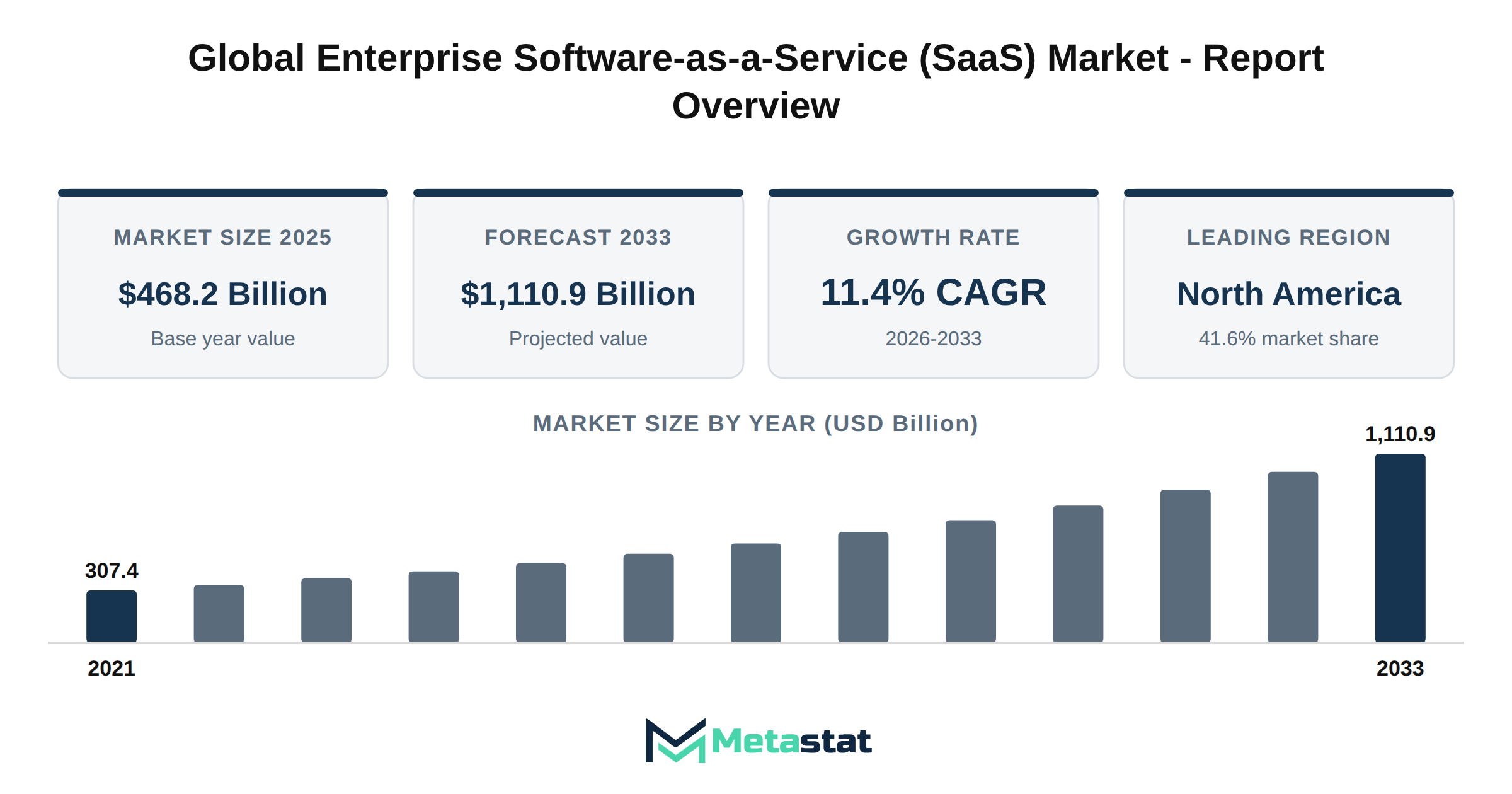
The Enterprise Software-as-a-Service (SaaS) market reached a valuation of USD 468.2 billion in 2025, with expectations for revenue to grow to USD 1,110.9 billion by 2033. This growth trajectory indicates a compound annual growth rate (CAGR) of 11.4% during the forecast period, reflecting robust demand across various sectors.
Key drivers of enterprise demand include accelerated migration to multi-tenant cloud environments. Organizations prioritize flexibility and scalability, enabling rapid responses to market changes and consumer needs. The integration of generative AI and agentic workflows into enterprise SaaS platforms significantly enhances operational efficiency, driving further adoption of these solutions.
Cost optimization strategies surrounding cloud services, app consolidation, and the dynamics of enterprise software spending remain essential. Companies increasingly focus on maximizing value from existing software investments while minimizing unnecessary expenditures.
Deployment models for enterprise SaaS emphasize hybrid architectures and private cloud tenancies. These models cater to diverse organizational requirements, allowing businesses to balance security and performance effectively. The rise in vertical SaaS adoption trends is particularly notable in the banking, financial services, and insurance (BFSI), healthcare, and manufacturing sectors, where specialized solutions address industry-specific challenges.
Compliance with cybersecurity mandates, data sovereignty regulations, and evolving compliance standards shapes enterprise SaaS strategies. Organizations strive to enhance their data security posture, ensuring adherence to legal and regulatory frameworks.
The Enterprise Software-as-a-Service (SaaS) market is poised for substantial expansion, driven by key factors including the increasing adoption of multi-tenant cloud solutions and the integration of generative AI technologies. Businesses across various sectors accelerate migration to cloud-based infrastructures to enhance operational efficiency and scalability.
Enterprises focus on optimizing costs associated with cloud services, consolidating applications, and managing overall software expenditures. This shift highlights the importance of strategic financial planning and resource allocation within organizations, ultimately influencing purchasing decisions and software selection criteria.
Deployment models evolve, with hybrid architectures and private cloud solutions gaining traction among enterprises. This trend results from the desire for flexibility, security, and control over sensitive data, prompting organizations to explore tailored deployment options that align with their specific operational needs.
Vertical SaaS adoption trends highlight significant growth in sectors including Banking, Financial Services, and Insurance (BFSI), healthcare, and manufacturing. These industries leverage specialized software solutions to address unique operational challenges, regulatory requirements, and customer demands, thereby driving market penetration and revenue growth.
Cybersecurity mandates and data sovereignty issues become increasingly critical for enterprises. Compliance with stringent regulations necessitates robust security measures and data governance frameworks, impacting software selection and deployment strategies across the market.
The transition from seat-based licensing to usage-based and hybrid pricing models reflects a significant shift in how enterprises evaluate software value. This evolution aligns software costs more closely with actual usage, promoting a performance-driven approach to software investment.
The competitive landscape of the market is characterized by vendor consolidation, with major players adopting platform ecosystem strategies to enhance their offerings. This consolidation encourages innovation and accelerates the development of integrated solutions that address diverse enterprise needs.
Recent trends in mergers and acquisitions (M&A) and private equity inflows indicate a growing interest in enterprise software, driving valuation multiples higher. This activity reflects investor confidence in the long-term growth potential of the market and the increasing importance of digital transformation initiatives.
Regional analysis indicates varying levels of cloud readiness, with emerging markets presenting high-growth opportunities. While organizations in these regions adopt cloud-based solutions, the market is expected to experience accelerated growth, driven by local demand and supportive government initiatives.
Legacy Enterprise Resource Planning (ERP) and Customer Relationship Management (CRM) systems undergo modernization, further fueling SaaS expansion. This transition facilitates enhanced functionality, improved user experiences, and greater agility in responding to market changes.
Churn mitigation strategies and net retention rate benchmarks become essential metrics for enterprises, guiding renewal dynamics and customer engagement efforts. These metrics reflect the importance of maintaining customer satisfaction and loyalty in a competitive landscape.
The growth of developer tooling, low-code integration frameworks, and API-first architectures reshapes the market. These innovations enable faster application development and facilitate integration with existing systems, allowing enterprises to adapt to evolving business requirements more effectively.
The long-term outlook for the Enterprise Software-as-a-Service (SaaS) market remains positive, with ongoing strategic modernization efforts anticipated to drive sustained growth. Organizations increasingly invest in innovative solutions to enhance productivity, streamline operations, and remain competitive in a rapidly changing environment.
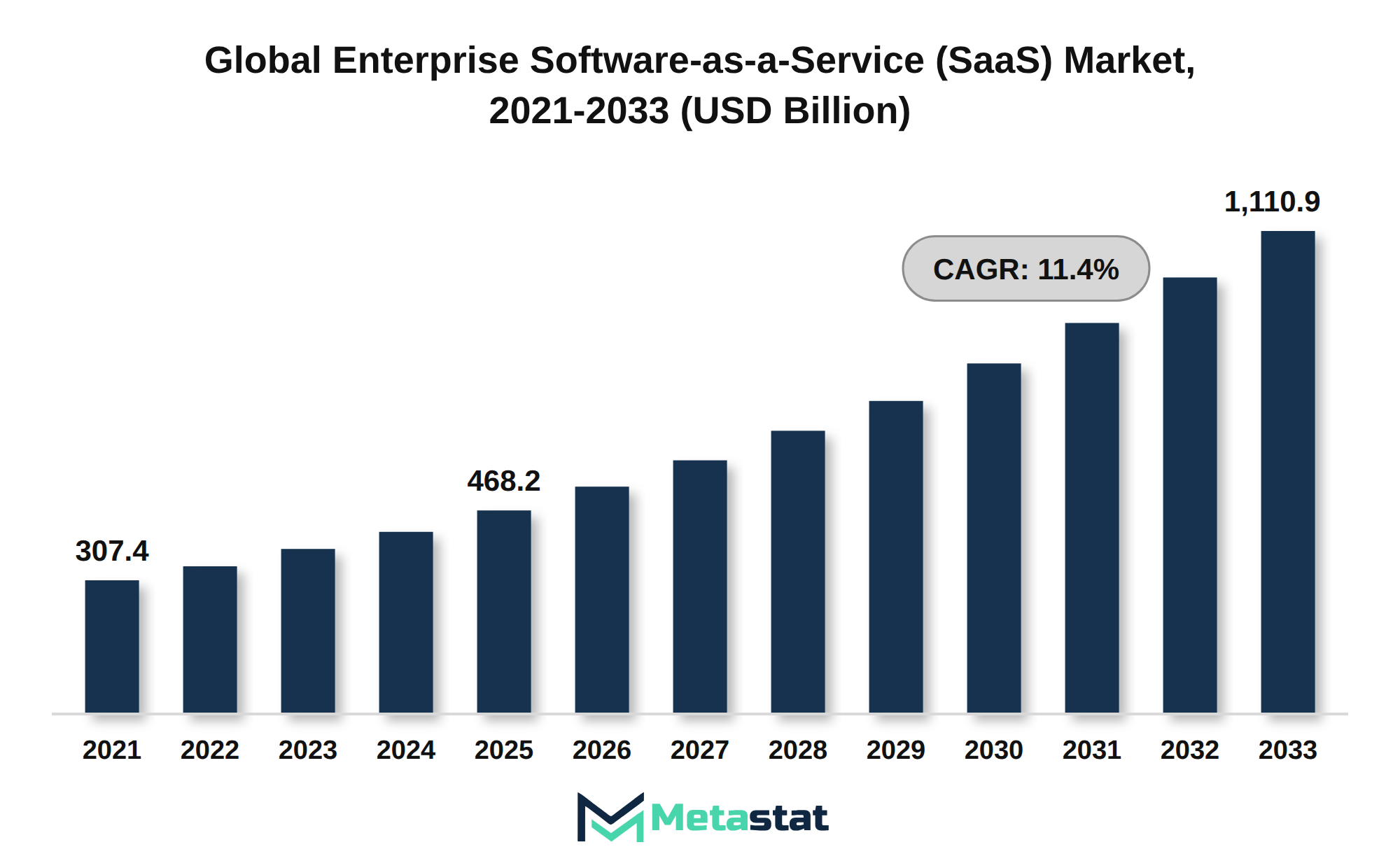
Digital transformation emerges because a critical driver of growth within the Enterprise Software-as-a-Service (SaaS) market. Organizations increasingly pursue innovative solutions to enhance operational efficiency, improve customer experiences, and adapt to changing market dynamics. The push towards digitization encourages businesses to modernize legacy systems, streamline processes, and embrace automation technologies. This technological integration enhances productivity and allows companies to respond more effectively to consumer demands.
Many sectors, including retail, healthcare, and finance, prioritize digital transformation initiatives. These industries invest in enterprise SaaS solutions to optimize their workflows, reduce costs, and enhance overall performance. Adopting cloud-based software enables organizations to access real-time data analytics and insights, which supports informed decision-making and agility in a competitive landscape.
The growing acceptance of remote work and digital collaboration further supports the demand for enterprise SaaS applications. Companies recognize the importance of providing employees with flexible tools that facilitate communication and teamwork, regardless of geographical location. This shift enhances employee engagement and drives organizational growth.
Overall, digital transformation significantly influences adoption trends within the market, presenting substantial opportunities for vendors that offer innovative and scalable solutions. The anticipated growth trajectory highlights the increasing importance of software-driven efficiencies and the strategic role of enterprise SaaS in transforming business operations.
The Enterprise Software-as-a-Service (SaaS) market experiences significant growth driven by organizations' pursuit of cost-efficiency initiatives. Companies prioritize labor optimization, process streamlining, and the reduction of overhead to improve margins and enhance operational performance. These initiatives create an environment where businesses actively seek advanced software solutions that facilitate automation and digitization of legacy processes.
Small and medium enterprises exhibit a growing interest in adopting SaaS solutions that offer scalable and affordable options. The market addresses this demand by providing subscription models that align with varying budget constraints, making advanced tools accessible to a broader range of organizations. Leveraging these cost-effective SaaS offerings enhances productivity while minimizing operational expenses.
Cost pressures challenge organizations across various industries, making investment in Enterprise Software-as-a-Service (SaaS) solutions essential for maintaining competitiveness. This trend indicates a long-term strategic shift towards integrating innovative software tools that optimize resource allocation and operational workflows. The impact of these initiatives is expected to drive sustained growth and increased adoption of SaaS solutions throughout the forecast period.
Increasing regulatory compliance and economic pressures present significant challenges for the Enterprise Software-as-a-Service (SaaS) market. Heightened scrutiny from regulatory bodies compels organizations to allocate substantial resources towards compliance, impacting overall operational efficiency. These requirements create barriers for smaller firms, limiting their ability to compete effectively against larger enterprises with more extensive compliance budgets.
Macroeconomic headwinds, including inflationary pressures and capital stagnation, further constrain market growth. Rising costs of materials and services force companies to re-evaluate their budgets, which hinders investments in new software solutions. Firms frequently defer upgrades or expansions, leading to stagnation in the adoption of innovative SaaS offerings.
Supply chain disruptions and geopolitical instability contribute to uncertainties that affect the market. Organizations face challenges in sourcing materials, which hampers their ability to deploy SaaS solutions efficiently. These factors create uneven demand across different regions, complicating growth strategies for SaaS providers.
Data security vulnerabilities and privacy concerns increasingly concern businesses adopting SaaS solutions. With rising incidents of cyber threats, organizations prioritize investments in security measures, diverting funds from other areas including SaaS adoption. This heightened focus on security slows market penetration, resulting from enterprises seeking to balance innovation with risk management.
The Enterprise Software-as-a-Service (SaaS) market encounters obstacles associated with skilled labor deficiencies and talent gaps, which impede successful implementation and utilization of SaaS solutions. A shortage of qualified personnel often leads to deployment bottlenecks, limiting the effectiveness of SaaS offerings. While organizations struggle to find skilled labor, the pace of digital transformation falters, impacting overall market growth.
The Enterprise Software-as-a-Service (SaaS) market faces significant challenges stemming from geopolitical fragmentation, which introduces uncertainties that disrupt trade relationships and supply chains. This fragmentation leads to trade deficits and tariff friction, increasing operational costs and complicating market entry strategies for providers. Effective management of these complexities demands heightened adaptability and strategic planning from market participants.
Technological disruptions, coupled with interoperability friction among disparate software systems, hinder integration. Many organizations struggle to implement cohesive solutions that connect various applications, limiting efficiency and creating operational bottlenecks. Organizations prioritize overcoming these challenges to enhance productivity and maintain a competitive edge in the market.
Pricing compression and margin pressures arise from the competitive nature of the market. Providers face constant pressure to deliver innovative solutions while maintaining cost-effectiveness, impacting profitability. Rising input cost structures, driven by inflation and supply chain instability, complicate pricing strategies for providers.
Workforce skill gaps continue to challenge organizations within the Enterprise Software-as-a-Service (SaaS) market. The rapid pace of technological advancement necessitates a skilled workforce capable of managing complex software integrations and ensuring optimal performance. Talent retention pressures affect organizations' ability to sustain operational continuity and drive innovation.
Increased focus on sustainability demands complicates market dynamics. Environmental lifecycle footprints and decarbonization mandates compel organizations to assess their operational impacts, influencing software capabilities and service offerings. Addressing these sustainability challenges will dictate future competitive positioning within the market.
These multifaceted challenges necessitate strategic approaches from organizations aiming to thrive in the evolving Enterprise Software-as-a-Service (SaaS) market. By addressing geopolitical fragmentation, technological disruptions, and emerging workforce demands, market players enhance resilience and adaptability in an increasingly complex environment.
The Enterprise Software-as-a-Service (SaaS) market experiences opportunities stemming from emerging regional demands. Regions including Asia Pacific show increasing interest in adopting cloud-based solutions, driven by the need for modernized infrastructure and enhanced accessibility. This transition supports businesses in scaling operations efficiently while accommodating varying customer requirements.
Technological disruptions drive growth by introducing innovative solutions that enhance user experience and streamline operational processes. The rise of artificial intelligence, machine learning, and advanced analytics creates avenues for product integration, enabling firms to optimize their offerings. This integration encourages cross-industry mergers, promoting collaboration among providers aiming to develop comprehensive solutions that meet complex client needs.
Sustainability imperatives gain prominence, with organizations prioritizing eco-friendly practices and alignment with ESG (Environmental, Social, and Governance) objectives. Companies that incorporate sustainable practices into their SaaS offerings capture market segments focused on reducing environmental impact. This shift influences purchasing decisions, driven by buyers increasingly favoring providers committed to sustainable solutions.
Strategic consolidation and geographical expansion contribute to market dynamism, allowing players to broaden their reach and diversify offerings. This consolidation creates robust ecosystems that enhance customer experience and drive loyalty. Evolving buying behaviors, including digital procurement shifts, lead organizations to adopt SaaS solutions for greater efficiency and reduced operational costs, further propelling market growth.
The market exhibits potential for niche application growth, particularly in sectors requiring specialized software solutions. By addressing unique industry challenges, SaaS providers cultivate dedicated markets that enhance customer satisfaction and drive revenue. This focus on niche offerings positions the market for sustained expansion through tailored solutions that meet specific user needs.
The Global Enterprise Software-as-a-Service (SaaS) market is segmented based on Type, Organization Size, Subscription Model, and End-Use Industry.
Valued at USD 92.5 billion in 2026, the Customer Relationship Management segment is projected to reach USD 178.5 billion by 2033, reflecting a CAGR of 9.9% during the forecast period. The rising need for enhanced customer engagement and retention drives demand within this segment. Organizations increasingly prioritize a unified approach to customer data management, enabling improved interactions and personalized experiences.
Investment in advanced analytics and artificial intelligence technologies supports the evolution of customer relationship management solutions. These technologies facilitate predictive insights, enabling businesses to anticipate customer needs and tailor offerings accordingly. Integration with other enterprise software systems enhances the overall functionality of customer relationship management platforms, encouraging greater adoption across various industries.
Shifts in consumer behavior emphasize the importance of effective multi-channel communication, prompting organizations to adopt robust customer relationship management solutions. The retail and e-commerce sectors particularly benefit from these tools, leveraging data-driven strategies to optimize sales and marketing efforts. Regulatory compliance standards in data privacy intensify the need for secure and efficient customer relationship management systems.
With organizations increasingly recognizing the strategic value of customer relationships, investment in customer relationship management solutions is expected to remain strong. This emphasis on customer-centric strategies drives revenue growth and enhances competitive positioning within the Enterprise Software-as-a-Service (SaaS) market.
In the Enterprise Resource Planning and Financial Management segment, demand arises from the increasing need for organizations to streamline their operations and enhance financial oversight. This trend reflects a shift towards integrated solutions that promote automation and real-time analytics, driving efficiencies across various business functions. Organizations, particularly large enterprises, invest heavily in these solutions to optimize resource allocation and improve decision-making processes.
The segment is estimated to reach USD 177.7 billion by 2033, at a CAGR of 10.6% during the forecast period. This growth trajectory results from the heightened adoption of cloud-based platforms, which offer flexibility and scalability to meet evolving business requirements. Technological maturation further supports this growth, with advancements in artificial intelligence and machine learning enhancing predictive analytics capabilities within enterprise resource planning systems.
Financial management applications increasingly play a crucial role in ensuring compliance with regulatory standards, enabling organizations to navigate complex financial landscapes effectively. Industries including BFSI and healthcare exhibit significant demand for these solutions, driven by the need for robust financial oversight to manage risks and ensure regulatory adherence. The integration of next-generation upgrades continues to reshape the market, propelling organizations towards more efficient financial management practices.
Competition intensifies within the market, prompting providers to innovate and differentiate their offerings. The rise of subscription models enhances accessibility for small and medium enterprises, promoting broader market penetration. Shifts in consumption patterns reflect a preference for solutions that not only address immediate operational needs but align with long-term strategic goals.
Growth in the Human Capital Management segment stems from several factors driving demand. Organizations increasingly seek innovative solutions to enhance workforce efficiency and optimize human resource processes. Technological advancements facilitate the development of sophisticated platforms that streamline recruitment, performance management, and employee engagement.
Investment in employee experience and talent retention contributes to the expansion of this segment. Companies recognize the importance of a skilled workforce in achieving competitive advantages, prompting them to adopt Human Capital Management solutions that promote collaboration and productivity.
Regulatory compliance standards significantly influence market dynamics. While businesses navigate complex labor laws and reporting requirements, robust Human Capital Management systems ensure adherence to these regulations, mitigating risks associated with non-compliance.
The Human Capital Management segment is expected to reach USD 122.2 billion by 2033. This growth reflects broader trends within the Enterprise Software-as-a-Service (SaaS) market, highlighting a shift towards integrated solutions that encompass various HR functions.
Increasing reliance on data analytics within Human Capital Management enhances decision-making processes. Organizations leverage data insights to identify talent gaps, forecast workforce needs, and evaluate employee performance, further fueling market expansion.
Overall, the evolving landscape of Human Capital Management solutions positions this segment because a vital component of the Enterprise Software-as-a-Service (SaaS) market, with continuous innovation and increased adoption expected to drive sustained growth.
Growth within the Collaboration, Communication and Productivity segment is driven by increasing reliance on remote work and digital collaboration tools. Organizations prioritize efficient communication and enhanced productivity to adapt to evolving work environments. Adoption among various industries, particularly in technology and professional services, highlights the need for integrated solutions that enhance teamwork and operational efficiency.
Projected growth at a CAGR of 10.4% during the forecast period reflects substantial demand for innovative tools that enable effective communication and collaborative processes. Organizations increasingly seek solutions that support real-time collaboration, flexible workflows, and comprehensive project management capabilities. The market responds with advancements in artificial intelligence and machine learning, delivering smarter tools that enhance user experiences and productivity outcomes.
Regulatory compliance standards, including data protection and privacy regulations, play a critical role in shaping product offerings. Vendors continually adapt solutions to align with these standards, ensuring businesses confidently leverage technology while maintaining compliance. Compliance influences purchase decisions, particularly in sectors like healthcare and finance, where data integrity remains essential.
Cost structures and pricing volatility affect purchasing strategies, particularly among small and medium enterprises. Competitive pricing models, including tiered subscriptions and flexible payment plans, attract a broader customer base. Consequently, the market sees a shift toward consumption-based pricing, enabling organizations to align costs with actual usage, promoting more extensive adoption.
The end-use dynamics across various industries reflect a growing recognition of the value derived from effective collaboration and communication tools. Organizations in sectors including retail and educational services leverage these technologies to improve customer engagement and operational efficiency. This trend signals a robust future for the Collaboration, Communication and Productivity segment within the Enterprise Software-as-a-Service (SaaS) market.
Technological advancements drive the evolution of IT Service Management and Workflow Automation within the Enterprise Software-as-a-Service (SaaS) market. Increased adoption of cloud solutions enhances workflow efficiency, enabling organizations to streamline operations and reduce costs. This segment attracts significant interest from large enterprises that prioritize operational agility and responsiveness.
Demand for improved service delivery drives investments in next-gen upgrades and automation tools. Organizations prioritize tools that enable proactive issue resolution and efficient service management. Integration with existing systems and platforms remains a critical factor for successful implementation.
Compliance with regulatory standards influences purchasing decisions. Businesses seek solutions that ensure adherence to industry regulations while optimizing operational workflows. Organizations navigating evolving compliance requirements experience intensified demand for adaptable and scalable solutions.
Investment in research and development by key players facilitates innovation in this segment. Continuous enhancements in product features cater to shifting customer preferences, while strategic partnerships expand market reach. Players emphasize user experience and functionality, responding to an increasing demand for integrated platforms capable of supporting diverse business processes.
Cost structures and pricing strategies significantly impact segment dynamics. Competitive pricing models appeal to both large enterprises and small to medium-sized businesses. This flexibility encourages broader adoption and drives market expansion, positioning IT Service Management and Workflow Automation because essential components of the broader Enterprise Software-as-a-Service (SaaS) market.
Growth in the Data Analytics and Business Intelligence segment reflects an increasing reliance on data-driven insights across various industries. Organizations prioritize using analytics to enhance decision-making processes, improve operational efficiency, and gain competitive advantages. Demand continues to rise owing to businesses seeking to optimize performance and drive innovation through extensive data analysis.
Investment in advanced technological capabilities fuels expansion within the segment. Companies actively adopt next-generation technologies, including artificial intelligence and machine learning, to enhance data processing and visualization. This trend encourages organizations to improve their analytical capabilities, leading to improved business outcomes and increased value generation.
Industry dynamics play a critical role in shaping end-use applications for analytics solutions. Sectors like finance, healthcare, and retail leverage data analytics to improve customer engagement and operational processes. These industries increasingly rely on insights derived from data, leading to higher adoption rates of analytics solutions within the Enterprise Software-as-a-Service (SaaS) market.
Regulatory compliance standards influence the growth trajectory of the segment. Organizations face mounting pressures to adhere to data protection regulations, necessitating robust analytics solutions that facilitate compliance. This requirement drives investments in analytics capabilities, because firms aim to minimize risks associated with regulatory breaches.
Pricing volatility and margin pressures impact the strategies employed by providers. Competitive pricing strategies adopted by vendors seeking to capture market share lead to fluctuations in pricing structures. Consequently, organizations benefit from a diverse range of options, allowing them to select solutions that align with their budgetary considerations.
The Data Analytics and Business Intelligence segment presents strategic opportunity windows for developers and enterprises. Continuous advancements in technology and an evolving regulatory landscape create fertile ground for innovation. Organizations that effectively utilize data analytics stand to gain significant insights, driving sustained growth within the Enterprise Software-as-a-Service (SaaS) market.
Cybersecurity threats drive demand for robust Cybersecurity and Identity Management solutions within the Enterprise Software-as-a-Service (SaaS) market. Organizations face increasing pressures to safeguard sensitive information, comply with regulatory standards, and mitigate potential breaches. The urgency of protecting digital assets encourages firms to adopt comprehensive security frameworks, enhancing overall resilience against cyber attacks.
Technological advancements significantly influence the evolution of cybersecurity solutions, driving the development of next-generation upgrades and innovative features. The integration of artificial intelligence and machine learning into identity management processes facilitates real-time threat assessment and response capabilities. These advancements improve security measures and streamline user access management, creating an efficient experience for employees and customers.
Industries including BFSI, IT and Telecommunications, and Healthcare prioritize cybersecurity initiatives, recognizing its critical role in maintaining trust and operational continuity. The complexity of regulatory compliance standards necessitates the implementation of robust identity management practices, ensuring organizations remain aligned with industry guidelines and avoid potential penalties. This environment creates strategic opportunities for providers offering specialized solutions tailored to industry needs.
Investment in cybersecurity infrastructure reflects the commitment of organizations to prioritize data protection. Firms allocate budgets to enhance their cybersecurity posture, reflecting the growing understanding of the financial repercussions associated with breaches. This trend highlights the importance of maintaining competitive advantage through effective security measures, ultimately contributing to the expanding landscape of the market.
Technological advancements significantly influence the Digital Commerce and Marketing segment within the Enterprise Software-as-a-Service (SaaS) market. Organizations increasingly prioritize customer experiences, driving the adoption of sophisticated digital marketing tools. Integration of AI and machine learning enhances personalization, enabling businesses to target specific customer segments effectively. Enhanced analytics capabilities facilitate data-driven decision-making, allowing companies to refine marketing strategies based on user behavior.
Competition intensifies within this segment, prompting providers to enhance features and functionalities to attract clients. The rise of e-commerce accelerates demand for effective digital marketing solutions, with businesses seeking to optimize their online presence and improve conversion rates. Growing investments in digital marketing technologies indicate a strategic focus on enhancing customer engagement and brand loyalty.
Regulatory compliance remains a critical consideration, shaping the development of marketing solutions that adhere to data protection laws. Companies prioritize solutions that maintain customer privacy while delivering targeted marketing efforts. This focus on compliance influences product evolution and shapes the types of tools offered in the market, ensuring alignment with evolving regulations.
While businesses continue to shift towards digital channels, the significance of robust digital commerce and marketing solutions within the market becomes increasingly evident. The segment is projected to benefit from ongoing advancements in technology and changing consumer preferences, leading to growth opportunities in the coming years.
Content, Creative and Document Management plays a significant role in the Enterprise Software-as-a-Service (SaaS) market, serving diverse business needs across industries. Demand drivers include the increasing necessity for effective collaboration tools, efficient document management, and streamlined content creation workflows. Rapid digitalization and the shift toward remote work increase the need for solutions that enhance productivity and improve communication.
Adoption of these solutions is further driven by advancements in technology, including artificial intelligence and machine learning, which enable automation and improved user experiences. Businesses experience enhanced operational efficiency and cost reductions through the integration of next-generation upgrades that simplify processes and improve accessibility.
Downstream applications in industries including marketing, design, and education demonstrate the versatility of these solutions. The ability to store, manage, and share content securely aligns with organizations prioritizing data compliance and operational resilience. End-use dynamics reflect a trend toward personalization and customization, pushing providers to innovate continuously.
Regulatory compliance standards influence the development of Content, Creative and Document Management tools, with organizations requiring solutions that adhere to policies governing data protection and intellectual property. Cost structures remain a critical consideration, leading to price volatility and margin pressures within the segment.
Strategic opportunity windows arise from the growing demand for digital-first solutions, positioning providers for capital investment to enhance their offerings. The ongoing evolution of technology within this sub-segment ensures that the market remains competitive, encouraging a climate of innovation that benefits end-users and service providers alike.
Vertical Software-as-a-Service (SaaS) solutions, including legal technology and industry-specific applications, gain traction due to the increasing complexity of sector-specific needs. Organizations seek tailored solutions that enhance efficiency and compliance with regulatory standards unique to various industries. This demand arises from businesses striving to optimize operations and improve customer engagement through specialized functionalities.
Adoption of these solutions benefits from technological maturation, where advancements in cloud computing, data analytics, and artificial intelligence enable providers to deliver more robust and user-friendly applications. Organizations experience significant operational improvements that lead to increased productivity and streamlined processes. The evolution of products in this segment aligns with the growing trend of digitization across various industries.
Downstream applications play a crucial role in enhancing the utility of vertical SaaS solutions. Industries, including healthcare, finance, and legal sectors, leverage these tailored applications to address unique challenges, improving service delivery and operational performance. Regulatory compliance standards drive demand, pushing organizations to adopt solutions that ensure adherence to industry-specific regulations.
Strategic opportunity windows arise from the heightened focus on sector-specific solutions. Investment in these applications reflects a shift towards recognizing the necessity of niche capabilities. Organizations prioritize flexibility and customization, enabling them to meet evolving market demands effectively. The Enterprise Software-as-a-Service (SaaS) market expands, driven by these trends in vertical applications.
Valued at USD 351.2 billion in 2026, the Large Enterprises segment is projected to reach USD 711 billion by 2033, at a CAGR of 10.6% during the forecast period. Demand for SaaS solutions in large enterprises is driven by the need for scalability and flexibility in operations, which enhances productivity while reducing overhead costs. These organizations face increasing pressure to adopt technology that streamlines processes, improves collaboration, and supports remote work environments. The integration of advanced data analytics and business intelligence tools within SaaS platforms allows large enterprises to use data for informed decision-making, further driving adoption.
Segment expansion connects to the evolving environment of digital transformation, where large enterprises pursue next-generation upgrades to remain competitive. Cloud-based solutions enable organizations to adapt swiftly to market changes and consumer demands, emphasizing the importance of agility in business operations. The Enterprise Software-as-a-Service (SaaS) market benefits from the strategic shift toward digitalization, where large enterprises prioritize investments in innovative technologies to enhance operational capabilities and customer engagement.
Regulatory compliance standards play a critical role in the adoption of SaaS solutions among large enterprises, driven by organizations seeking to meet legal requirements related to data security and privacy. Solutions that offer robust compliance features attract significant interest, driving further investment in the market. Cost structures related to licensing and subscription models present opportunities for large organizations to optimize their software expenses, with tiered feature-based subscriptions gaining traction for their scalability and adaptability.
While technological obsolescence becomes a concern, large enterprises are motivated to invest in SaaS solutions that evolve with market trends. This demand for continuous product evolution creates a competitive environment, where software providers focus on enhancing features and capabilities to meet customer expectations. The Enterprise Software-as-a-Service (SaaS) market is expected to see substantial growth, reflecting the ongoing transformation within large enterprises that embrace innovative solutions to drive efficiency and growth.
Valued at USD 399.9 billion by 2033, the Small and Medium Enterprises segment experiences a compound annual growth rate (CAGR) of 12.8% during the forecast period. This growth results from increasing digital transformation initiatives and the demand for cost-effective solutions among smaller organizations. Particularly, cloud-based solutions enhance operational efficiency and facilitate access to advanced technologies, driving adoption across various industries.
Technological maturation significantly influences the segment, with enterprises increasingly adopting SaaS solutions to streamline processes and improve collaboration. Next-generation upgrades in software functionalities and user interfaces further enhance user experiences, contributing to higher adoption rates. Evolving consumer preferences for agile and flexible solutions reinforce the trend, compelling providers to innovate continuously and meet these demands.
End-use dynamics reflect strong growth in industries including retail and e-commerce, where Small and Medium Enterprises increasingly rely on SaaS for enhanced customer engagement and operational management. This reliance leads to shifting consumption patterns, driven by businesses seeking integrated solutions to manage customer relationships and streamline financial operations effectively.
Regulatory compliance standards exert pressure on this segment, compelling enterprises to adopt SaaS solutions that provide enhanced compliance features. This adherence to regulations not only mitigates risks but positions organizations favorably in competitive markets. Cost structures and pricing volatility further motivate enterprises to shift from traditional software models to subscription-based SaaS solutions, promoting financial predictability and scalability.
Overall, the Small and Medium Enterprises segment represents a critical growth opportunity within the Enterprise Software-as-a-Service (SaaS) market. Strategic opportunity windows arise because businesses seek to leverage technology for competitive advantage, making this segment a focal point for investment and innovation.
Valued at USD 204.2 billion in 2026, the Per-User or Per-Seat Subscription segment is projected to reach USD 388.8 billion by 2033, at a CAGR of 9.6% during the forecast period. This growth derives from increasing adoption of flexible pricing models among businesses seeking to optimize costs. Organizations favor per-user subscriptions due to ease of scaling and straightforward budgeting, enabling alignment of costs directly with user engagement and productivity. Industries focusing on workforce efficiency, including IT, financial services, and retail, experience heightened demand for this subscription model, allowing for tailored solutions that meet specific operational needs.
Investment in next-generation upgrades fuels segment expansion, with evolving technologies enhancing user experiences and introducing advanced functionalities. Companies prioritizing user engagement and operational efficiency find per-user subscriptions particularly appealing, driving a shift towards subscription-based revenue models. The ability to quickly adapt to changing market conditions through agile deployment of software solutions positions the Per-User or Per-Seat Subscription segment favorably within the broader Enterprise Software-as-a-Service (SaaS) market.
Regulatory compliance and the need for secure data management shape demand dynamics, compelling businesses to invest in subscription models that ensure data protection and adherence to industry standards. Cost structures associated with per-user subscriptions offer predictable financial planning, appealing to organizations with fluctuating workforce numbers. This predictability, coupled with the ability to rapidly onboard new users, further enhances the attractiveness of this subscription model, contributing to sustained growth in the segment.
Investment in Tiered Feature-Based Subscription solutions reflects a significant shift in customer preferences within the Enterprise Software-as-a-Service (SaaS) market. Organizations increasingly seek customizable options that allow them to pay for specific features aligned with their operational needs. This trend is driven by the desire for flexibility, enabling businesses to optimize costs while enhancing their software capabilities.
The segment is estimated to reach USD 288.8 billion by 2033, at a CAGR of 10.9% during the forecast period. Adoption of tiered feature-based models supports organizations in managing their budgets effectively, since they scale features according to their growth. This adaptability appeals particularly to small and medium enterprises that prioritize financial efficiency.
Technological maturation plays a role in segment expansion, with innovations facilitating the development of sophisticated tiered solutions. Integration of advanced analytics and artificial intelligence into these subscriptions allows providers to offer tailored services, further attracting clients looking for competitive advantages. Continuous product evolution remains crucial, with frequent updates and feature enhancements ensuring offerings remain relevant in a rapidly changing market.
End-use dynamics significantly influence demand, particularly in industries including retail and e-commerce, where agility is vital to respond to consumer trends. Organizations in these sectors leverage tiered subscriptions to access specialized tools that enhance customer engagement and streamline operations. Regulatory compliance adds complexity but drives investment in flexible solutions that adapt to changing standards.
While businesses navigate increasing competition, strategic opportunity windows arise for local and global providers to capture market share. The anticipated growth in tiered feature-based subscriptions aligns with the broader trends within the Enterprise Software-as-a-Service (SaaS) market, positioning it because a key area for investment and innovation.
Growth in the Usage or Consumption-Based Subscription segment reflects a shift towards flexible pricing models that align costs with actual usage. This approach allows enterprises to tailor expenditures based on specific needs, optimizing budget allocation while enhancing resource management. Various industries, including IT and Telecommunications, benefit from this model, which supports scalable operations without the burden of fixed costs.
Technological maturation plays an essential role in propelling this segment forward, with advancements in cloud computing and data analytics facilitating more efficient tracking of usage patterns. Businesses increasingly adopt these technologies to enhance their decision-making processes, leading to improved operational efficiencies. Enterprises prioritize agility and responsiveness, and the adoption of usage-based pricing models is expected to accelerate.
Usage or Consumption-Based Subscription segment is expected to reach USD 266.6 billion by 2033. This growth will likely attract investments from software providers seeking to expand their offerings within the Enterprise Software-as-a-Service (SaaS) market. Competitive pressures will intensify owing to businesses seeking innovative solutions that enhance customer engagement and retention.
End-use dynamics influence purchasing trends, with sectors including BFSI and Healthcare increasingly adopting flexible subscription models. These industries prioritize cost management and operational efficiency, reinforcing the appeal of usage-based subscriptions. With the heightened focus on regulatory compliance and cost control, organizations gravitate towards solutions that allow for observable and manageable expenses.
Strategic opportunity windows arise owing to businesses seeking to differentiate themselves through innovative pricing strategies. The growing trend toward customization and personalization in software solutions drives the demand for flexible subscription models. Overall, the Usage or Consumption-Based Subscription segment contributes significantly to the sustained growth of the Enterprise Software-as-a-Service (SaaS) market.
Investment in innovative subscription models, including freemium, contract, committed-spend, and hybrid structures, significantly influences growth within the market. These models align with shifting preferences of businesses seeking flexibility in software solutions. The integration of these subscription types enhances customer engagement and retention, providing users with options tailored to unique operational needs.
The Others (Freemium, Contract, Committed-Spend, Hybrid) segment is projected to grow at a CAGR of 11.4% during the forecast period. This growth results from increasing demand for cost-effective solutions that enable businesses to adapt to evolving market conditions while optimizing expenditures. Companies adopt hybrid models that combine various subscription options, enhancing service offerings and creating new revenue streams.
Regulatory compliance and industry standards play crucial roles in shaping the offerings within this segment. Organizations prioritize compliance solutions that integrate seamlessly into existing systems while ensuring adherence to relevant regulations. The focus on data security and privacy further increases demand for subscription options that prioritize these aspects.
While businesses increasingly recognize the advantages of these flexible solutions, the market for Enterprise Software-as-a-Service (SaaS) continues to expand. The evolution of service delivery through innovative subscription models reflects a strategic shift toward more adaptive and responsive business practices.
Investment in the BFSI segment reflects a strong emphasis on digital transformation within financial institutions. Valued at USD 93.5 billion in 2026, this segment is projected to reach USD 189.6 billion by 2033, at a CAGR of 10.6% during the forecast period. Increased regulatory compliance requirements drive demand for sophisticated solutions that enhance security and streamline processes in banking, insurance, and financial services. Institutions adopt Enterprise Software-as-a-Service (SaaS) to improve efficiency, reduce operational costs, and enhance customer experience through personalized services.
Integration of advanced analytics facilitates data-driven decision-making, allowing organizations to respond swiftly to market changes. Adoption of next-gen technologies including artificial intelligence and machine learning enhances operational capabilities and risk management processes. With increasing competition in the sector, organizations prioritize solutions that support agility and scalability, enabling them to navigate market fluctuations effectively.
Investment in cybersecurity measures within the BFSI segment remains a priority due to the growing prevalence of cyber threats targeting financial data. Strategic opportunities arise from partnerships with technology providers that offer innovative SaaS solutions tailored to the unique needs of the financial sector. The evolving landscape of consumer preferences signals a shift toward digital banking and e-commerce, further propelling demand for advanced SaaS solutions within the Enterprise Software-as-a-Service (SaaS) market.
Demand in the IT and Telecommunications segment stems from the increasing reliance on digital solutions for communication, data management, and service delivery. Organizations across various sectors adopt cloud-based technologies to enhance operational efficiency, reduce costs, and improve customer engagement. This shift reflects broader trends within the Enterprise Software-as-a-Service (SaaS) market, where businesses prioritize agile and scalable solutions to keep pace with changing market conditions.
The segment is estimated to reach USD 177.7 billion by 2033, at a CAGR of 10.6% during the forecast period. The growing emphasis on integrated IT solutions drives significant investments in software that enhances connectivity and streamlines processes. Rising consumer expectations for digital experiences further incentivize companies to leverage IT and Telecommunications SaaS for enhanced service delivery and innovative product offerings.
Technological maturation within the sector creates an environment ripe for next-gen upgrades, enabling organizations to transition to advanced platforms that support artificial intelligence, machine learning, and big data analytics. These technologies enhance decision-making capabilities and improve responsiveness to market demands. Regulatory compliance standards and evolving cybersecurity concerns play a critical role in shaping investment strategies, prompting firms to adopt robust SaaS solutions that ensure data protection and regulatory adherence.
The IT and Telecommunications segment exemplifies dynamic growth, driven by digital transformation and the need for enhanced operational capabilities. Ongoing evolution within the Enterprise Software-as-a-Service (SaaS) market positions this segment favorably for sustained expansion, reflecting increasing demand for innovative and efficient solutions across industries.
Retail and E-Commerce continues to experience strong growth within the Enterprise Software-as-a-Service (SaaS) market, driven by increasing consumer demand for online shopping experiences and the need for businesses to improve operations. The segment is expected to reach USD 155.5 billion by 2033, reflecting significant investment in digital transformation initiatives. Rising competition in the retail space compels businesses to adopt advanced software solutions that enhance customer engagement and optimize inventory management.
Technological advancements play a crucial role in the evolution of Retail and E-Commerce solutions. Integration of artificial intelligence and machine learning into SaaS platforms enables personalized shopping experiences, data-driven decision-making, and improved supply chain management. Companies in this segment utilize these capabilities to enhance operational efficiency and respond to changing consumer preferences.
Regulatory compliance standards regarding data protection and consumer rights heighten the importance of adopting secure and reliable SaaS solutions. Businesses that embrace these technologies position themselves favorably within the market, driving adoption and enabling effective customer interactions. The increasing emphasis on omnichannel strategies further boosts demand for integrated software solutions that support multiple sales channels.
Investment in the Retail and E-Commerce segment reflects a strong commitment to enhancing customer experiences and operational effectiveness. While consumer behavior shifts toward online shopping, businesses prioritize the implementation of scalable SaaS solutions that adapt to fluctuating market demands. This dynamic environment creates a competitive landscape, where companies prioritize technological upgrades and next-generation product offerings.
In the Healthcare and Life Sciences segment, primary demand drivers include the increasing need for streamlined patient management systems and enhanced data analytics capabilities. Adoption of cloud-based solutions enables healthcare providers to access real-time data, improving decision-making processes and operational efficiency. Segment expansion catalysts comprise the urgent demand for compliance with regulatory standards and the rise of telehealth services, prompting organizations to integrate software solutions that facilitate remote care.
Technological maturation supports the growth of advanced data analytics and artificial intelligence, allowing healthcare organizations to leverage insights from vast amounts of data for improved patient outcomes. Next-gen upgrades in software offerings provide enhanced security features, ensuring compliance with stringent data protection regulations. Cost structures influence purchasing decisions, with institutions prioritizing solutions that offer scalability and flexibility while maintaining cost-effectiveness.
Pricing volatility impacts the market, particularly due to fluctuating demand for specialized software solutions tailored to healthcare needs. Margin pressures arise from the necessity to continually innovate and improve service offerings, ensuring competitiveness in a changing environment. The Healthcare and Life Sciences segment is projected to grow at a CAGR of 13.4% during the forecast period, reflecting significant opportunities for investment and development in the Enterprise Software-as-a-Service (SaaS) market.
Downstream applications in this segment include the utilization of software for electronic health records, telemedicine, and clinical trial management. Consumption shifts toward integrated solutions that enhance patient engagement and streamline administrative tasks further drive market dynamics. Overall, the combination of these factors positions the Healthcare and Life Sciences segment for strong growth within the broader Enterprise Software-as-a-Service (SaaS) market.
Investment in the Manufacturing sector reflects a growing focus on efficiency and productivity. Increasing demand for automation and digitalization drives the adoption of Enterprise Software-as-a-Service (SaaS) solutions, enabling manufacturers to streamline operations and enhance flexibility. The shift towards Industry 4.0 principles drives the integration of advanced technologies including the Internet of Things (IoT) and artificial intelligence (AI). This transition supports real-time data analytics and improves decision-making processes in manufacturing environments.
Regulatory compliance standards exert significant influence on software adoption. Manufacturers seek solutions that ensure adherence to safety and environmental regulations, driving investments in SaaS offerings designed for compliance management. Technology maturation in the sector leads to the evolution of software capabilities, with next-generation upgrades facilitating better resource management, supply chain resilience, and enhanced operational visibility.
Demand for SaaS solutions in manufacturing aligns with a broader trend towards consumption shifts, where organizations increasingly prioritize agility and scalability. This trend encourages investment in modular and flexible software architectures that adapt to changing market conditions and customer requirements. Consequently, manufacturers leverage these solutions to enhance production efficiency and respond swiftly to market fluctuations.
Strategic opportunity windows emerge for SaaS providers that deliver tailored solutions addressing specific challenges faced by manufacturers. Effective management of cost structures, pricing volatility, and margin pressures is critical in this competitive environment. Organizations that successfully integrate disruptive alternatives and avoid technological obsolescence position themselves favorably within the Enterprise Software-as-a-Service (SaaS) market.
The Government and Public Sector segment experiences significant transformation through the adoption of innovative technologies within the Enterprise Software-as-a-Service (SaaS) market. Key factors driving demand include the need for improved service delivery, enhanced data management capabilities, and increased operational efficiency. Public institutions prioritize solutions that facilitate transparency, accountability, and citizen engagement, contributing to the segment's growth.
Technological maturation plays a critical role in segment expansion. Agencies increasingly integrate advanced features including data analytics, artificial intelligence, and cloud computing into their operations. These next-generation upgrades enhance decision-making processes, optimize resource allocation, and improve the overall effectiveness of public services.
End-use dynamics in the Government and Public Sector emphasize compliance with regulatory standards and certifications. Agencies often face challenges related to policy headwinds and budget constraints, which necessitate cost-effective solutions. SaaS offerings provide scalable options that align with financial limitations while addressing specific needs.
Consumption shifts reflect a growing inclination towards digital platforms that streamline workflows and enhance collaboration among departments. Organizations leverage SaaS solutions to facilitate remote work and improve service delivery, resulting in more responsive governance.
Strategic opportunity windows emerge owing to governments seeking to modernize their IT infrastructure. Investment in the Enterprise Software-as-a-Service (SaaS) market positions agencies to respond effectively to evolving citizen demands and adapt to emerging challenges.
Demand for SaaS solutions within the Media and Entertainment sub-segment stems from the increasing need for efficient content management, enhanced customer engagement, and robust data analytics capabilities. The rapid digital transformation across this industry drives a strong adoption of cloud-based solutions that streamline operations and improve collaboration among teams. Major players in the market prioritize next-gen upgrades to address evolving consumer expectations and competitive pressures, resulting in significant investments in innovative technologies.
End-use dynamics reflect a shift toward subscription-based models that offer flexibility and scalability. This approach allows organizations to adapt to fluctuating market demands while maintaining cost efficiency. Regulatory compliance standards surrounding content distribution and data privacy further influence the adoption of SaaS solutions, driven by organizations seeking to ensure compliance with regional and global regulations.
Strategic opportunity windows arise from the ongoing evolution of media consumption patterns, including the shift from traditional broadcasting to on-demand streaming and interactive platforms. This transformation necessitates the integration of advanced analytics and AI-driven tools to enhance user experience and optimize content delivery. Investments in SaaS solutions become essential for companies aiming to remain competitive and relevant in a rapidly changing environment.
Educational institutions increasingly rely on Enterprise Software-as-a-Service (SaaS) solutions to enhance operational efficiency and student engagement. Driven by the need for flexible learning environments and remote educational capabilities, the adoption of these technologies has accelerated. The integration of cloud-based platforms facilitates access to educational resources, streamlining administrative processes and improving communication between educators and students.
Technological advancements significantly influence this segment, with next-generation upgrades enhancing user experience and functionality. Emerging tools, including data analytics and artificial intelligence, support personalized learning experiences, further driving demand. Educational institutions recognize the importance of maintaining regulatory compliance standards while navigating cost structures and pricing volatility associated with SaaS solutions.
The market observes a shift in consumption patterns, attributed to institutions increasingly prioritizing digital transformation and remote learning solutions. This evolution creates strategic opportunities for SaaS providers to innovate and expand their offerings. The focus on creating resilient supply chains and addressing substitution risks remains crucial in ensuring long-term sustainability. Overall, the Education segment within the market exhibits robust potential for growth, supported by ongoing investments and a commitment to enhancing educational outcomes.
Investment in Professional and Business Services reflects a strong emphasis on enhancing operational efficiency and client engagement. This segment benefits from the increasing need for organizations to optimize processes and improve project management capabilities. Rising demand for customized solutions drives the shift towards cloud-based platforms, facilitating collaboration and communication among teams. The integration of advanced technologies including artificial intelligence and machine learning enhances service delivery, allowing providers to offer data-driven insights and analytics.
Downstream applications within the segment focus on automating routine tasks and improving client interactions, which lead to higher customer satisfaction. Regulatory compliance standards significantly influence the adoption of SaaS solutions, because organizations work to meet evolving expectations across multiple jurisdictions. Cost structures remain a critical factor, with providers leveraging competitive pricing strategies to maintain margins while delivering value to clients.
Pricing volatility poses challenges, requiring firms to develop agile strategies that adapt to fluctuating market conditions. The increasing significance of supply chain resilience urges service providers to invest in robust technologies that maintain operational continuity during disruptions. Strategic opportunity windows arise for companies that identify gaps in service delivery, leading to innovative solutions that meet emerging client needs.
The Enterprise Software-as-a-Service (SaaS) market offers significant potential for growth within the Professional and Business Services segment, driven by evolving client expectations and the continuous push for digital transformation. Investment in next-generation upgrades will further enhance product evolution, allowing firms to stay competitive and meet the dynamic demands of the market.
Investment in the Energy and Utilities, Transportation, Hospitality sub-segment reflects a growing emphasis on sustainability and efficiency. Businesses within these sectors increasingly adopt Enterprise Software-as-a-Service (SaaS) solutions to enhance operational efficiency and reduce costs. Regulatory compliance standards drive demand for advanced software tools that support reporting and monitoring in line with environmental mandates.
Technological maturation within the market facilitates the integration of next-gen upgrades that enhance service delivery and operational management. Industry players focus on product evolution to address unique challenges faced by these sectors, including energy management and logistics optimization. Consumption shifts toward digital solutions reflect a broader trend toward automation and real-time data analytics to enhance decision-making.
Strategic opportunity windows arise due to businesses seeking to enhance supply chain resilience, particularly in light of disruptions experienced in recent years. The need for robust logistics solutions remains critical, with SaaS products offering adaptable frameworks that align with evolving market dynamics. Overall, the Energy and Utilities, Transportation, Hospitality sub-segment experiences significant transformations, highlighting the importance of tailored software solutions within the Enterprise Software-as-a-Service (SaaS) market.
Based on geography, the Global Enterprise Software-as-a-Service (SaaS) market is divided into North America, Europe, Asia-Pacific, South America, Middle East, and Africa.
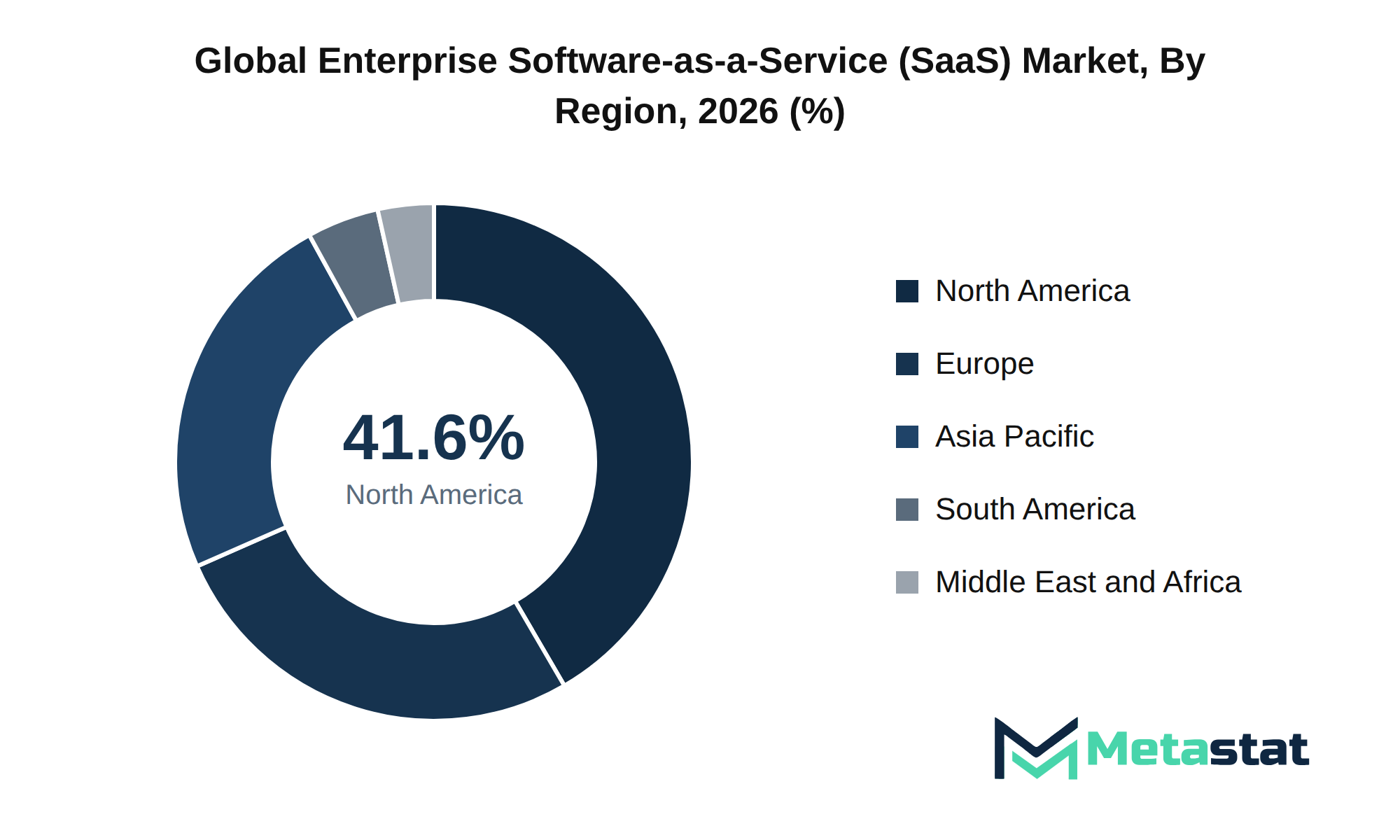
North America holds a prominent position within the Enterprise Software-as-a-Service (SaaS) market, characterized by a strong growth trajectory. The region is set to expand at a CAGR of 11.4% within the forecast period, reaching a market size (TAM) of USD 422.1 billion by the end of 2033. This growth is driven by high adoption rates across various sectors, particularly in the IT and Telecommunications, BFSI, and Healthcare and Life Sciences industries.
The technological infrastructure in the United States, Canada, and Mexico plays a crucial role in facilitating the deployment of SaaS solutions. Ongoing modernization initiatives and a robust demand for digital transformation contribute to enhanced service delivery and operational efficiency across enterprises. The increasing focus on customer relationship management, enterprise resource planning, and human capital management solutions indicates a shift towards comprehensive software solutions that integrate multiple functionalities.
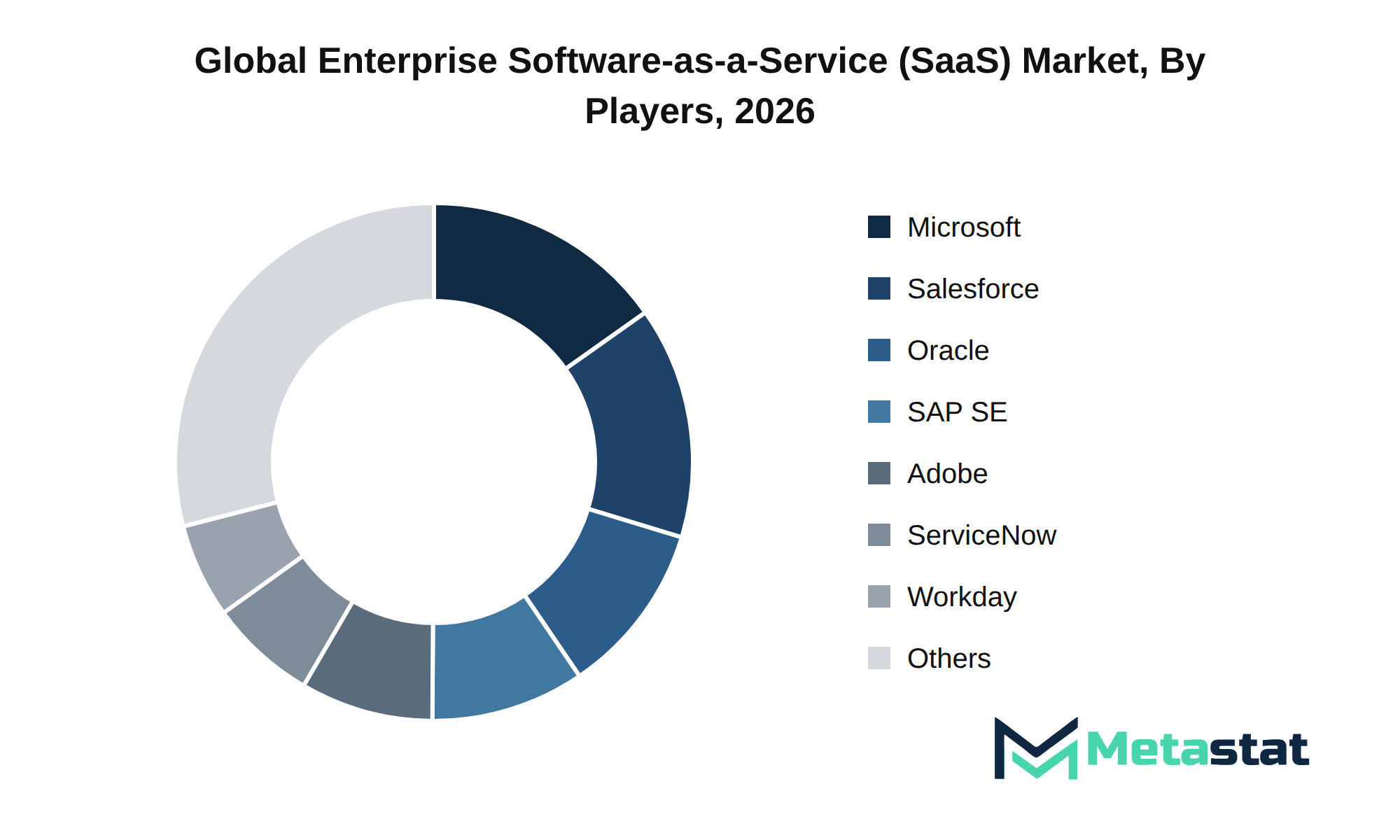
North America accounted for 41.6% of the global market in 2025, highlighting the region's strategic importance in developing and adopting SaaS technologies. The presence of domestic market participants, including Microsoft Corporation and Salesforce, creates a competitive landscape that encourages innovation and investment in new capabilities. Localized procurement dynamics and B2B buying behaviors further influence purchasing decisions, with organizations prioritizing scalable and customizable solutions that align with their operational requirements.
Increasing demand for collaboration and productivity tools reflects the evolving workplace landscape, where remote and hybrid work models become standard. This trend drives investment in solutions that enhance communication and teamwork, ultimately improving efficiency and productivity gains across various sectors. Consequently, the Enterprise Software-as-a-Service (SaaS) market in North America remains poised for substantial growth, driven by a combination of technological advancements and shifting market demands.
Europe represents a significant portion of the global Enterprise Software-as-a-Service (SaaS) market, accounting for 26.8% of the total share in 2025. Demand for SaaS solutions in this region is driven by rapid digital transformation initiatives adopted by businesses across various sectors. Industries including retail, healthcare, and financial services invest in technology to enhance operational efficiencies and customer engagement.
Mature market dynamics contribute to the growth of Enterprise Software-as-a-Service (SaaS) offerings, particularly in established economies like Germany, France, and the UK. High-value replacement cycles prompt organizations to seek advanced solutions that integrate seamlessly with existing infrastructures, facilitating better data management and analytics capabilities.
Regulatory frameworks within Europe influence SaaS adoption, requiring compliance with stringent data protection and privacy laws. Companies prioritize solutions that align with local compliance mandates, ensuring customer trust and security. This emphasis on regulatory adherence, alongside a surge in localized procurement dynamics, promotes increased investment in regional technology providers.
Geopolitical factors shape the competitive landscape. Domestic vendors benefit from nearshoring initiatives, which enhance supply chain resilience and reduce dependency on external markets. Local players strengthen their market positions by offering tailored solutions that address specific regional needs.
Investment patterns in Europe reflect a growing focus on cross-border trade corridors, facilitating collaboration among businesses in neighboring countries. Such dynamics encourage the sharing of best practices and innovative solutions, further stimulating market growth.
Regional dynamics in the Asia-Pacific region significantly influence the Enterprise Software-as-a-Service (SaaS) market, driven by evolving technology adoption and a growing digital economy. Countries including China, Japan, India, and South Korea exhibit high demand for SaaS solutions, supported by rapid urbanization and increasing internet penetration. The region's diverse market landscape creates unique opportunities, particularly in emerging markets like India and Southeast Asia, where organizations pursue modernization initiatives.
Investment in infrastructure modernization enhances SaaS adoption, enabling businesses to streamline operations and improve efficiency. High-value replacement cycles characterize the market, with enterprises prioritizing advanced solutions to replace legacy systems. Regional vendors increasingly focus on localized procurement dynamics, adapting offerings to meet specific cultural and operational needs. These tailored approaches strengthen competitive positions within the market.
The Asia-Pacific region's competitive landscape features several domestic market participants, including Alibaba and Tencent, who actively engage in vendor consolidation trends. Strategic entry barriers, driven by foreign direct investment flows, facilitate geographic expansion windows for both local and international players. This creates a dynamic environment for innovation and collaboration in the development of SaaS solutions.
Overall, the Asia-Pacific region significantly influences the future of the Enterprise Software-as-a-Service (SaaS) market, with increasing investments and commitment to digital transformation. The ongoing drive toward localized manufacturing and supply chain regionalization further enhances the region's status because a key player in the global SaaS ecosystem.
The Enterprise Software-as-a-Service (SaaS) market in South America experiences notable growth potential, driven by increasing digital transformation efforts across various sectors. Brazil and Argentina lead the market, with ongoing infrastructure modernization initiatives enhancing connectivity and accessibility to advanced technological solutions.
The region's share of the global market is projected at 4.5% in 2025, indicating a growing interest in SaaS solutions among businesses. Local firms increasingly adopt these technologies to improve operational efficiency and enhance customer engagement, reflecting broader trends in regional business practices.
Investment in localized manufacturing densities and supply chain regionalization supports the market's expansion. Companies focus on meeting local compliance mandates, driving demand for software solutions that enable regulatory adherence.
The competitive landscape features a mix of domestic market participants and international players, creating a dynamic environment for innovation and collaboration. Strategic entry barriers exist, but foreign direct investment flows into the region indicate confidence in growth opportunities, particularly within small and medium enterprises.
Overall, ongoing shifts in regional B2B buying behaviors and cultural nuances shape the adoption of Enterprise Software-as-a-Service (SaaS) solutions, positioning South America because a key player in the global market's trajectory.
Growth in the Enterprise Software-as-a-Service (SaaS) market across the Middle East and Africa benefits from increasing digital transformation initiatives. Countries including Saudi Arabia and the UAE invest significantly in technology to modernize their infrastructures, driving demand for SaaS solutions. The region's share of the global market reached 3.5% in 2025, reflecting a growing recognition of the operational efficiencies SaaS provides.
Emerging market front-runners in the region leverage localized procurement dynamics to align with cultural nuances and regional B2B buying behaviours. South Africa demonstrates robust adoption rates, with organizations prioritizing scalability and flexibility in their software solutions. This trend creates a competitive landscape characterized by domestic market participants enhancing their offerings.
Incremental growth vectors arise from high-value replacement cycles and supply chain regionalization. Local enterprises increasingly adopt SaaS models to streamline operations, improve customer engagement, and enhance data analytics capabilities, positioning themselves for future growth. The focus on infrastructure modernization drives further investment opportunities in the market.
Strategic entry barriers remain significant due to varying geographic regulatory frameworks and local compliance mandates. Foreign direct investment (FDI) flows into the region reflect confidence in its potential, with companies seeking to expand their presence. Cross-border trade corridors facilitate the exchange of technology and resources, reinforcing market growth.
Overall, the Enterprise Software-as-a-Service (SaaS) market in the Middle East and Africa experiences steady advancement driven by technological adoption and a shift towards digital transformation strategies. Ongoing investments in infrastructure and modernization are expected to enhance the region's market dynamics.
Major players in the Enterprise Software-as-a-Service (SaaS) market engage in various strategies to enhance their market position and drive growth. Mergers and acquisitions have played a crucial role in consolidating capabilities, allowing companies to expand their service offerings and leverage synergies. For instance, strategic alliances and partnerships enable firms to integrate complementary technologies, creating value-added solutions that meet diverse customer needs.
Product differentiation remains a key focus, with companies investing significantly in research and development pipelines to innovate their offerings. Proprietary technology moats provide a competitive edge, ensuring that firms maintain their market relevance. Effective go-to-market strategies, encompassing tailored commercial models, enhance customer acquisition and retention efforts. The threat of new entrants fuels continuous innovation, prompting established players to fortify their brand equity and strengthen their market positions.
The robust competitive environment drives dynamic pricing architectures, with firms adjusting their pricing strategies to optimize revenue streams while balancing customer value perception. Intellectual property portfolios serve because a critical asset, contributing to technological defensibility in an increasingly crowded marketplace. Overall, the competitive outlook for the Enterprise Software-as-a-Service (SaaS) market points to sustained growth, with established players continually adapting to evolving market demands and competitive pressures.
Market size is forecast to rise from USD 468.2 billion in 2025 to over USD 1,110.9 billion by 2033. The base case reflects a growth trajectory with a CAGR of 11.4%. In this scenario, increasing digital transformation initiatives and the necessity for operational efficiency drive demand for the Enterprise Software-as-a-Service (SaaS) market.
In a bullish case, rapid technological advancements and an accelerating shift towards cloud solutions could result in demand exceeding projections, reflecting a heightened urgency among enterprises to adopt innovative solutions. Conversely, the bearish case highlights economic uncertainty, which could stifle investment and slow adoption rates, impacting growth in specific segments.
Macroeconomic factors, including inflationary pressures and changes in consumer behavior, influence downstream demand for enterprise solutions. The market experiences structural shifts toward remote work and digital collaboration, requiring organizations to adapt their technology stacks to support new operational models.
Integration of next-generation technologies, including artificial intelligence and machine learning, enhances the functionality of SaaS applications, driving further adoption across industries. R&D commercialization timelines indicate that emerging technologies will significantly influence the product life cycle, creating opportunities for innovation and differentiation within the market.
Regulatory evolution, including compliance mandates and policy enforcement horizons, impacts the strategic direction of the market. Companies prioritize compliance because it is a key element of their SaaS offerings to ensure customer trust and mitigate legal risks.
Geopolitical realignments and evolving trade corridors create complexities within global supply chains. Organizations adapt their strategies to manage risks associated with international trade and supply chain disruptions, enhancing their resilience and agility.
Strategic capital allocation directives focus on infrastructure commitments and CapEx investment vectors, supporting the expansion of SaaS capabilities. Enterprises identify emerging white-space opportunities and unmet needs, highlighting high-growth pockets within specific verticals including healthcare and finance.
Executive-level strategic imperatives emphasize the importance of defensibility roadmaps and future growth recommendations. Organizations recognize the necessity of developing agile strategies to navigate market fluctuations and capitalize on evolving enterprise needs.
The report strategically identifies and profiles the key market players and analyses their core competencies in each sub-segment of the Enterprise Software-as-a-Service (SaaS) market.
Report Attributes | Details |
Study Period | 2021-2033 |
Base Year | 2025 |
Estimated Year | 2026 |
Forecast Period | 2026-2033 |
Historical Period | 2021-2025 |
Growth Rate | CAGR 11.4% from 2026 to 2033 |
Revenue Unit | USD billion |
Segmentation | By Type, Organization Size, Subscription Model, End-Use Industry, and Region |
By Region | North America (By Type, Organization Size, Subscription Model, End-Use Industry, and Country)
|
Europe (By Type, Organization Size, Subscription Model, End-Use Industry, and Country)
| |
Asia Pacific (By Type, Organization Size, Subscription Model, End-Use Industry, and Country)
| |
South America (By Type, Organization Size, Subscription Model, End-Use Industry, and Country)
| |
Middle East and Africa (By Type, Organization Size, Subscription Model, End-Use Industry, and Country)
|
Find answers to common questions about this report
The Enterprise Software-as-a-Service (SaaS) market size was valued at USD 468.2 billion in 2025, according to the Metastat Insights study.
The Enterprise Software-as-a-Service (SaaS) market is projected to grow at a CAGR of 11.4% during the forecast period from 2026 to 2033.
The North America Enterprise Software-as-a-Service (SaaS) market size is estimated to reach USD 422.1 billion by 2033.
The Customer Relationship Management segment leads the Enterprise Software-as-a-Service (SaaS) market, with a projected value of USD 178.5 billion by 2033. This segment demonstrates significant growth potential compared to other types.
Key drivers for the Enterprise Software-as-a-Service (SaaS) market include the pursuit of digital transformation, cost-efficiency initiatives, and the need for enhanced operational performance. Organizations prioritize innovative solutions to streamline processes, improve customer experiences, and adapt to market dynamics, driving demand for scalable SaaS offerings.
North America holds the dominant share of the Enterprise Software-as-a-Service (SaaS) market, with a value of USD 422.1 billion projected for 2033, representing 41.6 percent of the total market.
The Enterprise Software-as-a-Service (SaaS) market growth is restrained by increasing regulatory compliance costs, economic pressures including inflation, and a shortage of skilled labor. These challenges create barriers for smaller firms and hinder investments in innovative software solutions, impacting overall market penetration and adoption rates.
Digital transformation significantly influences product adoption in the Enterprise Software-as-a-Service (SaaS) market. Organizations pursue innovative solutions to enhance operational efficiency, improve customer experiences, and adapt to evolving market dynamics, driving demand for scalable and cost-effective SaaS offerings.
The Enterprise Software-as-a-Service (SaaS) market is estimated to reach a valuation of USD 1,110.9 billion by 2033.
Key players in the Enterprise Software-as-a-Service (SaaS) market include Microsoft Corporation, Salesforce, Inc., Oracle Corporation, SAP SE, Adobe Inc., and ServiceNow, Inc.
The analysts below cover Information & Technology research at Metastat Insights.
LEAD ANALYST
Utkarsh Khirodkar is a Lead Market Research Analyst at MetaStat Insight, specializing in market intelligence, technology sector assessments, and competitive strategy.

PRINCIPAL CONSULTANT - ENTERPRISE AI & EMERGING TECHNOLOGIES
Banking & Finance · Electronics and Semiconductor · Energy and Power · Healthcare IT · Information & Technology · Professional Services
Vijay Gunti is a Principal Consultant at MetaStat Insight, bringing over two decades of experience across enterprise digital transformation, technology strategy, and intelligent systems.

LEAD CONSULTANT - COMMUNICATION, TELECOM, AND IT
Electronics and Semiconductor · Information & Technology · Machinery & Equipment · Professional Services
Ravindra Sathe Consultants for Communication, Telecom, and IT at MetaStat Insight. He leads the firm's industry research initiatives across telecommunications infrastructure, digital connectivity, enterprise networking, and emerging information technology domains.
In the biological seed treatment space, registration timelines vary drastically between the European Union, Brazil, and North America. The MetaStat Insight research handled these cross-border regulatory barriers with genuine nuance, mapping commercialization pathways alongside historical field adoption rates. The segmentation between microbial strains and biochemical active ingredients was particularly well structured.
Our team was tracking whether regional recycling infrastructure could realistically absorb the growing volume of lithium iron phosphate batteries over the next decade. The report did a solid job separating announced hydrometallurgical plant capacity from active, permitted operational throughput. That distinction made the feedstock availability projections and regional recovery rate models far more credible than standard commercial overviews.
Tracking capacity expansion in single-use bioprocessing requires dependable data on raw material availability and cleanroom-grade polymer supply chains. The competitive landscape chapter gave a grounded evaluation of secondary component suppliers across North America and Asia-Pacific rather than simply reprinting press releases. Having that level of supplier benchmarking helped clarify dual-sourcing considerations for our clinical pipeline planning.
Explore related market intelligence reports worth reading alongside this one.