
LEAD ANALYST
Utkarsh Khirodkar is a Lead Market Research Analyst at MetaStat Insight, specializing in market intelligence, technology sector assessments, and competitive strategy.

Global Creative Advertising Services Market Size, Share, By Service Type (Creative Strategy and Campaign Development, Content Creation and Production, Brand Development and Identity Design, Graphic Design and Visual Communication, Social Media Creative Services, Advertising Copywriting, Experiential and Event-Based Advertising, Digital and Interactive Creative Development, Others), By Advertising Medium (Digital Advertising, Print Advertising, Television Advertising, Radio and Digital Audio Advertising, Social Media Advertising, Outdoor Advertising, Cinema Advertising, Others), By End-Use Industry (Consumer Goods and FMCG, Retail and E-commerce, Automotive and Mobility, Banking, Financial Services and Insurance, Information Technology and Telecommunications, Healthcare and Pharmaceuticals, Food and Beverage, Travel, Tourism and Hospitality, Media and Entertainment, Others), Industry Analysis, Growth, Trends, and Forecast, 2026-2033
Report ID
MSI-5769
Published
November, 2026
Pages
261 Pages
Format
Historical
Base year
Forecast
Forecast period
Report Details
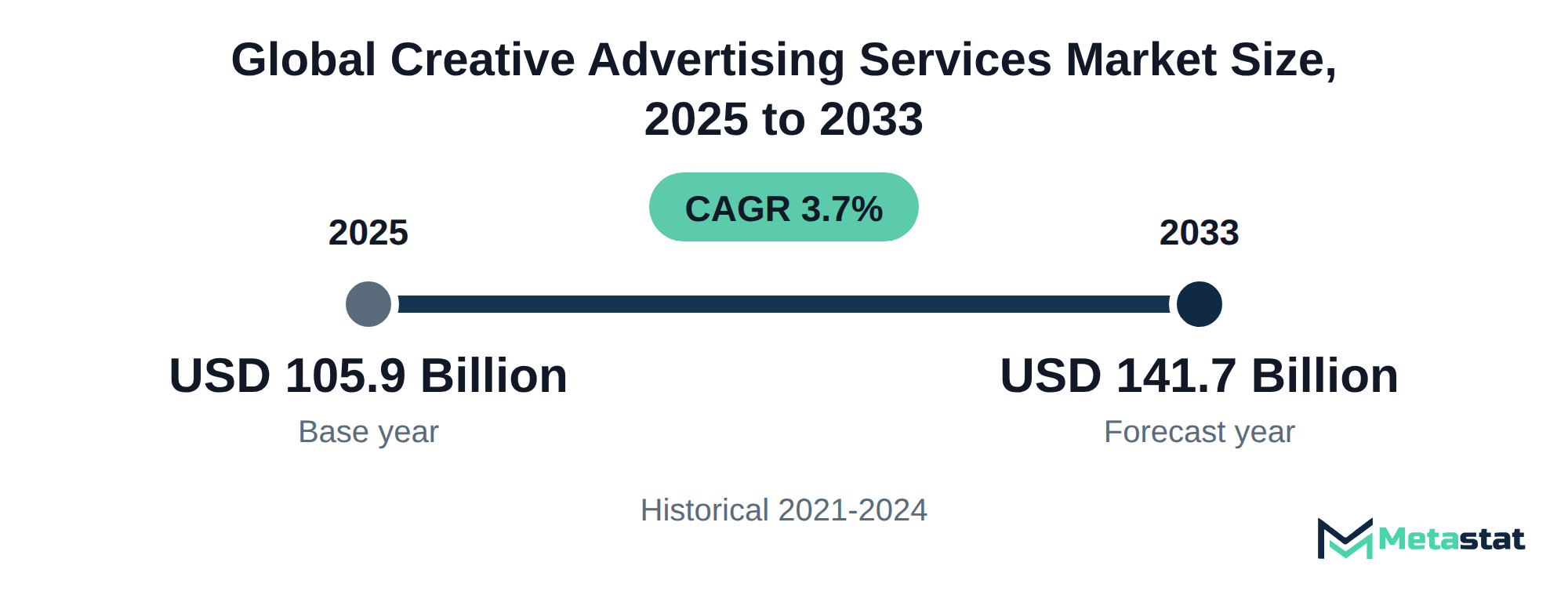
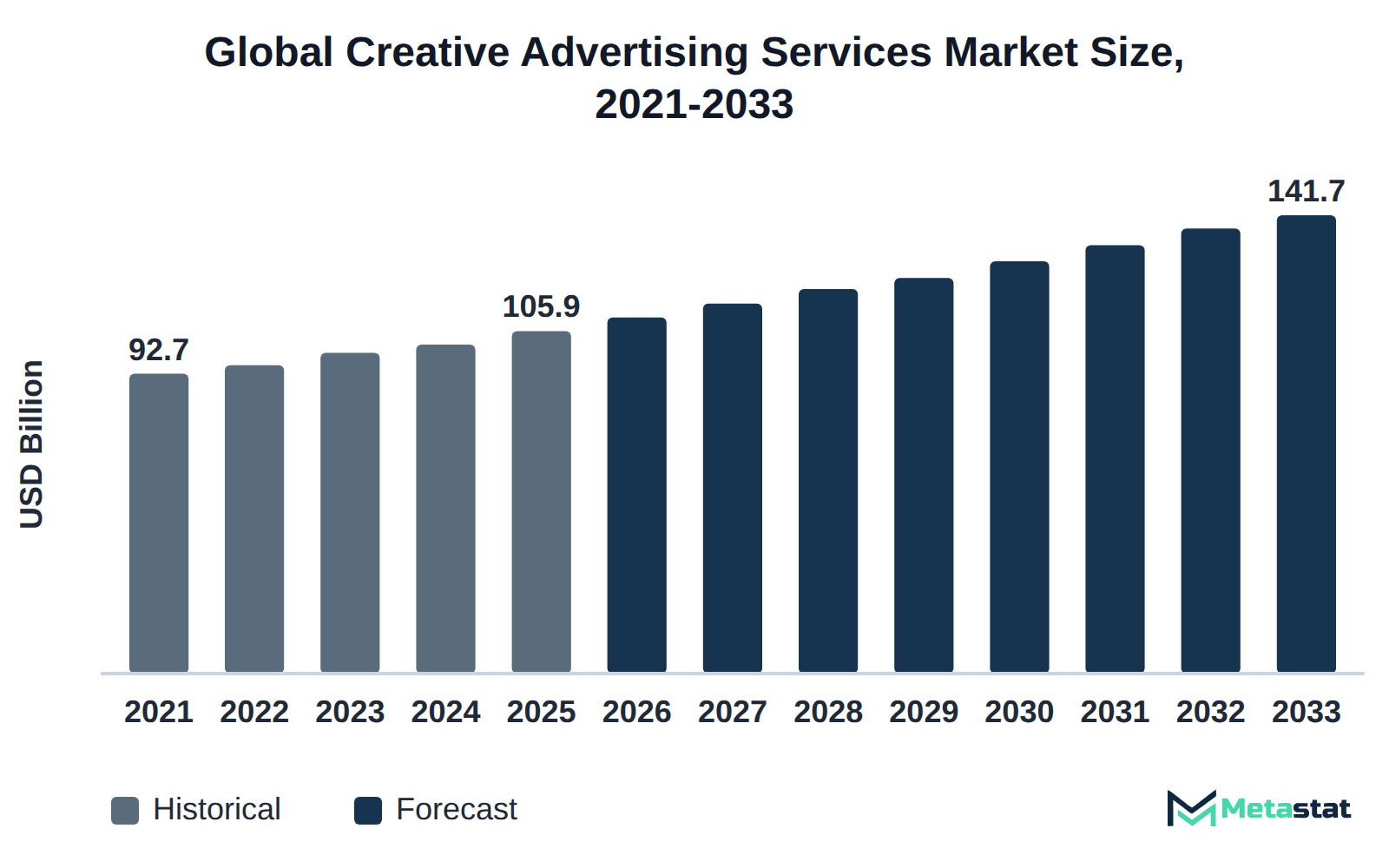
Market Valuation: Valued at $105.9 Billion in 2025, projected to reach $141.7 Billion by 2033 at a 3.7% CAGR.
Dominant Segment: Digital Advertising leads the market, driven by the growing demand for personalized advertising experiences that connect with consumers on digital platforms.
Geographic Lead: North America holds the largest market share at 38.0% in 2025, with the US projected to maintain its leadership position in 2026 due to strong digital advertising investments.
What's Inside: The report provides a comprehensive analysis of the Creative Advertising Services market, including competitive coverage, service type segmentation, and forecasts from 2026 to 2033.
Emerging Trends: The integration of AI-driven creative production and personalized content strategies is reshaping how brands engage with consumers, enhancing overall campaign effectiveness.
Industry-Specific Demand: The retail and FMCG sectors show significant demand for Creative Advertising Services, with the FMCG segment expected to grow from USD 19.4 billion in 2026 to USD 23.8 billion by 2033.
Choose Your License
Global Creative Advertising Services Market
The global Creative Advertising Services market was valued at USD 105.9 billion in 2025 and is projected to reach USD 141.7 billion by 2033, growing at a CAGR of 3.7% over the forecast period.
The Creative Advertising Services market encompasses a range of services aimed at enhancing brand visibility and engagement through various advertising mediums. These services form the creative segment of the broader advertising services industry. Businesses invest in these services to effectively communicate their brand messages, attract new customers, and retain existing ones. The increasing emphasis on digital transformation among companies drives demand for innovative advertising solutions that capture audience attention and deliver measurable results.
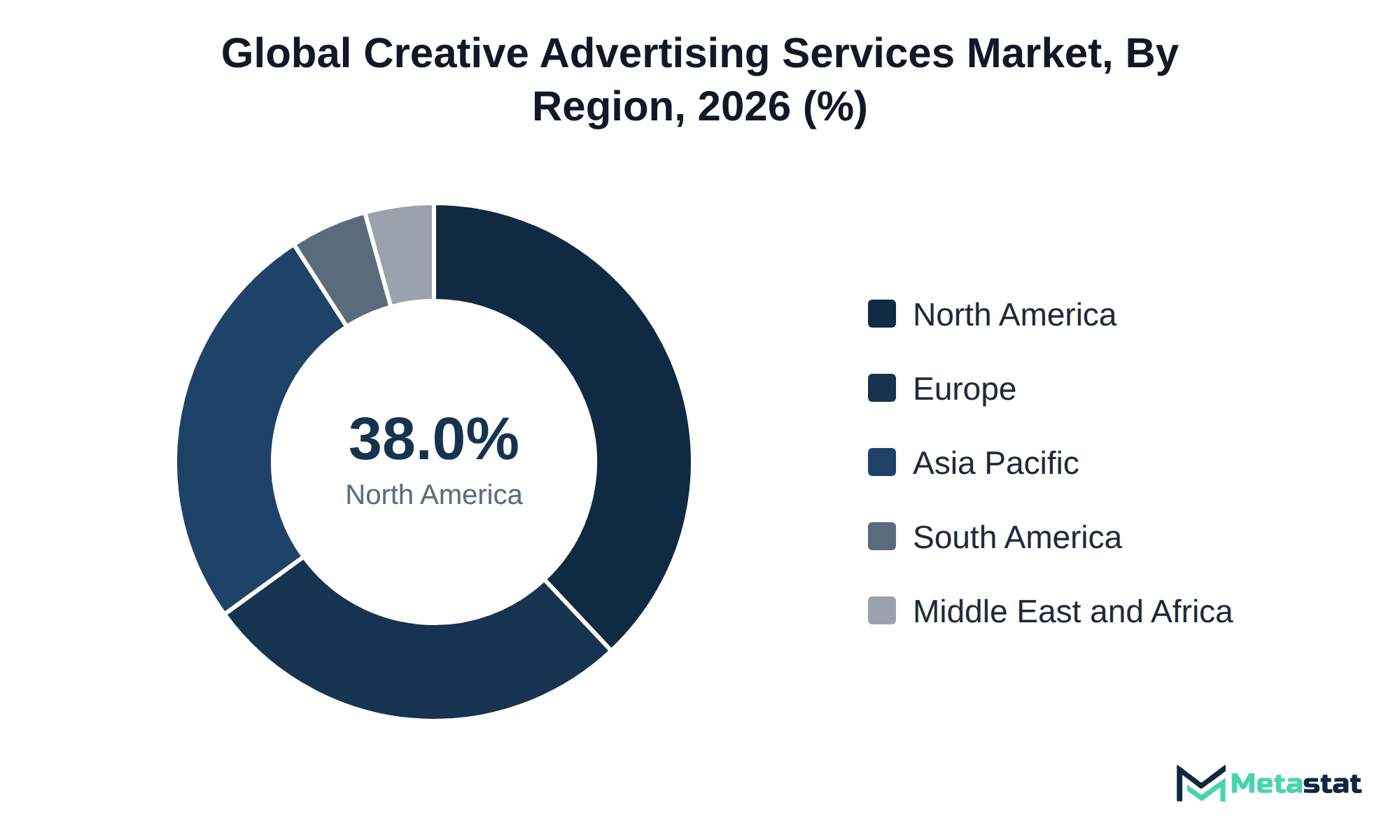
Growth in the market is primarily fueled by rising expenditure on digital advertising channels. The segment of Digital Advertising holds the most significant value, reflecting the shift in consumer behavior towards online platforms. North America holds 38.0% of the market in 2025, with the US leading in 2026. In comparison, Europe and Asia Pacific follow with 27.0% and 25.9%, respectively, while South America and the Middle East and Africa account for smaller shares of 4.8% and 4.3%.
Demand for effective advertising strategies stems from the need for brands to differentiate themselves in a competitive environment. Companies in sectors including Retail and E-commerce leverage creative advertising services to enhance customer engagement and drive sales. This focus on creative strategy supports market expansion and keeps advertising aligned with changing consumer preferences and technology.
The Creative Advertising Services market addresses the increasing demand for innovative marketing strategies across various industries. Buyers invest in these services to create effective advertising that connects with target audiences, enhancing brand recognition and customer loyalty. Factors driving spending include the need for businesses to maintain a competitive edge in a crowded marketplace and the growing significance of digital channels for effective outreach.
Growth within the market is driven by the rapid expansion of digital advertising, which captures the largest share of overall spending. The segment of Content Creation and Production stands out, reflecting the increasing focus on quality content in effective marketing strategies.
Businesses increasingly prioritize personalized and interactive advertising experiences, enhancing engagement and establishing a deeper connection with consumers. This trend towards customization aligns with consumer expectations, urging companies to adapt their advertising approaches accordingly. Ongoing technology advances support this growth by enabling more efficient and creative advertising solutions in the Creative Advertising Services market.
AI-driven creative production is reshaping advertising campaign development within the Creative Advertising Services market. Generative AI in marketing enables marketers to produce content faster and with greater personalization, enhancing audience engagement. For instance, the segment of Content Creation and Production is projected to reach USD 26.5 billion by 2033, reflecting a compounded annual growth rate of 4%. The integration of AI tools allows for real-time data analysis, optimizing creative strategies according to consumer preferences and behavior.
The use of artificial intelligence in creative strategy development transforms how advertisers approach their campaigns. Traditional methods often rely on broad demographic targeting, while AI facilitates hyper-targeted messaging that aligns closely with individual consumer interests. This shift drives efficiency and effectiveness, resulting in higher conversion rates and reduced marketing costs. AI tools analyze vast datasets, providing insights that help refine creative concepts before launch. These capabilities increase the overall impact of advertising campaigns.
Investments in digital-first brand storytelling have shown strong growth within the Creative Advertising Services market. The transition from traditional advertising methods to digital platforms necessitates a shift in pricing and contract models. Many firms adopt performance-based pricing, where fees align with the success of the campaign, ensuring mutual benefit for both clients and service providers. This approach enhances accountability and drives effective resource allocation.
The projected growth for digital advertising, expected to reach USD 49.8 billion by 2033, reflects the increasing reliance on digital strategies. This trend encourages agencies to innovate pricing strategies to attract a broader client base, particularly in sectors including retail and e-commerce, where digital presence is critical. Emphasizing transparency in fee structures and performance metrics improves client trust and establishes long-term partnerships. These developments shape competition in the market and push agencies to refine their offerings continually.
The retail and fast-moving consumer goods (FMCG) sectors exhibit a pronounced demand for Creative Advertising Services tailored to their unique characteristics. In 2026, the FMCG segment is projected to generate USD 19.4 billion in advertising expenditures, with expectations for growth to USD 23.8 billion by 2033. This upward trajectory reflects heightened competition among brands vying for consumer attention in a crowded marketplace.
Distinct from other industries, retail and FMCG firms require advertising strategies that emphasize quick consumer engagement and brand loyalty. Digital advertising plays a crucial role in this sector, with an anticipated growth rate of 4.9% from 2026 to 2033. This growth aligns with increasing reliance on online platforms for product discovery and purchase decisions. The Creative Advertising Services market provides innovative solutions to enhance brand visibility and create effective campaigns that connect with consumers, driving higher conversion rates.
Such tailored advertising efforts result in significant commercial benefits, enabling retailers and FMCG brands to maximize their marketing investments. Gains in market share and customer retention reinforce the relevance of specialized Creative Advertising Services for these industries and support sustained market growth.
Personalization, generative AI, and interactive media transform the Creative Advertising Services market, targeting consumer preferences with precision. The increasing integration of these technologies allows brands to deliver tailored content that connects with individual audiences. For instance, digital advertising is projected to expand from USD 35.7 billion in 2026 to USD 49.8 billion by 2033, reflecting a compound annual growth rate of 4.9%. This growth signifies a strong shift towards personalized marketing strategies, where businesses leverage data analytics to enhance engagement and drive conversions.
Generative AI transforms content creation in the Creative Advertising Services market by enabling rapid development of creative assets. With tools that automate design and copywriting processes, agencies enhance their capacity to produce high-quality content efficiently. This shift addresses the growing demand for fresh and engaging materials, particularly in sectors including consumer goods and FMCG, where the segment is expected to increase from USD 19.4 billion in 2026 to USD 23.8 billion by 2033. Efficiency gains from generative AI allow advertisers to allocate resources more strategically, which encourages innovation and improves competitive positioning.
Interactive media strategies significantly influence how brands connect with consumers within the Creative Advertising Services market. Engaging formats, including augmented reality and interactive storytelling, encourage deeper consumer interaction, building brand loyalty. The retail and e-commerce sector demonstrates this trend, with growth anticipated to reach USD 24.7 billion by 2033, driven by immersive experiences that captivate audiences. This emphasis on interactivity improves the user experience and generates valuable data insights that inform future campaigns.
Marketers increasingly emphasize digital advertising due to its effectiveness in reaching diverse audiences. Brands across various sectors, particularly in retail and e-commerce, shift their budgets toward digital channels to enhance engagement and drive sales. This transition stems from the growing dominance of online platforms and consumers' preference for digital content. Brands allocate more resources toward innovative digital strategies, recognizing the necessity to adapt to evolving consumer behaviors and preferences. The shift toward digital advertising optimizes marketing spend and improves campaign performance, increasing the volume of advertising activity in the market.
Advancements in technology enhance content creation capabilities within the Creative Advertising Services market. New tools and platforms enable advertisers to produce high-quality, engaging content tailored to specific audience segments. This technological evolution drives a shift towards more dynamic and interactive advertising, appealing to consumer preferences for personalized experiences. Companies using these tools optimize their campaigns across advertising mediums, which improves engagement rates and return on investment.
Increased demand for visually appealing content drives investment in graphic design and visual communication design services. These services play a crucial role in crafting compelling narratives that connect with consumers, particularly in the digital advertising space. Enhanced production capabilities contribute to faster turnaround times and wider distribution options, enabling brands to maintain relevance in a rapidly changing market. Consequently, the Creative Advertising Services market experiences steady growth while companies prioritize innovative content strategies to remain competitive.
Price sensitivity among buyers in the Creative Advertising Services market affects demand, particularly in sectors including retail and consumer goods. Many businesses hesitate to allocate budgets for creative services due to perceptions of high costs associated with innovative advertising strategies. This restraint manifests in slower adoption rates, with companies opting for less costly alternatives or delaying investment in comprehensive advertising campaigns. The presence of numerous substitutes, including in-house marketing teams and less expensive digital platforms, further exacerbates this challenge. Buyers prioritize short-term budget constraints over long-term marketing strategies, hindering their ability to capitalize on the full potential of creative advertising. The emphasis on immediate cost savings over effective advertising leads to reduced orders and weaker creative output in sectors that rely on advertising services.
Talent costs present a significant challenge for suppliers aiming to deliver high-quality Creative Advertising Services. Increased competition for skilled professionals in the advertising sector drives up salary expectations, compelling agencies to allocate larger portions of their budgets to attract and retain top talent. This cost pressure influences profitability and operational efficiency, particularly for smaller firms struggling to compete with larger agencies offering more attractive compensation packages.
In response, suppliers invest in training and development programs to enhance the skills of existing staff while exploring automation and technology solutions that streamline creative processes. By implementing these strategies, firms aim to mitigate rising talent costs while maintaining service quality and meeting client expectations. The Creative Advertising Services market adapts to these pressures, with agencies prioritizing innovative approaches to remain competitive while managing operational costs.
Digital advertising represents the fastest-growing segment within the Creative Advertising Services market, with a projected compound annual growth rate (CAGR) of 4.9% from 2026 to 2033. This growth stems from the increasing move by companies to enhance their online presence and engage consumers through targeted campaigns. Businesses from various industries, particularly consumer goods and retail, drive this demand by allocating significant budgets to digital platforms. The shift towards digital mediums enables brands to reach wider audiences effectively and optimize their advertising strategies. By 2033, the market value for digital advertising is projected to reach USD 49.8 billion, presenting a robust opportunity for service providers focusing on innovative solutions in this domain. The evolving landscape of the advertising ecosystem highlights the need for creative services that align with digital trends and consumer behavior.
The Global Creative Advertising Services market is segmented based on Service Type, Advertising Medium, and End-Use Industry.
Creative Strategy and Campaign Development segment is valued at USD 17.9 billion in 2026 and is projected to reach USD 22.4 billion by 2033, at a CAGR of 3.3% during the forecast period. This segment focuses on creating innovative advertising strategies and campaigns tailored to clients' specific needs, predominantly employed by brands in various industries seeking to enhance their market presence. Factors including the heightened emphasis on strategic brand positioning drive demand in this segment, particularly among consumer goods and retail sectors. Compared to other segments, including Content Creation and Production, which features a higher projected growth rate of 4%, Creative Strategy and Campaign Development presents a more modest growth trajectory, appealing to clients prioritizing long-term brand equity over short-term promotional tactics. The blend of analytical insights and creative ideation differentiates this segment, ensuring relevance in an evolving advertising landscape.
This segment focuses on developing and producing engaging content tailored to various advertising mediums, including digital platforms, television, and print. It serves clients in diverse industries, particularly those requiring compelling narratives to enhance brand identity and reach target audiences. Significant growth in this segment reflects the increasing emphasis on visual storytelling and rich media experiences. Factors driving this growth include the rising demand for high-quality content driven by competitive differentiation and increased consumer engagement. Unlike other segments, including Creative Strategy and Campaign Development, which experiences a CAGR of 3.3%, Content Creation and Production experiences faster growth due to the rapid evolution of digital platforms and consumer expectations for innovative marketing approaches.
Brand Development and Identity Design segment is expected to reach USD 15.5 billion by 2033. This segment focuses on creating and refining a brand's identity through logos, typography, and other visual elements that communicate a brand's essence. Businesses in various industries, including consumer goods and automotive, rely on this segment to establish a strong market presence and build customer loyalty. The segment experiences growth driven by the rising importance of brand recognition in an increasingly competitive environment. While this segment grows at a CAGR of 3.3%, it differs from others in the service type classification, including Content Creation and Production, which is projected to grow at a CAGR of 4%. The emphasis on unique brand identities is a key differentiator, ensuring that companies stand out in saturated markets.
Graphic Design and Visual Communication segment is projected to grow at a CAGR of 3.1% during the forecast period. This segment involves creating visual content that communicates messages through typography, imagery, and layout design. Buyers of these services include businesses across various sectors, particularly those seeking to enhance their branding and marketing efforts. Key demand drivers include the increasing emphasis on brand identity and the growing importance of visual storytelling in marketing strategies. This segment differentiates itself from other service types due to its focus on aesthetics and communication rather than purely functional aspects of advertising. In comparison, segment growth remains slower than that of Content Creation and Production, which is estimated to achieve a CAGR of 4% during the same period. The market continues to evolve, reflecting shifts in consumer preferences and technological advancements.
Social Media Creative Services focuses on creating tailored advertising content for platforms like Facebook, Instagram, Twitter, and TikTok. This service type is used predominantly by brands seeking to enhance engagement with younger demographics who are highly active on social media. The shift towards digital engagement drives demand for innovative and interactive content that connects with target audiences. The growth of this segment is propelled by increasing internet penetration and the adoption of mobile devices, allowing brands to reach wider audiences effectively. Compared to other service types, Social Media Creative Services often experiences faster growth, driven by the rapid evolution of social media trends and user behaviors. Brands leverage this segment to establish a strong online presence and encourage community interaction, distinguishing it from traditional advertising methods that lack the same level of direct consumer engagement. The market continues to adapt to the changing dynamics of social media, influencing content strategies and advertising approaches.
Advertising copywriting focuses on crafting persuasive and engaging text intended to promote products, services, or brands. This segment is employed by various industries, including consumer goods, retail, and automotive, to communicate effectively with target audiences. The increasing demand for compelling narratives that connect with consumers drives the growth of this segment. Marketing campaigns benefit from high-quality copy that captivates potential buyers and influences purchasing decisions. Compared to other segments, advertising copywriting experiences slower growth due to reliance on traditional talent and expertise. However, businesses recognize the importance of storytelling in marketing, and ongoing investment in copywriting services is expected to rise, reflecting a shift toward consumer-centric approaches and enhancing engagement across multiple advertising mediums.
Experiential and Event-Based Advertising engages consumers through immersive experiences and live events, creating memorable brand interactions. This segment attracts businesses seeking to enhance customer engagement and brand loyalty by delivering real-time, sensory experiences. Industries including consumer goods and retail increasingly invest in experiential marketing to differentiate themselves in a competitive landscape. A notable driver for growth includes the rising consumer preference for memorable and interactive experiences over traditional advertisements. This segment differs from others, including Digital Advertising, which demonstrates a higher growth rate due to its expansive reach and lower operational costs. Experiential and Event-Based Advertising emphasizes personal connections, establishing deeper emotional ties with the audience, which sets it apart from more conventional advertising methods.
Digital and Interactive Creative Development encompasses innovative strategies aimed at engaging audiences through digital platforms and interactive experiences. This segment attracts companies looking to enhance their online presence and connect with consumers in a more immersive manner. Increasing consumer demand for personalized and interactive content drives growth within this segment. Businesses across various industries, including retail and entertainment, leverage these services to capture audience attention and build brand loyalty. Compared to other service types, this segment experiences robust demand, largely due to the shift toward digital channels and the rise of interactive media. While consumers seek more engaging experiences, the segment differentiates itself by focusing on advanced technologies and creative methodologies, ensuring its relevance in the evolving market.
This segment encompasses various creative advertising services, including shopper marketing and influencer creative services. Businesses engage consumers effectively and enhance brand visibility through these offerings. Influencer marketing has gained significant traction, driven by the shift toward authentic endorsements from relatable figures, which connects well with target audiences. This segment differentiates itself from others through its focus on direct consumer engagement and reliance on social media platforms for execution. The rapid growth of e-commerce increases the significance of influencer marketing as brands seek innovative ways to connect with potential buyers. While other segments rely heavily on traditional methods, this area emphasizes a more contemporary approach, appealing to a digitally savvy audience. The unique characteristics of this sub-segment position it favorably within the broader Creative Advertising Services market, catering to evolving consumer preferences and trends.
This segment serves various industries, including retail, consumer goods, and technology, facilitating targeted marketing efforts that enhance brand visibility. A significant driver of this segment involves the growing demand for personalized advertising experiences, connecting with consumers on digital platforms. Investment in data analytics and targeted marketing strategies further strengthens this segment, resulting in a more effective reach for advertisers. Compared to Print Advertising, which is projected to grow at a CAGR of 2%, Digital Advertising exhibits a faster growth trajectory, highlighting the shift toward online engagement in the Creative Advertising Services market. This trend underscores the importance of adapting marketing strategies to leverage digital channels effectively.
Print Advertising segment is estimated to reach USD 12.6 billion by 2033, at a CAGR of 2% during the forecast period. This medium is significant in traditional marketing strategies, targeting audiences through newspapers, magazines, and brochures. Businesses engage in print advertising to enhance brand visibility and convey detailed messages effectively, particularly in industries like retail and consumer goods. The relatively slower growth of this segment compared to others, including Digital Advertising, is driven by the increasing shift towards online channels for engagement and interaction. However, within specific demographics, print advertising remains a valuable tool for reaching certain customer segments that appreciate tangible and physical media. This established method continues to coexist alongside digital strategies, offering an alternative that complements the evolving landscape of the Creative Advertising Services market.
Television Advertising segment is expected to reach USD 16.2 billion by 2033. This segment focuses on promoting products and services through commercial content aired on television networks, appealing particularly to consumer goods and automotive industries. The demand for this segment is driven by traditional advertisers seeking to reach a broad audience. While digital advertising experiences faster growth, the television advertising segment maintains a stable presence due to its ability to target diverse demographics and enhance brand visibility. The segment's compound annual growth rate (CAGR) stands lower at 2% compared to the 4.9% of digital advertising. Budget allocations toward television advertising remain significant, reflecting its enduring relevance despite the rising prominence of digital channels. Increased competition in other advertising mediums presents a challenge to the television segment; however, it continues to attract substantial investment from established brands aiming to leverage its reach.
Radio and Digital Audio Advertising segment is projected to grow at a CAGR of 2.6% during the forecast period. This segment encompasses traditional radio advertising and advertising on digital audio platforms like streaming services and podcasts. Brands targeting specific demographics utilize this form of advertising to enhance engagement with their audiences. One significant factor influencing this segment involves the growing popularity of on-demand audio content, which attracts larger audiences to digital platforms. Compared to other advertising mediums, this segment experiences slower growth due to competition from digital advertising, which is anticipated to reach USD 49.8 billion by 2033. Advertisers find Radio and Digital Audio Advertising less costly than television advertising, and it offers distinct opportunities for niche marketing.
Social Media Advertising focuses on creating targeted advertising content for various social media platforms, employing unique strategies to engage users effectively. Businesses leverage this segment to promote products and services by reaching audiences directly through channels like Facebook, Instagram, and Twitter. Factors driving growth in this segment include the rising usage of social media among consumers and the increasing demand for personalized advertising experiences. This segment offers distinct advantages over traditional advertising methods due to its ability to facilitate real-time engagement and interactions with target demographics. With a growing emphasis on data analytics and user engagement metrics, advertisers continue to refine their strategies, positioning Social Media Advertising as a vital aspect of the Creative Advertising Services market. Its dynamic nature encourages brands to innovate continuously, differentiating it from other segments that rely on more static advertising approaches.
Outdoor advertising, encompassing out-of-home (OOH) and digital out-of-home (DOOH) formats, serves a significant role in capturing consumer attention in public spaces. This segment appeals to brands aiming to enhance visibility and engage audiences in everyday environments, including transit systems, retail locations, and outdoor venues. Enhanced technological integration within the DOOH format allows for dynamic content that adapts based on real-time factors including audience demographics and weather conditions. Demand for outdoor advertising experiences fluctuations driven by urbanization and increased consumer mobility, with advertisers seeking to reach audiences on-the-go. Compared to other advertising mediums, this segment often faces higher production costs due to the need for larger display formats and strategic placement; however, it provides unique opportunities for brand storytelling and audience engagement. The Creative Advertising Services market experiences active competition within this segment, encouraging innovation and diverse creative strategies aimed at maximizing advertising effectiveness.
Cinema Advertising focuses on presenting advertisements before, during, or after film screenings, targeting audiences in a unique environment. This segment attracts various industries, including consumer goods and entertainment, seeking to engage viewers during their cinema experience. A driving force behind this segment is the growing trend of experiential marketing, where brands aim to provide immersive experiences that connect with consumers. Cinema advertising differs from other advertising mediums in its ability to create an emotional connection with audiences, leveraging the shared viewing experience, which remains distinct from digital or print formats. This segment does not show the rapid growth seen in digital advertising. It still holds an important place in broader advertising strategies within the Creative Advertising Services market, complementing other media and reinforcing brand messaging.
This sub-segment encompasses both Direct Mail and In-Store Advertising. Direct Mail employs physical mail to reach consumers directly, while In-Store Advertising focuses on engaging customers within retail environments. This approach draws interest from brands in various sectors, including consumer goods and retail, aiming to enhance customer engagement and drive sales. The growth of this segment is influenced by the increasing demand for personalized marketing strategies that connect directly with target audiences. These methods differ from digital advertising approaches, which experience faster growth rates due to rising online engagement. Higher production costs associated with physical materials restrict several businesses from fully leveraging this advertising medium, making it essential for brands to evaluate their marketing budgets and strategies critically. The Creative Advertising Services market continues to evolve, with this sub-segment addressing the needs of traditional marketing approaches.
This segment serves brands involved in consumer goods, including food, beverages, and household products, aiming to enhance brand recognition and drive sales through effective advertising strategies. Growth in this segment is driven by increasing consumer spending and the rising demand for innovative marketing approaches. Retailers and manufacturers invest in creative advertising to differentiate their offerings in a highly competitive market. Compared to other segments, the Consumer Goods and FMCG sector experiences steady growth, supported by consistent consumer demand and adaptive advertising strategies that connect with target audiences. In contrast, segments like Retail and E-commerce exhibit a higher CAGR of 5.2%, indicating faster growth potential due to the increasing shift toward online shopping.
The Retail and E-commerce segment is estimated to reach USD 24.7 billion by 2033, at a CAGR of 5.2% during the forecast period. This segment serves retailers and e-commerce companies looking to enhance their brand visibility and customer engagement through targeted advertising strategies. Growth in this segment results from the increasing shift towards online shopping and the rising demand for personalized marketing solutions. The Retail and E-commerce segment demonstrates faster growth compared to other segments in the market, driven by evolving consumer preferences and advancements in digital marketing technologies. This segment benefits from tailored advertising campaigns that connect with consumers, distinguishing it from more traditional advertising methods used in sectors like Automotive and Mobility.
The Automotive and Mobility segment is expected to reach USD 14.9 billion by 2033. This segment comprises advertising services targeted at automotive manufacturers, dealerships, and mobility service providers, highlighting vehicle features, promotions, and brand positioning. Rapid technological advancements in electric and autonomous vehicles drive interest and investment in tailored advertising strategies. Increasing competition among automotive brands compels organizations to adopt innovative marketing approaches to capture consumer attention. Compared to other segments in the market, the Automotive and Mobility segment features a unique focus on integrating digital platforms with traditional media, ensuring comprehensive reach to potential buyers. This segment is projected to grow at a CAGR of 3.3%, indicating steady demand alongside evolving consumer preferences in the automotive landscape.
The Banking, Financial Services and Insurance segment is projected to grow at a CAGR of 3.3% during the forecast period. This segment primarily serves banks, investment firms, and insurance companies seeking to enhance brand visibility and attract customers through effective advertising strategies. A significant driver for this segment stems from increasing competition among financial institutions, pushing them to invest in creative advertising services to differentiate their offerings. Unlike other segments, this sub-segment often experiences slower growth, primarily due to stringent regulatory environments that restrict marketing practices. The reliance on traditional channels, along with a cautious approach to innovative advertising tactics, further distinguishes it from faster-growing segments including Retail and E-commerce. Overall, the focus on building trust and brand loyalty within this sector remains crucial for effective advertising strategies, reflecting the unique nuances of the Creative Advertising Services market.
Information Technology and Telecommunications encompasses services tailored to improve brands within the tech sector. Organizations in this field apply creative advertising to differentiate themselves in a highly competitive landscape. This segment experiences growth driven by rapid technological advancements and the ongoing digital transformation across industries. Companies increasingly allocate budgets toward innovative campaigns that include digital marketing and social media strategies to engage tech-savvy consumers. Compared to other segments, this area often sees higher spending per campaign, reflecting the premium placed on effective communication of complex technological offerings. Enhanced consumer engagement through personalized advertising remains a critical focus for businesses aiming to connect meaningfully with their audience. Understanding the nuances of technology-driven consumer behavior remains essential for advertisers targeting this segment.
The Healthcare and Pharmaceuticals segment encompasses a range of advertising services tailored specifically for medical products, pharmaceutical companies, and healthcare providers. This sub-segment focuses on creating informative and engaging content that informs patients and healthcare professionals about various treatments and medications. Regulatory requirements significantly influence this segment, requiring compliance with strict guidelines regarding advertising practices. Firms in this segment face unique challenges in crafting compelling campaigns while adhering to these regulations. Compared to other segments, this sub-segment experiences slower growth due to these stringent regulations, which limit the scope of marketing initiatives. The Creative Advertising Services market continues to evolve, with healthcare companies increasingly seeking innovative approaches to reach their target audiences effectively.
The Food and Beverage sub-segment focuses on advertising services tailored for the food and beverage industry. Companies in this sector apply these services to enhance brand visibility, promote new products, and engage consumers through various marketing channels. Demand within this segment is driven by trends in consumer preferences and the growing importance of health and wellness in food choices. Brand loyalty significantly influences purchasing decisions in this industry, leading to increased investment in creative advertising strategies. Compared to other segments, this sub-segment experiences relatively slower growth, reflecting the competitive nature of the market and the necessity for brands to differentiate themselves. The Food and Beverage sub-segment emphasizes experiential marketing campaigns that connect with consumers, a strategy that diverges from traditional advertising methods seen in other sectors. The Creative Advertising Services market shapes brand narratives and drives consumer engagement in this evolving environment.
This sub-segment primarily focuses on advertising services tailored for the travel, tourism, and hospitality industries. Stakeholders including hotels, airlines, tour operators, and travel agencies employ these services to enhance their visibility, attract customers, and promote unique travel experiences. Increasing consumer interest in travel experiences drives demand, particularly post-pandemic, with individuals seeking leisure and adventure opportunities. In comparison to other segments, this sub-segment often faces higher costs due to the need for specialized marketing strategies that connect with diverse audiences. This results in a focus on high-quality visuals and compelling narratives, differentiating it from more conventional advertising sectors. The Creative Advertising Services market is expected to reflect growth as players adapt to evolving consumer preferences and technological advancements, ensuring effective outreach in this dynamic industry.
Media and Entertainment encompasses advertising services tailored for television shows, films, music, and other entertainment formats. This sub-segment serves various stakeholders, including production companies, streaming platforms, and event organizers. A significant driver influencing this segment involves robust audience engagement strategies, which ensure advertising connects effectively with viewers. In contrast to other segments, Media and Entertainment stands out due to its unique content integration capabilities, allowing brands to connect with audiences in immersive ways. While several segments experience rapid growth, the demand for media-centric advertising solutions remains steady, reflecting a consistent need for creative expression in campaigns. Advertisers increasingly recognize the importance of storytelling and emotional connection, which differentiates their approach in this competitive landscape. Insights into audience preferences further enable industry players to craft compelling narratives that enhance brand visibility and build loyalty.
This sub-segment consists of advertising services tailored for educational institutions, real estate companies, and government entities. These services encompass a variety of strategies designed to effectively reach their target audiences, which include students, homebuyers, and citizens seeking information on government initiatives. Demand for this segment relies heavily on the increasing emphasis on digital channels for outreach, especially in the education sector, where online courses and programs gain traction. Differentiating factors for this segment include its reliance on specific regulatory frameworks and the unique messaging required to engage public sector clients, leading to a slower growth rate compared to others. Unlike more consumer-focused segments that leverage broader advertising techniques, this sub-segment requires a more nuanced approach to convey its messages and address the distinct needs of its varied buyers. The market continues to evolve with the integration of technological advancements and changing consumer preferences.
Marketing professionals engage with this segment to enhance brand visibility and improve customer engagement across diverse platforms. The demand for innovative advertising approaches stimulates growth within this segment, driven by the need for brands to adapt to evolving consumer preferences. Compared to others in the group, this segment demonstrates a steadier growth trajectory. While segments including Retail and E-commerce experience higher growth rates, the comparatively consistent demand reflects a strong foundation for brands seeking long-term advertising solutions. Balancing creativity with strategic targeting remains crucial, while companies within this segment aim to navigate the complexities of a rapidly changing market.
Based on geography, the Global Creative Advertising Services market is divided into North America, Europe, Asia-Pacific, South America, Middle East, and Africa.
North America represents a significant portion of the Creative Advertising Services market, accounting for 38.0% of global market share in 2025. The market benefits from a robust infrastructure and a strong emphasis on innovative marketing strategies. North America is projected to reach USD 50.6 billion by the end of 2033, reflecting the region's dynamic advertising environment and substantial investment in creative services.
Germany, France, the UK, Italy, Spain, and Russia significantly influence the Creative Advertising Services market in Europe, contributing to robust demand. Increasing investments in digital transformation drive advertising strategies focused on interactive and engaging content, particularly in digital advertising. Companies prioritize social media platforms and online channels, reflecting consumer preferences for personalized marketing experiences. The European market benefits from established creative agencies and a highly skilled workforce, enhancing the quality of services provided. Rising competition among advertisers drives innovative approaches to brand development and identity design. Europe accounts for 27.0% of the global market share in 2025, highlighting its important role in the overall advertising ecosystem.
The Asia-Pacific region is experiencing significant growth in the Creative Advertising Services market, driven by the increasing digitalization of marketing strategies across key industries. Countries including China and India demonstrate robust demand for innovative and engaging advertising solutions, particularly in digital advertising. The rise of e-commerce platforms in Southeast Asia increases advertising expenditures, with brands seeking to capture the attention of a digitally savvy consumer base. Regulatory frameworks supporting digital marketing initiatives and advancements in infrastructure enhance market potential. By 2025, the region is expected to hold a 25.9% share of the global market, indicating strong regional engagement in creative advertising practices.
The South American region holds a 4.8% share of the global Creative Advertising Services market in 2025. Key drivers of demand include growth in e-commerce and consumer goods industries, particularly in Brazil and Argentina. Digital advertising continues to gain traction, supported by widespread internet access and mobile device usage. Improvements in regional infrastructure enable more effective advertising campaigns, especially in urban areas. The competitive landscape comprises local and international agencies vying for market share. The market's outlook remains positive, with anticipated growth reflecting increased investment in creative strategies and content production.
The Creative Advertising Services market in the Middle East and Africa experiences unique dynamics, driven by the growing digital landscape and increased investment in marketing initiatives. Saudi Arabia and the UAE emerge as key players, with significant spending on advertising efforts, particularly in digital formats. This spending makes both countries leading contributors to Middle East digital advertising. South Africa contributes to the market, exhibiting a rise in demand for creative advertising solutions tailored to local industries. The region benefits from expanding internet access and smartphone penetration, enabling businesses to adopt innovative advertising strategies and reach wider audiences. The market holds a 4.3% share of the global market in 2025, reflecting the ongoing evolution of advertising practices across the region, driven by the increasing importance of brand visibility and consumer engagement within various sectors.
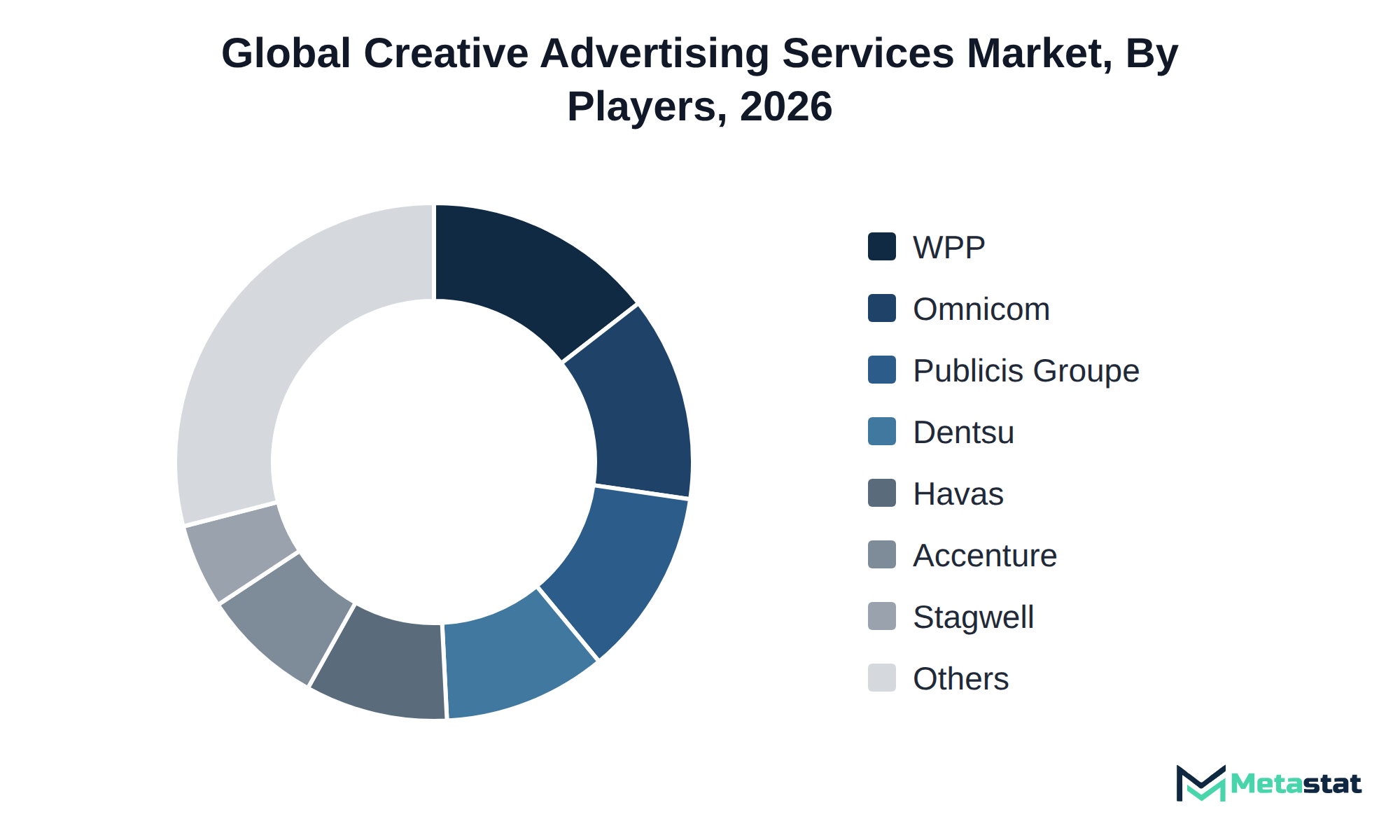
The competitive environment in the Creative Advertising Services market consists of various companies employing distinct strategies to cater to diverse client needs. Key factors influencing buyer choices include pricing, customization, service quality, and the overall ecosystem in which the services are offered.
WPP plc focuses on creative strategy and campaign development, enabling clients to execute comprehensive marketing initiatives. Omnicom Group Inc. emphasizes digital advertising and content creation, targeting businesses seeking to enhance online engagement. Publicis Groupe integrates data analytics with creative services to support clients in decision-making processes.
Dentsu Group Inc. stands out through its expertise in social media creative services, meeting the growing demand for tailored online marketing solutions. Havas SA offers a broad array of advertising mediums, creating value for clients across traditional and digital platforms. Stagwell Inc. specializes in experiential and event-based advertising, appealing to brands seeking innovative consumer interactions.
The growth trajectory hinges on several developments within the Creative Advertising Services market. A significant factor involves the expansion of digital advertising, projected to evolve from USD 35.7 billion in 2026 to USD 49.8 billion by 2033, driven by increased online engagement and targeted marketing strategies. Another vital development centers around the content creation and production segment, which anticipates reaching USD 26.5 billion by 2033, reflecting the rising demand for high-quality, engaging content tailored to diverse consumer preferences. Risks exist that could impede this growth. Economic fluctuations or shifts in consumer spending patterns challenge advertisers, particularly in regions heavily reliant on traditional media. If spending in sectors such as retail and e-commerce slows, overall market expansion will face downward pressure. Maintaining a focus on innovation and effective strategies will play a critical role in ensuring the market reaches its projected value, enhancing its appeal across various industries, including consumer goods and FMCG.
By Service Type: Creative Strategy and Campaign Development, Content Creation and Production, Brand Development and Identity Design, Graphic Design and Visual Communication, Social Media Creative Services, Advertising Copywriting, Experiential and Event-Based Advertising, Digital and Interactive Creative Development, Others (Shopper Marketing, Influencer Creative Services)
By Advertising Medium: Digital Advertising, Print Advertising, Television Advertising, Radio and Digital Audio Advertising, Social Media Advertising, Outdoor Advertising (OOH and DOOH), Cinema Advertising, Others (Direct Mail and In-Store Advertising)
By End-Use Industry: Consumer Goods and FMCG, Retail and E-commerce, Automotive and Mobility, Banking, Financial Services and Insurance, Information Technology and Telecommunications, Healthcare and Pharmaceuticals, Food and Beverage, Travel, Tourism and Hospitality, Media and Entertainment, Others (Education, Real Estate and Government), By
The report strategically identifies and profiles the key market players and analyses their core competencies in each sub-segment of the Creative Advertising Services market.
Report Attributes | Details |
Study Period | 2021-2033 |
Base Year | 2025 |
Estimated Year | 2026 |
Forecast Period | 2026-2033 |
Historical Period | 2021-2025 |
Growth Rate | CAGR 3.7% from 2026 to 2033 |
Revenue Unit | USD billion |
Segmentation | By Service Type, Advertising Medium, End-Use Industry, and Region |
By Region | North America (By Service Type, Advertising Medium, End-Use Industry, and Country)
|
Europe (By Service Type, Advertising Medium, End-Use Industry, and Country)
| |
Asia Pacific (By Service Type, Advertising Medium, End-Use Industry, and Country)
| |
South America (By Service Type, Advertising Medium, End-Use Industry, and Country)
| |
Middle East and Africa (By Service Type, Advertising Medium, End-Use Industry, and Country)
|
Find answers to common questions about this report
The Creative Advertising Services market size was valued at USD 105.9 billion in 2025.
The market is projected to grow at a CAGR of 3.7% during the forecast period from 2026 to 2033.
The North America Creative Advertising Services market size is estimated to reach USD 50.6 billion by 2033.
Content Creation and Production leads the Creative Advertising Services market with a projected value of USD 26.5 billion by 2033. This segment surpasses others in terms of revenue generation within the market.
Key drivers for the Creative Advertising Services market include increasing demand for digital advertising, driven by the shift toward online platforms and consumer preferences for digital content. Price sensitivity among buyers, particularly in retail and consumer goods, restrains demand and impacts investment in creative services.
North America holds the dominant share of the Creative Advertising Services market, with a value of USD 50.6 billion projected for 2033, representing 38 percent of the total market.
Price sensitivity among buyers impacts demand, particularly in sectors including retail and consumer goods. Talent costs present a significant challenge for suppliers aiming to deliver high-quality services, as increased competition for skilled professionals drives up salary expectations.
Increasing emphasis on digital advertising, driven by the need for brands to engage consumers effectively, supports adoption in the Creative Advertising Services market. Advancements in technology enhance content creation capabilities, allowing advertisers to produce high-quality, tailored content that appeals to specific audience segments.
The Creative Advertising Services market is estimated to reach a valuation of USD 141.7 billion by 2033.
Key players operating in the Creative Advertising Services market include WPP plc, Omnicom Group Inc., Publicis Groupe, Dentsu Group Inc., Havas SA, Stagwell Inc., Accenture plc, and Deloitte.
The analysts below cover Professional Services research at Metastat Insights.
LEAD ANALYST
Utkarsh Khirodkar is a Lead Market Research Analyst at MetaStat Insight, specializing in market intelligence, technology sector assessments, and competitive strategy.

PRINCIPAL CONSULTANT - ENTERPRISE AI & EMERGING TECHNOLOGIES
Banking & Finance · Electronics and Semiconductor · Energy and Power · Healthcare IT · Information & Technology · Professional Services
Vijay Gunti is a Principal Consultant at MetaStat Insight, bringing over two decades of experience across enterprise digital transformation, technology strategy, and intelligent systems.

PRINCIPAL CONSULTANT - QUALITY SYSTEMS & COMPLIANCE
Electronics and Semiconductor · Machinery & Equipment · Professional Services
Omkar Phadtare is an Industry Consultant at MetaStat Insight, specializing in quality systems, regulatory compliance, and standards benchmarking to drive data-driven market intelligence and strategic industry research.

LEAD CONSULTANT - COMMUNICATION, TELECOM, AND IT
Electronics and Semiconductor · Information & Technology · Machinery & Equipment · Professional Services
Ravindra Sathe Consultants for Communication, Telecom, and IT at MetaStat Insight. He leads the firm's industry research initiatives across telecommunications infrastructure, digital connectivity, enterprise networking, and emerging information technology domains.
Tracking ceramic matrix composite adoption in high-bypass aero engines requires strict attention to material qualification cycles and FAA airworthiness testing milestones. The MetaStat Insight team provided a detailed timeline of silicon carbide fiber manufacturing capacity and commercial foundry lead times. Having clear visibility into upstream thermal barrier coating supply helped us stress-test our long-term component procurement strategy.
Transitioning ultra-class mining haul trucks to alternative power requires concrete data on remote hydrogen refueling infrastructure economics. The report evaluated megawatt-scale electrolyzer installation expenses, onsite storage safety mandates, and heavy-duty fuel cell stack degradation under continuous duty cycles. That technical rigor helped our engineers benchmark realistic total operating cost horizons for off-highway fleet decarbonization.
Enterprise zero-trust network rollouts are often slowed down by multi-cloud transit latency and proprietary hardware retirement schedules. This study provided realistic total cost of ownership models comparing cloud-delivered security edge solutions against traditional hardware refreshes. The analysis of contract renewal lengths and software maintenance fees gave us clear visibility into enterprise replacement cycles over the next three to five years.
Explore related market intelligence reports worth reading alongside this one.