
LEAD ANALYST
Utkarsh Khirodkar is a Lead Market Research Analyst at MetaStat Insight, specializing in market intelligence, technology sector assessments, and competitive strategy.

Global Payroll Outsourcing Market Size, Share, By Service Model (Fully Managed Outsourcing and Co-Managed Outsourcing), By Organization Size (Large Enterprises, Medium-Sized Enterprises and Small Enterprises), By End-Use Industry (Banking, Financial Services and Insurance, IT and Telecommunications, Manufacturing, Retail and E-Commerce, Healthcare and Life Sciences, Government and Public Sector), By Deployment Model (Cloud-Based and On-Premises), Industry Analysis, Growth, Trends, and Forecast, 2026-2033
Report ID
MSI-5666
Published
November, 2026
Pages
289 Pages
Format
Historical
Base year
Forecast
Forecast period
Report Details
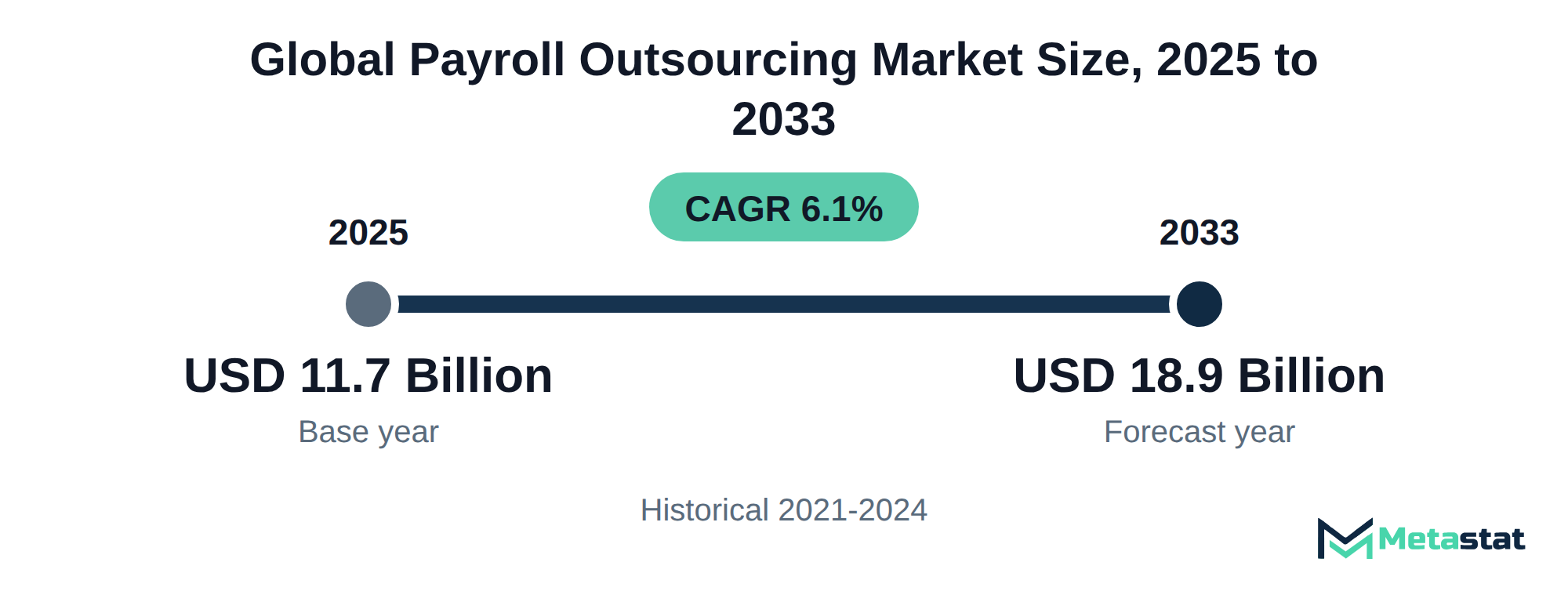
Market Valuation: Valued at $11.7 Billion in 2025, projected to reach $18.9 Billion by 2033 at a 6.1% CAGR.
Dominant Segment: The fully managed outsourcing segment leads the market, driven by increasing demand for comprehensive payroll management solutions that streamline processes and enhance compliance.
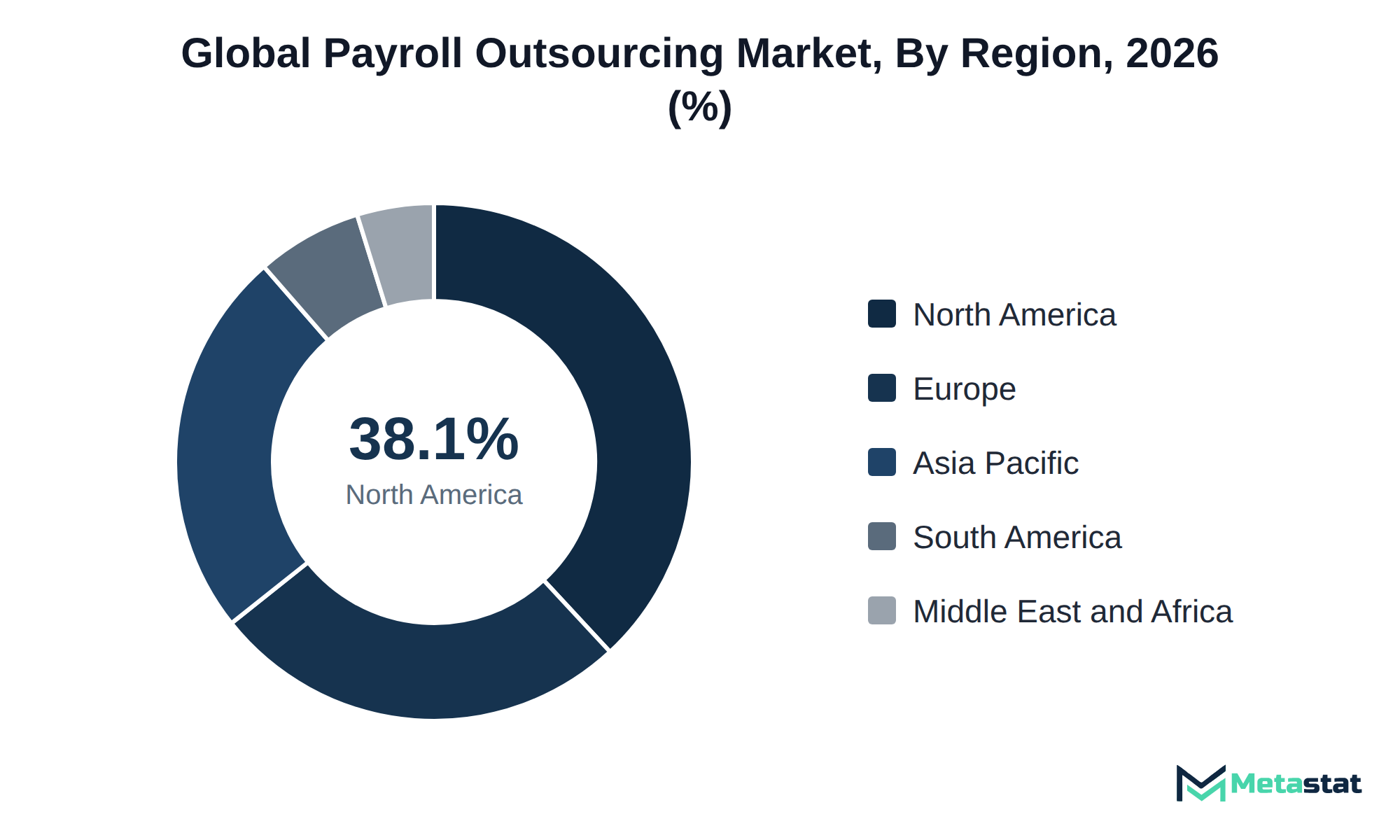
Geographic Lead: North America holds the largest market share, accounting for 38.1% in 2025, primarily due to a high concentration of large enterprises and robust technological infrastructure.
What's Inside: The report provides an in-depth analysis of market dynamics, competitive landscape, and forecasts for the period 2026-2033, covering various service models and organization sizes.
Growth in Fully Managed Outsourcing: This segment is projected to grow significantly, from USD 7.1 billion in 2026 to USD 11.5 billion by 2033, reflecting a strong trend towards centralized payroll solutions.
Technological Advancements: The integration of AI and cloud-based solutions is reshaping payroll operations, enhancing accuracy and efficiency while driving market growth.
Choose Your License
Global Payroll Outsourcing Market
The global Payroll Outsourcing market was valued at USD 11.7 billion in 2025 and is projected to reach USD 18.9 billion by 2033, growing at a CAGR of 6.1% over the forecast period.
The Payroll Outsourcing market covers services that manage payroll functions for businesses, allowing them to focus on core operations while meeting regulatory requirements. Buyers, including large enterprises, medium-sized enterprises, and small enterprises, invest in these services to streamline processes, improve efficiency, and mitigate risks associated with payroll management. The increasing complexity of labor regulations and the growing demand for real-time data analytics contribute to rising expenditure in this domain. Payroll is one of several back-office functions within the wider business process outsourcing industry.
Growth in the market is propelled by the expanding adoption of cloud-based solutions, which enhance accessibility and flexibility for businesses. The fully managed outsourcing segment holds the largest value, reflecting a significant shift towards comprehensive payroll management services. North America holds 38.1% of the market in 2025, with the US leading in 2026. This region's strong demand results from a high concentration of large enterprises and a well-developed technological infrastructure that supports payroll outsourcing initiatives.
In addition to North America, Europe and Asia Pacific represent substantial market shares, accounting for 26.2% and 24.3%, respectively. The growing emphasis on cost efficiency and the desire to use advanced technology drive market expansion. Businesses increasingly recognize the value of outsourcing payroll functions, which reduces operational burdens and enhances overall productivity.
The Payroll Outsourcing market gives organizations full-service payroll management, addressing complexities and compliance issues inherent in payroll processes. Buyers invest in these services to enhance operational efficiency, reduce errors, and ensure timely and accurate payroll delivery. The increasing demand for streamlined payroll systems reflects the necessity of maintaining compliance with evolving regulations while focusing on core business activities.
Growth in the market is driven by the rising adoption of cloud-based solutions, which facilitate real-time access to payroll data and improve overall service delivery. Among the various segments, Fully Managed Outsourcing stands out with the highest value. This region's significant share stems from a robust demand for advanced payroll services, which are essential for managing large workforces effectively.
Technological advancements in payroll solutions contribute significantly to market expansion. Businesses prioritize automation and integration capabilities, which streamline payroll processes and enhance data accuracy. The continuous evolution of workforce management practices fuels the demand for Payroll Outsourcing services. Companies increasingly seek to use these solutions to gain a competitive edge in the marketplace.
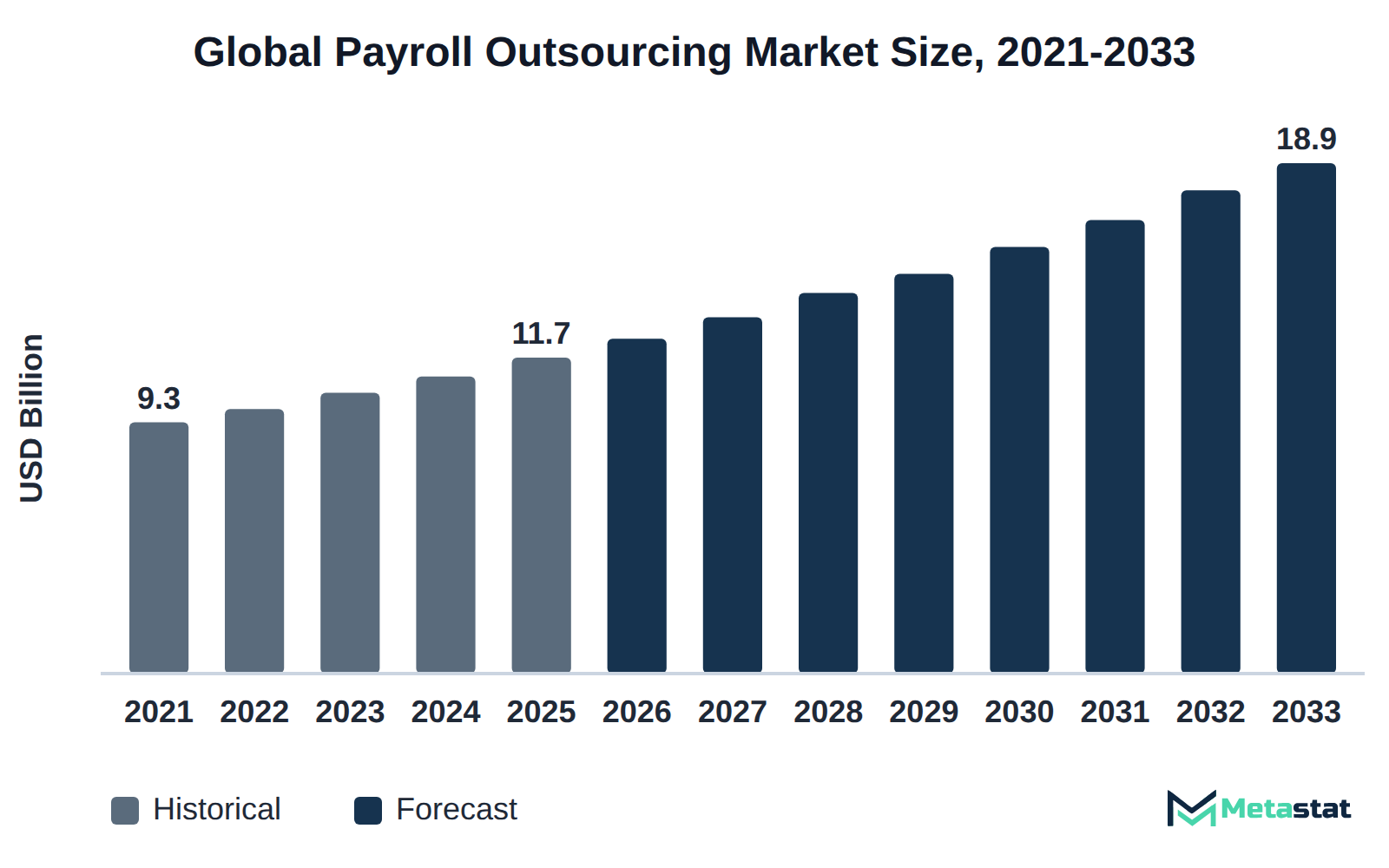
Multi-country payroll consolidation emerges as a strategic solution for organizations aiming to streamline operations and improve efficiency. This consolidation allows businesses to manage payroll processing across multiple regions through a single vendor, which simplifies compliance with local regulations and reduces administrative burdens. By 2033, the fully managed outsourcing segment is projected to reach USD 11.5 billion, indicating a strong trend toward centralized payroll solutions.
Standardizing vendors across regions enhances data consistency and improves overall payroll accuracy, which is critical for organizations operating in diverse regulatory environments. The ability to efficiently communicate with a single vendor reduces the likelihood of errors often found in fragmented payroll systems. Organizations achieve significant cost savings through bulk processing and reduced vendor management overhead. The payroll outsourcing market is expected to expand, and consolidation and vendor standardization are shaping competitive strategies.
AI-assisted payroll validation has become a key component of the Payroll Outsourcing market, particularly with the integration of cloud Human Capital Management (HCM) platforms. This technological advancement facilitates intelligent automation of payroll processes, ensuring accuracy and compliance while reducing manual intervention. The growing trend toward cloud-based solutions is evident, with the cloud-based deployment model expected to grow from USD 10.2 billion in 2026 to USD 16.4 billion by 2033, reflecting a compound annual growth rate of 7.0%. This shift shows how much payroll operations now depend on technology.
Pricing strategies within the Payroll Outsourcing market vary significantly based on service models and organizational needs. Fully managed outsourcing, for instance, generally involves fixed monthly fees determined by the complexity of services, the number of employees, and specific organizational requirements. This model allows enterprises to allocate budget resources effectively while enjoying comprehensive payroll management. The co-managed outsourcing model, in contrast, often employs a hybrid pricing structure, combining a base fee with variable charges tied to the services performed. This flexibility appeals particularly to medium-sized enterprises, which constitute a growing segment within the market, with projections indicating that their outsourcing revenue will reach USD 5.7 billion by 2033.
Such pricing and contract structures directly influence buyer decisions, creating a competitive environment where businesses seek solutions that align with their operational goals and budget constraints. Understanding these dynamics proves essential for any organization exploring payroll outsourcing options.
Effective payroll tax administration and statutory reporting represent critical elements for organizations engaging in payroll outsourcing. Large enterprises, in particular, face complex compliance requirements that necessitate precise tax management and reporting. Large enterprises are projected to reach a value of USD 8.9 billion by 2033, reflecting a significant demand for comprehensive payroll solutions.
This increasing value highlights the importance of outsourcing partners that specialize in tax regulations and statutory reporting. By drawing on expert knowledge, large enterprises reduce the risks associated with non-compliance, including financial penalties and reputational damage. Outsourcing payroll allows these organizations to focus on core business activities, ultimately enhancing operational efficiency and productivity.
The payroll outsourcing market continues to evolve, with providers expanding their services to include specialized offerings in tax administration and statutory reporting. Large enterprises seek to streamline their payroll processes. Successful outsourcing partnerships deliver tailored solutions that address their unique compliance challenges and support sustainable growth.
When businesses decide to outsource payroll, retaining certain functions in-house enhances efficiency and control. Organizations face a similar decision for related HR functions such as benefits administration outsourcing. Critical elements including employee relations and compliance management require a nuanced understanding of the company culture and specific regulatory environments, which often vary by region or industry. Maintaining a direct line of communication regarding these functions enables organizations to address employee concerns and ensure adherence to local laws.
For instance, the Payroll Outsourcing market reflects a strong preference for maintaining in-house processes related to human resources and employee engagement, where personal interactions and company values play a significant role. Companies in sectors like Banking, Financial Services, and Insurance, which are expected to achieve a market value of USD 4.5 billion by 2033, heavily depend on personalized employee relations. This dependency arises from the need to build trust and loyalty among employees, which outsourcing cannot replicate.
Consequently, businesses that strategically determine which functions to maintain in-house will likely experience improved employee satisfaction and compliance with regulations. This approach strengthens organizational culture and enhances overall operational effectiveness within the changing market environment.
Increased emphasis on regulatory compliance drives organizations to invest more in payroll outsourcing. Companies within industries including banking and financial services seek reliable solutions to manage complex payroll regulations, ensuring adherence to strict policies. This trend reflects a shift where businesses prioritize compliance-driven operational strategies, heightening demand for expert payroll services that enhance accuracy and reduce legal risks. In the Payroll Outsourcing market, the Banking, Financial Services and Insurance sector is projected to expand from USD 3.2 billion in 2026 to USD 4.5 billion in 2033, demonstrating a compound annual growth rate of 5.3%. Growing investment in these services illustrates organizations' recognition of the importance of mitigating compliance-related challenges and the associated financial implications. Such trends contribute to an increased volume of transactions and a greater willingness to allocate budgets toward outsourced payroll functions. RegTech solutions address related compliance needs in the financial services sector.
The shift toward compliance-driven operational strategies enhances demand for payroll outsourcing services among various organizations. Businesses increasingly recognize the necessity of expert payroll solutions to meet evolving regulatory requirements and to avoid costly penalties. This increasing focus on compliance signifies a strong growth driver within the market.
Cloud-based payroll solutions have transformed operations within many organizations, driving efficiency and flexibility. These solutions integrate with existing HR tech, including Human Capital Management (HCM) systems, allowing businesses to streamline processes and reduce manual effort. Providers that utilize advanced technology, including artificial intelligence and automation, enhance accuracy in payroll processing, minimizing errors and delays. Demand from various industries, particularly in banking and IT sectors, reflects the operational benefits that such advancements provide.
The market experiences substantial growth, fueled by increasing adoption of cloud technology. Organizations recognize that using cloud-based payroll systems results in cost savings, enhanced data security, and improved scalability, particularly beneficial for expanding businesses. Stakeholders prioritize investment in these innovative solutions to remain competitive and agile in a rapidly changing environment. The spread of these technologies positions the market for strong expansion through 2033.
High costs associated with payroll outsourcing restrict demand among small and medium-sized enterprises. Budget constraints significantly influence purchasing decisions, leading to slower uptake of outsourced services. Many businesses with limited financial resources prioritize cost-cutting measures that result in hesitance to engage with outsourcing options, impacting their operational efficiency. The Payroll Outsourcing market experiences challenges due to this price sensitivity, which leads to smaller order sizes and delayed replacement of in-house payroll systems. This resistance hinders broader market growth, with enterprises opting for less costly internal solutions rather than investing in comprehensive outsourcing. Ultimately, reluctance to commit to outsourcing services stifles innovation and operational improvements across various sectors. In the context of a competitive landscape, organizations striving for growth address pricing structures to encourage broader market participation.
Providers in the Payroll Outsourcing market face significant margin pressure stemming from rising operational costs and competitive pricing strategies. Increased competition among service providers compels them to offer lower prices, impacting profit margins. Ongoing talent shortages in the industry increase labor costs, further squeezing profitability. To address these challenges, suppliers adopt strategies focused on improving operational efficiency and automating processes. Investments in technology, including advanced payroll software and cloud-based solutions, streamline operations and reduce reliance on manual labor. This shift enables providers to maintain competitive pricing while improving service delivery. By diversifying service offerings and integrating value-added features, suppliers enhance their appeal to clients, building long-term relationships. These strategies mitigate margin pressure and contribute to growth in the Payroll Outsourcing market, aligning supply capabilities with evolving client needs.
Fully managed outsourcing represents a significant growth opportunity within the Payroll Outsourcing market, driven by the increasing demand for comprehensive payroll solutions. This segment is expected to expand from USD 7.1 billion in 2026 to USD 11.5 billion by 2033, reflecting a compound annual growth rate (CAGR) of 7.3%. Organizations prefer fully managed outsourcing due to its ability to streamline payroll processes, enhance compliance, and reduce administrative burdens. Large enterprises and medium-sized enterprises exhibit strong interest in this service model, seeking efficient payroll management that aligns with their operational requirements. The expansion of this segment correlates with the growing complexity of payroll regulations and the need for expert handling of payroll tasks. Consequently, market players focusing on fully managed outsourcing position themselves to capitalize on this trend and cater to the evolving needs of businesses in various sectors.
The Global Payroll Outsourcing market is segmented based on Service Model, Organization Size, End-Use Industry, and Deployment Model.
Fully Managed Outsourcing segment is valued at USD 7.1 billion in 2026 and is projected to reach USD 11.5 billion by 2033, at a CAGR of 7.3% during the forecast period. This segment provides businesses with a comprehensive solution for managing their payroll processes, allowing them to allocate resources to core operations while ensuring compliance and accuracy. Large enterprises frequently engage fully managed outsourcing due to the complexity of payroll regulations and employee management requirements. The significant growth in this segment derives from increasing demand for streamlined payroll services, driven by a heightened focus on compliance and operational efficiency. This segment demonstrates a faster growth trajectory compared to Co-Managed Outsourcing, which exhibits a CAGR of 4.5%. The overall shift toward digital solutions further enhances market appeal, with organizations seeking to leverage technology to improve payroll accuracy and reduce administrative burdens.
Co-Managed Outsourcing segment is estimated to reach USD 7.3 billion by 2033, at a CAGR of 4.5% during the forecast period. This segment serves organizations requiring a collaborative approach to payroll management, where both the company and the provider share responsibilities. Businesses seeking greater control over their payroll processes while leveraging external expertise drive demand for co-managed solutions. This segment attracts medium-sized and large enterprises prioritizing flexibility and compliance. Slower growth in this segment compared to fully managed outsourcing reflects its tailored nature, with organizations often adopting co-managed services to balance internal control with outsourced efficiency. Providers in this category face unique challenges related to integration and communication, which influence operational efficiency. In contrast, fully managed outsourcing offers a more comprehensive solution for organizations looking to delegate payroll functions entirely. The ongoing evolution of technology and regulatory requirements influences demand dynamics within the Payroll Outsourcing market.
Large Enterprises segment is valued at USD 6.4 billion in 2026 and is projected to reach USD 8.9 billion by 2033, at a CAGR of 4.9% during the forecast period. Large enterprises engage payroll outsourcing services to streamline payroll processes, ensuring efficient payroll management and compliance with regulations. This segment experiences growth driven by the increasing need for accuracy in payroll processing and the complexity of compliance requirements, particularly in heavily regulated industries. While large enterprises benefit from economies of scale and negotiate favorable terms, unique challenges related to data security and integration with existing systems persist. Compared to medium-sized and small enterprises, the demand for payroll services in the large enterprises segment reflects a more stable growth trajectory, supported by higher investment capacities and a focus on advanced technology solutions in the market.
Medium-Sized Enterprises segment is estimated to reach USD 5.7 billion by 2033, at a CAGR of 7.3% during the forecast period. This segment serves businesses that typically employ a range of 100 to 999 employees, focusing on efficient payroll management to streamline their operations. Growing regulatory compliance requirements drive demand within this segment, compelling medium-sized enterprises to adopt outsourced payroll solutions to maintain accuracy and minimize risks. Compared to the Large Enterprises segment, which has a projected CAGR of 4.9%, the Medium-Sized Enterprises segment exhibits more rapid growth. The willingness of these organizations to invest in automated payroll systems reflects their need for precision and efficiency, differentiating their purchasing behavior from smaller enterprises that face higher cost constraints. The Payroll Outsourcing market continues to evolve, creating opportunities for specialized solutions tailored to the unique needs of medium-sized businesses.
Small Enterprises segment is expected to reach USD 4.3 billion by 2033. This segment encompasses businesses with fewer employees and lower revenue thresholds, requiring tailored payroll solutions to manage their specific needs efficiently. The primary users of this segment include startups and small businesses that focus on growth while ensuring compliance with payroll regulations. Key drivers for this segment include increasing demand for cost-effective payroll solutions and enhanced service flexibility. Compared to larger organizations, Small Enterprises experience a faster growth rate, with a projected CAGR of 7.3%, reflecting significant demand for streamlined payroll processes. This sub-segment differs from larger organizations due to budget constraints and varying service expectations, which influence purchasing decisions and service requirements in the Payroll Outsourcing market.
This segment primarily serves banking institutions, insurance companies, and financial service providers, allowing them to streamline payroll processes while ensuring compliance with regulatory standards. The increasing focus on regulatory compliance drives demand in this segment, necessitating reliable payroll solutions that effectively manage complex wage calculations and tax reporting. Compared to other segments, the Banking, Financial Services and Insurance segment exhibits a moderate growth rate, influenced by the unique financial regulations governing this industry. Organizations in this segment prioritize accuracy and security, imposing higher expectations on payroll solutions than sectors with less stringent requirements. The market continues to evolve, driven by the need for enhanced operational efficiency and adaptability to regulatory changes.
IT and Telecommunications segment is estimated to reach USD 3.9 billion by 2033, at a CAGR of 6.4% during the forecast period. This segment serves technology companies and service providers, requiring efficient payroll solutions to manage employee compensation effectively. Increased investment in digital transformation drives demand, with organizations seeking to streamline operations and enhance workforce management. Compared to other segments, the IT and Telecommunications segment exhibits a faster growth trajectory, supported by ongoing technological advancements and the integration of innovative payroll systems. The shift towards cloud-based services contributes to this growth, enabling easier access to payroll solutions while minimizing traditional operational complexities. The focus on compliance with evolving regulations further drives organizations to adopt these services, ensuring adherence to the changing legal landscape related to payroll management.
The Manufacturing segment is expected to reach USD 2.9 billion by 2033. This segment serves various manufacturing firms seeking efficiency in payroll management, allowing them to focus on core operations. Key drivers include the rising complexity of payroll regulations, compelling manufacturers to adopt outsourcing solutions. Regulatory compliance demands often push companies to engage specialized providers, allowing them to avoid costly errors. In comparison to the IT and Telecommunications sector, which shows a CAGR of 6.4%, the Manufacturing segment experiences slower growth, offering a CAGR of 5.3%. Competitive pricing models and the need for accuracy in payroll processing present unique challenges that distinctly shape the dynamics of the Manufacturing segment in the Payroll Outsourcing market.
The Retail and E-Commerce segment is projected to grow at a CAGR of 6.4% during the forecast period. This segment serves businesses engaged in selling products and services online, relying heavily on efficient payroll management to ensure employee satisfaction and compliance with labor regulations. The increasing trend of e-commerce adoption drives demand for payroll outsourcing services, enabling retailers to focus on core operations while streamlining payroll processes. In comparison to other segments, Retail and E-Commerce experiences faster growth due to rapid digital transformation and a significant shift toward online shopping. The need for scalable payroll solutions that adapt to fluctuating workforce sizes is a critical demand driver. Competitive pricing and technological advancements further enhance service offerings, allowing providers to capture a larger share of this expanding market.
Healthcare and Life Sciences focuses on the management of payroll services for organizations operating within the medical and life sciences sectors. This segment serves hospitals, clinics, pharmaceutical companies, and research institutions seeking efficient payroll management that complies with stringent regulations. Healthcare RCM outsourcing covers revenue cycle management, a related administrative function for provider organizations. Increasing regulatory requirements push healthcare organizations to outsource payroll functions, ensuring compliance while focusing on patient care and innovation. Compared to other segments, this area experiences higher operational complexity due to the need for precise and compliant payroll processing, making it distinct from simpler organizational structures in other industries. The demand for specialized payroll solutions tailored to healthcare's unique needs drives growth, reflecting a critical factor influencing the segment's development. This sector's resilience amid economic fluctuations positions it favorably within the broader market, highlighting the ongoing necessity for specialized payroll services within Healthcare and Life Sciences.
Government and Public Sector organizations employ payroll outsourcing to streamline their payroll processes, ensuring compliance with various regulations while efficiently managing employee compensation. These organizations face unique challenges related to budget constraints and the need for transparency in financial operations. Demand for payroll outsourcing in this segment is driven by the increasing complexity of labor laws and the requirement for precise reporting and accountability. Unlike other segments, including Banking, Financial Services and Insurance, where growth occurs at a faster pace, the Government and Public Sector segment experiences steady growth due to its inherent operational structures and stringent regulatory oversight. While these organizations adapt to evolving policies, outsourcing payroll systems enhances their ability to focus on core functions while maintaining compliance and transparency.
The Others (Hospitality, Education, Professional Services) segment encompasses diverse sectors that engage payroll outsourcing to streamline administrative processes. Organizations within hospitality and education rely on efficient payroll management systems to handle employee compensation and ensure compliance with varying regulations. Demand for tailored solutions drives growth in this segment, with organizations emphasizing flexibility and accuracy in payroll processing. Factors influencing this segment include increasing workforce management complexities and the need for compliance with industry-specific regulations. The segment's growth trajectory differs from larger segments, characterized by unique operational challenges and varying pricing structures, which contribute to its distinctive position in the Payroll Outsourcing market. Payroll outsourcing enhances operational efficiency and allows these organizations to focus on core competencies, enabling effective responses to market demands.
Cloud-Based segment is valued at USD 10.2 billion in 2026 and is projected to reach USD 16.4 billion by 2033, at a CAGR of 7% during the forecast period. This segment serves various organizations seeking efficient payroll management solutions. Businesses, particularly large enterprises and medium-sized enterprises, increasingly adopt cloud-based payroll outsourcing due to its cost-effectiveness and flexibility. Rising demand for remote work solutions and digital transformation initiatives drives growth in this segment. Compared to on-premises models, the cloud-based approach offers faster implementation and scalability, attracting a broader customer base. The anticipated growth rate for this segment surpasses that of on-premises and hosted solutions, indicating a shift in preference toward more agile deployment methods. The Payroll Outsourcing market continues to evolve, with cloud solutions playing an important role in shaping operational efficiencies for organizations.
On-Premises and Hosted segment is estimated to reach USD 2.4 billion by 2033, at a CAGR of 1.1% during the forecast period. This segment serves organizations that prefer retaining control over their payroll systems and data security, often found in industries including manufacturing and retail. A driving force includes the emphasis on data privacy and compliance with regulations, which motivates companies to opt for in-house solutions. This segment differentiates itself by exhibiting slower growth compared to cloud-based alternatives, which are projected to grow at a CAGR of 7%. Organizations choosing this deployment model typically face higher upfront costs due to hardware and maintenance requirements, contrasting with the subscription-based pricing prevalent in cloud and software-as-a-service solutions. The market reflects a diverse array of buyer preferences, with buyers prioritizing control over convenience, influencing their deployment choices.
Based on geography, the Global Payroll Outsourcing market is divided into North America, Europe, Asia-Pacific, South America, Middle East, and Africa.
Demand for payroll outsourcing in North America derives significantly from the expansive presence of large enterprises, particularly in sectors including banking, financial services, and IT. The region's robust infrastructure supports advanced cloud technologies, which enhance efficiency in payroll processes. By the end of 2033, North America is projected to reach USD 6.7 billion. In 2025, this region holds a notable share of 38.1% in the global payroll outsourcing market. Companies in the United States, Canada, and Mexico increasingly seek solutions that streamline administrative tasks while ensuring compliance with local regulations. This trend reflects a growing emphasis on outsourcing as a strategic move to enhance operational capabilities and reduce overhead costs within competitive industries.
The European market captures 26.2% of the global Payroll Outsourcing market in 2025. The IT and Telecommunications sector shows promise, reflecting a CAGR of 6.4% during the forecast period. A well-developed regulatory framework supports compliance and operational efficiency, appealing to both large enterprises and medium-sized enterprises across Germany, France, the UK, Italy, Spain, and Russia. The need for advanced payroll solutions among these industries drives strong demand. Cloud-Based deployment models gain traction, reflecting the region's increasing reliance on innovative technologies to improve payroll management. In this evolving landscape, the market continues to adapt to changing regulations and industry needs, ensuring sustained growth and demand.
Asia-Pacific is a significant contributor to the Payroll Outsourcing market, accounting for 24.3% of the global share in 2025. The region's demand stems from various industries, including Banking, Financial Services and Insurance, which leverage these services for efficiency and compliance advantages. Rapid technological advancements in cloud-based solutions drive adoption among enterprises, especially in countries like China, India, and Japan. Infrastructure improvements and increasing digitalization enhance the market's growth prospects, while rising awareness of payroll compliance requirements drives further demand. Australia and South Korea exhibit strong interest in outsourcing solutions, emphasizing operational efficiency and cost management. The market is projected to thrive due to the expanding customer base and increasing service offerings tailored to regional needs.
Demand for payroll outsourcing in South America predominantly arises from the growing sectors of banking, financial services, and retail. Brazil and Argentina emerge as key players, driven by an increasing focus on efficiency and cost reduction in human resource management. The need for compliance with local regulations and tax obligations fuels adoption among businesses in these nations. The market in South America captures a share of 6.6% of the global payroll outsourcing market in 2025. Companies are investing in technology-driven solutions to streamline payroll processes, enhancing accuracy and reducing operational burdens. The regional market faces unique challenges related to economic fluctuations, which influence spending on outsourcing services. Continuous development in cloud-based solutions supports businesses in optimizing their payroll management systems.
The demand for payroll outsourcing in the Middle East and Africa reflects unique economic dynamics and industry needs. Key industries driving this demand include banking, financial services, and telecommunications, with companies seeking efficient payroll management solutions. The region's market share stands at 4.8% in 2025, indicative of its growing relevance in the global payroll outsourcing market. Countries including Saudi Arabia and the UAE experience increased adoption due to advancements in digital infrastructure and regulatory improvements. These developments enhance operational efficiency for enterprises while ensuring compliance with local labor laws. South Africa's diverse economic landscape further contributes to the market's expansion, with various sectors recognizing the benefits of outsourcing payroll functions. The growth potential in this region presents opportunities for service providers to address specific local requirements.
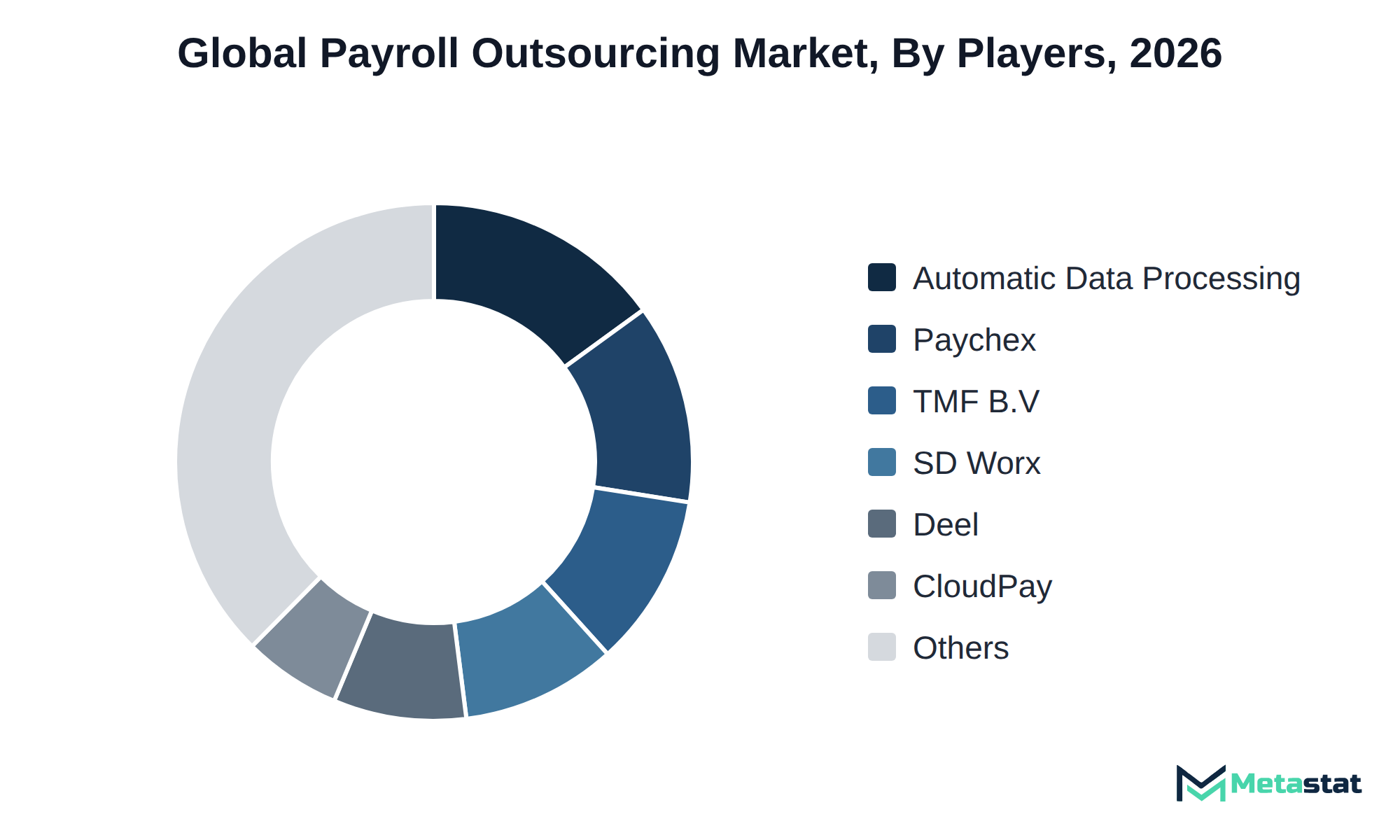
Companies within the Payroll Outsourcing market compete through various strategic approaches, focusing on service models, organizational size, and industry-specific needs. The market features two main service models: Fully Managed Outsourcing and Co-Managed Outsourcing, which influence buyer decisions based on the extent of control and customization required.
Buyers prioritize factors including price, service quality, customization, and certification when selecting a provider. Automatic Data Processing, Inc. specializes in comprehensive payroll solutions and aims to enhance operational efficiency for clients. Paychex, Inc. emphasizes user-friendly platforms and strong customer support, appealing particularly to small and medium-sized enterprises. Deel, Inc. focuses on global payroll and compliance solutions, attracting businesses operating in multiple countries.
This growth relies on several key developments within the Payroll Outsourcing market. Significant increases in demand for Fully Managed Outsourcing services, anticipated to grow from USD 7.1 billion in 2026 to USD 11.5 billion by 2033 at a 7.3% CAGR, will drive revenue. The expansion of Cloud-Based deployment models, projected to rise from USD 10.2 billion in 2026 to USD 16.4 billion by 2033 at a 7% CAGR, supports this trajectory while organizations increasingly adopt flexible solutions. However, potential risks, including regulatory challenges in major regions like North America, could hinder progress. The presence of stringent compliance requirements delays decision-making for organizations considering outsourcing. Successful navigation of these challenges alongside heightened adoption rates across key segments will be essential for the market to achieve the projected USD 18.9 billion by 2033.
By Organization Size: Large Enterprises, Medium-Sized Enterprises, Small Enterprises
By End-Use Industry: Banking, Financial Services and Insurance, IT and Telecommunications, Manufacturing, Retail and E-Commerce, Healthcare and Life Sciences, Government and Public Sector, Others (Hospitality, Education, Professional Services)
By Deployment Model: Cloud-Based, On-Premises and Hosted
The report strategically identifies and profiles the key market players and analyses their core competencies in each sub-segment of the Payroll Outsourcing market.
Report Attributes | Details |
Study Period | 2021-2033 |
Base Year | 2025 |
Estimated Year | 2026 |
Forecast Period | 2026-2033 |
Historical Period | 2021-2025 |
Growth Rate | CAGR 6.1% from 2026 to 2033 |
Revenue Unit | USD billion |
Segmentation | By Service Model, Organization Size, End-Use Industry, Deployment Model, and Region |
By Region | North America (By Service Model, Organization Size, End-Use Industry, Deployment Model, and Country)
|
Europe (By Service Model, Organization Size, End-Use Industry, Deployment Model, and Country)
| |
Asia Pacific (By Service Model, Organization Size, End-Use Industry, Deployment Model, and Country)
| |
South America (By Service Model, Organization Size, End-Use Industry, Deployment Model, and Country)
| |
Middle East and Africa (By Service Model, Organization Size, End-Use Industry, Deployment Model, and Country)
|
Find answers to common questions about this report
The Payroll Outsourcing market size was valued at USD 11.7 billion in 2025.
The market is projected to grow at a CAGR of 6.1% during the forecast period from 2026 to 2033.
The North America Payroll Outsourcing market size is estimated to reach USD 6.7 billion by 2033.
Fully Managed Outsourcing leads the Payroll Outsourcing market with a projected value of USD 11.5 billion by 2033, surpassing other segments in the service model category.
Key drivers for the Payroll Outsourcing market include increased emphasis on regulatory compliance, prompting organizations to invest in payroll solutions. High costs associated with payroll outsourcing restrict demand among small and medium-sized enterprises, influencing their purchasing decisions.
North America holds the dominant share of the Payroll Outsourcing market, with a value of USD 6.7 billion in 2033, representing 38.1 percent of the total market. This figure significantly exceeds the shares of other regions.
High costs associated with payroll outsourcing restrict demand among small and medium-sized enterprises. Budget constraints significantly influence purchasing decisions, leading to slower uptake of outsourced services and impacting operational efficiency.
Growing demand for fully managed outsourcing solutions drives adoption in the Payroll Outsourcing market. Organizations prioritize these services to streamline payroll processes, enhance compliance, and alleviate administrative burdens, particularly in response to increasing payroll regulation complexities.
The Payroll Outsourcing market is estimated to reach a valuation of USD 18.9 billion by 2033.
Key players operating in the Payroll Outsourcing market include Automatic Data Processing, Inc., Paychex, Inc., Dayforce, Inc., TMF Group B.V., Deel, Inc., Papaya Global Ltd., Neeyamo Enterprise Solutions Private Limited, and Human Quality BTB, S.A. de C.V.
The analysts below cover Professional Services research at Metastat Insights.
LEAD ANALYST
Utkarsh Khirodkar is a Lead Market Research Analyst at MetaStat Insight, specializing in market intelligence, technology sector assessments, and competitive strategy.

PRINCIPAL CONSULTANT - ENTERPRISE AI & EMERGING TECHNOLOGIES
Banking & Finance · Electronics and Semiconductor · Energy and Power · Healthcare IT · Information & Technology · Professional Services
Vijay Gunti is a Principal Consultant at MetaStat Insight, bringing over two decades of experience across enterprise digital transformation, technology strategy, and intelligent systems.

PRINCIPAL CONSULTANT - QUALITY SYSTEMS & COMPLIANCE
Electronics and Semiconductor · Machinery & Equipment · Professional Services
Omkar Phadtare is an Industry Consultant at MetaStat Insight, specializing in quality systems, regulatory compliance, and standards benchmarking to drive data-driven market intelligence and strategic industry research.

LEAD CONSULTANT - COMMUNICATION, TELECOM, AND IT
Electronics and Semiconductor · Information & Technology · Machinery & Equipment · Professional Services
Ravindra Sathe Consultants for Communication, Telecom, and IT at MetaStat Insight. He leads the firm's industry research initiatives across telecommunications infrastructure, digital connectivity, enterprise networking, and emerging information technology domains.
Our team was tracking whether regional recycling infrastructure could realistically absorb the growing volume of lithium iron phosphate batteries over the next decade. The report did a solid job separating announced hydrometallurgical plant capacity from active, permitted operational throughput. That distinction made the feedstock availability projections and regional recovery rate models far more credible than standard commercial overviews.
Tracking capacity expansion in single-use bioprocessing requires dependable data on raw material availability and cleanroom-grade polymer supply chains. The competitive landscape chapter gave a grounded evaluation of secondary component suppliers across North America and Asia-Pacific rather than simply reprinting press releases. Having that level of supplier benchmarking helped clarify dual-sourcing considerations for our clinical pipeline planning.
When evaluating distributed energy resource management systems, standard research summaries tend to gloss over the operational differences between front-of-the-meter utility deployments and behind-the-meter industrial sites. The MetaStat Insight report addressed those distinctions directly, especially regarding software interoperability standards and grid interconnection backlogs. The five-year market sizing across regional transmission organizations provided actionable context for our grid modernization strategy.
Explore related market intelligence reports worth reading alongside this one.
Starting from
$2950
Starting from
$2950