
LEAD ANALYST
Utkarsh Khirodkar is a Lead Market Research Analyst at MetaStat Insight, specializing in market intelligence, technology sector assessments, and competitive strategy.

Europe Construction Management Software Market Size, Share, By Deployment Model (Cloud and On-Premises), By Application (Project Management and Scheduling, Cost Estimation and Budget Management, Document Management and Digital Collaboration, Field Quality and Safety Management, Resource and Equipment Management), By Project Sector (Commercial Construction, Residential Construction, Infrastructure Construction, Industrial Construction), By Region (Germany, France, UK, Italy, Spain, Russia and Rest of Europe), Industry Analysis, Growth, Trends, and Forecast, 2026-2033
Report ID
MSI-5682
Published
November, 2026
Pages
292 Pages
Format
Historical
Base year
Forecast
Forecast period
Report Details
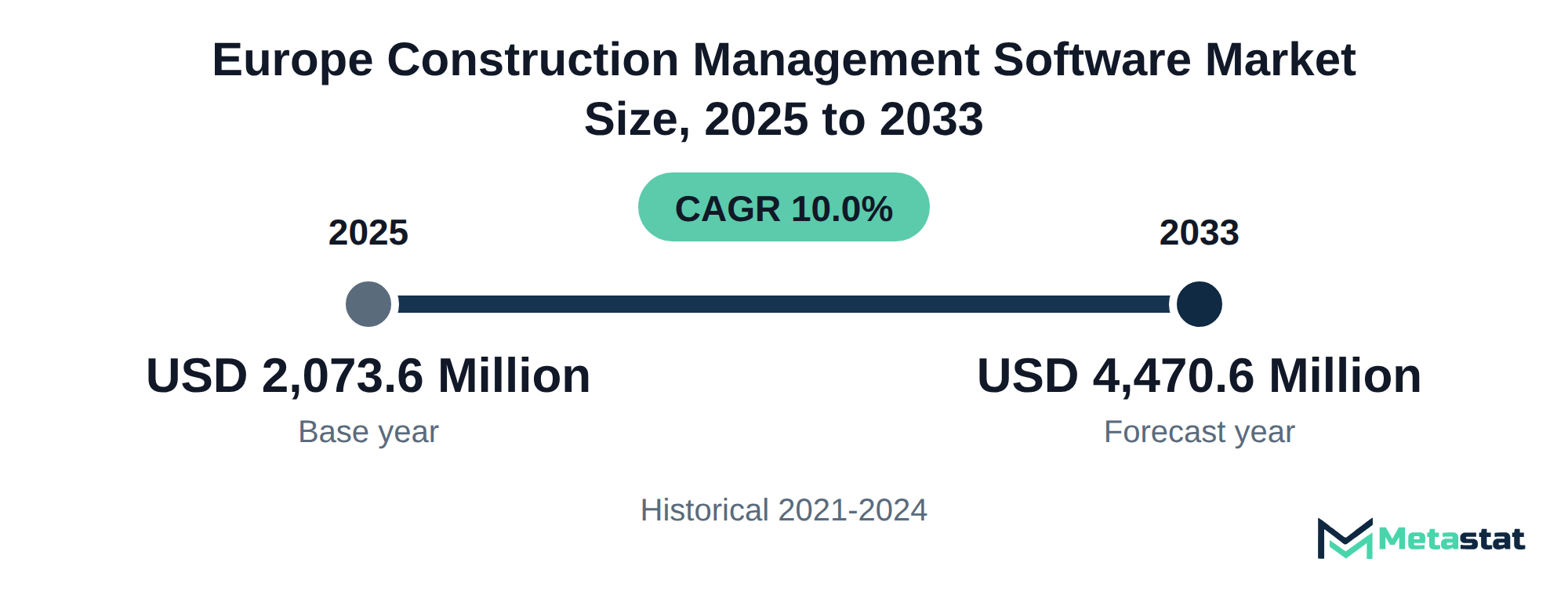
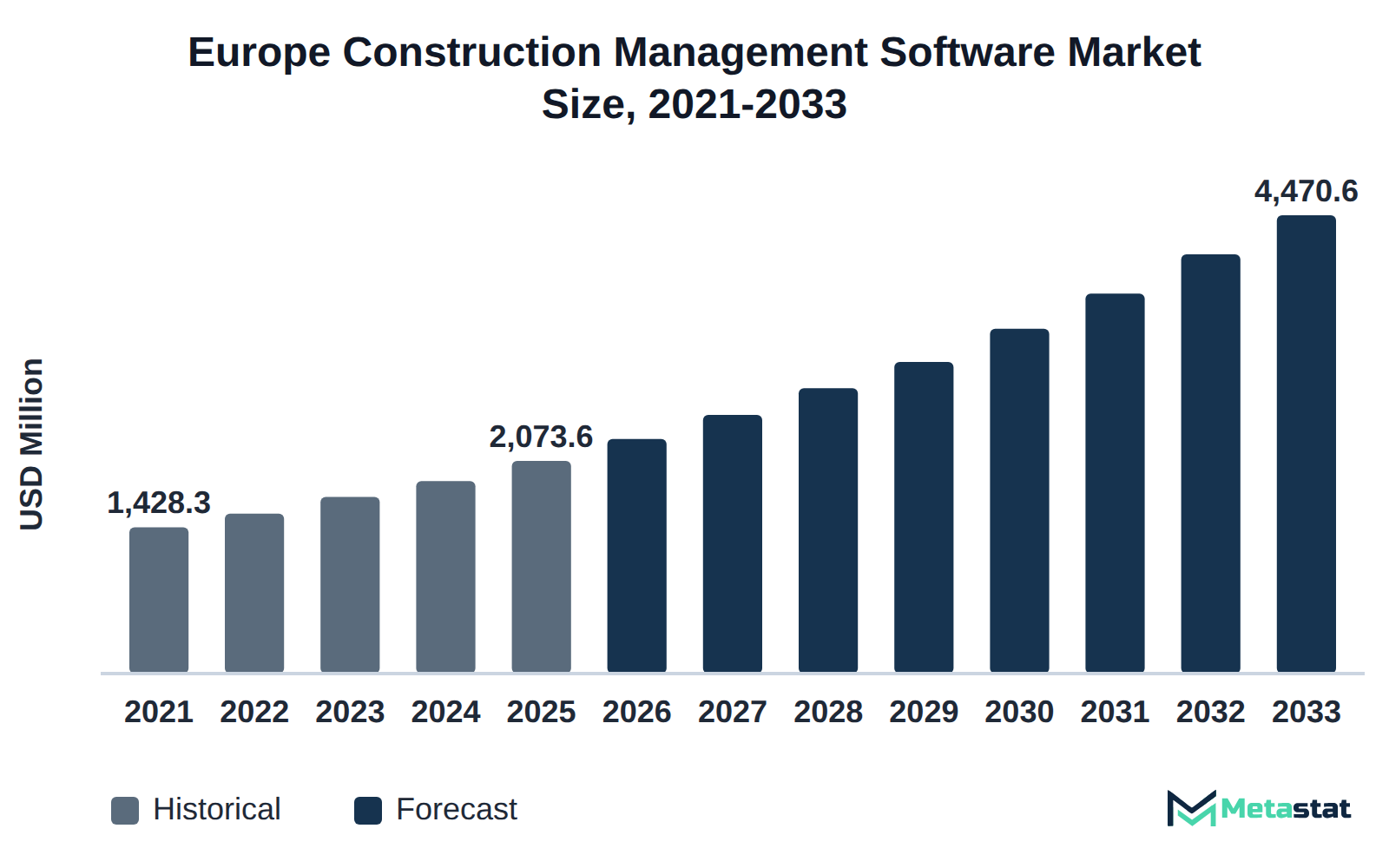
Market Valuation: Valued at $2,073.6 Million in 2025, projected to reach $4,470.6 Million by 2033 at a 10.0% CAGR.
Dominant Segment: Project Management and Scheduling leads the Europe Construction Management Software market, driven by the critical need for comprehensive planning tools in increasingly complex construction projects.
Geographic Lead: Germany holds the largest market share, reflecting robust construction activities and significant investments in modern project management practices.
What's Inside: The report provides in-depth competitive coverage, detailed analyses of market dynamics, and a comprehensive forecast window from 2026 to 2033.
Cloud Deployment Growth: The cloud deployment model is set to expand significantly, with a CAGR of 12.1%, driven by the demand for scalable and flexible solutions that enhance collaboration and real-time data access.
Integrated Cost Controls: Integrated cost controls are increasingly essential across commercial, residential, and infrastructure projects, with the project management and scheduling application projected to reach USD 1,500.8 million by 2033.
Choose Your License
Europe Construction Management Software Market
The Europe Construction Management Software market was valued at USD 2,073.6 million in 2025 and is projected to reach USD 4,470.6 million by 2033, growing at a CAGR of 10.0% over the forecast period.
The Europe Construction Management Software market encompasses various software solutions designed to enhance project management, scheduling, cost estimation, and collaboration within the construction sector. Buyers invest in these solutions to improve efficiency, reduce delays, and manage budgets effectively. This software replaces traditional manual processes, offering automation and real-time data access that supports informed decision-making across projects.
Growth in the market is driven by increasing demand for digital transformation within the construction industry, focusing on efficiency and productivity. Among the application segments, Project Management and Scheduling holds the most value, reflecting the critical need for comprehensive planning tools in construction projects. Germany holds the largest regional share of the market, reflecting its strong construction activity and investment in modernizing project management practices.
One main growth driver includes the rising complexity of construction projects, necessitating advanced software solutions to manage various aspects effectively. This complexity creates opportunities for software providers to tailor their offerings to meet specific project demands, supporting overall market expansion. Continuous technological evolution in construction enhances the adoption of innovative software solutions across the region.
Investment in the Europe Construction Management Software market reflects a commitment to improving efficiency, reducing costs, and enhancing project outcomes across various construction sectors. Buyers recognize the importance of these software solutions in streamlining operations, enabling effective collaboration, and facilitating real-time data management. The focus on digital transformation within the construction industry drives spending, with organizations prioritizing tools that ensure project success and profitability.
Growth in the market is primarily fueled by the increasing adoption of cloud-based solutions, which offer flexibility, scalability, and accessibility. Among the various applications, Project Management and Scheduling stands out, catering to the complex needs of construction projects. The demand for these solutions remains robust, particularly in Germany, which holds the largest share of the market in Europe, reflecting the region's strong commitment to modernizing construction practices.
Technological advances are reshaping the market, as new tools expand capabilities and improve efficiency. The emphasis on data-driven decision-making and automated processes positions the market for sustained growth. Organizations that adopt these solutions benefit from improved project outcomes, cost savings, and enhanced collaboration, further strengthening their competitive edge in the evolving construction environment.
Cloud construction platforms increasingly enhance collaboration between site and office teams in the Europe Construction Management Software market. This shift is driven by the rise in cloud-based solutions that facilitate real-time communication and data access, allowing for streamlined project management. The market for cloud deployment is projected to expand significantly, with a compound annual growth rate (CAGR) of 12.1%, reaching USD 3,505.8 million by 2033.
This transformation benefits the commercial and residential construction sectors, where efficient coordination between remote and on-site teams is essential. Projects become more complex, driving demand for integrated platforms that offer tools for project management and digital collaboration. The projected increase in revenue for project management and scheduling applications, estimated at USD 1,500.8 million by 2033, reflects this need.
Investment in cloud technology reduces operational inefficiencies and lowers the costs of project delays and miscommunication. By adopting these platforms, firms strengthen their competitive position and improve performance and project delivery. Momentum behind cloud construction platforms shapes the future direction of the Europe Construction Management Software market.
The evolution of pricing models in the Europe Construction Management Software market reflects a shift towards subscription-based services and usage-based pricing. This subscription approach follows the wider software-as-a-service model. This arrangement allows construction firms to access advanced scheduling and progress tracking tools without substantial upfront investments, thereby reducing financial barriers associated with traditional on-premises software.
Contract models have evolved, with many vendors offering flexible agreements that accommodate project-specific needs. Such flexibility enables companies to scale their software usage according to project scope and duration, enhancing cost-effectiveness. For example, several small and medium-sized enterprises benefit from the ability to pay for only what they use, ensuring that expenditures align with actual project requirements.
These developments in pricing and contract models not only cater to diverse buyer preferences but increase adoption of AI-assisted tools in construction projects. Consequently, the market is expected to see accelerated growth, with firms increasingly leveraging these technologies to optimize project outcomes and improve operational efficiency.
Integrated cost controls improve the efficiency of construction projects within the Europe Construction Management Software market. Buyers from commercial, residential, and infrastructure sectors require tailored solutions that address unique project complexities and manage financial risks effectively. For instance, the project management and scheduling application segment is projected to reach USD 1,500.8 million by 2033, reflecting a compound annual growth rate of 10.4%. This statistic highlights the growing emphasis on maintaining stringent cost management practices across diverse project types.
In the commercial construction sector, integrated cost controls enable stakeholders to track budgets, forecast expenses, and mitigate potential overruns. Residential projects benefit from precise budgeting tools that facilitate cost estimation and promote financial accountability. Infrastructure projects, often characterized by their scale and complexity, leverage these controls to manage extensive budgets and timelines effectively. The emphasis on integrated solutions addresses the distinct needs of each sector, ensuring that financial constraints do not hinder project delivery. Strong cost management capabilities improve competitiveness and sustainability within the market.
Choosing the right construction management software is critical for European contractors aiming to enhance project efficiency and profitability. Market growth indicates strong demand for solutions that streamline project management processes and improve collaboration among stakeholders.
Contractors should consider deploying cloud-based software solutions, which are expected to dominate the market. This trend highlights how cloud solutions enhance accessibility, allowing teams to collaborate in real-time, regardless of location. Organizations that adopt these technologies often experience improved project outcomes and reduced overhead costs.
Investing in project management and scheduling applications remains essential, with revenue projected to grow from USD 748.7 million in 2026 to USD 1,500.8 million by 2033. These tools facilitate effective planning and resource allocation, enabling contractors to meet project deadlines efficiently. While the Europe Construction Management Software market evolves, selecting software that aligns with project requirements drives competitive advantages and operational success.
The construction industry increasingly faces complex project requirements, leading to a shift in buyer behavior toward advanced software solutions that enhance efficiency and collaboration. Project managers and construction firms prioritize tools that facilitate effective communication, scheduling, and real-time tracking of project progress. This growing complexity results from factors including tighter project timelines and the need for integrated cost management strategies. The market reflects this trend, with the projected value expanding from USD 2,073.6 million in 2025 to USD 4,470.6 million by 2033, achieving a compound annual growth rate (CAGR) of 10%. Such growth highlights the importance of adopting construction management software that meets the demands of contemporary projects, reinforcing operational efficiency while managing costs effectively. Companies actively seek solutions that address these challenges, contributing to robust market demand.
Increased demand for cloud-based applications enhances collaboration among stakeholders, further driving adoption of construction management software. This shift toward digital solutions aligns with the growth strategy of firms operating in the market.
The integration of digital technologies significantly influences the evolution of tools and solutions within the Europe Construction Management Software market. Advances in construction technology, including Building Information Modeling (BIM) and Internet of Things (IoT) capabilities, enhance project visualization and real-time data collection, thereby improving decision-making processes. These tools enable construction professionals to optimize resource allocation, streamline workflows, and enhance communication across teams, reducing project delays and cost overruns.
Firms increasingly use digital platforms to support remote collaboration and link project management with financial oversight, keeping stakeholders aligned. This shift toward comprehensive digital solutions meets the growing demand for transparency and accountability in construction projects. Consequently, the market is projected to expand as organizations invest in innovative software that supports digital workflows and enhances overall project efficiency. Stakeholders that adopt advanced technologies can capture emerging opportunities and support sustained growth in the years ahead.
High costs associated with construction management software present a significant barrier for smaller construction firms and contractors. Rapidly rising prices of software solutions hinder adoption among these buyers, who operate on tight budgets. With limited financial flexibility, smaller firms delay software investments, choosing to rely on manual processes or less comprehensive tools. This situation results in slower uptake of advanced software technologies within the sector, ultimately affecting operational efficiency and project outcomes.
In the Europe Construction Management Software market, price sensitivity leads to smaller order sizes and a preference for basic functionalities over comprehensive solutions. The overall growth potential of the market experiences constraints, particularly among segments that could benefit from modern tools and digital transformation but hesitate due to financial concerns.
Suppliers in the Europe Construction Management Software market face significant margin pressure due to escalating competition and the need for continuous innovation. Intense competition compels firms to offer competitive pricing, impacting profitability. Increasing operational costs, including talent acquisition and retention, necessitate investment in skilled personnel to maintain product quality and service standards. This situation results in a challenging balance between maintaining margins and investing in growth-oriented initiatives.
To address these challenges, suppliers adopt various strategies. Many enhance operational efficiency through automation and process optimization, aiming to reduce costs without compromising service quality. Others focus on expanding their product offerings to capture a wider customer base, allowing for diversified revenue streams. These responses show the importance of strategic agility in managing profit pressures while pursuing sustainable growth.
The cloud deployment model represents a significant growth opportunity within the market, driven by increasing demand for scalable and flexible solutions. This shift aligns with the growing trend of digital transformation in various construction sectors, where companies prioritize collaboration and real-time data access. The cloud model enhances operational efficiency by enabling remote access and streamlined communication among project stakeholders, thus improving project outcomes.
Construction firms prioritizing cloud-based solutions gain a competitive edge in the evolving landscape. By adopting this model, companies significantly reduce infrastructure costs while enhancing project management capabilities. This approach aligns with broader market trends that emphasize agility and responsiveness to changing project demands, ultimately supporting the overall growth trajectory of the Europe Construction Management Software market.
The Europe Construction Management Software market is segmented based on Deployment Model, Application, Project Sector, and Region.
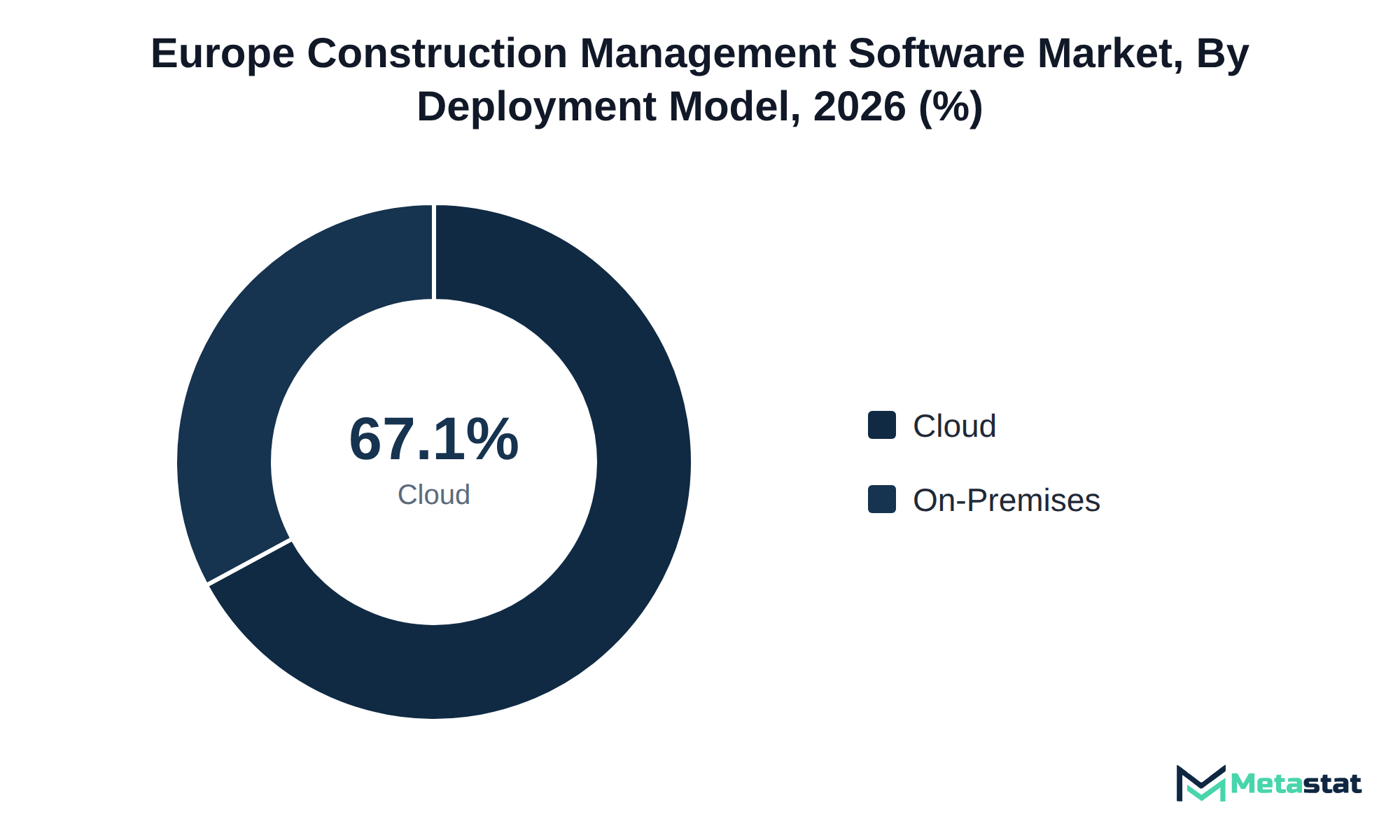
Cloud deployment for construction management software is valued at USD 1,575.1 million in 2026 and is projected to reach USD 3,505.8 million by 2033, at a CAGR of 12.1% during the forecast period. This segment serves various users including project managers, contractors, and construction firms, providing tools for project planning, scheduling, and real-time collaboration. The rapid adoption of cloud solutions is driven by the industry's need for enhanced flexibility and scalability, enabling teams to access critical information from multiple locations. Compared to on-premises solutions, the cloud segment exhibits faster growth due to lower upfront costs and improved accessibility. The anticipated expansion reflects a shift towards modernizing construction processes and embracing digital transformation, aligning with broader trends within the market.
On-Premises segment is estimated to reach USD 964.7 million by 2033, at a CAGR of 4.4% during the forecast period. This segment primarily serves construction firms seeking to maintain control over their software environment and data security. Users typically include larger enterprises that handle sensitive project information requiring stringent data governance. Demand for On-Premises solutions is driven by concerns regarding data privacy and regulatory compliance, particularly in sectors including infrastructure and commercial construction. Compared to the Cloud segment, which exhibits faster growth at a CAGR of 12.1%, the On-Premises segment shows more moderate expansion. Factors influencing On-Premises adoption include the higher upfront costs associated with software ownership and maintenance, which deter smaller firms from making the investment. Nevertheless, larger organizations benefit from the customization potential that On-Premises solutions offer, aligning with their unique operational needs in the market.
This segment focuses on facilitating the planning, execution, and monitoring of construction projects, ensuring that timelines are adhered to and resources are allocated effectively. These tools belong to the wider project management software category, adapted here for construction timelines and resources. Primarily used by project managers and construction firms, tools in this segment address the demand for streamlined processes and enhanced accountability. Growth in this area is driven by increasing project complexity and the need for real-time insights, which necessitate sophisticated scheduling capabilities. With a higher CAGR compared to other applications including Cost Estimation and Budget Management, which is projected at a CAGR of 10.6%, Project Management and Scheduling stands out due to its critical role in ensuring project efficiency and success across the Europe Construction Management Software market.
Cost Estimation and Budget Management segment is estimated to reach USD 1,088.1 million by 2033, at a CAGR of 10.6% during the forecast period. This segment focuses on the development and application of cost-estimating software and other tools that assist contractors and project managers in estimating project costs and managing budgets effectively. Construction firms increasingly rely on these solutions to ensure projects stay within financial limits and to enhance financial decision-making processes. The growth of this segment is driven by the rising complexity of construction projects, which necessitate precise budget management. Unlike the Document Management and Digital Collaboration segment, which experiences slower growth, Cost Estimation and Budget Management is projected to expand at a faster pace. This growth is supported by demand for advanced solutions that provide detailed insights into cost management, enabling firms to enhance overall project profitability.
Document Management and Digital Collaboration segment is expected to reach USD 907.1 million by 2033. This segment facilitates efficient handling, storage, and sharing of project documents among construction teams, ensuring streamlined communication and collaboration. Users of this segment include contractors, project managers, and architects who rely on real-time access to critical project information. Their workflows also connect with architecture, engineering and construction software used across design and delivery. The growing emphasis on collaboration in construction drives demand for effective document management solutions. Compared to other application segments, this segment experiences moderate growth, influenced by an increasing need for digital collaboration tools. Factors including the rise of remote work and the integration of digital solutions enhance its appeal. In contrast, segments like Project Management and Scheduling present faster growth opportunities, reflecting distinct trends in user needs and spending priorities within the Europe Construction Management Software market.
Field Quality and Safety Management segment is projected to grow at a CAGR of 10.2% during the forecast period. This segment focuses on ensuring compliance with safety regulations, maintaining quality standards, and managing risks at construction sites. Construction firms, project managers, and safety officers apply these solutions to improve on-site safety and enhance quality control processes. The increasing emphasis on workplace safety and adherence to regulatory standards drives demand for this segment. This emphasis connects to wider occupational health and safety practice on construction sites. Compared to other applications, including Cost Estimation and Budget Management, which is expected to reach USD 1,088.1 million by 2033, the Field Quality and Safety Management segment demonstrates a strong growth trajectory, reflecting heightened awareness of safety protocols across the industry. This trend highlights the importance of integrating safety measures into project management strategies to mitigate risks and enhance overall project outcomes in the market.
Resource and Equipment Management focuses on optimizing the use and allocation of construction resources, including machinery, tools, and labor. This application aids construction managers in tracking equipment usage, scheduling maintenance, and reducing downtime. The same priorities appear in construction equipment fleet management, which centers on keeping machinery available and maintained. The segment predominantly serves large-scale construction firms that prioritize efficiency and cost savings. Driven by the increasing complexity of construction projects, efficient resource management becomes essential for timely project completion and budget adherence. Compared to other applications, this segment experiences slower growth due to the higher integration costs associated with advanced resource management systems. Organizations seeking competitive advantages through improved operational efficiency will continue to drive demand. The Europe Construction Management Software market reflects these dynamics while companies increasingly prioritize solutions that support effective resource utilization.
This sub-segment encompasses bid management and handover management functionalities, contributing to the overall efficiency of construction processes. Primarily, project managers and construction firms apply these tools to streamline bid processes and ensure smooth transitions during project handovers. A significant driver for this sub-segment stems from the increasing complexity of construction projects, necessitating more organized and efficient management practices. This condition leads to a heightened demand for software solutions tailored to specific project phases. Compared to other application segments, including Project Management and Scheduling or Cost Estimation and Budget Management, the growth trajectory for this sub-segment does not exhibit the same rapid expansion. Nonetheless, its importance in enhancing project coordination and minimizing risks during transitions remains critical, reinforcing its value in the Europe Construction Management Software market.
Commercial Construction segment is valued at USD 737.5 million in 2026 and is projected to reach USD 1,398.4 million by 2033, at a CAGR of 9.6% during the forecast period. This segment comprises construction projects that focus on non-residential buildings, including offices, retail spaces, and industrial facilities. Main users include construction firms, project managers, and property developers. A significant driver for this segment stems from the growing demand for modern infrastructure, fueled by urbanization and economic expansion. Compared to other segments like Residential Construction, which has a CAGR of 9.4%, the Commercial Construction segment shows a slightly higher growth rate. Pricing strategies play an essential role, with fluctuations based on project size and complexity influencing overall expenditures in the market.
Residential Construction segment is estimated to reach USD 1,080.1 million by 2033, at a CAGR of 9.4% during the forecast period. This segment plays a critical role in managing the complexities associated with residential building projects, focusing on elements including scheduling, cost estimation, and compliance. Homebuilders and contractors apply construction management software to streamline workflows and enhance collaboration among teams. The residential construction sector experiences strong demand driven by population growth and urbanization, incentivizing builders to adopt advanced management solutions. The distinct dynamics influencing the residential construction segment contribute to its unique position and requirements within the market.
Infrastructure Construction segment is expected to reach USD 1,451.6 million by 2033. This segment encompasses various large-scale projects, including roads, bridges, and utilities, typically managed by governmental bodies and specialized contractors. Demand for advanced software solutions in this area is driven by the increasing complexity of infrastructure projects, which require precise coordination and compliance with regulatory standards. Ongoing investment in public infrastructure enhances the adoption of construction management software. This segment exhibits a moderate growth trajectory, with a CAGR of 9.7%, distinguishing it from other project sectors including Commercial Construction, which shows a CAGR of 9.6%. The Infrastructure Construction sector's unique requirements necessitate specialized tools to support efficient project management and execution, differentiating it within the market.
Industrial Construction segment is projected to grow at a CAGR of 9.7% during the forecast period. This segment encompasses the planning, design, and execution of large-scale facilities including factories and power plants. Construction firms and project managers frequently employ specialized software tools to enhance project efficiency and collaboration throughout complex industrial projects. Demand for advanced solutions arises from the increasing need for streamlined operations, improved resource management, and enhanced safety compliance. Compared to other segments, the Industrial Construction segment experiences steady growth, driven by significant investments in infrastructure and industrial facilities across Europe. The estimated revenue for this segment reflects a growing recognition of the benefits of integrated management software. In 2026, Industrial Construction is expected to contribute significantly to the overall growth of the market for construction management software in Europe.
Germany segment is valued at USD 540.7 million in 2026 and is projected to reach USD 1,081 million by 2033, at a CAGR of 10.4% during the forecast period. This segment finds extensive application in various construction projects, including commercial, residential, and infrastructure sectors. Construction firms leverage these solutions for efficient project tracking, resource management, and budget control. The growing emphasis on digital transformation within the construction industry drives demand for advanced solutions in Germany. This segment exhibits faster growth compared to the On-Premises deployment model, which is projected to reach USD 964.7 million by 2033 at a CAGR of 4.4%. The increasing push for cloud-based solutions within the Europe Construction Management Software market enhances the attractiveness of the Germany segment, providing greater scalability and flexibility to users.
France segment is estimated to reach USD 658.5 million by 2033, at a CAGR of 10.4% during the forecast period. This segment primarily serves construction firms, project managers, and stakeholders engaged in the construction process, facilitating project planning, budgeting, and documentation. The demand for efficient project management tools drives adoption, reflecting a broader shift toward digital transformation in the construction industry. Compared to other segments, the France segment demonstrates a strong growth trajectory, supported by increasing investment in infrastructure and modernization. The competitive landscape features various players offering tailored solutions that address specific regional needs, improving operational efficiencies. Particularly, the focus on innovation in cost estimation and budget management differentiates it from slower-growing segments, ensuring stakeholders achieve precise financial oversight throughout projects. This trend contributes to the overall expansion of the market.
UK segment is expected to reach USD 977.7 million by 2033. This segment primarily serves construction firms that require effective management of projects, budgets, and resources. Demand is driven by increasing infrastructure projects and the push for efficient project delivery. Compared to other regions, the UK benefits from a mature market with established players and a strong emphasis on regulatory compliance, which influences purchasing decisions. The growth rate aligns with the overall market trends, yet the UK segment displays unique characteristics in technology adoption and integration, distinguishing it from faster-growing regions including Germany.
Italy is projected to grow at a CAGR of 9.5% during the forecast period. This segment primarily serves construction firms focusing on both residential and commercial projects, offering tools for effective project management, scheduling, and budget oversight. The growing emphasis on infrastructure development within Italy drives demand for advanced software solutions, enabling streamlined operations and enhanced collaboration among stakeholders. In contrast to other regions, Italy’s market players prioritize cost estimation and budget management functionalities, reflecting a tailored approach to local project needs. The segment's growth trajectory aligns with increasing investments in residential constructions, expected to reach USD 1,080.1 million by 2033. The emerging emphasis on digital transformation reshapes the Italy segment, positioning it as a vital component within the Europe Construction Management Software market.
Spain's construction management software landscape enhances project efficiency and collaboration among stakeholders. It serves various sectors, including commercial and residential construction, driven by increasing demand for digital solutions that streamline project workflows. The push for improved project visibility and real-time data sharing supports the adoption of these solutions. Spain's growing emphasis on sustainability and smart construction further contributes to market dynamics, prompting companies to integrate advanced software tools into their processes. This segment demonstrates a slower growth rate compared to other regions, influenced by regional regulations and varying technological adoption levels. The unique needs of the Spanish market, combined with its focus on innovation, set it apart from neighboring markets in Europe, shaping its development trajectory within the broader Europe Construction Management Software market.
Russia encompasses a growing interest in construction management software, driven by the ongoing development of infrastructure projects and urbanization efforts. This segment finds utility among construction firms and project managers aiming to optimize project execution and resource allocation. Demand for advanced project management solutions is fueled by the increasing need for efficiency and transparency in construction activities. These solutions streamline communication and improve collaboration among stakeholders involved in various projects.
Compared to other segments, the market in Russia experiences different dynamics, influenced by regional economic conditions and regulatory environments. The emphasis on modernizing construction practices positions Russia uniquely within the broader Europe Construction Management Software market. Adoption of innovative technologies is crucial for enhancing productivity and achieving project objectives in this region.
This sub-segment includes various countries in Europe that do not fall under the primary national categories. Organizations in this region increasingly adopt construction management software to enhance project execution and streamline operations. Key drivers of demand include the rising complexity of construction projects and the necessity for improved collaboration among stakeholders. The growing emphasis on digital transformation in construction contributes significantly to software adoption in these markets. Compared to other regions, this sub-segment experiences slower growth rates, influenced by varying levels of digital infrastructure and investment in technology. Buyers in the Rest of the Europe sub-segment often seek cost-effective solutions tailored to their local needs, differentiating their approach from regions with higher budgets and advanced technology integration. The Europe Construction Management Software market captures these dynamics, illustrating the diverse challenges and opportunities across different geographic areas.
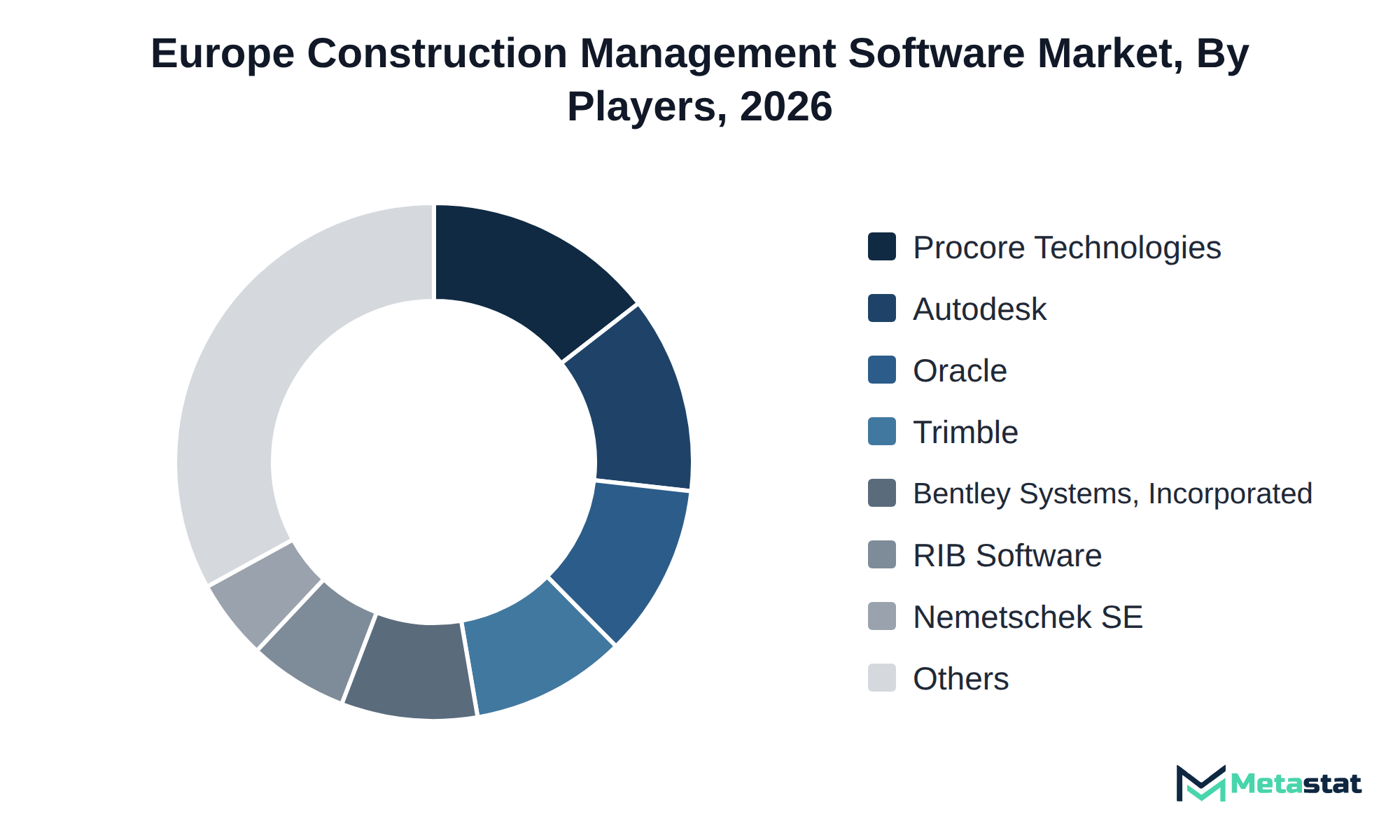
Competition within the Europe Construction Management Software market is shaped by various strategic behaviors. Key players differentiate their offerings through deployment models, application types, and project sectors. Companies focusing on cloud-based solutions, including Procore Technologies, Inc. and Autodesk, Inc., emphasize scalability and ease of access, while those with on-premises offerings, like RIB Software GmbH and Oracle Corporation, cater to clients prioritizing data security and control.
Buyers evaluate options based on factors including price, customization, and integrated services. Solutions that combine project management, cost estimation, and document management appeal to diverse construction sectors. For instance, Trimble Inc. specializes in project management and scheduling, supporting clients in optimizing workflows, while Bentley Systems, Incorporated focuses on infrastructure construction applications to enhance asset performance.
Market players continue to refine their positioning to address specific client needs. Companies including Hilti Corporation and PlanRadar GmbH emphasize high-quality service and user-friendly interfaces, attracting a clientele that values efficient experiences. Organizations including Buildxact and InEight Inc. apply advanced technology and innovative features to meet the growing demand for efficient construction management solutions.
Partnerships with other technology providers or service firms further enhance competitive positioning, creating an ecosystem that supports the comprehensive needs of customers. This approach helps companies manage the demands of the construction management market and supports growth and adoption.
Infrastructure construction acts as another key driver, contributing to the overall market expansion. The primary risk that could impede this growth centers on economic fluctuations that could affect construction spending, particularly in Germany and France, where investments in construction management software are critical. Such conditions could stall advancements and restrict market potential, thus limiting growth in the Europe Construction Management Software market.
By Deployment Model: Cloud, On-Premises
By Application: Project Management and Scheduling, Cost Estimation and Budget Management, Document Management and Digital Collaboration, Field Quality and Safety Management, Resource and Equipment Management, Others (Bid Management, Handover Management)
By Project Sector: Commercial Construction, Residential Construction, Infrastructure Construction, Industrial Construction
By Region: Germany, France, UK, Italy, Spain, Russia, Rest of the Europe
The report strategically identifies and profiles the key market players and analyses their core competencies in each sub-segment of the Construction Management Software market.
Report Attributes | Details |
Study Period | 2021-2033 |
Base Year | 2025 |
Estimated Year | 2026 |
Forecast Period | 2026-2033 |
Historical Period | 2021-2025 |
Growth Rate | CAGR 10.0% from 2026 to 2033 |
Revenue Unit | USD million |
Segmentation | By Deployment Model, Application, Project Sector, Region, and Region |
Find answers to common questions about this report
The Construction Management Software market size was valued at USD 2,073.6 million in 2025.
The market is projected to grow at a CAGR of 10.0% during the forecast period from 2026 to 2033.
The leading segment in the Construction Management Software market is the Cloud deployment model, with a projected value of USD 3,505.8 million by 2033. This segment outpaces the On-Premises model, which is expected to reach USD 964.7 million in the same year.
Increasing complexity in project requirements drives demand for advanced software solutions that enhance efficiency and collaboration. The growing preference for cloud-based applications further supports the adoption of construction management software by facilitating collaboration among stakeholders.
High costs associated with construction management software present a significant barrier for smaller construction firms and contractors, hindering adoption among these buyers. Price sensitivity leads to smaller order sizes and a preference for basic functionalities over comprehensive solutions, ultimately affecting operational efficiency and project outcomes.
Factors favoring adoption in the Europe Construction Management Software industry include the increasing demand for scalable cloud solutions and the emphasis on collaboration and real-time data access. These elements enhance project management capabilities, driving firms to invest in advanced software technologies.
The Construction Management Software market is estimated to reach a valuation of USD 4,470.6 million by 2033.
Key players operating in the Construction Management Software market include Procore Technologies, Inc., Autodesk, Inc., Oracle Corporation, Trimble Inc., Bentley Systems, Incorporated, RIB Software GmbH, and Catenda AS.
The cloud deployment model is anticipated to reach USD 3,505.8 million by 2033, reflecting a compound annual growth rate (CAGR) of 12.1 percent from USD 1,575.1 million in 2026.
Key applications include Project Management and Scheduling, with a projected increase from USD 748.7 million in 2026 to USD 1,500.8 million by 2033, achieving a CAGR of 10.4 percent.
The analysts below cover Professional Services research at Metastat Insights.
LEAD ANALYST
Utkarsh Khirodkar is a Lead Market Research Analyst at MetaStat Insight, specializing in market intelligence, technology sector assessments, and competitive strategy.

PRINCIPAL CONSULTANT - ENTERPRISE AI & EMERGING TECHNOLOGIES
Banking & Finance · Electronics and Semiconductor · Energy and Power · Healthcare IT · Information & Technology · Professional Services
Vijay Gunti is a Principal Consultant at MetaStat Insight, bringing over two decades of experience across enterprise digital transformation, technology strategy, and intelligent systems.

PRINCIPAL CONSULTANT - QUALITY SYSTEMS & COMPLIANCE
Electronics and Semiconductor · Machinery & Equipment · Professional Services
Omkar Phadtare is an Industry Consultant at MetaStat Insight, specializing in quality systems, regulatory compliance, and standards benchmarking to drive data-driven market intelligence and strategic industry research.

LEAD CONSULTANT - COMMUNICATION, TELECOM, AND IT
Electronics and Semiconductor · Information & Technology · Machinery & Equipment · Professional Services
Ravindra Sathe Consultants for Communication, Telecom, and IT at MetaStat Insight. He leads the firm's industry research initiatives across telecommunications infrastructure, digital connectivity, enterprise networking, and emerging information technology domains.
When planning edge sensor rollouts across refinery environments, generic IoT reports typically miss the harsh-environment certification bottlenecks. MetaStat Insight gave an objective evaluation of ATEX and Class 1 Division 2 hardware availability, along with realistic five-year maintenance cycle cost projections. The comparison of wireless mesh versus private cellular backhaul helped our team pressure-test network reliability models for remote processing facilities.
In the biological seed treatment space, registration timelines vary drastically between the European Union, Brazil, and North America. The MetaStat Insight research handled these cross-border regulatory barriers with genuine nuance, mapping commercialization pathways alongside historical field adoption rates. The segmentation between microbial strains and biochemical active ingredients was particularly well structured.
Our team was tracking whether regional recycling infrastructure could realistically absorb the growing volume of lithium iron phosphate batteries over the next decade. The report did a solid job separating announced hydrometallurgical plant capacity from active, permitted operational throughput. That distinction made the feedstock availability projections and regional recovery rate models far more credible than standard commercial overviews.
Explore related market intelligence reports worth reading alongside this one.
Starting from
$2950