
LEAD ANALYST
Utkarsh Khirodkar is a Lead Market Research Analyst at MetaStat Insight, specializing in market intelligence, technology sector assessments, and competitive strategy.

Global Digital BSS Market Size, Share, By Offering (Software, Implementation and Integration Services, Managed Services and Support), By Business Function (Billing and Charging, Customer Management and Digital Engagement, Order Management, Product Catalog and Offer Management, Partner Management and Settlement, Revenue Assurance and Fraud Management), By Deployment Model (Cloud Only, On-Premises Only, Hybrid), By End-Use Industry (Telecommunications, IT and IT-Enabled Services, Media and Entertainment, Banking, Financial Services and Insurance, Retail and E-Commerce, Energy and Utilities), Industry Analysis, Growth, Trends, and Forecast, 2026-2033
Report ID
MSI-5806
Published
November, 2026
Pages
271 Pages
Format
Historical
Base year
Forecast
Forecast period
Report Details
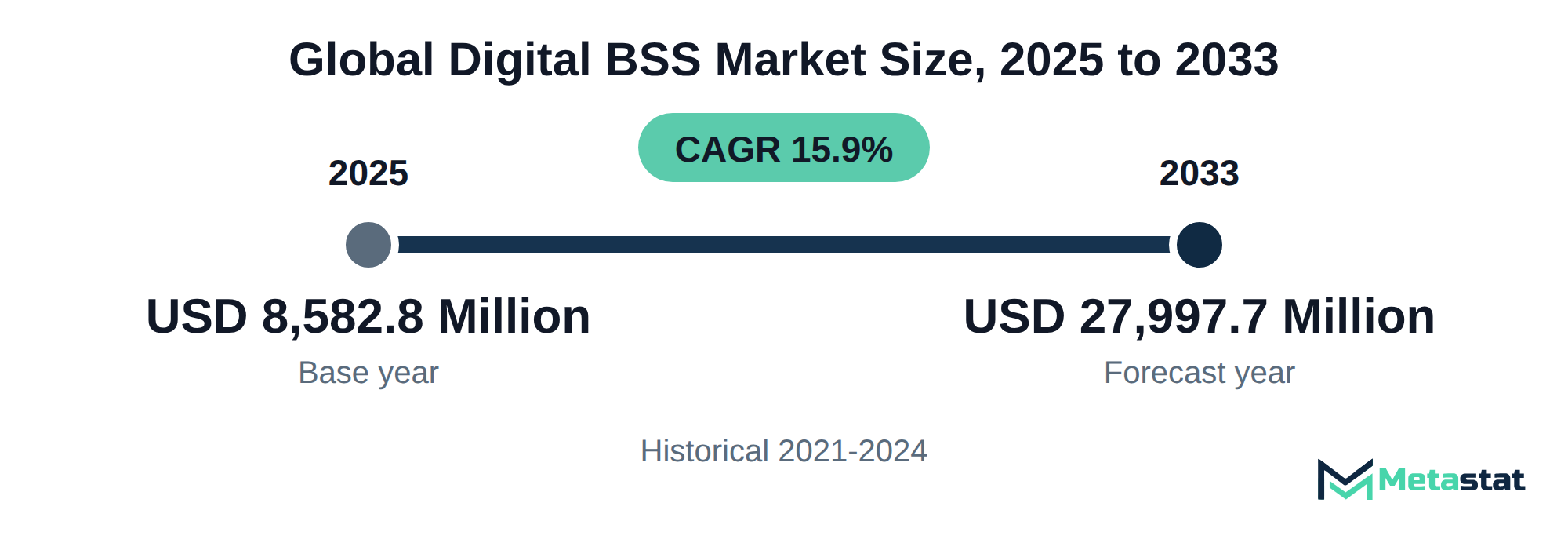
Market Valuation: Valued at $8,582.8 Million in 2025, projected to reach $27,997.7 Million by 2033 at a 15.9% CAGR.
Dominant Segment: The telecommunications segment leads the Digital BSS market, driven by the growing reliance on advanced billing and charging systems to manage complex service offerings.
Geographic Lead: North America is the leading region, capturing 33.6% of the market in 2025, with the United States expected to maintain its position as a key player in 2026.
What's Inside: The report provides a comprehensive analysis of market segmentation by offering, business function, deployment model, and end-use industry, along with detailed competitive coverage and forecasts through 2033.
Emerging Trends: The shift towards cloud-based solutions is a significant trend, enhancing scalability and operational efficiency, which is crucial for adapting to evolving customer demands.
Investment Drivers: Increasing demand for digital transformation and customer engagement technologies are primary factors driving market expansion, as organizations seek to improve operational efficiencies and customer loyalty.
Choose Your License
Global Digital BSS Market
The global Digital BSS market was valued at USD 8,582.8 million in 2025 and is projected to reach USD 27,997.7 million by 2033, growing at a CAGR of 15.9% over the forecast period.
The Digital BSS market encompasses software solutions and services that enhance business operations for telecommunications and digital service providers. Buyers invest in these offerings to streamline processes, improve customer interactions, and adapt to evolving market demands. The need for efficient billing systems, customer management, and digital engagement tools drives significant spending in this sector.
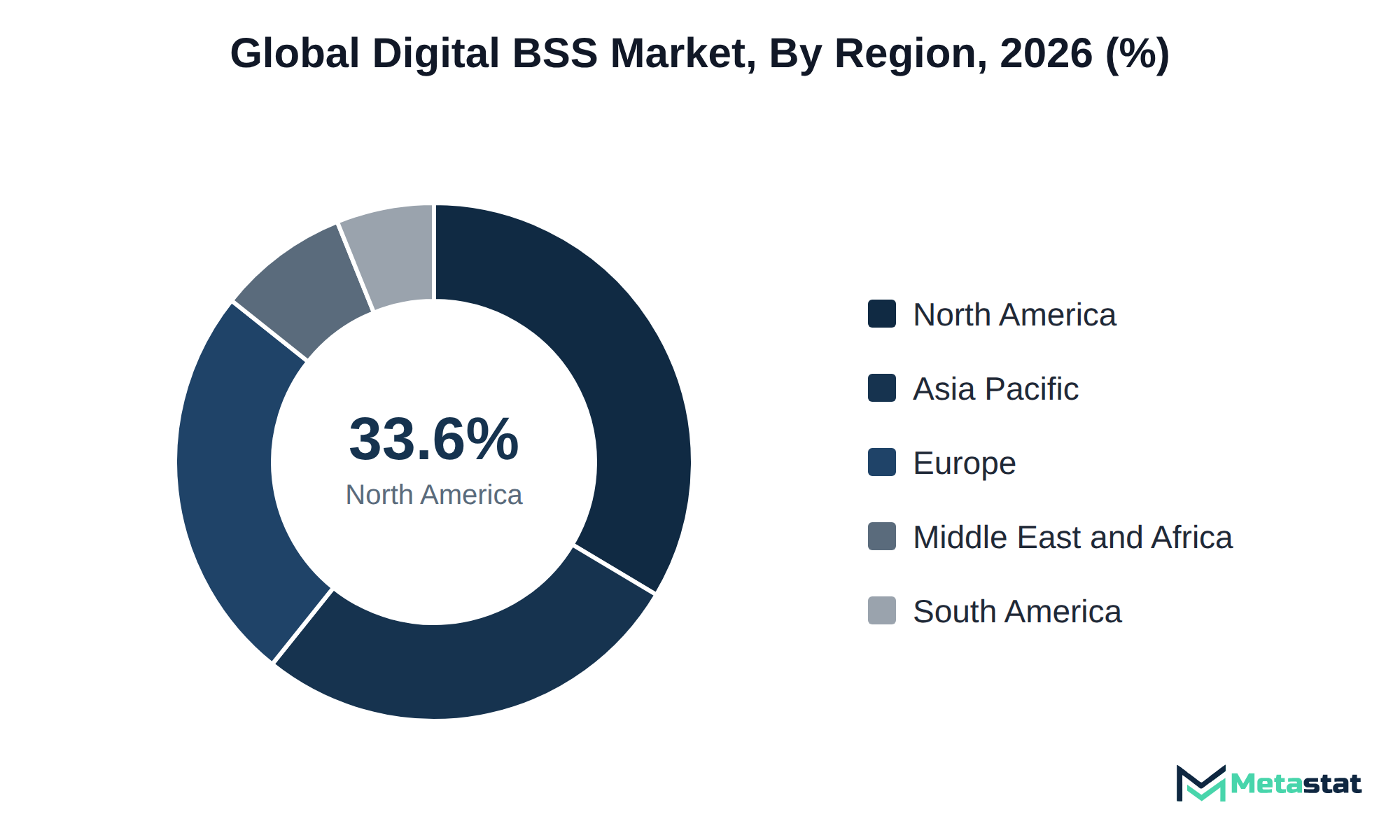
Growth in the market is propelled by increasing demand for digital transformation among service providers. Telecommunications represents the segment with the highest value, reflecting a growing reliance on advanced billing and charging systems. North America holds 33.6% of the market in 2025, with the US leading in 2026. The Asia Pacific region follows closely, capturing 27.2% of the market, while Europe accounts for 25%.
One primary driver of growth stems from the ongoing shift towards cloud-based solutions. This shift enhances scalability and flexibility, allowing providers to adapt services rapidly. The implementation of cloud technologies enhances operational efficiency and improves customer experiences, positioning businesses competitively in the evolving digital landscape.
The market encompasses a range of offerings that enhance billing, customer management, and operational efficiency for telecommunications and digital service providers. Buyers invest in these solutions to streamline their processes, improve customer engagement, and adapt to the evolving demands of the digital economy. The increasing reliance on digital services and the growing complexity of customer interactions drive the demand for advanced business support systems.
Growth in the Digital BSS market is propelled primarily by the shift towards cloud-based solutions, which provide scalability and flexibility for businesses. Among the various segments, software holds the largest share, reflecting the critical role it plays in optimizing business functions. The Asia Pacific region closely follows, accounting for 27.2%, indicating a strong demand for digital transformation in emerging markets.
Investments in customer engagement technologies emerge as a key factor supporting market expansion. Companies increasingly recognize the importance of leveraging data analytics and digital platforms to enhance customer experiences. This focus not only drives operational efficiencies but leads to greater customer loyalty, ultimately contributing to sustained growth in the market.
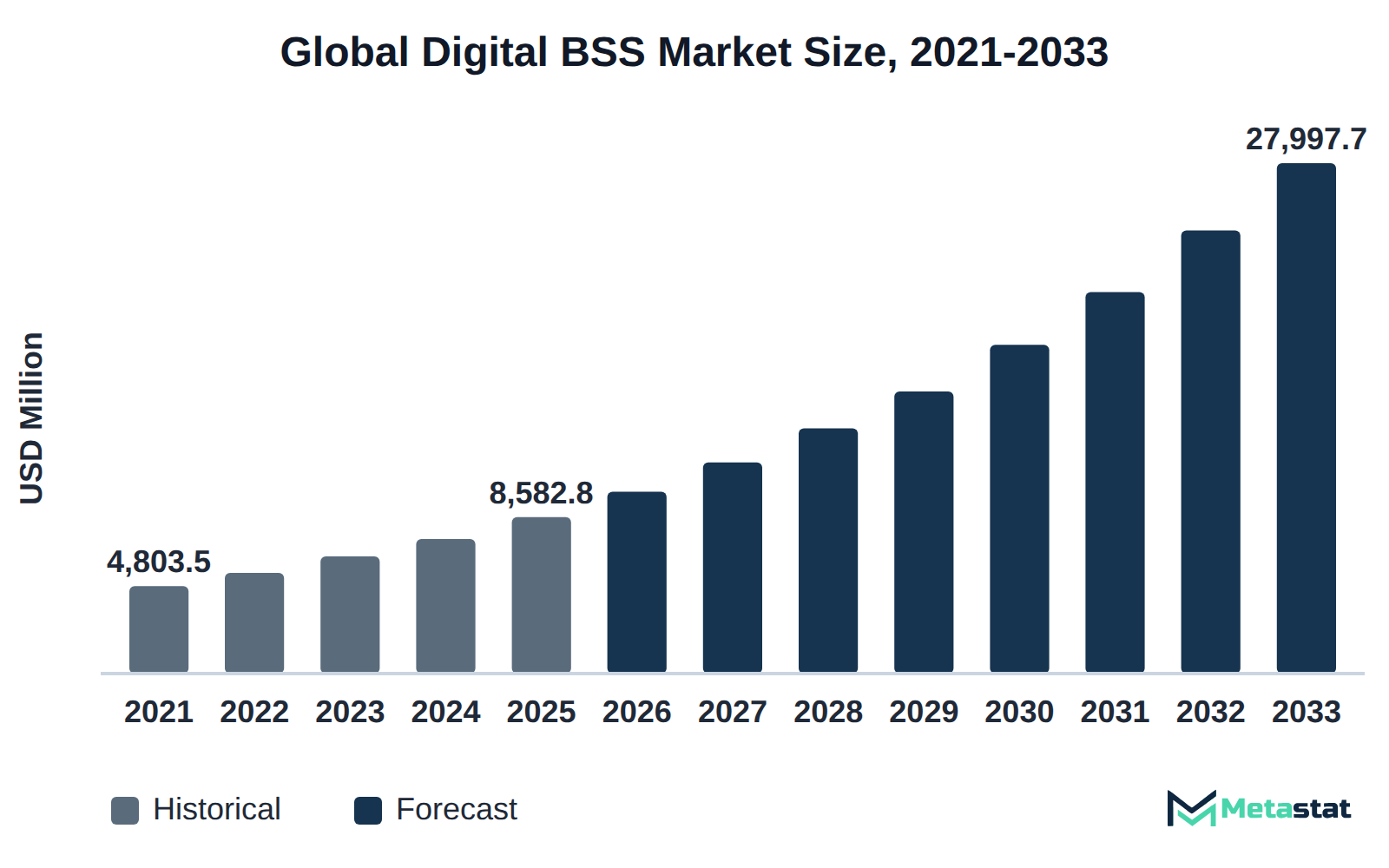
The shift towards cloud-native digital BSS systems represents a significant trend among telecom operators, facilitating enhanced operational efficiency and agility. By 2033, the revenue from cloud-only deployment models is projected to reach USD 18,327.3 million, reflecting a compound annual growth rate of 17.6%. This transformation supports the integration of various digital services, allowing telecom companies to adapt rapidly to evolving customer demands and market conditions.
Cloud-native architectures enable telecom operators to improve service delivery and customer engagement through advanced analytics and real-time data processing. The transition from traditional on-premises solutions to cloud platforms enhances scalability and flexibility, essential for managing the increasing volume of customer interactions and service offerings. Telecom operators leveraging cloud-native systems optimize their resources, reduce operational costs, and improve overall service quality, positioning themselves competitively in the digital BSS market.
This migration contributes to a more agile business model that enhances responsiveness to market changes. With the anticipated growth in cloud adoption, telecom operators stand to gain significant competitive advantages, enabling improved customer satisfaction and retention rates. The focus on cloud-native digital BSS solutions establishes the foundation for future growth and innovation in the market.
Converged charging for 5G standalone networks and network slicing presents significant opportunities for stakeholders in the Digital BSS market. Pricing models for these services play a crucial role in buyer decision-making. Operators increasingly seek flexible and scalable charging solutions that accommodate various customer requirements, especially in the context of 5G technologies.
Telecom service providers are projected to invest substantially in converged charging solutions, with the telecommunications end-use industry expected to reach USD 16,342.3 million by 2033. This investment reflects a growing recognition among operators of the necessity for enhanced billing systems that manage complex service offerings efficiently, including dynamic pricing models and real-time charging capabilities.
Operators increasingly favor subscription-based contracts combined with usage-based pricing structures. This approach allows for financial predictability while simultaneously enabling the flexibility to adapt to changing customer demands. Such strategies facilitate revenue maximization and ensure customer satisfaction, ultimately driving growth in the market.
Partner settlement plays a critical role in B2B2X telecom services, addressing the unique needs of telecommunications providers and their partners. The Digital BSS market has seen significant growth, with revenues reaching USD 8,582.8 million in 2025, reflecting the increasing complexity and demand for integration of services across various stakeholders. This growth necessitates robust systems that enable accurate billing, charging, and settlement processes, ensuring that all parties involved receive fair compensation for their contributions.
Specifically, the telecommunications segment anticipates a revenue increase from USD 6,046.5 million in 2026 to USD 16,342.3 million by 2033, highlighting the demand for efficient partner settlement solutions. Telecommunications providers require comprehensive partner management and settlement capabilities to navigate complex agreements with multiple service providers and resellers. These solutions simplify the reconciliation of services and billing, reducing operational overhead and enhancing revenue assurance.
Investment in advanced partner settlement systems leads to improved operational efficiency and customer satisfaction, strengthening relationships between telecom providers and their partners. While the market evolves, the implementation of innovative digital solutions in partner settlement plays a vital role in ensuring sustainable growth and competitiveness in the Digital BSS market.
Digital Business Support Systems (BSS) streamline operations for telecom operators, enhancing their ability to manage customer interactions, billing processes, and service delivery. The telecom industry increasingly adopts this technology to improve efficiency and customer satisfaction. In 2026, spending on billing and charging solutions, a critical component of Digital BSS, is anticipated to reach USD 4,765.1 million, highlighting the significant investment in this area. This demand reflects the industry's need for robust systems that handle complex billing scenarios efficiently.
Operators leverage Digital BSS to optimize customer management and digital engagement strategies. The integration of these systems results in better data analytics and insights, allowing companies to personalize services and enhance customer experiences. By 2033, the market for customer management and digital engagement in Digital BSS is projected to reach USD 4,877.2 million, demonstrating the growing recognition of the importance of strong customer relations in competitive telecommunications markets. Firms adopting these technologies typically experience improved customer retention rates, translating to higher revenue and market share.
Telecommunications providers increasingly adopt cloud-based Digital BSS solutions, driven by the need for agility and scalability in service delivery. This shift enhances operational efficiency, allowing operators to respond more rapidly to market demands. The trend reflects a broader industry change where companies prioritize flexible IT infrastructures to support digital transformation. In 2026, spending on software offerings is projected to reach USD 6,300.3 million, illustrating the growing investment in digital solutions. The market experiences heightened volume as providers seek to modernize their legacy systems and improve customer engagement strategies. Through this transition, buyers gain a competitive edge, positioning themselves to capitalize on evolving consumer preferences and technological advancements.
The increased focus on customer management and digital engagement within the telecommunications sector promotes higher investments in Digital BSS. Companies leverage these systems to streamline interactions and enhance customer satisfaction, driving market growth.
Telecommunications providers increasingly invest in virtualization technologies to enhance operational flexibility and efficiency. These technologies facilitate the transition from traditional infrastructures to more agile, software-defined networks, significantly impacting the Digital BSS market. Virtualization enables service providers to implement new services more rapidly, responding effectively to changing customer demands and competitive pressures. The growing complexity in service delivery, driven by diverse customer expectations and the need for personalized experiences, promotes the adoption of advanced Digital BSS solutions. Industry players leverage virtualization to reduce operational expenses and increase the speed of service deployment, improving overall customer satisfaction. The market experiences consistent growth, with an anticipated compound annual growth rate (CAGR) of 15.9% through 2033. This shift aligns with the market's strategic objectives and positions providers to capitalize on emerging opportunities within the digital ecosystem.
High implementation costs present a significant challenge for the Digital BSS market, particularly impacting telecommunications providers. The expenses associated with the deployment, integration, and customization of digital BSS solutions often result in slower adoption rates among these buyers. Firms face financial scrutiny when evaluating investments in new technologies, leading to smaller orders or delayed replacements of existing systems. This hesitance stems from the necessity to allocate substantial budgets not only for software acquisition but for the requisite services that ensure effective integration and operation. Consequently, several telecommunications companies encounter barriers that hinder their ability to fully embrace digital transformation, stalling overall market growth and innovation. Addressing these financial concerns is essential for improving the market's trajectory and supporting long-term expansion.
Talent costs present a significant challenge for suppliers in the Digital BSS market, impacting profit margins and operational efficiency. The demand for skilled professionals in software development and system integration drives labor expenses upward. Companies invest in training programs and partnerships with educational institutions to enhance the skill sets of their workforce while reducing reliance on expensive external consultants. Organizations implement automation tools to streamline processes and minimize the need for extensive human resources. This strategic pivot aims to offset rising costs while maintaining the quality of services delivered. Suppliers that adapt to these challenges position themselves to sustain profitability and strengthen competitive advantage in the evolving market.
Cloud-only deployment models present a significant growth opportunity within the Digital BSS market. This segment is projected to achieve a compound annual growth rate (CAGR) of 17.6% from 2026 to 2033, reflecting increasing adoption among telecommunications providers. The demand for enhanced scalability and flexibility in operations drives this trend, with providers looking to streamline their processes and improve customer engagement. Cloud-only solutions allow organizations to reduce infrastructure costs while providing the ability to innovate and respond to market changes rapidly. The benefits realized through this deployment model encourage firms to invest strategically in cloud-based Digital BSS offerings, promoting overall market growth. By enhancing operational efficiency, cloud-only deployments enable providers to meet the evolving needs of their customer base, thus strengthening their competitive position in the market.
The Global Digital BSS market is segmented based on Offering, Business Function, Deployment Model, and End-Use Industry.
Software valued at USD 6,300.3 million in 2026 is projected to reach USD 18,279.7 million by 2033, at a CAGR of 16.4% during the forecast period. This segment focuses on solutions that facilitate billing, charging, and customer management, primarily used by telecommunications providers and digital service companies. The increasing demand for improved customer engagement and operational efficiency drives this segment. This segment experiences higher growth compared to implementation and integration services, which show a CAGR of 13.6%. The rapid evolution of technology, particularly cloud-based solutions, supports a significant shift toward software that enhances flexibility and scalability in service delivery. Market participants prioritize the development of advanced software solutions to meet the dynamic needs of customers, contributing to its strong growth.
Implementation and Integration Services segment is estimated to reach USD 5,557.5 million by 2033, at a CAGR of 13.6% during the forecast period. This segment focuses on delivering essential services that assist organizations in deploying and integrating digital business support systems effectively. Telecommunications providers primarily apply these services to ensure that their systems align with business objectives and operational requirements. Key factors driving this segment include increasing demand for integration of advanced technologies, which enhances operational efficiency. The Implementation and Integration Services segment exhibits slower growth compared to software offerings, which have a projected CAGR of 16.4%. This difference reflects higher complexity and customization involved in implementation projects, resulting in longer sales cycles. Rising focus on digital transformation strategies among businesses fuels the need for skilled implementation services to navigate evolving market demands.
Managed Services and Support segment is expected to reach USD 4,160.5 million by 2033. This segment provides critical assistance in the management and operational support of digital business systems, primarily by telecommunications and IT service providers. Demand for these services is driven by the increasing complexity of managing digital infrastructures and the pressing need for operational efficiency. This segment experiences a Compound Annual Growth Rate (CAGR) of 13.6%, lower than the Software segment, which has a CAGR of 16.4%. The Managed Services and Support segment differs from other offerings by focusing on ongoing management rather than initial implementation, making it crucial for organizations looking to optimize their existing systems and processes. Enhanced customer experiences and streamlined operations represent significant outcomes for companies investing in these services, ensuring a competitive edge in the Digital BSS market.
Billing and Charging segment is valued at USD 4,765.1 million in 2026 and is projected to reach USD 12,789.3 million by 2033, at a CAGR of 15.1% during the forecast period. This segment serves telecommunications providers by facilitating accurate billing, charge management, and revenue assurance processes. Increasing demand for advanced billing systems arises from the growing complexity of pricing models, particularly in areas including subscription services and usage-based billing. The segment distinguishes itself with a higher growth rate than other business functions, including Order Management, which reflects a CAGR of 15.1% compared to a lower rate in that segment. Enhanced customer engagement strategies drive the need for effective billing solutions, positioning the segment as crucial in the competitive landscape of the Digital BSS market.
Customer Management and Digital Engagement segment is estimated to reach USD 4,877.2 million by 2033, at a CAGR of 15.6% during the forecast period. This segment focuses on enhancing customer interactions and engagement strategies for telecommunications providers and other digital service firms. Growth in this segment is driven by increasing demand for personalized customer experiences and effective engagement channels. Compared to other business functions, including Billing and Charging, which has a CAGR of 15.1%, this segment experiences more rapid growth due to the evolving landscape of customer expectations and technological advancements in digital engagement. The necessity for organizations to improve customer retention and satisfaction further drives investment in this segment, distinguishing it with a unique focus on customer experience rather than operational efficiency alone.
Order Management segment is expected to reach USD 3,200.1 million by 2033. This segment facilitates the processing and tracking of orders, ensuring effective fulfillment and customer satisfaction. It finds extensive use among telecommunications providers, enabling them to manage service requests and product deliveries efficiently. A significant demand driver includes the growing complexity of service offerings, necessitating advanced order processing capabilities. This segment exhibits slower growth compared to other segments in the Business Function category, with its performance closely tied to traditional service models. Segments including Billing and Charging are expected to expand at a faster rate due to increasing automation and digital engagement trends. Firms increasingly seek to enhance operational efficiency and customer experience through improved order management systems, positioning this segment as a critical component in adapting to market changes.
Product Catalog and Offer Management segment is projected to grow at a CAGR of 16.2% during the forecast period. This segment encompasses tools and systems that enable businesses to manage their products and service offerings effectively, ensuring accurate representation and pricing. Telecommunications companies widely adopt this segment to enhance their service catalogs, streamline offer management, and improve customer experience. Demand for this segment is driven by the increasing complexity of product offerings, which necessitates robust management capabilities. Compared to other segments in the Business Function category, Product Catalog and Offer Management exhibits faster growth due to the growing emphasis on personalization and dynamic pricing strategies. The need for agile and responsive product management systems distinguishes this segment from others like Billing and Charging, which grows at a CAGR of 15.1%. Enhanced digital capabilities and customer engagement strategies significantly influence the market trajectory.
Partner Management and Settlement focuses on the arrangement and administration of partnerships between service providers and their business partners. This function is essential for telecommunications operators, particularly in managing revenue-sharing agreements and ensuring efficient transaction processes. Demand for this segment is driven by the increasing complexity of partner ecosystems and the necessity for efficient settlement processes. Operators seek to enhance their competitive edge through robust partner management strategies, leading to improved revenue flows and operational efficiencies. Compared to other business functions, including Billing and Charging, this segment experiences slower growth due to the intricacies involved in managing multiple partner interactions and contracts. The Digital BSS market reflects a growing emphasis on optimizing partner relationships, influencing overall profitability and customer satisfaction.
Revenue Assurance and Fraud Management focuses on minimizing financial losses due to billing inaccuracies and fraudulent activities. Telecommunications providers rely heavily on this function to safeguard their revenue streams, ensuring accurate billing and operational integrity. Heightened regulatory scrutiny and the increasing prevalence of cyber threats drive demand for robust revenue assurance and fraud management solutions. The need for compliance with industry standards further drives investment in these systems. Compared to other business functions, this segment experiences unique pressures related to evolving technologies and the sophistication of fraud tactics, leading to distinct challenges. While other segments, including Customer Management, benefit from higher growth rates, Revenue Assurance and Fraud Management prioritizes stability by maintaining operational resilience in the market. The adaptation of these solutions aids providers in navigating complex financial landscapes, allowing them to sustain competitiveness.
Organizations adopt this model primarily for its flexibility, enabling rapid deployment and scalability in their operations. Telecommunications providers heavily rely on Cloud Only solutions to enhance customer experience through improved digital engagement strategies. The segment experiences strong growth driven by increasing demand for real-time data processing and analytics capabilities. Differentiating itself from the On-Premises Only segment, which is expected to grow at a slower CAGR of 7.7%, Cloud Only solutions provide lower upfront costs and reduced maintenance burdens, appealing to a wider range of buyers in the market. This deployment model significantly influences overall market dynamics as organizations shift towards more agile and cost-effective solutions.
On-Premises Only segment is estimated to reach USD 3,830.1 million by 2033, at a CAGR of 7.7% during the forecast period. This model involves deploying Digital BSS solutions on local servers, providing businesses with control over their infrastructure and data. It is primarily used by large enterprises that prioritize security and compliance; this approach suits organizations with stringent data governance policies. Demand for On-Premises Only solutions is influenced by growing concern for data privacy and security, compelling enterprises to retain sensitive data within their facilities. Compared to the Cloud Only segment, which is projected to grow at a CAGR of 17.6%, the On-Premises Only segment exhibits slower growth, reflecting a more cautious adoption pattern among organizations seeking to balance operational efficiency with data security considerations. The market shows a distinct preference for the flexibility and customization offered by On-Premises solutions.
Hybrid deployment models are projected to reach USD 5,840.3 million by 2033. This segment is used by telecommunications providers seeking a balance between cloud capabilities and on-premises infrastructure. The demand for hybrid solutions is driven by the flexibility they offer, allowing businesses to maintain control over sensitive data while enjoying the scalability of cloud services. Unlike cloud-only models, hybrid solutions appeal to organizations managing legacy systems alongside new digital infrastructures. Growth in this segment is expected at a compound annual growth rate (CAGR) of 17.6%, surpassing other deployment models, including on-premises only, which has a CAGR of 7.7%. The ability to integrate various operational needs efficiently contributes to the increasing adoption of hybrid models in the Digital BSS market.
This segment caters to telecom operators and service providers, enabling them to manage billing, customer interactions, and digital engagement effectively. The increasing demand for high-speed internet and mobile services drives growth, with consumers seeking more integrated and innovative solutions. Compared to other segments, the telecommunications segment experiences faster growth, benefiting from the constant evolution of technology and consumer expectations. This contrasts with industries including media and entertainment, where growth rates are relatively slower. Enhanced digital services and automation in billing and customer management improve operational efficiency, making this sector a focal point for investment in the Digital BSS market.
IT and IT-Enabled Services segment is estimated to reach USD 2,718.6 million by 2033, at a CAGR of 16.7% during the forecast period. This segment caters to businesses seeking digital solutions to enhance operational efficiency, improve customer interactions, and streamline processes. Demand for advanced technologies, including cloud computing and data analytics, fuels growth in this area. Companies in the IT sector prioritize digital transformation, driving significant investments in solutions that support business agility and innovation. With a projected growth rate surpassing that of several other segments, this sub-segment maintains a competitive edge due to its adaptability to emerging trends. In comparison to the Telecommunications segment, which has a CAGR of 15.3%, IT and IT-Enabled Services demonstrate a faster growth trajectory, reflecting the increasing reliance on technology across various industries. This heightened demand signifies a robust opportunity for suppliers in the Digital BSS market.
The Media and Entertainment segment is expected to reach USD 2,178.2 million by 2033. This segment primarily serves content creators, broadcasters, and streaming platforms, focusing on enhancing customer engagement and optimizing billing processes. Demand for innovative content delivery and personalized experiences drives growth in this segment. The increasing adoption of digital streaming services influences the need for efficient billing and customer management solutions. Compared to other segments, the Media and Entertainment segment experiences a higher growth rate, with a CAGR of 16.7%. This growth reflects the sector's rapid digital transformation and the rising demand for user-centric services, positioning it as a dynamic force in the market. The Digital BSS market supports companies in overcoming challenges related to customer engagement and revenue optimization, ensuring a competitive edge.
Banking, Financial Services and Insurance segment is projected to grow at a CAGR of 16.4% during the forecast period. This segment serves banks, insurance companies, and investment firms, facilitating essential functions including billing, customer management, and regulatory compliance. Demand for advanced digital solutions drives growth, driven by increasing customer expectations for personalized services and streamlined processes. Regulatory requirements further influence demand, compelling financial institutions to adopt more robust systems to ensure compliance. Compared to other segments, this one features a higher growth rate and a unique focus on the specific needs of financial organizations, distinguishing it from segments including Media and Entertainment, which does not experience the same level of regulatory pressure. Overall, the increasing complexity of financial services and the push for digital transformation drive significant investment in the Digital BSS market.
Retail and E-Commerce encompasses the sale of goods and services through online platforms, enabling consumers to purchase products directly from retailers via the internet. This segment serves various stakeholders, including large retailers, small businesses, and marketplace operators, all leveraging Digital BSS solutions for efficient billing, customer management, and order processing. A growing emphasis on digital transformation drives demand in this sector, particularly as consumers increasingly prefer online shopping experiences. The necessity for integration between sales channels and backend systems remains critical. Compared to other segments including Telecommunications, the Retail and E-Commerce segment experiences different pricing dynamics and customer expectations, reflecting its unique operational challenges. Overall, continuous advancements in technology and increasing consumer preferences for digital channels significantly impact the market.
Energy and Utilities include sectors involved in the generation, transmission, and distribution of energy resources. Companies in this segment employ Digital BSS solutions to streamline operations, enhance customer engagement, and manage billing and revenue processes efficiently. Key drivers influencing this segment include increasing demand for renewable energy sources and the need for improved operational efficiency. Investments in digital transformation initiatives remain crucial for utilities aiming to modernize their infrastructures. Compared to other segments, the Energy and Utilities category experiences slower growth due to regulatory hurdles and the traditional nature of the industry. Despite these challenges, the ongoing shift toward digital solutions and smart grid technologies presents significant opportunities for growth. The Digital BSS market supports these initiatives by providing advanced tools tailored to meet the unique needs of this sector.
Others encompasses industries in transportation, healthcare, and manufacturing, focusing on the unique business processes and operational requirements of these sectors. Organizations in these areas leverage digital BSS solutions to enhance efficiencies in billing, customer management, and service delivery. Key demand drivers include the increasing emphasis on digital transformation and integration of advanced technologies to streamline operations. Unlike telecommunications, which exhibits rapid growth, this segment experiences slower expansion, reflecting varying adoption rates due to industry-specific obstacles including regulatory compliance and legacy systems. Stakeholders in these industries seek tailored solutions that address their distinct challenges while driving improved customer experiences and operational efficiencies. The Digital BSS market serves diverse needs across multiple end-use industries, contributing to its overall growth trajectory.
Based on geography, the Global Digital BSS market is divided into North America, Europe, Asia-Pacific, South America, Middle East, and Africa.
The Digital BSS market in North America benefits from a robust telecommunications industry, with significant investment in new technologies and infrastructure. The increasing demand for digital transformation drives service providers to enhance their operational capabilities, leading to a projected market value of USD 8,995.7 million by the end of 2033. In this region, regulatory frameworks favor innovation and competition, enabling companies to adopt advanced digital solutions. The market share represented 33.6% in 2025, reflecting strong growth potential and interest from buyers in the United States, Canada, and Mexico. The focus on customer management and digital engagement solutions aligns with evolving consumer preferences, further influencing the landscape of the Digital BSS market.
In Europe, the Digital BSS market shows strong potential driven by significant demand from the telecommunications sector, which emphasizes advanced billing and charging solutions. Countries including Germany and the UK feature high investments in digital infrastructure, enhancing service delivery and customer engagement. Regulatory pressures regarding data privacy and consumer protection in these markets push service providers toward adopting innovative digital solutions. France and Italy present opportunities for growth in customer management and digital engagement functionalities. The market in this region is projected to account for 25.00% of the global market share by 2025, reflecting robust expansion plans in response to evolving consumer needs and technological advancements.
Asia-Pacific stands out in the Digital BSS market, driven by significant demand from the telecommunications sector. Countries like China and India lead in technology adoption, enhancing service delivery and customer engagement through advanced billing solutions. The region's extensive infrastructure development, particularly in cloud technologies, supports growth. Countries including South Korea and Australia exhibit a strong inclination towards cloud-based models, contributing to the anticipated expansion in the market. Forecasts indicate a regional market share of 27.2% in 2025, highlighting the area's strategic importance. The Digital BSS market benefits from a rapidly growing customer base, reflecting a robust appetite for digital transformation across various industries, including IT and IT-enabled services.
Growth in the Digital BSS market within South America largely stems from increasing investments in telecommunications infrastructure, especially in Brazil and Argentina. The region, accounting for 6.1% of the global market in 2025, experiences heightened demand for advanced billing and customer management solutions. Telecommunications companies in these countries prioritize digital transformation initiatives to enhance user experience and operational efficiency. Ongoing modernization of network systems drives adoption of cloud-based services, aligning with global trends in the market. Specific projects aimed at improving digital engagement further contribute to market expansion. The push toward integrating innovative technologies reflects broader regional efforts to strengthen digital capabilities.
In the Middle East and Africa, demand for the Digital BSS market is driven by the expanding telecommunications sector, which increasingly requires advanced billing and customer management solutions. Emerging economies within this region display a growing interest in digital transformation initiatives, enhancing the adoption of digital business support systems. Countries including Saudi Arabia and the UAE invest heavily in infrastructure improvements and digital technologies, supporting regional growth. South Africa's focus on enhancing its telecommunications capabilities through new technologies further stimulates market demand. The region's share of the global market in 2025 reflects its significance in the broader context of digital business transformation efforts.
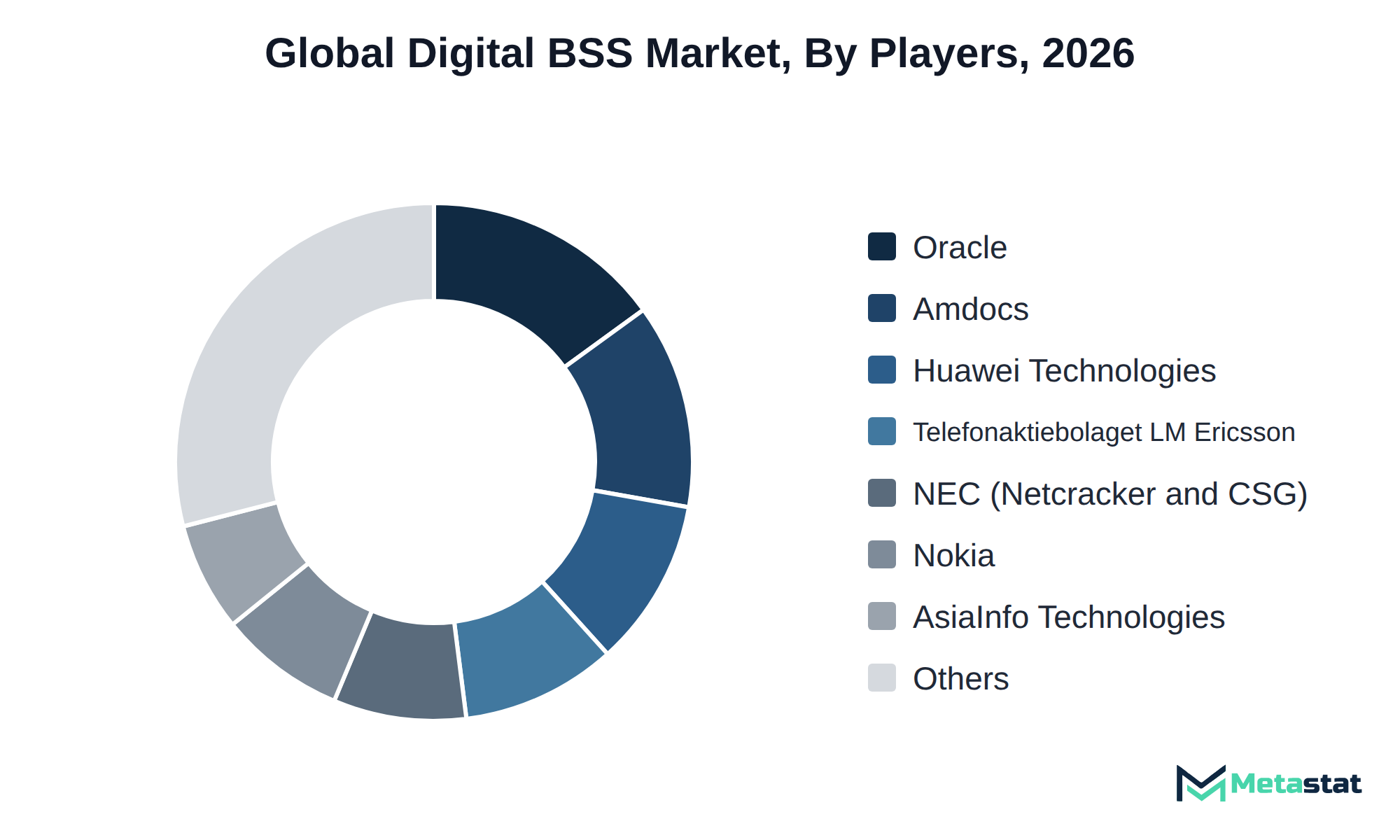
In the Digital BSS market, competition divides primarily along the lines of service offerings. Companies like Amdocs Limited and Oracle Corporation emphasize software development and deployment, focusing on tailored solutions that integrate seamlessly with existing infrastructures. In contrast, firms including NEC Corporation (Netcracker and CSG) and Tech Mahindra Limited (Comviva) prioritize implementation and integration services, ensuring clients receive comprehensive support throughout the adoption process.
Buyers in the market evaluate options based on several criteria, including price, customization, and service quality. Companies like Huawei Technologies Co., Ltd. and Tata Consultancy Services Limited have positioned themselves to excel in customer management and digital engagement, offering solutions that enhance user experience while meeting specific client needs. Players including SAP SE and Infosys Limited focus on providing robust managed services, catering to enterprises seeking reliable ongoing support in their digital transformation journeys.
Achieving this growth depends on several key developments within the Digital BSS market. Firstly, an increase in demand for Cloud Only deployment models, projected to grow from USD 5,906.7 million in 2026 to USD 18,327.3 million by 2033, will drive significant revenue growth. This shift aligns with the broader industry trend toward digital transformation across sectors, particularly in telecommunications, where revenues are forecast to expand from USD 6,046.5 million in 2026 to USD 16,342.3 million by 2033. Secondly, advancements in Customer Management and Digital Engagement functionalities, expected to reach USD 4,877.2 million by 2033, highlight the need for enhanced digital interactions. However, risks including economic volatility and potential regulatory challenges could hinder the anticipated growth, especially in regions like Europe, where the market share stands at 25%. Maintaining momentum in these segments and addressing external pressures will be crucial for the market to achieve its forecasted size.
By Offering: Software, Implementation and Integration Services, Managed Services and Support
By Business Function: Billing and Charging, Customer Management and Digital Engagement, Order Management, Product Catalog and Offer Management, Partner Management and Settlement, Revenue Assurance and Fraud Management
By Deployment Model: Cloud Only, On-Premises Only, Hybrid
By End-Use Industry: Telecommunications, IT and IT-Enabled Services, Media and Entertainment, Banking, Financial Services and Insurance, Retail and E-Commerce, Energy and Utilities, Others (Transportation, Healthcare, Manufacturing)
The report strategically identifies and profiles the key market players and analyses their core competencies in each sub-segment of the Digital BSS market.
Report Attributes | Details |
Study Period | 2021-2033 |
Base Year | 2025 |
Estimated Year | 2026 |
Forecast Period | 2026-2033 |
Historical Period | 2021-2025 |
Growth Rate | CAGR 15.9% from 2026 to 2033 |
Revenue Unit | USD million |
Segmentation | By Offering, Business Function, Deployment Model, End-Use Industry, and Region |
By Region | North America (By Offering, Business Function, Deployment Model, End-Use Industry, and Country)
|
Europe (By Offering, Business Function, Deployment Model, End-Use Industry, and Country)
| |
Asia Pacific (By Offering, Business Function, Deployment Model, End-Use Industry, and Country)
| |
South America (By Offering, Business Function, Deployment Model, End-Use Industry, and Country)
| |
Middle East and Africa (By Offering, Business Function, Deployment Model, End-Use Industry, and Country)
|
Find answers to common questions about this report
The Digital BSS market size was valued at USD 8,582.8 million in 2025.
The market is projected to grow at a CAGR of 15.9% during the forecast period from 2026 to 2033.
The North America Digital BSS market size is estimated to reach USD 8,995.7 million by 2033.
The leading segment in the Digital BSS market is Software, with a projected value of USD 18,279.7 million by 2033. This segment outpaces others in growth potential and revenue generation.
Telecommunications providers increasingly adopt cloud-based Digital BSS solutions to enhance operational efficiency and respond rapidly to market demands. The growing complexity in service delivery and the need for personalized experiences promote the adoption of advanced Digital BSS solutions.
North America holds the dominant share of the Digital BSS market, with a value of USD 8,995.7 million projected for 2033. This region accounts for 33.6 percent of the overall market share.
High implementation costs and talent costs restrain Digital BSS market growth. The expenses associated with deployment and integration impact adoption rates among telecommunications providers. the demand for skilled professionals drives labor expenses upward, further challenging market expansion.
Cloud-only deployment models significantly favor adoption within the Digital BSS market, projected to achieve a compound annual growth rate (CAGR) of 17.6% from 2026 to 2033. The demand for enhanced scalability and flexibility drives this trend, enabling providers to streamline processes and improve customer engagement.
The Digital BSS market is estimated to reach a valuation of USD 27,997.7 million by 2033.
Key players operating in the Digital BSS market include Amdocs Limited, Telefonaktiebolaget LM Ericsson, NEC Corporation (Netcracker and CSG), Huawei Technologies Co., Ltd., Oracle Corporation, and Nokia Corporation.
The analysts below cover Information & Technology research at Metastat Insights.
LEAD ANALYST
Utkarsh Khirodkar is a Lead Market Research Analyst at MetaStat Insight, specializing in market intelligence, technology sector assessments, and competitive strategy.

PRINCIPAL CONSULTANT - ENTERPRISE AI & EMERGING TECHNOLOGIES
Banking & Finance · Electronics and Semiconductor · Energy and Power · Healthcare IT · Information & Technology · Professional Services
Vijay Gunti is a Principal Consultant at MetaStat Insight, bringing over two decades of experience across enterprise digital transformation, technology strategy, and intelligent systems.

LEAD CONSULTANT - COMMUNICATION, TELECOM, AND IT
Electronics and Semiconductor · Information & Technology · Machinery & Equipment · Professional Services
Ravindra Sathe Consultants for Communication, Telecom, and IT at MetaStat Insight. He leads the firm's industry research initiatives across telecommunications infrastructure, digital connectivity, enterprise networking, and emerging information technology domains.
Decarbonizing industrial thermal processes hinges on refrigerant regulations and compressor efficiency limits. Metastat Insights delivered a thorough market analysis that evaluated natural refrigerants like CO2 and hydrocarbons against synthetic low-GWP alternatives. The breakdown of utility incentives and grid capacity constraints across key European manufacturing hubs offered valuable perspective. The follow-up conversation with their sector analysts addressed our specific questions on mechanical vapor recompression systems efficiently.
Assessing 200mm wafer transition schedules and substrate supply bottlenecks requires precise technical intelligence. MetaStat Insight supplied an actionable breakdown comparing planar and trench MOSFET architectures across automotive and industrial drive markets. The regional capacity estimates for Asia-Pacific foundries helped clarify lead-time uncertainties during our strategic planning session. When we needed additional clarification on high-purity raw material sourcing, their analyst team responded with helpful context within twenty-four hours.
Tracking maintenance cycle demand for secondary flight display units and terrain collision avoidance systems across regional jet fleets involves complex aftermarket dynamics. MetaStat Insight provided practical analysis separating airline retrofit programs from OEM forward-fit production schedules in North America and Southeast Asia. The supplier matrix highlighted component obsolescence timelines without resorting to vague generalizations. The dataset served as a dependable reference during our annual program review meetings.
Explore related market intelligence reports worth reading alongside this one.
Starting from
$2950
Starting from
$2950