
LEAD ANALYST
Utkarsh Khirodkar is a Lead Market Research Analyst at MetaStat Insight, specializing in market intelligence, technology sector assessments, and competitive strategy.

India Growing Media Market Size, Share, By Type (Soil-Based Growing Media, Peat-Based Growing Media, Coir-Based Growing Media, Compost-Based Growing Media, Mineral-Based Growing Media (Perlite, Vermiculite and Pumice), Bark-Based Growing Media and Others (Blended / Specialty Growing Media), By Application (Greenhouse and Protected Horticulture, Hydroponics and Soilless Cultivation, Nursery and Plant Propagation, Home Gardening and Indoor Plants, Agriculture and Crop Cultivation, Landscaping and Turf Management and Vertical Farming), By End-User (Commercial Greenhouses and Protected Cultivation Farms, Plant Nurseries, Hydroponic and Soilless Farms, Home Gardeners, Landscaping and Urban Greening Contractors and Agricultural Farms), By Distribution Channel (Direct Business-to-Business Sales, Agricultural Input Dealers, Nursery and Garden Centres, E-Commerce Platforms and Distributors and Wholesalers), Industry Analysis, Growth, Trends, and Forecast, 2026-2033
Report ID
MSI-5801
Published
November, 2026
Pages
305 Pages
Format
Historical
Base year
Forecast
Forecast period
Report Details
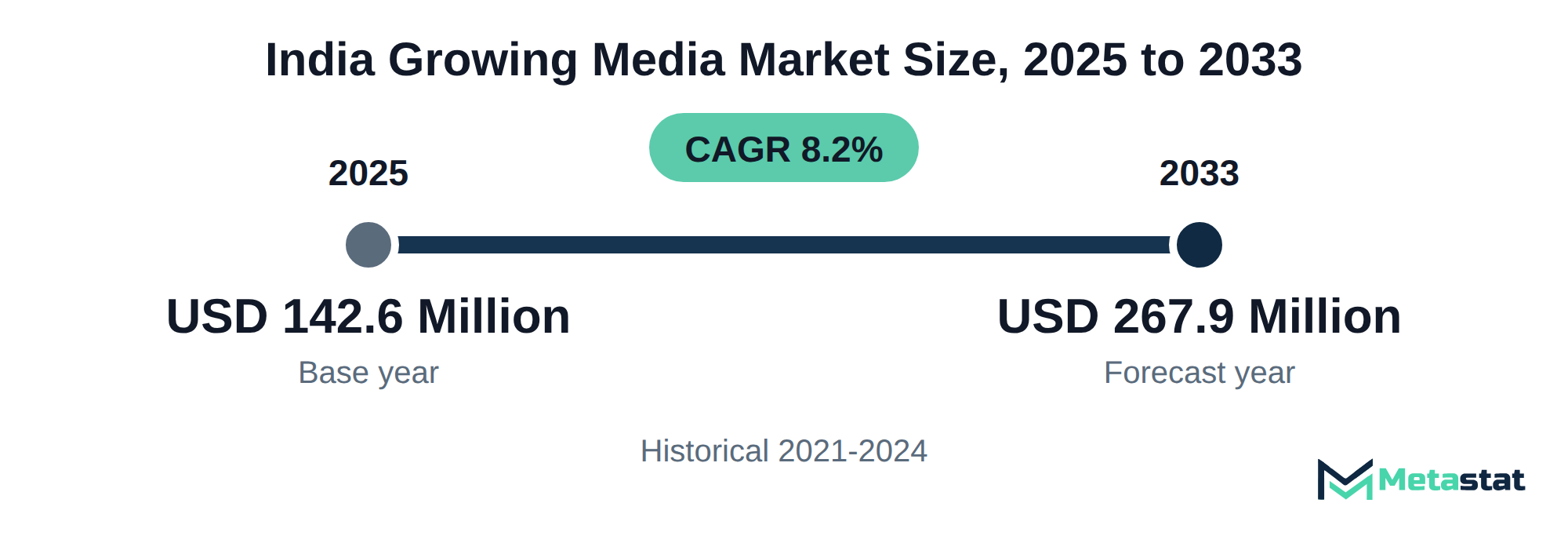
Market Valuation: Valued at $142.6 Million in 2025, projected to reach $267.9 Million by 2033 at a 8.2% CAGR.
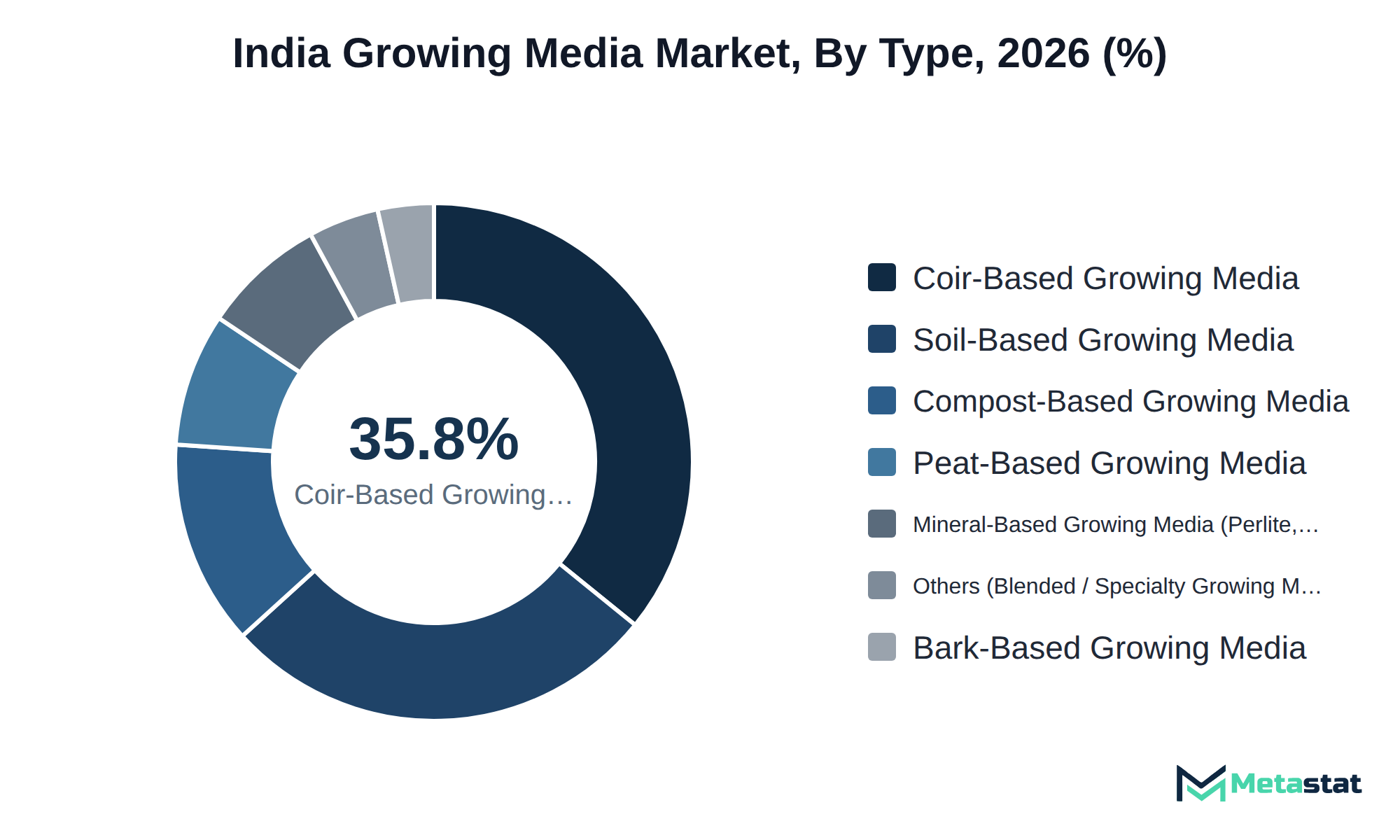
Dominant Segment: Coir-based growing media leads the India Growing Media market, driven by its eco-friendly properties and effectiveness in enhancing plant growth. This segment is projected to reach USD 109.3 million by 2033, reflecting strong user preference for sustainable options.
Geographic Lead: The India Growing Media market is primarily driven by the dynamic agricultural sector, which supports innovation and the adoption of advanced growing techniques. This region's focus on sustainable practices and urban gardening contributes to its leading position.
What's Inside: The report provides comprehensive coverage of market dynamics, competitive analysis, and forecasts from 2026 to 2033. It includes detailed insights into various growing media types, applications, and end-user segments.
Emerging Trends: The rise of hydroponics and soilless cultivation significantly influences substrate requirements, with this segment expected to grow at a CAGR of 9.5% by 2033. This shift highlights the increasing demand for specialized growing media tailored for efficient resource use.
E-Commerce Growth: The e-commerce segment is reshaping purchasing behaviors, showing a CAGR of 16.3% as consumers increasingly opt for online shopping for growing media. This trend enhances accessibility and variety for home gardeners.
Choose Your License
India Growing Media Market
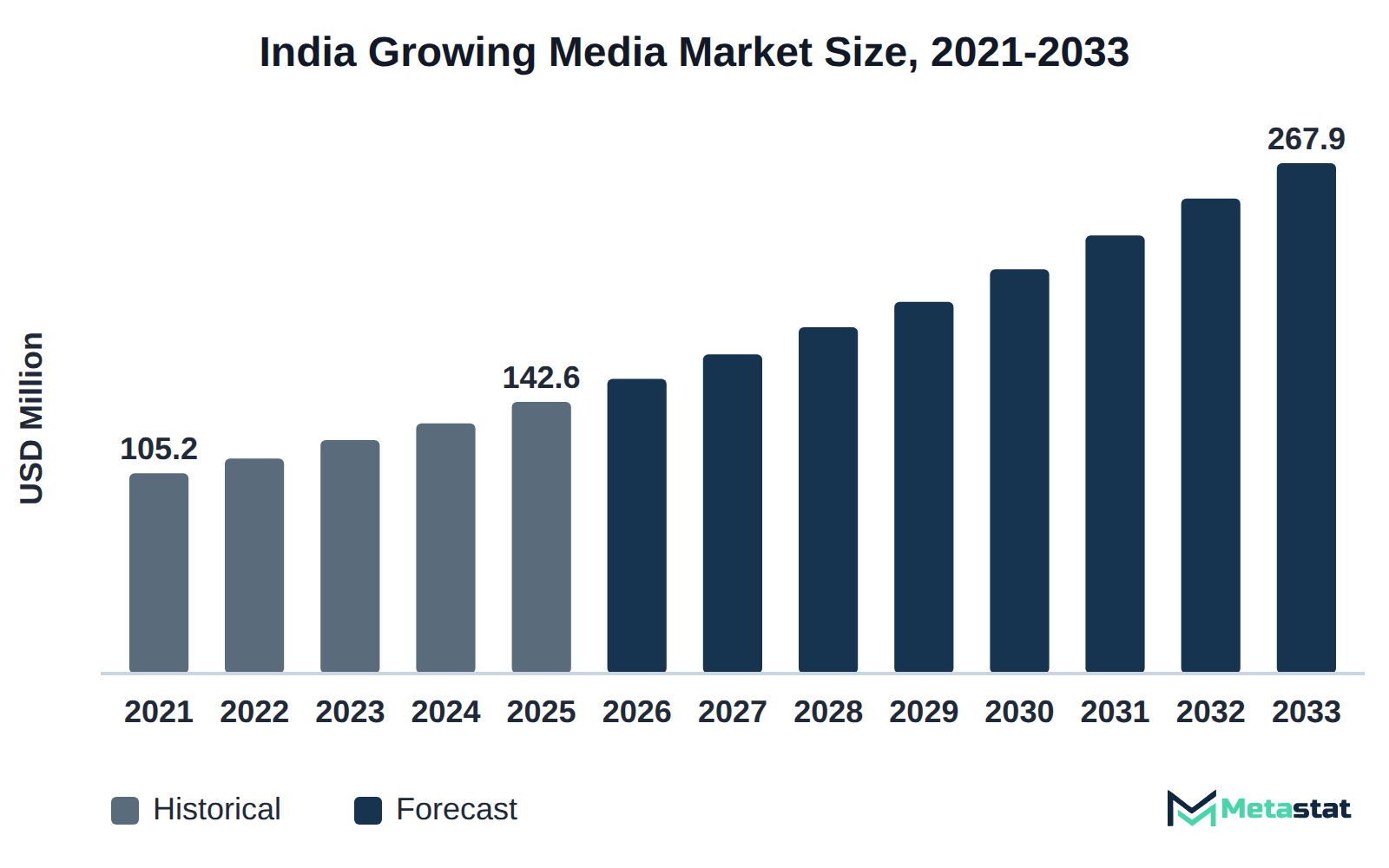
The India Growing Media market was valued at USD 142.6 million in 2025 and is projected to reach USD 267.9 million by 2033, growing at a CAGR of 8.2% over the forecast period.
The India Growing Media market encompasses a variety of substrates used in horticulture, agriculture, and gardening. This market includes soil-based, peat-based, coir-based, and compost-based growing media, catering to various applications, including greenhouse cultivation and hydroponics. Buyers invest in these products to enhance plant growth, improve yield quality, and adapt to sustainable practices in agriculture. Efficient growth solutions drive demand among commercial growers and home gardeners alike.
Growth in the market is fueled by an increasing focus on sustainable agricultural practices and the rising popularity of urban gardening. Coir-based growing media represents the segment with the most significant value, reflecting a strong preference among users for eco-friendly options. The region with the largest market share features a dynamic agricultural sector that supports innovation and adoption of advanced growing techniques.
One primary driver of growth involves the shift towards hydroponics and soilless cultivation, which offers efficient resource use and higher productivity. This trend attracts investments in research and development, enhancing product offerings and expanding market reach. The India Growing Media market is projected to grow, driven by ongoing advancements and increasing consumer interest in sustainable agricultural solutions.
The market covers various types of growing media, which serve essential substrates for plant cultivation across multiple sectors, including commercial agriculture and home gardening. Buyers invest in these materials to enhance plant growth, improve yield quality, and optimize resource use. Substantial demand arises from the need for effective solutions in greenhouse horticulture, hydroponics, and indoor gardening, where traditional soil does not provide the desired outcomes.
Among the segments, coir-based growing media holds the largest value within the India Growing Media market, driven by its sustainable properties and effectiveness in water retention and aeration. Increasing adoption of hydroponics and soilless cultivation techniques significantly contributes to market growth. In particular, commercial greenhouses and protected cultivation farms expand their use of these media, which boosts overall demand.
Rapid urbanization and a growing interest in sustainable agriculture further fuel the market's expansion. Home gardeners increasingly seek high-quality growing media to support their indoor and outdoor plants. This trend reflects a broader commitment to environmentally friendly practices in gardening and agriculture, enhancing the market's appeal among various consumer segments.
Coir-based growing media is gaining traction in protected horticulture due to its sustainability and effectiveness in enhancing plant growth. The India Growing Media market anticipates coir-based solutions will reach USD 109.3 million by 2033, reflecting significant adoption. This growth is attributed to the increasing emphasis on eco-friendly practices among horticulturists, who seek alternatives to traditional peat-based media. Coir, derived from coconut husks, offers several advantages, including excellent water retention and aeration properties, making it suitable for various horticultural applications.
Commercial greenhouse operators recognize the importance of adopting coir-based media to improve crop yield and sustainability. The transition to coir supports environmental initiatives, reducing reliance on non-renewable resources. Coir-based media contributes to healthier plant development, leading to better marketability of produce. The growing preference for organic and eco-friendly products among consumers increases the demand for coir in horticulture. While the market evolves, the focus on sustainable growing solutions is expected to drive further investment and innovation within the India Growing Media market.
The growing demand for premium potting mix in the India Growing Media market reflects a notable shift among urban home gardeners towards high-quality growing media. Urban home gardeners increasingly seek products that ensure optimal plant growth, health, and aesthetic appeal. In 2025, the value of premium potting mix is projected to rise significantly, with prices driven by increasing demand for organic and sustainable growing mediums. This trend aligns with the broader market growth, which anticipates a compound annual growth rate (CAGR) of 8.2% from 2026 to 2033.
Pricing for premium potting mixes varies widely based on composition, packaging, and brand reputation. High-quality mixes, particularly those formulated with organic materials, often command higher prices. Urban consumers prioritize value over cost, emphasizing product quality over affordability. Therefore, suppliers in the India Growing Media market focus on creating specialized products that meet the preferences of home gardeners, including features including moisture retention, nutrient content, and biodegradability.
Contract models for purchasing premium potting mix typically involve bulk orders, which allow urban gardeners to secure better pricing. Retailers offer loyalty programs and subscription services that cater to regular users, enhancing customer retention and satisfaction. The growing interest in home gardening, fueled by urbanization and lifestyle changes, positions premium potting mix suppliers to capitalize on this trend, creating opportunities for innovation in product offerings and pricing strategies.
The rise of e-commerce significantly transforms purchasing behaviors among home gardeners in the India Growing Media market. With an increasing number of consumers opting for online shopping, convenience and access to a broader range of products play a crucial role in driving this trend. The e-commerce segment shows a compound annual growth rate (CAGR) of 16.3%, highlighting its growing importance in the distribution of growing media.
Home gardeners seeking efficient solutions for their planting needs benefit from the extensive variety offered on e-commerce platforms. This shift enables them to access products not readily available in traditional retail outlets. The ability to compare prices, read reviews, and receive products directly at their doorstep enhances the purchasing experience.
This trend contributes to increased sales for suppliers who adapt their strategies to leverage online distribution channels. By prioritizing e-commerce, companies tap into the expanding home gardening demographic and cater to its unique needs, ultimately supporting growth in the overall market.
Hydroponic farms significantly influence the substrate requirements within the India Growing Media market. By relying on soilless cultivation techniques, these farms require specialized growing media that optimize plant growth without traditional soil. The hydroponics segment is expected to reach USD 51.7 million by 2033, reflecting a strong compound annual growth rate (CAGR) of 9.5%. This demand shift drives producers to innovate and adapt their substrate offerings.
Using specific growing media tailored for hydroponic systems enhances crop yield and reduces water usage, which aligns with India’s agricultural sustainability goals. The transition to hydroponics creates opportunities for companies to develop coir-based and compost-based growing media specifically engineered for these applications. Growth in hydroponic farms will lead to increased demand for these types of substrates, creating a competitive environment for suppliers.
Stakeholders involved in the India Growing Media market align product development strategies with emerging hydroponic trends. Establishing robust supply chains for hydroponic-specific substrates represents a vital commercial opportunity, positioning businesses to capitalize on the evolving agricultural landscape. Adaptation to these substrate requirements contributes to the market's expansion and drives revenue growth for producers.
The rising interest in hydroponics significantly influences the purchase behavior among commercial greenhouse operators and home gardeners. This interest stems from the efficiency and sustainability of soilless cultivation methods that yield higher productivity and quality crops. The shift toward hydroponics aligns with changing consumer preferences for fresh produce and organic gardening practices. Consequently, demand for appropriate growing media tailored for hydroponic systems is increasing, driving the market's growth. This trend indicates a significant phase in the India Growing Media market, with hydroponics leading the adoption of specialized substrates.
A growing number of home gardeners are embracing indoor gardening trends, further contributing to the demand for tailored growing media. The increasing focus on sustainable gardening practices, paired with advancements in hydroponic technology, strengthens this trend. This changing landscape emphasizes the importance of responsive growing media solutions that cater to evolving gardening preferences. Demand for these solutions is expected to rise.
Innovation in growing media products significantly influences the India Growing Media market. Suppliers actively develop advanced substrates that enhance plant growth, optimize water retention, and improve nutrient delivery. This strategic focus on product quality responds to increasing consumer preferences for sustainable and efficient growing solutions. Different buyer segments, including commercial greenhouses and home gardeners, exhibit heightened interest in innovative product formulations. The introduction of coir-based and compost-based media aligns with sustainability trends and addresses the growing demand for eco-friendly options. The shift toward high-performance substrates fuels competitive dynamics among suppliers, encouraging investments in research and development. Growth in premium product lines correlates with expanding market opportunities across horticultural and agricultural applications. Enhanced product offerings attract new buyers and reinforce loyalty among existing customers, underpinning the market expansion through 2033.
Price sensitivity among buyers significantly affects the adoption of growing media in the India Growing Media market. Commercial greenhouses and protected cultivation farms experience pressure to manage operational costs, which influences purchasing decisions. Budget constraints result in slower uptake of premium growing media options, prompting these buyers to opt for more affordable alternatives. This trend reflects a cautious approach toward making larger investments in substrate quality, ultimately affecting overall market growth. The need for cost-effective solutions leads to smaller orders and delayed replacement cycles among these end-users, hindering innovation and expansion in the market. Price limitations create a challenge for suppliers, as they balance quality and affordability to meet buyer demands while maintaining profitability.
Rising raw material costs present significant challenges for suppliers in the India Growing Media market. Input costs for materials including peat and coir have increased, impacting production expenses and overall profitability. Suppliers experience margin pressure while striving to maintain competitive pricing while sourcing high-quality materials. In response, several suppliers are exploring alternative materials that offer cost advantages, including compost and bark-based substrates. These alternatives not only alleviate cost burdens but cater to the growing demand for sustainable growing media. By focusing on innovative product formulations and enhancing operational efficiencies, suppliers aim to mitigate the impacts of rising input costs. This strategic shift strengthens their market positions while addressing the evolving preferences of end-users who prioritize quality and sustainability.
The hydroponics and soilless cultivation segment presents a significant market opportunity within the India Growing Media market. This segment is projected to achieve a compound annual growth rate (CAGR) of 9.5% by 2033, indicating a robust shift towards alternative cultivation methods that do not rely on soil. Increasing urbanization and a heightened focus on sustainable agriculture practices drive the adoption of hydroponic systems among commercial greenhouses and home gardeners. The need for efficient and high-quality growing media that supports plant health and productivity drives innovation in this area.
Investment in specialized substrates for hydroponics enhances yields while minimizing resource usage, aligning with the growing trend of sustainable practices in agriculture. Suppliers targeting this segment will benefit from the increasing demand for eco-friendly and effective growing media solutions. The rise in hydroponics reflects changing consumer preferences and presents a clear pathway for market growth in the coming years.
The India Growing Media market is segmented based on Type, Application, End-User, and Distribution Channel.
Soil-Based Growing Media segment is valued at USD 42.1 million in 2026 and is projected to reach USD 66.5 million by 2033, at a CAGR of 6.7% during the forecast period. This segment serves as a critical component for various horticultural applications, primarily used by commercial greenhouses and agricultural farms that require reliable substrates for plant growth. Demand increases significantly due to rising interest in sustainable agricultural practices. This segment grows at a steadier rate compared to others, driven by its established role in supporting soil health and enhancing nutrient retention. In contrast to peat-based and coir-based media, which experience faster growth rates, soil-based options present a stable choice for growers focused on traditional cultivation methods, reflecting consistent demand in the India Growing Media market.
Peat-Based Growing Media segment is estimated to reach USD 19.3 million by 2033, at a CAGR of 6.2% during the forecast period. This substrate serves primarily in greenhouse and protected horticulture applications, used by commercial growers and plant nurseries to enhance soil health and moisture retention. The segment experiences growth driven by the increasing adoption of sustainable farming practices and rising demand for high-quality plant propagation materials. Compared to other types of growing media, peat-based alternatives generally offer lower prices, making them attractive for budget-conscious buyers. This segment grows slower than coir-based media, which benefits from more extensive acceptance in the market due to its environmental advantages. Overall, the Peat-Based Growing Media segment contributes to the evolving dynamics of the India Growing Media market, aligning with the trend toward more sustainable horticultural practices.
Coir-Based Growing Media segment is expected to reach USD 109.3 million by 2033. This type of growing media is primarily used in various horticultural applications, including commercial greenhouses and home gardening, driven by its sustainability and effectiveness in enhancing plant growth. Demand for coir-based products is driven by the increasing preference for eco-friendly alternatives among growers. Compared to other segments, coir-based growing media offers superior moisture retention and aeration, which significantly benefits plant health. Its growth rate differs from peat-based growing media, which has a projected CAGR of 6.2%. This distinctive performance indicates stronger positioning within the market as growers seek reliable, sustainable growing solutions.
Compost-Based Growing Media segment is projected to grow at a CAGR of 8.5% during the forecast period. This type of growing media serves crucial roles in enhancing soil structure and providing essential nutrients for plants. Commercial greenhouse operators and plant nurseries predominantly use compost-based media, which supports both sustainability and plant health. Increasing consumer demand for organic and environmentally friendly products drives the growth of this segment. Compared to other types, including coir-based and peat-based media, compost-based growing media offers a unique advantage through its nutrient-rich composition. The projected growth of USD 181.8 million by 2033 exhibits its strong market position within the India Growing Media market.
Mineral-Based Growing Media, including Perlite, Vermiculite, and Pumice, functions as an essential substrate for horticulture applications, providing aeration and drainage benefits that promote healthy root growth. These materials are primarily used in landscaping, hydroponics, and indoor gardening, attracting home gardeners and commercial growers seeking lightweight and efficient growing solutions. The demand for lightweight substrates is driven by the growing trend towards urban gardening, where space-efficient solutions enhance cultivation efforts. Compared to other segments, including Coir-Based Growing Media, which is projected to achieve substantial growth, Mineral-Based Growing Media experiences moderate adoption rates. This segment's unique characteristics, including superior aeration and moisture retention properties, distinguish it from others, catering specifically to a niche market focused on high-performance growing conditions.
Bark-Based Growing Media primarily functions as a substrate for horticultural applications, particularly in specialized gardening and landscaping projects. This type of growing media finds usage among landscape architects, urban greening contractors, and commercial gardeners who seek effective solutions for plant health and growth. The growing trend towards sustainable gardening practices boosts demand for bark-based solutions. The segment distinguishes itself from others through its unique properties, including improved aeration and moisture retention, which cater to specific environmental conditions. Its distinct characteristics and applications position it differently compared to peat-based and coir-based alternatives in terms of pricing and suitability for certain plants. The India Growing Media market evolves, reflecting changing preferences among consumers and professionals in the gardening sector.
Blended and specialty growing media serve unique horticultural needs, combining various substrates to enhance plant health and growth. These products cater primarily to commercial growers, including nurseries and hydroponic farms, who seek optimal performance in diverse growing conditions. Demand for these media is driven by the increasing focus on sustainable gardening practices and the growing trend toward organic cultivation. Compared to other segments, this sub-segment often commands higher prices due to the specialized nature and tailored formulations of blended products. In the context of the India Growing Media market, the blend of components offers flexibility, allowing growers to customize their media for specific crops or environmental conditions, which sets it apart from more standardized growing media options.
Greenhouse and Protected Horticulture segment is valued at USD 41.5 million in 2026 and is projected to reach USD 74.2 million by 2033, at a CAGR of 8.7% during the forecast period. This segment serves commercial greenhouses and horticulture operations that focus on growing plants in controlled environments, employing substrates that optimize growth conditions. The increasing demand for high-quality produce drives growth, particularly among urban consumers seeking fresh produce. In comparison to other segments, this segment experiences faster growth due to its reliance on innovative cultivation techniques including hydroponics. The emphasis on sustainable practices and advanced technologies positions this segment as a key contributor to the overall development of the India Growing Media market. The commitment to improving crop yield and quality enhances the attractiveness of greenhouse and protected horticulture solutions, fueling investment and expansion in this area.
This segment caters to commercial greenhouse operators, plant nurseries, and home gardeners who prefer soil-less growing methods. Increasing urbanization and the need for sustainable farming practices drive demand in this segment. Hydroponics enables efficient water use and space optimization, appealing to growers seeking innovative solutions in limited spaces. Compared to other segments, this segment experiences faster growth due to heightened consumer awareness of sustainable agriculture, enhancing its profile in the India Growing Media market. While the home gardening segment sees solid demand, Hydroponics and Soilless Cultivation outpaces it, reflecting a clear trend toward advanced agricultural techniques.
Nursery and Plant Propagation segment is expected to reach USD 53.6 million by 2033. This segment finds application in the cultivation of plants for gardening and landscaping, serving plant nurseries and commercial growers. The increasing demand for plants, driven by urbanization and gardening trends, supports the growth of this segment. Compared to other applications, Nursery and Plant Propagation exhibits a moderate growth rate, shaped by the specific needs of buyers focused on plant diversity and availability. This segment's performance is influenced by advancements in growing media technology, aimed at improving plant health and growth rates. In addition, the segment's growth reflects rising consumer interest in gardening and sustainable practices, which drives investment in quality growing media solutions. The features of growing media used in this segment are tailored to enhance propagation success, differentiating it from more established applications including hydroponics.
Home Gardening and Indoor Plants segment is projected to grow at a CAGR of 8.7% during the forecast period. This segment caters to individuals engaging in gardening within residential settings, focusing on both aesthetic and functional aspects of indoor and outdoor plant cultivation. Increasing awareness about the benefits of indoor gardening and the desire for home beautification drive demand among home gardeners. Unlike other segments, this one appeals to a broader demographic, including those with limited space, leading to a unique market dynamic. The segment differentiates itself by emphasizing ease of use and convenience, often using lightweight and versatile growing media. This focus results in a distinct growth trajectory compared to more traditional applications, reflecting evolving consumer preferences in the India Growing Media market.
Agriculture and Crop Cultivation involves various methods used to enhance crop production and ensure sustainable farming practices. This segment is crucial for agricultural farms that focus on maximizing yield and efficiency in crop production. Factors influencing this segment include the increasing adoption of innovative agricultural practices and a growing emphasis on sustainable farming techniques. Demand for efficient and effective growing media rises among agricultural producers, driven by the need for reliable and high-performance substrates. Compared to other segments, this segment faces different dynamics, particularly in terms of buyer profiles and pricing strategies. The India Growing Media market sees unique user requirements from agricultural producers, which do not align with the demands of greenhouse operations or home gardening. These distinctions highlight the segment's specialized nature and its essential role within the broader market.
Landscaping and Turf Management involves creating and maintaining green spaces, including lawns, gardens, and parks. This application primarily serves landscapers, gardening contractors, and municipal governments focused on aesthetic and functional outdoor spaces. Demand is driven by urbanization, which increases the need for green areas in cities. The growing trend toward sustainable landscaping practices influences this segment's expansion, encouraging the use of eco-friendly growing media. Compared to other applications including Hydroponics and Soilless Cultivation, Landscaping and Turf Management typically features lower price points due to the larger-scale usage of materials. This segment often requires bulk purchasing, which further reduces costs for buyers. The ongoing emphasis on environmental sustainability and urban greening initiatives supports continued growth in the India Growing Media market.
Vertical farming employs innovative methods to cultivate plants in vertically stacked layers, incorporating controlled environment agriculture techniques. This approach primarily finds application in urban settings, where space constraints limit traditional farming. Commercial greenhouses, hydroponic farms, and specialized urban growers leverage vertical farming to optimize space and resource efficiency. Demand for this approach is increasing due to rising consumer interest in locally sourced, fresh produce. The segment faces challenges stemming from high initial setup costs and technological requirements compared to traditional growing methods. This positions vertical farming as a unique offering within the broader market, appealing to urban growers seeking sustainable solutions while contrasting with other applications that cater to larger agricultural operations.
Commercial Greenhouses and Protected Cultivation Farms segment is valued at USD 46 million in 2026 and is projected to reach USD 81.5 million by 2033, at a CAGR of 8.5% during the forecast period. This segment typically serves commercial growers focused on optimizing production within controlled environments. The growing demand for high-quality produce and the expansion of urban agriculture significantly influences growth in this area. Unlike other segments, including hydroponic and soilless farms, which experience higher growth rates at a CAGR of 9.5%, the commercial greenhouses segment maintains robust, steady expansion. Investment in advanced growing technologies and sustainable practices enhances productivity, meeting the increasing market demand for fresh produce. The market benefits from the push towards more efficient agricultural methods, driving adoption among large-scale farming operations.
Plant Nurseries segment is estimated to reach USD 54.4 million by 2033, at a CAGR of 6.9% during the forecast period. This segment is essential in supplying young plants for various horticultural applications, catering primarily to commercial greenhouses and individual gardeners. The rising interest in home gardening and urban greening initiatives drives demand for seedlings and starter plants, benefiting plant nurseries significantly. Compared to other segments, this sub-segment demonstrates steady growth, supported by consumer trends favoring sustainable practices and local sourcing. Advancements in propagation techniques enhance the efficiency and quality of young plant production, establishing a competitive edge for nurseries within the market. The India Growing Media market observes a shift toward increased utilization of eco-friendly growing media, aligning with environmental sustainability goals.
Hydroponic and Soilless Farms segment is expected to reach USD 48.6 million by 2033. This segment serves commercial and residential growers who use water-based systems to cultivate plants without soil. Significant growth is driven by rising interest in sustainable and efficient agricultural practices, leading to increased investment in hydroponic technologies. Compared to other end-user segments, Hydroponic and Soilless Farms exhibit faster adoption due to their ability to produce crops year-round, enhancing yields. The forecasted CAGR for this segment indicates strong momentum, particularly in urban areas where space for traditional farming is limited. The India Growing Media market benefits from this trend; suppliers focus on providing high-quality growing media tailored to the unique requirements of hydroponic systems.
The Home Gardeners segment is projected to grow at a CAGR of 9.3% during the forecast period. This segment caters to individuals engaged in gardening activities within residential spaces, focusing on growing plants, flowers, and vegetables. Increased interest in sustainable living and organic gardening drives demand among home gardeners, who seek accessible and efficient growing solutions. This segment shows faster growth compared to other end-user segments, reflecting a shift towards home-based gardening practices. The rise of e-commerce platforms enhances accessibility, allowing these consumers to conveniently purchase growing media tailored to their specific gardening needs. Home gardeners prioritize products that support organic practices, distinguishing their preferences from commercial growers who focus on larger-scale operations and different media types. Evolving consumer behavior towards gardening contributes to significant changes within the India Growing Media market.
Landscaping and Urban Greening Contractors focus on designing and maintaining green spaces within urban environments. This segment's services are essential for enhancing aesthetics and promoting sustainability in cities, attracting attention from various stakeholders, including municipalities and property developers. Increasing urbanization drives demand for these services, pushing contractors to seek high-quality growing media that supports plant health in challenging urban conditions. This segment differs from others, including Commercial Greenhouses, due to its emphasis on aesthetics and environmental impact rather than solely on agricultural yield. While the market for Landscaping and Urban Greening Contractors evolves, it faces challenges from rising costs of high-quality growing media, which could impact overall project budgets. The India Growing Media market supports this sub-segment by providing diverse substrates that are essential for effective urban landscaping and greening initiatives.
Agricultural Farms employ various types of growing media to enhance soil quality and improve crop yield. This end-user segment primarily serves farmers and agricultural producers who require efficient and effective substrates to support plant growth. Increasing demands for sustainable farming practices drive interest in diverse growing media options that cater to specific crop needs. Compared to other end-user segments, Agricultural Farms benefit from a more traditional approach to growing, where cost considerations and crop specificities play critical roles in selecting suitable products. This segment focuses on price-sensitive buyers who prioritize functional benefits over premium features, differentiating it from the more specialized segments. In the India Growing Media market, this segment reflects broader trends within agriculture while adapting to evolving customer preferences and environmental challenges.
Direct Business-to-Business Sales segment is valued at USD 59.2 million in 2026 and is projected to reach USD 96.9 million by 2033, at a CAGR of 7.3% during the forecast period. This segment primarily serves commercial growers, including greenhouse operators and horticultural enterprises, facilitating the procurement of growing media in bulk for large-scale operations. Demand for this segment is driven by the increasing adoption of advanced cultivation techniques, which require consistent and high-quality growing media. In comparison to other distribution channels, Direct Business-to-Business Sales demonstrates steady growth, although it experiences lower growth rates compared to the rapidly expanding e-commerce platforms segment, which achieves a CAGR of 16.3%. Suppliers focused on direct sales typically offer competitive pricing structures, enhancing accessibility for larger commercial clients while distinguishing themselves from other channels that cater to individual consumers.
Agricultural Input Dealers segment is estimated to reach USD 50.3 million by 2033, at a CAGR of 6.2% during the forecast period. This segment functions as a critical distribution channel for various types of growing media, catering primarily to farmers and commercial growers seeking quality inputs for their agricultural practices. Continuous demand for high-quality substrates among these end-users drives growth within the segment. Unlike other channels, Agricultural Input Dealers typically offer a wider range of products and services tailored to the needs of agricultural customers, allowing differentiation from competitors. Increasing adoption of advanced farming techniques and sustainable practices further supports the segment's expansion. This evolving landscape presents unique opportunities for growth in the India Growing Media market.
Nursery and Garden Centres segment is expected to reach USD 41.3 million by 2033. This segment supplies various gardening products, including soil and growing media, primarily to home gardeners and landscaping professionals. Increased interest in home gardening and urban greening spurs demand for quality growing media. This segment experiences a higher growth trajectory compared to other distribution channels, driven by the rising popularity of indoor plants and urban gardening initiatives. The CAGR for this segment is anticipated to be notable, supporting robust market expansion. Nursery and Garden Centres cater to a diverse clientele, differing from commercial-focused channels that primarily address large-scale agricultural operations. The market experiences significant fluctuations in pricing, driven by seasonal demand and the introduction of innovative growing media products. The India Growing Media market thrives on these trends, leading to greater investment and consumer engagement.
E-Commerce Platforms segment is projected to grow at a CAGR of 16.3% during the forecast period. This segment functions as a crucial channel for distributing various types of growing media, allowing consumers and businesses to purchase products online. Buyers include home gardeners, commercial enterprises, and agricultural professionals seeking convenient access to a range of growing media options. The increasing trend of online shopping drives demand for this segment, providing ease of access and a wider selection of products than traditional retail outlets. E-Commerce Platforms differ from other distribution channels, including Direct Business-to-Business Sales, which focus on bulk transactions with larger clients. The growing adoption of e-commerce for gardening and agricultural supplies reflects changing consumer behaviors, contributing to stronger growth in this segment compared to others in the market.
Distributors and wholesalers play a critical role in the supply chain of growing media, facilitating the movement of products from manufacturers to retail outlets and end users. These entities are essential for commercial greenhouses, hydroponic farms, and nurseries, enabling them to access a variety of growing media necessary for their operations. A strong demand for efficient distribution channels drives the growth of this segment, particularly in response to rising adoption of advanced horticultural practices. This segment differs from others in its focus on bulk sales, highlighting a preference among buyers for competitive pricing and reliable supply. While the hydroponics and soilless cultivation application shows rapid growth, distributors and wholesalers experience different dynamics, influenced by regional demand fluctuations and inventory management challenges. The market benefits from these entities, ensuring accessibility and availability of products across various geographic locations.
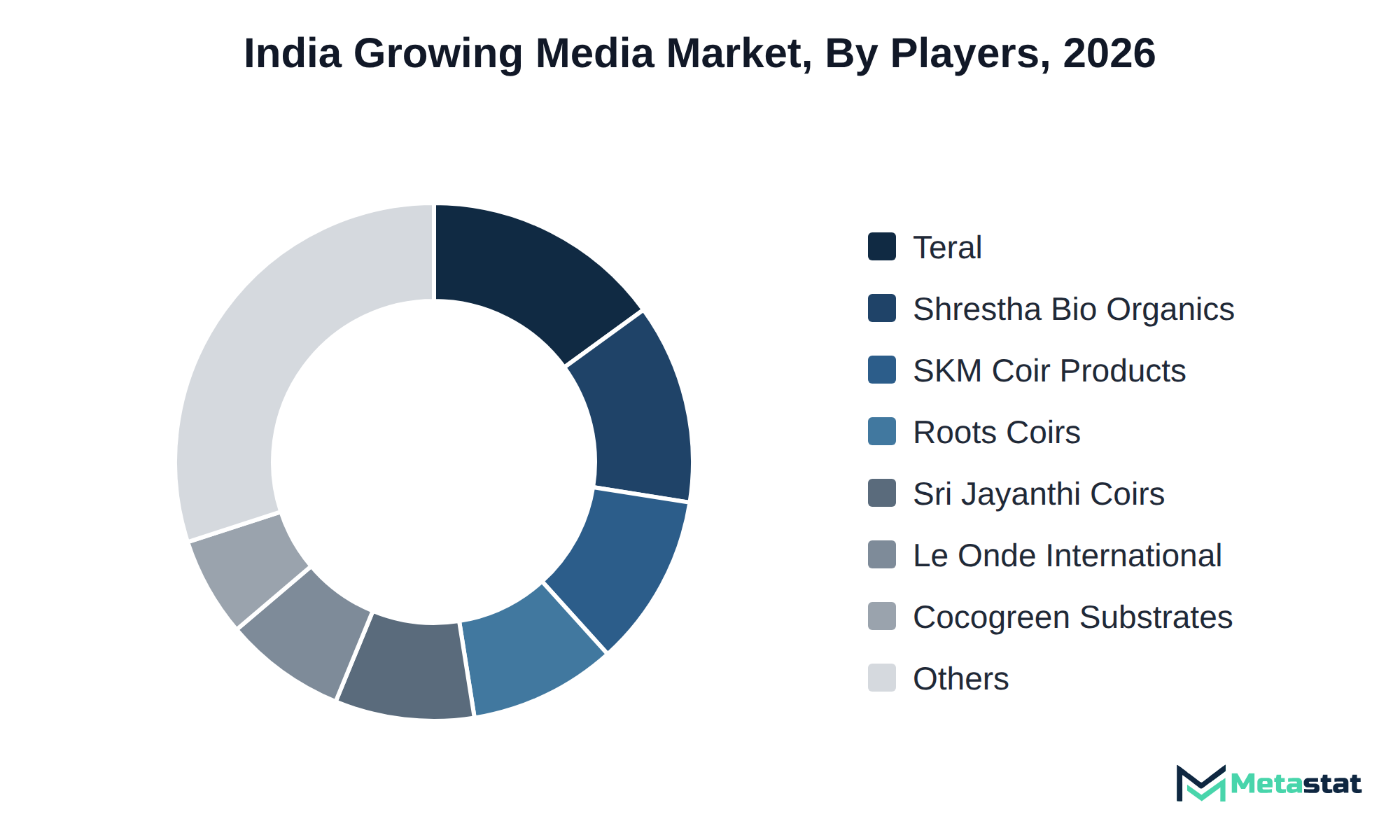
The competitive environment in the India Growing Media market reflects a mix of established players and emerging companies. Competition among these businesses revolves around product quality, pricing strategies, and customer service. Companies leverage distinct strengths to cater to various buyer preferences, including customization and certification, which significantly influence purchasing decisions.
Companies like Teral and Shrestha Bio Organics focus on delivering high-quality products tailored for specific applications, including greenhouse and protected horticulture. SKM Coir Products and Roots Coirs emphasize sustainable practices, appealing to environmentally conscious buyers. E-commerce platforms increasingly play a role in distribution, enabling companies like Yubi India and Cocotronics to reach a wider audience and enhance customer engagement.
Customization options and technical support are critical aspects for buyers, with firms like Sunco India and Ganapathy Coir Private Limited (Nature Coir Pithplus) prioritizing these services. Evolving preferences for high-performance growing media drive companies to innovate continually, ensuring they remain competitive in the dynamic market.
Achieving this growth relies on several key developments. The rising adoption of hydroponics and soilless cultivation, expected to reach USD 51.7 million by 2033, represents a significant driver, with consumers increasingly turning towards innovative agricultural practices. The expansion of greenhouse and protected horticulture applications, projected to reach USD 74.2 million during the same period, will enhance the demand for specialized growing media. Both segments highlight a shift in agricultural practices towards more sustainable and efficient methods. Operational challenges, including supply chain disruptions and fluctuating raw material prices, pose risks to this growth trajectory. If these challenges persist, they could hinder the market's ability to reach USD 267.9 million, limiting expansion opportunities for companies within the India Growing Media market. Overall, while the outlook remains optimistic, addressing these potential risks will be essential to achieving projected growth.
By Type: Soil-Based Growing Media, Peat-Based Growing Media, Coir-Based Growing Media, Compost-Based Growing Media, Mineral-Based Growing Media (Perlite, Vermiculite and Pumice), Bark-Based Growing Media, Others (Blended / Specialty Growing Media)
By Application: Greenhouse and Protected Horticulture, Hydroponics and Soilless Cultivation, Nursery and Plant Propagation, Home Gardening and Indoor Plants, Agriculture and Crop Cultivation, Landscaping and Turf Management, Vertical Farming
By End-User: Commercial Greenhouses and Protected Cultivation Farms, Plant Nurseries, Hydroponic and Soilless Farms, Home Gardeners, Landscaping and Urban Greening Contractors, Agricultural Farms
By Distribution Channel: Direct Business-to-Business Sales, Agricultural Input Dealers, Nursery and Garden Centres, E-Commerce Platforms, Distributors and Wholesalers
The report strategically identifies and profiles the key market players and analyses their core competencies in each sub-segment of the Growing Media market.
Report Attributes | Details |
Study Period | 2021-2033 |
Base Year | 2025 |
Estimated Year | 2026 |
Forecast Period | 2026-2033 |
Historical Period | 2021-2025 |
Growth Rate | CAGR 8.2% from 2026 to 2033 |
Revenue Unit | USD million |
Segmentation | By Type, Application, End-User, Distribution Channel, and Region |
Find answers to common questions about this report
The Growing Media market size was valued at USD 142.6 million in 2025.
The market is projected to grow at a CAGR of 8.2% during the forecast period from 2026 to 2033.
Coir-Based Growing Media leads the segment with a projected value of USD 109.3 million by 2033. This segment surpasses others in terms of market size and growth potential.
The rising interest in hydroponics significantly influences the purchase behavior among commercial greenhouse operators and home gardeners. Price sensitivity among buyers affects the adoption of growing media, leading to a cautious approach toward larger investments in substrate quality.
Price sensitivity among buyers significantly affects the adoption of growing media, leading to a cautious approach toward larger investments in substrate quality. Rising raw material costs create challenges for suppliers, impacting production expenses and overall profitability.
The increasing interest in hydroponics and soilless cultivation significantly drives adoption in the India Growing Media market. This shift aligns with urbanization trends and a focus on sustainable agriculture practices, leading to heightened demand for efficient growing media that supports plant health and productivity.
The Growing Media market is estimated to reach a valuation of USD 267.9 million by 2033.
Key players operating in the Growing Media industry include Teral, Shrestha Bio Organics, SKM Coir Products, Roots Coirs, Sri Jayanthi Coirs, Le Onde International, and Cocogreen Substrates.
Greenhouse and protected horticulture lead the applications segment, projected to reach USD 74.2 million by 2033, reflecting a compound annual growth rate of 8.7%. Hydroponics and soilless cultivation follow closely, expected to achieve USD 51.7 million in the same period.
Commercial greenhouses and protected cultivation farms represent the fastest-growing end-user segment, with a projected value of USD 81.5 million by 2033, reflecting a compound annual growth rate of 8.5%.
The analysts below cover Information & Technology research at Metastat Insights.
LEAD ANALYST
Utkarsh Khirodkar is a Lead Market Research Analyst at MetaStat Insight, specializing in market intelligence, technology sector assessments, and competitive strategy.

PRINCIPAL CONSULTANT - ENTERPRISE AI & EMERGING TECHNOLOGIES
Banking & Finance · Electronics and Semiconductor · Energy and Power · Healthcare IT · Information & Technology · Professional Services
Vijay Gunti is a Principal Consultant at MetaStat Insight, bringing over two decades of experience across enterprise digital transformation, technology strategy, and intelligent systems.

LEAD CONSULTANT - COMMUNICATION, TELECOM, AND IT
Electronics and Semiconductor · Information & Technology · Machinery & Equipment · Professional Services
Ravindra Sathe Consultants for Communication, Telecom, and IT at MetaStat Insight. He leads the firm's industry research initiatives across telecommunications infrastructure, digital connectivity, enterprise networking, and emerging information technology domains.
Our group needed clearer visibility into out-of-autoclave processing timelines for high-temperature thermoplastic composites. MetaStat Insight delivered an objective assessment that contrasted automated fiber placement scrap rates with traditional thermoset prepreg layup cycles. The supplier landscape mapped out primary resin suppliers and tape slitting capacity across France, Germany, and Japan with solid technical accuracy. Their analyst handled our questions on precursor supply risks during an unscheduled inquiry call, providing clear, unembellished context.
Evaluating sensor fusion reliability across harsh operating environments can be tricky without field-validated data. The study on agricultural autonomous guidance systems clearly separated stereo vision setups from automotive-grade solid-state LiDAR. We appreciated the regional infrastructure analysis, specifically around RTK network density across North America and South America. During our follow-up consultation, the MetaStat Insight team walked through tier-two perception software partnerships, giving our engineering leads a practical basis for vendor shortlisting.
Analyzing the transition from natural gas to green hydrogen in iron ore reduction requires realistic infrastructure timelines. Meta stat insight supplied a detailed regional assessment of DRI plant conversion costs and scrap metal availability in North America and Western Europe. Their report carefully examined pellet quality specs and electrical grid access constraints without making oversimplified market assumptions. The research material served as a practical reference during internal technology roadmap discussions.
Explore related market intelligence reports worth reading alongside this one.
Starting from
$2950
Starting from
$2950