
LEAD ANALYST
Utkarsh Khirodkar is a Lead Market Research Analyst at MetaStat Insight, specializing in market intelligence, technology sector assessments, and competitive strategy.

Door Systems Market By Material (Wood, Metal, Glass, Composite, Others), By Mechanism (Swinging, Sliding, Folding, Revolving, Others), By Technology (Manual, Automatic, Access Control), By Application (Residential, Non-Residential), Industry Analysis, Size, Share, Growth, Trends, and Forecasts 2025-2032
Report ID
MSI-4340
Published
October, 2025
Pages
255 Pages
Format
Report Details
Choose Your License
Door Systems Market
The global door systems market has evolved to be a vibrant part of the building and architectural business shaped by centuries of innovation, transition, and artisanship. It began in early civilization days when doors were barely anything more than a stone or wood barrier formed for protection and safety. Over time, societies began to view doors not only as functional objects but also as expressions of culture and aesthetics. The industrial revolution marked a critical juncture in the global door systems market, where mechanization made mass production and standardization possible. Steel and glass became the normative materials, transforming once-handmade wooden panels into engineered systems for durability and precision.
Factories, industrial buildings, and apartments needed systems that could cope with heavy use without sacrificing aesthetics. Automatic revolving and sliding doors became a reality in this period and brought a complete transformation to the way humans reacted to entrances. The late 20th century was marked by yet another milestone with the integration of electronic access controls, bringing mechanical engineering and digital technology together. Convenience and security were brought together, driving the market towards a new era of intelligent systems. Environmental awareness in the last decades has played a critical role in reshaping manufacturing techniques and the use of materials. The doors produced today are designed in accordance with energy saving and sustainability, using insulated materials and eco-friendly components.
Consumer demands have shifted towards products with design elegance side by side due to performance stability. Concurrently, the progress in automation and home intelligence is pressurizing producers to innovate beyond the present possibilities. Integrated systems that are voice-controlled or networked into building management systems will become the new standard soon, reflecting growing demand for customization and convenience. In the years to come, the global door systems market will continue to evolve with greater innovation and stronger regulation on safety and energy requirements. A craft that began modestly will exist as a merging of design, engineering, and technology a lasting symbol of how function and creativity can evolve hand in hand.
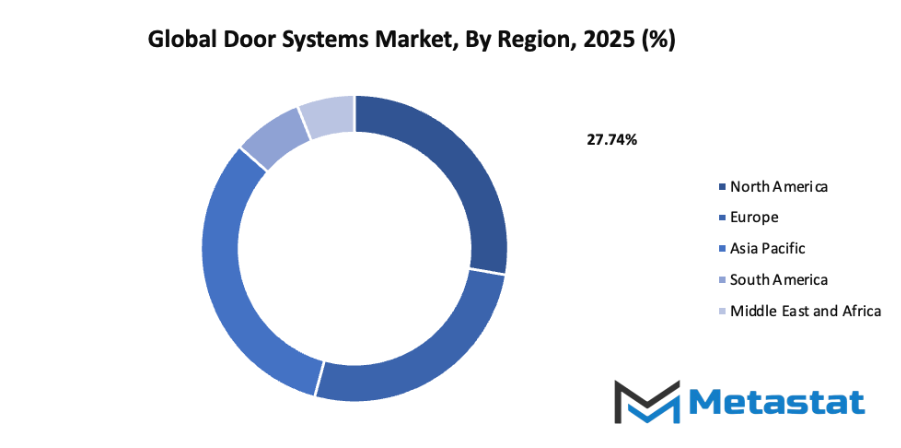
The global door systems market is mainly classified based on Material, Mechanism, Technology, Application.
|
Forecast Period |
2025-2032 |
|
Market Size in 2025 |
$77.8 Billion |
|
Market Size by 2032 |
$95.7 Billion |
|
Growth Rate from 2025 to 2032 |
3.0% |
|
Base Year |
2024 |
|
Regions Covered |
North America, Europe, Asia-Pacific, South America, Middle East & Africa |
The global door systems market reflects a dynamic landscape shaped by both long-standing international manufacturers and a growing number of regional innovators. As demand for security, energy efficiency, and aesthetic design continues to rise, this industry is expected to experience steady progress driven by technological integration and changing architectural preferences. With expanding construction activities across residential, commercial, and industrial sectors, the need for reliable and adaptable door systems has never been greater.
The industry is a mix of both international industry leaders and emerging regional competitors. Important competitors include Assa Abloy, Dorma Kaba, Allegion Plc, Masonite, Anderson Corporation, Simpson Door Company, Jeld Wen Inc, PGT, Fancy Doors and Mouldings, Cornerstone Corporation, ARCAT, La Cantina Doors, Pella Corporation, Atrium, Marvin, OCM Industrial Doors, Masonite International Corporation, Lowe’s Companies, Inc., JELD-WEN Holding, Inc., and HaciendaRustica in the global door systems market. These companies continue to strengthen their positions through product innovation, strategic partnerships, and an increased focus on sustainability. Many of them are integrating advanced automation and smart technologies, offering products that provide convenience, safety, and energy management through intelligent locking systems and digital controls.
Looking ahead, technological development will play a central role in shaping the future of door systems. The rise of smart homes and connected infrastructure will encourage greater use of automated doors equipped with sensors and wireless connectivity. The growing trend toward green construction will also promote doors made from recycled or eco-friendly materials, balancing performance with environmental responsibility. Furthermore, digital platforms will make customization more accessible, allowing customers to design doors that suit specific architectural and functional needs.
Market competition will likely intensify as regional manufacturers adopt advanced production techniques to compete with established brands. This will lead to broader product diversity and more competitive pricing. As emerging economies continue to urbanize, their growing middle-class populations will increase demand for modern housing solutions, thereby expanding the customer base for door systems. The industry’s progress will also depend on regulatory standards related to building safety and energy efficiency, pushing companies to comply with stricter requirements and improve their product quality.
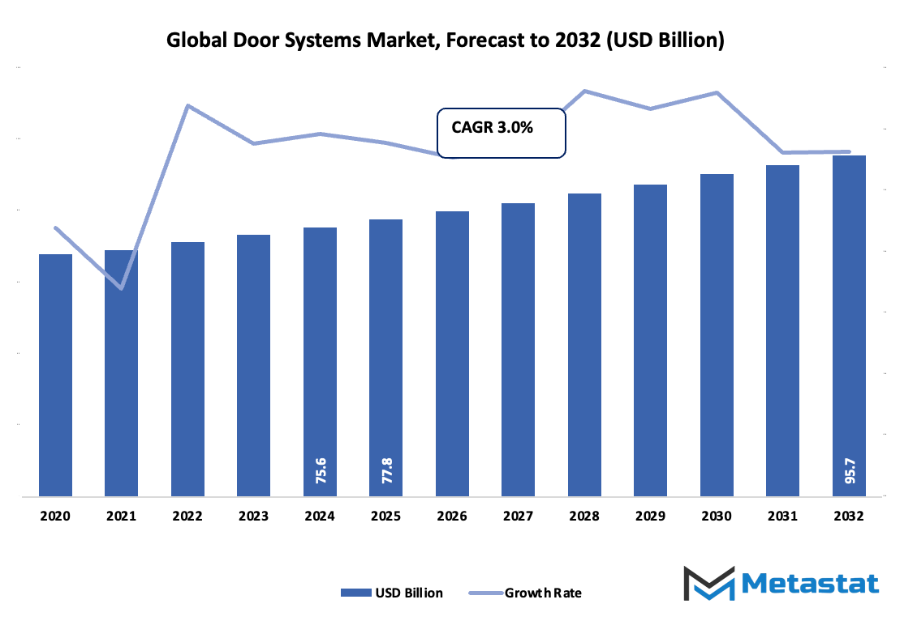
Market size is forecast to rise from USD 77.8 Billion in 2025 to over USD 95.7 Billion by 2032. Door Systems will maintain dominance but face growing competition from emerging formats.
Future growth in the global door systems market will be closely tied to innovation and sustainability. Manufacturers that focus on combining technology with design flexibility will be better positioned to meet evolving customer expectations. With continuous investment in research and development, the door systems industry is set to move toward a future where security, design, and sustainability come together to create smarter, more efficient spaces for both residential and commercial environments.
This research report categorizes the global door systems market based on various segments and regions, forecasts revenue growth, and analyzes trends in each submarket. The report analyses the key growth drivers, opportunities, and challenges influencing the global door systems market. Recent market developments and competitive strategies such as expansion, type launch, development, partnership, merger, and acquisition have been included to draw the competitive landscape in the market. The report strategically identifies and profiles the key market players and analyses their core competencies in each sub-segment of the global door systems market.
Find answers to common questions about this report
Global Door Systems market is valued at $77.8 Billion in 2025.
Global Door Systems market is estimated to grow with a CAGR of 3.0% from 2025 to 2032.
Global Door Systems market is estimated to reach $95.7 Billion by 2032.
Top players operating in the Door Systems industry includes Assa Abloy, Dorma Kaba, Allegion Plc, Masonite, Anderson Corporation, Simpson Door Company
The analysts below cover Machinery & Equipment research at Metastat Insights.
LEAD ANALYST
Utkarsh Khirodkar is a Lead Market Research Analyst at MetaStat Insight, specializing in market intelligence, technology sector assessments, and competitive strategy.

INDUSTRY CONSULTANT - CHEMICALS & ADVANCED MATERIALS
Chemicals and Materials · Machinery & Equipment · Packaging
Amit Gadhekar Consultant for Chemicals and Materials at MetaStat Insight, directing sector-specific intelligence, research, and strategic consulting across global chemical and processing markets.

PRINCIPAL CONSULTANT - QUALITY SYSTEMS & COMPLIANCE
Electronics and Semiconductor · Machinery & Equipment · Professional Services
Omkar Phadtare is an Industry Consultant at MetaStat Insight, specializing in quality systems, regulatory compliance, and standards benchmarking to drive data-driven market intelligence and strategic industry research.

ENERGY & INFRASTRUCTURE INDUSTRY CONSULTANT
Automotive and Transportation · Electronics and Semiconductor · Energy and Power · Machinery & Equipment
Saurabh Vasant Ganvir consults for Energy & Infrastructure Industry at MetaStat Insight, specializing in renewable energy, solar EPC, and electric vehicle (EV) infrastructure markets.

LEAD CONSULTANT - COMMUNICATION, TELECOM, AND IT
Electronics and Semiconductor · Information & Technology · Machinery & Equipment · Professional Services
Ravindra Sathe Consultants for Communication, Telecom, and IT at MetaStat Insight. He leads the firm's industry research initiatives across telecommunications infrastructure, digital connectivity, enterprise networking, and emerging information technology domains.
Our team was tracking whether regional recycling infrastructure could realistically absorb the growing volume of lithium iron phosphate batteries over the next decade. The report did a solid job separating announced hydrometallurgical plant capacity from active, permitted operational throughput. That distinction made the feedstock availability projections and regional recovery rate models far more credible than standard commercial overviews.
Tracking capacity expansion in single-use bioprocessing requires dependable data on raw material availability and cleanroom-grade polymer supply chains. The competitive landscape chapter gave a grounded evaluation of secondary component suppliers across North America and Asia-Pacific rather than simply reprinting press releases. Having that level of supplier benchmarking helped clarify dual-sourcing considerations for our clinical pipeline planning.
When evaluating distributed energy resource management systems, standard research summaries tend to gloss over the operational differences between front-of-the-meter utility deployments and behind-the-meter industrial sites. The MetaStat Insight report addressed those distinctions directly, especially regarding software interoperability standards and grid interconnection backlogs. The five-year market sizing across regional transmission organizations provided actionable context for our grid modernization strategy.
Explore related market intelligence reports worth reading alongside this one.
Starting from
$2950