
LEAD ANALYST
Utkarsh Khirodkar is a Lead Market Research Analyst at MetaStat Insight, specializing in market intelligence, technology sector assessments, and competitive strategy.

EV Wiring Harness Automation Market Size, Share, By Type (Hardware, Systems, Software, and Solutions), By Vehicle Type (Passenger Cars, Commercial Vehicles, and Others), Industry Analysis, Growth, Trends, and Forecast, 2026-2033
Report ID
MSI-4590
Published
April, 2026
Updated
Pages
320 Pages
Format
Report Details
Choose Your License
Electric Vehicle (EV) Wiring Harness Automation Market
The Global EV Wiring Harness Automation market size was valued at USD 8.5 billion in 2025 and projected to grow at a CAGR of 20.2% during the forecast period, reaching USD 37.0 billion by 2033.
North America held 25.7% in 2025, with the United States holding the largest share within the region.
Hardware and Systems segment accounts for a market share of 76.2% in 2026.
Key trends driving growth include increasing EV production volumes that propel high-throughput, repeatable harness manufacturing and end-of-line testing automation, along with rising harness complexity from high-voltage architectures, ADAS, and infotainment that pushes OEMs and Tier-1 suppliers toward automated processing and inspection.
Opportunities include expansion of flexible, modular automation supported by digital work instructions and inline electrical and vision inspection, enabling profitable automation in high-mix, low-volume EV programs.
Key insight: Automation in EV wiring harness manufacturing gains momentum owing to rising production scale and electrical complexity, while cost and integration barriers shape the adoption pace.
The Global EV Wiring Harness Automation market within the electric vehicle manufacturing industry is moving beyond conventional production constraints and is reshaping how vehicle electrical architectures are conceived, engineered, and integrated. Automation will extend beyond shop-floor execution and will influence early-stage vehicle design, where digital twins, simulation-driven routing, and software-defined layouts are embedded directly into engineering workflows. Wiring harness systems are increasingly planned alongside battery packs, power electronics, and vehicle control units rather than being treated as downstream components.
Over the forecast period, automation technologies will enable adaptive harness configurations that respond to new vehicle variants without major retooling. Production systems will increasingly rely on modular automation cells capable of adjusting wire length, terminal placement, and connector orientation in real time. This shift will guide shorter model cycles and higher customization tiers demanded through electric mobility platforms. Advanced inspection methods based on vision systems and embedded sensors will replace manual quality inspections, enabling continuous validation without interrupting production flow.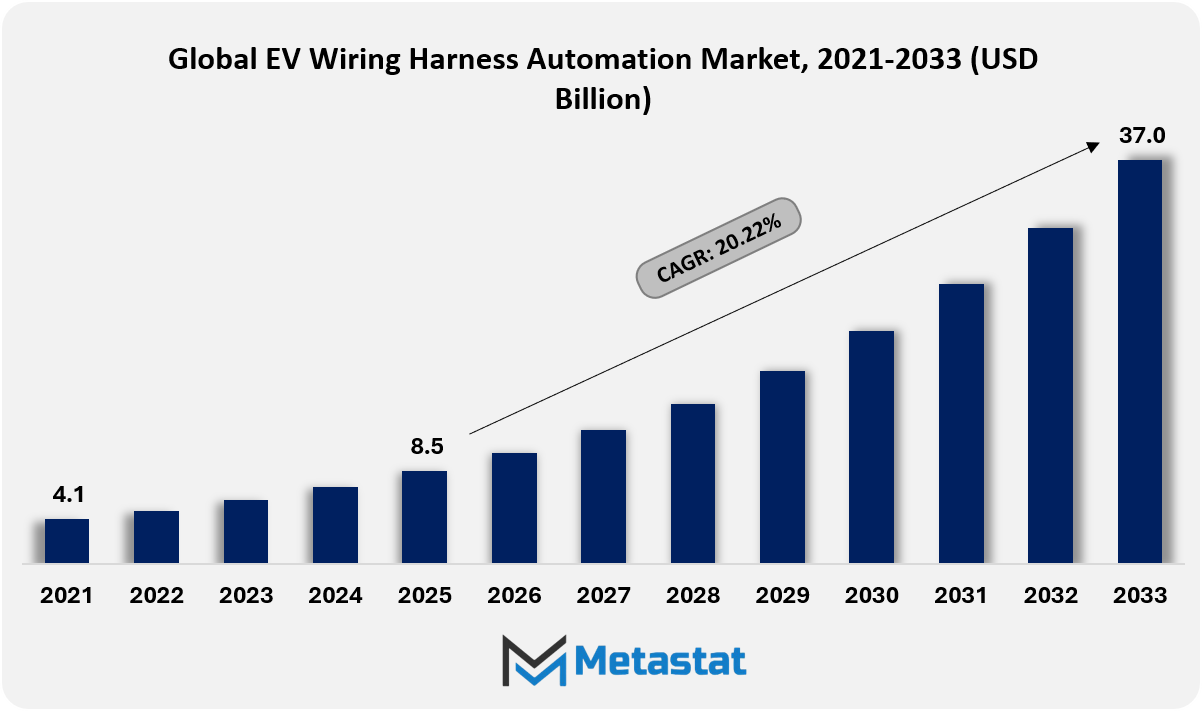
Increasing EV production volumes are propelling high-throughput, repeatable harness manufacturing and end-of-line testing automation.
Rising electric vehicle output is driving requirements for faster, repeatable wiring harness manufacturing supported by advanced automation. High-throughput cutting, crimping, routing, and end-of-line testing systems improve consistency across large production runs. Within the global EV wiring harness automation market, scalability through automation strengthens supply reliability while supporting competitive production targets set by automakers.
Rising harness complexity from high-voltage architectures, ADAS, and infotainment is pushing OEMs and Tier-1s toward automated processing and inspection.
Rising adoption of high-voltage systems, advanced driver-assistance systems, and integrated infotainment architectures increases wiring density and design complexity. Automated processing and inspection address accuracy requirements across safety-critical electrical paths. The global EV wiring harness automation market will progress through precision-focused solutions that handle complex layouts without compromising performance or manufacturing pace.
High capex and integration effort for automated cutting-crimping, sealing, and test lines constrain adoption among smaller harness suppliers.
Substantial capital expenditure tied to automated cutting and crimping, sealing, and electrical testing lines slows adoption among smaller harness suppliers. Integration requirements spanning software, robotics, and quality systems increase operational risk during early deployment phases. Budget sensitivity throughout the provider ranges will influence automation timelines in spite of long-term performance benefits.
Frequent model changes and variant proliferation reduce line utilization and increase retooling and changeover burden for automation assets.
Frequent vehicles refresh cycles and expanding variant portfolios reduce line utilization rates for dedicated automation assets. Retooling necessities and prolonged changeover durations will inflate operational overhead. Automation strategies will face strain to preserve monetary viability while production volumes differ throughout multiple EV configurations within short planning horizons.
Expansion of flexible, modular automation supported by digital work instructions and inline electrical and vision inspection, enabling profitable automation in high-mix, low-volume EV programs.
Development of modular automation cells paired with digital work instructions and inline electrical or vision inspection unlocks profitability in high-mix EV applications. Adaptive structures will aid rapid reconfiguration without manufacturing disruption. Forward-looking investment in flexible architectures positions automation vendors for sustained relevance across evolving EV production strategies.
The Global EV Wiring Harness Automation market is classified based on Type and Vehicle Type.
Hardware and Systems segment is estimated at USD 7.8 billion in 2026 and is projected to reach USD 25.9 billion by 2033, at a CAGR of 18.8% during the forecast period.
Hardware and Systems support automated wiring harness manufacturing through robotics, vision-guided tooling, and sensor-based assembly equipment. Future production environments will rely upon synchronized machines able to manage complicated wiring layouts with velocity and consistency, supporting high-volume electric vehicle manufacturing while meeting stringent safety and performance benchmarks.
Software and Solutions segment is estimated at USD 2.4 billion in 2026 and is projected to reach USD 11 billion by 2033, at a CAGR of 24.2% during the forecast period.
Software and Solutions enable predictive control, real-time monitoring, and adaptive system optimization within automated harness facilities. Advanced digital systems will enable multi-machine coordination, fault detection, and workflow efficiency, permitting manufacturers to gain precision-driven output at the same time as aligning production cycles with evolving electric vehicle architecture demands.
Passenger Cars segment is projected to reach USD 24.7 billion by 2033, at a CAGR of 19.4% during the forecast period.
Passenger cars stay a primary focus for wiring harness automation due to rising electric vehicle adoption and growing electronic content. Automated structures will assist light-weight harness designs, compact layouts, and consistent fine requirements, ensuring efficient manufacturing aligned with customer expectations for protection, performance, and long-time period vehicle reliability.
Commercial Vehicles segment is projected to reach USD 10.7 billion by 2033, at a CAGR of 22.8% during the forecast period.
Commercial vehicles benefit from automation through improved handling of high-load electrical systems and extended wiring configurations. Future production strains will emphasize durability, standardized assembly, and reduced downtime, allowing manufacturers to fulfill fleet electrification desires while maintaining operational efficiency throughout logistics, public transport, and industrial mobility segments.
Others segment is projected to reach USD 1.6 billion by 2033, at a CAGR of 17.6% during the forecast period.
Others, which include two-wheelers, specialty vehicles, and emerging mobility formats, will witness sluggish integration of wiring harness automation. Flexible automation frameworks will support varied layout requirements, decrease production volumes, and evolving use cases, encouraging broader adoption of electrical mobility solutions across diverse transportation packages.
Based on geography, the Global EV Wiring Harness Automation market is divided into North America, Europe, Asia-Pacific, South America, Middle East, and Africa.
North America EV Wiring Harness Automation Market is set to expand at a CAGR of 20.2% within the forecast period, reaching a market size of USD 8.5 billion by the end of 2033.
North America benefits from scaling EV manufacturing among OEMs, pushing demand for computerized wiring harness systems to enhance throughput and consistency.
North America sees strong adoption momentum supported by advanced manufacturing infrastructure and high labor costs, accelerating adoption of automation in EV wiring harness meeting.
Asia Pacific offers strong opportunity owing to expanding EV production hubs in China, India, Japan, and South Korea, encouraging funding in high-volume wiring harness automation.
Asia Pacific gains opportunity from government-subsidized EV incentives and rapid capacity expansion among domestic suppliers, increasing uptake of automatic harness production lines.
Across the Middle East, Africa, and South America, gradual EV ecosystem development and localized car assembly growth create consistent potential for value-efficient wiring harness automation adoption driven via industrial modernization desires.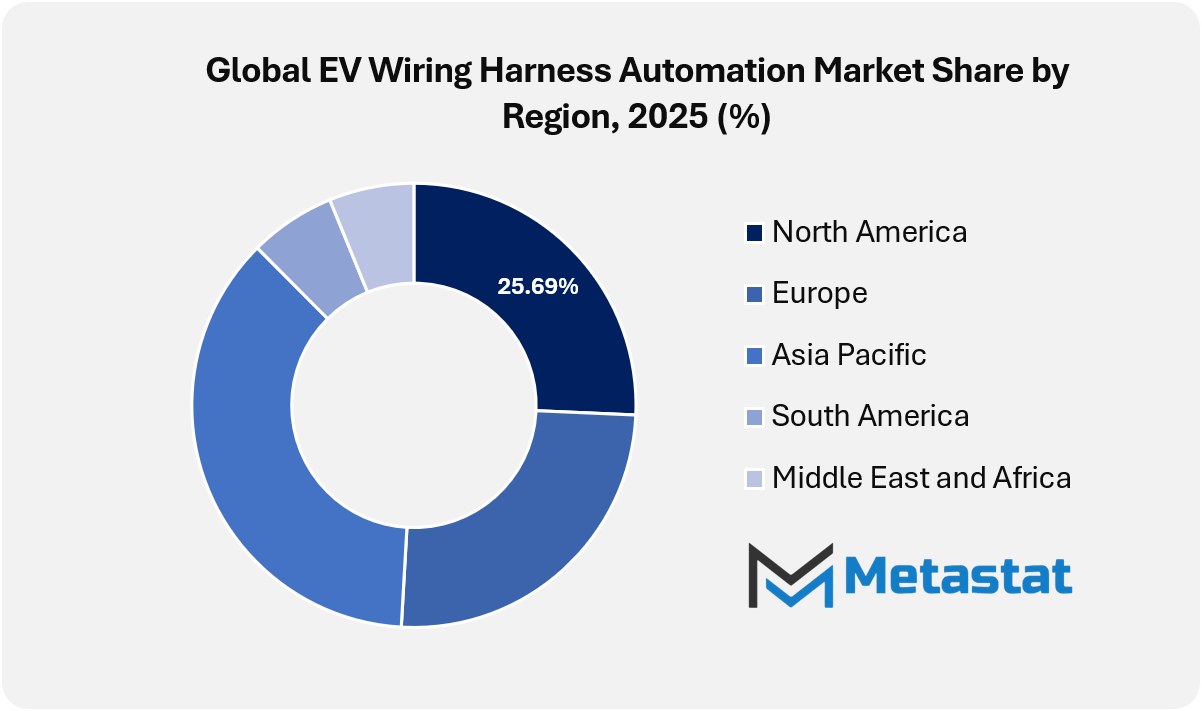
The Global EV Wiring Harness Automation market is gaining steady momentum as electric vehicle manufacturing scales up across regions. Automakers are shifting toward automated harness production to control rising design complexity, higher voltage necessities, and the need for consistent quality standards. Manual methods struggle to keep pace with demand, even as automation will assist in quicker cycle times, improved accuracy, and reduced material waste. As EV platforms continue to diversify, automatic wiring solutions will play a critical role in meeting production targets without compromising safety or reliability.
Technology-centered system producers shape the backbone of this marketplace. Companies including Komax Holding AG, CURTI Costruzioni Meccaniche S.P.A., Schäfer Group, Inc., Mecal by Starn, Metzner Maschinenbau GmbH, Eubanks Engineering Co., The Eraser Company, Inc., Japan Automatic Machine Co., Ltd. (JAM), Kodera Electronics Co., Ltd., Bmax, Rosendahl Nextrom, Cometo SRL, and Jiangsu Bozhiwang Automation Equipment are driving development through advanced cutting, crimping, stripping, and assembly systems. The solutions will permit producers to address complex wiring layouts with better speed and repeatable precision, which is essential for large-scale EV production.
Material handling, connectivity, and identification specialists also hold a strong position within the market. TE Connectivity Ltd., Molex, LLC, Panduit Corp., HellermannTyton Group, Brady Corporation, and HARTING support automated workflows through reliable connectors, cable management products, and labeling systems. These players will assist make sure electric balance, traceability, and long-term overall performance in EV wiring harnesses, which face thermal pressure and vibration during vehicle operation.
Automation and robotics leaders are shaping how wiring harness production and factory floors are structured. ABB, KUKA, FANUC, Kawasaki Robotics, Siemens Digital Industries Software, Zuken, Perspectiva Solutions, Q5D Technologies Limited, Cirris, and CAMI Research are enabling virtual design integration, robotic assembly, inline testing, and data-driven quality management. The structures will lessen dependency on manual labor whilst permitting producers to conform production lines quickly, while car designs change.
Market size is forecast to rise from USD 8.5 billion in 2025 to over USD 37.0 billion by 2033.
In the long term, the Global EV Wiring Harness Automation market will support self-optimizing production decision systems where machines will adjust processes based totally on car layout modifications without human intervention. Such improvements will function wiring harness automation as a strategic enabler of scalable electric car innovation instead of a backstop manufacturing characteristic.
By Type:
By Vehicle Type:
This research report categorizes the EV Wiring Harness Automation market based on key segments and regions, forecasts revenue growth, and analyses trends in each submarket. The report analyses the key growth drivers, opportunities, and challenges influencing the EV Wiring Harness Automation market. Recent market developments and competitive strategies such as expansion, product launch, partnership, merger, and acquisition have been included to draw the competitive landscape in the market.
The report strategically identifies and profiles the key market players and analyses their core competencies in each sub-segment of the EV Wiring Harness Automation market.
|
Report Attributes |
Details |
|
Study Period |
2021-2033 |
|
Base Year |
2025 |
|
Estimated Year |
2026 |
|
Forecast Period |
2026-2033 |
|
Historical Period |
2021-2025 |
|
Growth Rate |
CAGR 20.2% from 2026 to 2033 |
|
Revenue Unit |
USD billion |
|
Segmentation |
By Type, Vehicle Type, and Region |
|
By Region |
North America (By Type, Vehicle Type and Country)
|
|
Europe (By Type, Vehicle Type, and Country)
|
|
|
Asia Pacific (By Type, Vehicle Type, and Country)
|
|
|
South America (By Type, Vehicle Type, and Country)
|
|
|
Middle East and Africa (By Type, Vehicle Type, and Country)
|
Find answers to common questions about this report
Top players operating in the EV Wiring Harness Automation industry include Komax Holding AG, CURTI Costruzioni Meccaniche S.p.A., Schäfer Group, Inc., Mecal by Starn, and Metzner Maschinenbau GmbH.
Asia Pacific region dominates the market.
The Metastat Insight analysis shows that the North America EV Wiring Harness Automation market size is estimated to be USD 9.5 billion by 2033.
Increasing EV production volumes propel high-throughput, repeatable harness manufacturing and end-of-line testing automation, while rising harness complexity from high-voltage architectures, ADAS, and infotainment pushes OEMs and Tier-1 suppliers toward automated processing and inspection.
Global EV Wiring Harness Automation market is estimated to reach USD 37.0 billion by 2033.
High capex and integration effort for automated cutting and crimping, sealing, and test lines constrain adoption among smaller harness suppliers and will hamper market growth within the forecast period.
The Metastat Insight study shows that the Global EV Wiring Harness Automation market size was USD 8.5 billion in 2025.
The Global EV Wiring Harness Automation market is likely to grow at a CAGR of 20.2% over the forecast period (2026-2033).
Hardware and Systems is the leading type of segment in the global market.
The analysts below cover Automotive and Transportation research at Metastat Insights.
LEAD ANALYST
Utkarsh Khirodkar is a Lead Market Research Analyst at MetaStat Insight, specializing in market intelligence, technology sector assessments, and competitive strategy.

ENERGY & INFRASTRUCTURE INDUSTRY CONSULTANT
Automotive and Transportation · Electronics and Semiconductor · Energy and Power · Machinery & Equipment
Saurabh Vasant Ganvir consults for Energy & Infrastructure Industry at MetaStat Insight, specializing in renewable energy, solar EPC, and electric vehicle (EV) infrastructure markets.
Last Updated: August, 2026
Replacing petrochemical surfactants with bio-based alternatives requires realistic timelines on industrial precision fermentation scaling. The market research broke down commercialization timelines, feedstock sugar price sensitivities, and regional cosmetic ingredient regulatory approvals in Europe and East Asia. That supplier readiness mapping gave our formulations team reliable context when comparing renewable chemical sourcing roadmaps.
Tracking ceramic matrix composite adoption in high-bypass aero engines requires strict attention to material qualification cycles and FAA airworthiness testing milestones. The MetaStat Insight team provided a detailed timeline of silicon carbide fiber manufacturing capacity and commercial foundry lead times. Having clear visibility into upstream thermal barrier coating supply helped us stress-test our long-term component procurement strategy.
Transitioning ultra-class mining haul trucks to alternative power requires concrete data on remote hydrogen refueling infrastructure economics. The report evaluated megawatt-scale electrolyzer installation expenses, onsite storage safety mandates, and heavy-duty fuel cell stack degradation under continuous duty cycles. That technical rigor helped our engineers benchmark realistic total operating cost horizons for off-highway fleet decarbonization.
Explore related market intelligence reports worth reading alongside this one.
Starting from
$2950