
LEAD ANALYST
Utkarsh Khirodkar is a Lead Market Research Analyst at MetaStat Insight, specializing in market intelligence, technology sector assessments, and competitive strategy.

Global Light Weight Adventure Bikes Market Size, Share, By Engine Displacement (Below 150cc, 150cc-250cc, 251cc-400cc, 401cc-500cc, Above 500cc), By Motorcycle Category (Adventure Touring Motorcycles, Dual-Sport Motorcycles, Rally-Style Adventure Motorcycles, Enduro-Style Adventure Motorcycles), By Powertrain Configuration (Single-Cylinder Petrol Motorcycles, Parallel-Twin Petrol Motorcycles, V-Twin Petrol Motorcycles, Other Multi-Cylinder Petrol Motorcycles), By Sales Channel (Authorized Dealerships, Independent Motorcycle Dealers, Online Sales Channels), Industry Analysis, Growth, Trends, and Forecast, 2026-2033
Report ID
MSI-5702
Published
November, 2026
Pages
298 Pages
Format
Historical
Base year
Forecast
Forecast period
Report Details
Market Valuation: Valued at $2,032 Million in 2025, projected to reach $3,904 Million by 2033 at a 8.5% CAGR.
Dominant Segment: Adventure touring motorcycles lead the market, driven by increasing consumer interest in long-distance travel and exploration, projected to reach USD 1,359.4 million by 2033.
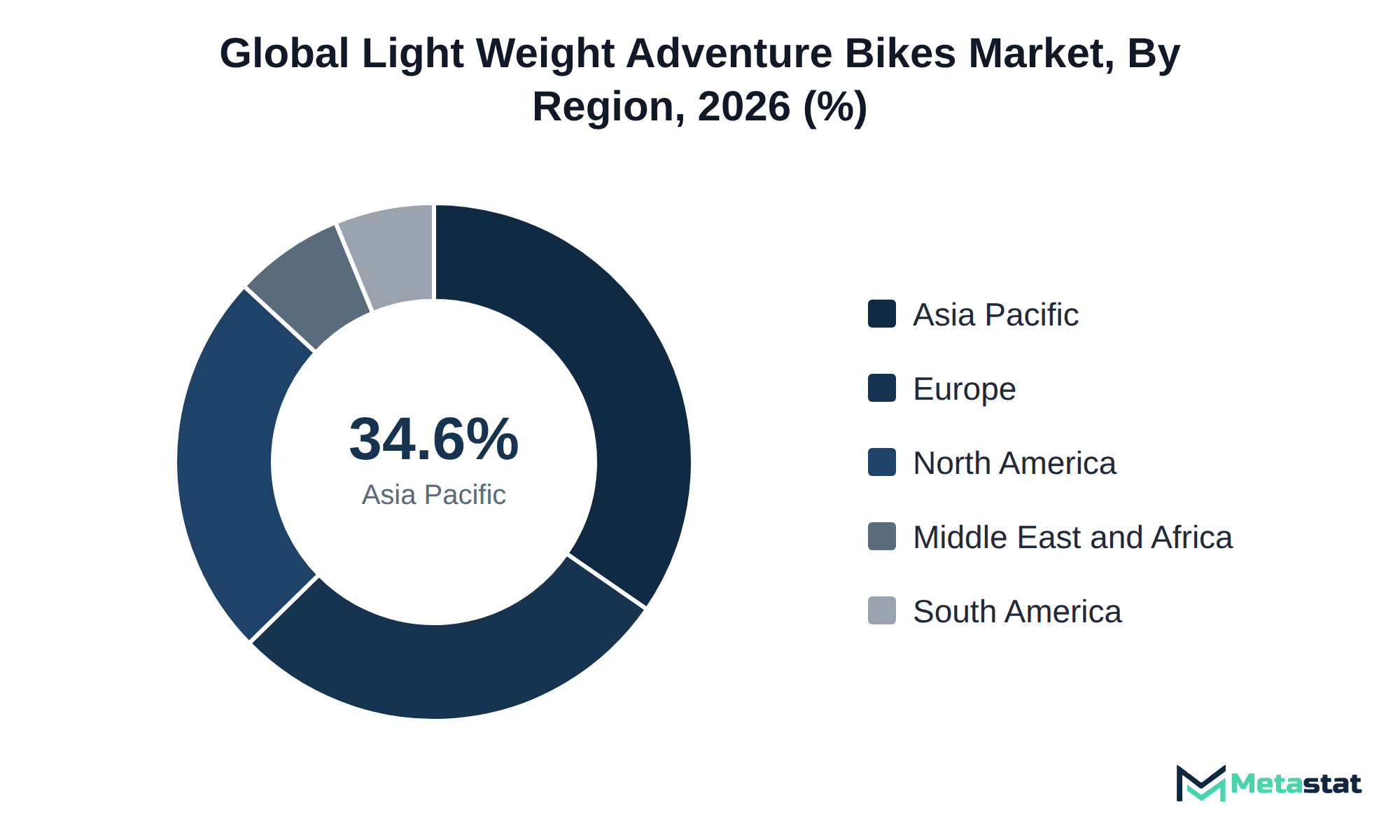
Geographic Lead: The Asia Pacific region captures the largest market share at 34.6%, fueled by a growing middle class and rising disposable income in countries like China and India.
What's Inside: This report provides comprehensive analysis including market segmentation by engine displacement, motorcycle category, powertrain configuration, and sales channels, along with competitive coverage and growth forecasts.
Emerging Trends: Technological advancements in lightweight materials and engine design are shaping the market, enhancing performance and appealing to environmentally conscious consumers.
Rider Preferences: There is a notable shift towards dual-sport motorcycles, with this segment projected to grow at a CAGR of 8.7%, reflecting riders' desire for versatility in both on-road and off-road conditions.
Choose Your License
Global Light Weight Adventure Bikes Market
The global Light Weight Adventure Bikes market was valued at USD 2,032 million in 2025 and is projected to reach USD 3,904 million by 2033, growing at a CAGR of 8.5% over the forecast period.
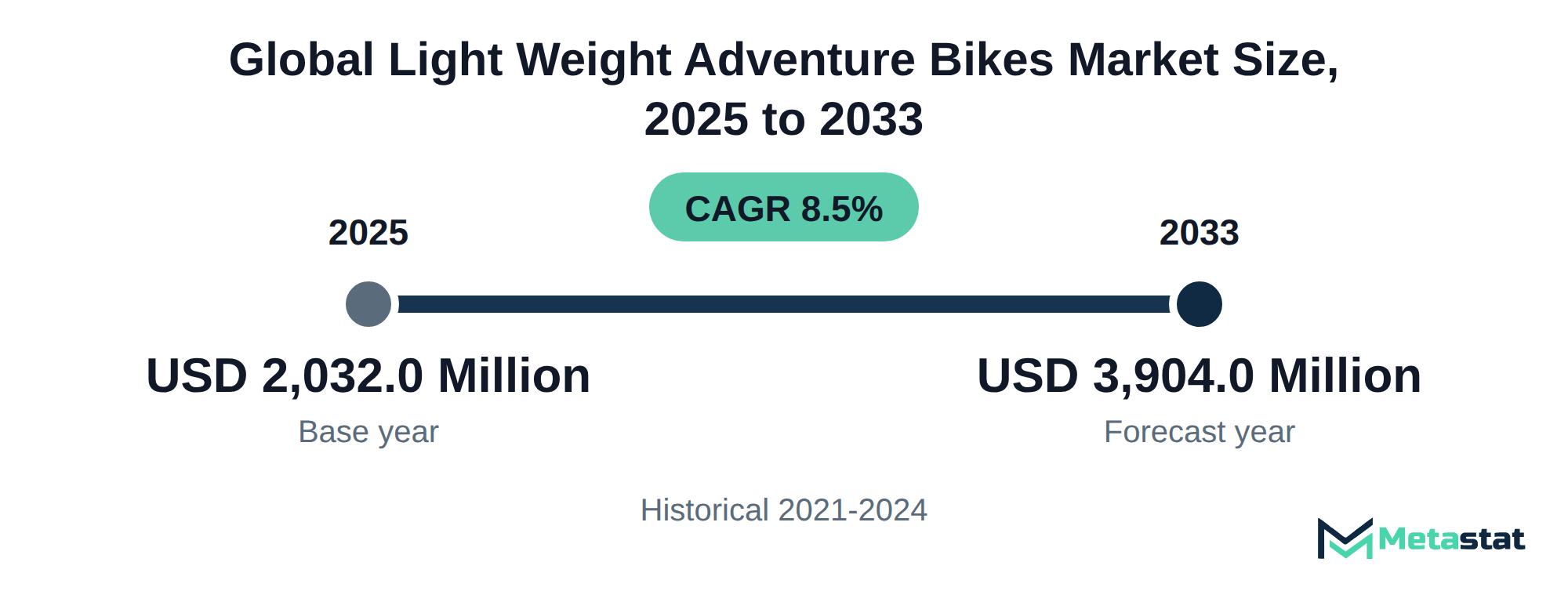
The Light Weight Adventure Bikes market encompasses a variety of motorcycle categories, including adventure touring, dual-sport, rally-style, and enduro-style motorcycles. Buyers invest in these vehicles primarily for recreational purposes and for their versatility in handling various terrains. This segment attracts a diverse customer base, from thrill-seekers to everyday commuters, driven by the increasing desire for outdoor activities and adventure travel.
Growth in the market is propelled by rising consumer interest in adventure tourism and outdoor experiences. Among the segments, the adventure touring motorcycles category holds the most value, reflecting a shift towards long-distance travel and exploration. The Asia Pacific region captures the largest market share at 34.6%, driven by a growing middle class and increasing disposable income in countries including China and India. North America holds 24.2% of the market in 2025, with the US leading in 2026.
Investment in advanced technology and enhanced fuel efficiency is a major growth driver. Manufacturers focus on developing lighter and more powerful motorcycles, catering to the increasing demand for efficient and high-performance vehicles. This trend influences consumer choices and shapes competitive strategies within the market.
The market focuses on lightweight motorcycles designed for various terrains, appealing to adventure enthusiasts and casual riders. Buyers invest in these motorcycles for their versatility, performance, and ability to handle diverse riding conditions. The growing popularity of adventure tourism and outdoor activities drives interest in lightweight adventure bikes among consumers who want both functionality and excitement.
Growth in the market is propelled by increased consumer interest in off-road experiences, coupled with advancements in motorcycle technology. The category of adventure touring motorcycles stands out, being the most valuable segment, catering to riders who seek comfort and capability for long-distance travel. Asia Pacific holds the largest market share, with a substantial portion of demand originating from countries like China and India, contributing significantly to overall sales.
Rising disposable income among consumers, along with a growing trend toward recreational activities, enhances demand for lightweight adventure bikes. Manufacturers focus on developing innovative models that meet the evolving preferences of riders, ensuring sustained growth in the coming years.
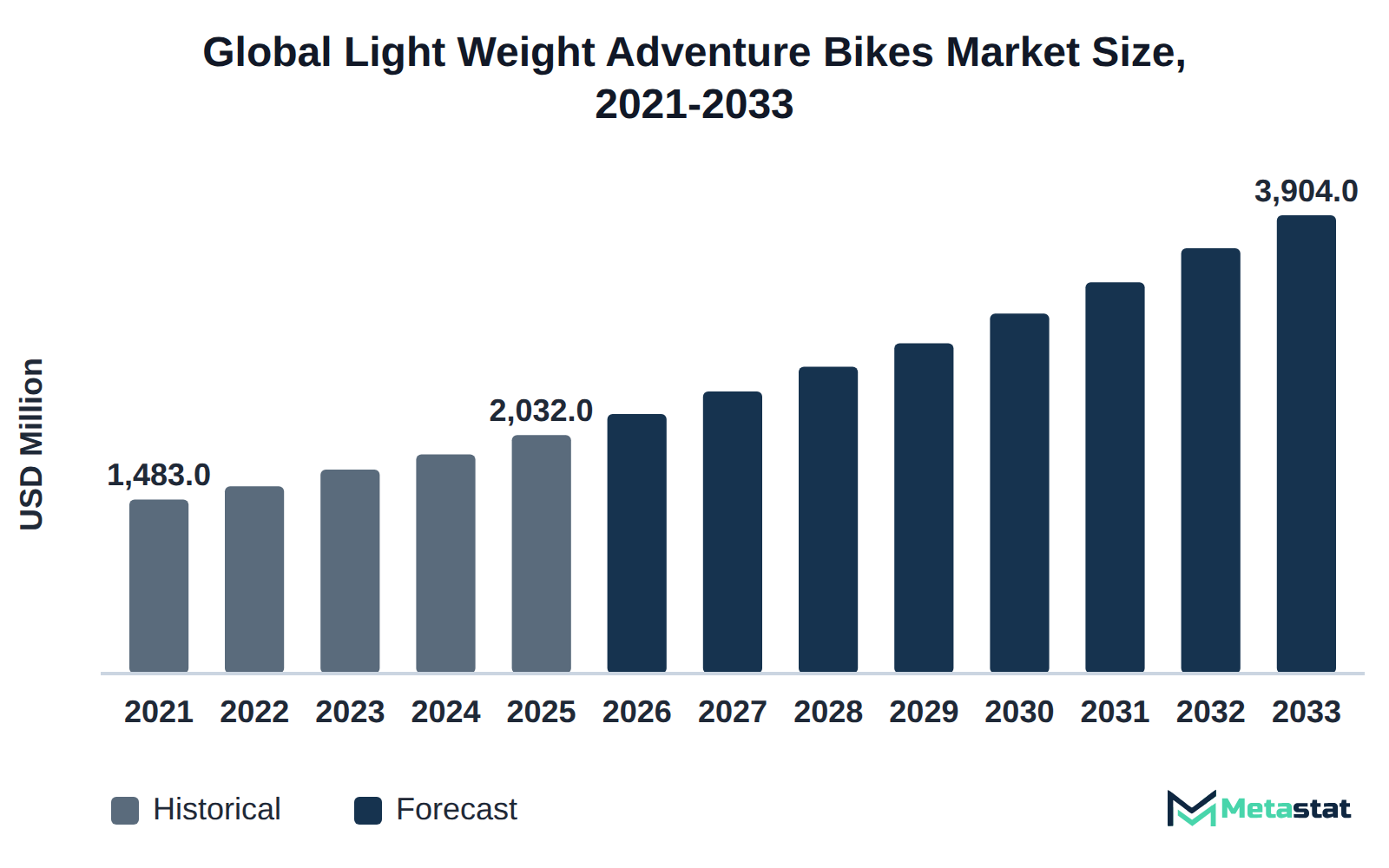
The Lightweight Adventure Bikes market sees a significant shift toward the adoption of advanced lightweight materials in motorcycle design. Innovations in materials science have led to the use of carbon fiber and aluminum alloys, which greatly enhance the strength-to-weight ratio of these motorcycles. This trend matches rising demand for efficient, agile bikes that serve both adventure touring and dual-sport categories. By 2033, the Adventure Touring Motorcycles segment is projected to reach USD 1,359.4 million, reflecting a compound annual growth rate (CAGR) of 8.0%. The introduction of these lightweight materials contributes to improved fuel efficiency and handling, directly appealing to environmentally conscious consumers and competitive riders alike.
While manufacturers embrace these material advancements, the Lightweight Adventure Bikes market experiences a significant effect on design and performance. Enhanced durability combined with reduced weight allows for extended off-road capabilities, positioning these bikes as versatile options for various riding conditions. The integration of lightweight designs influences consumer preferences and impacts production costs, potentially driving profit margins higher. This shift toward advanced materials is expected to drive growth, encouraging new entrants and established players to keep innovating.
Engine displacement and powertrain configuration shape buyers' purchasing decisions in the Light Weight Adventure Bikes market. Buyers focus on specific engine sizes that align with their riding preferences and intended usage. For instance, the segment for motorcycles with an engine displacement of 150cc to 250cc reflects a growing interest in this category among adventure riders seeking a balance between power and manageability.
This increasing demand for specific engine displacements influences pricing strategies and payment models among manufacturers. Many companies offer flexible financing options appealing to different buyer segments, including enthusiasts and casual riders. Authorized dealerships provide buy now pay later plans allowing buyers to spread the cost of their purchases over several months, enhancing affordability and accessibility. Such models support higher sales volumes while suiting the varied financial situations of consumers.
Manufacturers that adapt pricing strategies to buyer preferences for specific engine displacements gain a competitive edge. By understanding the commercial implications of engine configuration choices, companies align their product offerings with market demand, ultimately driving growth in the Light Weight Adventure Bikes market.
Riders increasingly seek dual-sport versatility in their motorcycles, influencing market dynamics significantly. These consumers prioritize bikes that excel in both on-road and off-road environments. The market has seen a notable shift towards dual-sport motorcycles, with the segment projected to reach USD 1,295.3 million by 2033, reflecting a compound annual growth rate (CAGR) of 8.7%. This growth is driven by the desire for flexibility and adventure among riders, who seek machines capable of handling diverse terrains.
This demand for versatility impacts manufacturers, prompting them to innovate and enhance their offerings. Companies develop features that improve performance in varied conditions, so their products match consumer preferences. The expansion of this segment within the market signifies a shift towards models that cater to adventurous riders, leading to increased sales opportunities and market share for manufacturers who successfully adapt to these changing preferences.
Lightweight adventure motorcycles are evolving to satisfy the growing demand for affordable touring and off-road performance through advancements in engine design and material selection. The segment of motorcycles with engine displacements between 150cc and 250cc is projected to reach USD 1,043.5 million by 2033, reflecting an increasing consumer preference for bikes that balance performance with cost-effectiveness. Customers pursuing these motorcycles prioritize lightweight structures and versatile capabilities, enabling easier handling in diverse environments.
The evolution of powertrain configurations contributes significantly to affordability. Single-cylinder petrol motorcycles, expected to grow from USD 1,482.8 million in 2026 to USD 2,506.7 million by 2033, provide an optimal combination of weight reduction and adequate power for both touring and off-road capabilities. This shift enhances accessibility for a broader range of buyers, including those new to the market.
Developments in the Light Weight Adventure Bikes market show manufacturers focusing on models for diverse riding conditions while keeping prices competitive. Manufacturers streamline production and enhance features, which benefits the overall market through increased adoption rates and opportunities for growth within the adventure motorcycle segment.
Growing participation in outdoor activities significantly influences spending patterns among buyers. Adventure enthusiasts, particularly younger demographics, increasingly pursue experiences that blend exploration with physical challenges. This behavioral shift drives demand for lightweight adventure bikes, which offer versatility for both touring and off-road experiences. Recent market analysis indicates that expenditure in the Light Weight Adventure Bikes market is projected to increase, with an anticipated market value of USD 3,904 million by 2033. This growth reflects a changing consumer base, where younger riders seeking adventure and a connection to nature prioritize lightweight and efficient motorcycles. The appeal of these bikes aligns with broader trends in outdoor recreation, supporting higher purchase volumes and sustained price stability in the segment.
Rising demand for lightweight adventure bikes creates substantial opportunities for manufacturers to innovate and capture market share. Stakeholders who track these trends will be better placed to respond to changing consumer preferences.
Technological innovations in motorcycle design significantly enhance performance and rider experience within the Light Weight Adventure Bikes market. Features including advanced suspension systems and improved braking technologies provide better handling and safety. Lightweight materials, including high-strength alloys and carbon fiber, contribute to reduced overall weight, which directly influences maneuverability and fuel efficiency. The integration of smart technology, including navigation systems and connectivity features, appeals to tech-savvy consumers, expanding the target audience.
Suppliers invest in research and development to create motorcycles that meet evolving consumer expectations for both on-road and off-road capabilities. This focus on technology increases competitive differentiation among manufacturers and creates a positive growth environment. Enhanced product offerings lead to increased consumer interest and spending, further driving revenue growth in the market. As the market matures, continued technological advances are expected to shape future trends and consumer preferences.
The Light Weight Adventure Bikes market faces limitations due to price sensitivity among potential buyers, particularly in the adventure touring and dual-sport segments. Higher upfront costs associated with these motorcycles result in slower uptake, particularly among budget-conscious consumers. The demand for affordable options influences purchasing decisions, leading to smaller orders or delayed replacements. Buyers prioritizing value often explore alternative models, which impacts overall market growth. Lower-cost substitutes further worsen this issue, as consumers weigh the benefits of premium lightweight models against cheaper choices. Manufacturers address the price factor to expand market penetration and reach a broader audience.
Suppliers in the Light Weight Adventure Bikes market confront increasing input costs, which directly impact profit margins. Manufacturing components including engines, frames, and electronic systems experience price inflation due to fluctuating raw material costs and supply chain disruptions. This situation creates significant pressure on manufacturers, prompting many to explore cost-reduction strategies and alternative sourcing options.
Several suppliers emphasize efficiency improvements and invest in automation to maintain competitiveness. In response to rising costs, several manufacturers shift toward using lightweight materials that balance performance and price. Forming strategic partnerships with raw material providers enhances supply chain stability, allowing suppliers to mitigate the impact of rising costs on operations. This adaptation supports growth, letting suppliers keep delivering quality products despite challenging economic conditions.
The segment of motorcycles with engine displacement between 401cc and 500cc reflects a significant opportunity in the market. This segment is projected to grow at a compound annual growth rate (CAGR) of 8.9%, addressing the needs of riders seeking enhanced performance without sacrificing lightweight design and maneuverability. The increasing interest in adventure touring and off-road capabilities drives purchases in this segment. Manufacturers focusing on this category capture a growing base of enthusiasts who prioritize both power and agility. The expected growth in this area will contribute to an overall increase in revenues within the Light Weight Adventure Bikes market, with more riders exploring the versatility these motorcycles offer for various terrains. This shift in consumer preference points to targeted marketing and product innovation for this demographic.
The Global Light Weight Adventure Bikes market is segmented based on Engine Displacement, Motorcycle Category, Powertrain Configuration, and Sales Channel.
The Below 150cc segment is valued at USD 266.5 million in 2026 and is projected to reach USD 423.2 million by 2033, at a CAGR of 6.8% during the forecast period. This segment caters mainly to novice riders and those seeking lightweight, easy-to-handle motorcycles for urban commuting and light off-road adventures. Demand for this segment thrives on increasing interest in entry-level bikes among younger riders and those new to motorcycling. Competitive pricing and lower maintenance costs compared to higher displacement motorcycles position it favorably among budget-conscious buyers. Unlike other segments, the Below 150cc segment experiences slower growth, driven by a more limited target demographic focused on affordability and ease of use, contrasting with higher growth rates seen in segments like 150cc-250cc, which appeal to more experienced riders seeking enhanced performance.
This segment caters to riders seeking motorcycles that offer a blend of agility and power for both on-road and off-road experiences. Customers in this segment include adventure enthusiasts and urban commuters, who appreciate the balance between performance and fuel efficiency. Increasing demand for versatile motorcycles drives growth in this segment, particularly among younger riders who prioritize affordability and functionality. Compared to other engine displacement segments, the 150cc-250cc category experiences a stronger growth trajectory, emphasizing accessibility and practicality. Buyers often prefer this segment for its lower entry price, making it an attractive option for first-time motorcycle owners. Innovations in design and technology provide further impetus, enhancing rider experience and performance in this competitive market.
The 251cc-400cc segment is expected to reach USD 1,595.2 million by 2033. This segment attracts riders seeking a balance between power and maneuverability, making it popular among both casual and experienced motorcyclists. The increasing demand for mid-range motorcycles, often used for both commuting and light off-road adventures, drives market growth. Technological advancements in engine performance and emissions control contribute to its appeal, enhancing efficiency and rider experience. In contrast to other segments, the 251cc-400cc category experiences a moderate growth rate, with a CAGR of 7.7%. Compared to the 150cc-250cc segment, which exhibits faster growth, this segment offers a more powerful alternative, catering to buyers prioritizing performance for varied riding conditions. Riders choosing this segment often seek durability and versatility, differentiating it from higher displacement options that command higher prices.
The 401cc-500cc segment is projected to grow at a CAGR of 8.9% during the forecast period. This segment appeals to riders seeking robust performance for both on-road and off-road adventures. Enthusiasts favor these motorcycles for their balance of power and handling, making them suitable for various terrains. The demand is driven by increasing interest in recreational riding and adventure travel. Compared to other segments, including 150cc-250cc, which experiences a CAGR of 7.7%, the 401cc-500cc segment exhibits stronger growth potential. Pricing strategies for motorcycles in this segment typically reflect higher performance specifications, positioning them at a premium compared to smaller categories. The combination of enhanced features and increasing rider experience contributes to expanding market opportunities for this segment.
Motorcycles with an engine displacement above 500cc cater to riders seeking high-performance capabilities and enhanced touring experiences. This segment attracts adventure enthusiasts and long-distance travelers who prioritize power and reliability in diverse riding conditions. Increasing demand for advanced functionality drives growth in this sub-segment, with buyers valuing features like improved suspension and advanced navigation systems. Compared to lower displacement segments, this category typically commands higher prices due to its superior engineering and technology integration. The distinct performance characteristics set it apart from other segments, appealing to a niche market focused on high-end specifications and premium features. Factors including rising disposable income among consumers worldwide enable growth in this sub-segment, reflecting a shift in buyer behavior toward seeking premium motorcycles tailored for both on-road and off-road adventures. These preferences and advances in engineering keep the market evolving.
Adventure Touring Motorcycles segment is valued at USD 795 million in 2026 and is projected to reach USD 1,359.4 million by 2033, at a CAGR of 8% during the forecast period. This segment attracts riders seeking comfortable touring options combined with off-road capabilities, appealing largely to adventure enthusiasts and long-distance travelers. Demand for these motorcycles is driven by the increasing popularity of outdoor recreational activities and the desire for versatile motorcycles capable of handling diverse terrains. Compared to other segments, including Dual-Sport Motorcycles, which exhibit a CAGR of 8.7%, Adventure Touring Motorcycles grow at a steadier rate of 8%. The emphasis on comfort and performance in this segment often results in higher price points, influencing buyer decisions and differentiating it from alternatives focused solely on off-road performance.
These motorcycles appeal to a diverse range of riders seeking versatility for both on-road and off-road experiences. Increasing interest in adventure tourism and outdoor activities drives demand for dual-sport models, which offer the ability to traverse various terrains. This segment's growth exceeds that of other categories due to its unique positioning, attracting buyers who prioritize multi-functional capabilities in design. Competition for features enhancing fuel efficiency and performance shapes pricing strategies, with dual-sport motorcycles generally priced competitively compared to Adventure Touring models. The distinct characteristics of this segment cater specifically to enthusiasts seeking a balance between practicality and adventure, contributing to its significant expansion in the market.
The Rally-Style Adventure Motorcycles segment is expected to reach USD 770.6 million by 2033. This segment appeals to riders seeking versatile performance for both on-road and off-road experiences, allowing for competitive racing and exploration. The ongoing interest in adventure sports and off-road racing drives demand, particularly among younger, active consumers. This segment differentiates itself from others within the motorcycle category due to its focus on performance and agility, appealing to a niche market. Demand for Rally-Style Adventure Motorcycles is supported by the increasing popularity of motorsport events and adventure riding experiences, leading to higher growth rates compared to other categories. The CAGR for this segment reflects a dynamic market landscape, attracting both enthusiasts and new riders interested in competitive and recreational uses. The market continues to evolve with advancements in technology and design, enhancing the overall riding experience.
Enduro-Style Adventure Motorcycles segment is projected to grow at a CAGR of 7.9% during the forecast period. These motorcycles cater to off-road enthusiasts who seek durable and versatile options for both trail riding and on-road use. The increasing interest in adventure riding significantly drives this segment, particularly among younger consumers who prioritize performance and adaptability. This segment distinguishes itself from others within the motorcycle category by focusing on rugged capabilities and enhanced suspension systems, which appeal to riders who tackle challenging terrains. With an estimated value of USD 770.6 million by 2033, this segment benefits from rising disposable incomes and an expanding outdoor recreation culture that encourages investment in high-quality adventure bikes. The market experiences a shift towards greater integration of advanced technologies, ensuring improved rider safety and performance. Buyers increasingly seek Enduro-Style Adventure Motorcycles for their unique combination of off-road prowess and everyday usability.
This category appeals to riders seeking lightweight, efficient options for both on-road and off-road use. Retailers target adventure enthusiasts and daily commuters, who prioritize fuel efficiency and maneuverability. Increasing fuel prices drive demand for these motorcycles, encouraging consumers to favor lightweight models. Compared to parallel-twin and V-twin configurations, single-cylinder motorcycles feature lower price points, catering to budget-conscious buyers. The market anticipates strong growth in this segment, especially in regions with rising interest in outdoor activities.
Parallel-Twin Petrol Motorcycles segment is estimated to reach USD 990 million by 2033, at a CAGR of 10.1% during the forecast period. This configuration appeals to riders who appreciate a balance of power and efficiency, particularly in adventure and touring applications. Enthusiasts favor these motorcycles for their smooth power delivery and versatility on various terrains. Growth in this segment aligns with increasing interest in longer-distance rides, driven by rising outdoor activity participation. Compared to other segments in the Powertrain Configuration category, the Parallel-Twin Petrol Motorcycles segment exhibits a faster growth rate. This faster trajectory stems from the segment's enhanced performance features, which attract buyers seeking reliability and improved fuel efficiency. The market is expected to experience increased competition among manufacturers focused on innovations tailored to this growing customer base.
V-Twin Petrol Motorcycles segment is expected to reach USD 262 million by 2033. This segment appeals to enthusiasts seeking a blend of power and performance, often used for both on-road and off-road adventures. Demand for V-Twin configurations is driven by a growing preference for unique engine characteristics, offering a distinctive riding experience. Performance-oriented buyers favor this segment due to its power delivery and torque characteristics, which differ from smaller engine configurations that focus on fuel efficiency. V-Twin Petrol Motorcycles typically feature higher price points compared to other segments, including Single-Cylinder Petrol Motorcycles, which influences purchasing decisions. The segment's anticipated growth reflects increasing interest in premium motorcycle offerings that deliver enhanced thrill, positioning it favorably in the Light Weight Adventure Bikes market.
Other Multi-Cylinder Petrol Motorcycles segment is projected to grow at a CAGR of 8.3% during the forecast period. These motorcycles appeal to enthusiasts seeking enhanced performance and versatility, featuring configurations that support a range of riding styles. Demand for this segment is driven by increasing preference for powerful motorcycles that excel in both on-road and off-road conditions. The higher price point of multi-cylinder models attracts a specific buyer demographic focused on performance and durability. This segment distinguishes itself through its growth rate compared to other configurations, reflecting robust interest in advanced engineering and performance features. The market recognizes this segment's value due to its combination of power and capability, positioning it well for significant growth through 2033.
Authorized Dealerships segment is valued at USD 1,571.4 million in 2026 and is projected to reach USD 2,666 million by 2033, at a CAGR of 7.8% during the forecast period. This segment primarily serves consumers seeking reliable access to Light Weight Adventure Bikes through a network of certified retailers. Growth is driven by increasing consumer confidence in purchasing from authorized sources and the rising preference for hands-on demonstrations. This segment experiences steady demand from motorcycle enthusiasts desiring expert advice and reliable service. Compared to online sales channels, this segment benefits from a strong focus on personalized customer experiences, though it faces competition from independent motorcycle dealers, which are expected to reach USD 896.4 million by 2033 at a CAGR of 9.7%. Authorized dealerships provide a trusted buying experience for Light Weight Adventure Bikes.
This segment serves customers seeking personalized service and specialized knowledge related to lightweight adventure motorcycles. The growth of this segment is driven by increasing demand for tailored products and local expertise in purchasing decisions. These dealers provide a broader selection of brands and models compared to authorized dealerships, appealing to enthusiasts and first-time buyers alike. The segment exhibits a faster growth rate than other sales channels, reflecting a shift in consumer preferences toward more individualized buying experiences. Consumers increasingly value the specialized support offered by independent dealers when selecting lightweight adventure bikes, contributing to a stronger competitive position within the market.
This segment serves customers seeking convenience and flexibility in purchasing Light Weight Adventure Bikes. Increasing internet penetration and the growth of e-commerce drive the expansion of this segment, attracting tech-savvy consumers who prefer online shopping. Compared to other sales channels, the Online Sales Channels segment experiences faster growth, with a notable CAGR, reflecting evolving buying behavior. In contrast to traditional dealership methods, online purchases offer a broader selection and competitive pricing, appealing to cost-conscious buyers. Digital marketing strategies and the availability of product information enhance buyer confidence, further boosting sales through this channel. The market reflects a distinct shift towards online purchasing habits, positioning this segment as a key player in the growing Light Weight Adventure Bikes market.
Based on geography, the Global Light Weight Adventure Bikes market is divided into North America, Europe, Asia-Pacific, South America, Middle East, and Africa.
Demand for light weight adventure bikes in North America is driven by increasing interest in outdoor recreational activities among consumers in the United States, Canada, and Mexico. A strong network of authorized dealerships supports the distribution of various motorcycle models, while independent motorcycle dealers further expand market reach. Investment in infrastructure, including improved road systems and trails, enhances the appeal of light weight adventure bikes for recreational use. The market benefits from rising disposable incomes, allowing consumers to invest in leisure and adventure motorcycles that deliver engaging riding experiences.
Demand in the European market reflects a strong preference for Light Weight Adventure Bikes, driven by a blend of recreational and utilitarian use among riders. Countries including Germany, France, and the UK highlight a growing interest in adventure touring, appealing to consumers seeking versatile motorcycles suitable for both on-road and off-road experiences. The competitive landscape features several established brands, resulting in increased product innovation and competitive pricing strategies. Regulatory standards, including emissions regulations imposed by the European Union, influence manufacturers to adopt cleaner technologies, aligning with consumer preferences for eco-friendly options. This evolving market supports a projected share of 28.0% in 2025 and indicates significant growth in segments including Dual-Sport and Adventure Touring Motorcycles, enhancing the overall attractiveness of the market.
Asia-Pacific represents a significant portion of the Light Weight Adventure Bikes market, with a share of 34.6% in 2025. Demand is driven by a growing population of outdoor enthusiasts and adventure-seekers in countries including China, India, and Japan. Infrastructure developments, particularly in urban areas, enhance access to adventure biking activities, contributing to increased sales. The presence of independent motorcycle dealers and authorized dealerships in this region supports consumer access to a diverse range of models. Competitive pricing strategies implemented by local manufacturers improve affordability, appealing to a broader customer base. This trend aligns with rising disposable incomes, particularly in urban centers, further propelling market growth.
Brazil and Argentina play significant roles in the Light Weight Adventure Bikes market, reflecting a growing enthusiasm for motorcycling and outdoor activities. This trend results from increased recreational spending among consumers in these countries, driving demand for versatile and durable motorcycles tailored for both adventure and daily commuting. Challenges related to infrastructure development, particularly in remote areas, impact accessibility and distribution of light weight adventure bikes. Brazil's robust motorcycle culture, combined with Argentina's scenic landscapes, fuels interest in these vehicles, providing opportunities for manufacturers to cater to specific consumer preferences and enhance market participation.
Strong interest in outdoor exploration among riders in Saudi Arabia, the UAE, and South Africa drives demand for the Light Weight Adventure Bikes market. Increasing urbanization and improved road infrastructure facilitate easier access to recreational trails, enhancing the appeal of these motorcycles. Affordability and fuel efficiency present key advantages for buyers, allowing greater access to adventure riding experiences. The market benefits from a growing middle class with disposable income, influencing purchasing behaviors toward leisure activities. Competition among local and international manufacturers introduces a variety of options, supporting market growth and consumer choice in the region. The market share of 6.9% in 2025 reflects the region's emerging position within the global landscape.
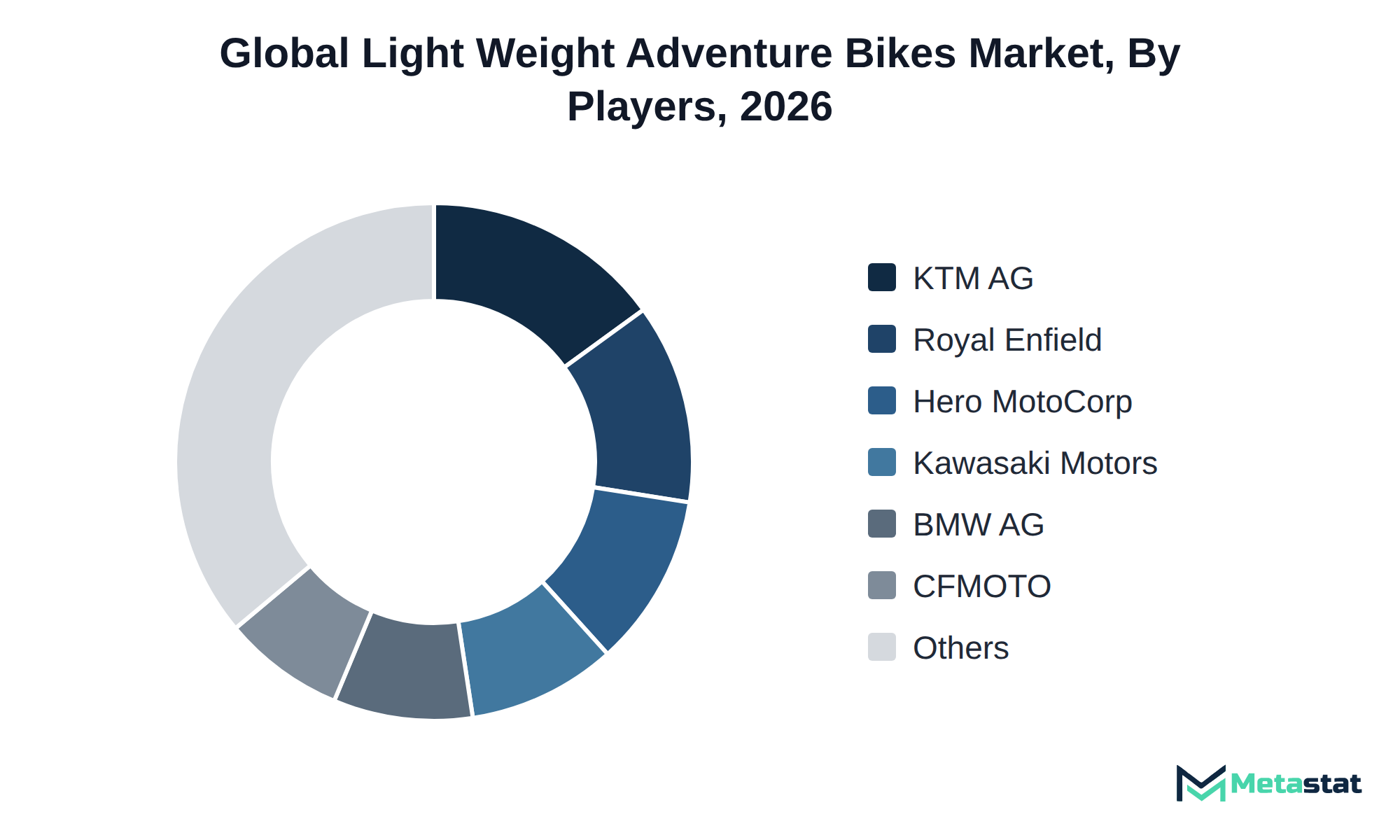
Competition in the Light Weight Adventure Bikes market involves several manufacturers focusing on different categories of motorcycles. Companies differentiate their offerings based on engine displacement, motorcycle category, powertrain configuration, and sales channels, targeting specific customer segments. Buyers often choose based on price, customization options, brand reputation, and after-sales service.
KTM AG emphasizes strong performance and adventure touring motorcycles, appealing to enthusiasts seeking high-quality options. Royal Enfield highlights its heritage and style, crafting motorcycles that align with classic design preferences. Honda Motor Co., Ltd. focuses on a diverse range of powertrain configurations, ensuring broad appeal across various customer segments.
This growth relies on several critical developments in the Light Weight Adventure Bikes market. First, consumer demand for Adventure Touring Motorcycles is expected to increase, driven by preferences for versatile travel options. Second, an expansion in online sales channels will facilitate access and convenience for buyers, with a target value of USD 341.6 million by 2033. However, challenges in supply chain disruptions, particularly in the Asia Pacific region, pose significant risks to achieving the forecasted growth. Such disruptions could delay production and limit market availability, impacting overall revenue potential.
By Engine Displacement: Below 150cc, 150cc-250cc, 251cc-400cc, 401cc-500cc, Above 500cc (Lightweight Models)
By Powertrain Configuration: Single-Cylinder Petrol Motorcycles, Parallel-Twin Petrol Motorcycles, V-Twin Petrol Motorcycles, Other Multi-Cylinder Petrol Motorcycles
By Sales Channel: Authorized Dealerships, Independent Motorcycle Dealers, Online Sales Channels
The report strategically identifies and profiles the key market players and analyses their core competencies in each sub-segment of the Light Weight Adventure Bikes market.
Report Attributes | Details |
Study Period | 2021-2033 |
Base Year | 2025 |
Estimated Year | 2026 |
Forecast Period | 2026-2033 |
Historical Period | 2021-2025 |
Growth Rate | CAGR 8.5% from 2026 to 2033 |
Revenue Unit | USD million |
Segmentation | By Engine Displacement, Motorcycle Category, Powertrain Configuration, Sales Channel, and Region |
By Region | North America (By Engine Displacement, Motorcycle Category, Powertrain Configuration, Sales Channel, and Country)
|
Europe (By Engine Displacement, Motorcycle Category, Powertrain Configuration, Sales Channel, and Country)
| |
Asia Pacific (By Engine Displacement, Motorcycle Category, Powertrain Configuration, Sales Channel, and Country)
| |
South America (By Engine Displacement, Motorcycle Category, Powertrain Configuration, Sales Channel, and Country)
| |
Middle East and Africa (By Engine Displacement, Motorcycle Category, Powertrain Configuration, Sales Channel, and Country)
|
Find answers to common questions about this report
The Light Weight Adventure Bikes market size was valued at USD 2,032 million in 2025.
The market is projected to grow at a CAGR of 8.5% during the forecast period from 2026 to 2033.
The North America Light Weight Adventure Bikes market size is estimated to reach USD 891.3 million by 2033.
The leading segment in the Light Weight Adventure Bikes market is the Adventure Touring Motorcycles category, with a projected value of USD 1,359.4 million by 2033. This segment surpasses others in terms of revenue generation within the market.
Growing participation in outdoor activities significantly influences spending patterns among buyers. Rising demand for lightweight adventure bikes creates substantial opportunities for manufacturers to innovate and capture market share.
Price sensitivity among potential buyers limits market growth, particularly in the adventure touring and dual-sport segments. Higher upfront costs associated with these motorcycles result in slower uptake, especially among budget-conscious consumers.
Factors favoring adoption in the lightweight adventure bikes industry include the growing interest in adventure touring and off-road capabilities among riders seeking enhanced performance and agility. The segment of motorcycles with engine displacement between 401cc and 500cc is projected to grow at a compound annual growth rate of 8.9%, reflecting evolving consumer preferences.
The Light Weight Adventure Bikes market is estimated to reach a valuation of USD 3,904 million by 2033.
Key players operating in the Light Weight Adventure Bikes market include KTM AG, Royal Enfield, Hero MotoCorp, Kawasaki Motors, CFMOTO, Benelli, KOVE, VOGE (LONCIN MOTOR CO., LTD), Rieju S.A., BMW AG, Beta Motor, Fantic Motor, Honda Motor Co., Ltd., Suzuki Motor Corporation, Yamaha Motor Co., Ltd., Triumph Motorcycles Ltd., TVS Motor Company, AJP Motorcycles, SWM Motorcycles, and Aprilia.
The Light Weight Adventure Bikes market is projected to reach a value of USD 3,904 million by 2033.
The analysts below cover Automotive and Transportation research at Metastat Insights.
LEAD ANALYST
Utkarsh Khirodkar is a Lead Market Research Analyst at MetaStat Insight, specializing in market intelligence, technology sector assessments, and competitive strategy.

ENERGY & INFRASTRUCTURE INDUSTRY CONSULTANT
Automotive and Transportation · Electronics and Semiconductor · Energy and Power · Machinery & Equipment
Saurabh Vasant Ganvir consults for Energy & Infrastructure Industry at MetaStat Insight, specializing in renewable energy, solar EPC, and electric vehicle (EV) infrastructure markets.
Scaling antibody-drug conjugate manufacturing hinges on contract manufacturing availability for high-potency active ingredients. The MetaStat Insight analysis looked closely at global cleanroom slot constraints, bioconjugation batch failure rates, and supply chain redundancies between the US, Europe, and India. The supplier capability matrix proved genuinely useful for our team when mapping secondary source options across our clinical pipeline.
Floating offshore wind feasibility relies heavily on specialized installation vessel availability and port crane limits, which most broad renewable energy forecasts ignore. The report delivered a thorough analysis of dry dock capacity, mooring chain supply constraints, and raw material pricing trends for deepwater anchor installations. It served as a solid independent sanity check for our offshore project capital expenditure assumptions.
Assessing commercial microgrid software adoption requires looking past top-level installation numbers and examining utility interconnection queues. The research provided verifiable data on average permitting timelines, tariff structures, and battery storage integration costs across regional utility territories. That grounded perspective was valuable for our team when building five-year demand projections for industrial microgrid controllers.
Explore related market intelligence reports worth reading alongside this one.