
LEAD ANALYST
Utkarsh Khirodkar is a Lead Market Research Analyst at MetaStat Insight, specializing in market intelligence, technology sector assessments, and competitive strategy.

Global Modular Bridges Market Size, Share, By Bridge Configuration (Panel Bridges, Truss Bridges, Beam Bridges, Girder Bridges, Modular Footbridges and Others), By Deployment Type (Temporary Bridges, Semi-Permanent Bridges and Permanent Bridges), By Material (Steel, Concrete, Steel-Concrete Composite, Fibre-Reinforced Polymer (FRP) and Aluminium), By Application (Road and Highway Crossings, Construction Site and Detour Routes, Mining and Industrial Access, Railway Crossings, Military Mobility, Emergency and Disaster Relief and Pedestrian and Cycle Crossings), Industry Analysis, Growth, Trends, and Forecast, 2026-2033
Report ID
MSI-5818
Published
November, 2026
Pages
304 Pages
Format
Historical
Base year
Forecast
Forecast period
Report Details
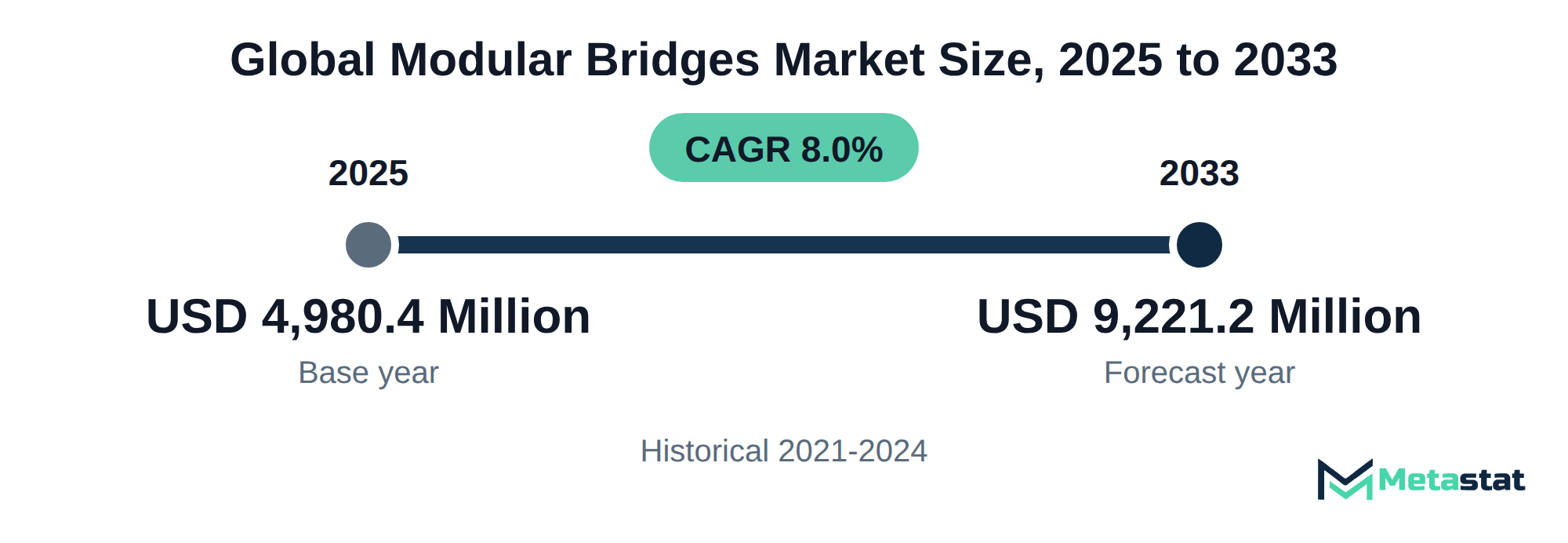
Market Valuation: Valued at $4,980.4 Million in 2025, projected to reach $9,221.2 Million by 2033 at a 8.0% CAGR.
Dominant Segment: Panel Bridges lead the market, driven by advancements in design and materials that enhance structural integrity and longevity.
Geographic Lead: North America is the leading region, capturing 31.9% of the market in 2025, with the US expected to maintain its dominance in 2026 due to significant investments in modular bridge solutions.
What's Inside: The report provides a comprehensive analysis of the Modular Bridges market, including competitive coverage, segment breakdowns by bridge configuration, deployment type, material, and application, along with growth forecasts through 2033.
Emerging Materials: Innovations in materials, particularly Fibre-Reinforced Polymer (FRP), are driving performance enhancements and expanding application flexibility in the Modular Bridges market.
Growing Demand for Temporary Bridges: The temporary bridges segment is experiencing significant growth, fueled by the need for quick and flexible infrastructure solutions, especially in emergency and disaster relief scenarios.
Choose Your License
Global Modular Bridges Market
The global Modular Bridges market was valued at USD 4,980.4 million in 2025 and is projected to reach USD 9,221.2 million by 2033, growing at a CAGR of 8.0% over the forecast period.
The Modular Bridges market encompasses a range of prefabricated structures designed for various applications, providing solutions for temporary, semi-permanent, and permanent installations. Buyers invest in modular bridges to address infrastructure needs efficiently, often responding to urgent requirements for connectivity in construction, disaster relief, and military operations. The flexibility, speed of installation, and cost-effectiveness of these structures drive purchasing decisions.
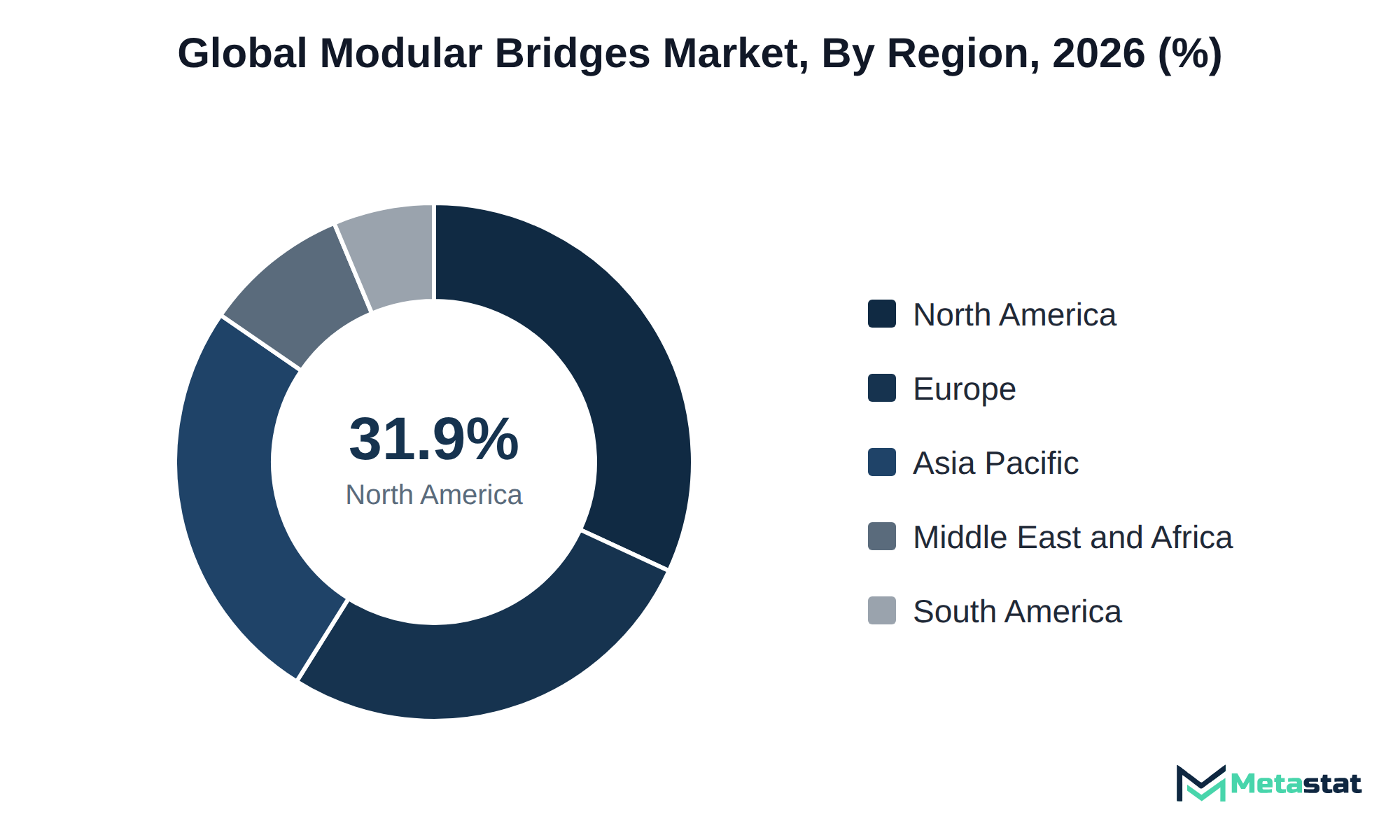
Growth in the market is propelled by increasing demand for infrastructure development, particularly in emerging economies. Among the segments, Panel Bridges represent the highest value, reflecting advancements in design and materials that enhance structural integrity and longevity. North America holds 31.9% of the market in 2025, with the US leading in 2026. Comparatively, Europe and Asia Pacific follow closely, capturing 27% and 25.7% of the market, respectively.
One significant driver for expansion stems from the rising need for rapid deployment of bridges in response to natural disasters and urbanization. Temporary and semi-permanent bridge solutions offer immediate relief and support for transportation networks during critical periods. This trend illustrates the market's role in facilitating efficient infrastructure development, catering to varying project timelines and budgets.
The Modular Bridges market addresses the increasing demand for efficient and flexible infrastructure solutions. Buyers invest due to the advantages modular bridges offer, including rapid installation, cost-effectiveness, and versatility in various applications. The ability to adapt to changing needs, particularly in emergency and temporary setups, drives spending in this sector.
Growth in the market is propelled by infrastructural developments and the rising need for quick deployment options. Among all segments, Temporary Bridges represent the highest value, reflecting their significant role in infrastructure projects across diverse industries. North America holds 31.9% of the market in 2025, with the US leading in 2026, highlighting the region's strong investment in modular bridge solutions.
Technological advancements continue to enhance the capabilities of modular bridges, making them more appealing to buyers. The expansion of the market is particularly evident within North America and Europe, where governments prioritize infrastructure modernization. The potential for increased applications in both urban and rural settings further enhances the market's growth trajectory.
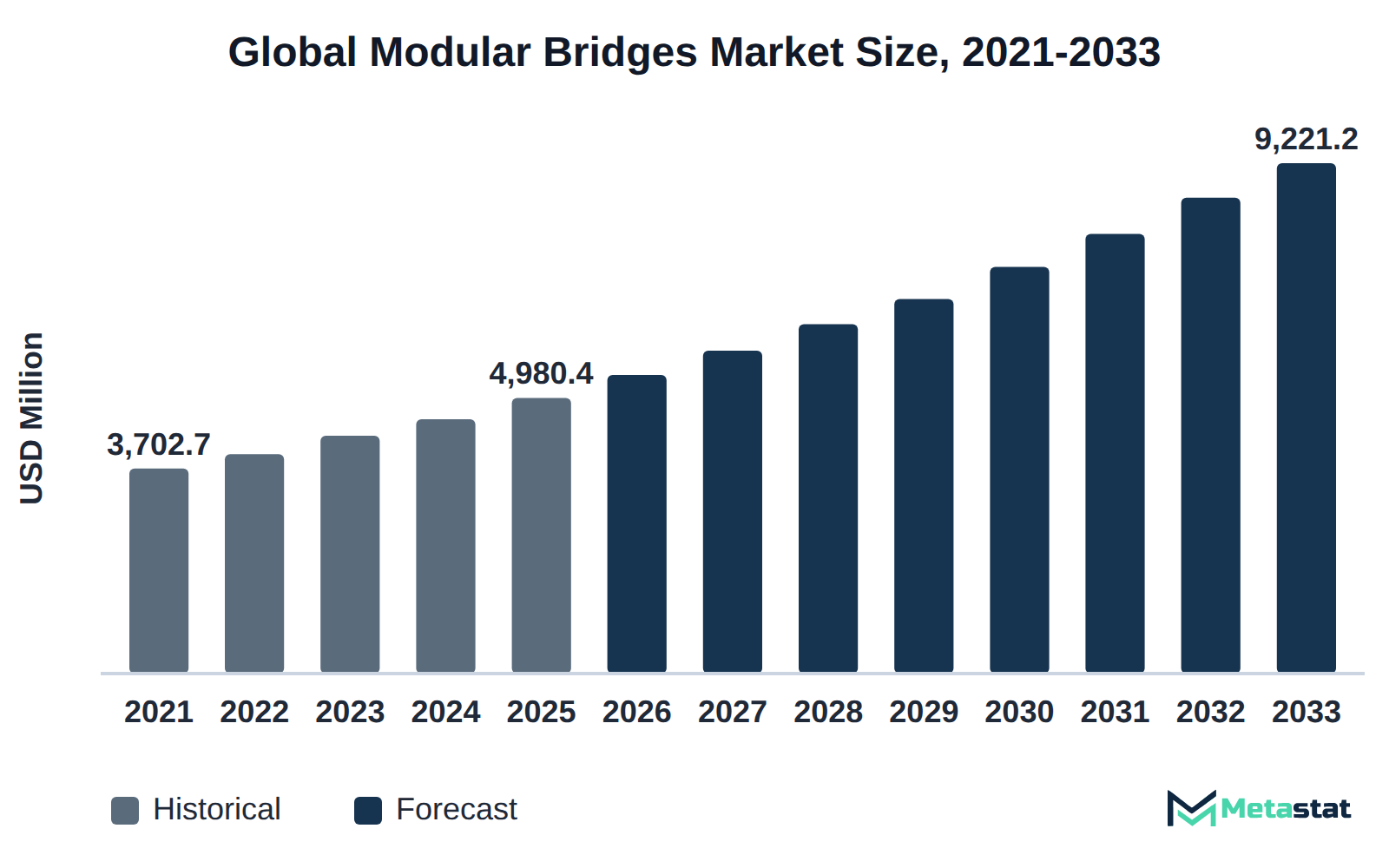
The modular bridges market experiences significant advancements driven by innovations in design technology, particularly in rapid-deployment and prefabricated construction. These innovations enhance the speed and efficiency of bridge installation, reducing project timelines considerably. For instance, temporary bridges, a key segment, are projected to expand from USD 2,255.2 million in 2026 to USD 3,671.9 million by 2033, reflecting a compound annual growth rate of 7.2%. This growth highlights the increasing preference for quick and efficient solutions in infrastructure development.
Technological advancements include the use of lightweight materials and modular components that facilitate easy transport and assembly on-site. The integration of smart technologies, including sensors for real-time structural health monitoring, improves safety and maintenance capabilities. These enhancements appeal to various sectors, including construction, transportation, and disaster relief, where quick access and timely infrastructure deployment are critical.
Rapid, efficient modular solutions position the market well for future infrastructure projects and match rising demand for sustainable, resilient construction. The emphasis on modular construction and prefabrication optimizes costs and supports environmental goals by minimizing on-site waste and reducing construction time.
Material selection is essential in modular bridge manufacturing, with buyers focusing on the long-term performance and cost-effectiveness of steel, concrete, and fibre-reinforced polymer (FRP). The demand for steel in this market is projected to grow from USD 2,580 million in 2026 to USD 4,225.2 million by 2033, driven by its high strength-to-weight ratio and durability. Buyers evaluate these materials based on structural requirements, environmental conditions, and lifecycle costs, ensuring that investments align with project specifications.
Pricing strategies vary significantly among materials, with steel often presenting a competitive initial cost, while concrete offers advantages in thermal properties and longevity. The FRP segment, although smaller, is gaining traction due to its lightweight properties and corrosion resistance. Each material's cost implications influence procurement decisions, with buyers negotiating contracts that reflect both upfront costs and expected maintenance expenses over the lifespan of the bridge. The modular bridges market benefits from these tailored pricing models, allowing buyers to secure optimal solutions for their specific needs.
Modular bridges strengthen infrastructure, particularly in highway and railway applications. The increasing demand for efficient transportation networks drives the adoption of modular bridges, enabling rapid deployment in various scenarios, including disaster relief. For instance, the road and highway crossings segment of the modular bridges market is projected to rise in value from USD 1,516.4 million in 2026 to USD 2,500.8 million by 2033. This represents a compound annual growth rate (CAGR) of 7.4%.
Railway operators and logistics companies actively seek solutions that facilitate quick construction and maintenance. Modular bridges offer an efficient alternative to traditional bridge-building methods, allowing for expedited assembly and disassembly, which is essential during emergencies or when addressing infrastructure failures. The ability to deploy temporary bridges rapidly supports effective transportation, particularly in regions susceptible to natural disasters.
Mining companies increasingly rely on modular bridges to ensure access to remote sites. These applications necessitate durable, versatile, and easily transportable solutions to connect operations while minimizing costs. The market responds to these requirements, with innovations in materials, including steel and fibre-reinforced polymer, enhancing the structural integrity of modular bridges.
Expanding use across highway, railway, mining, and disaster relief infrastructure points to strong potential for the modular bridges market. This trend indicates a strong commercial opportunity for manufacturers and suppliers, who use advances in design and materials to meet the specific demands of diverse sectors.
Modular bridge systems significantly reduce infrastructure construction time and installation costs through efficient design and prefabrication techniques. Panel bridges illustrate this efficiency, with projected market value rising from USD 1,671.6 million in 2026 to USD 2,752.5 million by 2033, a compound annual growth rate (CAGR) of 7.4%. This growth indicates a surge in demand for quick, cost-effective solutions in the Modular Bridges market.
These systems enable faster installation due to their factory-manufactured components, which reduce the need for extensive site work. In many cases, assembly occurs within days rather than months, leading to considerable labor cost savings and minimizing disruption to existing traffic and infrastructure. Municipalities and construction companies achieve greater efficiency and lower overall project budgets.
Through modular bridge solutions, stakeholders in the market experience enhanced project timelines and reduced financial burdens. This preference matches the industry's push for streamlined construction and cost-effective infrastructure solutions.
Increased infrastructure projects in various sectors drive demand for modular bridges. Key buyers include government agencies and private construction firms, focusing on efficient solutions to meet rising needs for connectivity and access. Economic growth and urbanization have prompted these entities to seek out modular options, which provide faster and cost-effective solutions compared to traditional bridge construction methods. Significant investment in infrastructure has escalated the volume of projects employing modular systems, enhancing overall adoption. The Modular Bridges market is projected to reach USD 9,221.2 million by 2033, reflecting an annual growth rate of 8%. This expanding market indicates a strong shift towards modular solutions, driven by the need for rapid deployment in various applications.
Growing demand for temporary and semi-permanent bridges further enhances market potential. Construction sites, mining locations, and disaster relief efforts increasingly employ these systems due to their flexibility and speed of installation.
Innovations in materials significantly enhance performance and application flexibility in the Modular Bridges market. The introduction of advanced composites, including Fibre-Reinforced Polymer (FRP), accelerates the development of lightweight and durable structures, appealing to various infrastructure projects. These materials reduce weight while maintaining strength, addressing challenges in transportation and installation. The increasing emphasis on sustainability drives the adoption of eco-friendly materials, aligning with global trends toward greener construction practices. Suppliers and manufacturers investing in these emerging materials position themselves competitively, enabling them to meet diverse customer needs across sectors including transportation, construction, and emergency response. This focus on material innovation directly contributes to the overall growth of the market, with buyers seeking solutions that enhance longevity and reduce maintenance costs. The integration of these advanced materials is expected to expand the functionality and efficiency of modular bridges in upcoming years.
High costs associated with modular bridges present a significant restraint for buyers, particularly in the construction and infrastructure sectors. Budget constraints among public and private organizations often limit the scope of projects that include these solutions, resulting in slower adoption rates. Buyers delay decisions on purchasing modular bridges due to upfront costs, opting instead for traditional methods that appear more economically feasible despite longer timelines. This restraint leads to smaller orders and hinders the frequency of replacement for aging infrastructure. Heightened price sensitivity among buyers therefore limits how fully the Modular Bridges market can capitalize on its growth opportunities.
Fluctuating input prices present a significant challenge for suppliers in the Modular Bridges market. Rising costs for essential building materials, particularly steel and concrete, impact profit margins and overall profitability. Suppliers face pressure to maintain competitive pricing while managing these increasing expenses, which influences the pricing strategies adopted across the market.
To mitigate the impact of rising costs, suppliers are seeking alternative materials and innovative manufacturing processes. Exploring composite materials or investing in advanced fabrication technologies helps reduce dependence on traditional, more expensive inputs. These strategies improve cost-efficiency and enhance product offerings, allowing suppliers to maintain competitiveness in a price-sensitive market environment. Changing market conditions encourage ongoing research and development, which drives innovation that benefits both manufacturers and end-users.
The sector of temporary bridges presents a significant growth opportunity within the Modular Bridges market. The rise in construction projects requiring quick and flexible infrastructure solutions drives this demand, particularly in emergency and disaster relief applications. Temporary bridges enable timely access to affected areas, enhancing operational efficiency for various industries, including military and disaster response organizations. The increasing reliance on modular solutions in construction and infrastructure projects highlights the strategic importance of this segment, positioning it favorably for suppliers aiming to capture market share. Enhanced design and material innovations in temporary bridges support advancements, facilitating penetration into underserved regions and applications.
The Global Modular Bridges market is segmented based on Bridge Configuration, Deployment Type, Material, and Application.
Panel bridges serve various applications, including road and highway crossings, making them essential for infrastructure projects across sectors. Demand for panel bridges rises due to increasing investments in infrastructure development, particularly in urban areas and transportation networks. The segment's growth trajectory contrasts with other configurations, including Truss Bridges, which exhibit a slightly higher CAGR of 7.7%. Pricing strategies vary within the market; panel bridges typically offer a more cost-effective solution compared to more complex designs. This positioning attracts a diverse buyer base, including government agencies and private contractors focused on efficiency and cost reduction.
Truss Bridges segment is estimated to reach USD 2,178.1 million by 2033, at a CAGR of 7.7% during the forecast period. This segment serves critical applications in various infrastructure projects, particularly in transportation networks and industrial access. Demand for Truss Bridges arises from construction firms and government agencies involved in large-scale projects that require temporary or permanent crossing solutions. A significant driver of this segment involves the increasing need for strong, lightweight structures that provide rapid installation capabilities. Compared to other segments, Truss Bridges typically exhibit a steady growth pattern, supported by structural advantages in load distribution and design versatility. This segment differs from Panel Bridges, which experience higher growth rates due to specific applications in temporary deployments, while Truss Bridges cater to a broader range of permanent and semi-permanent solutions. The combination of structural efficiency and adaptability positions Truss Bridges favorably in the evolving market landscape.
Beam Bridges segment is expected to reach USD 1,385 million by 2033. These structures serve multiple applications, particularly in infrastructure projects requiring straightforward and efficient designs. Civil engineering firms and construction companies commonly use Beam Bridges, aligning with growing demands for effective traffic management and infrastructure resilience. The segment experiences growth driven by increased public and private investment in transportation infrastructure, while urban and rural areas seek to upgrade outdated systems. Compared to other configurations, including Truss Bridges, which exhibit a CAGR of 7.7%, the Beam Bridges segment demonstrates stability in its demand dynamics, appealing to budget-conscious buyers focused on cost-effectiveness and ease of installation. With its established role in road and highway applications, this segment remains a critical element in addressing infrastructure needs while contributing to the overall growth observed in the Modular Bridges market.
Girder Bridges segment is projected to grow at a CAGR of 7.6% during the forecast period. This segment finds application in various infrastructure projects, including roadways and railways, serving contractors and governmental entities seeking reliable and durable solutions for crossing challenges. The demand for Girder Bridges is driven by the increasing need for robust infrastructure that withstands heavy loads and environmental conditions. Compared to other configurations, Girder Bridges typically command a higher price due to their structural integrity and long-term performance. This segment's growth is supported by advancements in material technology, allowing for enhanced design capabilities and construction efficiency. In contrast to Beam and Panel Bridges, which experience different growth rates and price points, Girder Bridges exhibit a steady upward trajectory, reinforcing their importance within the Modular Bridges market.
Modular footbridges serve as essential structures for pedestrian access across various terrains. Commonly used in urban planning, construction sites, and temporary events, these footbridges cater to municipalities and organizations requiring quick and safe passage options. Demand for modular footbridges is influenced by the growing focus on sustainable infrastructure and the increasing need for emergency relief solutions. Unlike other bridge configurations, footbridges feature lower costs and faster installation times, making them suitable for projects with limited timelines. This segment's appeal lies not only in its practical applications but in its versatility, capturing interest from diverse buyers seeking efficient and effective solutions. The market for modular bridges benefits from these innovations, enhancing the overall functionality and accessibility of infrastructure projects.
Others, including Arch and Suspension Bridge Configurations, provide unique design solutions for specific infrastructure needs. This segment caters to a variety of applications, particularly where aesthetics and load-bearing capabilities are essential, including pedestrian crossings and urban environments. Demand for these configurations is influenced by urban development projects that prioritize innovative and visually appealing structures. Compared to other segments, this area faces slower growth due to higher production costs and specialized design requirements. The focus on sustainable and visually integrated infrastructure in urban settings drives interest, differentiating it from more utilitarian segments like Beam and Panel Bridges, which prioritize functionality over design. The Modular Bridges market benefits from advancements in materials and engineering techniques, enhancing the appeal of these distinctive configurations.
Temporary bridges primarily serve construction sites, detour routes, and emergency applications, providing quick access in areas lacking permanent structures. The growing demand for fast deployment solutions in response to natural disasters and infrastructure repair projects drives this segment. Compared to Semi-Permanent and Permanent Bridges, which have higher price points and longer installation times, Temporary Bridges cater to several customers requiring expedited solutions. The unique positioning of this segment aligns with the needs of contractors and emergency services, enhancing its growth potential in the overall market.
Semi-Permanent Bridges segment is estimated to reach USD 2,665.9 million by 2033, at a CAGR of 8.6% during the forecast period. These structures serve critical functions in infrastructure projects, particularly where long-term temporary solutions are required, including in construction sites or during natural disaster recovery efforts. Demand for semi-permanent bridges aligns with increasing investments in infrastructure development and maintenance, particularly in regions focused on enhancing connectivity and mobility. This segment demonstrates stronger growth compared to other deployment types, reflecting a shift in buyer preferences toward adaptable and efficient solutions. The semi-permanent bridges segment stands out with its emphasis on rapid deployment and cost efficiency, appealing to contractors and government agencies seeking reliable yet flexible options in their infrastructure projects. Market trends indicate rising demand for such innovative bridge solutions, which cater to various applications across several sectors.
The Permanent Bridges segment is expected to reach USD 2,883.5 million by 2033. These structures primarily serve long-term applications, providing reliable solutions for a variety of transportation needs, including roadways and access points for industrial or commercial areas. Key drivers for this segment include increasing demand for durable, robust infrastructure driven by urban population growth and expanding economic activities. The Permanent Bridges segment exhibits a growth trajectory distinct from Temporary and Semi-Permanent Bridges, characterized by a lower price point and longer lifespan. This segment experiences a CAGR of 8.6%, reflecting a solid market position due to its strategic importance in construction projects. The versatility and lasting nature of Permanent Bridges set them apart, ensuring consistent investment from public and private sectors in the Modular Bridges market.
This material finds extensive application in various sectors, including road and highway crossings, where structural integrity and durability are essential. Demand for steel bridges arises from infrastructure development and public sector projects, with a notable focus on construction and transport networks. The continuous push for sustainable practices drives innovation in green steel production, enhancing its appeal over alternative materials. Compared to other segments, including concrete, the steel segment exhibits a strong growth trajectory, supported by its favorable cost-to-performance ratio and adaptability to various design configurations. While the concrete segment projects a CAGR of 7.7%, steel's unique properties promote its increasing use in modular bridge solutions. The Modular Bridges market is expected to experience substantial expansion, driven by these underlying trends.
The Concrete segment is estimated to reach USD 2,112.6 million by 2033, at a CAGR of 7.7% during the forecast period. This segment primarily serves the construction and infrastructure sectors, providing durable solutions for various bridge applications. Demand for concrete bridges stems from ongoing infrastructure development projects and the growing emphasis on sustainability. Compared to other material segments, the Concrete segment experiences a moderate growth rate. The Steel segment is projected to grow at a slightly higher CAGR of 7.3%. However, the pricing for concrete materials tends to be lower than that of steel, appealing to budget-conscious buyers. This segment addresses the requirements of various users, including government agencies and private contractors, ensuring the market maintains a competitive edge in modular bridge solutions.
Steel-Concrete Composite segment is expected to reach USD 1,487.4 million by 2033. This material combines the strength of steel with the durability of concrete, creating structures that are both robust and efficient. Common applications include temporary and permanent bridges serving construction sites, connecting roadways, and facilitating industrial access. Demand for this segment is driven by the increasing focus on sustainable construction practices and the need for resilience against natural disasters. Compared to other segments including Steel and Concrete, Steel-Concrete Composite offers a competitive advantage due to its favorable weight-to-strength ratio, leading to lower transportation costs. The segment experiences a CAGR of 7.3%, reflecting a steady growth trajectory while industries seek innovative solutions to meet infrastructure demands, contributing positively to the overall Modular Bridges market.
Fibre-Reinforced Polymer (FRP) segment is projected to grow at a CAGR of 9.4% during the forecast period. This segment finds application in various projects, primarily for constructing lightweight and durable bridges that require minimal maintenance. Industries including construction and infrastructure development frequently adopt FRP bridges due to their resistance to corrosion, leading to longer service life and reduced lifecycle costs. The strong growth in this segment is driven by increasing demand for sustainable and high-performance materials in the construction sector. Compared to other materials, FRP stands out with a higher growth trajectory, positioning it as a preferred option for innovative bridge solutions. In 2033, the FRP segment is expected to contribute significantly to the overall revenue of the market, reflecting evolving preferences of buyers toward advanced materials.
Aluminium is a lightweight material used in various bridge applications, offering unique advantages including corrosion resistance and ease of installation. This material finds its primary use by construction firms focused on creating efficient, portable, and durable structures. The demand for aluminium in the Modular Bridges market thrives on its favorable properties, making it an attractive option for temporary and semi-permanent structures. An increasing emphasis on sustainability and environmental considerations drives a preference for aluminium over heavier materials like steel. Compared to other materials in the market, aluminium often presents a higher upfront cost, but long-term savings on maintenance and transportation offset this initial investment. This segment distinguishes itself through its specific applications and benefits, appealing to buyers seeking innovative solutions that prioritize efficiency and longevity.
This segment primarily addresses the transportation infrastructure needs of urban planners, civil engineers, and governmental agencies focused on enhancing public road networks. Increasing road traffic and the urgent requirement for efficient connectivity drive demand for this segment. The relatively slower growth of Road and Highway Crossings compared to other applications stems from the established nature of existing infrastructure, which limits rapid expansions. In contrast, segments including Construction Site and Detour Routes exhibit faster growth due to heightened construction activities and temporary needs. While the market continues to evolve, investment in advanced modular solutions for road and highway crossings remains critical for meeting future transportation demands.
Construction Site and Detour Routes segment is estimated to reach USD 1,920.8 million by 2033, at a CAGR of 7.6% during the forecast period. This segment serves vital functions in facilitating traffic flow and ensuring safety during construction activities, often employed by construction companies and municipal agencies. Increased infrastructure development drives demand for these structures, particularly in urban areas with dense populations. Compared to other applications, including Road and Highway Crossings, this segment exhibits a unique growth trajectory, emphasizing rapid deployment in dynamic environments. The need for temporary solutions during construction projects reinforces its importance, positioning it distinctly within the modular bridges market. Overall, the growth of the Construction Site and Detour Routes segment reflects broader trends in infrastructure investment and urban planning, highlighting the segment's critical role in contemporary construction practices.
The Mining and Industrial Access segment is expected to reach USD 1,397.9 million by 2033. This segment serves critical functions for industries including mining, construction, and heavy manufacturing, providing essential access to remote locations and operational areas. Growth in this segment is primarily driven by rising demand for efficient transport solutions in resource-rich regions. Higher investment in infrastructure projects across various industries encourages adoption. Compared to other segments, Mining and Industrial Access experiences slower growth at a CAGR of 7.6%, influenced by the specific needs and challenges of industrial applications. Other segments, including Road and Highway Crossings, exhibit faster expansion, reflecting broader infrastructure development trends. Strengthening the market for modular bridges, this segment fulfills the demand for durable and adaptable solutions tailored to unique industrial requirements.
Railway Crossings segment is projected to grow at a CAGR of 8.6% during the forecast period. This segment enables the safe passage of trains over roadways, often implemented in urban areas where rail lines intersect with road traffic. Primary customers include government agencies and transportation authorities responsible for infrastructure development and maintenance. Increasing investments in rail transportation infrastructure and urban transit systems drive demand for modular solutions. Compared to Road and Highway Crossings, which generate revenues of USD 2,500.8 million by 2033, the Railway Crossings segment is smaller but exhibits higher growth potential, reflecting ongoing modernization of transport networks. The market emphasizes the increasing focus on safety and efficiency in transport infrastructure, promoting further investment in modular bridge solutions.
Military Mobility focuses on the design and construction of bridges that serve as portable military equipment for armed forces during operations. These structures facilitate the movement of heavy equipment and personnel across varied terrains, ensuring strategic mobility in military campaigns. Demand for this segment is driven by increasing investment in defense infrastructure globally, particularly in regions with evolving military needs. Compared to other applications in the market, Military Mobility experiences slower growth due to reliance on government contracts and procurement processes, which often involve longer timelines. This segment requires a distinct approach, emphasizing durability and rapid deployment, setting it apart from others including Road and Highway Crossings that cater primarily to civilian needs. Military forces prioritize efficiency and adaptability in design, making this segment critical for operational readiness.
Emergency and Disaster Relief focuses on providing immediate infrastructure solutions during critical situations, catering to various entities, including government agencies, humanitarian organizations, and military units. This sub-segment ensures accessibility in disaster-stricken areas, enabling rapid emergency response. The increasing frequency of natural disasters and emergencies globally drives demand for efficient and quickly deployable bridge solutions. Compared to other application segments, this area differs in urgency and adaptability, often requiring temporary solutions that are installed swiftly to address immediate needs. The necessity for these structures leads to a distinct customer base that prioritizes speed and efficiency over long-term durability, differentiating it from the more permanent applications in the market.
Pedestrian and Cycle Crossings represent vital infrastructure to facilitate safe and efficient movement for non-motorized users. Local governments and urban planners frequently employ these structures to enhance connectivity in urban environments, particularly in areas with high foot traffic. Growing urbanization and an increasing emphasis on sustainable transportation options drive demand for this segment. Urban areas prioritize pedestrian safety, resulting in an uptick in projects that include dedicated crossings. This segment responds to specific needs associated with urban development, differentiating it from other applications. Road and Highway Crossings and Railway Crossings segments target motorized traffic, whereas Pedestrian and Cycle Crossings focus on non-motorized transport users. The modular nature of these crossings allows for rapid deployment and adaptability, aligning with evolving urban landscapes. This adaptability enhances their appeal in the Modular Bridges market.
Based on geography, the Global Modular Bridges market is divided into North America, Europe, Asia-Pacific, South America, Middle East, and Africa.
Demand for modular bridges in North America largely stems from the need for rapid infrastructure solutions in various sectors. The region benefits from a strong construction industry that includes significant investments in road and highway projects, along with emergency and disaster response initiatives. The United States, Canada, and Mexico are significant contributors to this market, with demand driven by both public and private entities seeking efficient building methods. North America is projected to reach USD 2,713.8 million by the end of 2033. The market's strength reflects an increasing emphasis on temporary and semi-permanent structures, which support quick deployment in critical applications. With a regional market share of 31.9% in 2025, this area presents substantial opportunities for growth in the modular bridges market.
Germany, France, the UK, Italy, Spain, and Russia drive demand within the Modular Bridges market due to significant infrastructure projects and stringent regulations focusing on sustainability. Increased investments in transportation networks and the need for efficient connectivity accelerate growth in the region. Urbanization trends and a rising emphasis on temporary and semi-permanent infrastructure solutions further influence market dynamics. The market in Europe, holding a share of 27.00% in 2025, reflects strong interest from key industries, including construction and transportation. Government initiatives aimed at enhancing road and rail networks support demand for innovative bridge solutions, creating a competitive environment among suppliers.
Asia-Pacific holds a market share of 25.7% in 2025. Rapid urbanization and infrastructure development in countries including China, India, and Southeast Asia drive demand for modular solutions. Government initiatives focusing on enhancing transportation networks prioritize the deployment of these structures, leading to increased investments. The ongoing expansion of road infrastructure in India and major projects in China contribute to this trend, highlighting the region's commitment to modernizing its transport systems. The rising need for efficient and cost-effective bridge solutions in Australia and South Korea supports growth in the market. The integration of advanced materials, including Fibre-Reinforced Polymer, presents unique opportunities for innovation, further enhancing the appeal of modular bridges across various applications.
South America accounts for a market share of 6.3% in 2025, driven by ongoing infrastructure projects aimed at improving transportation networks. Significant investment in construction activities, particularly in Brazil and Argentina, fuels demand for modular bridges. The focus on cost-effective and efficient solutions in the region aligns with the increasing need for adaptable infrastructure. Temporary bridges serve critical roles in construction and emergency scenarios, enhancing connectivity while minimizing disruption. The modular bridges market benefits from increasing collaboration between public and private sectors, facilitating rapid deployment. This collaboration supports the development of essential infrastructure across various applications, including road and highway crossings, and contributes to market expansion.
In the Middle East and Africa, the modular bridges market experiences demand driven by urgent infrastructure needs, particularly in Saudi Arabia and the UAE. These countries invest heavily in transportation and construction projects, leading to increased adoption of modular bridge solutions. South Africa shows interest in modular bridges for both urban development and industrial applications. The region's share of the global market reached 9.1% in 2025, reflecting a growing recognition of the benefits of modular solutions, which offer rapid deployment and cost efficiency. Demand for these structures stems from the need for reliable and temporary transportation routes in challenging environments, enhancing regional connectivity and development efforts. The market in this region is expected to expand with rising investments in infrastructure projects.
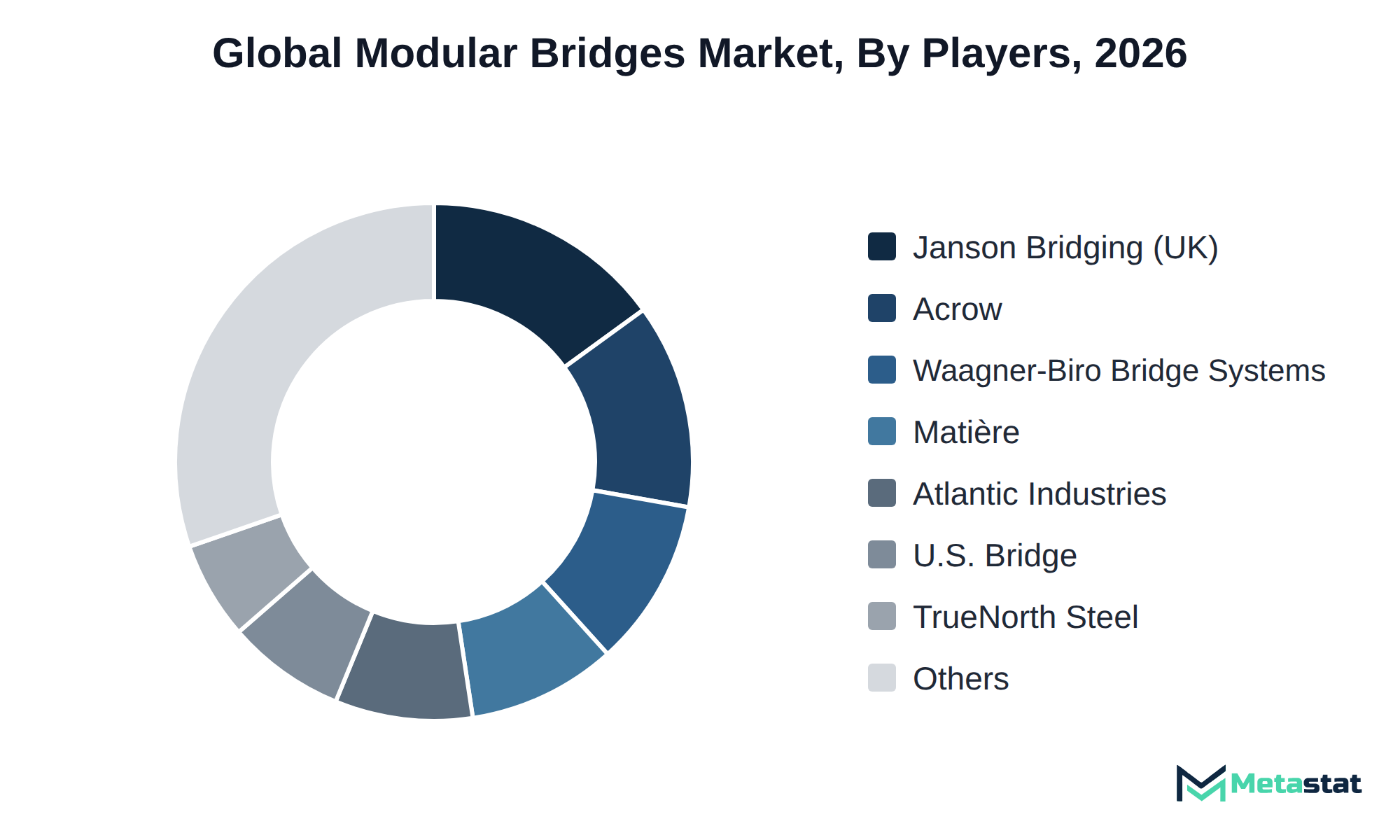
Competition within the Modular Bridges market involves a range of companies focusing on various aspects tailored to market demands. Buyers select providers based on key factors including price, certification, customization, and the ability to integrate solutions within existing ecosystems. Companies like Janson Bridging (UK) Ltd emphasize quality and innovation in their offerings, while Acrow promotes its extensive portfolio of modular bridge solutions.
Waagner-Biro Bridge Systems specializes in advanced engineering and design capabilities, appealing to clients seeking customized solutions. U.S. Bridge prioritizes rapid deployment and ease of installation, attracting buyers with time-sensitive projects. By differentiating their approaches, these companies enhance competitiveness in the growing market.
Several key developments underpin the anticipated growth of the Modular Bridges market. First, the increasing demand for temporary bridges, driven by infrastructure projects and emergency scenarios, will significantly contribute to the market expansion. Second, advancements in materials, particularly steel and steel-concrete composites, are expected to enhance the durability and cost-effectiveness of modular bridges, thereby attracting a wider customer base. Third, geographic expansion in regions like North America, which holds a significant market share, will be crucial; projections indicate that by 2033, this region could account for USD 2,713.8 million. However, economic fluctuations pose a potential risk, which could impact funding for infrastructure projects and slow growth in the market.
By Bridge Configuration: Panel Bridges, Truss Bridges, Beam Bridges, Girder Bridges, Modular Footbridges, Others (Arch and Suspension Bridge Configurations)
By Deployment Type: Temporary Bridges, Semi-Permanent Bridges, Permanent Bridges
By Material: Steel, Concrete, Steel-Concrete Composite, Fibre-Reinforced Polymer (FRP), Aluminium
By Application: Road and Highway Crossings, Construction Site and Detour Routes, Mining and Industrial Access, Railway Crossings, Military Mobility, Emergency and Disaster Relief, Pedestrian and Cycle Crossings
The report strategically identifies and profiles the key market players and analyses their core competencies in each sub-segment of the Modular Bridges market.
Report Attributes | Details |
Study Period | 2021-2033 |
Base Year | 2025 |
Estimated Year | 2026 |
Forecast Period | 2026-2033 |
Historical Period | 2021-2025 |
Growth Rate | CAGR 8.0% from 2026 to 2033 |
Revenue Unit | USD million |
Segmentation | By Bridge Configuration, Deployment Type, Material, Application, and Region |
By Region | North America (By Bridge Configuration, Deployment Type, Material, Application, and Country)
|
Europe (By Bridge Configuration, Deployment Type, Material, Application, and Country)
| |
Asia Pacific (By Bridge Configuration, Deployment Type, Material, Application, and Country)
| |
South America (By Bridge Configuration, Deployment Type, Material, Application, and Country)
| |
Middle East and Africa (By Bridge Configuration, Deployment Type, Material, Application, and Country)
|
Find answers to common questions about this report
The Modular Bridges market size was valued at USD 4,980.4 million in 2025.
The market is projected to grow at a CAGR of 8.0% during the forecast period from 2026 to 2033.
The North America Modular Bridges market size is estimated to reach USD 2,713.8 million by 2033.
Panel Bridges lead the Modular Bridges market with a projected value of USD 2,752.5 million by 2033, reflecting the highest growth among the bridge configuration segments.
Increased infrastructure projects across various sectors drive demand for modular bridges. Economic growth and urbanization prompt government agencies and private construction firms to seek efficient solutions for connectivity and access.
North America holds the dominant share of the Modular Bridges market, with a projected value of USD 2,713.8 million in 2033, representing 31.9 percent of the total market. This figure surpasses the shares of other regions, highlighting North America's leading position.
High costs associated with modular bridges present a significant restraint, limiting project scopes for buyers due to budget constraints. Fluctuating input prices for essential materials, particularly steel and concrete, challenge suppliers by impacting profit margins and overall profitability.
Several factors favor adoption in the Modular Bridges industry. Increased infrastructure projects drive demand for efficient solutions, particularly among government agencies and private construction firms. The rising emphasis on sustainability and the introduction of innovative materials enhance the appeal of modular bridges, supporting their integration into various applications.
The Modular Bridges market is estimated to reach a valuation of USD 9,221.2 million by 2033.
Key players operating in the Modular Bridges market include Janson Bridging (UK) Ltd, Acrow, Waagner-Biro Bridge Systems, Matière, Atlantic Industries Limited, U.S. Bridge, TrueNorth Steel, and Mabey Bridge.
The analysts below cover Automotive and Transportation research at Metastat Insights.
LEAD ANALYST
Utkarsh Khirodkar is a Lead Market Research Analyst at MetaStat Insight, specializing in market intelligence, technology sector assessments, and competitive strategy.

ENERGY & INFRASTRUCTURE INDUSTRY CONSULTANT
Automotive and Transportation · Electronics and Semiconductor · Energy and Power · Machinery & Equipment
Saurabh Vasant Ganvir consults for Energy & Infrastructure Industry at MetaStat Insight, specializing in renewable energy, solar EPC, and electric vehicle (EV) infrastructure markets.
When planning edge sensor rollouts across refinery environments, generic IoT reports typically miss the harsh-environment certification bottlenecks. MetaStat Insight gave an objective evaluation of ATEX and Class 1 Division 2 hardware availability, along with realistic five-year maintenance cycle cost projections. The comparison of wireless mesh versus private cellular backhaul helped our team pressure-test network reliability models for remote processing facilities.
In the biological seed treatment space, registration timelines vary drastically between the European Union, Brazil, and North America. The MetaStat Insight research handled these cross-border regulatory barriers with genuine nuance, mapping commercialization pathways alongside historical field adoption rates. The segmentation between microbial strains and biochemical active ingredients was particularly well structured.
Our team was tracking whether regional recycling infrastructure could realistically absorb the growing volume of lithium iron phosphate batteries over the next decade. The report did a solid job separating announced hydrometallurgical plant capacity from active, permitted operational throughput. That distinction made the feedstock availability projections and regional recovery rate models far more credible than standard commercial overviews.
Explore related market intelligence reports worth reading alongside this one.
Starting from
$2950
Starting from
$2950
Starting from
$2950