
LEAD ANALYST
Utkarsh Khirodkar is a Lead Market Research Analyst at MetaStat Insight, specializing in market intelligence, technology sector assessments, and competitive strategy.

Global Electromechanical Devices Market Size, Share, By Type (Relays, Solenoids, Contactors, Switches, Circuit Breakers, Actuators, Electromechanical Sensors, Motors, Encoders, and Others), By Voltage Range (Low Voltage, Medium Voltage, and High Voltage), By Sales Channel (Direct Sales, Distributors, Dealers, System Integrators, OEM Sales, and Online Sales), By End-Users (Industrial Manufacturing, Automotive, Transportation, Aerospace, Defense, Energy, Utilities, Building Automation, Consumer Electronics, Healthcare, Telecommunications, and Others), Industry Analysis, Growth, Trends, and Forecast, 2026-2033
Report ID
MSI-4738
Published
May, 2026
Pages
315 Pages
Format
Report Details
Choose Your License
Electromechanical Devices Market
Global Electromechanical Devices market size is valued at USD 591.6 billion in 2025 and projected to grow at a CAGR of 6.1% during the forecast period, reaching USD 949.6 billion by 2033.
North America holds 27.3% in 2025 with US leading the market share in 2025.
Relays segment account for a market share of 13.3% in 2025.
Key trends driving growth: Increasing industrial automation and adoption of smart manufacturing systems are propelling demand for electromechanical devices, along with rising integration of advanced electronics in automotive and consumer appliances is accelerating device deployment across sectors.
Opportunities include expansion of robotics, IoT-enabled systems, and precision engineering applications is creating strong growth opportunities for advanced electromechanical devices.
Key insight: The Global Electromechanical Devices market is gaining momentum owing to industrial modernization, automation demand, product reliability requirements, and expanding electrified infrastructure.
The Global Electromechanical Devices Market continues to play a vital role across modern industries, as these components convert electrical signals into mechanical motion and support switching, actuation, sensing, and motion control functions. These devices remain essential across factory equipment, transportation systems, household appliances, healthcare devices, and energy management systems. Adoption is supported by industries seeking durable products with reliable lifecycle performance.
Over the coming years, design priorities will shift toward compact systems, lower energy consumption, longer operating life, and predictive maintenance compatibility. The Global Electromechanical Devices Market will benefit from stronger integration with sensors, controllers, and connected platforms that improve operational visibility while reducing downtime across industrial environments.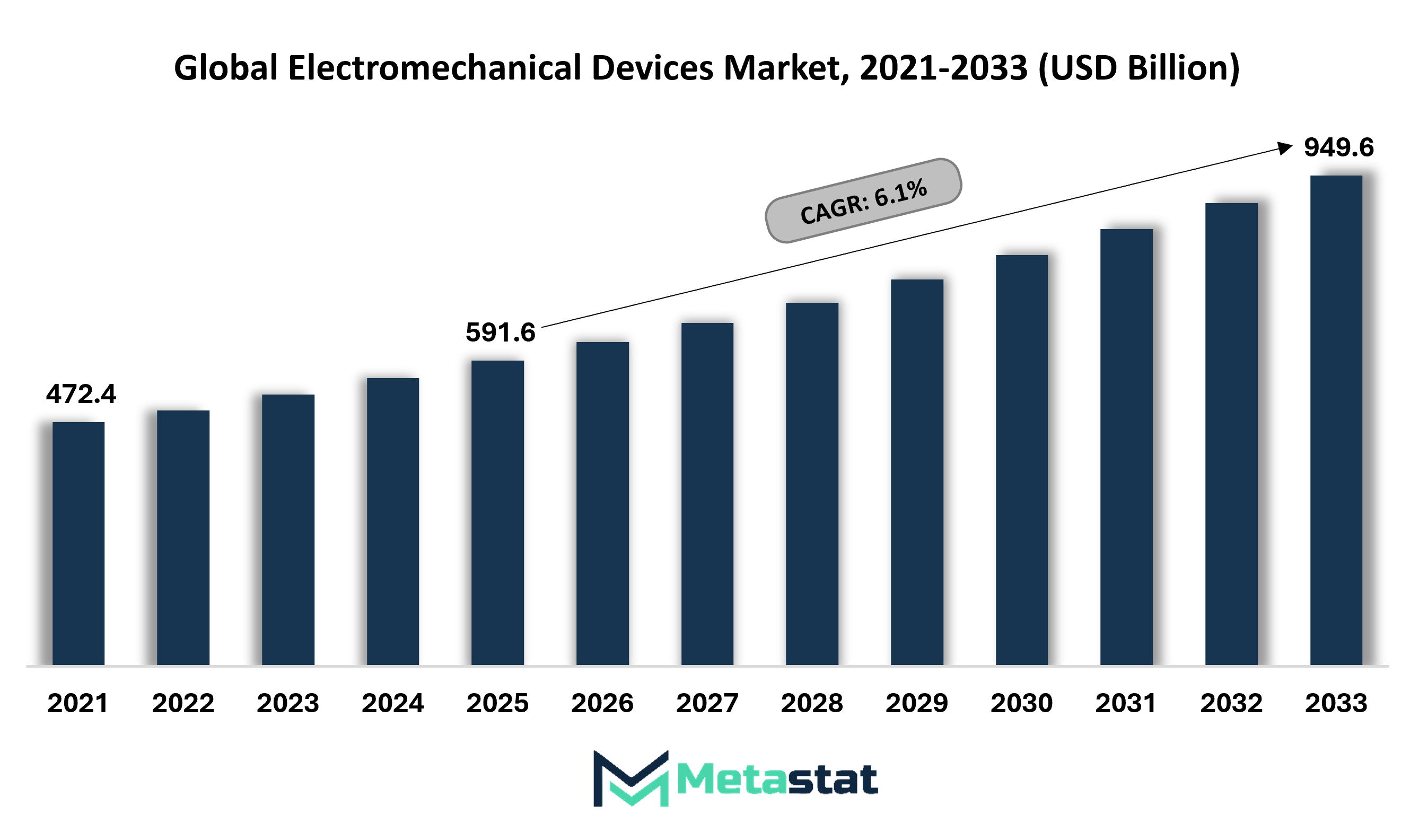
Increasing industrial automation and adoption of smart manufacturing systems are propelling demand for electromechanical devices.
Factory modernization, sensor-guided production lines, automated material handling, and connected control systems are driving equipment upgrades across manufacturing hubs. Requirement for motion control devices, relays, switches, and actuators will increase as manufacturers prioritize accuracy, uptime, energy savings, and continuous production efficiency under smart factory expansion plans.
Rising integration of advanced electronics in automotive and consumer appliances is accelerating device deployment across sectors.
Electric vehicles, driver-assistance systems, smart kitchen appliances, climate-control equipment, and connected home products require reliable switching, positioning, and control functions. Strong product innovation is supporting wider adoption of compact electromechanical components designed for safety, silent operation, lower energy use, and improved user convenience.
High design complexity and integration challenges are increasing development costs and limiting rapid adoption.
Multi-function product architecture, miniaturized layouts, thermal management needs, and compatibility requirements create longer engineering cycles. Additional testing, redesign work, and certification processes increase costs for manufacturers. Smaller companies face higher entry barriers, while deployment schedules slow under demanding integration standards across industries.
Susceptibility to mechanical wear and failure is impacting long-term reliability and maintenance requirements.
Repeated motion cycles, vibration exposure, dust contact, heat stress, and load variation can reduce the service life of moving assemblies. Frequent inspections, part replacement programs, and preventive maintenance planning increase ownership costs. Buyers prefer durable designs with predictive monitoring capabilities and stronger material quality.
Expansion of robotics, IoT-enabled systems, and precision engineering applications is creating strong growth opportunities for advanced electromechanical devices.
Collaborative robots, smart logistics networks, medical devices, semiconductor tools, and aerospace systems require high-response control hardware. Market expansion supports premium demand for miniature actuators, precision motors, intelligent relays, and connected assemblies that deliver data feedback, repeatable motion, and superior operational accuracy.
Market Segmentation Analysis
The Global Electromechanical Devices Market is classified based on type, voltage range, sales channel, end-users, and region.
Relays segment is valued at USD 83.3 billion in 2026 and is projected to reach USD 101.6 billion by 2033, at a CAGR of 2.9% during the forecast period.
Relay demand will rise with smart factories, grid controls, rail signaling, and safety systems. Compact relay designs, faster switching response, lower heat generation, and longer operating cycles will support adoption. Industrial automation applications across emerging economies will create sustained volume growth.
Solenoids segment is valued at USD 45.4 billion in 2026 and is projected to reach USD 64.9 billion by 2033, at a CAGR of 5.2% during the forecast period.
Solenoid usage will expand across fluid control, locking systems, vending equipment, medical tools, and automotive assemblies. Energy-efficient coil systems, quieter operation, and miniaturized formats will attract manufacturers. Automated dispensing and precision handling equipment will strengthen future revenue channels.
Contactors segment is valued at USD 53.2 billion in 2026 and is projected to reach USD 85.4 billion by 2033, at a CAGR of 7.0% during the forecast period.
Contactor opportunities will improve through motor control centers, HVAC installations, renewable energy plants, and industrial protection panels. Higher endurance ratings, arc suppression upgrades, and remote monitoring capabilities will influence purchase decisions. Infrastructure modernization projects will encourage large-scale procurement across industrial facilities.
Switches segment is valued at USD 76.4 billion in 2026 and is projected to reach USD 110.5 billion by 2033, at a CAGR of 5.4% during the forecast period.
Switch demand will continue through appliances, vehicles, machinery consoles, communication racks, and safety devices. Tactile feedback, dust resistance, compact footprints, and durable materials will shape purchasing decisions. Rising electronics production in Asia-Pacific will support broad demand expansion.
Circuit Breakers segment is valued at USD 65.3 billion in 2026 and is projected to reach USD 98.2 billion by 2033, at a CAGR of 6% during the forecast period.
Circuit breaker momentum will increase with power distribution upgrades, electric mobility charging networks, and residential safety standards. Faster fault interruption, digital diagnostics, and modular installation formats will attract utilities. Urban construction activity will generate strong replacement and new-build sales.
Actuators segment is valued at USD 72.8 billion in 2026 and is projected to reach USD 121.1 billion by 2033, at a CAGR of 7.5% during the forecast period.
Actuator demand will accelerate across robotics, packaging lines, smart buildings, and valve automation. Precision motion control, lower maintenance needs, and connected tracking features will improve adoption. Manufacturing facilities pursuing productivity gains will create long-term demand opportunities.
Electromechanical Sensors segment is valued at USD 62.4 billion in 2026 and is projected to reach USD 98.6 billion by 2033, at a CAGR of 6.7% during the forecast period.
Electromechanical sensor expansion will emerge from motion detection, pressure sensing, position monitoring, and machine protection systems. Greater accuracy, rugged casing designs, and rapid signal response will support adoption. Intelligent manufacturing environments will widen installation across multiple industries.
Motors segment is valued at USD 105 billion in 2026 and is projected to reach USD 173.2 billion by 2033, at a CAGR of 7.4% during the forecast period.
Motor sales will strengthen through conveyor systems, pumps, cooling devices, electric vehicles, and household equipment. Higher efficiency standards, reduced vibration, and smart control compatibility will influence buying patterns. Clean energy goals will promote premium motor replacement cycles.
Encoders segment is valued at USD 37.3 billion in 2026 and is projected to reach USD 61.1 billion by 2033, at a CAGR of 7.3% during the forecast period.
Encoder requirements will grow across CNC machines, elevators, robotics, printing devices, and semiconductor equipment. High-resolution feedback, strong signal output, and compact integration will drive preference. Precision manufacturing expansion will sustain future shipment volumes across regions.
Others segment is valued at USD 25.8 billion in 2026 and is projected to reach USD 35.1 billion by 2033, at a CAGR of 4.5% during the forecast period.
Additional categories will include timers, buzzers, connectors, latches, and specialty assemblies serving niche applications. Customized engineering, faster lead times, and rugged operating capability will attract buyers. Diverse end-use demand will keep smaller segments commercially relevant.
Low Voltage segment is projected to reach USD 486.7 billion by 2033, at a CAGR of 5.5% during the forecast period.
The low-voltage segment will lead through consumer products, workplace infrastructure, smart homes, telecom cabinets, and light industrial systems. Safety compliance, easy installation, and reasonable ownership costs will sustain strong preference. Rapid urban electrification will support continuing demand.
Medium Voltage segment is projected to reach USD 321.1 billion by 2033, at a CAGR of 7% during the forecast period.
Medium-voltage demand will rise across factories, commercial complexes, renewable integration points, and regional substations. Reliable switching performance, insulation strength, and digital supervision capabilities will gain importance. Expanding industrial corridors will create notable procurement opportunities.
High Voltage segment is projected to reach USD 141.7 billion by 2033, at a CAGR of 6.3% during the forecast period.
The high-voltage segment will progress with transmission expansion, utility modernization, mining operations, and heavy equipment industries. Strong fault tolerance, advanced insulation materials, and remote asset monitoring will guide investment. Grid resilience programs will support premium system sales.
Direct Sales segment is projected to reach USD 267.2 billion by 2033.
Direct sales channels will remain essential for large contracts requiring engineering support, customized specifications, and long-term service agreements. Strong manufacturer-buyer coordination will improve project execution speed. Industrial megaproject pipelines will keep direct engagement commercially attractive.
Distributors and Dealers segment is projected to reach USD 214.2 billion by 2033.
Distributors and dealers will expand reach through local inventory, technical guidance, quick delivery, and aftermarket support. Regional networks will help smaller buyers secure reliable supply. Growing maintenance spending will strengthen channel relevance across developing markets.
System Integrators segment is projected to reach USD 151.2 billion by 2033.
System integrators will gain share through turnkey automation lines, control panel assembly, and smart facility deployment. Multi-brand compatibility expertise and installation capabilities will create value. Industry digitalization programs will increase dependence on integration partners.
OEM Sales segment is projected to reach USD 218.8 billion by 2033.
OEM sales will rise through appliances, vehicles, machinery, medical devices, and electronics manufacturing. Long production runs, recurring contracts, and component standardization will support stable revenue streams. Product innovation cycles will open fresh sourcing agreements.
Online Sales segment is projected to reach USD 98.2 billion by 2033.
Online sales will accelerate with catalog transparency, fast comparison tools, and simplified procurement for small orders. Digital storefronts, real-time inventory visibility, and quicker delivery options will attract buyers. E-commerce adoption in B2B purchasing will rise steadily.
Industrial Manufacturing segment is projected to grow at a CAGR of 6.2% during the forecast period.
Industrial manufacturing demand will dominate through assembly lines, packaging systems, conveyors, machine tools, and process plants. Productivity goals, predictive maintenance programs, and automation upgrades will sustain purchases. Capacity expansion across Asia will strengthen segment leadership.
Automotive and Transportation segment is projected to grow at a CAGR of 7.2% during the forecast period.
Automotive and transportation usage will increase across braking systems, seat controls, charging units, rail networks, and fleet electronics. Electrification trends, safety mandates, and connected mobility programs will drive component sourcing across global vehicle platforms.
Aerospace and Defense segment is projected to grow at a CAGR of 5.6% during the forecast period.
Aerospace and defense demand will develop through avionics support systems, landing gear controls, surveillance systems, and mission equipment. High reliability standards, vibration resistance, and compact engineering will remain essential. Defense modernization budgets will support procurement activity.
Energy and Utilities segment is projected to grow at a CAGR of 6.5% during the forecast period.
The energy and utilities segment will expand through substations, wind farms, solar parks, storage systems, and smart grids. Continuous operation needs, protective switching functions, and monitoring capability will guide investment. Clean energy expansion will create long-term demand.
Building Automation segment is projected to grow at a CAGR of 6.8% during the forecast period.
Building automation adoption will rise across elevators, HVAC controls, access systems, lighting networks, and fire safety devices. Energy efficiency targets, comfort requirements, and smart property development will improve adoption across commercial real estate.
Consumer Electronics segment is projected to grow at a CAGR of 4.2% during the forecast period.
Consumer electronics demand will grow across wearables, home appliances, gaming hardware, and personal devices. Miniaturization trends, tactile interfaces, and efficient power-control components will shape sourcing decisions. Rising disposable income levels will support unit sales.
Healthcare segment is projected to grow at a CAGR of 7.1% during the forecast period.
Healthcare applications will expand across diagnostic equipment, infusion systems, surgical tools, patient beds, and laboratory automation. Precision motion, reliable switching, and hygiene-friendly materials will remain important. Healthcare infrastructure spending will create strong long-term demand.
Telecommunications segment is projected to grow at a CAGR of 8.2% during the forecast period.
Telecommunications demand will increase across data centers, network cabinets, cooling systems, signal routing, and backup power units. High uptime needs, remote monitoring, and rapid maintenance access will encourage investment. 5G network expansion will support purchasing activity.
Others segment is projected to grow at a CAGR of 0.9% during the forecast period.
Other end-users will include agriculture, marine operations, education facilities, retail systems, and public infrastructure. Diverse operating needs will encourage specialized product development. Broader electrification trends across multiple sectors will sustain incremental revenue opportunities.
Based on geography, the Electromechanical Devices market is divided into North America, Europe, Asia-Pacific, South America, Middle East, and Africa.
North America is witnessing rising demand owing to automation upgrades, aerospace manufacturing strength, and investment in advanced industrial systems.
In North America, the Electromechanical Devices Market is gaining momentum from EV manufacturing growth and smart building retrofits requiring advanced motion and switching components.
Europe represents a mature and technology-intensive region in the Electromechanical Devices Market, supported by advanced industrial automation, automotive engineering, aerospace systems, energy transition investments, and strict electrical safety standards.
Asia-Pacific presents strong opportunities for the Electromechanical Devices Market through expanding electronics manufacturing bases and large-scale industrial investments.
Across Asia-Pacific, the Electromechanical Devices Market benefits from rising equipment demand, industrial output expansion, and cost-competitive supply chains.
Across the Middle East, Africa, and South America, the Electromechanical Devices Market is progressing through infrastructure development, mining activity, utility upgrades, and growing industrial equipment demand.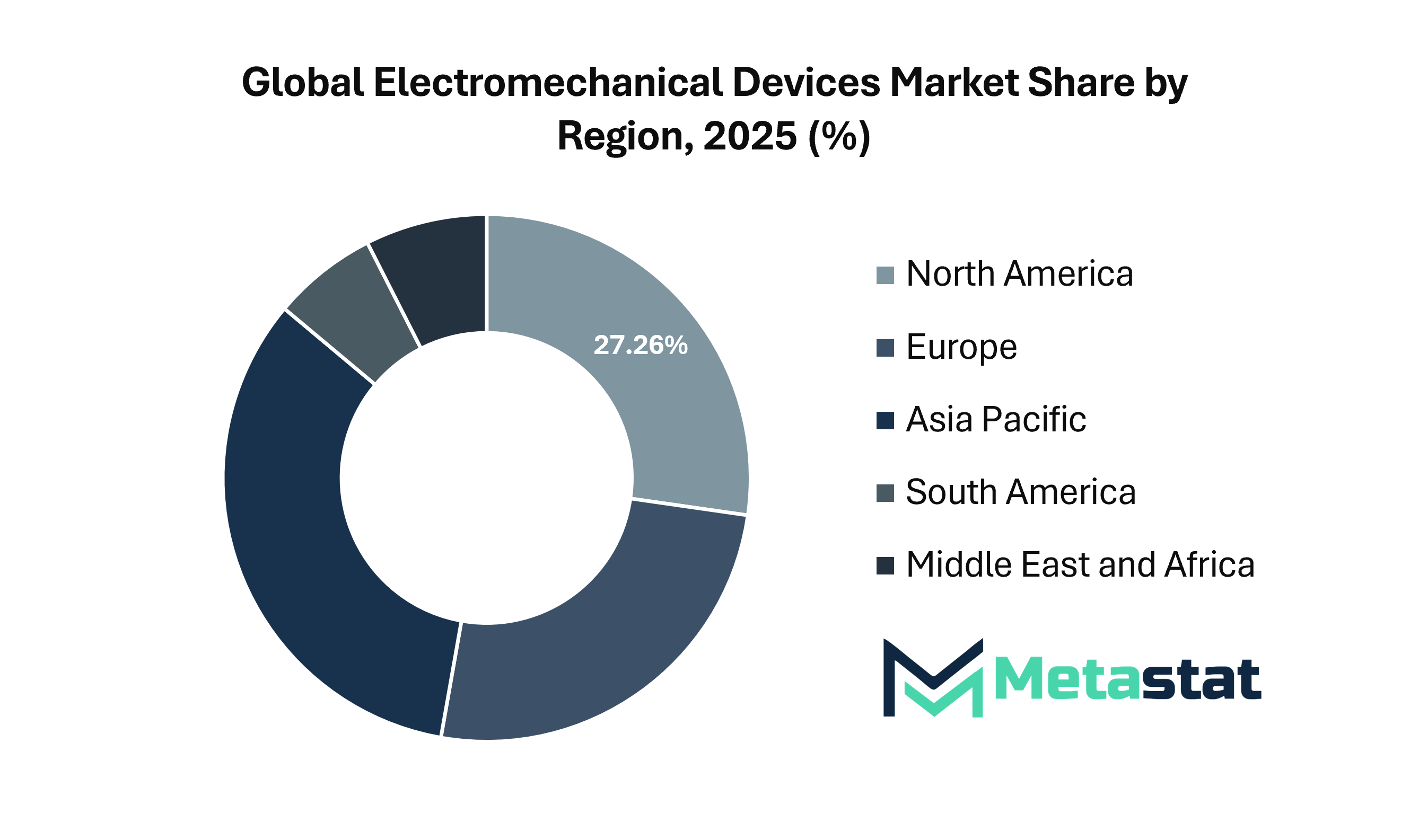
The Global Electromechanical Devices Market continues to expand as factories, buildings, vehicles, healthcare systems, and smart appliances require reliable motion, switching, sensing, and control components. Buyers are prioritizing products that reduce energy consumption, extend operating life, improve safety, and connect with digital monitoring systems. Manufacturers are focusing on faster response, quieter operation, compact design, easy maintenance, and stronger service support to improve customer retention across industrial and commercial applications.
Leading manufacturers such as ABB Ltd, Siemens AG, Schneider Electric SE, Rockwell Automation, Inc., and Emerson Electric Co. maintain strong positions through broad portfolios and global industrial customer relationships. Eaton Corporation plc and Honeywell International Inc. serve customers requiring dependable switching, sensing, and control solutions. Mitsubishi Electric Corporation, OMRON Corporation, and Panasonic Industry Co., Ltd. support automation and component demand across Asia, while TE Connectivity plc, Sensata Technologies Holding plc, and Littelfuse, Inc. add value through connectors, protection devices, sensors, and circuit protection technologies.
Other established companies include Johnson Electric Holdings Limited, Nidec Corporation, MinebeaMitsumi Inc., AMETEK, Inc., Regal Rexnord Corporation, and Parker-Hannifin Corporation. Yaskawa Electric Corporation and FANUC Corporation remain important in robotics and motion control, while Fuji Electric Co., Ltd., Delta Electronics, Inc., and WEG S.A. support drives and power systems across industrial facilities. Robert Bosch GmbH, DENSO CORPORATION, and Aisin Corporation serve mobility applications with precision components, while Bosch Rexroth AG, SKF AB, and SMC Corporation support fluid power, bearings, and automation-related supply.
Looking ahead, buyers will compare product quality, service speed, pricing, energy savings, availability, and lifecycle support before signing contracts. Companies that shorten lead times, maintain ready inventory, and provide strong after-sales support will win repeat orders. Digital monitoring will become increasingly important as users seek early failure alerts and predictive maintenance capabilities. Smaller firms will continue to find opportunities by serving niche requirements with customized designs, while larger players will compete through scale, innovation, distribution reach, and integrated solution portfolios.
Market size is forecast to rise from USD 591.6 billion in 2025 to over USD 949.6 billion by 2033.
The Global Electromechanical Devices Market is expected to advance through closer integration with connected systems, predictive maintenance tools, and energy management platforms. Growth from automation, electrified transport, and intelligent infrastructure is likely to remain strong during the forecast period.
This research report categorizes the Electromechanical Devices market based on key segments and regions, forecasts revenue growth, and analyses trends in each submarket. The report analyses the key growth drivers, opportunities, and challenges influencing the Electromechanical Devices market. Recent market developments and competitive strategies such as expansion, product launch, partnership, merger, and acquisition have been included to draw the competitive landscape in the market.
The report strategically identifies and profiles the key market players and analyses their core competencies in each sub-segment of the Electromechanical Devices market.
|
Report Attributes |
Details |
|
Study Period |
2021-2033 |
|
Base Year |
2025 |
|
Estimated Year |
2026 |
|
Forecast Period |
2026-2033 |
|
Historical Period |
2021-2025 |
|
Growth Rate |
CAGR 6.1% from 2026 to 2033 |
|
Revenue Unit |
USD billion |
|
Sales Volume Unit |
Thousand Units |
|
Segmentation |
By Type, Voltage Range, Sales Channel, End-Users, and Region |
|
By Region |
North America (By Type, Voltage Range, Sales Channel, End-Users, and Country)
|
|
Europe (By Type, Voltage Range, Sales Channel, End-Users, and Country)
|
|
|
Asia Pacific (By Type, Voltage Range, Sales Channel, End-Users, and Country)
|
|
|
South America (By Type, Voltage Range, Sales Channel, End-Users, and Country)
|
|
|
Middle East and Africa (By Type, Voltage Range, Sales Channel, End-Users, and Country)
|
Find answers to common questions about this report
Top players operating in the Electromechanical Devices industry include ABB Ltd, Siemens AG, Schneider Electric SE, Rockwell Automation, Inc., and Emerson Electric Co.
Increasing industrial automation and adoption of smart manufacturing systems are propelling demand for electromechanical devices and rising integration of advanced electronics in automotive and consumer appliances is accelerating device deployment across sectors are key driving factors, boosting the market.
Global Electromechanical Devices market is estimated to reach USD 949.6 billion by 2033.
High design complexity and integration challenges are increasing development costs and limiting rapid adoption. will hamper the market growth within the forecast period.
Asia Pacific region dominates the market.
The Motors is the leading type segment in the Global market.
The Metastat Insights analysis shows that the North America Electromechanical Devices market size is estimated to be USD 239.5 billion by 2033.
The Global Electromechanical Devices market is expected to grow at a CAGR of 6.1% over the forecast period (2026-2033).
The Metastat Insights study shows that the Global Electromechanical Devices market size was USD 591.6 billion in 2025.
The analysts below cover Electronics and Semiconductor research at Metastat Insights.
LEAD ANALYST
Utkarsh Khirodkar is a Lead Market Research Analyst at MetaStat Insight, specializing in market intelligence, technology sector assessments, and competitive strategy.

PRINCIPAL CONSULTANT - ENTERPRISE AI & EMERGING TECHNOLOGIES
Banking & Finance · Electronics and Semiconductor · Energy and Power · Healthcare IT · Information & Technology · Professional Services
Vijay Gunti is a Principal Consultant at MetaStat Insight, bringing over two decades of experience across enterprise digital transformation, technology strategy, and intelligent systems.

PRINCIPAL CONSULTANT - QUALITY SYSTEMS & COMPLIANCE
Electronics and Semiconductor · Machinery & Equipment · Professional Services
Omkar Phadtare is an Industry Consultant at MetaStat Insight, specializing in quality systems, regulatory compliance, and standards benchmarking to drive data-driven market intelligence and strategic industry research.

ENERGY & INFRASTRUCTURE INDUSTRY CONSULTANT
Automotive and Transportation · Electronics and Semiconductor · Energy and Power · Machinery & Equipment
Saurabh Vasant Ganvir consults for Energy & Infrastructure Industry at MetaStat Insight, specializing in renewable energy, solar EPC, and electric vehicle (EV) infrastructure markets.

LEAD CONSULTANT - COMMUNICATION, TELECOM, AND IT
Electronics and Semiconductor · Information & Technology · Machinery & Equipment · Professional Services
Ravindra Sathe Consultants for Communication, Telecom, and IT at MetaStat Insight. He leads the firm's industry research initiatives across telecommunications infrastructure, digital connectivity, enterprise networking, and emerging information technology domains.
Evaluating calorific value requirements and air permit compliance across municipal waste facilities requires localized data. Metastat Insight structured their analysis around operational throughput capacity and feedstock composition variations in Latin America and Eastern Europe. Their competitive mapping of sorting equipment vendors helped clarify technology differences between optical separators and heavy media systems. The study provided an objective baseline during our capital expenditure reviews.
Decarbonizing industrial thermal processes hinges on refrigerant regulations and compressor efficiency limits. Metastat Insights delivered a thorough market analysis that evaluated natural refrigerants like CO2 and hydrocarbons against synthetic low-GWP alternatives. The breakdown of utility incentives and grid capacity constraints across key European manufacturing hubs offered valuable perspective. The follow-up conversation with their sector analysts addressed our specific questions on mechanical vapor recompression systems efficiently.
Assessing 200mm wafer transition schedules and substrate supply bottlenecks requires precise technical intelligence. MetaStat Insight supplied an actionable breakdown comparing planar and trench MOSFET architectures across automotive and industrial drive markets. The regional capacity estimates for Asia-Pacific foundries helped clarify lead-time uncertainties during our strategic planning session. When we needed additional clarification on high-purity raw material sourcing, their analyst team responded with helpful context within twenty-four hours.
Explore related market intelligence reports worth reading alongside this one.
Starting from
$2950