
LEAD ANALYST
Utkarsh Khirodkar is a Lead Market Research Analyst at MetaStat Insight, specializing in market intelligence, technology sector assessments, and competitive strategy.

Enteral Single Use Syringes Market By Type (1 ml, 3 ml, 5 ml, 10 ml, 20 ml, and 60 ml), By Application (Hospitals, Clinics, and Home Use), Industry Analysis, Size, Share, Growth, Trends, and Forecast, 2024-2031
Report ID
MSI-2795
Published
February, 2026
Pages
251 Pages
Format
Report Details
Choose Your License
Enteral Single Use Syringes Market
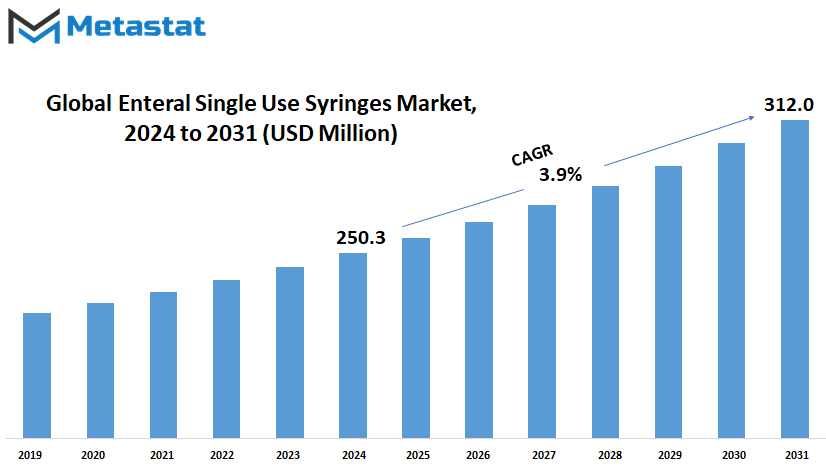
The Global Enteral Single Use Syringes market is estimated to reach $312.0 Million by 2031; growing at a CAGR of 3.9% from 2024 to 2031.
The Global Enteral Single Use Syringes market is poised to redefine the landscape of the healthcare industry in the coming years. This industry, which focuses on the production and distribution of single-use syringes specifically designed for enteral feeding, is witnessing a surge in demand owing to several factors driving the need for safer and more efficient medical devices.
Enteral feeding, a method of delivering nutrients directly into the gastrointestinal tract, is commonly employed in patients who are unable to ingest food orally. As the prevalence of chronic diseases such as cancer, neurological disorders, and gastrointestinal diseases continues to rise worldwide, the demand for enteral feeding solutions is expected to escalate exponentially. This surge in demand, in turn, is fueling the growth of the Global Enteral Single Use Syringes market.
Moreover, advancements in medical technology and the increasing emphasis on patient safety are driving the development of innovative enteral feeding devices, including single-use syringes. These syringes offer several advantages over traditional reusable syringes, such as reduced risk of cross-contamination, precise dosing accuracy, and convenience in clinical settings. Healthcare facilities are increasingly adopting single-use syringes to minimize the risk of nosocomial infections and improve patient outcomes.
In addition to the growing demand for enteral feeding solutions, changing regulatory landscapes and stringent quality standards are shaping the dynamics of the Global Enteral Single Use Syringes market. Regulatory bodies across the globe are imposing stringent guidelines to ensure the safety and efficacy of medical devices, thereby necessitating compliance with rigorous quality standards by manufacturers. Companies operating in this market are investing significant resources in research and development to innovate and develop products that meet regulatory requirements and address the evolving needs of healthcare providers and patients.
Furthermore, the advent of digitalization and the integration of smart technologies are poised to revolutionize the Global Enteral Single Use Syringes market in the foreseeable future. Smart syringes equipped with connectivity features and sensors offer real-time monitoring and data analytics capabilities, enabling healthcare professionals to track patient progress, optimize treatment protocols, and enhance patient outcomes. The integration of such technologies not only improves the efficiency and effectiveness of enteral feeding procedures but also contributes to the overall advancement of healthcare delivery systems.
The Global Enteral Single Use Syringes market is on the cusp of significant growth and transformation, driven by the increasing prevalence of chronic diseases, advancements in medical technology, evolving regulatory landscapes, and the integration of smart technologies. As the demand for safer and more efficient enteral feeding solutions continues to rise, stakeholders across the healthcare industry must adapt to these changes and capitalize on emerging opportunities to drive innovation and improve patient care globally.
The increasing prevalence of chronic diseases and an aging population are driving up the demand for enteral feeding solutions. This surge in demand is particularly boosting the market for single-use enteral syringes as more healthcare providers opt for enteral nutrition over parenteral nutrition. However, the high costs associated with enteral feeding equipment and supplies may hinder accessibility for certain patients and healthcare providers. Additionally, stringent regulatory requirements and the necessity for consistent quality control present challenges for manufacturers in this sector.
Despite these obstacles, there are promising prospects for growth in the market. The development of innovative enteral syringes that are cost-effective and feature enhanced safety measures could significantly improve patient care and widen the market's reach in the years to come. These advancements not only address the current challenges but also create lucrative opportunities for both manufacturers and healthcare providers.
As technology continues to advance, we can anticipate further innovations in enteral feeding solutions. These innovations may include smart devices equipped with sensors to monitor and regulate feeding, ensuring precise and optimal delivery of nutrients to patients. Moreover, advancements in materials science may lead to the development of more durable and eco-friendly syringes, reducing both costs and environmental impact.
Furthermore, the integration of telehealth services into enteral nutrition management could revolutionize patient care delivery. Remote monitoring and consultation services would enable healthcare providers to efficiently manage patients' nutritional needs, improving accessibility and reducing the burden on traditional healthcare systems.
While challenges such as cost and regulatory requirements may present obstacles to market growth, the continued development of innovative solutions holds immense promise for the future of enteral feeding. By addressing these challenges and leveraging emerging technologies, the market for enteral syringes is poised for significant expansion, benefiting both patients and healthcare providers alike.
The Global Enteral Single Use Syringes market, classified by type, encompasses various capacities ranging from 1 ml to 60 ml. This segmentation allows for catering to diverse medical needs efficiently.
In the foreseeable future, the demand for these syringes will likely surge due to several factors. Firstly, the growing awareness and emphasis on maintaining proper medical hygiene standards will lead to an increased preference for single-use syringes over their reusable counterparts. This shift will be driven by the need to mitigate the risk of cross-contamination and infection transmission in medical settings.
Furthermore, advancements in healthcare infrastructure and rising healthcare expenditures in emerging economies will bolster the adoption of enteral single-use syringes. As these countries strive to enhance their healthcare systems, they will invest in modern medical equipment, including disposable syringes, to ensure safer and more effective patient care.
Additionally, technological innovations will play a pivotal role in shaping the enteral single-use syringes market. Manufacturers will focus on developing syringes with improved features such as enhanced precision, user-friendliness, and compatibility with enteral feeding systems. These innovations will not only meet the evolving needs of healthcare professionals but also enhance patient comfort and safety.
Moreover, the increasing prevalence of chronic diseases and the growing geriatric population worldwide will drive the demand for enteral feeding solutions. Enteral single-use syringes, with their convenience, accuracy, and hygiene benefits, will emerge as indispensable tools in managing nutritional support for patients with feeding difficulties.
As healthcare becomes more personalized and patient-centric, the demand for enteral single-use syringes will continue to grow. Healthcare providers will prioritize solutions that offer precise dosage administration and minimize the risk of medication errors. The versatility of enteral single-use syringes, coupled with their ability to deliver various types of medications and nutrients, will make them indispensable in both clinical and homecare settings.

In today's fast-paced world, where advancements in medical technology are constantly changing the landscape of healthcare, the global enteral single-use syringes market is emerging as a crucial player. This market, segmented by application into hospitals, clinics, and home use, is set to play a significant role in delivering enteral nutrition safely and efficiently to patients across various settings.
Hospitals, being the primary centers for medical care, will continue to drive demand for enteral single-use syringes. These syringes, designed for one-time use, offer a hygienic and convenient solution for administering enteral nutrition to patients in hospital settings. With the increasing prevalence of chronic diseases and the growing aging population worldwide, the demand for enteral feeding is expected to rise, thereby propelling the need for these syringes in hospitals.
Clinics, serving as important secondary healthcare facilities, will also contribute to the demand for enteral single-use syringes. As clinics handle a wide range of medical cases, including outpatient care and minor procedures, the use of enteral nutrition is prevalent in these settings. Single-use syringes provide a cost-effective and practical option for clinics to administer enteral feeds safely and efficiently to patients under their care.
Furthermore, the concept of home healthcare is gaining traction globally, driven by factors such as the preference for aging in place and the rising healthcare costs associated with hospital stays. In this regard, enteral single-use syringes play a crucial role in enabling patients to receive enteral nutrition in the comfort of their homes. Patients with chronic conditions or those recovering from surgeries often require long-term enteral feeding, and single-use syringes offer a convenient and user-friendly solution for caregivers to administer feeds at home.
The global market for Enteral Single Use Syringes is analyzed across various regions, each with its own unique characteristics and trends. These regions include North America, Europe, Asia-Pacific, South America, and Middle East & Africa.
In North America, the market is further segmented into the United States, Canada, and Mexico. This region boasts a robust healthcare infrastructure and a high adoption rate of advanced medical technologies. Factors such as increasing healthcare expenditure and a growing elderly population are expected to drive market growth in this region.
Moving on to Europe, the market encompasses countries such as the United Kingdom, Germany, France, Italy, and the rest of Europe. Europe has a well-established healthcare system and stringent regulations governing medical devices. The presence of key market players and technological advancements contribute to the growth of the Enteral Single Use Syringes market in this region.
The Asia-Pacific region comprises India, China, Japan, South Korea, and the rest of Asia-Pacific. With a large population and improving healthcare infrastructure, this region presents significant opportunities for market expansion. Rising disposable income, increasing healthcare awareness, and government initiatives to enhance healthcare facilities further fuel market growth in Asia-Pacific.
In South America, countries like Brazil, Argentina, and the rest of South America are included in the analysis. South America is witnessing rapid urbanization and improving healthcare access, which is expected to drive market demand. However, economic fluctuations and healthcare disparities across countries may pose challenges to market growth in this region.
The Middle East & Africa region includes GCC Countries, Egypt, South Africa, and the rest of Middle East & Africa. Despite facing challenges such as political instability and limited access to healthcare in certain areas, the region is witnessing investments in healthcare infrastructure, which will positively impact market growth.
The global Enteral Single Use Syringes market exhibits varying dynamics across different regions. Factors such as healthcare infrastructure, regulatory environment, population demographics, and economic conditions will influence market growth in each region. Understanding these regional nuances is crucial for market players to formulate effective strategies and capitalize on emerging opportunities.
In the dynamic landscape of the global Enteral Single Use Syringes market, several prominent players are actively shaping its trajectory. These key players, comprising a mix of established entities and emerging contenders, play pivotal roles in driving innovation, meeting consumer needs, and navigating regulatory landscapes.
One of the prominent names in this sphere is B. Braun Melsungen, a company renowned for its commitment to quality and patient safety. With a rich legacy and a focus on research and development, B. Braun Melsungen is poised to continue its influential presence in the Enteral Single Use Syringes market.
BD, another significant player in this arena, brings to the table a wealth of expertise and a diverse portfolio of products. Their dedication to advancing healthcare solutions has earned them a reputable position among competitors.
Cardinal Health, with its extensive global reach and comprehensive offerings, is a formidable force in the Enteral Single Use Syringes market. Known for its emphasis on efficiency and reliability, Cardinal Health is well-positioned to capitalize on emerging opportunities.
Terumo, a company synonymous with innovation and excellence, remains a key player in driving technological advancements in the Enteral Single Use Syringes sector. Their focus on precision and safety continues to resonate with healthcare professionals worldwide.
Philips, a household name in healthcare technology, is leveraging its expertise to deliver cutting-edge solutions in the Enteral Single Use Syringes market. With a commitment to improving patient outcomes and enhancing efficiency, Philips is poised for sustained growth.
Thermo Fisher Scientific, a leader in scientific research and laboratory equipment, brings its formidable resources and expertise to bear in the Enteral Single Use Syringes space. Their robust product offerings and dedication to customer satisfaction reinforce their position as a key player in the market.
Other notable players in this competitive landscape include GBUK Enteral, Baxter International, Vygon SA, Medline Industries, Vesco Medical, Abbott Laboratories Inc., TECHNOPATH Distribution, and Kentec Medical, Inc. Each of these entities brings its unique strengths and capabilities to the table, contributing to the vibrancy and competitiveness of the Enteral Single Use Syringes market.
As the market continues to evolve, these key players will undoubtedly play instrumental roles in shaping its direction and driving growth. With a focus on innovation, quality, and customer satisfaction, they are poised to capitalize on emerging opportunities and overcome challenges in the dynamic landscape of the global Enteral Single Use Syringes market.
Find answers to common questions about this report
Global Enteral Single Use Syringes market is valued at $250.3 million in 2024.
Global Enteral Single Use Syringes market is estimated to grow with a CAGR of 3.9% from 2024 to 2031.
Global Enteral Single Use Syringes market is estimated to reach $312.0 million by 2031.
Top players operating in the Enteral Single Use Syringes industry includes B. Braun Melsungen, BD, Cardinal Health, Terumo, Philips, Thermo Fisher Scientific, and Others.
The analysts below cover Medical Devices research at Metastat Insights.
LEAD ANALYST
Utkarsh Khirodkar is a Lead Market Research Analyst at MetaStat Insight, specializing in market intelligence, technology sector assessments, and competitive strategy.

LEAD PRINCIPAL ANALYST, PHARMA AND HEALTHCARE
Food and Beverages · Healthcare · Healthcare IT · Medical Devices
Ajay Devgire is the Lead Healthcare Analyst at MetaStat Insight, leading strategic research and market intelligence initiatives across the global healthcare domain.

SENIOR RESEARCH ANALYST
Biotechnology · Food and Beverages · Medical Devices · Packaging
Snehal Pasalkar is a Research Analyst at MetaStat Insight, operating at the intersection of life sciences research, competitive strategy, and market intelligence.
Floating offshore wind feasibility relies heavily on specialized installation vessel availability and port crane limits, which most broad renewable energy forecasts ignore. The report delivered a thorough analysis of dry dock capacity, mooring chain supply constraints, and raw material pricing trends for deepwater anchor installations. It served as a solid independent sanity check for our offshore project capital expenditure assumptions.
Assessing commercial microgrid software adoption requires looking past top-level installation numbers and examining utility interconnection queues. The research provided verifiable data on average permitting timelines, tariff structures, and battery storage integration costs across regional utility territories. That grounded perspective was valuable for our team when building five-year demand projections for industrial microgrid controllers.
Ambulatory surgical centers have very different purchasing cycles for robotic-assisted surgery platforms than major hospital networks. The MetaStat Insight study focused squarely on capital expenditure depreciation, procedural reimbursement pathways, and surgeon training overhead. That operational clarity made it much simpler to validate multi-year procedure growth forecasts against actual ambulatory center adoption patterns.
Explore related market intelligence reports worth reading alongside this one.
Starting from
$2950