
LEAD ANALYST
Utkarsh Khirodkar is a Lead Market Research Analyst at MetaStat Insight, specializing in market intelligence, technology sector assessments, and competitive strategy.

Fibroblast Cells Market By Product Type (Human Dermal Fibroblasts, Dermal Fibroblasts matched with Subcutaneous Preadipocytes, and Others), By Type (Tissue-Specific Fibroblasts, Disease-specific Fibroblasts, and Serum-free Fibroblast Culture Medium), By Application (Adults and Neonatal), By End Users (Hospitals, Clinics, Research, Academic Institutes, and Others), By Industry Analysis, Size, Share, Growth, Trends, and Forecast, 2023-2030
Report ID
MSI-2491
Published
February, 2026
Pages
253 Pages
Format
Report Details
Choose Your License
Fibroblast Cells Market
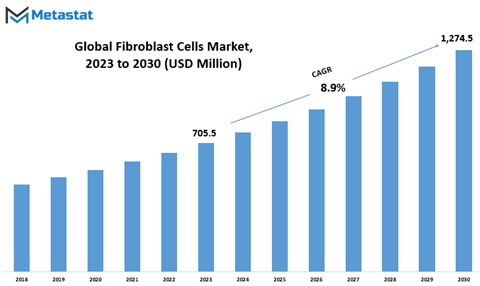
The Global Fibroblast Cells market is estimated to reach $1,274.5 Million by 2030; growing at a CAGR of 8.9% from 2023 to 2030.
The Global Fibroblast Cells Market encompasses a range of activities associated with the acquisition, cultivation, and utilization of fibroblast cells. Fibroblasts are a type of cell found in connective tissues throughout the human body and are known for their versatility in various biological processes. These cells serve as a fundamental building block for the formation and repair of connective tissues, making them an essential component in wound healing and tissue regeneration. In the context of the market, fibroblast cells are harnessed and cultured for research, therapeutic, and diagnostic applications.
The significance of the Global Fibroblast Cells Market lies in its pivotal role in advancing medical and biotechnological research. Fibroblast cells are invaluable tools for scientists and researchers who study cell biology, tissue engineering, regenerative medicine, and drug development. They enable the investigation of fundamental cellular processes, disease modeling, and the testing of potential therapies. These cells offer insights into various diseases, including fibrosis, cancer, and skin disorders, leading to the development of novel treatment approaches.
Furthermore, the Global Fibroblast Cells Market's importance is underscored by its contribution to personalized medicine. The ability to culture and manipulate fibroblast cells allows for the development of patient-specific models, enabling more tailored and effective treatments. This individualized approach has the potential to revolutionize the healthcare industry, improving patient outcomes and reducing the trial-and-error approach to medical interventions.
The Fibroblast Cells Market is experiencing notable growth, and several factors contribute to its upward trajectory. The increasing prevalence of various skin disorders and the rising demand for advanced skincare solutions drive the market's expansion. People are becoming more conscious of their skin health, fueling the demand for innovative therapies, and fibroblast cells play a crucial role in this context.
These cells are instrumental in producing collagen and other essential proteins, contributing to the maintenance of skin elasticity and health. The growing awareness among individuals about the importance of collagen in skincare has led to an upsurge in the demand for fibroblast cell-based products.
Moreover, advancements in medical research have paved the way for the development of novel therapies and treatments utilizing fibroblast cells. This has significantly propelled the market forward, as healthcare professionals increasingly integrate these innovative approaches into their practices.
However, certain challenges pose potential obstacles to the market's growth. Regulatory complexities and stringent approval processes for new therapies may slow down the pace of market expansion. Navigating these regulatory hurdles requires significant time and resources, affecting the timely introduction of new fibroblast cell-based products into the market.
Additionally, economic uncertainties and fluctuating market dynamics can also impact the Fibroblast Cells Market. The market's vulnerability to these external factors necessitates careful strategic planning by industry players to mitigate potential setbacks and sustain growth.
Despite these challenges, promising opportunities lie ahead for the Fibroblast Cells Market. The increasing research and development activities focused on enhancing the efficacy of fibroblast cell-based therapies hold significant promise. Collaborations between research institutions and pharmaceutical companies are likely to result in the introduction of more advanced and effective products, fostering market growth.
Furthermore, the expanding geriatric population worldwide presents a substantial market opportunity. Aging is often accompanied by a decline in collagen production and skin elasticity, leading to a higher demand for fibroblast cell-based interventions to address these issues. This demographic trend is expected to drive market growth in the coming years.
In the expansive landscape of the healthcare industry, one facet that has been garnering attention is the Fibroblast Cells Market. This market is intricately woven into the fabric of medical research and applications, playing a pivotal role in various therapeutic and cosmetic pursuits.
The market, divided by product types, unfolds a diverse array of offerings. Among these, the Human Dermal Fibroblasts emerge as a focal point, capturing interest due to their significant role in tissue repair and regeneration. These cells, derived from human skin, hold the promise of advancements in wound healing and dermatological treatments.
Another noteworthy segment within the Fibroblast Cells Market is the category of Dermal Fibroblasts matched with Subcutaneous Preadipocytes. This amalgamation presents a dynamic interplay, showcasing the interconnectedness of different cell types for potential applications. The synergy between dermal fibroblasts and preadipocytes adds a layer of complexity to the market dynamics, paving the way for innovative approaches in regenerative medicine.
Beyond these primary categories, the market extends its reach to encompass other variations of fibroblast cells. These diverse offerings cater to a spectrum of research needs and medical applications, illustrating the adaptability and versatility of fibroblast cells in addressing varied requirements.
As researchers delve into the functionalities of these cells, a deeper understanding of their potential unfolds. The Human Dermal Fibroblasts, with their intrinsic ability to contribute to collagen production and tissue remodeling, present a canvas for exploring novel avenues in dermatology. Similarly, the combination of Dermal Fibroblasts with Subcutaneous Preadipocytes opens doors to innovative strategies in the realms of tissue engineering and regenerative medicine.
The Fibroblast Cells Market, with its diverse product types, stands as a testament to the dynamic nature of medical research. The exploration and utilization of Human Dermal Fibroblasts, Dermal Fibroblasts matched with Subcutaneous Preadipocytes, and other variants underscore the continuous evolution within the healthcare landscape. This market not only represents the present state of scientific inquiry but also hints at the promising horizons that lie ahead, where the role of fibroblast cells continues to unfold in the pursuit of better health and medical advancements.
Each of these plays a crucial role in the broader landscape of cell biology and medical research. Tissue-Specific Fibroblasts are cells derived from specific tissues in the body. They serve as the foundation for understanding the behavior and characteristics of cells within a particular organ or structure. This specificity allows researchers to delve into the intricacies of tissue function and response.
However, Disease-Specific Fibroblasts offer a targeted approach to studying various medical conditions. By isolating fibroblasts associated with specific diseases, scientists gain valuable insights into the cellular mechanisms underlying those conditions. This type of research contributes significantly to advancements in medical diagnostics and treatment strategies.
The Serum-Free Fibroblast Culture Medium represents a critical component in the cultivation of fibroblast cells. This medium provides a controlled environment for the growth and maintenance of these cells outside the body. The absence of serum, a component in traditional culture mediums, minimizes external influences and allows for more precise experimentation and observation.
In the dynamic landscape of cell biology, the Fibroblast Cells Market responds to the increasing demand for specialized tools and resources. Tissue-Specific Fibroblasts enable researchers to explore the nuances of different tissues, Disease-Specific Fibroblasts contribute to the understanding of specific medical conditions, and Serum-Free Fibroblast Culture Medium facilitates controlled experimentation. Together, these components empower scientists and medical professionals to make strides in unraveling the complexities of cellular behavior and, ultimately, improving human health.
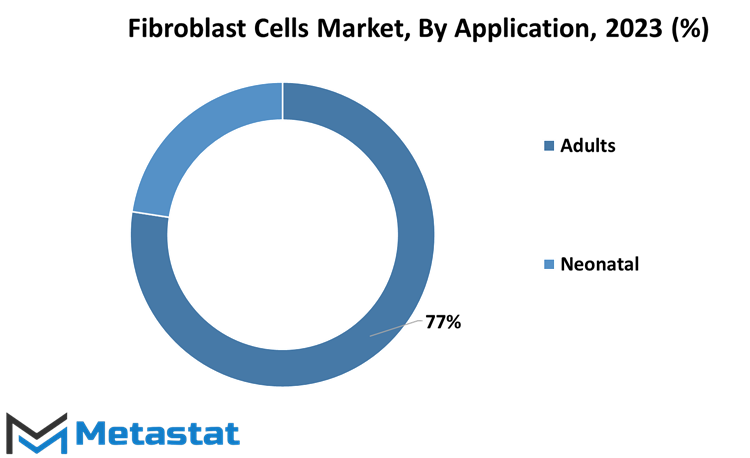
The Fibroblast Cells Market, when examined by application, is categorized into distinct segments, namely Adults and Neonatal. This classification provides a comprehensive overview of the market's diverse applications.
Adults represent a significant sector within the Fibroblast Cells Market. These cells play a crucial role in various physiological processes in adult organisms. They contribute to tissue repair, maintenance, and overall homeostasis. Understanding the application of fibroblast cells in adults is paramount for researchers and healthcare professionals alike, as it sheds light on potential therapeutic interventions and medical advancements.
On the other hand, the Neonatal segment highlights the relevance of fibroblast cells in the early stages of life. Neonatal fibroblast cells serve vital functions in the development and growth of newborns. Research in this area is essential for enhancing our comprehension of neonatal health and addressing medical challenges that may arise during this critical phase.
The market's division into Adults and Neonatal applications emphasizes the versatility and broad spectrum of applications for fibroblast cells. This categorization aids not only in understanding the distinct roles these cells play in different life stages but also in tailoring medical interventions and research initiatives to address specific needs within each segment. As the Fibroblast Cells Market continues to advance, a nuanced understanding of these applications will be crucial for driving innovation and improving healthcare outcomes.
In the expansive landscape of the global Fibroblast Cells market, various end users play a crucial role in steering its course. These end users, acting as key players in the market, delineate the diverse applications and significance of fibroblast cells in different sectors.
Hospitals stand at the forefront of this market, serving as pivotal hubs where fibroblast cells find extensive use. The dynamic nature of healthcare demands a robust presence of these cells in hospitals, contributing to a range of medical procedures and treatments. From wound healing to tissue repair, fibroblast cells are instrumental in the intricate web of healthcare services provided by hospitals.
Clinics, another significant end user, echo the importance of fibroblast cells in a more focused setting. In these settings, where medical attention is often specialized, fibroblast cells find application in targeted treatments. The adaptability of these cells makes them valuable assets in clinics, where specific medical conditions can be addressed with precision.
Research and Academic Institutes constitute a vital segment in the global Fibroblast Cells market, acting as catalysts for innovation and progress. Within the walls of these institutions, scientists and researchers explore the potential of fibroblast cells, unraveling their capabilities and charting new territories in medical science. The quest for knowledge and advancements in medical research hinges on the availability and understanding of fibroblast cells.
Beyond healthcare and research, fibroblast cells extend their influence on other sectors categorized as Others. This diverse category encapsulates a spectrum of applications, from cosmetic procedures to industrial uses. The versatility of fibroblast cells ensures their presence in unexpected corners, contributing to a myriad of fields beyond the well-defined boundaries of hospitals and research institutes.
The Fibroblast Cells Market is an expansive domain, intricately woven into the global economic fabric. Geographically, this market spreads its wings across North America, Europe, and Asia-Pacific. Each region plays a vital role in shaping the trajectory of this market, contributing to its overall dynamics.
North America stands as a significant player in the Fibroblast Cells Market. With a robust healthcare infrastructure and a penchant for technological advancements, the region has become a hotspot for research and development in the field of fibroblast cells. The demand for these cells is on the rise, driven by a growing awareness of their applications in medical research and therapy.
Moving across the Atlantic, Europe emerges as another crucial hub for the Fibroblast Cells Market. European countries, with their well-established pharmaceutical and biotechnology sectors, foster an environment conducive to the growth of this market. The emphasis on scientific innovation and collaboration further propels the utilization of fibroblast cells in various medical pursuits.
Venturing into the vast expanse of Asia-Pacific, we witness a dynamic landscape in the Fibroblast Cells Market. The region, known for its burgeoning population and diverse healthcare needs, presents both challenges and opportunities. As countries in Asia-Pacific invest in healthcare infrastructure and research capabilities, the demand for fibroblast cells is poised to witness significant growth.
The global Fibroblast Cells Market, with its roots deeply embedded in North America, Europe, and Asia-Pacific, is a testament to the interconnectedness of the world in matters of healthcare and scientific exploration. The market's dynamics are shaped by the unique characteristics of each geography, creating a tapestry of growth and innovation that spans continents.
The Fibroblast Cells Market is a dynamic sector with several key players driving its growth. Among these, Axol Bioscience Ltd. and Cell Applications, Inc. stand out as significant contributors to the industry.
Axol Bioscience Ltd. is recognized for its expertise in providing high-quality fibroblast cells. These cells play a crucial role in various research applications, including drug discovery and regenerative medicine. The company's commitment to delivering reliable and consistent products has established it as a reliable partner for researchers and institutions engaged in cutting-edge biomedical studies.
Similarly, Cell Applications, Inc. is a notable player in the Fibroblast Cells industry. Known for its focus on cell biology, the company offers a range of fibroblast cells that cater to the diverse needs of scientific research. Researchers value the precision and performance of Cell Applications' products, making it a preferred choice in the competitive market.
The Fibroblast Cells Market's growth is not only attributed to the key players' product offerings but also to the increasing demand for these cells in scientific research. Fibroblast cells are vital in understanding various biological processes and mechanisms, making them indispensable in laboratories worldwide.
Researchers leverage fibroblast cells for studying cell behavior, tissue development, and disease modeling. The versatile applications of these cells make them a cornerstone in advancing our understanding of biology and developing new medical interventions.
The Fibroblast Cells Market is marked by the significant presence of key players like Axol Bioscience Ltd. and Cell Applications, Inc. These companies play a pivotal role in advancing scientific research by providing high-quality fibroblast cells. As the demand for these cells continues to grow, the industry's landscape is likely to witness further expansion, with these key players at the forefront of innovation and progress.
Find answers to common questions about this report
Global Fibroblast Cells market is valued at $705.5 million in 2023.
Global Fibroblast Cells market is estimated to grow with a CAGR of 8.9% from 2023 to 2030.
Global Fibroblast Cells market is estimated to reach $1,274.5 million by 2030.
Top players operating in the Fibroblast Cells industry includes Axol Bioscience Ltd., Cell Applications, Inc., FibroGenesis, Merck KGaA, Bio-Techne, ThermoFisher Scientific, and others.
The analysts below cover Healthcare research at Metastat Insights.
LEAD ANALYST
Utkarsh Khirodkar is a Lead Market Research Analyst at MetaStat Insight, specializing in market intelligence, technology sector assessments, and competitive strategy.

LEAD PRINCIPAL ANALYST, PHARMA AND HEALTHCARE
Food and Beverages · Healthcare · Healthcare IT · Medical Devices
Ajay Devgire is the Lead Healthcare Analyst at MetaStat Insight, leading strategic research and market intelligence initiatives across the global healthcare domain.
In the biological seed treatment space, registration timelines vary drastically between the European Union, Brazil, and North America. The MetaStat Insight research handled these cross-border regulatory barriers with genuine nuance, mapping commercialization pathways alongside historical field adoption rates. The segmentation between microbial strains and biochemical active ingredients was particularly well structured.
Our team was tracking whether regional recycling infrastructure could realistically absorb the growing volume of lithium iron phosphate batteries over the next decade. The report did a solid job separating announced hydrometallurgical plant capacity from active, permitted operational throughput. That distinction made the feedstock availability projections and regional recovery rate models far more credible than standard commercial overviews.
Tracking capacity expansion in single-use bioprocessing requires dependable data on raw material availability and cleanroom-grade polymer supply chains. The competitive landscape chapter gave a grounded evaluation of secondary component suppliers across North America and Asia-Pacific rather than simply reprinting press releases. Having that level of supplier benchmarking helped clarify dual-sourcing considerations for our clinical pipeline planning.
Explore related market intelligence reports worth reading alongside this one.
Starting from
$2950