
LEAD ANALYST
Utkarsh Khirodkar is a Lead Market Research Analyst at MetaStat Insight, specializing in market intelligence, technology sector assessments, and competitive strategy.

Emission Monitoring System Market By Type (Continuous Emission Monitoring System (CEMS) and Predictive Emission Monitoring System (PEMS)), By Component (Hardware, Software, and Services), By End-User (Power Generation, Oil, Gas, Cement, Chemicals, Fertilizers, Mining, Pulp, Paper, Waste Incineration, and Others), Industry Analysis, Size, Share, Growth, Trends, and Forecast, 2024-2031
Report ID
MSI-2792
Published
February, 2026
Pages
252 Pages
Format
Report Details
Choose Your License
Emission Monitoring System Market
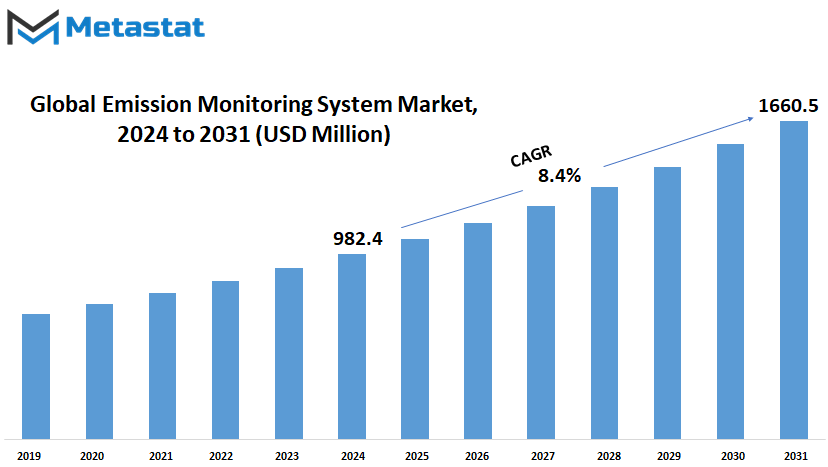
The Global Emission Monitoring System market is estimated to reach $1660.5 Million by 2031; growing at a CAGR of 8.4% from 2024 to 2031.
The Global Emission Monitoring System market is a vital industry that focuses on the technologies and services designed to measure and manage the release of pollutants into the atmosphere. As environmental regulations become increasingly stringent worldwide, industries are under growing pressure to monitor their emissions accurately and efficiently. This market plays a critical role in providing the tools necessary for companies to comply with environmental laws and standards.
In the coming years, the market for Global Emission Monitoring Systems will expand significantly as industries strive to reduce their carbon footprint and adhere to regulatory demands. These systems are essential for continuous and precise monitoring of emissions from industrial sources such as power plants, oil refineries, chemical plants, and manufacturing facilities. By using advanced technologies like gas analyzers, dust monitors, and software solutions, these systems enable real-time tracking and reporting of various pollutants, including carbon dioxide, sulfur dioxide, nitrogen oxides, and particulate matter.
The development and implementation of Global Emission Monitoring Systems are driven by technological advancements and innovation. Emerging technologies, such as the Internet of Things (IoT) and big data analytics, are being integrated into these systems to enhance their accuracy and functionality. IoT-enabled sensors and devices can provide continuous, real-time data collection and transmission, allowing for more detailed and immediate insights into emission levels. Big data analytics further aids in the interpretation of this data, helping industries to identify patterns, predict potential issues, and optimize their emission control strategies.
In addition to technological advancements, regulatory frameworks and international agreements will shape the future of the Global Emission Monitoring System market. Governments worldwide are enacting more stringent regulations to combat air pollution and climate change. International agreements like the Paris Agreement emphasize the need for countries to monitor and report their greenhouse gas emissions accurately. Consequently, industries will increasingly invest in sophisticated emission monitoring systems to ensure compliance and avoid hefty fines or sanctions.
The market is also influenced by the growing awareness and concern about environmental sustainability among businesses and consumers. Companies are recognizing the importance of corporate social responsibility and the benefits of adopting green practices. By investing in emission monitoring systems, businesses can demonstrate their commitment to reducing their environmental impact, enhancing their reputation, and gaining a competitive edge in the marketplace.
The adoption of Global Emission Monitoring Systems will also be driven by the need for operational efficiency and cost savings. Accurate emission monitoring helps industries identify inefficiencies and optimize their processes, leading to reduced waste and lower operational costs. Moreover, the data generated by these systems can inform maintenance schedules and prevent costly equipment failures, contributing to overall productivity and profitability.
The Global Emission Monitoring System market is a dynamic and essential industry poised for significant growth in the coming years. With technological advancements, regulatory pressures, and increasing environmental awareness, the demand for accurate and efficient emission monitoring solutions will continue to rise. Industries across various sectors will rely on these systems to ensure regulatory compliance, enhance operational efficiency, and contribute to a more sustainable future. As the world moves towards greater environmental responsibility, the role of emission monitoring systems will become even more crucial in safeguarding the planet for future generations.
The global market for emission monitoring systems is poised for significant growth due to several factors. A major driver is the increasing number of environmental regulations and stringent government policies that are being implemented worldwide. These regulations aim to reduce pollution and mitigate climate change, pushing industries to adopt more advanced emission monitoring technologies to comply with the new standards. Additionally, public awareness and concern about air quality and environmental protection are rising, further fueling the demand for these systems. People are becoming more conscious of the impact of industrial emissions on health and the environment, which pressures companies to invest in emission monitoring.
Despite these growth factors, the market faces some challenges that could hinder its expansion. One significant obstacle is the high cost associated with the installation and maintenance of emission monitoring systems. For many businesses, especially smaller ones, these costs can be prohibitive. Another challenge is the technical difficulties involved in accurately measuring emissions from various industrial processes. Different industries produce different types of emissions, each requiring specific monitoring technologies and methodologies. These complexities can make it difficult for companies to implement effective monitoring systems across diverse operations.
However, the future of the emission monitoring systems market looks promising due to ongoing advancements in technology. Developing more cost-effective and accurate monitoring solutions is a key area of focus. Integrating advanced data analytics into these systems can enhance regulatory compliance and improve environmental performance. For instance, data analytics can help identify emission trends, predict potential violations, and suggest corrective actions, making the monitoring process more efficient and effective.
Moreover, as technology evolves, the costs associated with emission monitoring systems are likely to decrease, making them more accessible to a broader range of industries. This trend, combined with the growing emphasis on sustainability and environmental responsibility, will likely drive further adoption of these systems.
The global emission monitoring systems market is set to grow due to stricter environmental regulations and increased public awareness about air quality. While high costs and technical challenges present obstacles, advancements in technology and data analytics offer promising solutions. These innovations will not only help industries meet regulatory requirements but also enhance their overall environmental performance. As such, the market for emission monitoring systems is expected to expand, driven by the need for more sustainable and responsible industrial practices.
The global emission monitoring system market is set to experience significant growth in the coming years. This market is broadly segmented into two main types: Continuous Emission Monitoring Systems (CEMS) and Predictive Emission Monitoring Systems (PEMS). These technologies play a critical role in tracking and managing emissions, which is essential for reducing the impact of industrial activities on the environment.
Continuous Emission Monitoring Systems (CEMS) are widely used to provide real-time data on the emissions produced by industrial processes. These systems are highly effective in measuring pollutants such as sulfur dioxide, nitrogen oxides, carbon monoxide, and particulate matter. By providing accurate and timely data, CEMS help industries comply with environmental regulations and standards. The ongoing advancements in sensor technologies and data analytics will make these systems even more reliable and efficient in the future.
On the other hand, Predictive Emission Monitoring Systems (PEMS) use mathematical models and algorithms to predict emission levels based on various input parameters. Unlike CEMS, PEMS do not require continuous sampling of emissions. Instead, they rely on process parameters such as temperature, pressure, and fuel flow rates to estimate emissions. This approach can be highly cost-effective and flexible, especially for industries where installing traditional CEMS might be challenging or expensive. As computational power and machine learning algorithms continue to improve, PEMS will become more accurate and widespread, offering a viable alternative to traditional monitoring systems.
The demand for both CEMS and PEMS is driven by stringent environmental regulations and the increasing awareness of the need to control pollution. Governments around the world are implementing stricter emission standards to combat climate change and protect public health. This regulatory push will drive industries to adopt advanced emission monitoring systems to ensure compliance and avoid penalties.
In the future, we can expect the integration of these emission monitoring systems with the Internet of Things (IoT) and other digital technologies. This integration will enable remote monitoring and control of emissions, providing real-time insights and allowing for swift corrective actions. The use of big data analytics and cloud computing will further enhance the capabilities of these systems, making them more intelligent and responsive.
Additionally, as industries move towards more sustainable practices, the role of emission monitoring systems will become even more crucial. Companies will need to demonstrate their commitment to environmental stewardship by actively monitoring and reducing their emissions. This trend will drive innovation and investment in both CEMS and PEMS, leading to more advanced and efficient solutions.
The global emission monitoring system market, segmented into CEMS and PEMS, will play a vital role in helping industries manage their emissions more effectively. With advancements in technology and increasing regulatory pressure, these systems will become more sophisticated and integral to sustainable industrial practices. The future holds great promise for the development and adoption of these critical technologies.

The Global Emission Monitoring System market is poised for significant growth in the coming years, driven by increasing awareness of environmental issues and the need for stricter regulatory compliance. By focusing on various components, this market is divided into three key segments: hardware, software, and services. Each of these components plays a crucial role in shaping the future of emission monitoring and its impact on global sustainability efforts.
Hardware components in emission monitoring systems include sensors, gas analyzers, and detectors, which are essential for accurate data collection. As technology advances, these devices are becoming more sophisticated, providing higher precision and reliability. The integration of advanced materials and innovative designs is expected to enhance the performance of hardware, making it more efficient and cost-effective. With the push towards reducing emissions, industries will increasingly adopt these improved hardware solutions to meet stringent regulatory standards and contribute to a cleaner environment.
Software in emission monitoring systems is equally vital, serving as the brain behind data analysis and reporting. Advanced software platforms enable real-time data processing, predictive analytics, and remote monitoring, which are crucial for timely decision-making. The future will see software becoming more intelligent, leveraging artificial intelligence and machine learning to predict emission trends and identify potential issues before they escalate. This proactive approach will help industries minimize their environmental footprint and comply with regulations more effectively. Additionally, user-friendly interfaces and customizable dashboards will make it easier for operators to manage and interpret data, further driving the adoption of sophisticated software solutions.
Services in the emission monitoring market encompass installation, maintenance, calibration, and training, ensuring that systems operate optimally throughout their lifecycle. As emission regulations become more stringent, the demand for specialized services will rise. Future service offerings will likely include remote diagnostics and support, facilitated by the Internet of Things (IoT) and cloud technologies. These advancements will enable quicker response times and reduce the need for on-site interventions, making it more convenient and efficient for industries to maintain their emission monitoring systems.
In the realm of environmental consciousness, the Global Emission Monitoring System market plays a pivotal role. It encompasses various sectors, each with its own unique contribution and challenges. This market is segmented by end-users, with notable divisions including Power Generation, Oil & Gas, Cement, Chemicals and Fertilizers, Mining, Pulp & Paper, Waste Incineration, and Others.
Power Generation stands as a cornerstone within this market. As societies worldwide continue to demand electricity, power plants are under pressure to minimize emissions. With stricter regulations looming on the horizon, the need for effective emission monitoring systems will only increase.
Similarly, the Oil & Gas sector faces mounting scrutiny regarding its environmental impact. From extraction to refining, every step of the process emits greenhouse gases and other pollutants. As governments tighten regulations, companies in this sector will have to invest in robust monitoring solutions to stay compliant.
The Cement industry, vital for infrastructure development, is also a significant contributor to emissions. The production of cement involves high-temperature processes that release substantial amounts of CO2. To mitigate its environmental footprint, the industry must adopt advanced monitoring technologies to track and reduce emissions effectively.
Chemicals and Fertilizers, essential for agriculture and manufacturing, are no strangers to emission challenges. The production of chemicals often involves volatile compounds and energy-intensive processes, leading to significant emissions. As sustainability becomes a top priority, companies in this sector will need reliable monitoring systems to manage and mitigate their environmental impact.
Mining operations, crucial for resource extraction, face increasing pressure to minimize emissions and environmental damage. From surface mining to deep-sea exploration, the industry grapples with various emission sources, including dust, gases, and wastewater. Implementing emission monitoring systems will be crucial for ensuring compliance and sustainability in the long term.
The Pulp & Paper industry, despite advancements in sustainability, still grapples with emissions from pulp mills and paper production processes. As consumer demand for eco-friendly products grows, companies in this sector must invest in emission monitoring technologies to track and reduce their carbon footprint.
Waste Incineration, while offering a solution for waste management, poses its own emission challenges. Incineration processes release pollutants such as particulate matter, heavy metals, and dioxins into the atmosphere. Robust monitoring systems will be essential for minimizing these emissions and ensuring public health and environmental safety.
The Global Emission Monitoring System market plays a critical role in addressing the environmental challenges faced by various industries. By investing in advanced monitoring technologies, companies across different sectors will not only meet regulatory requirements but also contribute to a more sustainable future..
The global Emission Monitoring System market is poised for significant growth in the coming years, driven by an increasing awareness of environmental issues and the tightening of regulations to combat pollution. This market is segmented by geography into several regions: North America, Europe, Asia-Pacific, South America, and the Middle East & Africa. Each region has unique characteristics that influence the adoption and growth of emission monitoring technologies.
In North America, the market is further divided into the U.S., Canada, and Mexico. The U.S. is expected to lead this region due to stringent environmental regulations and a strong focus on reducing industrial emissions. Canada is also investing heavily in emission monitoring systems, supported by government initiatives aimed at environmental protection. Mexico, while still developing its infrastructure, is gradually increasing its efforts to monitor and control emissions, aligning with global environmental standards.
Europe, consisting of the UK, Germany, France, Italy, and the rest of Europe, has long been at the forefront of environmental legislation. The European Union's rigorous emission standards drive the adoption of advanced monitoring systems. Germany and the UK are notable for their technological advancements and robust regulatory frameworks, which ensure compliance and encourage continuous improvement in emission reduction.
The Asia-Pacific region, segmented into India, China, Japan, South Korea, and the rest of Asia-Pacific, presents a dynamic market for emission monitoring systems. China and India, with their rapid industrialization and urbanization, face significant environmental challenges. These countries are increasingly adopting emission monitoring systems to meet national and international environmental standards. Japan and South Korea, known for their technological prowess, are also key markets where continuous innovation drives the implementation of advanced monitoring solutions.
South America, including Brazil, Argentina, and the rest of the continent, is gradually recognizing the importance of emission monitoring. Brazil, with its vast industrial base and environmental diversity, is leading the way in adopting these systems. Argentina is following suit, focusing on improving its environmental policies and infrastructure to support emission monitoring.
The Middle East & Africa, categorized into GCC countries, Egypt, South Africa, and the rest of the region, is also experiencing growth in this market. The GCC countries, driven by their oil and gas industries, are increasingly adopting emission monitoring systems to reduce their environmental impact. South Africa and Egypt are investing in these technologies to address their unique environmental challenges and comply with international standards.
Overall, the global Emission Monitoring System market is set to expand as regions worldwide recognize the importance of monitoring and reducing emissions. This trend is supported by technological advancements, stricter regulations, and a growing commitment to environmental sustainability. The future of this market looks promising, with continued innovation and regional efforts driving its development.
The Global Emission Monitoring System market is experiencing significant growth as the world becomes more conscious of environmental issues and the need for sustainable practices. The future of this market looks promising, driven by increasing regulations on emissions and a growing emphasis on reducing pollution. Competitive players in this industry are continuously innovating to meet the demands of more stringent environmental standards and the need for accurate and reliable monitoring solutions.
Emerson Electric, for instance, is known for its advanced technologies that provide precise emission monitoring, helping industries comply with environmental regulations. ABB offers comprehensive solutions that integrate seamlessly into existing systems, enhancing the accuracy and efficiency of emission measurements. Thermo Fisher Scientific stands out with its cutting-edge analytical instruments that deliver high-quality data, essential for effective emission control.
General Electric and Siemens, both giants in the industrial sector, are leveraging their extensive expertise to develop robust emission monitoring systems. Their solutions are designed to be scalable and adaptable, catering to a wide range of industrial applications. Ecotech (part of the ACOEM Group) focuses on innovative environmental monitoring solutions that are both reliable and user-friendly, addressing the specific needs of various industries.
Parker Hannifin and Teledyne Monitor Labs are key players offering sophisticated monitoring technologies that ensure compliance with environmental standards. AMETEK provides a broad range of monitoring solutions that are known for their accuracy and durability, making them a preferred choice for many industries. Babcock & Wilcox, with its long history in industrial solutions, offers emission monitoring systems that are both effective and efficient.
Gasmet Technologies specializes in advanced gas analysis technology, providing solutions that are crucial for monitoring a wide range of emissions. Shimadzu Corporation and Rockwell Automation offer comprehensive systems that combine precision with ease of use, making them ideal for diverse industrial environments. CMC Solutions, Baker Hughes, and Envea are also prominent in the market, known for their reliable and innovative monitoring systems.
Envirp & Industrial Solutions ME, Fuji Electric France SAS, and Horiba Ltd. contribute to the market with their specialized technologies and commitment to environmental sustainability. Intertek Group plc and Sick AG provide extensive testing and monitoring services, ensuring that industries meet regulatory requirements and maintain optimal performance.
Looking ahead, the Global Emission Monitoring System market is set to expand further as technological advancements continue to improve the accuracy and efficiency of these systems. The competition among key players will drive innovation, resulting in more sophisticated and user-friendly solutions. This will ultimately lead to better environmental outcomes, as industries worldwide adopt these advanced systems to monitor and reduce emissions effectively.
By Type
Find answers to common questions about this report
Global Emission Monitoring System market is valued at $982.4 million in 2024.
Global Emission Monitoring System market is estimated to grow with a CAGR of 8.4% from 2024 to 2031.
Global Emission Monitoring System market is estimated to reach $1660.5 million by 2031.
Top players operating in the Emission Monitoring System industry includes Emerson Electric, ABB, Thermo Fisher Scientific, General Electric, Siemens, and Others.
The analysts below cover Electronics and Semiconductor research at Metastat Insights.
LEAD ANALYST
Utkarsh Khirodkar is a Lead Market Research Analyst at MetaStat Insight, specializing in market intelligence, technology sector assessments, and competitive strategy.

PRINCIPAL CONSULTANT - ENTERPRISE AI & EMERGING TECHNOLOGIES
Banking & Finance · Electronics and Semiconductor · Energy and Power · Healthcare IT · Information & Technology · Professional Services
Vijay Gunti is a Principal Consultant at MetaStat Insight, bringing over two decades of experience across enterprise digital transformation, technology strategy, and intelligent systems.

PRINCIPAL CONSULTANT - QUALITY SYSTEMS & COMPLIANCE
Electronics and Semiconductor · Machinery & Equipment · Professional Services
Omkar Phadtare is an Industry Consultant at MetaStat Insight, specializing in quality systems, regulatory compliance, and standards benchmarking to drive data-driven market intelligence and strategic industry research.

ENERGY & INFRASTRUCTURE INDUSTRY CONSULTANT
Automotive and Transportation · Electronics and Semiconductor · Energy and Power · Machinery & Equipment
Saurabh Vasant Ganvir consults for Energy & Infrastructure Industry at MetaStat Insight, specializing in renewable energy, solar EPC, and electric vehicle (EV) infrastructure markets.

LEAD CONSULTANT - COMMUNICATION, TELECOM, AND IT
Electronics and Semiconductor · Information & Technology · Machinery & Equipment · Professional Services
Ravindra Sathe Consultants for Communication, Telecom, and IT at MetaStat Insight. He leads the firm's industry research initiatives across telecommunications infrastructure, digital connectivity, enterprise networking, and emerging information technology domains.
Transitioning ultra-class mining haul trucks to alternative power requires concrete data on remote hydrogen refueling infrastructure economics. The report evaluated megawatt-scale electrolyzer installation expenses, onsite storage safety mandates, and heavy-duty fuel cell stack degradation under continuous duty cycles. That technical rigor helped our engineers benchmark realistic total operating cost horizons for off-highway fleet decarbonization.
Enterprise zero-trust network rollouts are often slowed down by multi-cloud transit latency and proprietary hardware retirement schedules. This study provided realistic total cost of ownership models comparing cloud-delivered security edge solutions against traditional hardware refreshes. The analysis of contract renewal lengths and software maintenance fees gave us clear visibility into enterprise replacement cycles over the next three to five years.
Scaling antibody-drug conjugate manufacturing hinges on contract manufacturing availability for high-potency active ingredients. The MetaStat Insight analysis looked closely at global cleanroom slot constraints, bioconjugation batch failure rates, and supply chain redundancies between the US, Europe, and India. The supplier capability matrix proved genuinely useful for our team when mapping secondary source options across our clinical pipeline.
Explore related market intelligence reports worth reading alongside this one.