
LEAD ANALYST
Utkarsh Khirodkar is a Lead Market Research Analyst at MetaStat Insight, specializing in market intelligence, technology sector assessments, and competitive strategy.

Immunology Market Size, Share, By Type (Monoclonal Antibodies(mAb), Immunosuppressants, Polyclonal Antibody(pAb), Fusion Proteins, and Others), By Application (Rheumatoid Arthritis, Psoriatic Arthritis, Ankylosing Spondylitis, Plaque Psoriasis, Prophylaxis of Organ Rejection, Inflammatory Bowel Disease, and Others), Industry Analysis, Growth, Trends, and Forecast, 2026-2033
Report ID
MSI-2339
Published
February, 2026
Pages
320 Pages
Format
Report Details
Choose Your License
Immunology Market
Immunology is a study of immune system that protects the body from infection through various lines of defence. The dysfunction in the immune system can cause immunological disorders including allergy, autoimmune diseases, asthma, autoinflammatory syndromes and cancer. The immunological disorders can be treated form monoclonal antibody (mAb), immunosuppressants, polyclonal antibody (pAb), fusion proteins, and others. 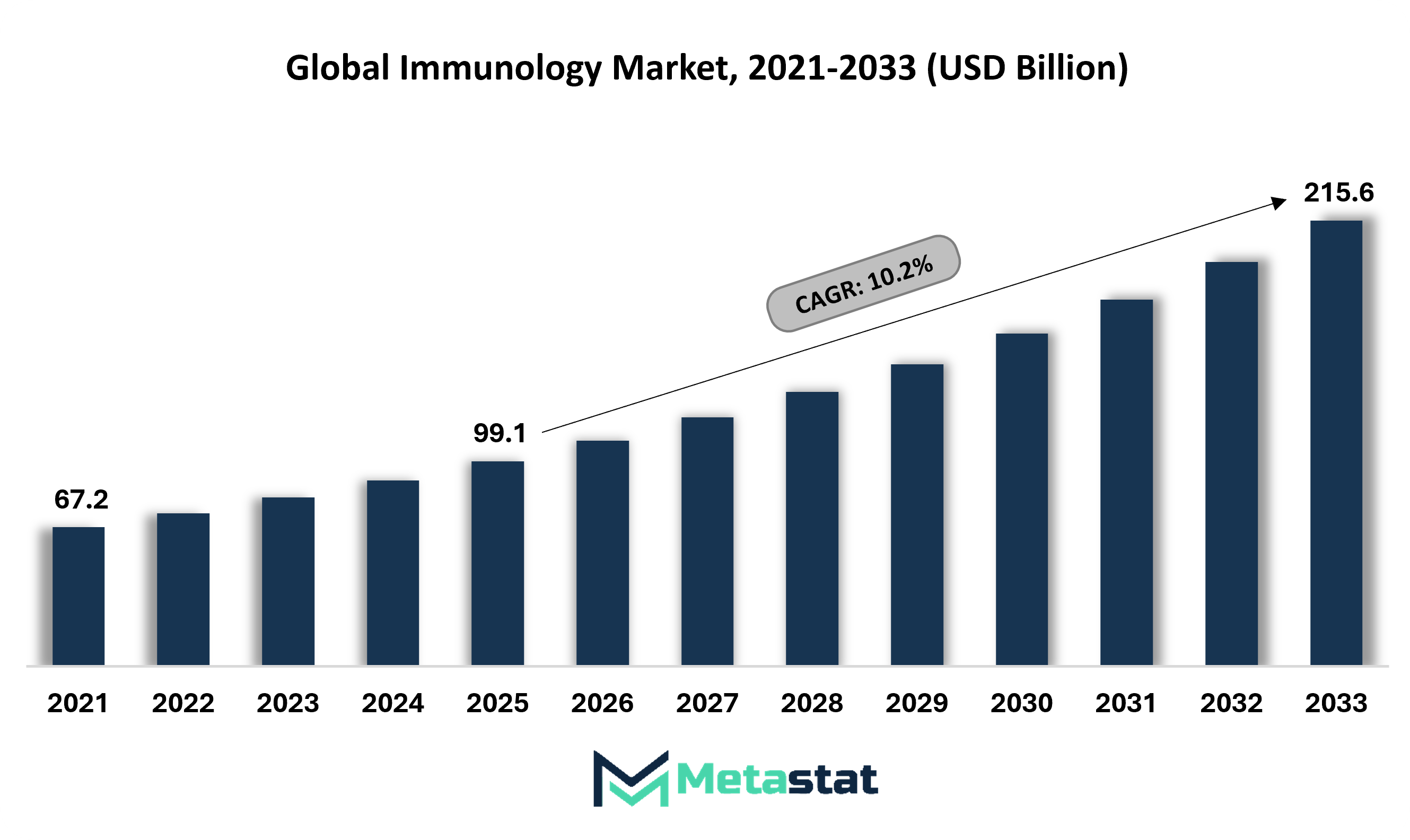
Rising prevalence of autoimmune and other immunological disorders are key driving factors of the market. Immunological disorders are caused by a dysfunction of the immune system including allergy, autoimmune diseases, asthma, autoinflammatory syndromes and immunological deficiency syndromes. According to the National Institutes of Health (NIH), globally, more than 700 million people, nearly one-tenth of the global population suffer from autoimmune disease. According to the American Autoimmune Related Diseases Association (AARDA), up to 50 million Americans suffer from an autoimmune disease and the prevalence is expected to rise in the coming years. According to the British Society for Immunology, more than four million people in the UK have an autoimmune condition. However, the side effect of immunotherapy might hamper market growth. The most common side effect of immunotherapy includes skin redness, blistering, dryness, fever, weakness, vomiting, nausea, body aches, dizziness, and high or low blood pressure. Moreover, increasing investment for immunotherapy would provide lucrative opportunities for the market in the coming years.
The global immunology market is mainly classified based on type and application. Type is further segmented into Monoclonal Antibodies (mAb), Immunosuppressants, Polyclonal Antibody (pAb), Fusion Proteins, and Others. By application, the market is divided into Rheumatoid Arthritis, Psoriatic Arthritis, Ankylosing Spondylitis, Plaque Psoriasis, Prophylaxis of Organ Rejection, Inflammatory Bowel Disease, and Others.
Monoclonal Antibodies(mAb) segment is valued at USD 52.2 billion in 2026 and is projected to reach USD 107.8 billion by 2033, at a CAGR of 10.9% during the forecast period. For instance, AbbVie has received the U.S. Food and Drug Administration (FDA) approval for SKYRIZI (risankizumab-rzaa). SKYRIZI is an interleukin-23 (IL-23) inhibitor for the treatment of moderate to severe plaque psoriasis in adults.
By Application, Rheumatoid Arthritis segment is projected to reach USD 81.9 billion by 2033, at a CAGR of 9.5% during the forecast period.
Based on geography, the global immunology market is divided into North America, Europe, Asia-Pacific, South America, and Middle East & Africa. North America is further divided in the U.S., Canada, and Mexico, whereas Europe consists of the UK, Germany, France, Italy, and Rest of Europe. Asia-Pacific is segmented into India, China, Japan, South Korea, and Rest of Asia-Pacific. The South America region includes Brazil, Argentina, and the Rest of South America, while the Middle East & Africa is categorized into GCC Countries, Egypt, South Africa, and Rest of Middle East & Africa.
North America was dominating the global immunology market in 2025, due to the rising incidence of autoimmune and other immunological disorders, commercialization of new immunology products, increasing clinical studies, the partnership between companies to develop and commercialize new immunology products, and government support to develop immunology products. For instance, The National Institute of Allergy and Infectious Diseases (NIAID) a part of the National Institutes of Health, has funded $30 million three institutions to provide new centers of immunology research for tuberculosis (TB) vaccine development. The three institutions include the Harvard T.H. Chan School of Public Health in Boston, the Infectious Disease Research Institute of Seattle, and the Seattle Children’s Hospital.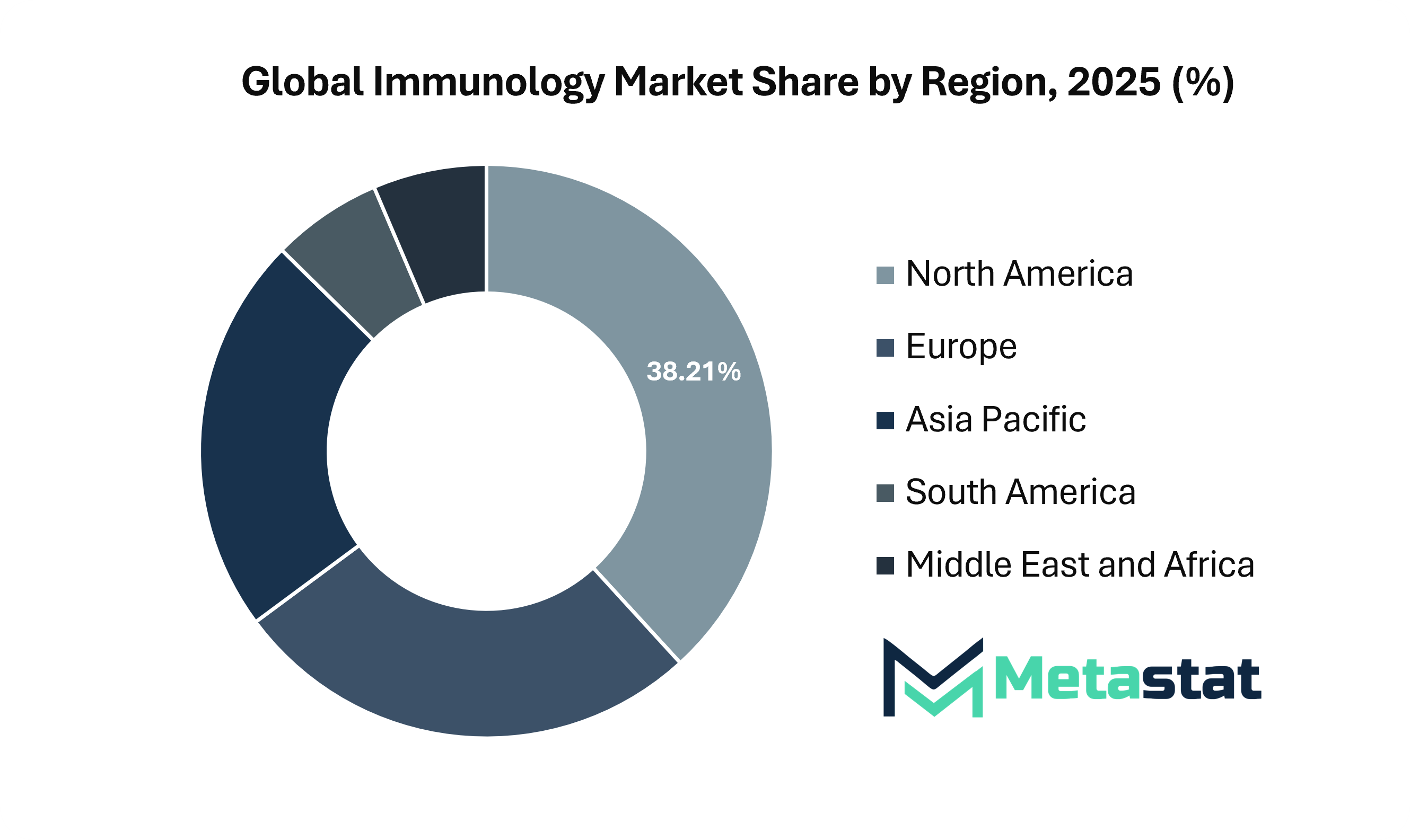
Key players operating in the immunology industry include AbbVie Inc., F. Hoffmann-La Roche Ltd, Pfizer Inc., Astellas, Janssen, Novartis AG, Merck, UCB SA, Bristol-Myers Squibb, and Amgen Inc.
The increasing commercialization of immunology products, rising clinical studies on immunology products, the partnership between companies to develop and commercialize of immunology products, increasing investment and funding by the companies to develop and commercialize immunology products and increasing regulatory approval for immunology products are some of the strategies adopted by the major companies. For instance, on March 26, 2020, Bristol-Myers Squibb Company has received the U.S. Food and Drug Administration (FDA) approval for ZEPOSIA (ozanimod) 0.92 mg for the treatment of relapsing forms of multiple sclerosis (RMS) in adults. ZEPOSIA is an oral medication, is the only approved sphingosine-1-phosphate (S1P) receptor modulator.
|
Report Attributes |
Details |
|
Study Period |
2021-2033 |
|
Base Year |
2025 |
|
Estimated Year |
2026 |
|
Forecast Period |
2026-2033 |
|
Historical Period |
2021-2025 |
|
Growth Rate |
CAGR 10.2% from 2026 to 2033 |
|
Revenue Unit |
USD billion |
|
Sales Volume Unit |
Units |
|
Segmentation |
By Type, Application, and Region |
|
By Region |
North America (By Type, Application, and Country)
|
|
|
Europe (By Type, Application, and Country)
|
|
|
Asia Pacific (By Type, Application, and Country)
|
|
|
South America (By Type, Application, and Country)
|
|
|
Middle East and Africa (By Type, Application, and Country)
|
Find answers to common questions about this report
The Metastat Insights study reveals that the Immunology market size was valued at USD 99.1 billion in 2025.
The Immunology market is projected to grow at a CAGR of 10.2% during the forecast period from 2026 to 2033.
According to Metastat Insights analysis, the North America Immunology market size is estimated to reach USD 75.9 billion by 2033.
The analysts below cover Healthcare research at Metastat Insights.
LEAD ANALYST
Utkarsh Khirodkar is a Lead Market Research Analyst at MetaStat Insight, specializing in market intelligence, technology sector assessments, and competitive strategy.

LEAD PRINCIPAL ANALYST, PHARMA AND HEALTHCARE
Food and Beverages · Healthcare · Healthcare IT · Medical Devices
Ajay Devgire is the Lead Healthcare Analyst at MetaStat Insight, leading strategic research and market intelligence initiatives across the global healthcare domain.
Tracking capacity expansion in single-use bioprocessing requires dependable data on raw material availability and cleanroom-grade polymer supply chains. The competitive landscape chapter gave a grounded evaluation of secondary component suppliers across North America and Asia-Pacific rather than simply reprinting press releases. Having that level of supplier benchmarking helped clarify dual-sourcing considerations for our clinical pipeline planning.
When evaluating distributed energy resource management systems, standard research summaries tend to gloss over the operational differences between front-of-the-meter utility deployments and behind-the-meter industrial sites. The MetaStat Insight report addressed those distinctions directly, especially regarding software interoperability standards and grid interconnection backlogs. The five-year market sizing across regional transmission organizations provided actionable context for our grid modernization strategy.
Most industry reports on warehouse automation bundle autonomous mobile robots and fixed conveyor installations into the same top-level numbers, which complicates advisory work. This study split the market cleanly by payload tiers, navigation technology, and fleet management software layers. The regional forecast for Western Europe gave our team defensible adoption benchmarks when evaluating capital allocation for logistics clients, saving us days of secondary data scrubbing.
Explore related market intelligence reports worth reading alongside this one.