
LEAD ANALYST
Utkarsh Khirodkar is a Lead Market Research Analyst at MetaStat Insight, specializing in market intelligence, technology sector assessments, and competitive strategy.

Global In-Space Manufacturing, Servicing and Transportation Market Size, Share, By Service Type (Orbital transportation and payload deployment, Space-station cargo delivery and return, Satellite life extension, Inspection and diagnostics, Repair and component replacement, Refueling and propellant transfer, Debris removal and disposal, In-space manufacturing and processing and On-orbit assembly), By Orbit (Low Earth orbit (LEO), Geostationary orbit (GEO), Medium Earth orbit (MEO) and Cislunar and deep space), By Application (Satellite fleet operations, Space-station operations, Space telescopes and scientific spacecraft and Free-flying manufacturing platforms), By End User (Commercial satellite operators, Civil space agencies, Defense and intelligence agencies, Commercial space-infrastructure operators, Industrial manufacturing customers, Research institutions and Others (Spacecraft prime contractors and mission integrators)), Industry Analysis, Growth, Trends, and Forecast, 2026-2033
Report ID
MSI-3433
Published
October, 2026
Pages
294 Pages
Format
Historical
Base year
Forecast
Forecast period
Report Details
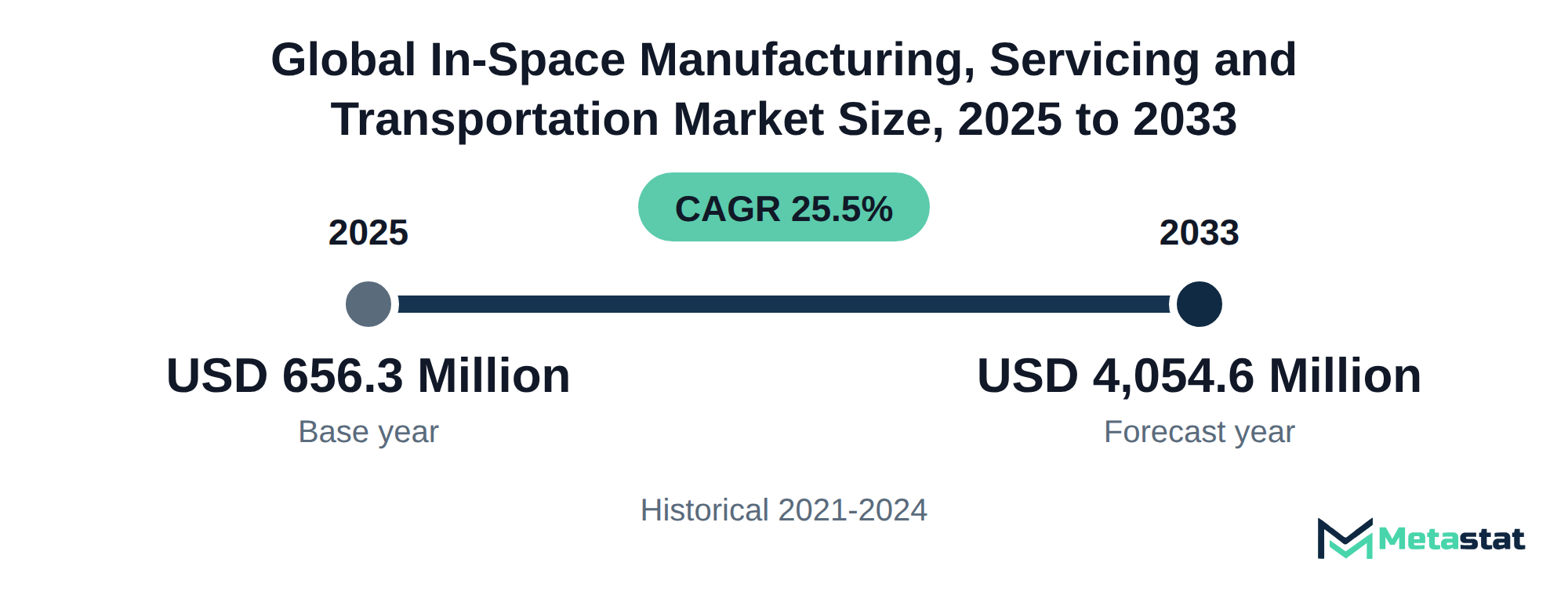
Market Valuation: Valued at $656.3 Million in 2025, projected to reach $4,054.6 Million by 2033 at a 25.5% CAGR.
Dominant Segment: The orbital transportation and payload deployment segment leads the market, driven by increasing demand for satellite services and efficient logistics.
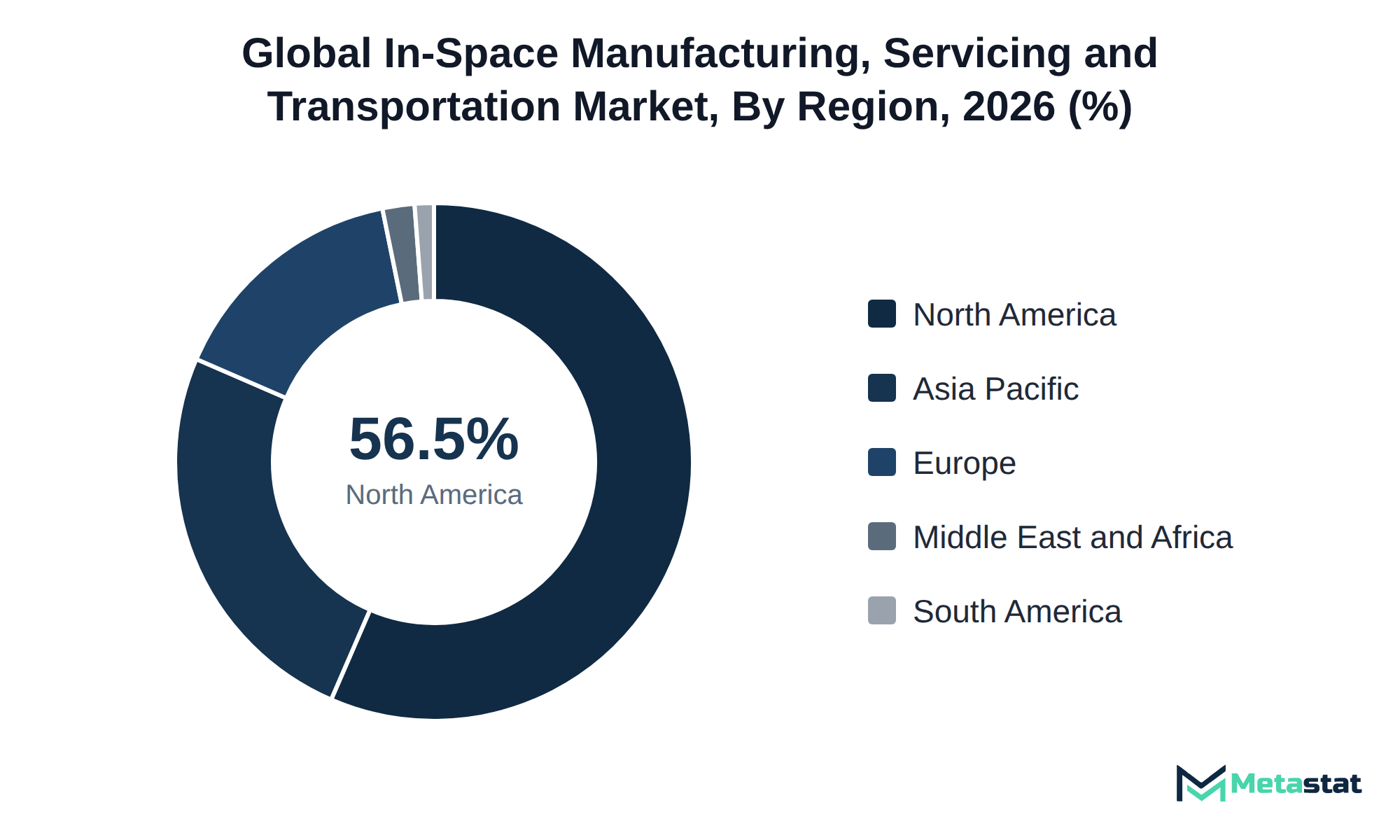
Geographic Lead: North America dominates the market, holding 56.5% in 2025, with the U.S. leading due to robust infrastructure and investment in space capabilities.
What's Inside: The report provides comprehensive coverage of market dynamics, competitive landscape, and detailed forecasts from 2026 to 2033 across various segments and applications.
Emerging Technologies: Advancements in robotics and automation are enhancing operational efficiency, reducing costs, and improving service offerings for satellite servicing and maintenance.
Price Sensitivity: Commercial satellite operators exhibit price sensitivity, impacting procurement decisions and leading to a preference for lower-cost alternatives in the market.
Choose Your License
Global In-Space Manufacturing, Servicing and Transportation Market
The global In-Space Manufacturing, Servicing and Transportation market was valued at USD 656.3 million in 2025 and is projected to reach USD 4,054.6 million by 2033, growing at a CAGR of 25.5% over the forecast period.
The In-Space Manufacturing, Servicing and Transportation market encompasses the development and deployment of technologies aimed at enhancing space operations. This includes services including orbital transportation, cargo delivery, satellite life extension, and in-space manufacturing. Buyers invest in this market driven by increasing demand for space exploration, satellite deployment, and the need for more efficient space logistics. The expansion of commercial space activities and government initiatives in space research fuels investment in these services.
Growth in the market is primarily influenced by advancements in technology that facilitate more efficient operations in space. The segment focused on orbital transportation and payload deployment represents the largest share within the market, capturing significant attention from various stakeholders. North America holds 56.5% of the market in 2025, with the US leading in 2026. This dominance reflects strong infrastructure and investment in space capabilities within the region.
Demand for satellite operations and space-station initiatives increases, and the market shows a strong trajectory toward expansion. The need for sustainable practices in space operations drives innovation and competition among service providers. This environment presents opportunities for growth across different regions, particularly where governments and private enterprises collaborate on space missions.
The In-Space Manufacturing, Servicing and Transportation market focuses on a variety of services including orbital transportation, payload deployment, and satellite life extension. Buyers invest in this market to improve operational efficiency and ensure the longevity of space assets. Demand for these services arises from commercial satellite operators, civil space agencies, and defense entities, all requiring reliable solutions for their unique space missions. Growing complexity of space operations necessitates advanced technologies that enhance performance and safety, driving investment in this sector.
Significant growth in the market is propelled by increasing demand for satellite fleet operations, particularly in Low Earth Orbit (LEO). The region's established aviation, defense, and space ecosystem, coupled with robust government funding, positions it favorably for continued growth. In contrast, Europe and Asia Pacific represent 15.3% and 25% of the market, respectively, indicating potential for expansion in those regions.
The commercial satellite operators segment leads in value, reflecting the rising need for advanced satellite services. Market competition heightens, driving innovation across service types and applications. Investment in in-space manufacturing technologies enhances operational capabilities, ultimately contributing to overall growth of the In-Space Manufacturing, Servicing and Transportation market.
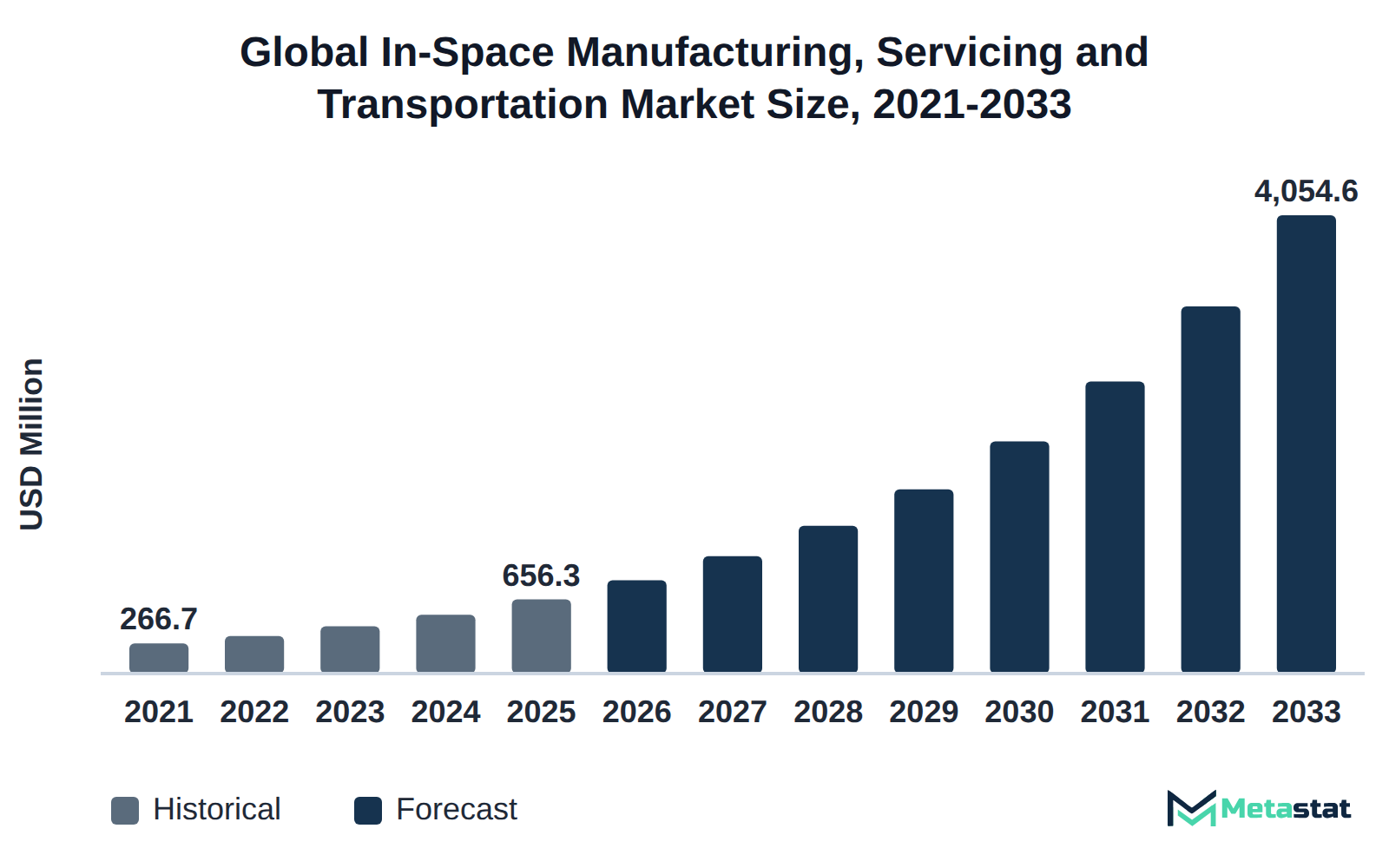
Orbital transfer vehicles (OTVs) enhance the efficiency and reliability of satellite deployment and cargo logistics within the In-Space Manufacturing, Servicing and Transportation market. These vehicles facilitate the movement of payloads between different orbital locations, significantly reducing the logistical complexities associated with conventional launch methods. The forecasted growth of the OTV segment highlights its importance. Orbital transportation and payload deployment are expected to increase from USD 267.6 million in 2026 to USD 1,197.7 million by 2033, reflecting a compound annual growth rate (CAGR) of 23.9%.
The rapid development of OTV technology stems from increasing demand for satellite services, particularly among commercial satellite operators and civil space agencies. These buyers require efficient and reliable systems for deploying and maintaining satellite constellations, driving investments in advanced OTV designs and functionalities. The operational cost savings and increased payload capacity offered by OTVs create a competitive advantage for firms operating in the market. Strategic investments in OTV technology improve operational efficiency and position companies to meet rising demand for satellite-based services.
Refueling interfaces and robotic docking shape the economics of satellite life-extension projects within the In-Space Manufacturing, Servicing and Transportation market. The increasing significance of these technologies influences contract models and pricing strategies for buyers. For instance, the segment targeting satellite life extension is projected to reach USD 493 million by 2033, reflecting a growing commitment to enhancing operational capabilities.
Buyers approach contracts for satellite life-extension services with a keen focus on performance-based pricing models. This shift aligns with the industry's need for cost efficiency, enabling stakeholders to pay based on outcomes rather than fixed fees. Contracts often encompass provisions related to the successful execution of refueling operations and robotic docking, ensuring that satellite operators incur costs only when service quality meets specified criteria.
In the context of the market, the integration of advanced refueling interfaces and robotic systems streamlines operations, enhancing the reliability of satellite extensions. Buyers in the commercial satellite operator sector, projected to grow from USD 233.1 million in 2026 to USD 1,201 million in 2033, prioritize these innovations to optimize investment returns. This trend underlines the strategic importance of incorporating innovative technologies in procurement decisions.
The evolution of pricing and contract models driven by advancements in refueling interfaces and robotic docking positions buyers to achieve greater operational efficiency within the In-Space Manufacturing, Servicing and Transportation market. This approach encourages innovation and drives sustainable growth while organizations seek to maximize the longevity and performance of their satellite assets.
Microgravity processing enhances the quality of semiconductor materials and pharmaceuticals produced in space. The unique conditions of microgravity enable the manufacturing of materials with fewer defects, leading to improved performance and reliability. For instance, semiconductor materials benefit from the reduced sedimentation and convection currents present in a microgravity environment, which leads to higher purity and better structural integrity. High purity is also a defining requirement in the polysilicon for electronics industry.
In the In-Space Manufacturing, Servicing and Transportation market, the anticipated growth in microgravity processing directly correlates with the increasing demand for high-quality semiconductor products and pharmaceuticals. By 2033, the segment for satellite life extension is expected to reach USD 493 million, highlighting the financial potential associated with advanced production techniques in space. This trend reflects the growing recognition among commercial satellite operators and civil space agencies of the value added by microgravity manufacturing processes.
Investments in microgravity manufacturing technologies are expected to yield significant returns for stakeholders, including improved efficiency and reduced costs associated with defects and reworks in semiconductor and pharmaceutical production. While the market evolves, the opportunity for companies to use these advanced manufacturing techniques significantly influences overall competitiveness and innovation in the sector.
On-orbit satellite servicing presents a cost-effective alternative to satellite replacement, particularly in situations involving aging satellites. Servicing options are gaining recognition for their value over traditional replacement methods.
Cost savings through servicing derive from the ability to extend satellite life, perform repairs, and update technologies in space. By applying on-orbit servicing, satellite operators avoid the high costs associated with launching new satellites, which often exceed USD 100 million. Operational downtime linked to satellite replacement significantly impacts service revenue, emphasizing the benefits of extending existing satellite capabilities.
The In-Space Manufacturing, Servicing and Transportation market continues to evolve, highlighting the importance of servicing solutions that enhance satellite longevity and performance. This shift toward servicing over replacement is expected to reshape investment strategies within the satellite industry, encouraging stakeholders to explore innovative servicing options to optimize fleet management and reduce long-term operational costs.
Commercial satellite operators show heightened interest in satellite life extension and operational support. Factors driving this trend include the growing reliance on satellites for communication, navigation, and scientific research. The increase in demand for satellite services results in more operators seeking efficient solutions to extend satellite lifespan and enhance service capabilities. This shift leads to greater spending on in-space manufacturing and servicing solutions. The sector is projected to reach USD 1,201 million by 2033, driven by commercial satellite operators’ efforts to optimize their investments. These developments reinforce the positive outlook for the market.
In parallel, civil space agencies respond to the same demand dynamics, focusing on operational advancements within their satellite fleets. The anticipated growth in budget allocations for such projects contributes to the expanding market landscape. The increasing prevalence of satellite deployment and servicing is expected to attract further investment, thereby enhancing competitive positioning within the market.
Advancements in robotics and automation significantly enhance operational efficiency within the In-Space Manufacturing, Servicing and Transportation market. Innovations in robotic systems streamline tasks including satellite servicing, maintenance, and assembly, reducing dependency on extensive human intervention. These technological developments lower operational costs for commercial satellite operators and civil space agencies, allowing for more extensive service offerings in orbital environments. Automation capabilities improve precision in on-orbit tasks, thereby increasing the reliability of mission-critical operations.
The integration of artificial intelligence and machine learning into operational processes improves decision-making, enabling companies to optimize resources effectively. This growing technological landscape supports market expansion by attracting investment from both traditional aerospace players and emerging startups. Enhanced efficiency from these advancements leads to a reduction in time and expenses associated with space missions, creating a favorable environment for growth. Overall, these technological innovations position market participants for increased competitiveness and operational success.
Price sensitivity impacts the purchasing decisions of commercial satellite operators within the market. High costs associated with in-space manufacturing and servicing technologies contribute to slower uptake and smaller order sizes among these buyers. Many operators prioritize budget constraints, leading to a preference for lower-cost alternatives when making procurement decisions. Overall investment levels in advanced technologies are hindered by this trend, which limits growth of the market. The presence of less expensive substitutes often delays replacement of aging satellite systems, further constraining demand. Cost pressures from fiscal uncertainties and competitive bidding environments create additional challenges for commercial operators, limiting their ability to invest in innovative in-space solutions. In this context, achieving economies of scale and reducing operational costs becomes necessary for improving adoption and growth within the market.
Suppliers within the In-Space Manufacturing, Servicing and Transportation market experience increasing margin pressure due to rising operational costs. Factors including inflation and the escalating costs of advanced technologies contribute to this challenge. Suppliers struggle to maintain profitability while facing demands for competitive pricing from commercial satellite operators and civil space agencies. The necessity to balance cost management with service quality complicates operational strategies. In response, companies explore innovative operational efficiencies and strategic partnerships to share resources and reduce overhead expenses. Investments in automation and advanced manufacturing techniques emerge as a popular approach to streamline operations and reduce costs. These measures help suppliers enhance their competitive position while addressing margin pressures. Sustaining growth and profitability in the market depends on controlling costs without compromising service quality.
Commercial satellite operators represent a significant growth opportunity within the In-Space Manufacturing, Servicing and Transportation market. This segment is projected to experience a compound annual growth rate of 26.4% from 2026 to 2033, reaching a market value of USD 1,201 million by 2033. Factors contributing to this growth include increasing demand for extended operational timelines of satellites, which enhances return on investment and operational flexibility for operators. The adoption of advanced technologies, including autonomous systems for servicing and in-orbit assembly, further supports this trend. This segment addresses the economic pressures faced by operators seeking cost-effective solutions and aligns with evolving industry standards aimed at sustainability and efficiency. Innovative service models targeting satellite life extension enhance market penetration and attract a broader customer base, ultimately driving competitive dynamics within the market.
The Global In-Space Manufacturing, Servicing and Transportation market is segmented based on Service Type, Orbit, Application, and End User.
This segment primarily facilitates the delivery of payloads to various orbits, serving commercial satellite operators and civil space agencies by ensuring efficient and reliable transportation of equipment and supplies. Demand stems from the increasing number of satellite launches and the growing need for reliable logistics in space. The segment features a higher growth rate compared to others including satellite life extension, which has a CAGR of 22.3%. This difference highlights the increasing emphasis on timely orbital transportation to support expanding satellite networks and missions, positioning the segment as a critical component of the market's evolution.
Space-station cargo delivery and return segment is estimated to reach USD 361.3 million by 2033, at a CAGR of 22.3% during the forecast period. This segment facilitates the transportation of cargo to and from space stations, primarily aiding research institutions and civil space agencies in their operations. Increased investment in space research and development drives demand for reliable cargo delivery systems, increasing the importance of this segment relative to others. Compared to orbital transportation and payload deployment, which has a CAGR of 23.9%, growth in space-station cargo delivery is slightly slower. The unique needs of civil space agencies for safe and efficient transportation of materials and equipment distinguish this segment from others, reflecting a strategic approach to support ongoing scientific activities in low Earth orbit.
This segment provides services that extend the operational life of satellites, primarily serving commercial satellite operators and civil space agencies. Expansion of satellite constellations drives demand for life extension services, helping to mitigate the costs associated with satellite replacement. This segment shows a compound annual growth rate (CAGR) of 22.3%, slightly lower than the orbital transportation and payload deployment segment, which has a CAGR of 23.9%. Technological advancements in satellite servicing and diagnostics play an essential role in shaping this segment, enabling operators to extend the functional lifespan of their assets effectively. The focus on sustainability within the market influences investment in these services, highlighting a shift towards optimizing existing space infrastructure rather than pursuing new launches.
Inspection and diagnostics segment is projected to grow at a CAGR of 22.3% during the forecast period. This segment involves assessing the condition and functionality of spacecraft and satellites to ensure optimal performance. Commercial satellite operators and civil space agencies primarily use inspection and diagnostics to maintain mission readiness and operational efficiency. The ongoing evolution in satellite technology drives demand for advanced diagnostic tools and techniques, enhancing the ability to quickly identify and rectify issues. Condition monitoring of this kind is also central to the predictive maintenance industry. Compared to other service segments, this segment experiences steady growth due to the increasing complexity of satellite operations and the high costs associated with satellite failures. Significant investment in technology for improved diagnostics and monitoring supports this trend, positioning inspection and diagnostics as a vital aspect of the market's overall expansion.
Repair and component replacement involves the maintenance and upgrading of various space assets, ensuring their continued functionality in the harsh environment of space. This segment primarily serves commercial satellite operators, civil space agencies, and defense agencies, highlighting the critical need for operational reliability in space missions. Growth in this area is propelled by the increasing complexity of satellite systems and the rising costs associated with satellite replacement. Advancements in technology facilitate more effective repair solutions, providing significant cost savings and extending the operational lifespan of existing assets. Unlike other segments, including orbital transportation, this segment experiences slower growth due to the specialized nature of repairs and the intricate logistics involved. The market thrives on the necessity of maintaining active satellite fleets and supporting ongoing missions rather than focusing solely on new deployments.
Refueling and propellant transfer help maintain satellite operations and support the longevity of spacecraft. This process involves transferring fuel and other propellants to various orbital platforms, enabling them to sustain their missions for extended periods. Commercial satellite operators and space agencies apply refueling technologies to maximize the efficiency of their fleets and reduce the costs associated with replacing satellites. Growth in this segment is driven by the increasing number of satellites in orbit and the need for ongoing support for existing spacecraft. Compared with other segments, refueling and propellant transfer experience slower growth due to the high initial investment required for infrastructure development. The market experiences distinct pricing dynamics, influenced by technological advancements and competition among service providers.
Debris removal and disposal involves the active management of space debris to maintain a safe operational environment for spacecraft and satellites. This segment supports the sustainability of space activities, with stakeholders including commercial satellite operators and civil space agencies prioritizing debris mitigation strategies. Increasing satellite launches contribute to the growing recognition of space debris as a significant risk, driving investments in effective removal technologies. This segment differs from others in the market, addressing a critical challenge faced by all space operators rather than focusing solely on servicing existing assets. While other segments experience growth driven by operational needs, debris removal and disposal plays a unique role in enhancing safety and sustainability within the space ecosystem.
In-space manufacturing and processing involves the creation of components and products in low-gravity environments. This segment serves significant functions for commercial satellite operators and civil space agencies, supporting the production of materials that enhance satellite capabilities and operational longevity. Heightened demand for customized and innovative solutions drives growth, particularly in advanced materials and technologies. This sub-segment typically experiences higher pricing compared to others, including satellite life extension, due to the specialized equipment and expertise required. Differentiation from other service types occurs through its focus on manufacturing processes, while orbital transportation and payload deployment primarily address logistics needs. The innovative nature of in-space manufacturing fuels investment and competition, positioning it as a vital component of the broader In-Space Manufacturing, Servicing, and Transportation market.
On-orbit assembly involves the construction and integration of spacecraft components while in space. This process is essential for complex missions, particularly for building larger structures like space stations or habitats. Commercial satellite operators and civil space agencies apply on-orbit assembly to enhance the capabilities of their missions, enabling greater operational flexibility and reducing the need for extensive pre-launch assembly. Demand for this segment is influenced by advancements in robotics and automation, which streamline assembly tasks and increase efficiency. In contrast to other service types, on-orbit assembly experiences slower growth due to the higher complexity and cost associated with developing such capabilities. This differentiates it from segments like orbital transportation and payload deployment, which are projected to grow at a faster rate during the forecast period. Merging technologies and evolving market dynamics continue to shape the market.
Low Earth orbit (LEO) segment is valued at USD 443 million in 2026 and is projected to reach USD 1,952.7 million by 2033, at a CAGR of 23.6% during the forecast period. This segment primarily supports satellite fleet operations and space-station activities, catering to commercial satellite operators, civil space agencies, and defense entities. Increased demand for satellite services drives growth, supported by advancements in satellite technology that enhance operational capabilities. In comparison to geostationary and medium Earth orbit segments, LEO exhibits a higher growth rate driven by its suitability for varied applications, including Earth observation and communication. This growth trajectory highlights the increasing need for efficient and cost-effective solutions within the market, resulting in significant investment in infrastructure and technology development.
Geostationary orbit (GEO) segment is estimated to reach USD 1,314.5 million by 2033, at a CAGR of 24% during the forecast period. This orbit is primarily used by GEO satellite platforms for communications, broadcasting, and weather monitoring, serving governmental and commercial users. The increasing demand for reliable communication services drives growth in this segment, with operators seeking to enhance connectivity across various regions. This segment differentiates itself from others within the market due to its higher average pricing and stable operational characteristics. The GEO segment experiences greater adoption rates than low Earth orbit (LEO) options, which face competition from emerging technologies and lower-cost alternatives. The need for advanced satellite capabilities and long-duration missions supports continued investment in geostationary solutions within the In-Space Manufacturing, Servicing and Transportation market.
Medium Earth orbit (MEO) segment is expected to reach USD 116.8 million by 2033. This segment primarily supports applications including telecommunications, navigation, and Earth observation. Operators use MEO for its ability to balance coverage area and latency, serving both commercial satellite operators and civil agencies. A significant factor driving growth in this segment involves increasing demand for enhanced connectivity and real-time data access, aligning with evolving technological needs. MEO experiences slower growth than Low Earth orbit (LEO), which features a CAGR of 23.6%, indicating a higher competitive advantage in terms of operational costs and pricing. The anticipated growth trajectory of this segment highlights its importance in the overall market, addressing specific user requirements while contributing to advancements across the In-Space Manufacturing, Servicing, and Transportation market.
The Cislunar and deep space segment is projected to grow at a CAGR of 38.9% during the forecast period. This segment focuses on supporting operations beyond Low Earth Orbit (LEO), including missions to the Moon and beyond. Key players, including defense and intelligence agencies, engage in this segment for exploration and scientific research purposes. The increasing interest in lunar exploration and future Mars missions drives demand, supported by advancements in rocket propulsion technologies and mission planning. Unlike other segments, this domain experiences faster growth due to its unique applications and the anticipated influx of investment from both public and private sectors. Given the ongoing interest in deep space exploration, the Cislunar and deep space segment holds substantial potential for expansion and innovation, differentiating it from other orbit categories in the In-Space Manufacturing, Servicing and Transportation market.
Highly elliptical Earth orbits represent a unique category within the orbit segmentation of the market, catering to specialized missions requiring specific trajectories. This segment finds applications in scientific research, satellite communications, and exploratory missions that require flexible and extended orbital paths. It serves civil space agencies and private enterprises focused on advanced research and technology development. Demand for this segment increases due to the growing emphasis on innovative space exploration strategies and the necessity for diverse orbital capabilities. Compared to other orbit categories, this segment faces slower growth, primarily due to its niche applications and the higher costs associated with specialized vehicles and technologies needed for operation. The intricacies of mission planning in this segment require significant expertise, differentiating it from more standard orbital applications in the market.
Satellite fleet operations segment is valued at USD 450.3 million in 2026 and is projected to reach USD 1,831.9 million by 2033, at a CAGR of 22.2% during the forecast period. This segment focuses on managing and coordinating satellite operations across various fleets, ensuring optimal functionality and performance. Commercial satellite operators, civil space agencies, and defense organizations engage in these operations to enhance mission success rates. A significant driver for this segment includes the increasing demand for satellite-based services, especially in telecommunications and earth observation. Compared to other segments, satellite fleet operations experience higher growth rates, with a CAGR of 22.2%, influenced by advancements in satellite technology and increased investment in space exploration. This growth positions it favorably within the In-Space Manufacturing, Servicing and Transportation market.
Space-station operations segment is estimated to reach USD 824.7 million by 2033, at a CAGR of 24.3% during the forecast period. This segment focuses on research and experiments conducted aboard space stations, primarily performed by civil space agencies and commercial entities for scientific purposes. The growing demand for space exploration and the need for advanced research capabilities drive the expansion of this segment. Comparatively, this segment exhibits a higher growth rate than satellite fleet operations, which has a CAGR of 22.2%. Ongoing advancements in technology for conducting experiments in microgravity environments enhance the operational potential of space stations, positioning this segment as a vital component of the market. Increased investment from both governmental and private sectors encourages growth in this segment, fostering further innovation and exploration opportunities that contribute to the overall dynamics of the In-Space Manufacturing, Servicing and Transportation market.
Space telescopes and scientific spacecraft segment is expected to reach USD 351.5 million by 2033. This segment focuses on the development and operation of telescopes and spacecraft for scientific research and exploration. These assets are critical for various applications, including astronomical observation, planetary exploration, and space weather monitoring, primarily by government agencies and research institutions. Developments in optical telescope technology also inform the astronomical observation work of these assets. Demand for advanced scientific capabilities drives growth in this segment, alongside increasing investments in space exploration initiatives. Compared to other segments, growth in this area is anticipated to be relatively high, supported by a CAGR of 24.3% during the forecast period, reflecting a robust interest in expanding scientific knowledge. The market sees considerable competition as various stakeholders engage in developing innovative technologies to enhance the performance and capabilities of these missions.
Free-flying manufacturing platforms segment is projected to grow at a CAGR of 34.1% during the forecast period. This application focuses on manufacturing activities occurring in space, independent of a fixed facility. Industries including commercial satellite operators and civil space agencies employ these platforms for innovative manufacturing processes that leverage microgravity. Rapid advancements in technology drive this segment, enabling the creation of products with unique properties that cannot be achieved on Earth. Compared to other applications, free-flying manufacturing platforms exhibit faster growth due to increased demand for in-space production capabilities and the potential for cost savings in materials and logistics. This segment stands out for its ability to offer solutions that traditional manufacturing methods cannot, thereby attracting significant interest and investment in the In-Space Manufacturing, Servicing and Transportation market.
Cislunar infrastructure support focuses on enabling operations and activities in the cislunar space, which encompasses the region between the Earth and the Moon. This segment serves commercial players and governmental space agencies undertaking missions that involve lunar exploration, resource extraction, and potential habitation. Demand for advancements in cislunar infrastructure support is driven by increasing interest in the Moon's resources and the establishment of sustainable human presence beyond Earth. This segment typically experiences faster growth compared to other applications due to its unique positioning as a bridge for deeper space exploration. Unlike segments focused on lower Earth orbits, cislunar infrastructure support attracts investments aimed at long-term lunar activities, indicating strong commitment from stakeholders in the In-Space Manufacturing, Servicing and Transportation market.
This segment serves various businesses and organizations involved in satellite operations, including telecommunications, Earth observation, and weather monitoring. Growth in this segment is driven by increasing demand for satellite services and advancements in satellite technology. Compared to other segments, commercial satellite operators exhibit a higher growth rate, reflecting a strong reliance on satellite-based solutions for connectivity and data collection. The affordability of satellite launch services and the push for enhanced communication infrastructure significantly influence the dynamics of this segment. Robust interest from private enterprises seeking to expand their capabilities in space operations leads to a competitive landscape that encourages innovation and investment.
Civil space agencies segment is estimated to reach USD 1,181.5 million by 2033, at a CAGR of 22.3% during the forecast period. This segment includes various governmental organizations that focus on space exploration, research, and technology development. These agencies employ in-space manufacturing and servicing to enhance their operational capabilities, conduct scientific research, and improve satellite longevity. Increasing global emphasis on space exploration and the need for sustainable practices drive demand in this segment. Compared to other end users, civil space agencies often have longer project timelines and funding cycles, leading to more gradual growth compared to commercial satellite operators, which exhibit faster expansion at a CAGR of 26.4%. The unique requirements of civil agencies result in higher investment values, reflecting the critical nature of their missions and objectives in the market.
The defense and intelligence agencies segment is expected to reach USD 844.6 million by 2033. This segment focuses on high-stakes operations involving national security, surveillance, and intelligence gathering. Key players include governmental organizations and defense contractors that engage in in-space services to enhance capabilities. A primary force driving this segment is the increasing demand for advanced surveillance technologies, reflecting a global push to enhance security measures. With a CAGR of 22.3%, this segment expands at a slower rate compared to commercial satellite operators, which grow at a CAGR of 26.4%. Technological advancements in satellite life extension and repair services further influence growth in this segment. The distinct focus on national interests and security applications differentiates it from other end-user segments in the market. That emphasis on security ties the segment to the wider defense system industry.
Commercial space-infrastructure operators segment is projected to grow at a CAGR of 31.7% during the forecast period. This segment involves the provision of essential support services and facilities designed to enable space missions and operations. Key users include private operators developing infrastructure for satellite launches, orbital maintenance, and transportation services. Demand for advanced capabilities in space logistics is a significant driver for this segment. Differing from other end-user segments, commercial space-infrastructure operators benefit from a dynamic market, with increasing investments in space-related activities. The anticipated growth contrasts with slower expansion in sectors including civil space agencies, which project a CAGR of 22.3%. The emphasis on commercial partnerships and technological advancements positions this segment for substantial revenue increases, contributing to the overall dynamics of the market.
Industrial manufacturing customers engage in-space services for various applications, including the development of advanced materials and components designed for space operations. These customers typically include private sector companies seeking to enhance their capabilities in the production of specialized equipment for space exploration and satellite systems. The growing demand for innovative manufacturing solutions in low-gravity environments drives this segment's growth. Unlike civil space agencies, which focus on governmental and scientific objectives, industrial manufacturing customers prioritize commercial viability and profitability, contributing to potentially higher price sensitivity. The unique challenges of operating in space present both opportunities and barriers, influencing investment strategies and technological advancements. This segment's focus on efficiency and cost-effectiveness contrasts with the more research-oriented approach of other end users. Increasing investments in space infrastructure and commercial satellite operations positively impact the overall dynamics of the In-Space Manufacturing, Servicing and Transportation market.
Research institutions play a significant role in the exploration and advancement of in-space technologies. These entities conduct experiments and develop new methodologies to enhance the capabilities of in-space manufacturing and servicing. Driven by the demand for innovative research and technological breakthroughs, these institutions often collaborate with commercial firms to leverage their resources and expertise. The focus on scientific discovery and technological development distinguishes this sub-segment from others, including commercial satellite operators, which primarily aim for profit-driven outcomes. Research institutions seek to push the boundaries of knowledge and technology, creating an environment conducive to groundbreaking developments. While other segments experience rapid growth, research institutions operate with a longer-term perspective that prioritizes exploration and discovery over immediate financial returns, aligning with the broader objectives of the In-Space Manufacturing, Servicing and Transportation market.
Others (Spacecraft prime contractors, mission integrators) focus on providing comprehensive solutions for the integration and management of space missions, employing in-space manufacturing and servicing capabilities. These contractors and integrators play essential roles in ensuring mission success for various stakeholders, including government space agencies and commercial satellite operators. Demand for advanced technologies drives this segment, enabling enhanced mission capabilities and reduced operational risks. In contrast to other segments, this sub-segment typically involves higher budget allocations and longer project timelines, reflecting the complexity and scale of the missions involved. The market presents ongoing opportunities due to the increasing number of space missions and the growing reliance on private sector expertise in mission execution. The In-Space Manufacturing, Servicing and Transportation market continues to evolve, encouraging innovation and collaboration among service providers and end users alike.
Based on geography, the Global In-Space Manufacturing, Servicing and Transportation market is divided into North America, Europe, Asia-Pacific, South America, Middle East, and Africa.
North America commands a 56.5% share in the In-Space Manufacturing, Servicing and Transportation market in 2025. The projection of USD 2,077.6 million by the end of 2033 reflects strong demand driven by commercial satellite operators and civil space agencies. The United States leads in investment and innovation, with initiatives focusing on enhancing satellite capabilities and space station operations. Infrastructure development in low Earth orbit (LEO) and geostationary orbit (GEO) enables efficient deployment of services, creating a competitive landscape. Rapid advancements in technology and increasing collaboration among key players are essential for market growth in this region, creating opportunities for space-infrastructure operators and addressing evolving requirements in the industry.
Demand within the European region for the In-Space Manufacturing, Servicing and Transportation market is driven by a robust presence of commercial satellite operators and civil space agencies. Countries including Germany, France, and the UK exhibit significant activity in satellite development and deployment, contributing to advancements in space infrastructure. The integration of innovative technologies and collaboration among private and governmental entities enhances operational capabilities. The regional share of the global market stands at 15.3% in 2025, with expectations of increased investment in satellite life extension and space-station cargo delivery services. The focus on sustainable space practices reflects the evolving regulatory landscape, which encourages environmentally responsible operations. These conditions position Europe as a key player in the market, driving growth and innovation in related applications.
Rapid advancements in technology and increasing investment in space exploration fuel growth in the In-Space Manufacturing, Servicing and Transportation market across Asia-Pacific. Countries including China, Japan, and India emphasize the development of satellite technologies, driving demand from commercial satellite operators and civil space agencies. The regional share of the global market stands at 25.0% in 2025, reflecting strong commercial interest and government support for space initiatives. Infrastructure development in Low Earth Orbit (LEO) supports orbital transportation and payload deployment services, which are essential for new missions. The region's emphasis on research and development enhances opportunities for innovation within the market, particularly in applications related to space-station operations and satellite life extension. This focus on expanding capabilities contributes to a projected market value of USD 4,054.6 million by 2033.
Brazil and Argentina exhibit increasing interest in the In-Space Manufacturing, Servicing and Transportation market due to government initiatives aimed at enhancing their space capabilities. These countries actively explore opportunities within satellite life extension and orbital transportation, reflecting their growing ambitions in space technology. The South American market represents a niche yet significant role in global space operations. Investment in infrastructure and regional partnerships signals a commitment to boosting local capabilities in space activities. Growth potential in South America relies on developing commercial satellite operations and collaborative projects involving civil space agencies, enabling advancement in scientific and industrial applications.
Growth within the Middle East and Africa region derives from increasing investments in space exploration and development initiatives. Countries like Saudi Arabia and the UAE emphasize advancing their space capabilities through national programs and partnerships, which directly influence demand within the market. South Africa contributes to this momentum with its own growing space sector, enhancing regional collaboration. The share of the global market for this region is projected at 2.0% in 2025. Companies operating in this area focus on various applications, including satellite operations and servicing, which are essential for the development of a robust in-space infrastructure. The market presents unique opportunities for players aiming to expand their footprint in this emerging sector.
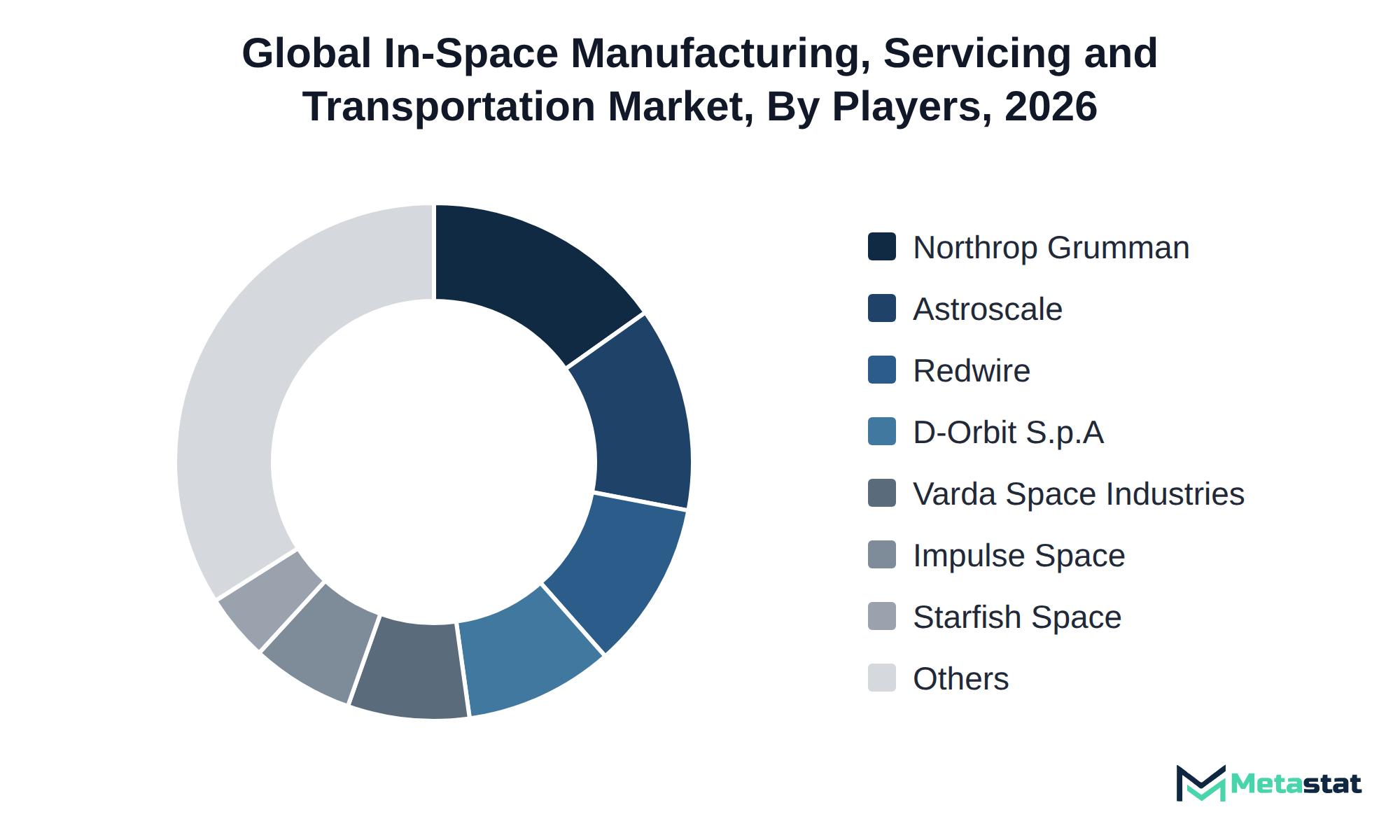
Competition within the In-Space Manufacturing, Servicing and Transportation market occurs across various dimensions, including service type, application, and end-user segment. Companies position themselves based on their technological capabilities, service offerings, and customer engagement strategies. Buyers typically select providers based on factors including price, certification, customization, and the overall ecosystem surrounding service delivery.
Different service types create distinct competitive arenas. For instance, Northrop Grumman Corporation emphasizes orbital transportation and payload deployment, while Varda Space Industries, Inc. focuses on in-space manufacturing and processing. Companies including Astroscale Holdings Inc. and ClearSpace target debris removal and disposal, addressing growing concerns related to space sustainability.
End users play a significant role in shaping competitive dynamics. Commercial satellite operators represent a crucial demand segment, driving companies like Firefly Aerospace Inc. and Rocket Lab Corporation to develop tailored solutions for satellite fleet operations. Civil space agencies, including those engaging with D-Orbit S.p.A. and Thales Alenia Space, prioritize reliability and compliance in their partnerships, further influencing provider selection within the market.
This growth depends on several key developments within the In-Space Manufacturing, Servicing and Transportation market. First, the expansion of orbital transportation and payload deployment services will significantly contribute to market growth, driven by increasing demands from commercial satellite operators, projected to grow from USD 267.6 million in 2026 to USD 1,197.7 million by 2033. Second, advancements in low Earth orbit (LEO) operations will enhance market dynamics, with revenue anticipated to increase from USD 443 million in 2026 to USD 1,952.7 million by 2033. Third, developments in satellite life extension services are expected to support the market's trajectory, with growth projected alongside the increasing operational lifespans of satellites. However, potential risks including regulatory challenges and delays in technology deployment hinder market growth, particularly affecting the civil space agencies segment, which targets an estimated USD 1,181.5 million by 2033. Overcoming these challenges is necessary to realize the market's full potential.
By Service Type: Orbital transportation and payload deployment, Space-station cargo delivery and return, Satellite life extension, Inspection and diagnostics, Repair and component replacement, Refueling and propellant transfer, Debris removal and disposal, In-space manufacturing and processing, On-orbit assembly
By Orbit: Low Earth orbit (LEO), Geostationary orbit (GEO), Medium Earth orbit (MEO), Cislunar and deep space, Others (Highly elliptical Earth orbits)
By Application: Satellite fleet operations, Space-station operations, Space telescopes and scientific spacecraft, Free-flying manufacturing platforms, Cislunar infrastructure support
By End User: Commercial satellite operators, Civil space agencies, Defense and intelligence agencies, Commercial space-infrastructure operators, Industrial manufacturing customers, Research institutions, Others (Spacecraft prime contractors, mission integrators)
The report strategically identifies and profiles the key market players and analyses their core competencies in each sub-segment of the In-Space Manufacturing, Servicing and Transportation market.
|
Report Attributes |
Details |
|
Study Period |
2021-2033 |
|
Base Year |
2025 |
|
Estimated Year |
2026 |
|
Forecast Period |
2026-2033 |
|
Historical Period |
2021-2025 |
|
Growth Rate |
CAGR 25.5% from 2026 to 2033 |
|
Revenue Unit |
USD million |
|
Segmentation |
By Service Type, Orbit, Application, End User, and Region |
|
By Region |
North America (By Service Type, Orbit, Application, End User, and Country)
|
|
Europe (By Service Type, Orbit, Application, End User, and Country)
|
|
|
Asia Pacific (By Service Type, Orbit, Application, End User, and Country)
|
|
|
South America (By Service Type, Orbit, Application, End User, and Country)
|
|
|
Middle East and Africa (By Service Type, Orbit, Application, End User, and Country)
|
Find answers to common questions about this report
The In-Space Manufacturing, Servicing and Transportation market size was valued at USD 656.3 million in 2025.
The market is projected to grow at a CAGR of 25.5% during the forecast period from 2026 to 2033.
The North America In-Space Manufacturing, Servicing and Transportation market size is projected to reach USD 2,077.6 million by 2033.
The leading segment in the In-Space Manufacturing, Servicing and Transportation market is Orbital transportation and payload deployment, with a projected value of USD 1,197.7 million by 2033. This segment demonstrates the highest growth potential, with a compound annual growth rate of 23.9 percent.
Key drivers for the In-Space Manufacturing, Servicing and Transportation market include the increasing demand for satellite life extension and operational support from commercial satellite operators. Advancements in robotics and automation enhance operational efficiency, reducing costs and improving service capabilities across manufacturing, servicing, and transportation sectors.
North America holds the dominant share of the In-Space Manufacturing, Servicing and Transportation market, with a value of USD 2,077.6 million projected for 2033, representing 56.5 percent of the total market.
Price sensitivity among commercial satellite operators limits investment in advanced in-space solutions, leading to slower uptake and smaller order sizes. rising operational costs and inflation put pressure on suppliers, complicating their ability to maintain profitability while meeting competitive pricing demands.
Increasing demand for satellite life extension and operational support drives adoption within the In-Space Manufacturing, Servicing and Transportation market. The focus on optimizing investments and enhancing service capabilities creates growth opportunities for commercial satellite operators.
The In-Space Manufacturing, Servicing and Transportation market is estimated to reach a valuation of USD 4,054.6 million by 2033.
Key players operating in the In-Space Manufacturing, Servicing and Transportation market include Northrop Grumman Corporation, Astroscale Holdings Inc., D-Orbit S.p.A., Redwire Corporation, Varda Space Industries, Inc., and SpaceX.
The analysts below cover Aerospace and Defense research at Metastat Insights.
LEAD ANALYST
Utkarsh Khirodkar is a Lead Market Research Analyst at MetaStat Insight, specializing in market intelligence, technology sector assessments, and competitive strategy.
Decarbonizing industrial thermal processes hinges on refrigerant regulations and compressor efficiency limits. Metastat Insights delivered a thorough market analysis that evaluated natural refrigerants like CO2 and hydrocarbons against synthetic low-GWP alternatives. The breakdown of utility incentives and grid capacity constraints across key European manufacturing hubs offered valuable perspective. The follow-up conversation with their sector analysts addressed our specific questions on mechanical vapor recompression systems efficiently.
Assessing 200mm wafer transition schedules and substrate supply bottlenecks requires precise technical intelligence. MetaStat Insight supplied an actionable breakdown comparing planar and trench MOSFET architectures across automotive and industrial drive markets. The regional capacity estimates for Asia-Pacific foundries helped clarify lead-time uncertainties during our strategic planning session. When we needed additional clarification on high-purity raw material sourcing, their analyst team responded with helpful context within twenty-four hours.
Tracking maintenance cycle demand for secondary flight display units and terrain collision avoidance systems across regional jet fleets involves complex aftermarket dynamics. MetaStat Insight provided practical analysis separating airline retrofit programs from OEM forward-fit production schedules in North America and Southeast Asia. The supplier matrix highlighted component obsolescence timelines without resorting to vague generalizations. The dataset served as a dependable reference during our annual program review meetings.
Explore related market intelligence reports worth reading alongside this one.
Starting from
$2950