
LEAD ANALYST
Utkarsh Khirodkar is a Lead Market Research Analyst at MetaStat Insight, specializing in market intelligence, technology sector assessments, and competitive strategy.

Indoor Shooting Simulator Market By Type (Software and Hardware), By Application (Military Smalls Arms, Other Military Arms, Police, and Entertainment), Industry Analysis, Size, Share, Growth, Trends, and Forecast, 2023-2030
Report ID
MSI-2424
Published
February, 2026
Pages
257 Pages
Format
Report Details
Choose Your License
Indoor Shooting Simulator Market
The Global indoor shooting simulator market is estimated to reach USD 440.4 million in 2023 and is projected to grow at a CAGR of 4.7% in forecast period.
The Global Indoor Shooting Simulator market has shown substantial growth in recent years. In 2022, this market was valued at 423 million US$, and it is poised for continued expansion. Projections indicate that by 2030, the Indoor Shooting Simulator market is expected to reach 608.6 million US$, reflecting a compound annual growth rate (CAGR) of 4.73% during the forecast period.
The market growth can be attributed to several factors. The increasing emphasis on firearms training and safety measures is driving the demand for indoor shooting simulators. Law enforcement agencies, military forces, and civilian firearm enthusiasts are increasingly recognizing the value of simulated training environments for honing shooting skills and ensuring safety.
Additionally, advancements in technology have played a pivotal role in the market's expansion. Indoor shooting simulators have evolved to provide highly realistic and immersive training experiences. These simulators incorporate cutting-edge graphics, ballistics modeling, and realistic weapon feedback to create an environment that closely mimics real-world shooting scenarios.
The growing popularity of shooting sports and recreational shooting has also contributed to the market's growth. Shooting enthusiasts are turning to indoor shooting simulators for practice and entertainment, offering a safe and controlled environment for marksmanship skill development.
Furthermore, the versatility of indoor shooting simulators makes them attractive to a wide range of users. These systems can be customized to simulate various shooting scenarios, from target practice to tactical training exercises, making them adaptable for different training needs.
Moreover, the awareness of the environmental impact of traditional shooting ranges has driven interest in indoor shooting simulators, which are more eco-friendly due to reduced lead exposure and ammunition consumption.
The Global Indoor Shooting Simulator market is on a growth trajectory by 2030. Factors such as increased focus on firearms training and safety, technological advancements, rising interest in shooting sports, and environmental considerations are driving this market's expansion. As the demand for realistic and versatile training solutions continues to grow, the Indoor Shooting Simulator market is poised to play a significant role in firearm training and recreational shooting.
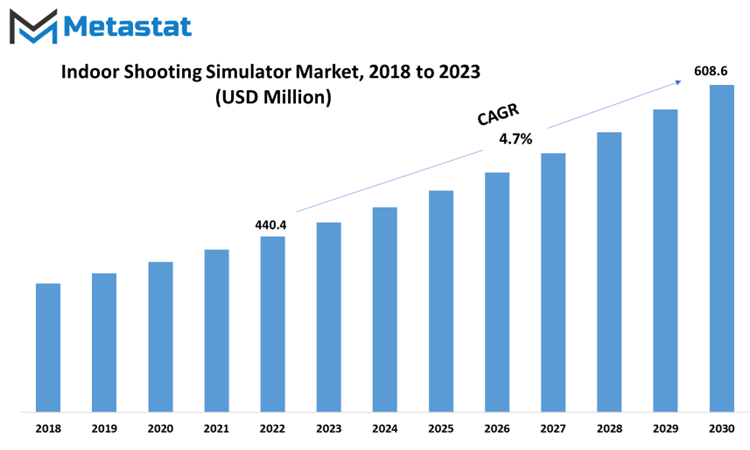
The Indoor Shooting Simulator market is strongly propelled by the imperative need for effective training and skill enhancement. These simulators present a controlled and secure environment for realistic firearms training, notably attracting the attention of law enforcement agencies, military personnel, and private security sectors. Furthermore, the incorporation of advanced technology and improved accessibility has considerably broadened their appeal, encompassing shooting enthusiasts and individuals new to shooting sports.
Safety and convenience stand as pivotal drivers within the Indoor Shooting Simulator market. These simulators offer a haven for training, eliminating the inherent risks associated with live-fire exercises. This enhanced safety factor holds a broad appeal, catering to diverse user groups. Additionally, their round-the-clock availability effectively erases the traditional limitations of conventional shooting ranges, rendering indoor shooting simulators highly attractive to enthusiasts, seasoned marksmen, and newcomers alike.
The market encounters a notable hindrance in the form of substantial initial investment costs. The acquisition of high-quality hardware components, coupled with construction expenses and ongoing maintenance, can be financially daunting. Consequently, smaller organizations and those with budgetary constraints may find it challenging to embrace indoor shooting simulators as a viable training solution.
Maintenance and upkeep present another set of challenges within the Indoor Shooting Simulator market. The necessity to continually ensure hardware reliability, keep software up to date, adhere to safety standards, and provide comprehensive user support adds layers of complexity and recurring costs to the operation of indoor shooting simulators, which can deter potential adopters.
The evolving landscape of virtual training solutions offers compelling opportunities within the Indoor Shooting Simulator market. The integration of Virtual Reality (VR) and Augmented Reality (AR) technologies amplifies the realism of training sessions, elevating the immersive experience. This not only enhances the effectiveness of training but also facilitates remote training, real-time collaborative exercises, data analytics, and personalized training programs. Consequently, the adoption of virtual training solutions has the potential to significantly expand the market's reach and user base, opening new avenues for growth and innovation.
Within the global Indoor Shooting Simulator market, a key aspect of its segmentation revolves around the categorization by type, which essentially splits the market into two primary segments: Software and Hardware. These two segments cater to distinct aspects of indoor shooting simulation, each contributing to the overall market in its own way.
The Hardware segment of the market, valued at 136.2 USD Million in 2022, encompasses the physical components and equipment that constitute an indoor shooting simulator. This includes the simulation firearms, target systems, sensors, and related hardware required to create a realistic shooting experience. These hardware elements play a critical role in delivering a tangible and immersive shooting experience for users, replicating the feel and functionality of real firearms. The hardware segment appeals to training facilities, shooting ranges, and enthusiasts seeking a realistic and hands-on simulation experience.
On the other hand, the Software segment of the market, valued at 286.8 USD Million in 2022, focuses on the digital and software aspects of indoor shooting simulation. This segment involves the development and deployment of simulation software, virtual scenarios, graphics, and user interfaces that drive the immersive experience within the simulator. The software is responsible for creating lifelike shooting scenarios, training modules, and environments, making it a critical component for both training and entertainment purposes. This software-driven approach caters to a wide range of users, including law enforcement agencies, military organizations, recreational shooters, and gaming enthusiasts.
The dichotomy between hardware and software within the Indoor Shooting Simulator market reflects the diverse needs and preferences of its consumers. While the hardware segment emphasizes realism and tactile engagement, the software segment capitalizes on digital technologies to provide dynamic and versatile shooting experiences. Together, these segments collectively contribute to the growth and evolution of the indoor shooting simulator market, offering a range of options to meet the demands of various user groups.

In the global Indoor Shooting Simulator market, a crucial aspect of its segmentation lies in categorizing it by application, shedding light on the diverse uses and demand for this technology. Four primary application segments emerge: Military Small Arms, Other Military Arms, Police, and Entertainment.
The Military Small Arms segment stood out prominently in 2022, recording a market value of 161.8 USD Million. This segment's significance reflects the adoption of indoor shooting simulators for training and honing the skills of military personnel in the use of small arms, such as handguns and rifles. The precision and realism offered by these simulators contribute to their value in military training scenarios.
The Other Military Arms segment presents another facet of the market, poised for growth in the coming years. It is forecasted to expand at a Compound Annual Growth Rate (CAGR) of 4.79% during the period from 2023 to 2030. This growth projection signifies the increasing utilization of indoor shooting simulators for training purposes beyond small arms, encompassing a broader range of military weaponry and tactics.
In law enforcement, the Police segment held its ground in 2022 with a market valuation of 109 USD Million. Police agencies around the world have recognized the benefits of indoor shooting simulators for training their officers, offering a controlled and immersive environment to practice critical decision-making and marksmanship skills.
Apart from these, the Entertainment segment also made a notable impact, registering a market value of 65.7 USD Million in 2022. This segment caters to recreational and entertainment purposes, offering individuals and enthusiasts an opportunity to experience simulated shooting scenarios for sport, leisure, or skill improvement. The market's recognition of entertainment as a viable application underscores the broad appeal of indoor shooting simulators.
The segmentation of the Indoor Shooting Simulator market by application reveals a multifaceted landscape, with distinct sectors like Military Small Arms, Other Military Arms, Police, and Entertainment driving its growth and adoption. These segments cater to varied needs, from military and law enforcement training to recreational and skill-enhancing experiences, reflecting the versatility and expanding market potential of indoor shooting simulators.
The global Indoor Shooting Simulator market exhibits a comprehensive geographical segmentation to better understand its reach and dynamics. This segmentation includes North America, Europe, Asia-Pacific, South America, and the Middle East & Africa.
Within North America, the market is further subdivided into the United States (U.S.), Canada, and Mexico. These distinctions reflect the diverse landscape of businesses and consumer preferences in North America. The United States, as one of the largest markets, has a high demand for indoor shooting simulators, driven by factors such as firearm training, recreational shooting, and security preparedness. Canada and Mexico also contribute to the regional market, each with its unique set of drivers and market conditions. Further, Europe, including the United Kingdom, Germany, France, Italy, and the Rest of Europe, represents a region with a rich tradition of firearms and shooting sports. The market in Europe is influenced by a combination of recreational shooters, professional training facilities, and law enforcement agencies seeking advanced training tools.
The geographical segmentation of the global Indoor Shooting Simulator market highlights the varied factors influencing the adoption and growth of this technology in different regions. The market's subdivision provides valuable insights into the specific needs and opportunities within each geographic area, allowing businesses and stakeholders to tailor their strategies and offers accordingly.
In the Indoor Shooting Simulators market, there are several key players who have made significant contributions to shaping this specialized market. These companies have earned their reputation as industry leaders through their unwavering commitment to innovation, their deep expertise, and their relentless dedication to delivering state-of-the-art solutions to address the diverse shooting simulation needs across various sectors. Among the standout names in this dynamic field are VirTra Inc., Marksman Training Systems AB, Laser Ammo USA Inc., Sports Entertainment Specialists, Inc., Laser Shot, Inc., Shootin-Soft LLC, Indra Sistemas, SA, GAIM Immersive Technology Group AB, Table Mountain Group LLC (Ti Training), and SimWay AB.
These key players collectively contribute to the growth and dynamism within the Indoor Shooting Simulator industry. Their diverse range of offerings caters to the varied needs of customers across different sectors, ensuring that the industry continues to evolve and remains responsive to the ever-changing demands of the modern world.
Find answers to common questions about this report
Global Indoor Shooting Simulator market is valued at $440.4 million in 2023.
Global Indoor Shooting Simulator market is estimated to grow with a CAGR of 4.7% from 2023 to 2030.
Global Indoor Shooting Simulator market is estimated to reach $608.6 million by 2030.
Top players operating in the Indoor Shooting Simulator industry includes VirTra Inc., Marksman Training Systems AB, Laser Ammo USA Inc., Sports Entertainment Specialists, and others.
The analysts below cover Information & Technology research at Metastat Insights.
LEAD ANALYST
Utkarsh Khirodkar is a Lead Market Research Analyst at MetaStat Insight, specializing in market intelligence, technology sector assessments, and competitive strategy.

PRINCIPAL CONSULTANT - ENTERPRISE AI & EMERGING TECHNOLOGIES
Banking & Finance · Electronics and Semiconductor · Energy and Power · Healthcare IT · Information & Technology · Professional Services
Vijay Gunti is a Principal Consultant at MetaStat Insight, bringing over two decades of experience across enterprise digital transformation, technology strategy, and intelligent systems.

LEAD CONSULTANT - COMMUNICATION, TELECOM, AND IT
Electronics and Semiconductor · Information & Technology · Machinery & Equipment · Professional Services
Ravindra Sathe Consultants for Communication, Telecom, and IT at MetaStat Insight. He leads the firm's industry research initiatives across telecommunications infrastructure, digital connectivity, enterprise networking, and emerging information technology domains.
When planning edge sensor rollouts across refinery environments, generic IoT reports typically miss the harsh-environment certification bottlenecks. MetaStat Insight gave an objective evaluation of ATEX and Class 1 Division 2 hardware availability, along with realistic five-year maintenance cycle cost projections. The comparison of wireless mesh versus private cellular backhaul helped our team pressure-test network reliability models for remote processing facilities.
In the biological seed treatment space, registration timelines vary drastically between the European Union, Brazil, and North America. The MetaStat Insight research handled these cross-border regulatory barriers with genuine nuance, mapping commercialization pathways alongside historical field adoption rates. The segmentation between microbial strains and biochemical active ingredients was particularly well structured.
Our team was tracking whether regional recycling infrastructure could realistically absorb the growing volume of lithium iron phosphate batteries over the next decade. The report did a solid job separating announced hydrometallurgical plant capacity from active, permitted operational throughput. That distinction made the feedstock availability projections and regional recovery rate models far more credible than standard commercial overviews.
Explore related market intelligence reports worth reading alongside this one.
Starting from
$2950