
LEAD ANALYST
Utkarsh Khirodkar is a Lead Market Research Analyst at MetaStat Insight, specializing in market intelligence, technology sector assessments, and competitive strategy.

Linear Motion System Market By Type (Single-Axis Linear Motion System, Multi-Axis Linear Motion System), By End-User Industry (Automotive, Aerospace, Electronics & Semiconductor, Medical & Healthcare, Packaging, Other), Industry Analysis, Size, Share, Growth, Trends, and Forecasts 2025-2032
Report ID
MSI-4419
Published
December, 2025
Pages
255 Pages
Format
Report Details
Choose Your License
Linear Motion System Market
The global linear motion system market and its industry were prompted by a very simple requirement: to move objects accurately along a straight line. By the beginning of the twentieth century, most workers in factories were replaced by manual operators and essential mechanical tracks. The expansion of industrial production motivated the builders of various machines to come up with the ways that would allow the movements to be guided with minimum friction and maximum repeatability. The very first and most significant move was the introduction of rolling elements and precision rails that permitted machinery in automotive and metal processing industries to glide without any resistance. What initially was a mechanical assistance develop into the base of unobtrusive manufacturing.
The space witnessed a revolution in the late twentieth century due to electronics. Motors, sensors, and control software all together made the linear motion much more reliable. Computers made their way into the factory floors, and the manufacturers started to ask for systems that could keep the exact speed and position without any human adjustment. The CNC machining came in, and it was a turning point. All of a sudden, the linear motion was not just a helper but rather the backbone of the entire automation process. The linear motion systems were gradually adopted by the pharmaceutical, semiconductor, and medical equipment industries due to the levels of accuracy that manual setups could not deliver.
At this point, it was the consumer behaviour that determined the next stage. The customers began to expect among many things, speedy deliveries, products that are tailored to their preferences, and digital services that are flawless. The production process had to change from mass or bulk production to that of being flexible. As a result, linear motion systems were required to operate at rapid changeovers and to frequently update designs. The customers' concerns regarding sustainability also influenced the choice of motion systems that brought about lesser energy usage and waste. Government also played a role by setting safety and efficiency standards which in turn pushed the manufacturers to come up with designs that would have less mechanical failure and less risk for the workers.
The industry that is in the midst of the global linear motion system market still keeps a balance between cost efficiency and precision. Engineers are constantly improving the properties of materials, trying out lubrication-free designs and installing real-time monitoring. Machine builders are linking these systems with smart data platforms, which result in predictive maintenance and reduced downtime. In the coming times, these systems will not just be one of the components; instead, they will be intelligent units that interact with bigger production networks. They will take part in factories that automatically increase or decrease the output based on the demand which in turn would make the manufacturing cleaner, faster, and much more flexible. From its mechanical beginnings to its data-driven present, the journey of linear motion reflects how technology consistently pushes industries toward accuracy and smart automation.
The global linear motion system market is mainly classified based on Type, End-User Industry.
|
Forecast Period |
2025-2032 |
|
Market Size in 2025 |
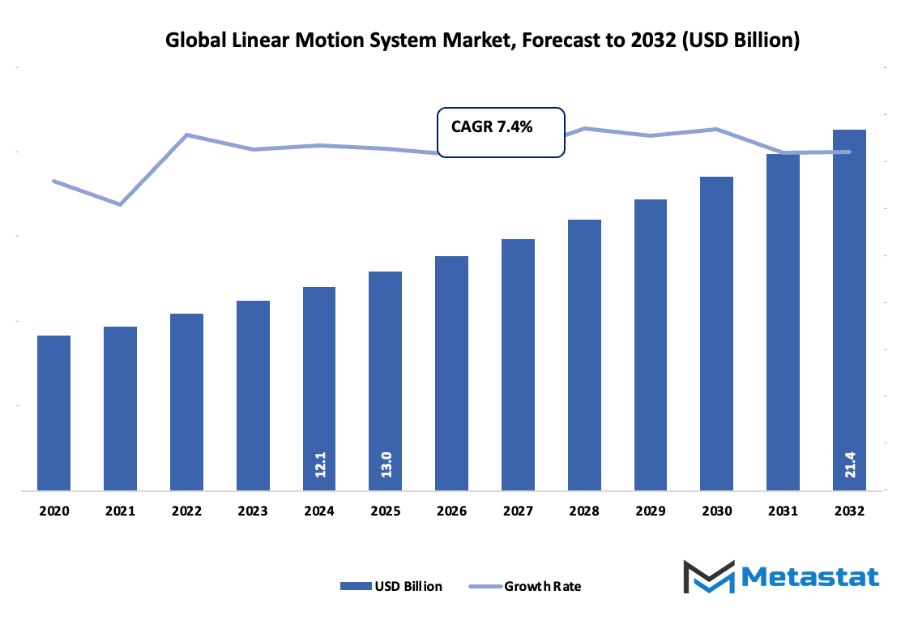
$13 Billion |
|
Market Size by 2032 |
$21.4 Billion |
|
Growth Rate from 2025 to 2032 |
7.4% |
|
Base Year |
2024 |
|
Regions Covered |
North America, Europe, Asia-Pacific, South America, Middle East & Africa |
The global linear motion system market shows strong competition and continuous progress. Major companies from several regions work toward better technology and steady improvement. Well-known groups such as Bosch Rexroth, Schneeberger Group, NSK Ltd., SKF Group, HIWIN Corporation, Schaeffler AG, NTN Corporation, LinTech, Schneider Electric Motion, Rockwell Automation, Ewellix AB, Thomson Industries, Inc., Igus Inc., TBI Motion Technology Co., Ltd., Rollon S.p.A., PBC Linear, Bishop-Wisecarver Corporation, Kuroda Precision Industries Ltd., and MISUMI Group Inc. play leading roles. Each company focuses on strong engineering standards, dependable performance, and product longevity.
Global demand continues to rise as factories and automated facilities search for faster and more accurate movement of machine parts. Faster production, reduced downtime, and higher product quality encourage further investment. Growing use of automation in manufacturing, medical equipment, packaging, and material handling increases interest in advanced linear motion systems. Consistent research supports quiet movement, improved load capacity, and lower energy use. Clear goals guide development: stronger durability, lower maintenance, and smoother operation.
Established corporations offer broad product lines and long industrial experience. These organizations hold strong distribution channels and dependable service networks, which help secure customer trust. Regional competitors enter the market by offering specialized designs and affordable solutions. Competition pushes every organization to strengthen product quality and customer support, creating wider choices for buyers.
Ongoing progress in robotics and precision machinery encourages greater adoption of linear motion equipment. Digital control features allow quicker setup and better accuracy, helping factories run more efficiently. Every improvement supports consistent motion, reduced waste, and smoother production flow.
Market size is forecast to rise from USD 13 billion in 2025 to over USD 21.4 billion by 2032. Linear Motion System will maintain dominance but face growing competition from emerging formats.
Future growth will depend on continued innovation, investment in research, and strong partnerships between manufacturers and equipment users. Clear attention to customer needs, flexible product designs, and reliable performance will support stable progress. Increasing automation in manufacturing and industrial upgrades across global markets ensures steady demand. By offering dependable solutions and continuous improvement, each competitor contributes to the advancement of high-precision motion technology.
This research report categorizes the global linear motion system market based on various segments and regions, forecasts revenue growth, and analyzes trends in each submarket. The report analyses the key growth drivers, opportunities, and challenges influencing the global linear motion system market. Recent market developments and competitive strategies such as expansion, type launch, development, partnership, merger, and acquisition have been included to draw the competitive landscape in the market. The report strategically identifies and profiles the key market players and analyses their core competencies in each sub-segment of the global linear motion system market.
Find answers to common questions about this report
Global Linear Motion System market is valued at $13 billion in 2025.
Global Linear Motion System market is estimated to grow with a CAGR of 7.4% from 2025 to 2032.
Global Linear Motion System market is estimated to reach $21.4 billion by 2032.
Top players operating in the Linear Motion System industry includes Bosch Rexroth, Schneeberger Group, NSK Ltd., SKF Group, HIWIN Corporation, Schaeff
The analysts below cover Electronics and Semiconductor research at Metastat Insights.
LEAD ANALYST
Utkarsh Khirodkar is a Lead Market Research Analyst at MetaStat Insight, specializing in market intelligence, technology sector assessments, and competitive strategy.

PRINCIPAL CONSULTANT - ENTERPRISE AI & EMERGING TECHNOLOGIES
Banking & Finance · Electronics and Semiconductor · Energy and Power · Healthcare IT · Information & Technology · Professional Services
Vijay Gunti is a Principal Consultant at MetaStat Insight, bringing over two decades of experience across enterprise digital transformation, technology strategy, and intelligent systems.

PRINCIPAL CONSULTANT - QUALITY SYSTEMS & COMPLIANCE
Electronics and Semiconductor · Machinery & Equipment · Professional Services
Omkar Phadtare is an Industry Consultant at MetaStat Insight, specializing in quality systems, regulatory compliance, and standards benchmarking to drive data-driven market intelligence and strategic industry research.

ENERGY & INFRASTRUCTURE INDUSTRY CONSULTANT
Automotive and Transportation · Electronics and Semiconductor · Energy and Power · Machinery & Equipment
Saurabh Vasant Ganvir consults for Energy & Infrastructure Industry at MetaStat Insight, specializing in renewable energy, solar EPC, and electric vehicle (EV) infrastructure markets.

LEAD CONSULTANT - COMMUNICATION, TELECOM, AND IT
Electronics and Semiconductor · Information & Technology · Machinery & Equipment · Professional Services
Ravindra Sathe Consultants for Communication, Telecom, and IT at MetaStat Insight. He leads the firm's industry research initiatives across telecommunications infrastructure, digital connectivity, enterprise networking, and emerging information technology domains.
Tracking ceramic matrix composite adoption in high-bypass aero engines requires strict attention to material qualification cycles and FAA airworthiness testing milestones. The MetaStat Insight team provided a detailed timeline of silicon carbide fiber manufacturing capacity and commercial foundry lead times. Having clear visibility into upstream thermal barrier coating supply helped us stress-test our long-term component procurement strategy.
Transitioning ultra-class mining haul trucks to alternative power requires concrete data on remote hydrogen refueling infrastructure economics. The report evaluated megawatt-scale electrolyzer installation expenses, onsite storage safety mandates, and heavy-duty fuel cell stack degradation under continuous duty cycles. That technical rigor helped our engineers benchmark realistic total operating cost horizons for off-highway fleet decarbonization.
Enterprise zero-trust network rollouts are often slowed down by multi-cloud transit latency and proprietary hardware retirement schedules. This study provided realistic total cost of ownership models comparing cloud-delivered security edge solutions against traditional hardware refreshes. The analysis of contract renewal lengths and software maintenance fees gave us clear visibility into enterprise replacement cycles over the next three to five years.
Explore related market intelligence reports worth reading alongside this one.