
LEAD ANALYST
Utkarsh Khirodkar is a Lead Market Research Analyst at MetaStat Insight, specializing in market intelligence, technology sector assessments, and competitive strategy.

Global Managed Infrastructure Services Market Size, Share, By Service Type (Managed Network Services, Managed Server and Compute Services, Managed Infrastructure Security Services, Managed Cloud Platform Operations, Managed Storage, Backup and Recovery Services, Managed Edge Infrastructure Services), By Deployment Model (On-Premises and Colocation, Cloud-Only, Hybrid), By Enterprise Size (Large Enterprises and Small and Medium-Sized Enterprises), By End-Use Industry (Banking, Financial Services and Insurance, IT and Telecommunications, Manufacturing, Government and Public Sector, Healthcare and Life Sciences, Retail and E-Commerce, Energy and Utilities), Industry Analysis, Growth, Trends, and Forecast, 2026-2033
Report ID
MSI-5804
Published
November, 2026
Pages
268 Pages
Format
Historical
Base year
Forecast
Forecast period
Report Details
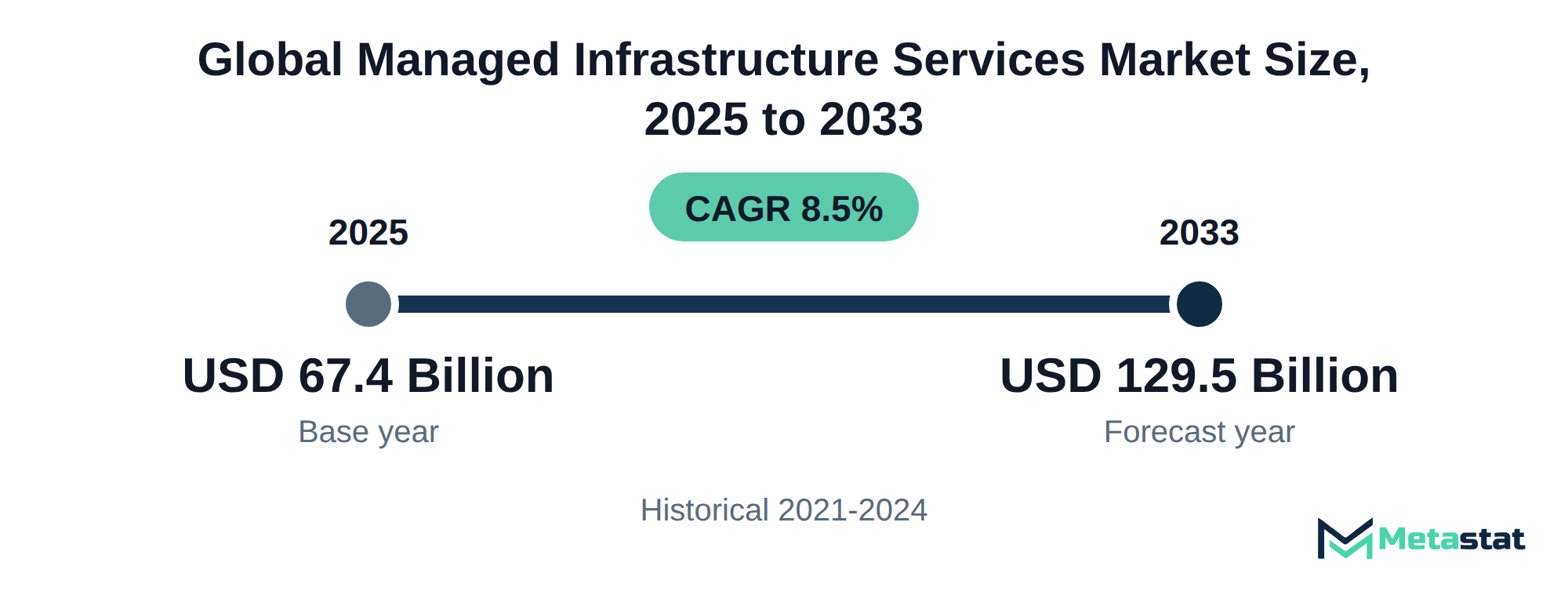
Market Valuation: Valued at $67.4 Billion in 2025, projected to reach $129.5 Billion by 2033 at a 8.5% CAGR.
Dominant Segment: Managed Network Services leads the market, driven by increasing demand for reliable connectivity and network performance as organizations prioritize digital transformation.
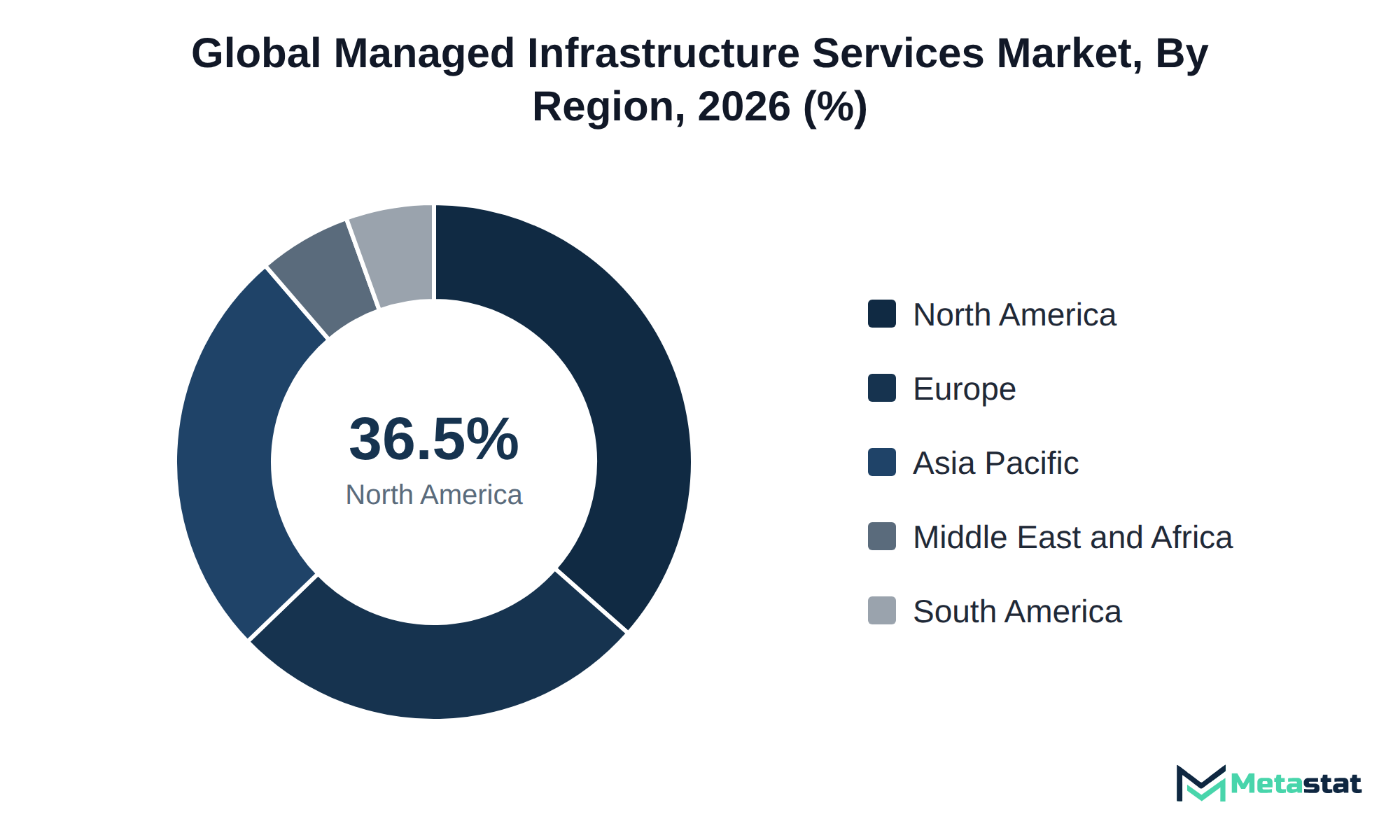
Geographic Lead: North America is the leading region, holding 36.5% of the market in 2025, fueled by strong technological adoption and substantial infrastructure investments.
What's Inside: The report provides comprehensive competitive coverage, detailed analyses of service types, deployment models, and enterprise sizes, along with a forecast window extending to 2033.
Emerging Trends: The shift towards managed cloud platform operations is significant, with a projected CAGR of 9.5%, reflecting organizations' increasing reliance on scalable and flexible IT solutions.
Price Sensitivity: Cost considerations are impacting buyer engagement, particularly among large enterprises and SMEs, leading to a preference for budget-friendly managed infrastructure solutions.
Choose Your License
Global Managed Infrastructure Services Market
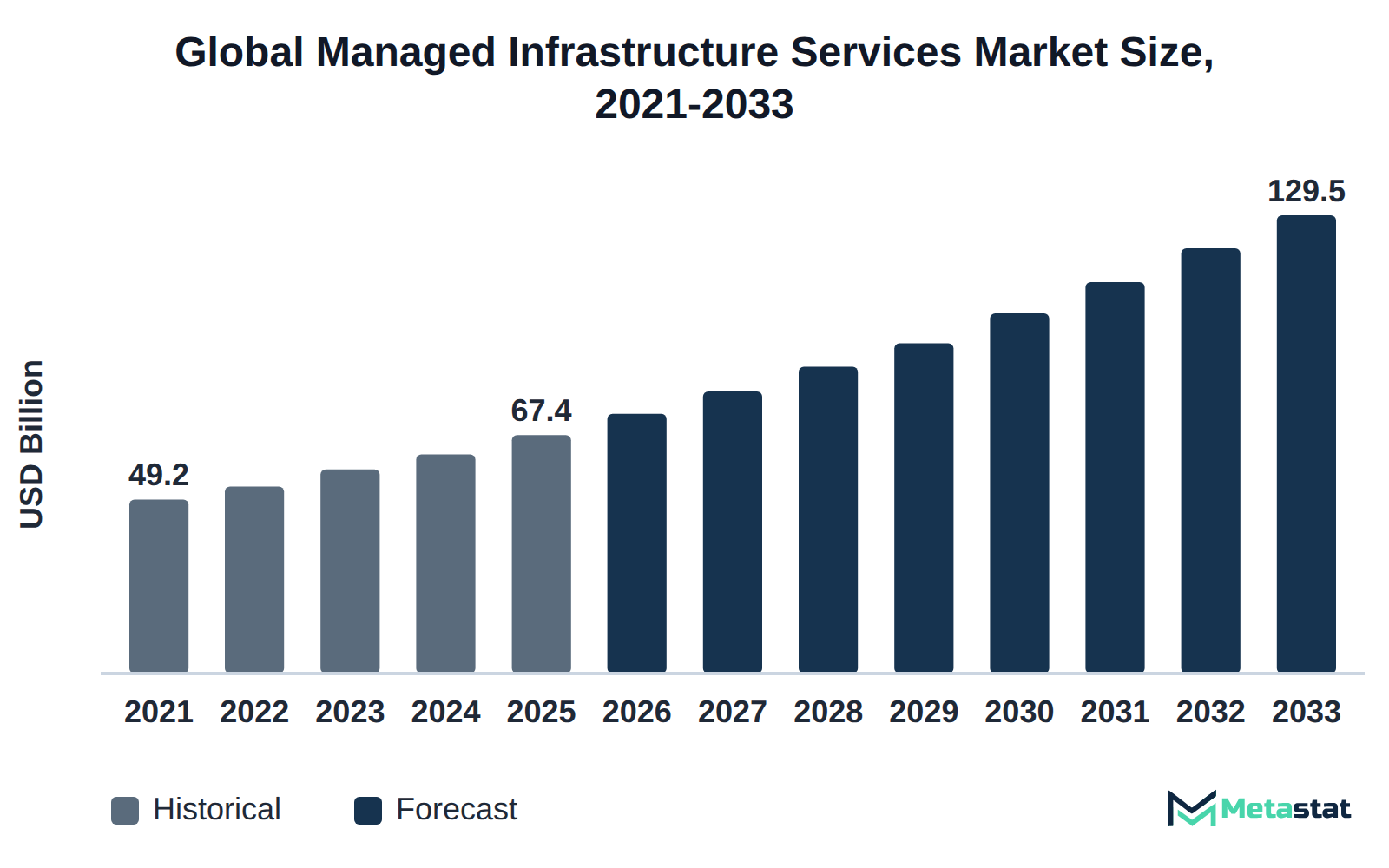
The global Managed Infrastructure Services market was valued at USD 67.4 billion in 2025 and is projected to reach USD 129.5 billion by 2033, growing at a CAGR of 8.5% over the forecast period.
The Managed Infrastructure Services market encompasses a range of solutions designed to help organizations manage their IT infrastructure effectively. Buyers invest in these services to enhance operational efficiency, reduce costs, and utilize the latest technologies without significant upfront capital expenditure. The growing reliance on digital transformation initiatives drives spending, as organizations seek to remain competitive and agile in an evolving business landscape.
Growth in the market is fueled by increasing demand for managed network services, which represent the largest segment by value. North America holds 36.5% of the market in 2025, with the US leading in 2026. This region's strong technological adoption and substantial investments in infrastructure create a favorable environment for service providers, contributing to its leading position.
The rise in cloud adoption is a primary driver of market expansion. Organizations across various sectors acknowledge the benefits of cloud solutions, including scalability and flexibility, prompting a shift towards managed cloud platform operations. These dynamics position the market for significant growth, reflecting a broader trend towards outsourcing IT services to enhance performance and reliability.
The Managed Infrastructure Services market addresses the comprehensive management of IT infrastructure through various service types, enabling organizations to optimize performance and enhance efficiency. Buyers invest in these services to reduce operational risks, improve scalability, and ensure robust security measures. The increasing complexity of IT environments drives the demand for managed services, with organizations seeking reliable solutions to maintain their competitive edge.
Growth in the market is primarily influenced by the rising adoption of cloud computing solutions, which enable flexible and scalable infrastructure management. Among the various segments, Managed Network Services holds the most value, catering to organizations that require reliable connectivity and network performance. The region's advanced technological landscape and significant investments in digital transformation initiatives support its strong market position.
The increasing urgency for organizations to enhance their digital capabilities drives the demand for managed infrastructure services. By leveraging these solutions, businesses focus on core competencies while ensuring their IT frameworks remain resilient and adaptive to evolving market conditions. This dynamic highlights the importance of managed services in improving operational efficiency and driving business growth.
Adoption of hybrid cloud operations has gained momentum in the Managed Infrastructure Services market, driven by the increasing need for flexibility and scalability among enterprises. Specifically, the deployment model of hybrid services is projected to reach USD 45.3 billion by 2033. This growth reflects a shift in enterprise preferences toward integrating on-premises infrastructure with cloud resources, enabling organizations to scale operations efficiently while maintaining control over critical data.
The transition to hybrid cloud models allows enterprises to optimize their infrastructure costs and enhance performance through outsourcing contracts. Companies leverage outsourcing to reduce operational burdens and concentrate on core competencies, promoting efficiency and innovation. With large enterprises expected to increase their spending on managed services from USD 47.2 billion in 2026 to USD 81 billion by 2033, the demand for tailored outsourcing solutions is expected to intensify.
Firms specializing in providing hybrid cloud services gain a competitive edge by offering comprehensive solutions that address specific operational needs. The rising trend toward hybrid environments indicates significant opportunities for service providers to develop tailored offerings that align with evolving customer requirements in the Managed Infrastructure Services market.
Pricing structures in the Managed Infrastructure Services market reflect a shift toward flexible and scalable models, particularly in Managed SD-WAN solutions. Buyers increasingly prefer subscription-based contracts that allow for predictable budgeting and easier adjustments to service levels. For instance, the market for Managed Network Services, which includes SD-WAN, is projected to expand from USD 18.7 billion in 2026 to USD 31.3 billion by 2033, indicating robust demand for such adaptable pricing strategies.
Contract terms have evolved, with many providers offering tiered service levels that allow businesses to select features based on their specific needs. This customization enhances buyer satisfaction, with organizations tailoring services without incurring unnecessary costs. The expected growth in Managed Infrastructure Services creates a competitive environment where providers refine their pricing and service offerings to attract diverse clients.
The strategic implementation of these pricing models impacts market dynamics, driving increased adoption among enterprises of all sizes. Firms that apply Managed Infrastructure Services achieve operational efficiencies while managing their IT budgets effectively, ultimately boosting profitability and competitiveness in their respective sectors.
The emergence of AI-assisted monitoring and field dispatch systems significantly enhances the efficiency of incident management within the Managed Infrastructure Services market. These systems facilitate real-time insights and proactive responses to infrastructure incidents, addressing the distinct needs of large enterprises that rely heavily on uninterrupted operations. In 2026, the market for large enterprises is projected to reach USD 47.2 billion, highlighting substantial investment in solutions that minimize downtime and optimize resource allocation.
AI technologies streamline incident detection and dispatch processes, resulting in reduced response times and improved resolution rates. By integrating machine learning algorithms, organizations analyze historical data to predict incidents before they escalate. This predictive capability is particularly beneficial for industries including banking, financial services, and insurance, where downtime leads to significant financial losses.
Organizations that invest in AI-assisted monitoring and field dispatch systems secure a competitive advantage by enhancing operational efficiency and minimizing disruption. This trend reflects the broader shift within the Managed Infrastructure Services market toward leveraging advanced technologies to meet the evolving demands of enterprise clients.
Managed Infrastructure Services encompass a variety of critical offerings that support the operational backbone of modern enterprises. These services include Managed Network Services, Managed Server and Compute Services, and Managed Infrastructure Security Services, among others. Each category serves a unique role in enhancing efficiency and security within IT environments.
This growth reflects the increasing reliance on robust and secure network infrastructures, especially in industries including IT and Telecommunications. With rising cyber threats, organizations prioritize secure and efficient network operations, driving demand for these services.
The Managed Infrastructure Services market stands poised for significant expansion. Businesses prioritize investments in these essential services to enhance operational efficiency. By adopting Managed Server and Compute Services, organizations streamline their IT operations, enabling them to focus on core business objectives while leveraging specialized expertise to manage their infrastructure effectively. This strategic approach reduces operational costs and positions enterprises to adapt to evolving market demands and technological advancements.
Growth in managed cloud platform operations drives increased spending by organizations looking to enhance their digital capabilities. Large enterprises adopt cloud solutions to streamline operations and improve scalability, resulting in higher demand for infrastructure services. The transition from traditional on-premises models to cloud-based services reflects a broader industry trend toward digital transformation. This shift leads to a compound annual growth rate (CAGR) of 9.5% in the managed cloud platform operations segment through 2033. Organizations recognize the need for advanced solutions to support their evolving IT environments, fueling investment in managed infrastructure services. This transformation impacts pricing structures and operational efficiency in the market.
Demand for managed infrastructure services continues to rise, driven by the growing adoption of cloud solutions among enterprises of various sizes. Increased reliance on cloud-based platforms furthers demand for managed services, shaping the market's landscape.
Growing reliance on hybrid infrastructure solutions influences investment decisions in the Managed Infrastructure Services market. Organizations increasingly seek flexibility in their IT environments, prompting investments in solutions that integrate both on-premises and cloud services. This trend reflects a broader shift toward systems that offer scalability and adaptability, allowing businesses to respond swiftly to changing market conditions.
Large enterprises, particularly in sectors including banking and telecommunications, prioritize hybrid solutions to optimize operational efficiency and reduce costs. The ability to manage workloads seamlessly across different environments enhances overall performance and supports business continuity. Increased adoption of cloud technologies drives competition among service providers, propelling innovation and service enhancement in the market.
Businesses recognize the benefits of hybrid models, and demand for Managed Infrastructure Services continues to strengthen. The integration of hybrid infrastructure solutions addresses immediate operational challenges and positions organizations for long-term growth and sustainability. The evolving nature of business requirements necessitates ongoing investment in these services, further stimulating market expansion.
Cost considerations significantly impact buyer engagement in the Managed Infrastructure Services market. Large enterprises, facing budget constraints, prioritize cost-effective solutions when managing IT infrastructure. This focus results in slower uptake of advanced services, leading to smaller orders and delayed replacements for outdated systems.
Small and medium-sized enterprises experience similar challenges, facing heightened price sensitivity due to limited financial resources. The reliance on budget-friendly options restricts their ability to invest in comprehensive managed services, hindering overall market growth. Consequently, companies within these segments opt for less integrated solutions, impacting service adoption rates across the market.
Increasing talent costs present a significant challenge for suppliers in the Managed Infrastructure Services market. Demand for skilled professionals in technology sectors has surged, driven by the expansion of managed services and the integration of advanced technologies. This upward pressure on labor costs directly impacts service providers' profit margins, requiring them to adapt their business models. Many suppliers invest in training programs and upskilling initiatives to enhance their workforce capabilities. This approach aims to improve operational efficiency and reduce reliance on external talent sources. Automation technologies integrate into service offerings, enabling companies to streamline operations and maintain competitiveness in a cost-sensitive environment. The market's ability to address these rising talent costs influences overall growth and the sustainability of service offerings. Efficient talent management strategies are critical for suppliers aiming to thrive in this evolving landscape.
Rapid growth in managed cloud platform operations highlights a significant opportunity within the market, driven by increased demand for scalable and flexible IT solutions. This segment is projected to expand at a CAGR of 9.5% through 2033, reflecting a strong shift among organizations toward cloud-centric infrastructure management. Enterprises increasingly recognize the advantages of cloud operations in enhancing operational agility and reducing overhead costs.
Small and medium-sized enterprises, in particular, represent a key buyer group, seeking innovation that aligns with their digital transformation goals. The need for reliable managed cloud services arises from the complexity of maintaining hybrid infrastructures while ensuring data security and compliance. By investing in managed cloud platform operations, organizations streamline their IT management, enhancing overall efficiency and supporting business growth.
Growth in this segment contributes to the overall expansion of the Managed Infrastructure Services market, which reached a base value of USD 67.4 billion in 2025 and is expected to rise to USD 129.5 billion by 2033. This upward trajectory emphasizes the crucial role managed cloud services play in the evolving infrastructure management sector.
The Global Managed Infrastructure Services market is segmented based on Service Type, Deployment Model, Enterprise Size, and End-Use Industry.
This segment provides comprehensive network management solutions, allowing organizations to enhance their network efficiency and reliability. Enterprises across various sectors, particularly in IT and telecommunications, rely on these services to optimize their operations. The increasing demand for reliable connectivity drives growth in this segment. The shift towards digital transformation prompts organizations to invest in advanced network solutions. Compared to other service types, Managed Network Services experience steady growth, with a CAGR that aligns closely with Managed Server and Compute Services, reflecting robust demand for enhancing network capabilities in an increasingly interconnected environment. The focus on security and performance differentiates this segment from others, ensuring organizations maintain competitive advantages through improved network operations.
Managed Server and Compute Services segment is estimated to reach USD 28.7 billion by 2033, at a CAGR of 7.7% during the forecast period. This segment focuses on providing managed server resources and computing power, essential for businesses requiring reliable IT infrastructure. Organizations in sectors including banking, financial services, and manufacturing leverage these services to ensure operational continuity and enhance their IT capabilities. The increasing demand for efficient computing resources supports growth in this segment, while rising adoption of cloud-based solutions presents an opportunity for expansion. Compared to other segments, Managed Server and Compute Services exhibits a moderate growth rate, influenced by ongoing trends in digital transformation and the cloud-based service model. This contrasts with segments like Managed Cloud Platform Operations, which experience higher growth driven by the rapid shift to cloud environments that enhance scalability and operational agility.
Managed Infrastructure Security Services segment is expected to reach USD 24.5 billion by 2033. This segment focuses on safeguarding an organization's infrastructure against various security threats and breaches, targeting enterprises across sectors including banking, financial services, and healthcare. Growth in this segment is driven by increasing cyber threats and regulations requiring enhanced data protection. Organizations, particularly large enterprises, actively seek robust security solutions, leading to higher demand for these services. Compared to other segments, Managed Infrastructure Security Services exhibits a competitive growth trajectory. The segment's growth rate aligns closely with that of Managed Network Services and Managed Server and Compute Services, which share similar CAGRs of 7.7%. Investment in advanced security technologies further increases demand, reinforcing its importance in the Managed Infrastructure Services market.
Managed Cloud Platform Operations segment is projected to grow at a CAGR of 9.5% during the forecast period. This segment focuses on the management and optimization of cloud-based platforms, supporting enterprises in their digital transformation efforts. Organizations across various industries, particularly IT and telecommunications, heavily employ these services to enhance scalability, agility, and efficiency in their operations. Increased demand for cloud adoption drives this segment, reflecting the market's shift toward flexible IT solutions. Compared to other service types, including Managed Server and Compute Services, which are expected to reach USD 28.7 billion by 2033, Managed Cloud Platform Operations shows stronger growth potential. The emphasis on cloud technologies sets it apart from segments reliant on traditional infrastructure, ultimately positioning it as a vital component of the Managed Infrastructure Services market.
Managed Storage, Backup and Recovery Services encompass solutions that ensure data integrity and availability through effective management practices. Organizations leverage these services to safeguard critical information and maintain business continuity, catering to a diverse range of industries, including healthcare and finance. The segment experiences growth driven by the increasing need for robust data protection mechanisms, particularly in data-sensitive sectors. Unlike other service types, including Managed Network Services and Managed Server and Compute Services, which exhibit faster growth rates, this segment focuses on stability and reliability. Buyers emphasize the importance of compliance with regulations and standards, influencing their purchasing decisions. The market exhibits a unique trajectory where organizations prioritize disaster recovery and backup solutions to mitigate risks associated with data loss.
Managed Edge Infrastructure Services provide organizations with the capability to manage and optimize edge computing resources. This service type supports various industries by ensuring efficient data processing and low latency for applications requiring real-time responsiveness. Increased adoption of IoT devices and smart technologies represents a significant demand driver for this segment. Organizations seek to enhance operational efficiency and performance, particularly in sectors including manufacturing and healthcare, where real-time data processing is critical. Compared to other service types, Managed Edge Infrastructure Services exhibit a different growth trajectory, reflecting the rapid expansion of edge computing solutions. While the market focuses on optimizing resources at the perimeter, challenges related to integration with existing systems and varying technology standards across different sectors affect overall adoption rates.
This sub-segment encompasses offerings related to Mainframe Operations and Infrastructure Observability, focusing on specialized services that enhance operational efficiency. These solutions cater primarily to large enterprises that rely heavily on legacy systems and robust infrastructure monitoring capabilities. Demand for these services arises from increasing complexities in IT environments and the imperative to ensure system reliability and performance. Differentiation from other segments occurs through a distinct emphasis on high-availability requirements and the management of critical systems, establishing a unique positioning in the market. Growth factors include the ongoing integration of traditional mainframe systems with modern cloud architectures, which drives sustained interest among organizations seeking to optimize their existing infrastructure without compromising performance. This positioning illustrates how tailored solutions in the segment shape the broader Managed Infrastructure Services market.
On-Premises and Colocation segment is valued at USD 27.9 billion in 2026 and is projected to reach USD 42.3 billion by 2033, at a CAGR of 6.1% during the forecast period. This segment includes solutions that allow organizations to maintain their infrastructure on-site or through colocation facilities. Enterprises across various sectors use these services to gain control over their IT resources while ensuring compliance with regulatory requirements. The growing emphasis on data security and management drives demand for these offerings, particularly among large enterprises that prioritize scalability and reliability. Compared to other deployment models, this segment exhibits slower growth, reflecting the gradual shift toward cloud-only and hybrid solutions, which express higher compound annual growth rates (CAGRs). The On-Premises and Colocation segment remains a critical component of the Managed Infrastructure Services market, appealing to businesses focused on maintaining a robust and secure IT infrastructure.
Cloud-Only segment is estimated to reach USD 41.9 billion by 2033, at a CAGR of 8.9% during the forecast period. This segment serves organizations seeking fully cloud-based infrastructure solutions, often adopted by companies prioritizing flexibility and scalability in their operations. The increasing adoption of cloud technologies among small and medium-sized enterprises (SMEs) drives demand, with these businesses leveraging cloud-only services to reduce costs associated with on-premises infrastructure. This segment distinguishes itself with a higher growth rate compared to others in the deployment model category, reflecting a robust response to the evolving digital landscape. The rise of cloud-native applications and services significantly influences this segment's expansion, creating a favorable environment for investment and innovation in the market.
This segment serves organizations seeking to blend on-premises infrastructure with cloud capabilities for increased flexibility and efficiency. Enterprises employ hybrid models to optimize costs and performance while ensuring data security and compliance requirements are met. Increased demand for hybrid solutions results from the growing complexity of IT environments, where businesses require adaptable infrastructure to meet varying workloads. Compared to other segments, the hybrid deployment model experiences a distinct growth trajectory, leveraging advancements in cloud technology and services. This segment is expected to outperform the On-Premises and Colocation segment, which anticipates a CAGR of 6.1% during the forecast period. The Managed Infrastructure Services market benefits from the evolving landscape, positioning hybrid offerings as a crucial component in meeting diverse enterprise needs.
Large Enterprises segment is valued at USD 47.2 billion in 2026 and is projected to reach USD 81 billion by 2033, at a CAGR of 8% during the forecast period. This segment primarily serves large organizations that require comprehensive managed infrastructure services to support their extensive IT operations. Factors driving growth in this segment include increasing focus on digital transformation and the necessity for robust cybersecurity measures. The demand for tailored solutions in large enterprises differentiates this segment, exhibiting a higher growth rate compared to Small and Medium-Sized Enterprises. With a CAGR of 8%, the Large Enterprises segment experiences robust expansion, reflecting ongoing commitment to adopting advanced technologies and infrastructure solutions. This strategic investment aligns with broader trends in the Managed Infrastructure Services market, emphasizing efficiency and security as critical considerations for large organizations.
Small and Medium-Sized Enterprises segment is estimated to reach USD 48.5 billion by 2033, at a CAGR of 9.2% during the forecast period. This segment targets organizations that require cost-effective managed infrastructure solutions to optimize their IT operations. Demand for these services is driven by the growing need for enhanced operational efficiency and the ability to scale IT resources without significant upfront investment. Compared to larger enterprises, small and medium-sized enterprises often face tighter budgets, influencing their purchasing decisions. The segment demonstrates faster growth than the large enterprise segment, which is projected to grow at a CAGR of 8%. Adoption barriers include limited availability of skilled personnel and concerns regarding data security, which deter investment in managed infrastructure services. The Managed Infrastructure Services market sees strong interest from this demographic, emphasizing the importance of tailored solutions for varying enterprise sizes.
Banking, Financial Services and Insurance segment is valued at USD 16.7 billion in 2026 and is projected to reach USD 28.7 billion by 2033, at a CAGR of 8.1% during the forecast period. This segment serves institutions seeking to enhance operational efficiency and ensure compliance with regulatory demands. The increasing digitization of financial services drives substantial demand for reliable managed infrastructure solutions, allowing organizations to focus on core activities while outsourcing complex IT operations. Unlike other segments, this market experiences consistent growth due to the critical nature of financial transactions and data security. Continuous regulatory changes compel organizations to adopt more robust managed infrastructure services, creating a distinct trajectory compared to other sectors in the market. The emphasis on cybersecurity and data integrity places this segment in a unique position, necessitating advanced solutions that adapt to evolving threats and compliance requirements.
IT and Telecommunications segment is estimated to reach USD 27.4 billion by 2033, at a CAGR of 8.3% during the forecast period. This segment encompasses services used primarily by companies in the technology and communication sectors to enhance their operational efficiency and manage complex IT environments. Increased reliance on digital transformation and cloud adoption drives demand for these services. This segment distinguishes itself through its rapid growth compared to others, reflecting the industry's ongoing evolution and the critical role of technology in modern business. The need for robust networking solutions and secure infrastructure has intensified the focus on managed services. Companies in this space actively seek advanced solutions to address security challenges, creating a competitive environment that encourages innovation and collaboration. The market adapts to the changing landscape, with investment directed toward advanced technologies and effective integration.
The manufacturing segment is expected to reach USD 18.4 billion by 2033. This segment involves solutions that optimize production processes and enhance operational efficiency for manufacturers. Key players include those in the automotive, electronics, and consumer goods sectors. A primary driver in this segment is the increasing demand for automation and digital transformation in manufacturing environments. This demand stems from the industry’s ongoing efforts to improve productivity and reduce operational costs. Compared to other segments, the manufacturing sub-segment exhibits a moderate growth rate, reflecting a CAGR of 8.1% during the forecast period. The need for advanced infrastructure services tailored specifically to manufacturing requirements differentiates this segment from those catering to industries including banking or telecommunications. Unique challenges faced by manufacturers, including supply chain complexities and regulatory compliance, significantly shape the offerings in this segment, emphasizing the importance of tailored managed infrastructure services.
Government and Public Sector segment is projected to grow at a CAGR of 8.4% during the forecast period. This segment serves public agencies and governmental organizations that require robust infrastructure support for operations and service delivery. Increasing demand for secure and efficient services drives growth, particularly due to rising cyber threats and the need for digital transformation in public systems. The segment's growth is slower than that of Small and Medium-Sized Enterprises, which expands at a CAGR of 9.2%. Regulatory requirements and funding limitations pose challenges in this area, impacting the speed of adoption and overall investment levels. These factors distinguish the Government and Public Sector segment from others in the market, highlighting unique needs and priorities.
Healthcare and Life Sciences focus on delivering essential services and innovative solutions to public and private health organizations, research institutions, and pharmaceutical companies. Demand drivers within this segment include the increasing emphasis on digital health technologies and the adoption of telemedicine, which enhance patient care and operational efficiency. Organizations in this sector leverage managed infrastructure services to support complex regulatory requirements and ensure data security, which differ from other segments that prioritize cost efficiency or scalability. Compared to segments like Banking and Financial Services, which experience rapid growth, Healthcare and Life Sciences maintain steady demand driven by ongoing technological advancements and compliance with healthcare regulations. The market presents unique challenges, including stringent data privacy laws and the need for specialized knowledge in medical infrastructures, making tailored services crucial for clients in this area.
Retail and E-Commerce encompasses businesses focused on selling products or services directly to consumers via online platforms. This segment serves various entities, including large retailers and small businesses, leveraging managed infrastructure services to enhance operational efficiency and customer experience. Growing consumer demand for online shopping drives this segment's evolution, pushing organizations to adopt advanced technologies for inventory management and customer engagement. Unlike other segments in the market, Retail and E-Commerce experiences accelerated growth due to increased digital transactions and the necessity for secure payment processing. This segment demands a high level of data security and infrastructure reliability, distinguishing it from traditional sectors that do not prioritize these aspects to the same extent. The Managed Infrastructure Services market supports these needs by providing solutions tailored to the dynamic nature of the retail environment.
Energy and Utilities encompass services tailored to the energy production and distribution sectors, facilitating efficient infrastructure management and security. Organizations within this segment, including utility companies and energy producers, employ these services to ensure reliable operations and compliance with regulatory standards. Demand is driven by an increasing emphasis on sustainability and the integration of renewable energy sources. These factors necessitate advanced managed infrastructure solutions capable of supporting complex energy systems and networks. Compared to other segments, this sub-segment experiences distinct challenges related to regulatory compliance and operational efficiency, influencing pricing and service adoption. The Managed Infrastructure Services market evolves to address the unique needs of the Energy and Utilities industry.
This sub-segment includes services tailored for Education, Transportation and Logistics, and Professional Services sectors, focusing on their unique infrastructure management needs. Organizations in these industries leverage managed infrastructure services to enhance operational efficiency, streamline processes, and support digital transformation efforts. Key drivers for this segment include increasing demand for advanced IT solutions and the necessity for reliable data management practices. Unlike other segments, this sub-segment experiences varied growth rates due to the diverse nature of its clients and distinct compliance requirements across sectors. Educational institutions, logistics companies, and professional service firms each have specific infrastructure challenges, resulting in a mixed demand profile within this segment. The managed infrastructure services market addresses these challenges through customized offerings that cater to the individual requirements of these industries, supporting growth and innovation.
Based on geography, the Global Managed Infrastructure Services market is divided into North America, Europe, Asia-Pacific, South America, Middle East, and Africa.
Demand for managed infrastructure services in North America is driven by the increasing need for digital transformation across various sectors, particularly in the United States, Canada, and Mexico. The region's focus on enhancing technological capabilities stems from a robust financial services sector, which typically requires secure and efficient IT infrastructure. By 2033, the North American market is projected to reach USD 45.1 billion. The emphasis on cloud adoption and hybrid deployment models sets North America apart, with organizations seeking scalable solutions that optimize operational efficiencies. Large enterprises play a significant role in this market, contributing to growth through investments in advanced managed services. Strong demand trends in the region underline the importance of the managed infrastructure services market for ongoing digital evolution.
Demand for managed infrastructure services in Europe is driven by industries including banking, financial services, and insurance, where the need for secure and reliable IT infrastructure remains crucial. Countries like Germany and the UK highlight significant investments in cloud and hybrid solutions, facilitating efficient operations and enhancing service delivery. The market is expected to benefit from regulatory initiatives aimed at improving data security and compliance, particularly in sectors including finance and healthcare. Spain and France show increasing adoption of managed network services, reflecting a shift toward managed solutions that streamline operations and reduce costs. By 2025, Europe is projected to hold a 26.3% share of the global managed infrastructure services market, with growth anticipated in sectors prioritizing digital transformation and infrastructure security.
Demand in the Asia-Pacific region derives from a diverse array of industries, particularly in sectors like IT and Telecommunications, which is projected to reach USD 27.4 billion by 2033. The region benefits from significant investments in technology infrastructure, enhancing the capacity for Managed Infrastructure Services. Countries including China, Japan, and India lead in technological advancements, driving the adoption of managed services. A strong emphasis on cloud solutions and hybrid models supports the market expansion. Regulatory frameworks within these nations encourage innovation and growth, contributing to a competitive environment for service providers. This environment positions the managed infrastructure services market for significant growth through 2033.
In South America, demand for the Managed Infrastructure Services market is primarily driven by the banking and financial services sectors, which require robust infrastructure to support secure transactions and data management. Brazil and Argentina represent key markets, reflecting a growing interest in cloud-based solutions and enhanced security measures. Challenges related to infrastructure investment and cost management impact the overall adoption of services. Local initiatives aimed at improving digital connectivity further influence purchasing decisions. By 2025, the region holds a share of 5.5% of the global market, reflecting the growing recognition of managed services for optimizing operational efficiency.
In the Middle East and Africa, demand for managed infrastructure services derives from several sectors, particularly in countries including Saudi Arabia and the UAE, where significant investments in digital transformation drive growth. A strong emphasis on cloud adoption and enhanced connectivity supports market expansion. South Africa experiences an increasing focus on cybersecurity solutions, reflecting the rising importance of data protection across industries. The market share in this region is expected to reach 5.8% by 2025, highlighting its growing contribution to the global managed infrastructure services market. Initiatives aimed at improving local infrastructure and boosting technology adoption further enhance the competitive landscape, attracting both international and regional players to invest in this developing market.
Varying competitive strategies define the Managed Infrastructure Services market. Companies differentiate based on service offerings, pricing structures, and customization options. Managed Network Services and Managed Cloud Platform Operations emerge as significant categories, with providers focusing on tailored solutions to meet specific customer needs.
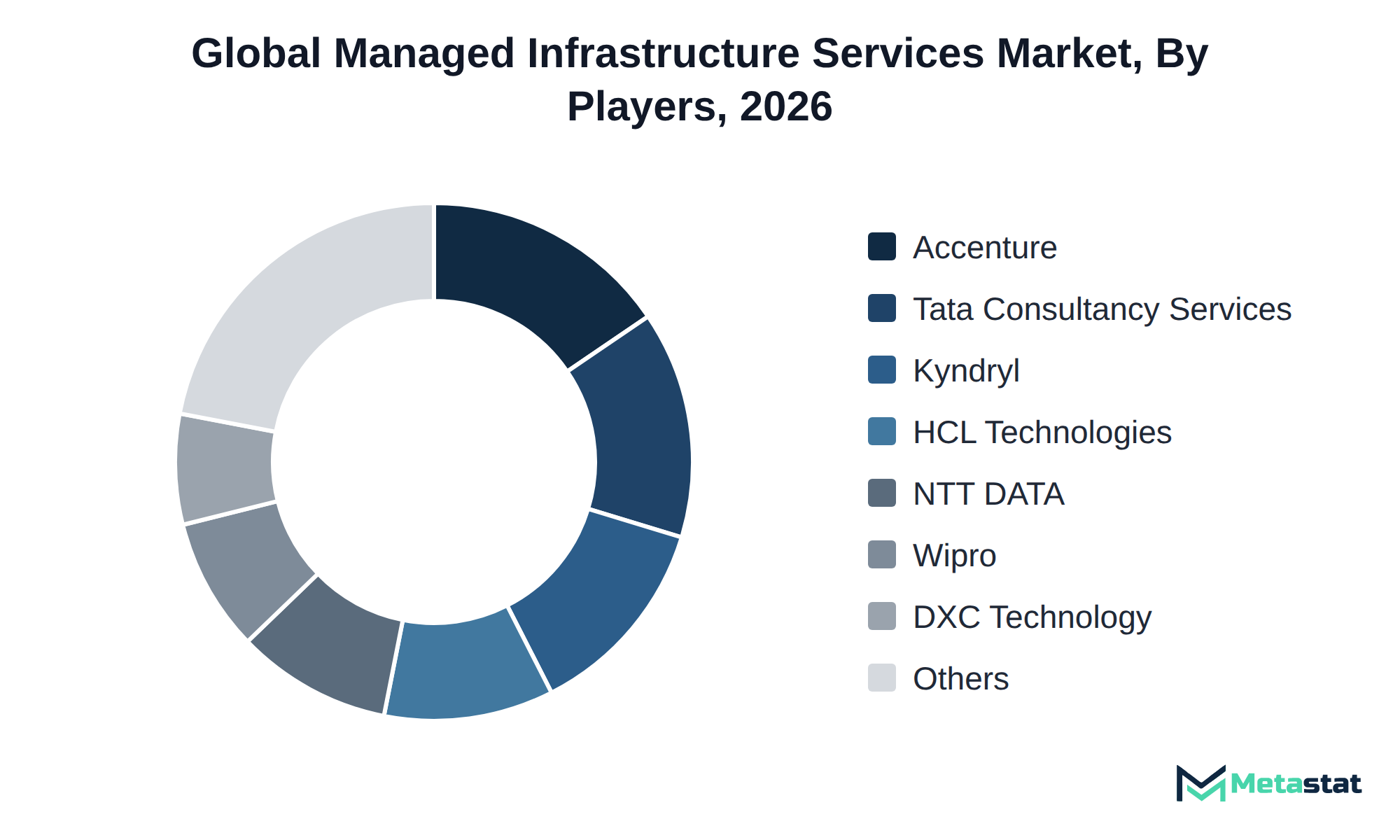
Kyndryl Holdings, Inc. and Accenture plc prioritize extensive service portfolios and robust customization capabilities, enhancing client satisfaction. NTT DATA Group Corporation emphasizes its global reach and integrated solutions, appealing to enterprises seeking comprehensive services. HCL Technologies Limited focuses on delivering specialized services in sectors including IT and telecommunications, ensuring alignment with industry requirements.
Buyers frequently consider factors including service reliability, pricing, and the ability to integrate with existing systems when selecting providers. Companies including Wipro Limited and Fujitsu Limited leverage their technological expertise and service ecosystems to attract diverse client bases. This competitive environment drives innovation and enhances the overall value proposition within the market.
Achieving this growth relies on several key developments. Firstly, the Managed Cloud Platform Operations segment is projected to experience significant growth, driven by the increasing adoption of cloud-based services across various industries. Secondly, the Hybrid deployment model is expected to gain traction, appealing to organizations seeking flexibility and scalability in their infrastructure solutions. This trend is particularly prominent among Large Enterprises that prioritize agile operational frameworks. A strong focus on Managed Infrastructure Security Services will support overall market growth, driven by rising cybersecurity threats in sectors including Banking, Financial Services, and Insurance. However, regional disparities present a risk to market expansion. North America, leading in market share, faces challenges related to regulatory compliance and increasing competition. If these issues are not addressed effectively, growth in the Managed Infrastructure Services market slows, impacting the forecast trajectory. Addressing these developments and risks will be essential for reaching the projected market size of USD 129.5 billion by 2033.
By Service Type: Managed Network Services, Managed Server and Compute Services, Managed Infrastructure Security Services, Managed Cloud Platform Operations, Managed Storage, Backup and Recovery Services, Managed Edge Infrastructure Services, Others (Mainframe Operations, Infrastructure Observability)
By Deployment Model: On-Premises and Colocation, Cloud-Only, Hybrid
By Enterprise Size: Large Enterprises, Small and Medium-Sized Enterprises
By End-Use Industry: Banking, Financial Services and Insurance, IT and Telecommunications, Manufacturing, Government and Public Sector, Healthcare and Life Sciences, Retail and E-Commerce, Energy and Utilities, Others (Education, Transportation and Logistics, Professional Services)
The report strategically identifies and profiles the key market players and analyses their core competencies in each sub-segment of the Managed Infrastructure Services market.
Report Attributes | Details |
Study Period | 2021-2033 |
Base Year | 2025 |
Estimated Year | 2026 |
Forecast Period | 2026-2033 |
Historical Period | 2021-2025 |
Growth Rate | CAGR 8.5% from 2026 to 2033 |
Revenue Unit | USD billion |
Segmentation | By Service Type, Deployment Model, Enterprise Size, End-Use Industry, and Region |
By Region | North America (By Service Type, Deployment Model, Enterprise Size, End-Use Industry, and Country)
|
Europe (By Service Type, Deployment Model, Enterprise Size, End-Use Industry, and Country)
| |
Asia Pacific (By Service Type, Deployment Model, Enterprise Size, End-Use Industry, and Country)
| |
South America (By Service Type, Deployment Model, Enterprise Size, End-Use Industry, and Country)
| |
Middle East and Africa (By Service Type, Deployment Model, Enterprise Size, End-Use Industry, and Country)
|
Find answers to common questions about this report
The Managed Infrastructure Services market size was valued at USD 67.4 billion in 2025.
The market is projected to grow at a CAGR of 8.5% during the forecast period from 2026 to 2033.
The North America Managed Infrastructure Services market size is projected to reach USD 45.1 billion by 2033.
Managed Network Services leads the Managed Infrastructure Services market with a projected value of USD 31.3 billion in 2033. This segment outpaces others in growth potential and revenue generation.
Growth in managed cloud platform operations drives increased spending by organizations seeking to enhance digital capabilities. The transition from traditional on-premises models to cloud-based services reflects a broader industry trend toward digital transformation.
North America holds the dominant share of the Managed Infrastructure Services market, with a projected value of USD 45.1 billion in 2033, representing 36.5 percent of the total market.
Cost considerations significantly impact buyer engagement, as large enterprises prioritize cost-effective solutions when managing IT infrastructure. Increasing talent costs present a challenge for suppliers, as the demand for skilled professionals in technology sectors has surged, directly affecting profit margins.
Rapid growth in managed cloud platform operations drives adoption, with organizations increasingly recognizing the advantages of scalable and flexible IT solutions. This shift enhances operational agility and reduces overhead costs, particularly for small and medium-sized enterprises pursuing digital transformation.
The Managed Infrastructure Services market is estimated to reach a valuation of USD 129.5 billion by 2033.
Key players operating in the Managed Infrastructure Services market include Kyndryl Holdings, Inc., NTT DATA Group Corporation, Accenture plc, HCL Technologies Limited, Tata Consultancy Services Limited, DXC Technology Company, and Wipro Limited.
The analysts below cover Information & Technology research at Metastat Insights.
LEAD ANALYST
Utkarsh Khirodkar is a Lead Market Research Analyst at MetaStat Insight, specializing in market intelligence, technology sector assessments, and competitive strategy.

PRINCIPAL CONSULTANT - ENTERPRISE AI & EMERGING TECHNOLOGIES
Banking & Finance · Electronics and Semiconductor · Energy and Power · Healthcare IT · Information & Technology · Professional Services
Vijay Gunti is a Principal Consultant at MetaStat Insight, bringing over two decades of experience across enterprise digital transformation, technology strategy, and intelligent systems.

LEAD CONSULTANT - COMMUNICATION, TELECOM, AND IT
Electronics and Semiconductor · Information & Technology · Machinery & Equipment · Professional Services
Ravindra Sathe Consultants for Communication, Telecom, and IT at MetaStat Insight. He leads the firm's industry research initiatives across telecommunications infrastructure, digital connectivity, enterprise networking, and emerging information technology domains.
Integrating zero-trust access controls across legacy electronic health record systems involves complex compliance overhead. Team produced an analysis that clearly separated identity governance and administration tools from privileged access management platforms. Their evaluation of HIPAA and GDPR compliance features across cloud native solutions gave our architecture group clear baseline criteria. The custom data request regarding biometric authentication adoption in hospital networks was returned promptly with clear documentation.
Evaluating calorific value requirements and air permit compliance across municipal waste facilities requires localized data. Metastat Insight structured their analysis around operational throughput capacity and feedstock composition variations in Latin America and Eastern Europe. Their competitive mapping of sorting equipment vendors helped clarify technology differences between optical separators and heavy media systems. The study provided an objective baseline during our capital expenditure reviews.
Decarbonizing industrial thermal processes hinges on refrigerant regulations and compressor efficiency limits. Metastat Insights delivered a thorough market analysis that evaluated natural refrigerants like CO2 and hydrocarbons against synthetic low-GWP alternatives. The breakdown of utility incentives and grid capacity constraints across key European manufacturing hubs offered valuable perspective. The follow-up conversation with their sector analysts addressed our specific questions on mechanical vapor recompression systems efficiently.
Explore related market intelligence reports worth reading alongside this one.
Starting from
$2950