
LEAD ANALYST
Utkarsh Khirodkar is a Lead Market Research Analyst at MetaStat Insight, specializing in market intelligence, technology sector assessments, and competitive strategy.

Global Medical Laundry Services Market Size, Share, By Service Type (On-premise Laundry Services, Outsourced Laundry Services, Dry Cleaning Services, In-house Laundry Services, and Specialized Linen Services), By Product Type (Soiled Linen, Surgical Drapes and Gowns, Patient Garments, Linen, Instruments and Equipment Covers, and Others), By Process Type (Wet Cleaning, Industrial Laundering, Steam Laundering, Heat Sterilization, and Ultrasonic Cleaning), By End-User (Hospitals, Clinics, Nursing Homes, Ambulatory Surgical Centers, Pharmaceutical Companies, and Others), Industry Analysis, Growth, Trends, and Forecast, 2026-2033
Report ID
MSI-4623
Published
April, 2026
Pages
320 Pages
Format
Report Details
Choose Your License
Medical Laundry Services Market
Global Medical Laundry Services market size is valued at USD 12.5 billion in 2025 and projected to grow at a CAGR of 5.2% during the forecast period, reaching USD 18.7 billion by 2033.
North America holds 31.3% of the Global Medical Laundry Services market in 2025, with the United States accounting for the largest regional share.
On-premise Laundry Services segment account for a market share of 15.9% in 2025.
Key trends driving growth: Rising hospital admissions and surgical procedures propel linen throughput across acute care, ambulatory surgery, and specialty clinics, along with stricter infection prevention and accreditation requirements increase outsourcing to validated, auditable healthcare-grade laundering processes.
Opportunities include RFID-enabled linen tracking unlocks operational gains via loss reduction, inventory optimization, and performance-based contracts with hospitals.
Key insight: The Global Medical Laundry Services market is evolving toward highly standardized, technology-enabled service models that emphasize hygiene compliance, traceability, and cost efficiency.
The Global Medical Laundry Services market is expanding steadily with rising healthcare utilization, growing emphasis on infection prevention, and increased outsourcing of non-core hospital operations. Hospitals, clinics, and surgical centers are prioritizing hygienic, traceable, and cost-efficient textile processing solutions to support clinical safety and operational efficiency.
Future trends will focus on automation, RFID-enabled linen tracking, water and energy optimization, and wider adoption of audit-ready, compliance-driven laundry workflows. Sustainability targets and stricter hygiene standards will continue to shape investment decisions across the market.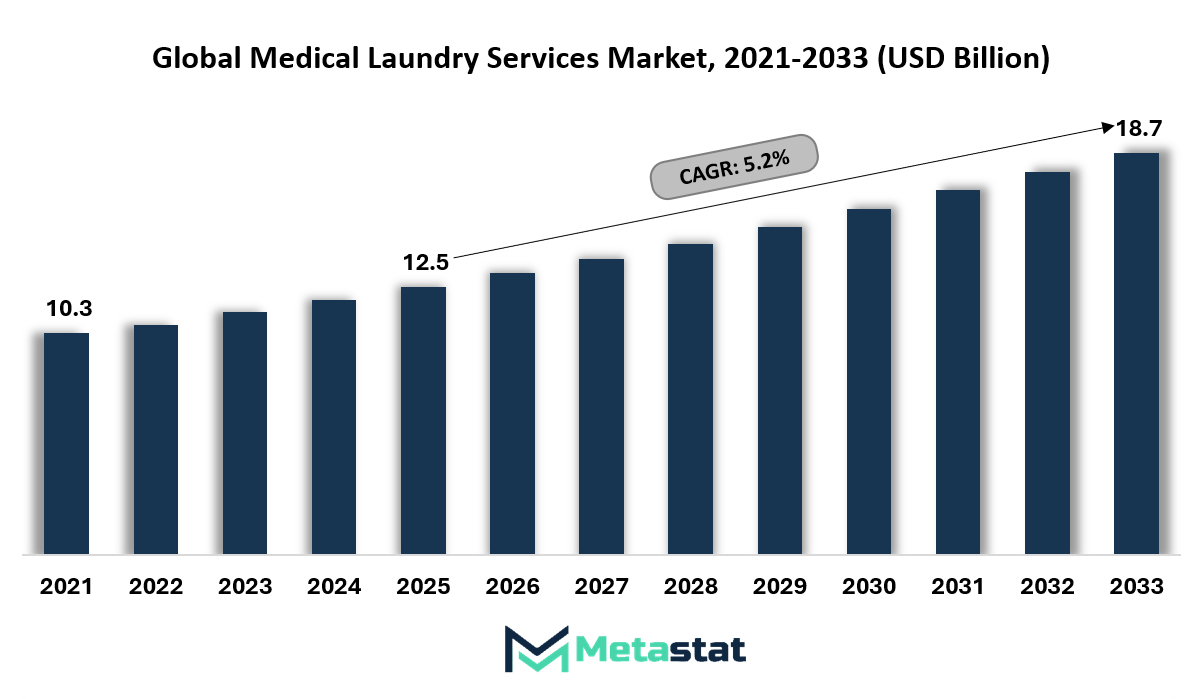
Rising hospital admissions and surgical procedures propel linen throughput across acute care, ambulatory surgery, and specialty clinics.
Rising hospital admissions and surgical procedures continue to increase service volumes in the Global Medical Laundry Services market. Higher patient throughput across hospitals, ambulatory surgical centers, and specialty clinics is increasing linen circulation and replacement frequency. The trend supports long-term demand for sterile, high-turnover textile management and strengthens service contract volumes across healthcare networks.
Stricter infection prevention and accreditation requirements increase outsourcing to validated, auditable healthcare-grade laundering processes.
Stricter infection prevention standards and accreditation requirements are increasing reliance on professional laundering providers in the Global Medical Laundry Services market. Healthcare facilities are adopting validated and auditable cleaning processes to maintain hygiene benchmarks and reduce contamination risk. Certified systems with traceability and compliance assurance are strengthening outsourcing trends and long-term vendor partnerships.
High energy, water, and labor costs constrain margins across wash, drying, and transport operations.
High energy, water, and labor costs continue to pressure profitability in the Global Medical Laundry Services market. Resource-intensive washing, drying, and transport operations require ongoing cost optimization and process efficiency improvements. Utility price volatility and labor inflation will affect operating margins across service providers.
Compliance burden and contamination risk restrain scale-up with stringent segregation, tracking, and quality audits for healthcare textiles.
Compliance burden and contamination risk will restrict rapid expansion in the Global Medical Laundry Services market. Strict segregation protocols, textile tracking requirements, and continuous quality audits increase operational complexity and onboarding timelines. Providers must maintain rigorous standards across diverse healthcare environments, which can slow scale-up and capacity expansion.
RFID-enabled linen tracking unlocks operational gains via loss reduction, inventory optimization, and performance-based contracts with hospitals.
RFID-enabled linen tracking offers measurable performance gains in the Global Medical Laundry Services market. Advanced tracking systems reduce textile loss, improve inventory accuracy, and support performance-based service models. Integration of digital monitoring tools also improves transparency, data-driven decision-making, and long-term contractual alignment with healthcare institutions.
The Global Medical Laundry Services market is classified based on Service Type, Product Type, Process Type, and End-User.
On-premise Laundry Services segment is valued at USD 2.1 billion in 2026 and is projected to reach USD 3.2 billion by 2033, at a CAGR of 6.2% during the forecast period.
On-premise laundry services remain relevant for healthcare facilities seeking stronger control over hygiene protocols, processing schedules, and internal linen handling. Adoption of on-premise laundry services is supported by the need for faster turnaround time, direct supervision of sanitation practices, and better coordination with hospital-specific operational requirements.
Outsourced Laundry Services segment is valued at USD 5.6 billion in 2026 and is projected to reach USD 8.4 billion by 2033, at a CAGR of 6% during the forecast period.
Outsourced laundry services continue to gain traction owing to cost efficiency, scalability, and access to specialized healthcare-grade processing capabilities. Hospitals and clinics are increasingly partnering with third-party providers that offer standardized hygiene workflows, traceability systems, and consistent collection and delivery models across high-volume operations.
Dry Cleaning Services segment is valued at USD 1.2 billion in 2026 and is projected to reach USD 1.4 billion by 2033, at a CAGR of 2.4% during the forecast period.
Dry cleaning services serve a narrower still important role in handling delicate healthcare textiles and specialty garments that require controlled fabric care. Growth in dry cleaning services is supported by demand for material preservation, appearance maintenance, and careful processing of reusable textile items used in select medical and administrative settings.
In-house Laundry Services segment is valued at USD 2.8 billion in 2026 and is projected to reach USD 3.4 billion by 2033, at a CAGR of 3.2% during the forecast period.
In-house laundry services continue to support healthcare facilities that prefer direct operational control over linen management and contamination prevention practices. In-house laundry services remain relevant among institutions with dedicated infrastructure, though cost pressures, maintenance requirements, and compliance demands will limit broader expansion.
Specialized Linen Services segment is valued at USD 1.5 billion in 2026 and is projected to reach USD 2.3 billion by 2033, at a CAGR of 6.1% during the forecast period.
Specialized linen services are gaining importance as healthcare facilities increase focus on high-performance textiles designed for hygiene-critical environments. Demand is being supported by the use of antimicrobial fabrics, stricter processing standards, and greater need for traceable, unit-specific linen management across intensive care and surgical applications.
Soiled Linen segment is projected to reach USD 5.2 billion by 2033, at a CAGR of 5.5% during the forecast period.
Soiled linen management remains a core component of the Global Medical Laundry Services market owing to the constant need for safe collection, segregation, transport, and disinfection of contaminated textiles. Efficient handling of this category is essential for infection prevention, workflow continuity, and compliance with healthcare sanitation standards.
Surgical Drapes and Gowns segment is projected to reach USD 4.2 billion by 2033, at a CAGR of 5.8% during the forecast period.
Surgical drapes and gowns represent a critical product category supported by strict sterilization requirements and high usage across operating environments. Growth of surgical drapes and gowns is being shaped by rising surgical volumes, preference for reusable sterile textiles in some facilities, and stronger focus on material durability and contamination resistance.
Patient Garments segment is projected to reach USD 2.9 billion by 2033, at a CAGR of 4.5% during the forecast period.
Patient garments account for a steady share of demand as healthcare facilities prioritize comfort, hygiene, and repeated-use durability in textile procurement. Service providers are focusing on gentle yet effective processing methods that preserve fabric quality while meeting strict sanitation and appearance requirements.
Linen segment is projected to reach USD 3.3 billion by 2033, at a CAGR of 4.6% during the forecast period.
General linen continues to hold an important share in the market owing to ongoing demand from hospitals, nursing homes, and clinical care centers. Consistent replacement, repeated wash cycles, and rising emphasis on inventory optimization are supporting the need for efficient and compliant laundry service solutions in this category.
Instruments and Equipment Covers segment is projected to reach USD 1.4 billion by 2033, at a CAGR of 5.3% during the forecast period.
Instruments and equipment covers require precise handling and specialized cleaning workflows to maintain protective performance and reduce contamination risk. Demand in instruments and equipment covers is supported by growing use of sensitive medical equipment and the need for reliable textile hygiene across high-dependency clinical environments.
Others segment is projected to reach USD 1.8 billion by 2033, at a CAGR of 5.2% during the forecast period.
Other textile categories include specialized reusable fabric items designed for specific healthcare functions. Growth in other textile categories is supported by changing clinical requirements, wider textile customization, and increasing adoption of hygiene-focused service solutions across diverse care settings.
Wet Cleaning segment is projected to reach USD 4.1 billion by 2033.
Wet cleaning remains a widely used process in the Global Medical Laundry Services market owing to its compatibility with healthcare textiles and its ability to support effective stain removal, sanitation, and fabric care. Improvements in detergents, water management systems, and wash-cycle control are strengthening its operational efficiency.
Industrial Laundering segment is projected to reach USD 7.5 billion by 2033.
Industrial laundering represents the backbone of large-scale medical textile processing owing to its ability to handle high volumes with consistency and speed. Growth in industrial laundering is supported by automation, route-based collection systems, and expanding demand from hospitals and multi-facility healthcare networks requiring centralized processing capacity.
Steam Laundering segment is projected to reach USD 2.5 billion by 2033.
Steam laundering remains important in healthcare laundry operations where high-temperature disinfection is required to reduce microbial load and strengthen hygiene assurance. This process supports facilities seeking dependable pathogen reduction and improved textile sanitation across frequently used linen categories.
Heat Sterilization segment is projected to reach USD 3.2 billion by 2033.
Heat sterilization plays an essential role in processing selected reusable healthcare textiles that require strong microbial control and validated sanitation outcomes. Adoption of heat sterilization is supported by rising focus on infection prevention, regulatory compliance, and safer reuse of textile materials in sensitive medical environments.
Ultrasonic Cleaning segment is projected to reach USD 1.3 billion by 2033.
Ultrasonic cleaning serves niche applications that require precision removal of contaminants from delicate or specialized reusable items. The segment is supported by increasing interest in advanced cleaning methods that improve effectiveness while minimizing fabric stress and supporting high-quality service outcomes.
Hospitals segment is projected to grow at a CAGR of 5.3% during the forecast period.
Hospitals represent the leading end-user segment in the Global Medical Laundry Services market owing to high patient volume, continuous linen consumption, and strict sanitation requirements. Large-scale operations, surgical throughput, and infection-control priorities continue to support strong and recurring demand from this segment.
Clinics segment is projected to grow at a CAGR of 4% during the forecast period.
Clinics are increasingly adopting professional laundry services to maintain hygiene standards without investing heavily in internal processing infrastructure. Growth in clinic segment is supported by the need for dependable, cost-efficient, and compliance-oriented textile management across outpatient and specialty care settings.
Nursing Homes segment is projected to grow at a CAGR of 4% during the forecast period.
Nursing homes generate consistent demand for medical laundry services owing to long-term care needs, frequent textile replacement, and high emphasis on cleanliness and resident comfort. Service providers supporting nursing homes segment focus on gentle yet hygienic processing methods that align with repeated-use textile requirements.
Ambulatory Surgical Centers segment is projected to grow at a CAGR of 6.4% during the forecast period.
Ambulatory surgical centers are emerging as an important demand center owing to high procedure turnover, need for rapid linen turnaround, and strict sterilization requirements. Efficient textile processing and dependable service scheduling remain essential for supporting uninterrupted clinical workflow in these facilities.
Pharmaceutical Companies segment is projected to grow at a CAGR of 6.6% during the forecast period.
Pharmaceutical companies contribute to market demand through the need for contamination-controlled textile maintenance across production, laboratory, and research environments. Growth in pharmaceutical companies is supported by strict quality requirements, hygiene-sensitive operations, and expanding pharmaceutical manufacturing and testing activity.
Others segment is projected to grow at a CAGR of 5.7% during the forecast period.
Other end-users include diagnostic centers, rehabilitation facilities, and research institutions that require reliable and hygienic textile processing services. Demand across these settings is supported by varied operational needs, growing compliance awareness, and increasing preference for outsourced service support.
Based on geography, the Global Medical Laundry Services market is divided into North America, Europe, Asia-Pacific, South America, Middle East, and Africa.
North America leads the Medical Laundry Services market owing to strong healthcare infrastructure, strict infection-control regulations, and high adoption of outsourced support services.
Europe holds a significant share in the Medical Laundry Services market, supported by mature healthcare systems, strong hygiene compliance requirements, and established textile service outsourcing models.
Asia Pacific is witnessing notable growth in the Medical Laundry Services market owing to rapid healthcare infrastructure expansion, rising hospital investments, and increasing awareness of infection prevention.
South America is showing gradual growth in the Medical Laundry Services market, supported by improving healthcare infrastructure, rising hygiene awareness, and increasing use of outsourced facility support services.
The Middle East and Africa market is developing steadily with rising healthcare investments, stronger focus on hygiene compliance, and growing awareness of structured textile processing requirements.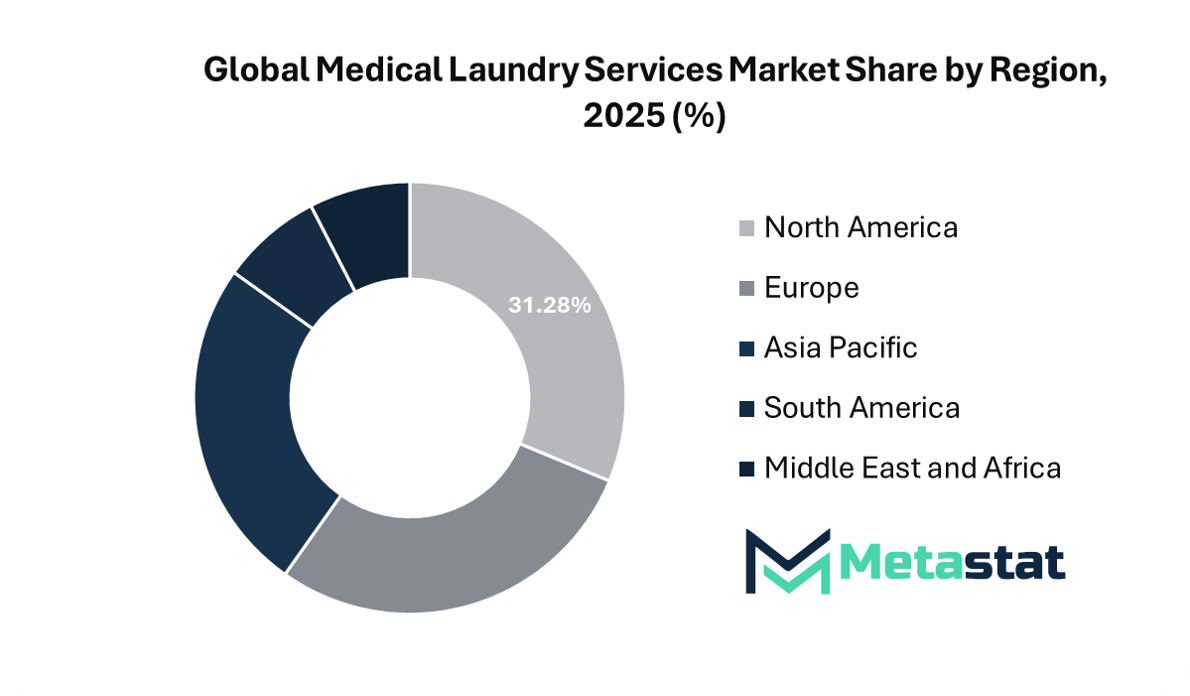
The Global Medical Laundry Services market serves as a critical support function within healthcare operations, where hygiene consistency, service reliability, and turnaround efficiency directly influence patient safety and institutional performance. Hospitals, clinics, diagnostic centers, and other healthcare facilities depend on structured laundry service providers to manage large volumes of linens, uniforms, gowns, drapes, and reusable textiles that require strict sanitation and controlled handling. Market demand continues to strengthen with the expansion of healthcare infrastructure and the increasing need for compliant, high-quality textile processing solutions that support both operational continuity and infection-control standards.
Service providers are strengthening their capabilities through investments in advanced washing technologies, water-efficient systems, and contamination-control processes that improve service quality and resource optimization. Automation is gaining importance across sorting, washing, drying, and distribution activities, helping reduce manual handling and improve consistency across healthcare textile workflows. Sustainability is also emerging as a major competitive parameter, with companies adopting energy-efficient equipment, eco-friendly detergents, and optimized water usage practices to align with environmental goals while maintaining required hygiene standards.
The competitive landscape remains centered on established players with strong operational networks, processing scale, and healthcare-focused service expertise. Companies such as Elis SA, Cintas Corporation, Alsco Inc., Aramark Corporation, UniFirst Corporation, and ImageFIRST Healthcare Laundry Specialists, LLC continue to reinforce their market presence through reliable service delivery, broad customer coverage, and compliance-oriented operating models. European participants including MEWA Textil-Management AG & Co. KG, Lindström Oy, and Salesianer Miettex GmbH also hold an important position, supported by regional strength, structured service frameworks, and long-standing experience in textile management.
Additional market participants such as K-Bro Linen Inc., Emerald Textiles, and Bardusch GmbH & Co. KG contribute to market stability through region-specific service capabilities and tailored healthcare textile solutions. Companies including CWS International GmbH, Healthcare Services Group, Inc., and Compass Group PLC through Crothall Healthcare are expanding their role by integrating laundry services with wider facility support offerings. Sodexo S.A. and Rentokil Initial plc through Initial Hygiene also strengthen competitive intensity through diversified service portfolios that help healthcare providers improve efficiency through bundled operational solutions.
Market size is forecast to rise from USD 12.5 billion in 2025 to over USD 18.7 billion by 2033.
The Global Medical Laundry Services market reflecting continued demand from healthcare facilities for hygienic, traceable, and cost-efficient textile processing solutions. Market expansion will be supported by rising patient volumes, stronger outsourcing adoption, growing compliance requirements, and wider use of automation and RFID-based linen management systems.
By Service Type:
By Product Type:
By Process Type:
By End-User:
This research report categorizes the Medical Laundry Services market based on key segments and regions, forecasts revenue growth, and analyses trends in each submarket. The report analyses the key growth drivers, opportunities, and challenges influencing the Medical Laundry Services market. Recent market developments and competitive strategies such as expansion, product launch, partnership, merger, and acquisition have been included to draw the competitive landscape in the market.
The report strategically identifies and profiles the key market players and analyses their core competencies in each sub-segment of the Medical Laundry Services market.
|
Report Attributes |
Details |
|
Study Period |
2021-2033 |
|
Base Year |
2025 |
|
Estimated Year |
2026 |
|
Forecast Period |
2026-2033 |
|
Historical Period |
2021-2025 |
|
Growth Rate |
CAGR 5.2% from 2026 to 2033 |
|
Revenue Unit |
USD billion |
|
Segmentation |
By Service Type, Product Type, Process Type, End-User, and Region |
|
By Region |
North America (By Service Type, Product Type, Process Type, End-User, and Country)
|
|
Europe (By Service Type, Product Type, Process Type, End-User, and Country)
|
|
|
Asia Pacific (By Service Type, Product Type, Process Type, End-User, and Country)
|
|
|
South America (By Service Type, Product Type, Process Type, End-User, and Country)
|
|
|
Middle East and Africa (By Service Type, Product Type, Process Type, End-User, and Country)
|
Find answers to common questions about this report
Top players operating in the Medical Laundry Services industry include Elis SA, Cintas Corporation, Alsco Inc., Aramark Corporation, UniFirst Corporation, and ImageFIRST Healthcare Laundry Specialists, LLC.
Global Medical Laundry Services market is estimated to reach USD 18.7 billion by 2033.
High energy, water, and labor costs constrain margins across wash, drying, and transport operations. will hamper the market growth within the forecast period.
North America region dominates the market.
The Industrial Laundering is the leading type segment in the Global market.
Rising hospital admissions and surgical procedures propel linen throughput across acute care, ambulatory surgery, and specialty clinics and stricter infection prevention and accreditation requirements increase outsourcing to validated, auditable healthcare-grade laundering processes. are key driving factors, boosting the market.
The Metastat Insights analysis shows that the North America Medical Laundry Services market size is estimated to be USD 6.2 billion by 2033.
The Global Medical Laundry Services market is expected to grow at a CAGR of 5.2% over the forecast period (2026-2033).
The Metastat Insights study shows that the Global Medical Laundry Services market size was USD 12.5 billion in 2025.
The analysts below cover Professional Services research at Metastat Insights.
LEAD ANALYST
Utkarsh Khirodkar is a Lead Market Research Analyst at MetaStat Insight, specializing in market intelligence, technology sector assessments, and competitive strategy.

PRINCIPAL CONSULTANT - ENTERPRISE AI & EMERGING TECHNOLOGIES
Banking & Finance · Electronics and Semiconductor · Energy and Power · Healthcare IT · Information & Technology · Professional Services
Vijay Gunti is a Principal Consultant at MetaStat Insight, bringing over two decades of experience across enterprise digital transformation, technology strategy, and intelligent systems.

PRINCIPAL CONSULTANT - QUALITY SYSTEMS & COMPLIANCE
Electronics and Semiconductor · Machinery & Equipment · Professional Services
Omkar Phadtare is an Industry Consultant at MetaStat Insight, specializing in quality systems, regulatory compliance, and standards benchmarking to drive data-driven market intelligence and strategic industry research.

LEAD CONSULTANT - COMMUNICATION, TELECOM, AND IT
Electronics and Semiconductor · Information & Technology · Machinery & Equipment · Professional Services
Ravindra Sathe Consultants for Communication, Telecom, and IT at MetaStat Insight. He leads the firm's industry research initiatives across telecommunications infrastructure, digital connectivity, enterprise networking, and emerging information technology domains.
Tracking ceramic matrix composite adoption in high-bypass aero engines requires strict attention to material qualification cycles and FAA airworthiness testing milestones. The MetaStat Insight team provided a detailed timeline of silicon carbide fiber manufacturing capacity and commercial foundry lead times. Having clear visibility into upstream thermal barrier coating supply helped us stress-test our long-term component procurement strategy.
Transitioning ultra-class mining haul trucks to alternative power requires concrete data on remote hydrogen refueling infrastructure economics. The report evaluated megawatt-scale electrolyzer installation expenses, onsite storage safety mandates, and heavy-duty fuel cell stack degradation under continuous duty cycles. That technical rigor helped our engineers benchmark realistic total operating cost horizons for off-highway fleet decarbonization.
Enterprise zero-trust network rollouts are often slowed down by multi-cloud transit latency and proprietary hardware retirement schedules. This study provided realistic total cost of ownership models comparing cloud-delivered security edge solutions against traditional hardware refreshes. The analysis of contract renewal lengths and software maintenance fees gave us clear visibility into enterprise replacement cycles over the next three to five years.
Explore related market intelligence reports worth reading alongside this one.