
LEAD ANALYST
Utkarsh Khirodkar is a Lead Market Research Analyst at MetaStat Insight, specializing in market intelligence, technology sector assessments, and competitive strategy.

Global Natural Industrial Absorbent Market Size, Share, By Type (Natural Inorganic Absorbents and Natural Organic Absorbents), By Material (Clay-Based Absorbents, Cellulose-Based Absorbents, Natural Fiber-Based Absorbents, Coconut Coir-Based Absorbents, Starch-Based Absorbents and Others (Peat-Based Absorbents)), By Application (Oil Spill Cleanup, Industrial Liquid Spill Control, Chemical and Hazardous Liquid Absorption, Industrial Cleaning and Maintenance and Waste Management and Liquid Containment), By End-Use Industry (Oil and Gas, Manufacturing and Industrial Processing, Automotive and Transportation, Chemical and Petrochemical, Marine and Shipping, Mining and Metals, Power Generation and Utilities and Others (Construction and Infrastructure)), Industry Analysis, Growth, Trends, and Forecast, 2026-2033
Report ID
MSI-5767
Published
November, 2026
Pages
297 Pages
Format
Historical
Base year
Forecast
Forecast period
Report Details
Market Valuation: Valued at $1,536.1 Million in 2025, projected to reach $2,287.6 Million by 2033 at a 5.1% CAGR.
Dominant Segment: Natural Organic Absorbents lead the market, driven by the rising demand for eco-friendly solutions in applications such as oil spill cleanup and industrial liquid spill control.
Geographic Lead: North America is the leading region, holding 31.1% of the market in 2025, with the US expected to continue its dominance due to a strong industrial base and stringent safety regulations.
What's Inside: The report provides a comprehensive analysis of the market, including competitive coverage, detailed segmentations by type and application, and forecasts extending to 2033.
Growth Drivers: The market is primarily fueled by increasing industrial activity, heightened regulatory scrutiny on environmental safety, and the growing emphasis on sustainable practices across various sectors.
Choose Your License
Global Natural Industrial Absorbent Market
The global Natural Industrial Absorbent market was valued at USD 1,536.1 million in 2025 and is projected to reach USD 2,287.6 million by 2033, growing at a CAGR of 5.1% over the forecast period.
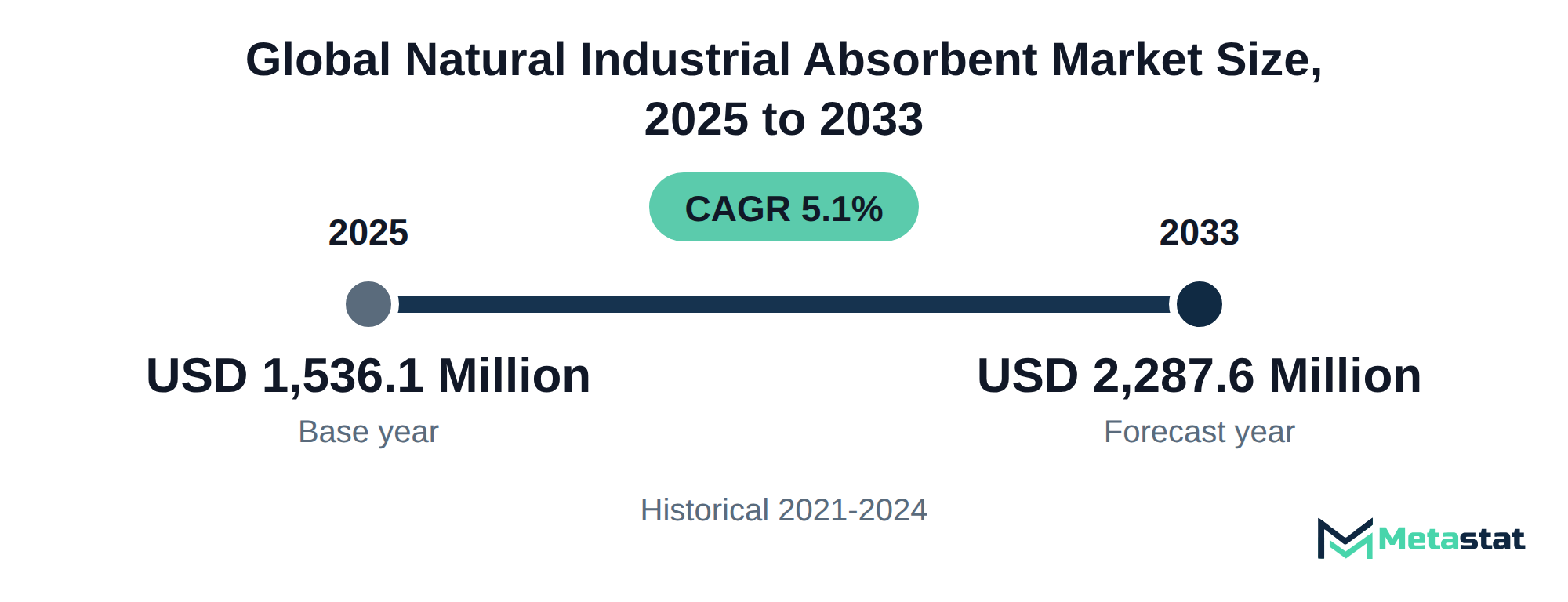
The Natural Industrial Absorbent market encompasses various products designed to effectively manage spills and absorb liquids in industrial settings. Buyers invest in these solutions to minimize environmental impact, enhance safety, and ensure compliance with regulations. Key sectors including oil and gas, manufacturing, and automotive drive demand, highlighting the importance of reliable absorbent materials in operational activities.
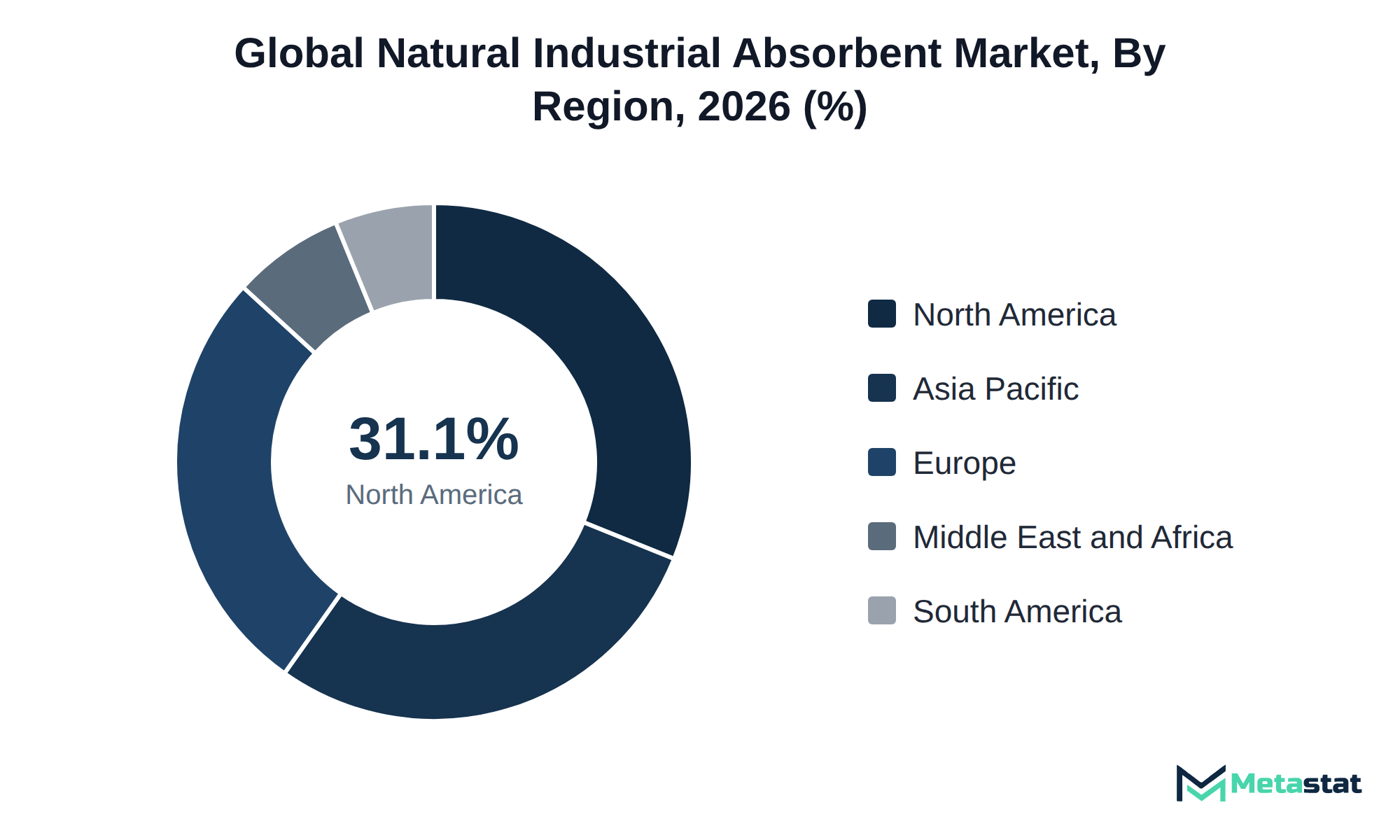
Growth within the market is largely fueled by the increasing frequency of industrial spills and the growing emphasis on environmental sustainability. Among the segments, Natural Organic Absorbents represent the highest value, aligning with the rising preference for eco-friendly solutions. North America holds 31.1% of the market in 2025, with the US leading in 2026. This region's strong industrial base and focus on safety regulations contribute significantly to its market share.
The demand for advanced absorbent products reflects the evolving needs of industries facing stringent environmental standards. The expansion of production capabilities and innovation in absorbent materials support the market's trajectory. In particular, the oil spill cleanup application segment helps limit ecological damage and supports operational compliance.
The market includes a range of absorbent materials for managing spills and controlling liquid contamination across various industries. Buyers prioritize these products to ensure compliance with environmental regulations and to meet occupational health and safety requirements. The versatility of absorbents in addressing different types of spills, including oil, chemicals, and hazardous liquids, influences purchasing decisions. Their effectiveness in reducing liquid spill risks drives demand in key sectors such as oil and gas, manufacturing, and automotive.
Growth in the market is fueled by increasing industrial activity and heightened awareness regarding environmental safety. The Natural Organic Absorbents segment represents the largest share of value within the market, reflecting its popularity among users seeking sustainable solutions. This region benefits from stringent regulations promoting safety and environmental protection, pushing industries towards the adoption of effective absorbent solutions.
Increased investment in eco-friendly products further supports market expansion. The demand for absorbents is expected to rise in response to the growing need for effective spill management solutions. Companies are developing new materials and applications to meet changing customer requirements. The need for effective and sustainable absorbent solutions across industries points to significant growth for natural industrial absorbents.
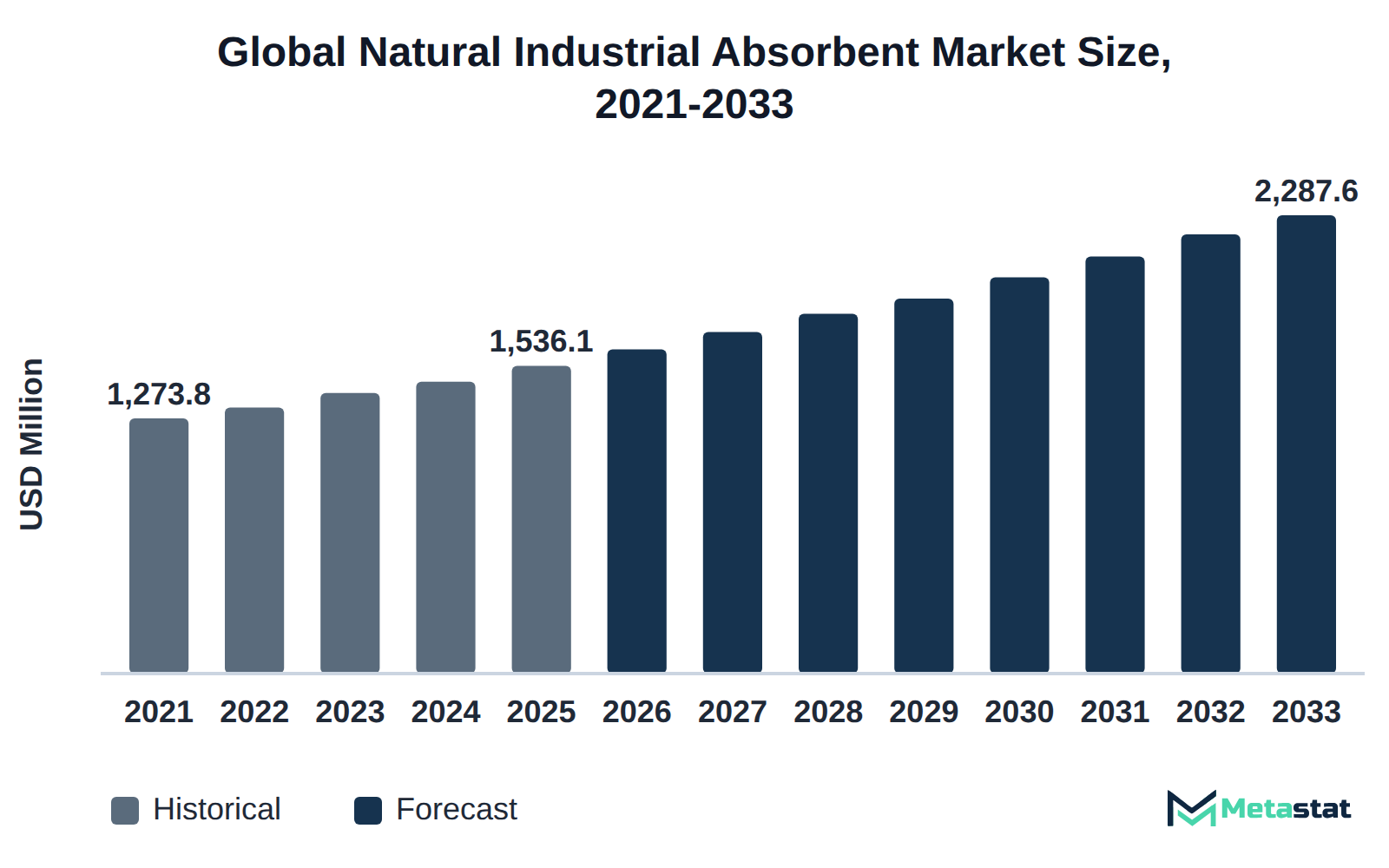
Natural industrial absorbents play a central role in oil spill management and hazardous liquid handling. The effectiveness of these materials, particularly in oil spill cleanup, relies on their ability to absorb significant volumes of liquid. From 2026 to 2033, this application segment is projected to increase from USD 516.2 million to USD 706 million, representing a compound annual growth rate (CAGR) of 4.6%. This growth is driven by heightened regulatory scrutiny and the need for effective environmental protection solutions.
In recent years, advances in cellulose-based absorbents have brought a notable shift in the market. Cellulose-based absorbents offer superior retention and biodegradability compared to traditional materials. Industries face increasing pressure to adopt sustainable practices, driving demand for cellulose-based options. By 2033, the market for cellulose-based absorbents is expected to reach USD 680.8 million. This shift provides companies with an opportunity to enhance their product offerings and appeal to environmentally conscious consumers.
The transition toward more sustainable absorbent solutions addresses environmental concerns and strengthens companies' positions within the natural industrial absorbent market. By investing in innovative materials and technologies, businesses enhance their competitive edge and capture a larger share of the growing demand for effective liquid management solutions.
Purchasing models for absorbent materials in the Natural Industrial Absorbent market increasingly emphasize flexibility and cost-effectiveness. Buyers often seek long-term contracts to secure stable pricing and ensure availability. Such contracts typically involve commitments for several years, enabling manufacturers to anticipate demand and optimize production schedules. In 2026, the market for clay-based absorbents, a sub-segment of the materials category, is valued at USD 501.4 million and is projected to reach USD 682.6 million by 2033, reflecting a compound annual growth rate of 4.5%. This growth signals robust demand among industrial sectors requiring reliable supply chains.
Price negotiation influences the purchasing process, with buyers advocating for volume discounts while suppliers aim to maintain profit margins. This dynamic drives innovation in pricing models, often resulting in tiered pricing based on order volume or contract length. Buyers become more informed about market trends and competitor offerings, prompting suppliers to adjust their pricing strategies accordingly to enhance competitiveness. With the increasing demand for eco-friendly materials, many buyers prioritize sourcing from suppliers who adopt sustainable practices, influencing their purchasing decisions and long-term supplier relationships. Stakeholders in the Natural Industrial Absorbent market therefore need a clear understanding of these purchasing models to manage pricing pressures.
The manufacturing, chemical, and automotive industries increasingly rely on high-performance absorbents for effective spill management and maintenance applications. Within this context, the oil and gas sector specifically demonstrates substantial demand for natural industrial absorbents, projected to reach USD 426 million by 2033, reflecting a compound annual growth rate (CAGR) of 5.2%. The critical nature of operations in these industries necessitates the use of absorbents that deliver rapid and efficient cleaning solutions in response to spills and leaks.
The expected rise in regulatory requirements concerning environmental safety drives the adoption of effective absorbent solutions. Manufacturers seek products that meet performance standards while aligning with sustainability initiatives. The integration of natural materials in absorbents, including cellulose-based and coconut coir-based options, supports a transition toward more environmentally friendly practices while fulfilling operational demands. This trend positions players in the natural industrial absorbent market to enhance their product offerings and cater to evolving customer preferences.
The increasing focus on environmental sustainability significantly influences the adoption of natural industrial absorbent materials. A growing number of industries prioritize eco-friendly solutions, leading to strong demand for products that minimize environmental impact. In the Natural Industrial Absorbent market, natural organic absorbents are projected to reach USD 1,330 million by 2033, reflecting a compound annual growth rate (CAGR) of 5.3% during the forecast period. This trend highlights the shift toward materials that align with green initiatives and regulatory requirements aimed at reducing pollution.
Businesses across various sectors recognize the long-term cost benefits of adopting sustainable absorbents. Operational efficiency achieved through effective spill management and clean-up operations results in reduced waste disposal costs. By investing in environmentally responsible products, companies enhance their corporate image, advance their environmental, social and governance (ESG) goals, and meet consumer expectations for sustainability. The transition toward natural absorbent materials creates competitive advantages while ensuring compliance with increasingly stringent environmental regulations.
Increasing emphasis on sustainability leads to heightened demand for natural industrial absorbents, particularly among environmentally conscious industries including oil and gas and manufacturing. Buyers prioritize absorbents that offer eco-friendly properties, aligning with corporate responsibility goals and environmental regulations. This shift in buyer behavior significantly impacts purchasing patterns, driving up volume as companies seek to replace traditional synthetic industrial absorbents with more sustainable options. This transition supports broader environmental initiatives, making natural industrial absorbents more appealing to businesses aiming to enhance their sustainability credentials.
Heightened regulatory scrutiny on environmental impact further boosts this trend, compelling organizations to invest in greener solutions. Rising costs of traditional absorbents due to resource scarcity reinforce this movement, making natural solutions more competitive in terms of pricing and performance. This evolving dynamic highlights the significant opportunity for growth within the natural industrial absorbent market.
Innovations in material science significantly influence the development of natural industrial absorbents. Advanced manufacturing processes and the introduction of novel absorbent formulations enhance performance and effectiveness in various applications. Suppliers increasingly use new technologies to create products with higher absorption capacity and faster response times, attracting industries that need high-performance solutions.
This shift in technology increases the competitiveness of the natural industrial absorbent market, positioning providers to meet the demands of diverse sectors, including oil and gas, chemical processing, and environmental cleanup. Enhanced product offerings allow suppliers to address specific industry challenges, including effective management of hazardous spills, leading to greater customer satisfaction and loyalty. As these advances continue, market participants are likely to see more investment opportunities and a wider customer base, supporting further growth in the natural industrial absorbent market.
Fluctuations in the prices of raw materials significantly impact the Natural Industrial Absorbent market. Buyers in industries including oil and gas and manufacturing respond to price increases by delaying orders or reducing their purchase volumes. This challenge arises from the reliance on various natural materials, which face pricing pressures due to changes in supply and demand dynamics, geopolitical factors, and environmental regulations. Smaller firms with limited resources struggle to absorb these price changes, leading to slower uptake of absorbent materials. Consequently, the need for cost-effective solutions becomes a priority, affecting the overall growth trajectory of the market. Competition from alternative absorbents with lower upfront costs adds to this pressure and slows adoption among potential customers. Buyers in these sectors require stable pricing and reliable supply chains to ensure operational efficiency.
Fluctuations in input costs for raw materials exert significant pressure on suppliers within the Natural Industrial Absorbent market. These variations arise from factors including global supply chain disruptions and increased demand for certain materials, leading to unpredictable pricing. Suppliers face challenges in maintaining profit margins while adjusting product pricing to align with these fluctuations. In response, many companies are exploring alternative sourcing strategies, including long-term contracts with suppliers and investments in material innovation to reduce dependence on fluctuating inputs. Such strategies create greater stability in pricing and enhance competitive positioning. By adopting sustainable practices and focusing on the development of cost-effective absorbent solutions, suppliers strive to balance operational costs with market demands. This approach shapes the market landscape and influences growth and investment strategies in sectors that rely on industrial absorbents.
The segment of natural organic absorbents is projected to experience significant growth, with an expected compound annual growth rate (CAGR) of 5.3% until 2033. This growth is driven by increasing demand for environmentally friendly solutions in various applications, particularly in oil spill cleanup and industrial liquid spill control. Companies focus on developing sustainable products that cater to the rising preferences of consumers and industries prioritizing environmental responsibility. In the Natural Industrial Absorbent market, the shift towards natural organic absorbents aligns with broader trends in sustainability, driving investments in this segment. The expanding focus on eco-friendly solutions enhances market opportunities for businesses that innovate in absorbent material formulations. Suppliers that meet this demand for natural organic absorbents gain access to a high-value segment, supported by growing industry awareness of environmental impacts.
The Global Natural Industrial Absorbent market is segmented based on Type, Material, Application, and End-Use Industry.
Natural Inorganic Absorbents segment is valued at USD 695.5 million in 2026 and is projected to reach USD 957.6 million by 2033, at a CAGR of 4.7% during the forecast period. These absorbents find application in various industrial sectors for spill management and liquid control, particularly in oil and gas, manufacturing, and chemical processing. Growth in this segment is driven by increasing regulations surrounding environmental safety and rising demand for efficient spill containment solutions. Compared to Natural Organic Absorbents, which exhibit a higher CAGR of 5.3%, Natural Inorganic Absorbents experience slower growth, reflecting varying preferences among buyers. The market's focus on improving absorption efficiency and cost-effectiveness influences product developments, enhancing competitiveness among suppliers. The transition to more sustainable materials continues to shape investment and innovation strategies across the market.
This segment finds application in various industries, particularly in environments requiring the absorption of liquids. Manufacturers and industrial operators apply these absorbents for oil spill cleanup and management of hazardous liquids. Key drivers for this segment include rising demand for eco-friendly solutions, which increases adoption among environmentally conscious industries. Compared to Natural Inorganic Absorbents, which exhibit a lower CAGR of 4.7%, Natural Organic Absorbents present greater growth potential due to their appeal to buyers prioritizing sustainability. Escalating emphasis on environmentally safe products continues to shape purchasing decisions within the market.
These absorbents find application in various industries, particularly in oil spill cleanup and industrial liquid spill control. The increasing focus on environmental sustainability drives demand for these materials, owing to companies seeking efficient and eco-friendly solutions for liquid management. Compared to the Natural Organic Absorbents segment, which is expected to grow at a CAGR of 5.3%, Clay-Based Absorbents exhibit slower growth but maintain a competitive price point. The distinctive properties of clay allow effective absorption, making clay-based products suitable for industrial settings that require dependable spill management. This segment appeals to sectors including oil and gas, manufacturing, and transportation, where liquid containment and cleanup are critical operational needs.
Cellulose-Based Absorbents segment is estimated to reach USD 680.8 million by 2033, at a CAGR of 5.6% during the forecast period. These absorbents find extensive use in applications including industrial cleaning, oil spill cleanup, and the absorption of hazardous liquids. Industries including manufacturing, automotive, and chemicals employ cellulose-based materials for their effectiveness in managing spills. The driving force for this segment stems from increasing emphasis on sustainability and preference for biodegradable materials. Compared to other segments, cellulose-based absorbents exhibit a higher growth rate, reflecting growing consumer preference for eco-friendly solutions. The market's overall movement indicates a shift toward more sustainable practices across several sectors, enhancing the adoption of cellulose-based materials in various applications.
Natural Fiber-Based Absorbents segment is expected to reach USD 332.2 million by 2033. These absorbents find applications across various sectors, including oil and gas, manufacturing, and automotive industries, where effective liquid management is crucial. Demand for natural fiber-based solutions is driven by an increasing focus on environmentally friendly practices, aligning with sustainability trends in industrial operations. This segment experiences a compound annual growth rate (CAGR) of 5.6%, distinguishing itself with a higher growth trajectory compared to clay-based absorbents, which have a CAGR of 4.5%. The market shows a growing preference for natural fiber materials due to their biodegradable properties and lower environmental impact, appealing to buyers seeking sustainable alternatives. Regulatory pressures for eco-friendly materials intensify, leading to increased attention and investment in natural fiber-based absorbents, further enhancing their market position.
Coconut Coir-Based Absorbents segment is projected to grow at a CAGR of 5.6% during the forecast period. This segment provides high absorbency and biodegradability, making it suitable for various applications including oil spill cleanup and industrial maintenance. Users in the oil and gas industry and manufacturing sectors increasingly adopt coconut coir-based options due to their environmental benefits and effectiveness in managing spills. Demand for natural materials drives growth in this segment, distinguishing it from alternatives that rely on synthetic components. With a focus on sustainable practices, the market recognizes coconut coir-based absorbents as a viable solution, contributing to the overall expansion of the market.
Starch-Based Absorbents serve vital roles in various applications, providing effective solutions for liquid spill management, particularly in industries including manufacturing and chemical processing. Demand for these absorbents stems from their eco-friendly attributes, appealing to environmentally conscious companies that prioritize sustainability in their operations. This segment differentiates itself by targeting clients seeking innovative, biodegradable options, aligning with the growing trend of sustainable practices in industrial environments. Competitive pricing and material efficiency influence purchasing decisions, allowing this segment to carve out a niche among users requiring high-performing products. While growth rates for this segment align closely with other biodegradable products, the specific focus on starch-based materials creates unique market dynamics, appealing to a distinct buyer group that prioritizes environmental impact alongside performance.
Peat-Based Absorbents serve as effective materials for absorbing spills in various industrial applications. Industries including oil and gas, manufacturing, and transportation use these absorbents to manage liquid spills efficiently. Demand for peat-based options arises from their natural composition and effectiveness in handling both organic and inorganic liquids. Environmental considerations drive interest, with industries seeking sustainable solutions that minimize ecological impact. The segment's growth trajectory diverges from others, particularly due to varying price sensitivity among buyers. In comparison to clay and cellulose-based absorbents, peat-based options attract interest from niche markets focused on eco-friendliness and natural sourcing. This focus influences purchasing decisions, leading to unique positioning within the Natural Industrial Absorbent market.
This segment focuses on the absorption and management of oil spills, predominantly by industries including oil and gas, marine, and environmental services. The rising frequency of oil spills, driven by increased drilling in oil and gas exploration and production and by the transportation of petroleum products, significantly increases demand for effective absorbent solutions. Compared to other applications, including Industrial Liquid Spill Control, this segment experiences a slower growth rate, reflecting its specialized nature. The higher pricing associated with oil spill cleanup absorbents influences purchasing decisions, particularly in sectors prioritizing compliance with stringent environmental regulations. In a market characterized by diverse applications and materials, the Oil Spill Cleanup segment highlights the critical need for sustainable and efficient solutions to mitigate environmental impacts.
Industrial Liquid Spill Control segment is estimated to reach USD 563 million by 2033, at a CAGR of 5.2% during the forecast period. This segment primarily serves industries that deal with liquid spills, including oil and gas, manufacturing, and transportation. Companies in these sectors apply absorbents for efficient cleanup and containment of spills, minimizing environmental impact and enhancing safety protocols. Demand for industrial liquid spill control is driven by stringent regulations concerning safety and environmental protection. This segment experiences faster growth compared to other applications due to increasing spill incidents across various sectors. Its focus on efficiency and compliance distinguishes it from segments including Chemical and Hazardous Liquid Absorption, which experiences slower growth in comparison. The market continues to evolve with innovations that enhance absorbent effectiveness and reduce overall environmental impact.
Chemical and Hazardous Liquid Absorption segment is expected to reach USD 435.6 million by 2033. This segment primarily serves industries requiring effective management of spills involving hazardous materials, ensuring compliance with environmental regulations. Strong adherence to safety standards fuels demand among chemical manufacturing, oil and gas, and dangerous goods logistics operators, driving growth in this category. The segment exhibits a compound annual growth rate (CAGR) of 5.2%, reflecting a robust market response to increasing regulatory pressures. Unlike other segments, including Oil Spill Cleanup, which is valued at USD 516.2 million in 2026, Chemical and Hazardous Liquid Absorption emphasizes the specific needs of industries managing dangerous liquids and complies with stringent safety protocols that often require specialized absorbent materials. This focus on regulatory adherence influences purchasing decisions, distinguishing it from segments driven by broader environmental concerns.
Industrial Cleaning and Maintenance segment is projected to grow at a CAGR of 4.9% during the forecast period. This segment focuses on products used for cleaning and maintaining industrial environments, primarily in manufacturing and processing sectors. Industries including automotive, oil and gas, and chemical processing apply these absorbents for liquid spills and other cleaning applications. Demand drivers include increasing regulations on workplace safety and environmental compliance, promoting the adoption of effective spill control solutions. Compared to other segments, this segment exhibits slower growth, attributed to the established nature of cleaning practices and competition from synthetic alternatives. The market continues to evolve, with an emphasis on sustainable solutions driving innovation and investment.
Waste Management and Liquid Containment involves the application of natural absorbent materials to manage liquid spills and hazardous waste. Industries including manufacturing, oil and gas, and transportation apply this application for effective spill response and environmental protection. Growing regulations surrounding waste disposal and environmental safety enhance the demand for effective absorbents in this segment. Environmental concerns regarding waste management drive industries to adopt sustainable practices, highlighting the relevance of natural absorbent solutions. Compared to other applications including Oil Spill Cleanup, this segment emphasizes the increasing focus on regulatory compliance and environmental stewardship. The need for innovative absorbent materials that perform effectively under varied conditions presents opportunities for product development and market expansion, further influencing dynamics within the Natural Industrial Absorbent market.
This segment involves the use of natural industrial absorbents for managing spills, ensuring safety, and maintaining operational efficiency in the oil and gas sector. Demand primarily arises from companies focused on environmental protection and compliance with regulations regarding spill management. Growth in this segment is driven by increasing regulatory scrutiny and rising environmental concerns, which push companies to invest in effective spill control solutions. Compared to other segments, the Oil and Gas segment exhibits a moderate growth rate, influenced heavily by the complexities of environmental regulations and the need for specialized absorbent solutions tailored for hazardous materials. The market experiences robust competition, with suppliers differentiating through innovative materials and technology tailored to the specific challenges of the oil and gas industry.
Manufacturing and Industrial Processing segment is estimated to reach USD 377 million by 2033, at a CAGR of 5.2% during the forecast period. This segment primarily serves industries engaged in the production and processing of goods, applying absorbents for managing spills and maintaining cleanliness. Key drivers for this segment include increasing emphasis on workplace safety and regulatory compliance related to spill management. Companies within manufacturing and industrial processing sectors prioritize the adoption of effective absorbents to mitigate risks associated with liquid spills. Compared to other segments, including Oil Spill Cleanup, this segment exhibits steady growth, reflecting consistent demand from industrial operations. The positioning of this segment highlights its critical role in ensuring operational efficiency while adhering to safety standards, thereby influencing the overall dynamics of the market.
The Automotive and Transportation segment is expected to reach USD 278.9 million by 2033. This segment encompasses the use of natural absorbents in various applications, including spill control and maintenance tasks across vehicles and transport facilities. Demand growth in this segment is driven by increasing regulatory pressure for environmental sustainability and cleaner operations in the automotive industry. Compared to other segments, this one presents a relatively lower growth rate, reflecting a CAGR of 5.2%, in line with the Oil and Gas segment, but outpacing segments including Industrial Cleaning and Maintenance. The Automotive and Transportation segment relies heavily on effective liquid spill management, with companies striving to maintain compliance while ensuring operational efficiency within the market.
Segment valued at USD 435.6 million by 2033 reflects the growing importance of the Chemical and Petrochemical sector. This segment is essential for effective management of spills involving hazardous chemicals and petrochemical products, largely serving industries engaged in chemical manufacturing, oil refining, and petrochemical processing. Demand growth is driven by increasing regulatory emphasis on environmental safety and spill prevention in these industries. Companies operating in high-risk environments prioritize absorbents to mitigate spill-related liabilities and enhance workplace safety. This segment exhibits a CAGR of 5.2% during the forecast period, indicating robust demand compared to other segments. In contrast to sectors including Oil and Gas, which has a lower projected growth rate, the Chemical and Petrochemical segment commands a unique position due to its regulatory pressures and operational requirements, highlighting its significant role in the Natural Industrial Absorbent market.
Marine and Shipping focuses on the transportation and handling of goods over water, using absorbents to manage spills and leaks that occur during operations. Companies involved in marine logistics, shipping, and port services rely on natural industrial absorbents to minimize environmental impacts resulting from oil and chemical spills. The increasing emphasis on environmental regulations drives demand for effective spill management solutions in this segment. In contrast to other end-use industries, the marine sector experiences slower growth due to stringent regulations and operational complexities inherent in maritime activities. However, the growing focus on sustainability initiatives among shipping companies supports the adoption of eco-friendly absorbent solutions, highlighting a critical shift in procurement strategies within the segment.
Mining and Metals involves the use of absorbents for managing spills and controlling contaminants in mining operations and metal processing environments. This segment caters to industries seeking effective solutions to manage liquid hazards, ensuring compliance with environmental regulations and promoting workplace safety. The increasing focus on sustainable practices drives demand for natural absorbent materials, enhancing the segment's appeal to environmentally conscious buyers. Regulation influences market dynamics, with stringent guidelines pushing industries toward eco-friendly alternatives. Compared to other segments, the Mining and Metals segment has unique characteristics, including specific application needs and material preferences tailored to harsh operational conditions. In contrast to segments including Oil and Gas, which sees rapid growth, Mining and Metals reflects steady progress, aligning with broader industry trends seeking safer and more sustainable operational methods. The Natural Industrial Absorbent market is expected to evolve, reflecting these changing demand patterns.
The Power Generation and Utilities segment is essential in energy production and management. Operators in power generation and utilities use natural absorbents to manage spills and leaks, ensuring environmental compliance and safety. Demand for these materials is driven by stringent regulations aimed at minimizing ecological damage. Companies operating in this sector prioritize cost-effective solutions that enhance spill response efficiency. Compared to other segments, this sub-segment experiences slower growth due to challenges in sourcing sustainable materials and integrating them into existing processes. The market reflects a growing emphasis on eco-friendly practices, which increases demand for innovative absorbent products tailored to the specific needs of the Power Generation and Utilities sector. This focus on sustainability aligns with broader trends in the Natural Industrial Absorbent market that emphasize reducing environmental impact.
This sub-segment encompasses various applications within construction and infrastructure, using natural industrial absorbents to manage spills and maintain safety standards on job sites. Typical users include construction firms and infrastructure developers focused on minimizing environmental impact during operations. Growing regulations regarding waste management drive demand for these materials, ensuring compliance with safety protocols. Compared to other segments, this sub-segment experiences different purchasing dynamics, targeting specialized buyers who prioritize sustainability and environmental safety. The market features diverse absorbent materials tailored to specific construction needs, distinguishing it from broader applications that serve more general industrial sectors. This segment remains integral to the overall Natural Industrial Absorbent market, reflecting the rising emphasis on eco-friendly solutions in construction practices.
Based on geography, the Global Natural Industrial Absorbent market is divided into North America, Europe, Asia-Pacific, South America, Middle East, and Africa.
North America stands out in the Natural Industrial Absorbent market, driven by strong demand from sectors including oil and gas, manufacturing, and industrial processing. The presence of stringent environmental regulations enhances the market's growth, particularly in the oil and gas industry, where the need for effective spill management solutions remains critical. The region's market share reached 31.1% in 2025, highlighting its significant role in the global landscape. North America is projected to reach USD 682.6 million by the end of 2033. The adoption of advanced absorbent materials, particularly in chemical and hazardous liquid applications, fuels demand across various industries. Infrastructure investments in spill response capabilities further support market expansion.
The Natural Industrial Absorbent market in Europe demonstrates significant potential, primarily driven by the manufacturing and chemical sectors. Countries including Germany and France emphasize stringent environmental regulations, pushing industries to adopt sustainable practices, including the use of natural absorbents for spill management. The region's focus on safety and efficiency influences demand across various applications, particularly in oil spill cleanup and industrial liquid spill control. With a market share of 27.00% in 2025, Europe reflects a robust commitment to innovation and sustainability. Industries seek effective solutions for hazardous liquid absorption, and the market is projected to evolve, aligning with the needs of both manufacturers and regulatory requirements.
Countries in Asia-Pacific, including China, Japan, India, South Korea, and Australia, contribute significantly to the Natural Industrial Absorbent market. Demand arises from various industries, particularly oil and gas, manufacturing, and automotive sectors, driven by ongoing industrial expansion in these regions. The presence of stringent environmental regulations further increases the adoption of natural absorbents for spill management and containment practices. The market in Asia-Pacific, accounting for 28.7% of the global share in 2025, reflects the region's increasing focus on sustainable solutions. Investments in infrastructure enhancements support market growth by facilitating accessibility and distribution of absorbent products across diverse applications. The market is projected to exhibit strong growth, driven by rising awareness of environmental impacts and the need for effective spill response solutions.
Brazil and Argentina play important roles in driving demand within the Natural Industrial Absorbent market, fueled by the oil and gas industry, which employs absorbents for spill response and management. This region's unique environmental regulations encourage the adoption of eco-friendly absorbent solutions, enhancing market potential. South America holds a significant market share in 2025, reflecting its importance on the global stage. Stakeholders seek to capitalize on growth opportunities presented by increasing industrial activities in Brazil, coupled with rising awareness of environmental safety and compliance. Emerging investments in infrastructure projects further stimulate demand for absorbents in construction and maintenance applications across the region.
In the Middle East and Africa, the Natural Industrial Absorbent market experiences notable dynamics, particularly driven by the oil and gas sector. Countries including Saudi Arabia and the UAE demonstrate strong demand for absorbents due to extensive oil production activities. South Africa represents another significant player, with industries focusing on chemical and hazardous liquid absorption, reflecting a growing awareness of environmental safety. The regional market accounts for 7.0% of the global share in 2025, highlighting its importance in the overall landscape. Limited regulatory frameworks for waste management present challenges, while ongoing industrialization efforts support further growth opportunities in this market.
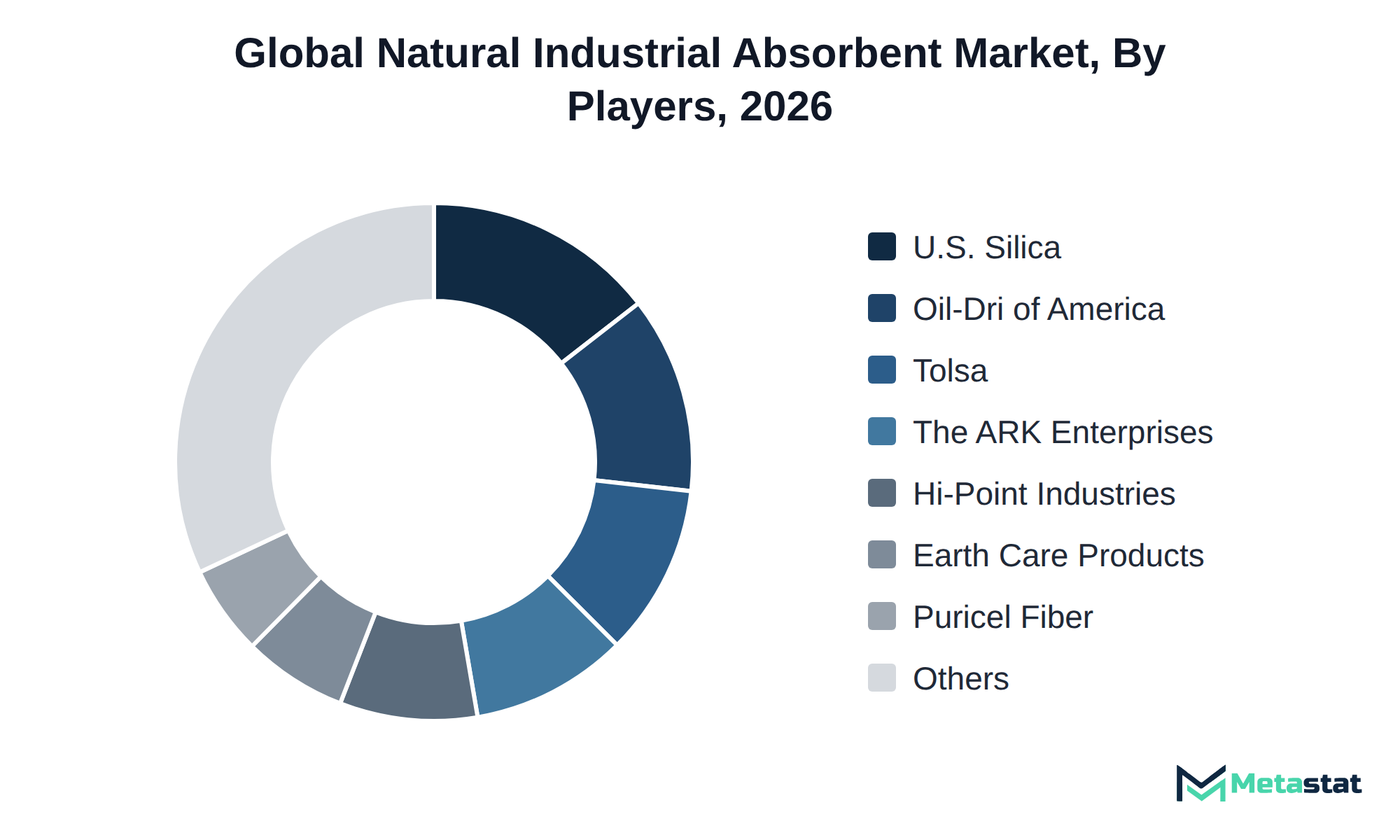
Companies within the Natural Industrial Absorbent market position themselves through various strategies, focusing on product differentiation and customer service. U.S. Silica Company and Oil-Dri Corporation of America emphasize high-quality materials and certifications, attracting buyers who prioritize reliability and performance in absorbents. This focus on quality enhances their competitive edge, allowing them to command premium pricing and foster long-term relationships with clients.
Buyers opt for products based on factors including price, certification, and customization. Companies like Tolsa Group and The ARK Enterprises, Inc. focus on providing tailored solutions that meet specific buyer requirements while maintaining competitive pricing. These strategies aim to enhance customer loyalty and increase market share in a competitive environment, driven by the growing demand for sustainable and effective absorbent solutions.
The forecast for the Natural Industrial Absorbent market relies on several key developments. First, the growth of the oil and gas industry will drive demand for absorbents, particularly for oil spill cleanup applications, which is projected to expand significantly. Second, increasing regulatory pressures regarding environmental safety will lead industries to adopt more effective industrial liquid spill control measures. This trend is particularly relevant in North America and Europe, where regulations are stringent. Third, the rise in manufacturing and industrial processing activities will further increase demand, especially in Asia Pacific, where manufacturing output continues to surge. However, a potential risk that could impede market growth involves fluctuations in raw material prices. Volatility could lead to increased production costs, affecting profit margins and ultimately hindering adoption rates across segments. Stakeholders continue to monitor market conditions and pricing trends to manage these challenges.
By Type: Natural Inorganic Absorbents, Natural Organic Absorbents
By Material: Clay-Based Absorbents, Cellulose-Based Absorbents, Natural Fiber-Based Absorbents, Coconut Coir-Based Absorbents, Starch-Based Absorbents, Others (Peat-Based Absorbents)
By Application: Oil Spill Cleanup, Industrial Liquid Spill Control, Chemical and Hazardous Liquid Absorption, Industrial Cleaning and Maintenance, Waste Management and Liquid Containment
By End-Use Industry: Oil and Gas, Manufacturing and Industrial Processing, Automotive and Transportation, Chemical and Petrochemical, Marine and Shipping, Mining and Metals, Power Generation and Utilities, Others (Construction and Infrastructure)
The report strategically identifies and profiles the key market players and analyses their core competencies in each sub-segment of the Natural Industrial Absorbent market.
Report Attributes | Details |
Study Period | 2021-2033 |
Base Year | 2025 |
Estimated Year | 2026 |
Forecast Period | 2026-2033 |
Historical Period | 2021-2025 |
Growth Rate | CAGR 5.1% from 2026 to 2033 |
Revenue Unit | USD million |
Segmentation | By Type, Material, Application, End-Use Industry, and Region |
By Region | North America (By Type, Material, Application, End-Use Industry, and Country)
|
Europe (By Type, Material, Application, End-Use Industry, and Country)
| |
Asia Pacific (By Type, Material, Application, End-Use Industry, and Country)
| |
South America (By Type, Material, Application, End-Use Industry, and Country)
| |
Middle East and Africa (By Type, Material, Application, End-Use Industry, and Country)
|
Find answers to common questions about this report
The Natural Industrial Absorbent market size was valued at USD 1,536.1 million in 2025.
The market is projected to grow at a CAGR of 5.1% during the forecast period from 2026 to 2033.
The North America Natural Industrial Absorbent market size is estimated to reach USD 682.6 million by 2033.
Natural Organic Absorbents lead the market with a projected value of USD 1,330 million by 2033, surpassing Natural Inorganic Absorbents, which are expected to reach USD 957.6 million in the same year.
Increasing emphasis on sustainability drives demand for natural industrial absorbents, particularly among environmentally conscious industries. Innovations in material science enhance the performance and effectiveness of absorbents, attracting interest from various sectors.
North America holds the dominant share of the Natural Industrial Absorbent market, with a value of USD 682.6 million projected for 2033. This region accounts for 31.1 percent of the total market share.
Fluctuations in raw material prices significantly restrain market growth, as buyers often delay orders or reduce purchase volumes in response to price increases. Competitive pressures from alternative absorbents with lower upfront costs further challenge market adoption among potential customers.
Increasing emphasis on sustainability and heightened regulatory scrutiny on environmental impact favor adoption in the natural industrial absorbent market. The shift towards eco-friendly products aligns with corporate responsibility goals, driving investments in innovative absorbent solutions.
The Natural Industrial Absorbent market is estimated to reach a valuation of USD 2,287.6 million by 2033.
Key players operating in the Natural Industrial Absorbent industry include U.S. Silica Company, Oil-Dri Corporation of America, Tolsa Group, The ARK Enterprises, Inc., Hi-Point Industries, Earth Care Products, and SpillTech.
The analysts below cover Chemicals and Materials research at Metastat Insights.
LEAD ANALYST
Utkarsh Khirodkar is a Lead Market Research Analyst at MetaStat Insight, specializing in market intelligence, technology sector assessments, and competitive strategy.

INDUSTRY CONSULTANT - CHEMICALS & ADVANCED MATERIALS
Chemicals and Materials · Machinery & Equipment · Packaging
Amit Gadhekar Consultant for Chemicals and Materials at MetaStat Insight, directing sector-specific intelligence, research, and strategic consulting across global chemical and processing markets.
Evaluating sovereign cloud deployments for core banking platforms demands a clear view of data residency regulations and migration exit strategies. MetaStat Insight delivered an exhaustive review of regional latency tolerances, mainframe decommission milestones, and third-party vendor concentration risk. The regulatory compliance mapping across European and Asian financial jurisdictions gave our team a dependable baseline for multi-cloud infrastructure discussions.
Replacing petrochemical surfactants with bio-based alternatives requires realistic timelines on industrial precision fermentation scaling. The market research broke down commercialization timelines, feedstock sugar price sensitivities, and regional cosmetic ingredient regulatory approvals in Europe and East Asia. That supplier readiness mapping gave our formulations team reliable context when comparing renewable chemical sourcing roadmaps.
Tracking ceramic matrix composite adoption in high-bypass aero engines requires strict attention to material qualification cycles and FAA airworthiness testing milestones. The MetaStat Insight team provided a detailed timeline of silicon carbide fiber manufacturing capacity and commercial foundry lead times. Having clear visibility into upstream thermal barrier coating supply helped us stress-test our long-term component procurement strategy.
Explore related market intelligence reports worth reading alongside this one.