
LEAD ANALYST
Utkarsh Khirodkar is a Lead Market Research Analyst at MetaStat Insight, specializing in market intelligence, technology sector assessments, and competitive strategy.

Peripheral Vascular Devices Market Size, Share, By Type (Carotid and Renal Artery Stents, Peripheral Embolic Protection Devices, Arteriotomy Closure Devices, PTA Balloon Catheters, Peripheral Vascular Stents, Peripheral Guidewires, Renal Denervation Catheters, and PV Embolization Plugs & Coils), By End User (Hospitals, Clinics, Ambulatory Surgical Centers, and Others), Industry Analysis, Growth, Trends, and Forecast, 2026-2033
Report ID
MSI-2310
Published
February, 2026
Pages
288 Pages
Format
Report Details
Choose Your License
Peripheral Vascular Devices Market
Peripheral vascular devices are used for treating peripheral arterial or coronary arterial disease and also used for peripheral endovascular and coronary procedure. The peripheral vascular devices include Carotid and Renal Artery Stents, Peripheral Vascular Stents, Peripheral Embolic Protection Devices, Arteriotomy Closure Devices, PTA Balloon Catheters, Renal Denervation Catheters, Peripheral Guidewires, and PV Embolization Plugs & Coils.
Rising incidence of peripheral arterial disease (PAD) is boosting the market growth. According to the National Center for Chronic Disease Prevention, globally, more than 236·62 million people aged 25 years and older live with peripheral artery disease in 2019. According to the American Heart Association, in 2018, approximately 8.5 million people age 40 and older have peripheral artery disease (PAD) in the U.S. In Canada, 800,000 people suffer from some form of peripheral artery disease (PAD). Further, increasing regulatory approval of peripheral vascular devices is a key driving factor of the market. For instance, Concept Medical has received CE Certification for Magic Touch PTA 0.035 OTW (Percutaneous Transluminal Angioplasty), a Sirolimus drug-coated balloon (DCB) catheter, for the treatment of Peripheral Artery Disease. MagicTouch PTA prevents re-narrowing of superficial femoral and popliteal arteries in patients with peripheral artery disease. However, product recall of peripheral vascular devices might hamper the market growth. For instance, Medtronic has recalled its 6-French Sherpa NX Active Guide catheter because the outer material may separate from the device, which results in the detachment of fragments and exposure of stainless-steel braid wires. The US Food and Drug Administration (FDA) has identified Sherpa NX Active Guide catheter as a class 1 recall, the most serious kind, because of the potential for serious injuries or death. Moreover, technological innovations in peripheral vascular devices would provide lucrative opportunities for the market in coming years.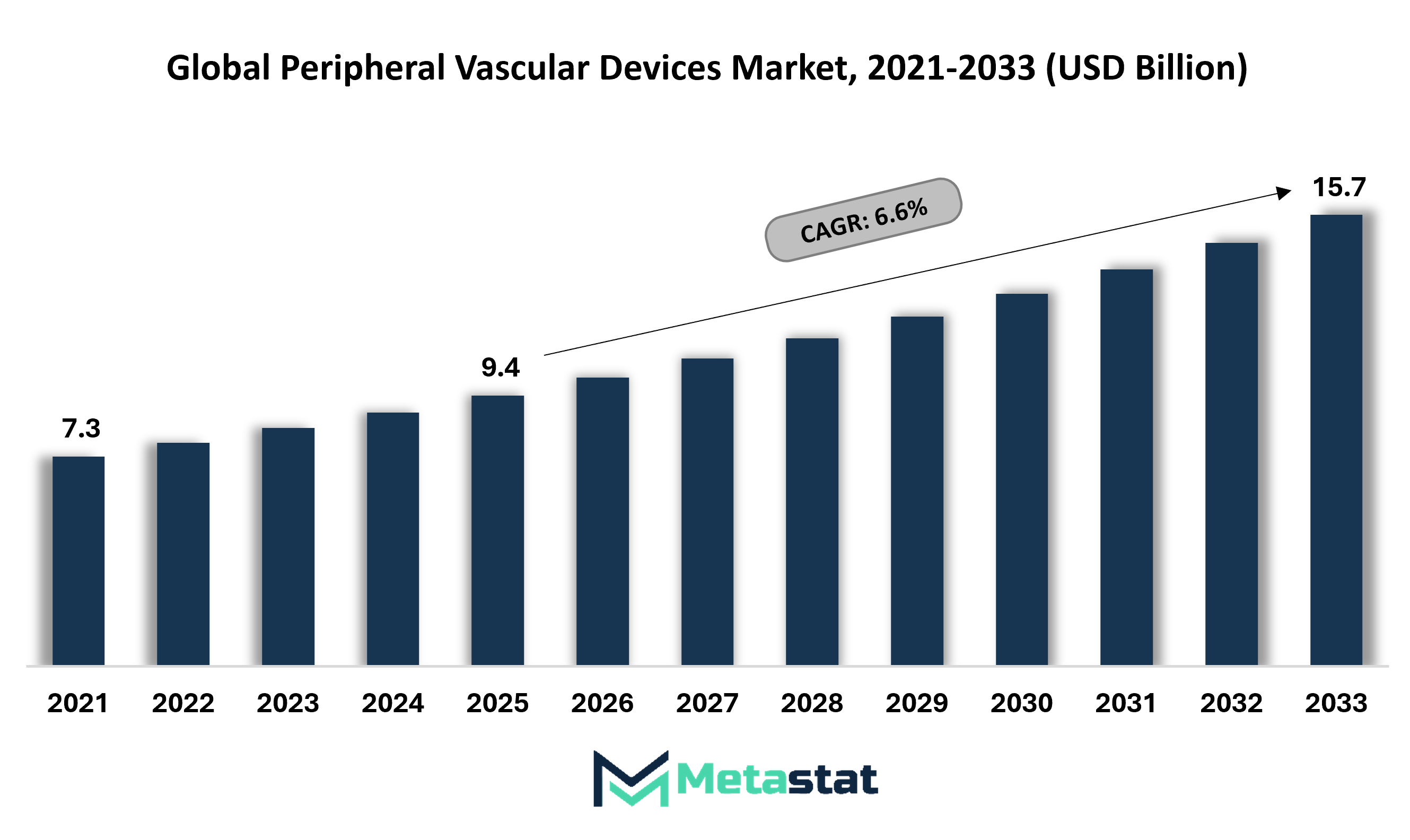
The global peripheral vascular devices market is mainly classified based on type and end user. Type is further segmented into Carotid and Renal Artery Stents, Peripheral Embolic Protection Devices, Arteriotomy Closure Devices, PTA Balloon Catheters, Peripheral Vascular Stents, Peripheral Guidewires, Renal Denervation Catheters, and PV Embolization Plugs & Coils. By end user the market is divided into Hospitals, Clinics, Ambulatory Surgical Centers, and Others.
Peripheral Vascular Stents segment is valued at USD 2.1 billion in 2026 and is projected to reach USD 2.7 billion by 2033, at a CAGR of 3.6% during the forecast period. Due to the commercialization of peripheral vascular stents, increasing investigational studies related to peripheral vascular stents, R&D activities, partnership between companies to expand the peripheral vascular stents market at the global scale and increasing regulatory approval of peripheral vascular stents. For instance, Boston Scientific has received U.S. Food and Drug Administration (FDA) approval to market the Eluvia Drug-Eluting Vascular Stent System, developed for the treatment of peripheral artery disease (PAD). The Eluvia stent utilizes a drug-polymer combination to offer sustained release of the drug paclitaxel, designed to prevent tissue regrowth, which might otherwise block the stented artery.
By End User, Hospitals segment is projected to reach USD 10 billion by 2033, at a CAGR of 5.8% during the forecast period.
Based on geography, the global peripheral vascular devices market is divided into North America, Europe, Asia-Pacific, South America, and Middle East & Africa. North America is further divided in the U.S., Canada, and Mexico, whereas Europe consists of the UK, Germany, France, Italy, and Rest of Europe. Asia-Pacific is segmented into India, China, Japan, South Korea, and Rest of Asia-Pacific. The South America region includes Brazil, Argentina, and the Rest of South America, while the Middle East & Africa is categorized into GCC Countries, Egypt, South Africa, and Rest of Middle East & Africa.
North America was dominating the global peripheral vascular devices market in 2020, due to the rising prevalence of peripheral arterial disease (PAD), government funding for research and development activities and technologically advanced of peripheral vascular devices, and commercialization of regulatory approved peripheral vascular devices. For instance, Terumo Medical Corporation (TMC) has introduced the R2P MISAGO RX Self-expanding Peripheral Stent. The introduction of R2P MISAGO helps physicians to provide the benefits associated with a radial access approach to patients with peripheral artery disease (PAD). R2P MISAGO is the longest stent platform designed for above-the-knee PAD interventions via radial access, incorporating Rapid Exchange (RX) technology and innovative bare metal stent design.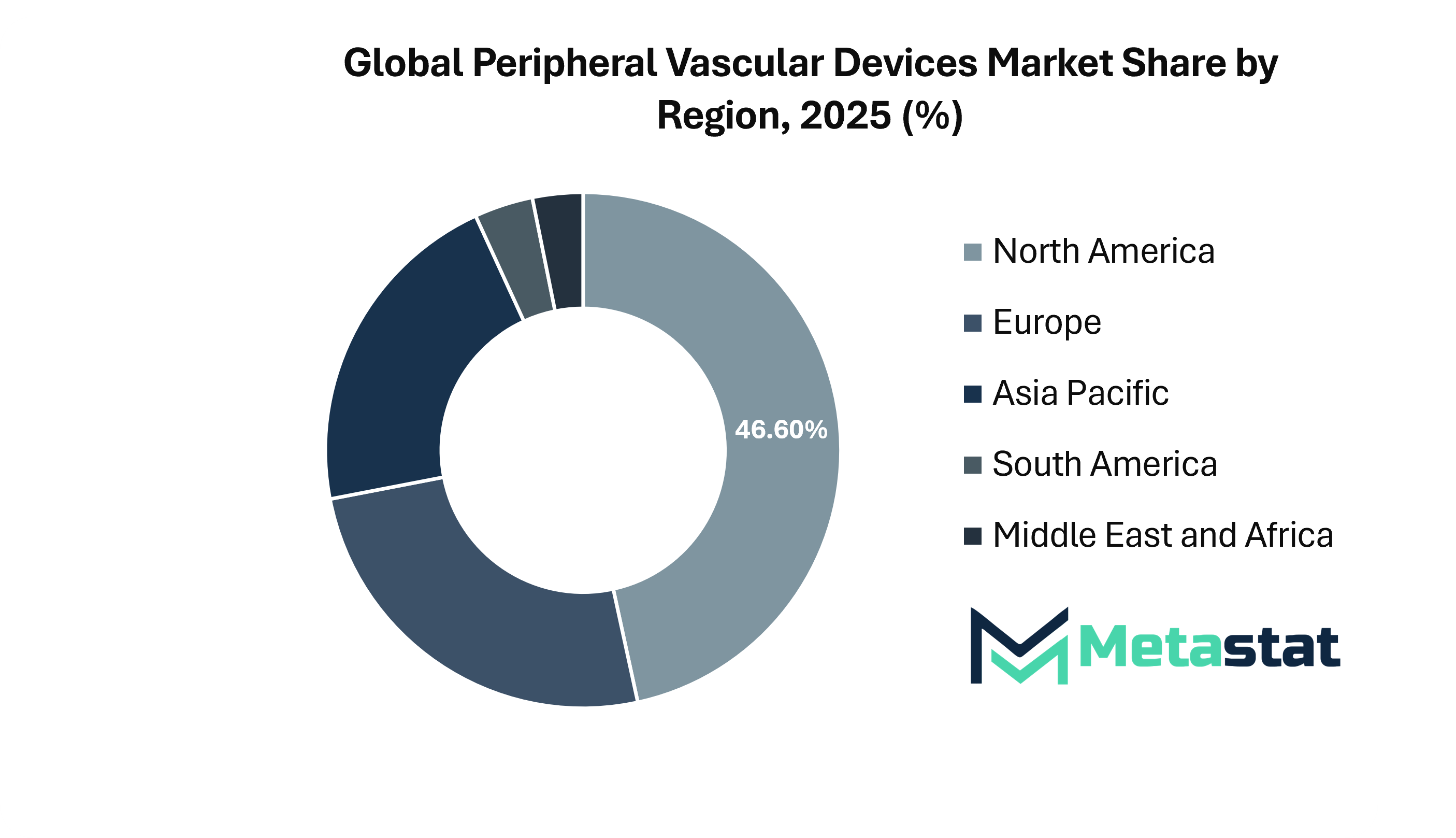
Key players operating in the peripheral vascular devices industry include Abbot Laboratories, Medtronic, Boston Scientific Corporation, Terumo Corporation, Becton, Dickinson and Company, Teleflex Incorporated, Cordis, Cook Medical, Koninklijke Philips N.V., and Merit Medical.
The increasing investment by the companies on R&D activities on peripheral vascular devices, commercialization of new peripheral vascular devices, the collaboration between companies to expand the peripheral vascular devices business, and increasing regulatory approval of peripheral vascular devices are some of the strategies adopted by the major companies. For instance, on November 2, 2020, Boston Scientific has received U.S. Food and Drug Administration (FDA) approval for Ranger Drug-Coated Balloon, developed for the treatment of patients with peripheral artery disease (PAD) in the superficial femoral artery (SFA) and proximal popliteal artery (PPA). The approval is based on results from the RANGER II SFA pivotal trial, which helped to evaluate the safety and effectiveness of the Ranger DCB versus standard percutaneous transluminal angioplasty (PTA) for the treatment of patients with PAD in the SFA and PPA.
|
Report Attributes |
Details |
|
Study Period |
2021-2033 |
|
Base Year |
2025 |
|
Estimated Year |
2026 |
|
Forecast Period |
2026-2033 |
|
Historical Period |
2021-2025 |
|
Growth Rate |
CAGR 6.6% from 2026 to 2033 |
|
Revenue Unit |
USD billion |
|
Sales Volume Unit |
Thousand Units |
|
Segmentation |
By Type, End User, and Region |
|
By Region |
North America (By Type, End User, and Country)
|
|
|
Europe (By Type, End User, and Country)
|
|
|
Asia Pacific (By Type, End User, and Country)
|
|
|
South America (By Type, End User, and Country)
|
|
|
Middle East and Africa (By Type, End User, and Country)
|
Find answers to common questions about this report
Top players operating in the Peripheral Vascular Devices industry includes Abbot Laboratories, Medtronic, Boston Scientific Corporation, Terumo Corporation, Becton, Dickinson and Company, Teleflex Incorporated, Cordis, Cook Medical, Koninklijke Philips N.V., and Merit Medical.
According to Metastat Insights analysis, the North America Peripheral Vascular Devices market size is estimated to reach USD 6.1 billion by 2033.
The Peripheral Vascular Devices market is estimated to reach a valuation of USD 15.7 billion by 2033.
The Peripheral Vascular Devices market is projected to grow at a CAGR of 6.6% during the forecast period from 2026 to 2033.
The Metastat Insights study reveals that the Peripheral Vascular Devices market size was valued at USD 9.4 billion in 2025.
The analysts below cover Medical Devices research at Metastat Insights.
LEAD ANALYST
Utkarsh Khirodkar is a Lead Market Research Analyst at MetaStat Insight, specializing in market intelligence, technology sector assessments, and competitive strategy.

LEAD PRINCIPAL ANALYST, PHARMA AND HEALTHCARE
Food and Beverages · Healthcare · Healthcare IT · Medical Devices
Ajay Devgire is the Lead Healthcare Analyst at MetaStat Insight, leading strategic research and market intelligence initiatives across the global healthcare domain.

SENIOR RESEARCH ANALYST
Biotechnology · Food and Beverages · Medical Devices · Packaging
Snehal Pasalkar is a Research Analyst at MetaStat Insight, operating at the intersection of life sciences research, competitive strategy, and market intelligence.
Scaling antibody-drug conjugate manufacturing hinges on contract manufacturing availability for high-potency active ingredients. The MetaStat Insight analysis looked closely at global cleanroom slot constraints, bioconjugation batch failure rates, and supply chain redundancies between the US, Europe, and India. The supplier capability matrix proved genuinely useful for our team when mapping secondary source options across our clinical pipeline.
Floating offshore wind feasibility relies heavily on specialized installation vessel availability and port crane limits, which most broad renewable energy forecasts ignore. The report delivered a thorough analysis of dry dock capacity, mooring chain supply constraints, and raw material pricing trends for deepwater anchor installations. It served as a solid independent sanity check for our offshore project capital expenditure assumptions.
Assessing commercial microgrid software adoption requires looking past top-level installation numbers and examining utility interconnection queues. The research provided verifiable data on average permitting timelines, tariff structures, and battery storage integration costs across regional utility territories. That grounded perspective was valuable for our team when building five-year demand projections for industrial microgrid controllers.
Explore related market intelligence reports worth reading alongside this one.