
LEAD ANALYST
Utkarsh Khirodkar is a Lead Market Research Analyst at MetaStat Insight, specializing in market intelligence, technology sector assessments, and competitive strategy.

Point of Care Glucose Testing Market By Product Type (Lancing Devices, Test Strips, and Blood-Glucose Meter), By End-Users (Hospitals, Clinics, Diagnostic Centers, Home Care Settings, and Other), By Industry Analysis, Size, Share, Growth, Trends, and Forecast, 2025-2032
Report ID
MSI-4386
Published
January, 2026
Pages
256 Pages
Format
Report Details
Choose Your License
Point of Care Glucose Testing Market
The global point of care glucose testing market will further expand beyond traditional limits, a time when accessibility and accuracy in healthcare diagnostics will be at the forefront. As the need for rapid and accurate glucose testing increases, the market will move beyond traditional lab tests to create a future that will be characterized by medical convenience and efficiency, influencing patient care. With the ongoing demand for real-time information and enhanced health outcomes, this market will not only shape clinical practice but also reshape the way people live their life every day.
How are developments around personalized healthcare shaping the future of the Point of Care Glucose Testing Market, and thinking long-term, could advanced wearable sensors eliminate traditional treatment options? With growing competition is the affordability and accessibility of services likely become the major differentiator as the primary market leader, or will it all boil down to continued talk of innovation?
In the years to come, the global point of care glucose testing market will experience a move toward future-proof technologies that will blend digital innovation with medical functionality. Devices will be smarter, less bulky, and more intuitive for patients who will demand seamless integration of their medical requirements with contemporary lifestyles. The spread of connected healthcare ecosystems will be key, wherein glucose monitoring will be synchronized with larger medical networks to enable improved coordination between patients and healthcare professionals.
The global point of care glucose testing market is mainly classified based on Product Type, End-Users.
|
Forecast Period |
2025-2032 |
|
Market Size in 2025 |
$3725.7 Million |
|
Market Size by 2032 |
$5140.5 Million |
|
Growth Rate from 2025 to 2032 |
4.7% |
|
Base Year |
2024 |
|
Regions Covered |
North America, Europe, Asia-Pacific, South America, Middle East & Africa |
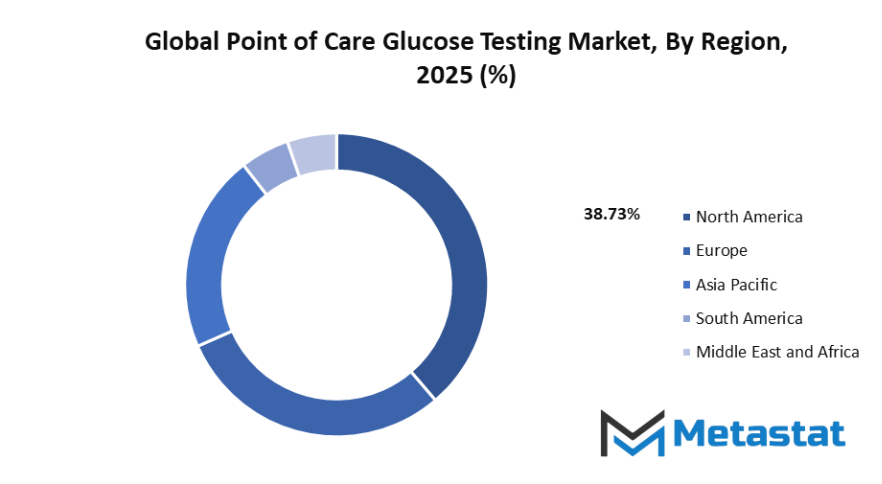
Based on geography, the global point of care glucose testing market is divided into North America, Europe, Asia-Pacific, South America, and Middle East & Africa. North America is further divided in the U.S., Canada, and Mexico, whereas Europe consists of the UK, Germany, France, Italy, and Rest of Europe. Asia-Pacific is segmented into India, China, Japan, South Korea, and Rest of Asia-Pacific. The South America region includes Brazil, Argentina, and the Rest of South America, while the Middle East & Africa is categorized into GCC Countries, Egypt, South Africa, and Rest of Middle East & Africa.
The global point of care glucose testing market offered by Metastat Insight is a major shift in the way diabetes management and blood glucose monitoring are being addressed globally. The market has expanded dramatically as healthcare systems persistently focus on early detection, convenience to patients, and real-time tracking. The demand for portable and dependable glucose-testing devices is consistently increasing due to patients and healthcare professionals seeking devices to improve the management of diabetes without compromising precision. In combination with advancements in technology, further interest in chronic disease will create the continuing evolution of the market to shape the future of point-of-care testing.
In this context, there exist multinational corporations and small local organizations seeking to capitalize on this newest marketplace through innovative, cost-efficient solutions. For instance, a company such as Abbott Laboratories, F. Hoffmann-La Roche Ltd., and Siemens Healthineers AG have been through the rigors of entrance into the marketplace and have experienced great success by addressing the need for accuracy and efficiency. Alternatively, a contingent of smaller businesses such as ACON Laboratories and EKF Diagnostics Holdings Plc are trying to thread the needle of affordability and simplicity with the intent of attracting market share in developing economies. This competition has the effect of continually developing innovation around patients' ability to monitor their own blood glucose levels safely and effectively without professional input.
Many of these companies are leveraging digital technology for connectivity between testing systems and mobile telephones or cloud-based traffic systems. The convergence of these definable developments enables seamless tracking and sharing of information between patient information into cloud-based or mobile traffic systems, thereby allowing for increasingly personalized treatment plans for patients. Companies like LifeScan IP Holdings LLC and Nova Biomedical Corp. lead the charge in supporting connected care, while companies like PTS Diagnostics and Prodigy Diabetes Care, LLC prioritize accessibility and portability for users of various ages and income strata. These developments will continue to close the gap between testing and monitoring in medical professionals and patients’ testing capabilities.
In addition to technological advancements, the Global Point-of-Care Glucose Testing Market will be influenced by rising health consciousness and the global prevalence of diabetes. The firms will continue to push into underserved areas where patients have limited access to hospitals and laboratories. Organizations like Nipro Corp., Danaher Corp., and Trividia Health, Inc., among others, are modifying their products to meet the needs of these populations to boost adoption and uptake. The combined effort of worldwide and regional companies is making glucose monitoring more accurate and accessible to hundreds of millions globally.
The Global Point-of-Care Glucose Testing Market will continue to benefit from these technological advancements in sensor technologies, hyper-miniaturizing devices, and data analytics over the next five years. With the incorporation of digital health models for health and wellness, point of care testing will be key for improving outcomes for diabetic patients. The Global Point-of-Care Glucose Testing Market will continue to be a key component of the future of healthcare due to innovation in the sector and the close collaboration of leading companies in the industry.
Advanced POC testing devices and consumables are very costly: The exorbitant cost of advanced devices and consumables will remain a barrier to growth in the global point of care glucose testing market. Although innovation is happening faster than ever before, newer versions that are released to the market and have more features, have higher price tags. This may be limiting accessibility, particularly in areas with a lack of funding for healthcare, so affordability will be part of increased uptake going forward.
Accuracy and reliability issues in relation to routine laboratory tests: In the upcoming years, the global point of care glucose testing market will have to confront issues regarding the precision and dependability of results, compared to traditional lab testing. No doubt, advancements are being made; however, the inconsistencies with the readings and errors associated with user handling will raise concerns for clinicians. Maintaining accuracy and dependability will always be an imperative for building trust and for increasing use within various healthcare environments.
As a result of the expansion of telemedicine, home-based and remote glucose monitoring services will offer an opportunity for growth: The global point-of-care glucose testing market will have huge opportunities with the expansion of telemedicine and in-home healthcare services. With these developments in technology and digital health platforms, there will be a growing demand for simple, self-managed solutions that ease the burden of monitoring glucose levels. This growth message will provide patients with the ability to monitor their glucose levels from afar and connect with their health care providers in real time with a more connected and responsive treatment plan for diabetes.
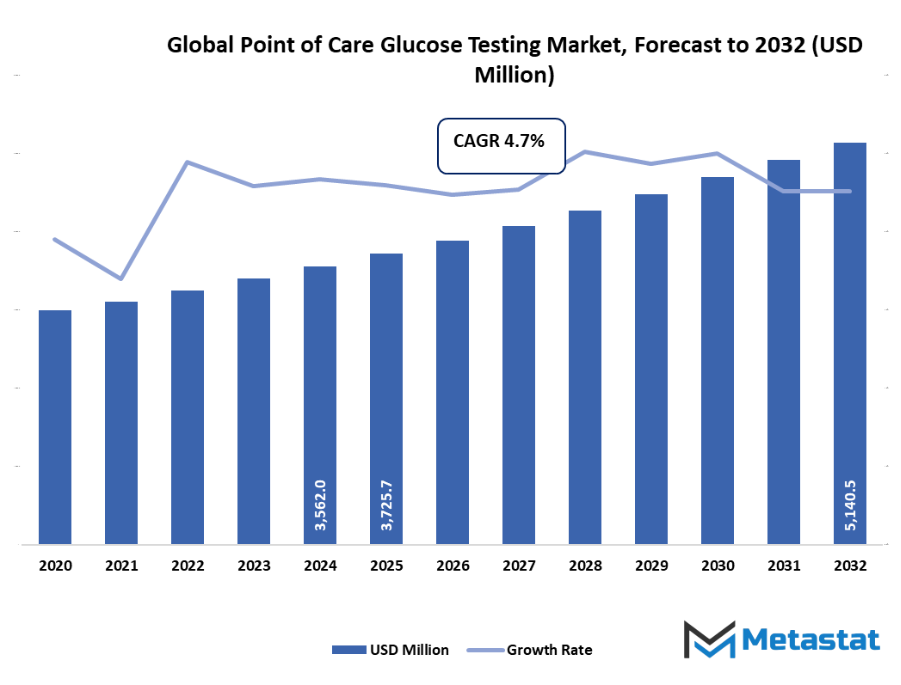
Market size is forecast to rise from USD 3725.7 million in 2025 to over USD 5140.5 million by 2032. Point of Care Glucose Testing will maintain dominance but face growing competition from emerging formats.
Outside clinical facilities, the market will expand its applicability to homes, rural health centers, and on-the-move healthcare settings so that location is no longer a hindrance to necessary testing. This trend toward accessibility will define a new era of healthcare democratization, in which personalized testing will enable individuals to take charge of their well-being. Since innovation will keep redefining boundaries, the global point of care glucose testing market won't merely support medical advancement tomorrow it will represent the revolution of healthcare delivery into a more responsive, patient-centered future.
This research report categorizes the global point of care glucose testing market based on various segments and regions, forecasts revenue growth, and analyzes trends in each submarket. The report analyses the key growth drivers, opportunities, and challenges influencing the global point of care glucose testing market. Recent market developments and competitive strategies such as expansion, type launch, development, partnership, merger, and acquisition have been included to draw the competitive landscape in the market. The report strategically identifies and profiles the key market players and analyses their core competencies in each sub-segment of the global point of care glucose testing market.
Find answers to common questions about this report
Global Point of Care Glucose Testing market is valued at $3725.7 million in 2025.
Global Point of Care Glucose Testing market is estimated to grow with a CAGR of 4.7% from 2025 to 2032.
Global Point of Care Glucose Testing market is estimated to reach $5140.5 million by 2032.
Top players operating in the Point of Care Glucose Testing industry includes Abbott Laboratories, ACON Laboratories, Bayer AG/Ascensia Diabetes Care, and Others.
The analysts below cover Medical Devices research at Metastat Insights.
LEAD ANALYST
Utkarsh Khirodkar is a Lead Market Research Analyst at MetaStat Insight, specializing in market intelligence, technology sector assessments, and competitive strategy.

LEAD PRINCIPAL ANALYST, PHARMA AND HEALTHCARE
Food and Beverages · Healthcare · Healthcare IT · Medical Devices
Ajay Devgire is the Lead Healthcare Analyst at MetaStat Insight, leading strategic research and market intelligence initiatives across the global healthcare domain.

SENIOR RESEARCH ANALYST
Biotechnology · Food and Beverages · Medical Devices · Packaging
Snehal Pasalkar is a Research Analyst at MetaStat Insight, operating at the intersection of life sciences research, competitive strategy, and market intelligence.
When evaluating distributed energy resource management systems, standard research summaries tend to gloss over the operational differences between front-of-the-meter utility deployments and behind-the-meter industrial sites. The MetaStat Insight report addressed those distinctions directly, especially regarding software interoperability standards and grid interconnection backlogs. The five-year market sizing across regional transmission organizations provided actionable context for our grid modernization strategy.
Most industry reports on warehouse automation bundle autonomous mobile robots and fixed conveyor installations into the same top-level numbers, which complicates advisory work. This study split the market cleanly by payload tiers, navigation technology, and fleet management software layers. The regional forecast for Western Europe gave our team defensible adoption benchmarks when evaluating capital allocation for logistics clients, saving us days of secondary data scrubbing.
Analyzing the transition from natural gas to green hydrogen in iron ore reduction requires realistic infrastructure timelines. Meta stat insight supplied a detailed regional assessment of DRI plant conversion costs and scrap metal availability in North America and Western Europe. Their report carefully examined pellet quality specs and electrical grid access constraints without making oversimplified market assumptions. The research material served as a practical reference during internal technology roadmap discussions.
Explore related market intelligence reports worth reading alongside this one.