
LEAD ANALYST
Utkarsh Khirodkar is a Lead Market Research Analyst at MetaStat Insight, specializing in market intelligence, technology sector assessments, and competitive strategy.

Global Pro Gaming Controller Market Size, Share, by Type (Standalone Gamepads, Telescopic Mobile Gamepads and Split Gamepads), by Connectivity (Wired-Only Controllers, Wireless-Only Controllers and Wired and Wireless Controllers), by Platform Compatibility (Console-Compatible Controllers, PC-Only Controllers, Mobile-Only Controllers and PC and Mobile Controllers), by Distribution Channel (Direct-to-Consumer Online Sales, Third-Party Online Retail and Physical Retail), Industry Analysis, Growth, Trends, and Forecast, 2026-2033
Report ID
MSI-5418
Published
October, 2026
Pages
288 Pages
Format
Historical
Base year
Forecast
Forecast period
Report Details
Market Valuation: Valued at $628.2 Million in 2025, projected to reach $1,289.3 Million by 2033 at a 9.4% CAGR.
Dominant Segment: Standalone gamepads lead the market by value, projected to reach USD 1,059.3 million by 2033, driven by broad platform compatibility and strong adoption among console and PC gamers.
Fastest Growing Segment: Telescopic mobile gamepads are expected to post the fastest CAGR of 14.3%, reflecting surging demand from mobile-first gamers seeking portable, high-precision controls.
Geographic Lead: North America holds the largest market share at 39.0% in 2025, supported by early technology adoption and a robust esports infrastructure.
What's Inside: The report provides detailed segmentation by type, connectivity, platform compatibility, and distribution channel, with market size and growth forecasts to 2033, and includes competitive landscape and strategic insights.
Choose Your License
Global Pro Gaming Controller Market
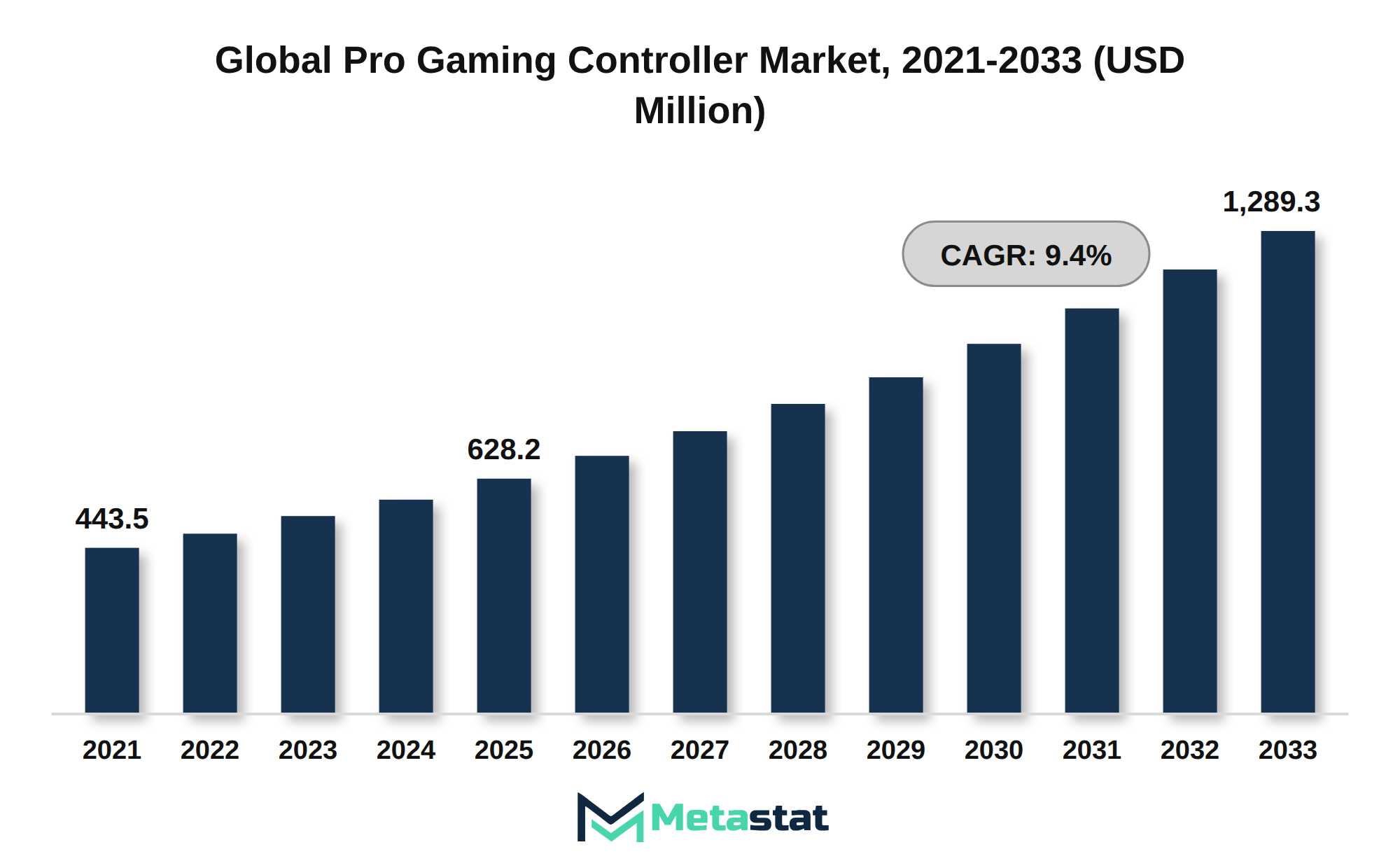
The global Pro Gaming Controller market was valued at USD 628.2 million in 2025 and is projected to reach USD 1,289.3 million by 2033, growing at a CAGR of 9.4% over the forecast period.
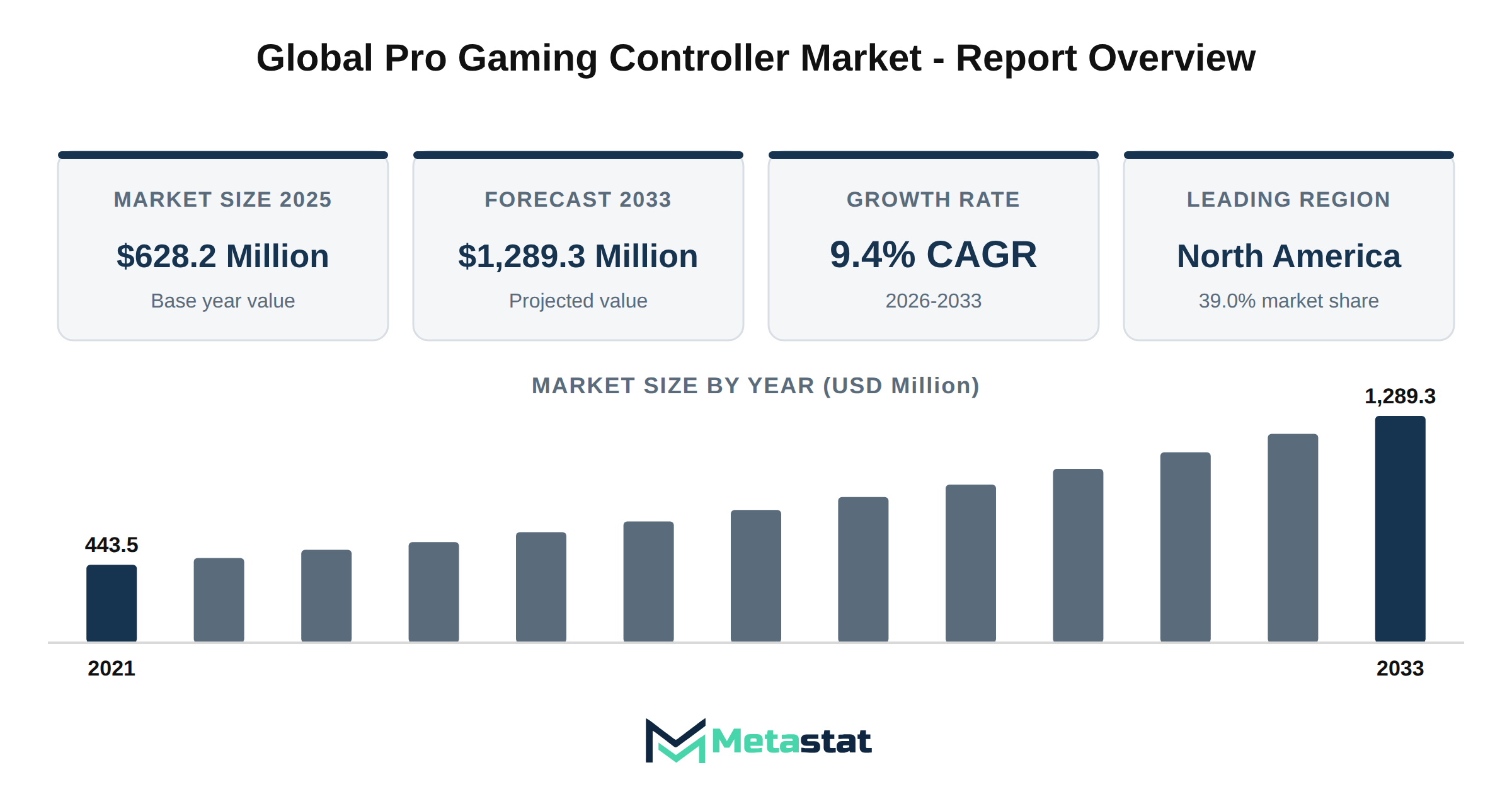
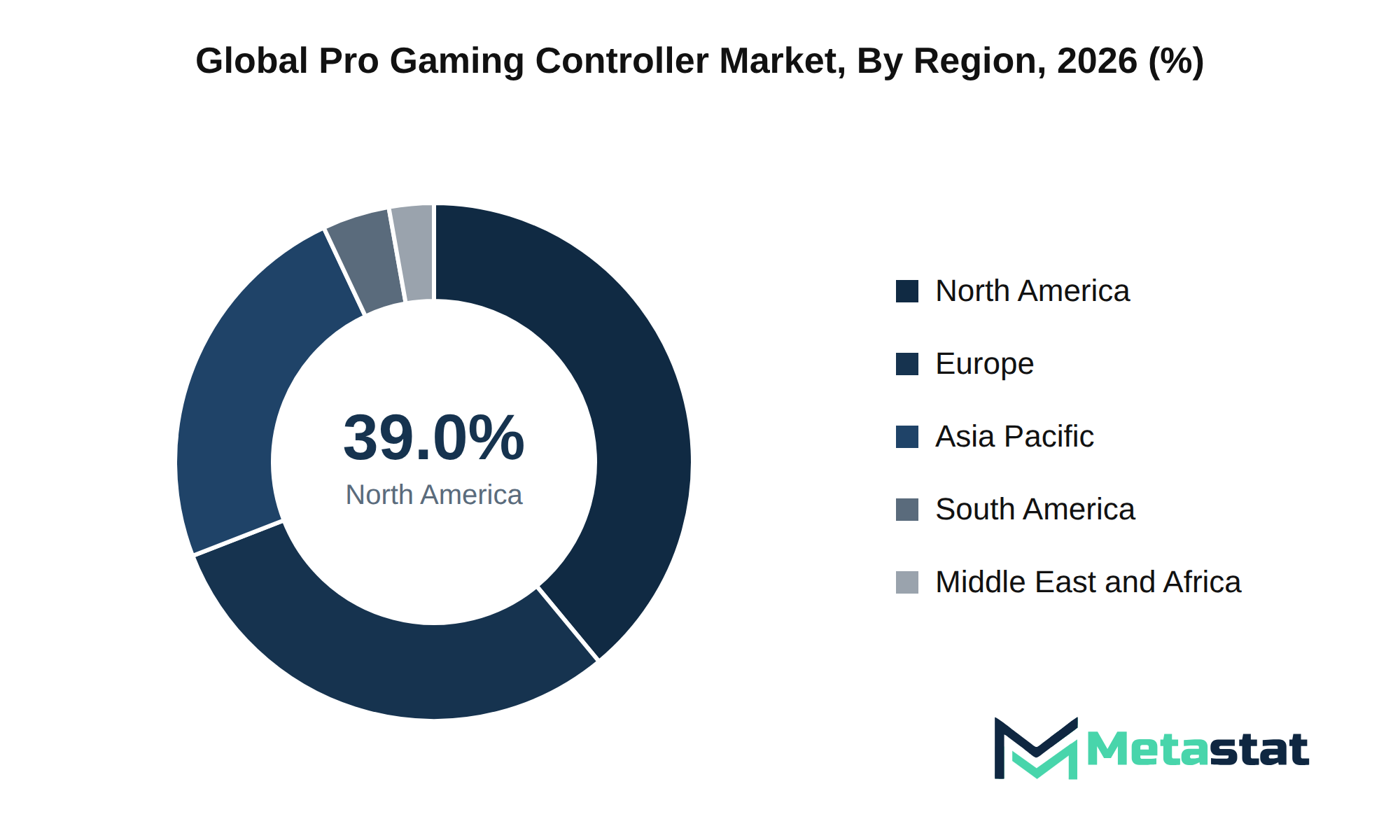
The Pro Gaming Controller market covers high-performance input devices designed for competitive and enthusiast gaming, serving both console and PC users. These controllers replace standard gamepads by offering advanced features including programmable buttons, adjustable triggers, and customizable ergonomics, aligning with the needs of professional gamers and dedicated hobbyists. The primary buyer groups include esports professionals, serious gaming enthusiasts, and tech-forward consumers seeking enhanced precision and personalization in gameplay. Growth in the market is driven by rising participation in esports tournaments and increasing demand for devices that deliver a competitive edge. North America holds 39.0% in 2025 with US leading the market share in 2026.
Standalone gamepads account for the largest segment by value, projected to reach USD 1,059.3 million by 2033, supported by their broad platform compatibility and adoption in both console and PC gaming. Telescopic mobile gamepads are expected to experience the fastest CAGR at 14.3%, reflecting a surge in mobile gaming and the demand for portable, high-precision controls. The dominance of North America results from early technology adoption and robust esports infrastructure, while Europe and Asia Pacific represent significant shares, driven by growing gaming communities and rising disposable incomes. Commercial esports venues and live tournament stages within this regional infrastructure rely heavily on specialized systems from the Pro AV industry to broadcast competitive gameplay to arena audiences.
The market's expansion signals a shift toward customization and performance driving purchase decisions for buyers. A parallel focus on precision control and high-performance tactile response is evident in the Gaming Mouse Pad sector, where dedicated setups require specialized surfaces to complement advanced hardware.
Buyers in the Pro Gaming Controller market prioritize advanced features that deliver a competitive edge and enhanced gaming experiences. The segment for standalone gamepads stands out, reflecting sustained demand from professional players and serious enthusiasts who invest in premium hardware. Telescopic mobile gamepads and split gamepads address rising interest in mobile and modular play, attracting audiences seeking flexibility and innovation. This enthusiast investment pattern mirrors peripheral adoption across the Gaming Headsets and Headphones ecosystem, where competitive players demand high acoustic fidelity alongside responsive input hardware. Connectivity further differentiates the market: wired and wireless controllers meet distinct preferences for latency and convenience, while dual-mode products serve users who engage across platforms. These multi-device wireless controllers increasingly connect directly to living room displays facilitating frictionless engagement in Smart TV Gaming.
The rise from USD 628.2 million in 2025 to USD 1,289.3 million in 2033 reflects ongoing upgrades and replacement cycles, with buyers responding to evolving game requirements and new hardware generations. This hardware replacement cycle correlates with the broader expansion of interactive media within the Home Entertainment Audio and Video Content sector as interactive streaming and console gaming converge. Direct-to-consumer online sales and third-party online retail channels grow rapidly, supported by the proliferation of eSports, influencer marketing, and limited-edition product drops. The single biggest force behind growth remains the shift toward devices that support multiple platforms and connectivity modes, with these controllers serving primary roles for both casual and competitive gaming communities. The Pro Gaming Controller market draws investment from leading brands and new entrants alike, intensifying competition and accelerating product innovation.
Integration of Hall Effect and Tunnel Magnetoresistance (TMR) thumbsticks is reshaping product expectations among competitive gamers, with these components emerging to distinguish premium pro gaming controllers. Traditional potentiometer-based thumbsticks face limitations including stick drift and reduced lifecycle, leading performance-oriented buyers to prioritize durability and precision delivered by next-generation Electronic Sensors. In the Pro Gaming Controller market, this shift responds to end users who demand greater reliability during intensive gaming sessions, particularly in regions with high esports adoption and strong disposable income. Manufacturers leverage Hall Effect and TMR sensors to differentiate their offerings, supporting higher price points for controllers used in tournaments and professional settings.
Adoption of these advanced thumbsticks supports differentiation for brands seeking to target enthusiasts and esports professionals. Suppliers introducing TMR and Hall Effect-equipped models respond to buyers frustrated by maintenance costs and performance drops in conventional designs. This shift enables premiumization, influencing average selling prices in channels including direct-to-consumer online sales, which are projected to reach USD 422.4 million by 2033, and third-party online retail, expected at USD 598.1 million by the same year. For investors, this trend highlights the importance of sensor innovation in capturing value in the upper tiers of the market.
With Hall Effect and TMR technologies gaining traction, controller manufacturers reposition their offerings to flagship products targeting core gaming communities. This technology shift attracts buyers focused on long-term reliability and competitive edge, reinforcing a cycle where component quality influences purchasing decisions. The ongoing transition supports higher operating margins for suppliers able to secure differentiated supply chains and establish reputations for durability and accuracy, positioning them to capture demand in segments where performance is a primary concern.
Premium pricing defines the upper tier of the Pro Gaming Controller market, with demand increasingly shaped by buyers seeking advanced features and exclusive customization. Enthusiast gamers and professional eSports participants act in key buyer roles, prioritizing controllers with programmable buttons, swappable components, and ergonomic enhancements. These requirements push average selling prices higher, particularly for models that serve to signal status within gaming communities.
The willingness to pay more for tailored devices correlates with the expansion of direct-to-consumer online sales, which are projected to rise from USD 204.1 million in 2026 to USD 422.4 million in 2033. This channel enables brands to offer extensive personalization options, including custom grips, unique color schemes, and exclusive branding, meeting the demand for differentiation that mass retail outlets rarely address. The growth of this segment signals a shift in how buyers approach these products, valuing them not only for functionality but for identity expression within competitive and recreational gaming.
Emerging technologies in controller design facilitate deeper customization, giving rise to niche brands and aftermarket specialists who act in innovation driver roles. These suppliers attract players seeking performance edge and individuality, increasing competition among established manufacturers and boutique providers. The result is an increasingly diverse product landscape, with price points reflecting both component quality and customization depth. Buyers in this segment now weigh functional innovation and personalization equally, supporting a premiumization trend that expands both volume and revenue potential for suppliers.
ODM (Original Design Manufacturer) and OEM (Original Equipment Manufacturer) partnerships shape product accessibility and feature innovation in the Pro Gaming Controller market. Leading console brands partner with ODMs and OEMs to launch licensed controllers that comply with proprietary technology and quality standards. This collaboration controls entry barriers for new suppliers, since only licensees gain access to required protocols for console integration. Console-compatible controllers are projected to generate USD 913.1 million in revenue by 2033. Licensing stands out as a commercial prerequisite for suppliers targeting the largest and most established user base.
Console licensing requirements from companies including Sony Interactive Entertainment Inc. and Microsoft Corporation define technical and functional specifications, influencing controller design cycles and cost structures. At the component level, implementing proprietary encryption coprocessors and RF transceivers requires reliable packaging solutions supported by the Integrated Circuit (IC) Substrate industry. These requirements often result in extended development timelines and higher compliance costs for manufacturers. Product differentiation and access to official distribution channels depend on meeting these standards. Licensed products act as a premium offering, carrying higher perceived value and retail pricing compared to unlicensed alternatives.
ODM/OEM partnerships act as a strategic enabler for brands without in-house manufacturing. They facilitate rapid product launches and regional adaptation. In the Pro Gaming Controller market, these collaborations support a broader range of SKUs, tailored ergonomics, and platform compatibility. Supply chain efficiency is maintained through these relationships. Suppliers that secure console licensing and trusted ODM/OEM relationships are positioned to capture premium market segments and reinforce brand visibility.
Direct comparison of SCUF, Xbox Elite, and DualSense Edge controllers shows competitive differentiation rooted in customization, platform integration, and price positioning. SCUF Gaming, part of Corsair Gaming, Inc., has established its reputation with highly modular designs, enabling users to swap components and adjust ergonomics to individual preferences. This appeal to enthusiast and professional gamers supports premium pricing and drives demand among buyers seeking tailored performance. Microsoft Corporation’s Xbox Elite controller stands out with integrated software customization and cross-device compatibility within the Xbox ecosystem. Its adoption is concentrated among console gamers looking for easy device pairing and advanced configuration without third-party tools. Sony Interactive Entertainment's DualSense Edge leverages the PlayStation platform's proprietary features, including haptic feedback and adaptive triggers, attracting users committed to the PlayStation environment. Spatial computing and immersive visual platforms, including AR and VR Smart Glasses, rely on comparable low-latency tactile interfaces and spatial tracking to establish player presence. These distinctions impact buyer decision cycles, with SCUF serving in a premium aftermarket role, Xbox Elite acting in an integrated accessory role for console-centric households, and DualSense Edge emerging in the preferred upgrade role for PlayStation users. The market’s segmentation by platform compatibility, reflected by console-compatible controllers projected to reach USD 913.1 million by 2033, shows how brand ecosystem ties influence volume and pricing strategy.
Technology innovation in the Pro Gaming Controller market has accelerated differentiation between these brands, particularly in input latency, durability, and modularity. SCUF’s controllers introduce swappable thumbsticks and paddles that support long-term use and adaptation to diverse gaming styles, enhancing value perception among competitive players. Xbox Elite’s focus on low-latency wireless integration and robust build quality strengthens its position in the default upgrade role for Xbox console owners. The DualSense Edge controller integrates advanced force feedback and adaptive triggers, capitalizing on exclusive PlayStation titles that use these hardware capabilities. These developments increase demand in the wired and wireless controller segment, which is expected to reach USD 978.7 million by 2033. For investors, the sustained focus on proprietary technology and differentiation by leading brands supports the market’s premiumization trend, increasing average selling prices and supporting higher margins across key player portfolios.
Purchasing channels for SCUF, Xbox Elite, and DualSense Edge controllers have diversified, enabling direct brand-to-consumer engagement and reshaping market access. SCUF and Sony have expanded direct-to-consumer online sales, which are projected to grow to USD 422.4 million by 2033, allowing for tailored promotions, enhanced customer support, and deeper brand loyalty. Microsoft’s Xbox Elite controller, while available through direct sales, relies heavily on third-party online retail and physical retail networks to reach a broad base of console gamers. This distribution approach supports wider geographic coverage but limits customization options compared to direct sales channels. The trend toward online brand stores and targeted digital campaigns is expected to continue reshaping how buyers discover and select professional-grade controllers, influencing both volume and value growth in the market.
Competitive gaming tournaments and organized esports leagues have expanded the pool of players seeking professional-grade equipment. Enthusiast and amateur gamers emulate professional setups to achieve higher responsiveness, durability, and tactile performance, which accelerates replacement and upgrade cycles. This behavioral shift supports rising unit volumes and higher average selling prices across direct-to-consumer and third-party online retail channels. Growing participation leads individual buyers to invest in additional controllers for practice, competition, and team play, directly influencing segment revenue and premium product adoption. Sustained growth favors suppliers able to balance technical innovation with supply chain responsiveness.
Device compatibility limitations restrict adoption rates among mobile gaming enthusiasts. Many pro gaming controllers lack broad support for mobile operating systems or require additional adapters, resulting in integration challenges for smartphone users compared to console or PC users. This gap reduces the appeal for buyers in the Telescopic Mobile Gamepads and Mobile-Only Controllers segments, who expect simple plug-and-play experiences. The market sees slower growth from these buyer groups, with compatibility challenges translating to lower conversion rates and smaller order volumes. Mobile gamers tend to delay upgrades or select less specialized alternatives, impacting potential revenue in emerging regions where mobile gaming growth outpaces console and PC platforms. This friction remains a constraint on the market’s expansion into the mobile segment.
Suppliers face escalating costs for advanced sensors, premium plastics, and haptic feedback modules, which directly compress profit margins for pro-grade controller designs. The market places a premium on tactile precision and durability, requiring high-quality parts that often carry volatile pricing linked to global electronics supply chains. Manufacturers have responded by implementing multi-sourcing strategies and negotiating bulk procurement contracts to stabilize costs over the forecast period. In this environment, larger suppliers with established procurement networks stand out due to their ability to absorb fluctuations, while smaller brands encounter greater challenges in maintaining profitability. Continual pressure to integrate the latest features without passing significant cost increases to buyers affects pricing flexibility and impacts competitiveness across this segment.
Direct-to-consumer online sales represent a high-growth channel within the Pro Gaming Controller market, reflecting a shift in buyer behavior toward digital-first purchasing. Brands that invest in direct digital storefronts reach enthusiasts seeking exclusive customizations, faster access to limited-edition models, and tailored after-sales support. The online sales route reduces intermediary markups, allowing suppliers to offer broader configuration options and rapid product iteration. This business model benefits buyers who prioritize personalization and timely product availability. Accelerating order volume and higher average selling prices through this channel support enhanced supplier margins and deeper customer engagement.
The global Pro Gaming Controller market is segmented based on Type, Connectivity, Platform Compatibility, and Distribution Channel.
Standalone Gamepads segment is valued at USD 595.5 million in 2026 and is projected to reach USD 1,059.3 million by 2033, at a CAGR of 8.6% during the forecast period. This segment serves gamers who seek dedicated devices for high-precision control, especially in competitive console and PC environments. Buyers include esports professionals and enthusiasts who require reliability and fast response for tournament scenarios. Standalone models deliver tactile feedback and ergonomic layouts that integrated or mobile-focused controllers do not offer, supporting demand growth. Compared to Telescopic Mobile Gamepads, Standalone Gamepads segment holds a larger market share and posts steadier growth, reflecting sustained demand among core gaming audiences. These controllers often command higher price points, supported by advanced component quality and customization options unique to this form factor. Upgrades in sensor technology and trigger responsiveness influence purchasing decisions in this segment. Widespread compatibility across leading platforms helps limit adoption barriers. In the broader market, standalone products act as a benchmark for durability and consistent performance.
Reaching USD 160.8 million by 2033 at a CAGR of 14.3%, telescopic mobile gamepads stand out as the fastest growing type in this segment. These controllers attach directly to smartphones, transforming mobile devices into console-like gaming systems for users seeking portability without sacrificing control or precision. Growth in this segment is driven by rising engagement in mobile esports and the increasing sophistication of mobile games, which now demand advanced input methods. Compared to standalone gamepads, telescopic mobile gamepads address a distinct user group - mobile-first gamers who value the ability to play on the go. The segment attracts buyers who prioritize device compatibility and tactile accuracy, bridging the gap between touchscreen limitations and the demands of competitive gameplay. While standalone gamepads dominate in revenue, telescopic designs distinguish themselves with higher adoption rates among younger, mobile-centric players. This acceleration signals a structural shift, with developers and brands investing to capture this high-growth user base.
Split Gamepads segment is expected to reach USD 69.2 million by 2033. This segment appeals to mobile and hybrid gamers seeking modularity and ergonomics unavailable in standard all-in-one controllers. Demand originates from users who require adaptability for gaming on the go, with split designs enabling tailored control schemes for different play styles. Split Gamepads stand out in a niche compared to Standalone Gamepads, which target a broader audience and post higher revenue figures. Adoption remains selective due to the lower familiarity of split formats among casual players and a price point that limits impulse upgrades. Split Gamepads act in specialized roles, valued for flexibility but trailing in growth rate behind Telescopic Mobile Gamepads, which attract buyers with higher portability demands and a 14.3% CAGR. Continued refinement of design supports the relevance of Split Gamepads among a dedicated user base.
Valued at USD 160.8 million in 2026 and projected to reach USD 248.3 million by 2033, wired-only controllers serve end users who prioritize consistent low-latency input and uninterrupted connectivity, particularly in competitive PC and console gaming environments. This segment draws steady demand from buyers who reject input lag, battery limitations, and wireless interference, with esports participants and dedicated enthusiasts standing out as frequent adopters. The 6.4% CAGR from 2026 to 2033 trails the faster expansion seen in wireless or hybrid controllers, indicating a more stable buyer base with less change in preferences. Wired-only controllers typically hold lower average price points compared to wireless or feature-rich hybrid offerings, making them accessible to cost-sensitive gamers and institutions outfitting communal gaming spaces. Wired-only options act as an equipment standard for venues enforcing controlled environments and for users who value reliability over the advanced functionality of emerging wireless models. Among the connectivity segments, wired-only solutions maintain relevance by addressing these specialized operational requirements while wireless innovation attracts investment.
Wireless-Only Controllers segment is estimated to reach USD 62.3 million by 2033, at a CAGR of 5.8% during the forecast period. Usage of these controllers is most prevalent among players seeking cable-free setups and streamlined mobility across gaming environments. This segment appeals to buyers who prioritize untethered gameplay, particularly those engaged in living room or on-the-go settings where cable management presents a challenge. While the market overall is shifting toward hybrid and multi-platform compatibility, wireless-only units address customers who value simplicity and freedom of movement over customization or lowest-latency input. Slower growth compared to hybrid wired/wireless controllers reflects both the premium associated with advanced wireless technologies and competitive price pressure from alternatives that integrate both connectivity modes. Adoption faces constraints from latency sensitivity and battery life concerns, making this segment less attractive for tournament-grade competitive players who favor wired reliability. The segment continues to observe a divergence between mainstream demand for wireless convenience and professional requirements for performance-centric solutions.
Hybrid connectivity appeals to competitive and enthusiast gamers who require adaptability across multiple platforms and gaming environments. The segment is a preferred solution for buyers who demand smooth transitions between wired performance and wireless convenience, driven by evolving use cases in both home and tournament settings. This flexibility is a core advantage over wired-only or wireless-only controllers, which address narrower user preferences. Demand for hybrid models is reinforced by purchasers seeking low-latency input for esports applications, while retaining the freedom of wireless gameplay during casual use. Buyers willing to pay a premium for versatility and future proofing are increasingly attracted to this segment. Slower adoption of single-mode controllers, particularly among advanced users, contrasts with the incremental growth registered by hybrid connectivity solutions, signaling a shift in purchasing criteria toward adaptability and enhanced user experience.
Valued at USD 518.9 million in 2026 and projected to reach USD 913.1 million by 2033 at a CAGR of 8.4%, controllers in this segment serve console gamers who demand high-fidelity input precision and platform-specific integration. Dedicated buyers include both competitive and casual console players seeking enhanced ergonomics, proprietary button layouts, and compatibility with major systems. Preference for officially licensed devices and first-party accessories influences spending patterns, often resulting in higher average selling prices compared to PC-only or mobile-only controllers. This segment benefits from sustained demand linked to regular console hardware refresh cycles and exclusive game releases, which prompt users to upgrade peripherals for optimal experience. In contrast to the PC-only controller segment, growth in console-compatible controllers displays a steadier trajectory, supported by strong brand loyalty and robust console install bases. Suppliers invest in optimizing compatibility and latency to meet platform certification requirements, making this segment a focal point for technology partnerships.
PC-Only Controllers segment is estimated to reach USD 160.6 million by 2033, at a CAGR of 10.6% during the forecast period. Dedicated PC gamers drive this segment, drawn by controllers that serve ergonomic and performance-focused roles compared to keyboard and mouse setups. PC-only buyers typically consist of competitive players and technology enthusiasts who require precise input response, customizable button mapping, and software integration tailored specifically for PC titles. This specialization differentiates the segment from console-compatible counterparts, which often prioritize cross-platform use. The market sees the PC-only category outpacing the console-compatible segment in growth rate, with a 10.6% CAGR for PC-only controllers compared to 8.4% for console-compatible alternatives. Price sensitivity remains less pronounced among these buyers, who value technical features and software updates over entry-level affordability. Continuous growth in the PC gaming ecosystem and the increasing sophistication of PC e-sports titles emerge as fundamental drivers for this segment, supporting ongoing innovation and demand.
Mobile-Only Controllers segment is expected to reach USD 58.9 million by 2033. This segment addresses the requirements of users who prioritize gaming on smartphones, offering portable solutions tailored for touch-centric titles and mobile esports. Younger consumers and on-the-go players in regions where mobile gaming dominates the gaming platform drive adoption, which distinguishes this segment from console or PC controller categories. While the market overall benefits from rising discretionary income and digital entertainment trends, mobile-only devices remain at the lower end in both volume and price compared to multi-platform controllers. Slower expansion in this segment results from intense competition from lower-cost generic accessories and built-in touchscreen controls, limiting premiumization opportunities. Buyers selecting mobile-only options frequently prioritize affordability and compact form factor, leading to a differentiated value proposition relative to advanced, feature-rich controllers targeting the console and PC ecosystem.
PC and Mobile Controllers segment is projected to grow at a CAGR of 13.6% during the forecast period, outpacing other platform compatibility options in the Pro Gaming Controller market. Gamers looking for flexibility across personal computers and smartphones drive demand for these controllers, which bridge users who alternate between platforms. The rising multi-device gamer base influences this segment, with content streaming, cloud gaming, and the growth of cross-platform titles pushing buyers to seek controllers supporting both PC and mobile use. Unlike PC-only or mobile-only controllers, which address narrower user needs, PC and Mobile Controllers respond to the converging preferences of tech-savvy consumers prioritizing cross-device functionality. These controllers support suppliers in commanding higher prices due to expanded utility, and their higher growth rate reflects their appeal as gaming ecosystems diversify and device boundaries blur.
This segment serves digital-first buyers who prioritize rapid access to new releases and customization options unavailable in traditional retail. High engagement among competitive gamers and enthusiasts explains the segment’s quick adoption, with many seeking advanced features and limited-edition variants available exclusively online. Physical retail targets a broader, less specialized audience, while direct-to-consumer channels operate an efficient platform for personalized marketing and exclusive product drops. This channel delivers a faster growth trajectory than third-party online retail, which is expected to reach USD 598.1 million by 2033 but at a lower CAGR. The shift in purchasing behavior toward brand-controlled storefronts reflects a growing preference for authenticity, faster customer service, and access to official product support. Direct-to-consumer strategies stand out for manufacturers aiming to boost margins while deepening relationships with end users.
Third-Party Online Retail segment is estimated to reach USD 598.1 million by 2033, at a CAGR of 10.2% during the forecast period. This channel appeals to buyers seeking a wide assortment of pro gaming controllers from various brands, often leveraging competitive pricing and frequent promotions unavailable through direct channels. Tech-savvy consumers and price-conscious enthusiasts emerge with primary audience status, relying on comparison tools and independent reviews to guide purchase decisions. The segment’s growth rate outpaces physical retail, driven by the convenience of online shopping and the trust built with established e-commerce platforms. Compared to direct-to-consumer online sales, third-party retail provides broader brand coverage but less customization, suiting buyers who prioritize speed and variety over personalized experiences. Third-party online retail acts as a discovery platform for emerging brands, aggregates demand, and reduces price barriers, supporting expansion among younger and international buyers.
Physical retail sales are projected to reach USD 268.8 million by 2033, reflecting the ongoing relevance of in-store purchasing for pro gaming controllers. This segment draws buyers who prioritize tactile evaluation, brand assurance, and immediate product access, including competitive players and consumers seeking personalized guidance before purchase. While digital channels deliver faster growth, physical retail continues to anchor buyers valuing in-person experience and post-sale service. Compared to faster-growing online distribution, physical retail advances at a steadier pace, shaped by established buyer loyalty and preference for hands-on selection. The segment faces a unique adoption barrier: evolving consumer habits toward online purchases compress growth potential, yet brick-and-mortar locations remain essential touchpoints for premium, high-investment gaming peripherals. Physical retail stands out by capturing a buyer base less influenced by rapid channel shifts, supporting continued demand in regions where in-person retail retains strong cultural significance.
Based on geography, the Global Pro Gaming Controller market is divided into North America, Europe, Asia-Pacific, South America, Middle East, and Africa.
Leading brands and competitive esports leagues in the United States drive significant buyer interest in high-performance controllers, supported by a large base of professional and enthusiast gamers. Canada and Mexico contribute steadily to regional demand, reflecting active console and PC gaming communities and established electronics distribution networks. High disposable income in the United States supports premium product adoption, while regular upgrade cycles influence purchasing frequency in this segment. The Pro Gaming Controller market in North America is projected to reach USD 461.8 million by the end of 2033, backed by the region’s 39.00% share of global revenue in 2025. Developers in this region supply a wide range of platform-compatible devices, with innovation in ergonomic design and customization options emerging to drive purchasing decisions. This region benefits from an ecosystem of advanced manufacturing capabilities and engaged consumer bases, supporting long-term demand for high-performance controllers.
Germany, France, and the UK represent the strongest demand centers in Europe for the Pro Gaming Controller market, driven by established console and PC gaming cultures and high per capita discretionary spending. Competitive e-sports events and the presence of specialized gaming communities in these countries encourage frequent hardware upgrades and strong user engagement with premium peripherals. Gaming cafes and e-sports arenas in Germany and France influence product adoption and awareness. In the UK and Spain, digital payment infrastructure and widespread access to high-speed internet support online purchasing, streamlining the acquisition of advanced gaming controllers. Europe acts as a prominent force in shaping user preferences and adoption patterns for advanced controllers, reflecting its influence on global trends. National preferences for controller ergonomics and customization drive localized product offerings, with regional brands in Italy and Russia responding to demand for tailored designs and unique features.
Expanding digital infrastructure and a young, tech-savvy population support strong demand for high-performance controllers in China, Japan, and South Korea. Esports tournaments and competitive gaming communities in these countries act as key drivers for product adoption, with professional and mid-tier players fueling purchases of advanced input devices. The Pro Gaming Controller market in Asia Pacific accounted for 23.9% of global value in 2025, reflecting growing disposable income and a trend toward premium gaming accessories. India and Southeast Asia are experiencing rising engagement from mobile gamers and content creators, contributing to a broader user base for both standalone and mobile-compatible controllers. Manufacturers address region-specific preferences by offering customizable features and regionally tailored product lines. Local distribution networks and regional gaming events further influence buyer preferences, strengthening the presence of the Pro Gaming Controller market across diverse urban and emerging markets in Asia Pacific.
Brazil and Argentina emerge as the principal buyers in South America, supported by active gaming communities and a rising interest in competitive esports. Local demand for advanced controllers is shaped by the growing popularity of online multiplayer titles, especially among younger demographics in urban centers. The Rest of South America follows, with an emerging segment of gamers seeking accessible, mid-range options. South America holds a modest share of global value, reflecting the region's scale relative to global demand. In this region, price sensitivity influences purchasing behavior, prompting buyers to consider value propositions and durability in purchasing decisions. Distributors and retailers operating in Brazil and Argentina serve as critical channels for reaching the target audience, given the diverse preferences and varying spending power across sub-regions. The broader presence of internet-enabled devices and increased exposure to international gaming trends support adoption, enabling steady penetration of advanced controllers among performance-focused users.
Gaming spend in Saudi Arabia, the UAE, and South Africa is shaped by a combination of rising digital entertainment investment and increased participation in online gaming communities. Regional buyers tend to favor advanced controllers that serve as status symbols within the competitive gaming segment, especially among younger consumers drawn to esports. The region accounted for 2.8% of global revenue in 2025, reflecting a niche but steadily growing presence. While premium console-compatible products attract urban buyers in Saudi Arabia and the UAE, South Africa’s market activity is influenced by a blend of console and PC users seeking higher durability and customization. Cultural interest in multiplayer and tournament play supports this demand, which influences both product specification and brand positioning. Buyer preferences in the Middle East and Africa are shaped by digital engagement trends and consumer aspirations specific to these countries.
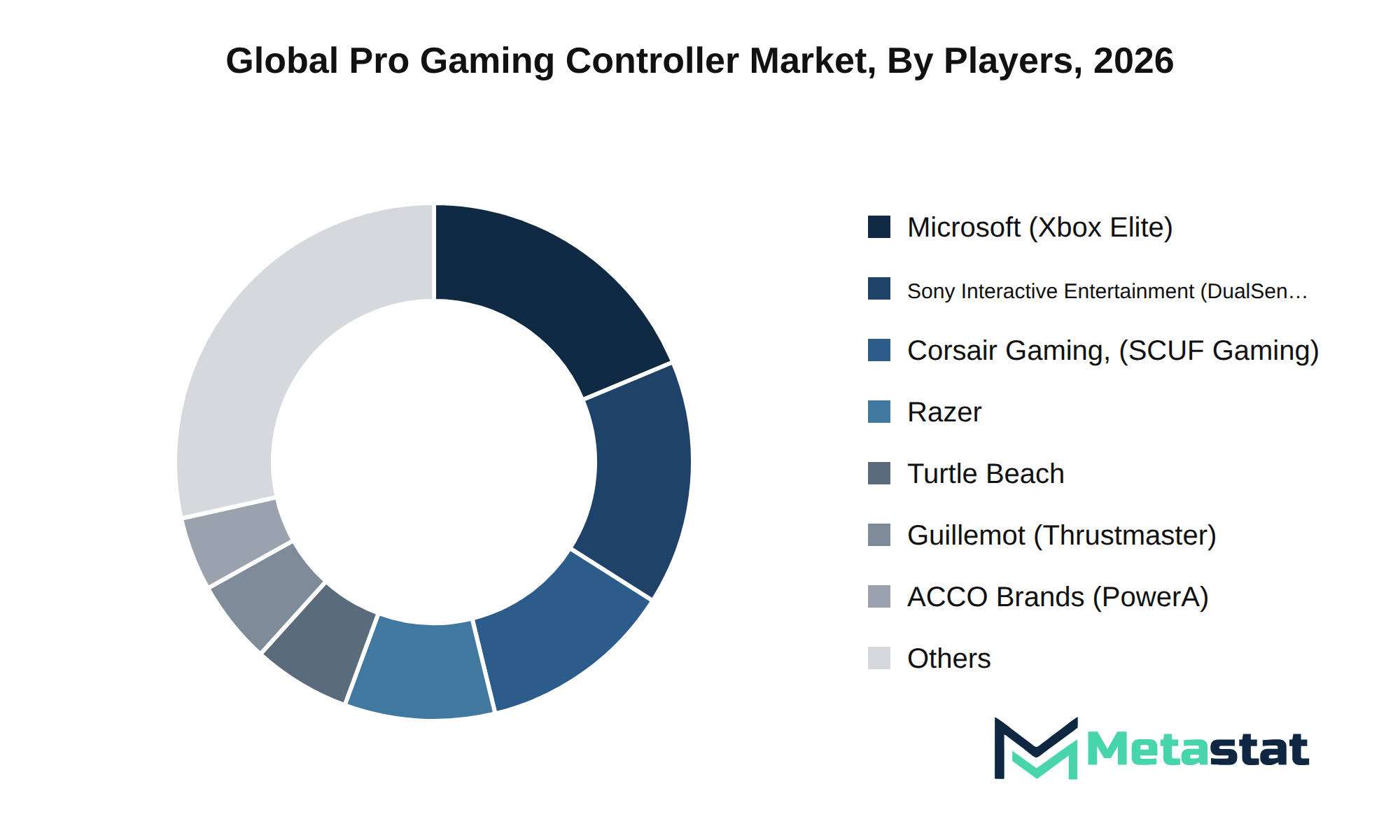
Competition in the Pro Gaming Controller market centers on design innovation, platform compatibility, and premium build quality. Buyers evaluate products based on customization options, input precision, wireless connectivity, and brand reputation. Demand for advanced features and responsive controls drives differentiation among suppliers. E-sports professionals and dedicated gamers influence supplier priorities. The field includes established names recognized for integrating high-end components. Emerging suppliers target niche segments with specialized offerings, expanding the range of available options.
Several companies act in leadership roles in specialized controller innovation. Corsair Gaming, Inc. (SCUF Gaming) is known for its focus on customizable hardware, supporting competitive gaming preferences with modular features. Microsoft Corporation (Xbox Elite) and Sony Interactive Entertainment Inc. (DualSense Edge) invest in compatibility across major platforms and advanced ergonomics, appealing to console users seeking performance upgrades. Razer Inc. and Turtle Beach Corporation focus on integrating multi-platform support and enhanced wireless connectivity, serving users who prefer flexible gaming setups. Brands including 8BitDo and GameSir stand out for balancing affordability and high utility, attracting buyers looking for value and broad compatibility. These approaches highlight varied strategies, reflecting buyer priorities for customization, connectivity, and gaming experience.
Three developments influence this growth across segments and regions. Further adoption of console-compatible controllers, especially in North America and Europe, is expected to drive volume. Console-compatible controllers are projected to increase from USD 518.9 million in 2026 to USD 913.1 million by 2033, reflecting sustained investment in gaming hardware and content ecosystems. Online retail channels are expanding, including direct-to-consumer and third-party platforms. Direct-to-consumer online sales are forecast to grow at a 10.9% CAGR, reaching USD 422.4 million by 2033. This shift supports greater accessibility for buyers in Asia Pacific and other emerging markets and facilitates higher penetration rates.
A primary risk to the Pro Gaming Controller market outlook is potential supply chain disruptions or regulatory changes impacting hardware imports in key regions. Delays or cost increases in component availability restrict production, especially for wireless and hybrid controllers favored by competitive gamers. If such risks materialize, adoption could slow and the growth trajectory expected through 2033 could be tempered.
By Type: Standalone Gamepads, Telescopic Mobile Gamepads, Split Gamepads
By Platform Compatibility: Console-Compatible Controllers, PC-Only Controllers, Mobile-Only Controllers, PC and Mobile Controllers
By Distribution Channel: Direct-to-Consumer Online Sales, Third-Party Online Retail, Physical Retail
The report strategically identifies and profiles the key market players and analyses their core competencies in each sub-segment of the Pro Gaming Controller market.
|
Report Attributes |
Details |
|
Study Period |
2021-2033 |
|
Base Year |
2025 |
|
Estimated Year |
2026 |
|
Forecast Period |
2026-2033 |
|
Historical Period |
2021-2025 |
|
Growth Rate |
CAGR 9.4% from 2026 to 2033 |
|
Revenue Unit |
USD million |
|
Segmentation |
By Type, Connectivity, Platform Compatibility, Distribution Channel, and Region |
|
By Region |
North America (By Type, Connectivity, Platform Compatibility, Distribution Channel, and Country)
|
|
|
|
Asia Pacific (By Type, Connectivity, Platform Compatibility, Distribution Channel, and Country)
|
|
|
|
|
Middle East and Africa (By Type, Connectivity, Platform Compatibility, Distribution Channel, and Country)
|
Find answers to common questions about this report
The Metastat Insights study reveals that the Pro Gaming Controller market size was valued at USD 628.2 million in 2025.
The Pro Gaming Controller market is projected to grow at a CAGR of 9.4% during the forecast period from 2026 to 2033.
According to Metastat Insights analysis, the North America Pro Gaming Controller market size is estimated to reach USD 461.8 million by 2033.
Standalone Gamepads lead the type segment with a projected value of USD 1,059.3 million in 2033. This segment holds the highest revenue among all type categories.
Driver 1: Rising demand from competitive and professional gamers drives volume growth, with North America leading at 39 percent regional share. Driver 2: Standalone gamepads act as the leading segment by revenue, reaching USD 1,059.3 million by 2033.
North America holds the dominant share with 39.0% of the total, leading all other regions by market share. This position is supported by a projected value of USD 461.8 million in 2033.
High average selling prices and limited adoption in price-sensitive regions restrict growth. North America holds the dominant regional share at 39 percent, while Standalone Gamepads lead by segment with a projected value of USD 1,059.3 million in 2033.
Expanding participation in competitive gaming tournaments and esports leagues drives adoption among enthusiast and amateur gamers, who emulate professional setups for higher performance. This buyer group accelerates replacement and upgrade cycles, supporting increased unit volumes and premium product sales.
The Pro Gaming Controller market is estimated to reach a valuation of USD 1,289.3 million by 2033.
Key players in the pro gaming controller industry include Corsair Gaming, Inc. (SCUF Gaming), Microsoft Corporation (Xbox Elite), Sony Interactive Entertainment Inc. (DualSense Edge), Razer Inc., Turtle Beach Corporation, NACON SA, ASUSTeK Computer Inc., and Guillemot Corporation S.A. (Thrustmaster). These companies act as leading suppliers, shaping product innovation and influencing competitive dynamics within the sector.
The analysts below cover Electronics and Semiconductor research at Metastat Insights.
LEAD ANALYST
Utkarsh Khirodkar is a Lead Market Research Analyst at MetaStat Insight, specializing in market intelligence, technology sector assessments, and competitive strategy.

PRINCIPAL CONSULTANT - ENTERPRISE AI & EMERGING TECHNOLOGIES
Banking & Finance · Electronics and Semiconductor · Energy and Power · Healthcare IT · Information & Technology · Professional Services
Vijay Gunti is a Principal Consultant at MetaStat Insight, bringing over two decades of experience across enterprise digital transformation, technology strategy, and intelligent systems.

PRINCIPAL CONSULTANT - QUALITY SYSTEMS & COMPLIANCE
Electronics and Semiconductor · Machinery & Equipment · Professional Services
Omkar Phadtare is an Industry Consultant at MetaStat Insight, specializing in quality systems, regulatory compliance, and standards benchmarking to drive data-driven market intelligence and strategic industry research.

ENERGY & INFRASTRUCTURE INDUSTRY CONSULTANT
Automotive and Transportation · Electronics and Semiconductor · Energy and Power · Machinery & Equipment
Saurabh Vasant Ganvir consults for Energy & Infrastructure Industry at MetaStat Insight, specializing in renewable energy, solar EPC, and electric vehicle (EV) infrastructure markets.

LEAD CONSULTANT - COMMUNICATION, TELECOM, AND IT
Electronics and Semiconductor · Information & Technology · Machinery & Equipment · Professional Services
Ravindra Sathe Consultants for Communication, Telecom, and IT at MetaStat Insight. He leads the firm's industry research initiatives across telecommunications infrastructure, digital connectivity, enterprise networking, and emerging information technology domains.
Floating offshore wind feasibility relies heavily on specialized installation vessel availability and port crane limits, which most broad renewable energy forecasts ignore. The report delivered a thorough analysis of dry dock capacity, mooring chain supply constraints, and raw material pricing trends for deepwater anchor installations. It served as a solid independent sanity check for our offshore project capital expenditure assumptions.
Assessing commercial microgrid software adoption requires looking past top-level installation numbers and examining utility interconnection queues. The research provided verifiable data on average permitting timelines, tariff structures, and battery storage integration costs across regional utility territories. That grounded perspective was valuable for our team when building five-year demand projections for industrial microgrid controllers.
Ambulatory surgical centers have very different purchasing cycles for robotic-assisted surgery platforms than major hospital networks. The MetaStat Insight study focused squarely on capital expenditure depreciation, procedural reimbursement pathways, and surgeon training overhead. That operational clarity made it much simpler to validate multi-year procedure growth forecasts against actual ambulatory center adoption patterns.
Explore related market intelligence reports worth reading alongside this one.