
LEAD ANALYST
Utkarsh Khirodkar is a Lead Market Research Analyst at MetaStat Insight, specializing in market intelligence, technology sector assessments, and competitive strategy.

Global Push Buttons and Signaling Devices market Size, Share, By Type (Momentary Push Buttons, Latching Push Buttons, Illuminated Push Buttons, Emergency Stop Push Buttons, and Multi-Function Push Buttons), By Technology (Mechanical, Electronic, Hydraulic, Pneumatic, and Optical), By Application (Industrial Automation, Transportation, Telecommunications, Healthcare, and Consumer Electronics), By End Users (Manufacturing, Construction, Aerospace, Energy, and Marine), Industry Analysis, Growth, Trends, and Forecast, 2026-2033
Report ID
MSI-4736
Published
May, 2026
Pages
315 Pages
Format
Report Details
Choose Your License
Push Buttons and Signaling Devices Market
Global Push Buttons and Signaling Devices market size is valued at USD 2,287.9 million in 2025 and projected to grow at a CAGR of 5.1% during the forecast period, reaching USD 3,404.1 million by 2033.
North America holds 26.9% in 2025 with US leading the market share in 2025.
Momentary Push Buttons segment account for a market share of 27.9% in 2025.
Key trends driving growth: Increasing industrial automation and smart manufacturing adoption propel demand for advanced control and signaling components, along with growing emphasis on workplace safety and real-time operational monitoring increases deployment of signaling devices across industries.
Opportunities include rising adoption of Industry 4.0 and IoT-enabled control systems creates opportunities for smart, connected push buttons and signaling solutions.
Key insight: The Global Push Buttons and Signaling Devices market is gaining steady momentum owing to automation upgrades, workplace safety focus, infrastructure modernization, and growing demand for dependable human-machine interface components.
The Global Push Buttons and Signaling Devices Market within the industrial electrical equipment industry will move beyond conventional switching and indication roles. These devices are increasingly becoming integrated communication points within automated systems, enabling faster operator response, improved system visibility, and safer process control across complex operating environments.
Over the coming years, product development will shift toward modular, compact, and intelligent designs, while the Push Buttons and Signaling Devices Market will support products with LED efficiency, rugged enclosures, remote monitoring capability, and improved lifecycle durability suited for demanding commercial and industrial applications.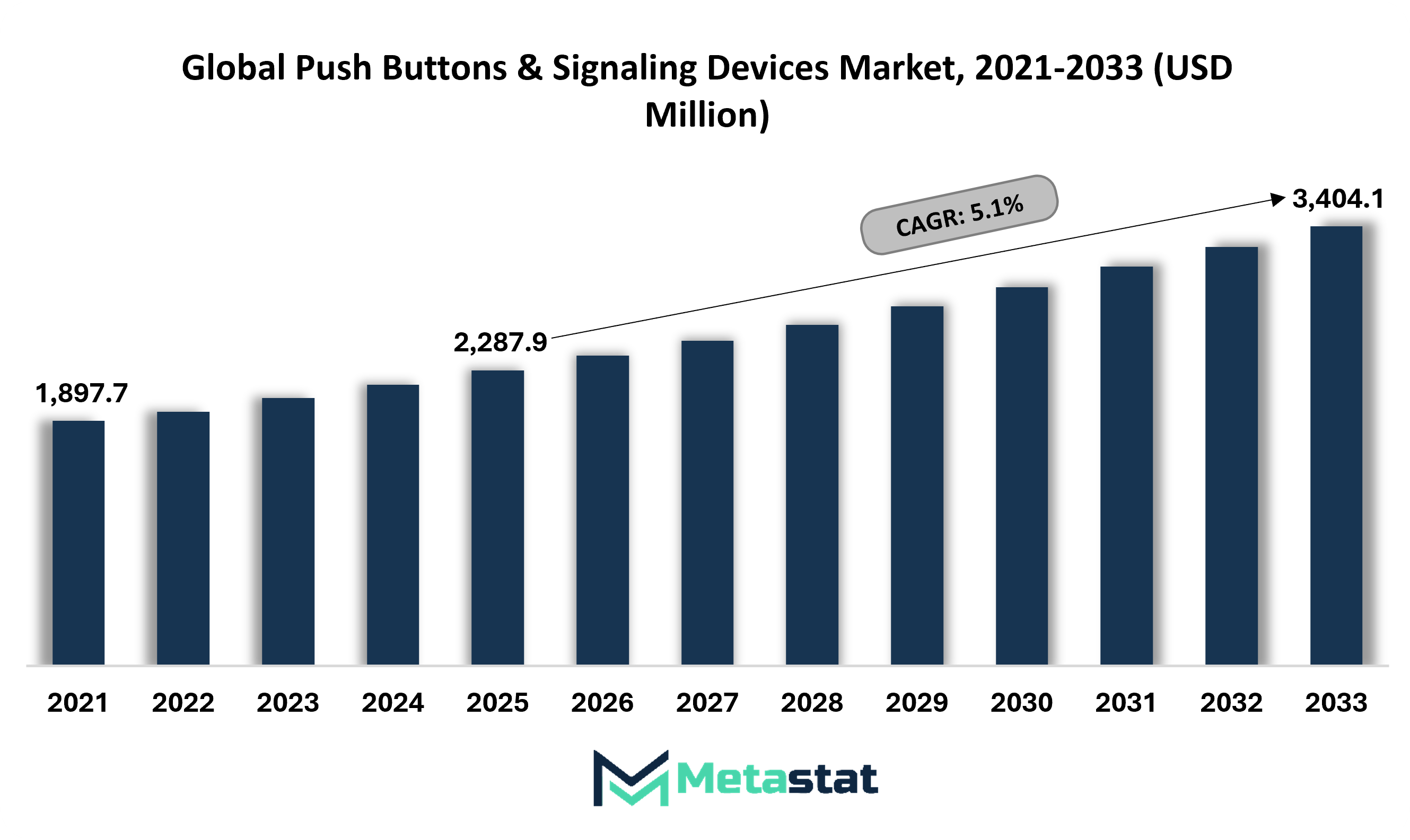
Increasing industrial automation and smart manufacturing adoption propel demand for advanced control and signaling components.
Rapid factory modernization, robotic assembly lines, sensor-based production, and data-led maintenance programs create strong need for dependable push buttons, indicators, and alarms, as manufacturing facilities seek faster response, lower downtime, and precise machine control across automotive, electronics, packaging, food processing, and machinery industries worldwide.
Growing emphasis on workplace safety and real-time operational monitoring increases deployment of signaling devices across industries.
Strict safety norms, hazard prevention targets, and continuous monitoring standards encourage wider use of warning lights, buzzers, sirens, emergency stop devices, and status indicators, while industrial sites require immediate alerts for faults, overheating, pressure shifts, and movement zones, supporting stable long-term market growth.
Price sensitivity and availability of low-cost alternatives in developing markets constrain premium product adoption.
Budget-focused customers in emerging economies often prefer low-cost local products with basic features, while premium branded devices face slower adoption where capital planning remains constrained, with procurement-led cost comparison reducing margins for advanced suppliers and affecting product positioning strategies.
Integration complexity with legacy systems limits replacement cycles and slows adoption of advanced devices.
Older control panels, aging wiring layouts, and outdated system interfaces create technical barriers during upgrade projects, as compatibility checks, shutdown schedules, engineering redesign, and training requirements can delay purchasing decisions, leading many facilities to continue using existing systems until full modernization budgets receive approval.
Rising adoption of Industry 4.0 and IoT-enabled control systems creates opportunities for smart, connected push buttons and signaling solutions.
Connected factories increasingly require intelligent devices with diagnostics, wireless links, remote indicators, energy tracking, and predictive maintenance support, while smart push buttons with programmable features improve workflow visibility and operator efficiency across warehouses, utilities, transport hubs, smart buildings, and automated industrial facilities globally.
The Global Push Buttons and Signaling Devices market is classified based on Type, Technology, Application, and End Users.
Momentary Push Buttons segment is valued at USD 670.9 million in 2026 and is projected to reach USD 941.2 million by 2033, at a CAGR of 5% during the forecast period.
Momentary push buttons support fast command input across production lines, control panels, and compact machinery, while growing preference for responsive interfaces is encouraging longer contact life, low-force actuation, and compact formats suited for automated systems requiring quick reset cycles and reliable short-duration switching performance.
Latching Push Buttons segment is valued at USD 503.8 million in 2026 and is projected to reach USD 654.6 million by 2033, at a CAGR of 3.8% during the forecast period.
Latching push buttons remain valuable where maintained on-off status is required for machinery, safety panels, and process controls, with smart factory expansion creating demand for durable locking action, clear tactile feedback, high-endurance materials, and energy-efficient systems with stable operating control.
Illuminated Push Buttons segment is valued at USD 451.6 million in 2026 and is projected to reach USD 698.9 million by 2033, at a CAGR of 6.4% during the forecast period.
Illuminated push buttons are gaining traction through visibility benefits in dim areas, crowded panels, and safety zones, while LED integration is improving energy savings, color signaling, operating life, customizable lighting patterns, diagnostic alerts, and stronger human-machine interaction across advanced facilities.
Emergency Stop Push Buttons segment is valued at USD 424.3 million in 2026 and is projected to reach USD 624.7 million by 2033, at a CAGR of 5.7% during the forecast period.
Emergency stop push buttons maintain strong importance in risk-sensitive environments such as plants, transport systems, and heavy equipment zones, while safety regulations continue supporting adoption of faster response engineering, tamper resistance, clearer visibility, and integration with shutdown networks designed for hazard prevention.
Multi-Function Push Buttons segment is valued at USD 351.6 million in 2026 and is projected to reach USD 484.7 million by 2033, at a CAGR of 4.7% during the forecast period.
Multi-function push buttons integrate multiple commands within limited panel space, supporting modern compact machine design, while rising preference for efficient layouts is increasing usage across control stations and digital interfaces with programmable settings, tactile feedback, and adaptable operation modes.
Mechanical segment is projected to reach USD 1,175.4 million by 2033, at a CAGR of 4.3% during the forecast period.
Mechanical technology remains widely used owing to simplicity, cost efficiency, and reliable switching cycles, with strong demand continuing across factories, transport hardware, and public infrastructure where future enhancements will focus on wear resistance, silent operation, and compact assemblies with longer service life.
Electronic segment is projected to reach USD 1,000.1 million by 2033, at a CAGR of 5.9% during the forecast period.
Electronic technology supports precise signal transmission, low-maintenance operation, and compatibility with smart systems, while growth in connected devices is strengthening adoption across automation and healthcare equipment through embedded sensors, programmable responses, and advanced diagnostics that improve uptime and operational visibility.
Hydraulic segment is projected to reach USD 385.3 million by 2033, at a CAGR of 3.8% during the forecast period.
Hydraulic technology serves heavy-duty environments where force handling and rugged performance remain essential, with construction equipment, lifting systems, and industrial machinery supporting adoption of leak-resistant designs, stronger sealing materials, and efficient pressure management for harsh operating conditions.
Pneumatic segment is projected to reach USD 314.5 million by 2033, at a CAGR of 3.8% during the forecast period.
Pneumatic technology offers quick response, safe operation, and suitability for moisture-prone or explosive settings, with food processing, packaging, and plant operations continuing to use pneumatic controls linked with cleaner air systems, noise reduction engineering, and improved power control across manufacturing environments.
Optical segment is projected to reach USD 528.7 million by 2033, at a CAGR of 7.5% during the forecast period.
Optical technology is gaining momentum through contactless activation, high precision, and reduced wear, with adoption increasing in cleanrooms, medical devices, and advanced electronics systems where gesture sensing, rapid data feedback, and improved contamination control support premium automated operations.
Industrial Automation segment is projected to reach USD 1,265.6 million by 2033.
Industrial automation remains a primary application area owing to rising factory modernization and machine performance goals, with push buttons and signaling devices supporting machine control, alerts, workflow continuity, connected panels, predictive maintenance indicators, and adaptive interfaces that enhance production consistency.
Transportation segment is projected to reach USD 705.7 million by 2033.
Transportation systems use push buttons and signaling devices for passenger access, cabin controls, and operational safety, while urban mobility growth is increasing installation volumes across rail, road, and airport infrastructure with future development focused on weather-resistant devices, smart signaling, and durable high-traffic components.
Telecommunications segment is projected to reach USD 450.7 million by 2033.
Telecommunications networks require dependable control devices for cabinets, service facilities, and backup systems, while network expansion and data traffic growth are supporting demand for compact controls, remote monitoring signals, and resilient components suited for uninterrupted communication infrastructure performance.
Healthcare segment is projected to reach USD 433.3 million by 2033.
Healthcare settings depend on reliable controls for diagnostic equipment, patient assistance systems, and laboratory devices, while hygiene standards and precision requirements continue supporting quality-focused demand for antimicrobial surfaces, silent actuation, and intuitive signaling designed for critical care performance.
Consumer Electronics segment is projected to reach USD 548.7 million by 2033.
Consumer electronics support demand for compact and stylish control components across home appliances, gaming devices, and smart products, while user experience remains a primary growth factor encouraging slimmer designs, illuminated feedback, and longer lifecycle performance aligned with premium device expectations.
Manufacturing segment is projected to grow at a CAGR of 4.0% during the forecast period.
Manufacturing remains a major end user owing to the continuous need for machine control, safety alerts, and system management, with production expansion across developing economies supporting sales momentum and future demand from robotics integration, digital dashboards, and stronger plant safety standards.
Construction segment is projected to grow at a CAGR of 5.0% during the forecast period.
Construction activities require durable control devices for lifts, mixers, power tools, and site systems, while infrastructure spending continues creating opportunities for rugged dust-resistant designs, portable control units, and improved signaling solutions supporting safer project execution.
Aerospace segment is projected to grow at a CAGR of 7.2% during the forecast period.
Aerospace applications require precision controls with strict reliability standards, while cockpit panels, maintenance systems, and support equipment generate steady demand for lightweight materials, vibration resistance, and compact high-performance units aligned with next-generation aircraft programs.
Energy segment is projected to grow at a CAGR of 5.8% during the forecast period.
Energy facilities use signaling devices and push buttons across generation plants, grids, and control rooms, while grid modernization and renewable capacity growth are increasing installation needs for remote status signals, weather-resistant devices, and reliable controls for continuous power operations.
Marine segment is projected to grow at a CAGR of 5.6% during the forecast period.
Marine environments need corrosion-resistant controls capable of managing moisture, vibration, and salt exposure, with commercial fleets, ports, and offshore platforms supporting demand for sealed housings, enhanced visibility systems, and robust long-life components suited for harsh sea conditions.
Based on geography, the Global Push Buttons and Signaling Devices market is divided into North America, Europe, Asia-Pacific, South America, Middle East, and Africa.
North America is witnessing rising adoption owing to industrial automation investments, strict workplace safety regulations, modernization of legacy manufacturing facilities, and demand for premium certified push buttons and signaling devices.
Europe represents a mature but steadily expanding market for push buttons and signaling devices, supported by advanced manufacturing, strict machinery safety standards, industrial automation upgrades, and strong adoption of certified control components
Asia Pacific presents significant opportunities for the Push Buttons and Signaling Devices Market through expanding manufacturing bases, electronics production, infrastructure development, cost-efficient production ecosystems, and growing industrial control demand.
Across the Middle East, Africa, and South America, the Push Buttons and Signaling Devices market progresses through industrial expansion, mining activity, utilities projects, and commercial construction upgrades.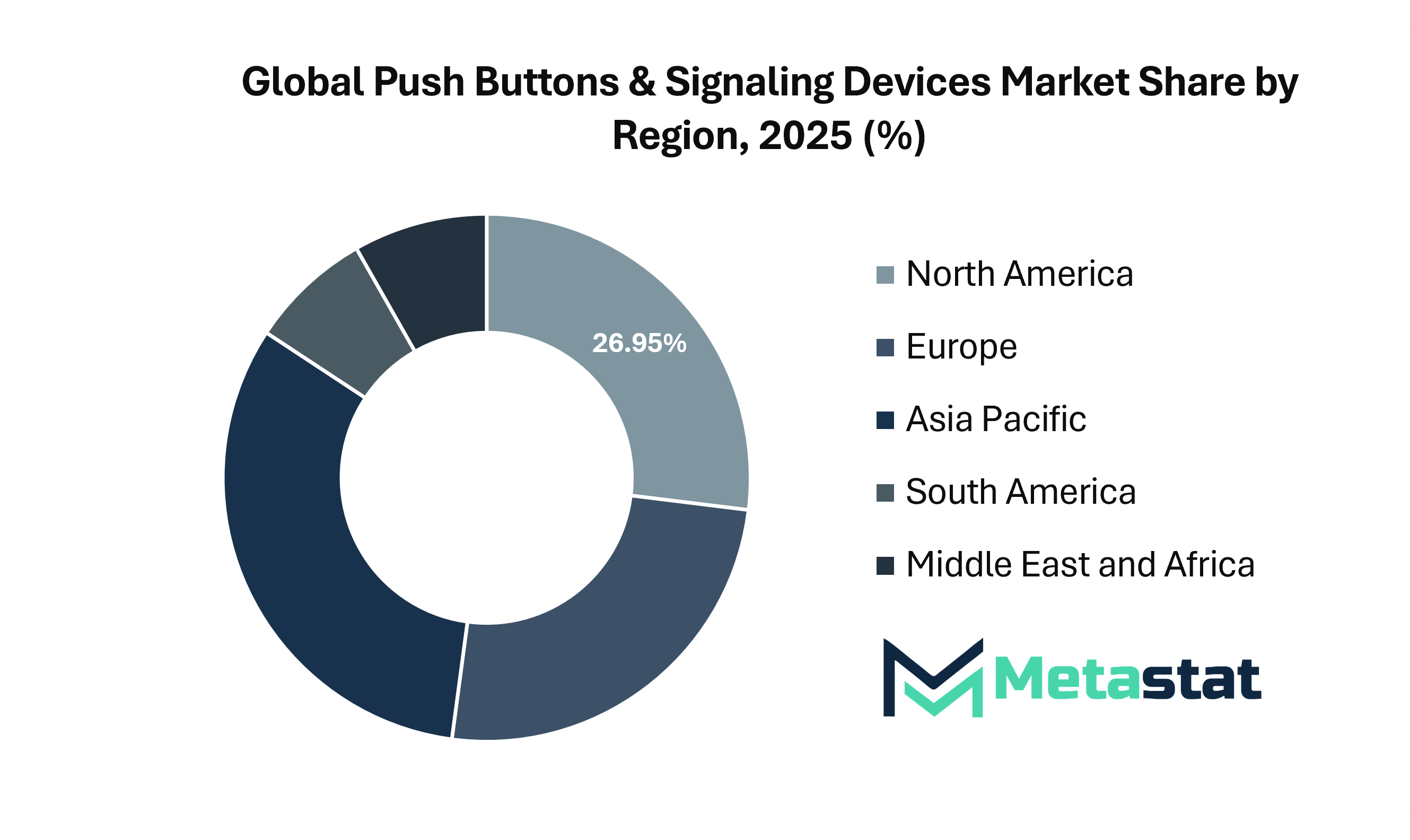
The Global Push Buttons and Signaling Devices Market supports safe control across factories, buildings, transport hubs, and power sites. Operators rely on clear start, stop, reset, alarm, and status indicators to guide daily operations and reduce errors. Demand will increase with automation upgrades, stricter safety regulations, and replacement of aging panels. Buyers now prefer durable devices that resist dust, moisture, shock, and frequent use. They also seek simple installation, long service life, and designs that fit compact control cabinets in modern facilities.
Leading providers compete through product quality, broad catalogs, certification coverage, and support networks. Schneider Electric SE, Siemens AG, ABB Ltd., Eaton Corporation plc, and Rockwell Automation, Inc. serve many industrial and commercial accounts. OMRON Corporation, IDEC Corporation, and Fuji Electric Co., Ltd. focus on reliable control components, while Phoenix Contact GmbH & Co. KG and Pilz GmbH & Co. KG add safety-focused alternatives. Pepperl+Fuchs SE, Carlo Gavazzi Holding AG, and LOVATO Electric S.p.A. widen product choice for regional buyers seeking value, steady supply, responsive service, and trusted product lines.
Product trends show growing interest in illuminated buttons, modular contact blocks, stackable tower lights, audible alarms, and smart indicators connected to control software. Wireless alerts remain limited in harsh sites, yet connected diagnostics will gain ground. Manufacturers are improving energy efficiency, LED brightness, buzzer performance, and housing strength. Food plants, warehouses, data centers, and transit systems need clear alerts during faults, maintenance, changeovers, and emergency stops. Custom colors, labels, and mounting options also help teams match site rules and operator habits for safer daily response and easier maintenance.
For buyers and planners, the Push Buttons and Signaling Devices Market offers stable demand as every plant requires basic human controls and visible warnings. Growth will come from retrofits, new production lines, safer work regulations, and compact machines. Price pressure will remain present as low-cost imports expand, yet buyers often return to tested brands after product failures. Fast delivery, aftersales support, and certification data remain key strengths for long-term wins across regions where uptime, daily output, and safety budgets remain critical.
Market size is forecast to rise from USD 2,287.9 million in 2025 to over USD 3,404.1 million by 2033.
The Global Push Buttons and Signaling Devices Market is expected to increasingly align with Industry 4.0 requirements. Future demand will center on compact, intelligent devices capable of communication, diagnostics, status monitoring, and seamless integration into automated control architectures.
This research report categorizes the Push Buttons and Signaling Devices market based on key segments and regions, forecasts revenue growth, and analyses trends in each submarket. The report analyses the key growth drivers, opportunities, and challenges influencing the Push Buttons and Signaling Devices market. Recent market developments and competitive strategies such as expansion, product launch, partnership, merger, and acquisition have been included to draw the competitive landscape in the market.
The report strategically identifies and profiles the key market players and analyses their core competencies in each sub-segment of the Push Buttons and Signaling Devices market.
|
Report Attributes |
Details |
|
Study Period |
2021-2033 |
|
Base Year |
2025 |
|
Estimated Year |
2026 |
|
Forecast Period |
2026-2033 |
|
Historical Period |
2021-2025 |
|
Growth Rate |
CAGR 5.1% from 2026 to 2033 |
|
Revenue Unit |
USD million |
|
Sales Volume Unit |
Thousand Units |
|
Segmentation |
By Type, Technology, Application, End Users, and Region |
|
By Region |
North America (By Type, Technology, Application, End Users, and Country)
|
|
Europe (By Type, Technology, Application, End Users, and Country)
|
|
|
Asia Pacific (By Type, Technology, Application, End Users, and Country)
|
|
|
South America (By Type, Technology, Application, End Users, and Country)
|
|
|
Middle East and Africa (By Type, Technology, Application, End Users, and Country)
|
WHAT REPORT PROVIDES
Find answers to common questions about this report
Top players operating in the Push Buttons & Signaling Devices industry include Schneider Electric SE, Siemens AG, ABB Ltd., Eaton Corporation plc, Rockwell Automation, Inc., and OMRON Corporation.
Price sensitivity and availability of low-cost alternatives in developing markets constrain premium product adoption. will hamper the market growth within the forecast period.
Global Push Buttons and Signaling Devices market is estimated to reach USD 3,404.1 million by 2033.
Asia Pacific region dominates the market.
Increasing industrial automation and smart manufacturing adoption propel demand for advanced control and signaling components. and Growing emphasis on workplace safety and real-time operational monitoring increases deployment of signaling devices across industries. are key driving factors, boosting the market.
The Metastat Insights analysis shows that the North America Push Buttons and Signaling Devices market size is estimated to be USD 919.1 million by 2033.
The Momentary Push Buttons is the leading type segment in the Global market.
The Metastat Insights study shows that the Global Push Buttons and Signaling Devices market size was USD 2,287.9 million in 2025.
The Global Push Buttons and Signaling Devices market is expected to grow at a CAGR of 5.1% over the forecast period (2026-2033).
The analysts below cover Electronics and Semiconductor research at Metastat Insights.
LEAD ANALYST
Utkarsh Khirodkar is a Lead Market Research Analyst at MetaStat Insight, specializing in market intelligence, technology sector assessments, and competitive strategy.

PRINCIPAL CONSULTANT - ENTERPRISE AI & EMERGING TECHNOLOGIES
Banking & Finance · Electronics and Semiconductor · Energy and Power · Healthcare IT · Information & Technology · Professional Services
Vijay Gunti is a Principal Consultant at MetaStat Insight, bringing over two decades of experience across enterprise digital transformation, technology strategy, and intelligent systems.

PRINCIPAL CONSULTANT - QUALITY SYSTEMS & COMPLIANCE
Electronics and Semiconductor · Machinery & Equipment · Professional Services
Omkar Phadtare is an Industry Consultant at MetaStat Insight, specializing in quality systems, regulatory compliance, and standards benchmarking to drive data-driven market intelligence and strategic industry research.

ENERGY & INFRASTRUCTURE INDUSTRY CONSULTANT
Automotive and Transportation · Electronics and Semiconductor · Energy and Power · Machinery & Equipment
Saurabh Vasant Ganvir consults for Energy & Infrastructure Industry at MetaStat Insight, specializing in renewable energy, solar EPC, and electric vehicle (EV) infrastructure markets.

LEAD CONSULTANT - COMMUNICATION, TELECOM, AND IT
Electronics and Semiconductor · Information & Technology · Machinery & Equipment · Professional Services
Ravindra Sathe Consultants for Communication, Telecom, and IT at MetaStat Insight. He leads the firm's industry research initiatives across telecommunications infrastructure, digital connectivity, enterprise networking, and emerging information technology domains.
Analyzing the transition from natural gas to green hydrogen in iron ore reduction requires realistic infrastructure timelines. Meta stat insight supplied a detailed regional assessment of DRI plant conversion costs and scrap metal availability in North America and Western Europe. Their report carefully examined pellet quality specs and electrical grid access constraints without making oversimplified market assumptions. The research material served as a practical reference during internal technology roadmap discussions.
Integrating zero-trust access controls across legacy electronic health record systems involves complex compliance overhead. Team produced an analysis that clearly separated identity governance and administration tools from privileged access management platforms. Their evaluation of HIPAA and GDPR compliance features across cloud native solutions gave our architecture group clear baseline criteria. The custom data request regarding biometric authentication adoption in hospital networks was returned promptly with clear documentation.
Evaluating calorific value requirements and air permit compliance across municipal waste facilities requires localized data. Metastat Insight structured their analysis around operational throughput capacity and feedstock composition variations in Latin America and Eastern Europe. Their competitive mapping of sorting equipment vendors helped clarify technology differences between optical separators and heavy media systems. The study provided an objective baseline during our capital expenditure reviews.
Explore related market intelligence reports worth reading alongside this one.
Starting from
$2950