
LEAD ANALYST
Utkarsh Khirodkar is a Lead Market Research Analyst at MetaStat Insight, specializing in market intelligence, technology sector assessments, and competitive strategy.

Smart PPE Market By Product Type (Smart Clothing, Head/Eye/Face Protection, Protective Footwear, Hearing Protection, Respiratory Protection, Hand Protection, Others), By End-use Industry (Construction, Oil & Gas, Firefighting, Manufacturing, Healthcare Facilities, Mining, Others), Industry Analysis, Size, Share, Growth, Trends, and Forecasts 2025–2032
Report ID
MSI-4396
Published
November, 2025
Pages
255 Pages
Format
Report Details
Choose Your License
Smart PPE Market
The global smart PPE market and the industrial safety technology industry arose from the problem of traditional protective gear limitations. The workers in construction, mining, and chemical plants were using equipment that provided no information about exposure or danger but protected the body. The companies started to ask the question: What if protective gear could think, measure, and warn? This question led to a series of experiments that included embedding sensors in helmets and industrial clothing. At that time, the idea was still considered a bit too much, and the process of adoption was gradual as the technology still was massive and costly.
The small and inexpensive wireless communication technology was a factor to bring in a major turning point. The technology made it possible to have helmets that could monitor physical impact, the vests could be monitoring the heart rate of the worker and the gloves could be sending a signal to the supervisor that the worker is fatigued. Safety became active instead of being passive. At about the same time, the stricter workplace regulations forced the employers to keep records of the hazardous exposure. The data-based safety practice was turned from being not mandatory to being a legal advantage. The market was propelled when the governments advocated the digital monitoring of dangerously located work sites, and the insurance companies gave rewards to the companies that offered connected protection.
The behavior of the consumers had an unexpected share of influence. The workers started asking for comfort and personalizing instead of equipment that is suitable for all. The technology-minded younger generation of employees looked for the kind of equipment that could be connected to their phones and would provide real-time data. That anticipation compelled the manufacturers to reconsider the design, which resulted in the production of lighter batteries, washable sensors, and more flexible electronics.
The world market of the smart ppe is the combination of safety equipment and the digital analytics platforms. The companies are not purchasing only gloves or helmets anymore; they are making an investment in systems that would monitor the quality of air, detect falls, or send alerts even before a hazard turns into an accident. The future defining phase would be the one that is dominated by artificial intelligence. The equipment would analyze the previous incidents and would then be able to forewarn the workers about the potential danger. Besides, the manufacturers would be looking for recyclable materials and makers of electronic components giving longer life to the units.
With the improvement of connectivity, this market will change from a protective approach to one that is preventative. What was once just equipment will evolve into a network of intelligent guardians powered by data and accuracy and a future where accidents will be avoided.
The global smart PPE market is mainly classified based on Product Type, End-use Industry, , .
|
Forecast Period |
2025-2032 |
|
Market Size in 2025 |
$1746 Million |
|
Market Size by 2032 |
$4562 Million |
|
Growth Rate from 2025 to 2032 |
14.7% |
|
Base Year |
2024 |
|
Regions Covered |
North America, Europe, Asia-Pacific, South America, Middle East & Africa |
Rising workplace safety regulations and compliance standards boost demand for smart PPE: The global smart PPE market is witnessing steady growth due to stricter workplace safety rules across various industries. Governments and organizations are emphasizing the need for safer working conditions, which has encouraged companies to invest in advanced protective equipment. Smart PPE helps track worker health and environmental conditions, ensuring compliance and reducing risks. As industries such as construction, manufacturing, and mining continue to face hazards, the demand for intelligent safety gear is expected to grow further.
Increasing adoption of IoT and wearable technologies in industrial and healthcare sectors: The growing use of IoT and wearable devices in industries and healthcare has created strong momentum for the global smart PPE market. These devices allow real-time tracking of workers’ health and environmental hazards, improving workplace safety. Smart helmets, vests, and glasses provide instant alerts about temperature, gas leaks, or fatigue, helping prevent accidents. In healthcare, smart PPE assists in monitoring medical staff and patient safety. This integration of technology into safety gear ensures better protection and efficiency in critical operations.
High cost of smart PPE limits adoption among small and medium enterprises: Despite its benefits, the global smart PPE market faces a challenge due to high initial costs. Small and medium-sized enterprises often struggle to invest in advanced wearable safety equipment because of limited budgets. The expense of sensors, connectivity, and data management systems adds to the overall cost. Many organizations continue using traditional PPE to cut expenses, slowing the wider adoption of smart variants. To overcome this, cost-effective solutions and subsidies may encourage broader market participation.
Concerns regarding data privacy and security in wearable devices: The expansion of the global smart PPE market is affected by growing concerns over data privacy and security. Smart PPE collects and transmits sensitive information such as location, health status, and activity data. Any breach or misuse of this information can lead to serious risks for both employers and employees. Ensuring data protection and compliance with privacy regulations is crucial to building trust among users. Companies need to adopt secure platforms and encrypted systems to safeguard information while maintaining safety efficiency.
Growing integration of AI and real-time monitoring in smart PPE for predictive safety measures: The global smart PPE market has significant opportunities due to the increasing use of AI and real-time monitoring systems. Artificial intelligence helps predict potential hazards before they occur by analyzing data collected from wearable sensors. This allows faster responses and preventive actions to ensure worker safety. Real-time monitoring also enhances communication between workers and safety managers, creating a more proactive approach to accident prevention. The combination of AI and connected technologies is expected to shape the future of workplace protection across multiple sectors.
The global smart PPE market competition involves several established brands and newer regional participants. The market products support safer work environments by using sensors, wireless links, and data systems to warn workers about possible hazards. Growth in the market demand comes from construction, healthcare, oil and gas, and chemical facilities. Modern workplaces now focus on preventing accidents before harmful exposure occurs. The global smart PPE market solutions help supervisors monitor conditions and address risks faster than older protective gear.
Major companies help guide progress in the global smart PPE market development. Leading participants include 3M, Ansell Ltd., Bullard, Delta Plus Group, Draegerwerk AG & Co. KGaA, DuPont de Nemours, Inc., Ergodyne, Honeywell International Inc., IML Group PLC (Hazardex), Lakeland Industries Inc., Moldex-Metric AG & Co. KG, MSA Safety Incorporated, Radians, Inc., Skylotec GmbH, Uvex Group, and Vuzix Corporation. Well-known corporations support product improvement through research, advanced materials, and partnerships with industrial clients. New regional brands work to offer lower-cost products while enhancing comfort and performance. Competition encourages higher safety standards and continuous upgrades in technology.
The global smart PPE market adoption rises because industrial accidents bring financial loss and emotional stress for workers and families. Safer tools protect health and reduce downtime across factories, warehouses, and laboratories. Organizations also face strict rules from governments and workplace agencies. The market devices help organizations follow standards and reduce penalties related to non-compliance.
Investment in modern protective gear supports faster detection of gas leaks, harmful particles, extreme temperature, and noise levels. Connected gear sends data to supervisors, supporting quick decisions that reduce danger. Improved alert systems bring peace of mind to workers and management. Growth in the market awareness encourages training programs that help workers understand how to use advanced gear correctly.
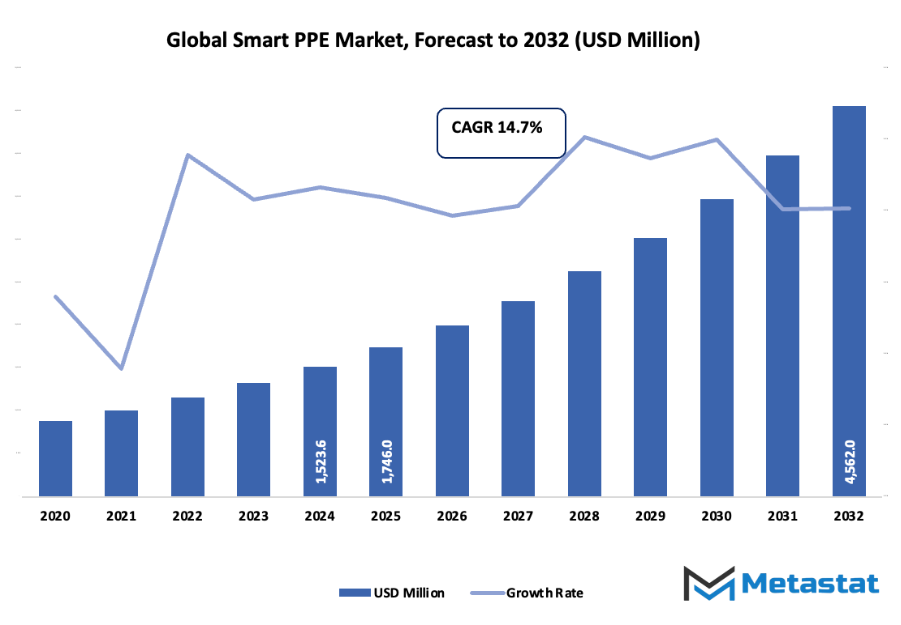
Market size is forecast to rise from USD 1746 million in 2025 to over USD 4562 million by 2032. Smart PPE will maintain dominance but face growing competition from emerging formats.
Continuous progress in materials, sensors, and connectivity will support expanded the global smart PPE market use in the future. As more industries value safe working conditions, The market adoption will continue to increase, helping create safer workplaces across the world.
This research report categorizes the global smart PPE market based on various segments and regions, forecasts revenue growth, and analyzes trends in each submarket. The report analyses the key growth drivers, opportunities, and challenges influencing the global smart PPE market. Recent market developments and competitive strategies such as expansion, type launch, development, partnership, merger, and acquisition have been included to draw the competitive landscape in the market. The report strategically identifies and profiles the key market players and analyses their core competencies in each sub-segment of the global smart PPE market.
Find answers to common questions about this report
Global Smart PPE market is valued at $1746 million in 2025.
Global Smart PPE market is estimated to grow with a CAGR of 14.7% from 2025 to 2032.
Global Smart PPE market is estimated to reach $4562 million by 2032.
Top players operating in the Smart PPE industry includes 3M, Ansell Ltd., Bullard, Delta Plus Group, Draegerwerk AG & Co. KGaA, DuPont de Nemours, Inc
The analysts below cover Chemicals and Materials research at Metastat Insights.
LEAD ANALYST
Utkarsh Khirodkar is a Lead Market Research Analyst at MetaStat Insight, specializing in market intelligence, technology sector assessments, and competitive strategy.

INDUSTRY CONSULTANT - CHEMICALS & ADVANCED MATERIALS
Chemicals and Materials · Machinery & Equipment · Packaging
Amit Gadhekar Consultant for Chemicals and Materials at MetaStat Insight, directing sector-specific intelligence, research, and strategic consulting across global chemical and processing markets.
Replacing petrochemical surfactants with bio-based alternatives requires realistic timelines on industrial precision fermentation scaling. The market research broke down commercialization timelines, feedstock sugar price sensitivities, and regional cosmetic ingredient regulatory approvals in Europe and East Asia. That supplier readiness mapping gave our formulations team reliable context when comparing renewable chemical sourcing roadmaps.
Tracking ceramic matrix composite adoption in high-bypass aero engines requires strict attention to material qualification cycles and FAA airworthiness testing milestones. The MetaStat Insight team provided a detailed timeline of silicon carbide fiber manufacturing capacity and commercial foundry lead times. Having clear visibility into upstream thermal barrier coating supply helped us stress-test our long-term component procurement strategy.
Transitioning ultra-class mining haul trucks to alternative power requires concrete data on remote hydrogen refueling infrastructure economics. The report evaluated megawatt-scale electrolyzer installation expenses, onsite storage safety mandates, and heavy-duty fuel cell stack degradation under continuous duty cycles. That technical rigor helped our engineers benchmark realistic total operating cost horizons for off-highway fleet decarbonization.
Explore related market intelligence reports worth reading alongside this one.
Starting from
$2950