
LEAD ANALYST
Utkarsh Khirodkar is a Lead Market Research Analyst at MetaStat Insight, specializing in market intelligence, technology sector assessments, and competitive strategy.

Global Precious Metals Market Size, Share, By Metal Type (Gold, Silver, Platinum, Palladium, Rhodium and Others), By Source Type (Primary Mined Supply and Recycled Secondary Supply), By Application (Jewellery and Watches, Investment and Official Reserves, Electronics and Electrical, Automotive and Catalysts, Chemical and Industrial Processing, Medical and Dental and Others), By Sales Channel (Direct Supply to Fabricators and Industry, Bullion Banks and Commodity Traders, Authorised Dealers and Jewellers and Online Bullion Platforms), Industry Analysis, Growth, Trends, and Forecast, 2026-2033
Report ID
MSI-5717
Published
November, 2026
Pages
257 Pages
Format
Historical
Base year
Forecast
Forecast period
Report Details
Market Valuation: Valued at $514.9 Billion in 2025, projected to reach $924.8 Billion by 2033 at a 7.6% CAGR.
Dominant Segment: Gold remains the most valuable segment within the Precious Metals market, driven by its status as a safe-haven asset and increasing investment interest amid economic uncertainties.
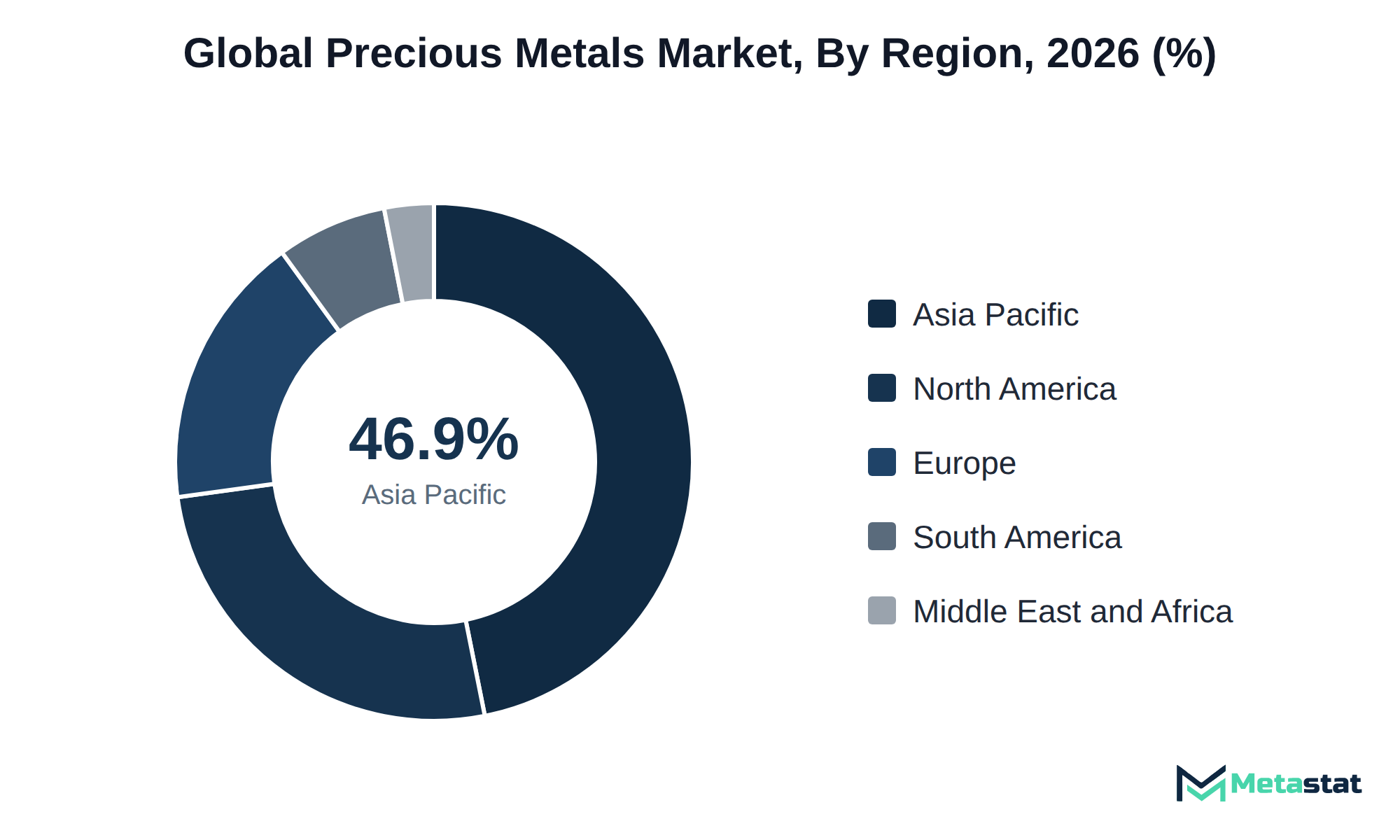
Geographic Lead: The Asia Pacific region leads the market, accounting for 46.9% of the share, supported by robust industrial activities and a strong consumer appetite for precious metals.
What's Inside: The report provides comprehensive competitive coverage, detailed analyses of market dynamics, and forecasts for the period from 2026 to 2033, focusing on various segments and applications.
Emerging Trends: Investment in advanced recycling technologies is reshaping the market, enhancing the efficiency of metal recovery and appealing to environmentally conscious buyers across industries.
Price Volatility Impact: Fluctuations in precious metals prices create uncertainty, leading to cautious purchasing behaviors among buyers in sectors like jewelry and electronics, ultimately affecting overall market demand.
Choose Your License
Global Precious Metals Market
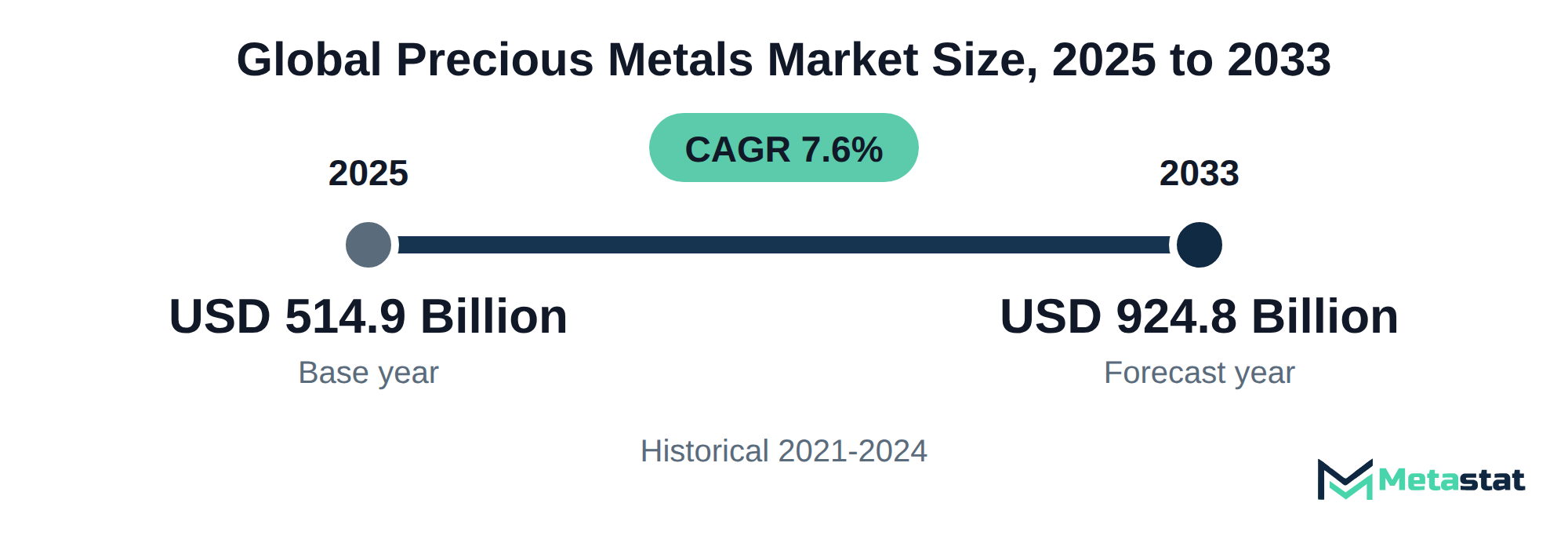
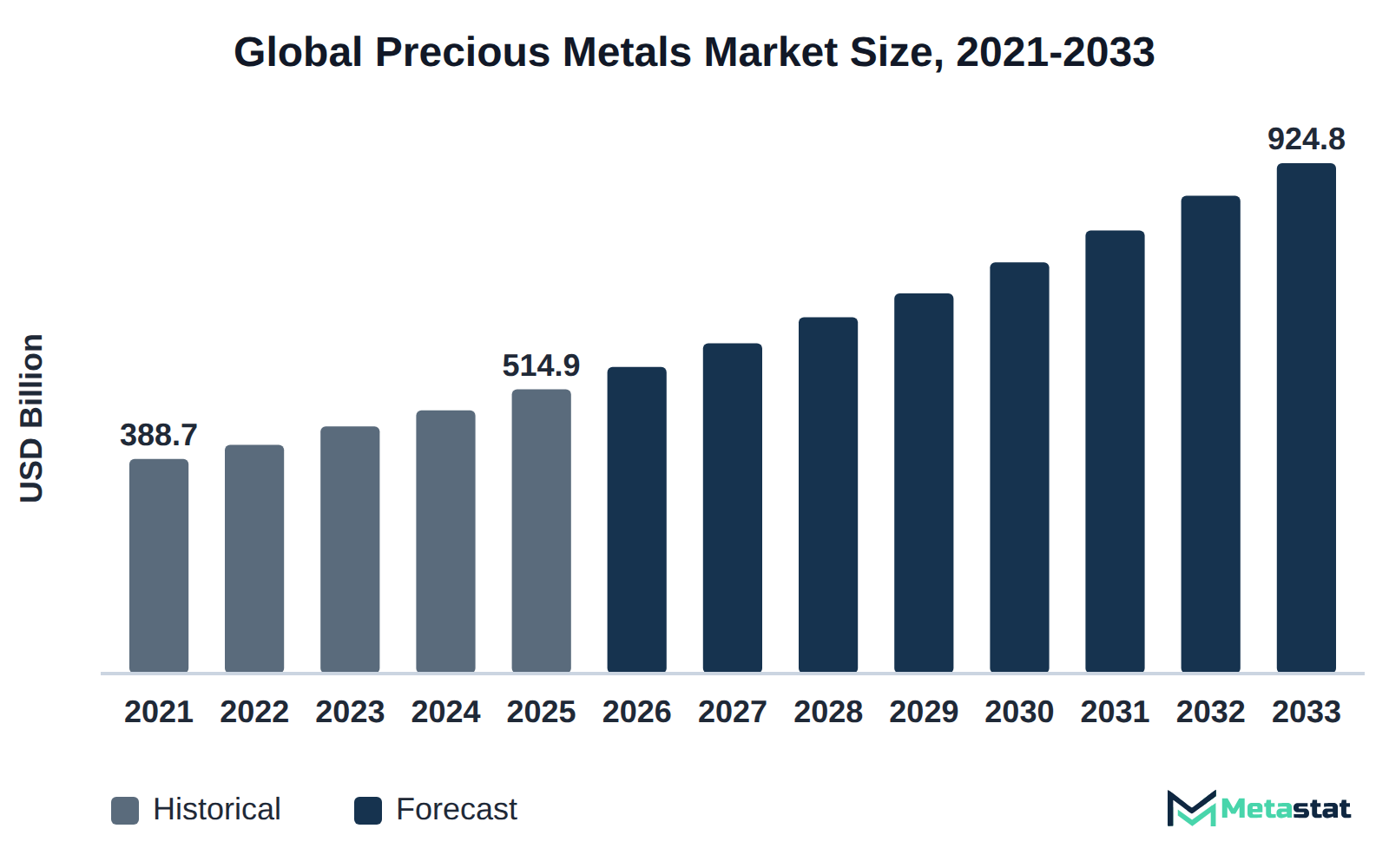
The global Precious Metals market was valued at USD 514.9 billion in 2025 and is projected to reach USD 924.8 billion by 2033, growing at a CAGR of 7.6% over the forecast period.
The Precious Metals market covers gold, silver, platinum, and palladium, which are used across industries including jewelry, electronics, and automotive. Buyers invest in these metals due to their intrinsic value, versatility, and demand in investment and manufacturing sectors. This market is significant in the global economy, driven by consumer needs for luxury goods, technological advancements, and a growing interest in precious metal investments.
Growth in the market is supported by increasing demand for gold, which is the most valuable segment within the industry. The Asia Pacific region commands the largest share, accounting for 46.9% of the market, reflecting its significant industrial activities and consumer appetite for precious metals. North America holds 26.0% of the market in 2025, with the US leading in 2026. Rising interest in sustainable and recycled materials provides a further impetus for market expansion.
Investment in the Precious Metals market is expected to accelerate, driven by economic uncertainties and inflation hedging strategies. This trend emphasizes the importance of metals in portfolio diversification and asset allocation, prompting greater engagement from both institutional and retail investors. Strong regional demand and rising value in key segments point to sustained growth in the coming years.
The Precious Metals market encompasses various segments, including gold, silver, platinum, and palladium, which serve multiple applications ranging from jewelry to electronics. Buyers invest in these metals due to their intrinsic value, aesthetic appeal, and critical roles in technology and industry. Emerging technologies and shifting consumer preferences also raise demand for these precious materials.
Growth in the market is significantly driven by the increasing demand for gold, which stands out as the most valuable segment. The region's strong economic performance, combined with investment trends favoring gold and other precious metals, supports this growth and reflects a global shift toward securing tangible assets.
The expansion of the electronics and automotive sectors further influences the demand for precious metals. These industries rely on metals for components that ensure efficiency and durability in their products. Technological advances continue, and the market expects more activity and investment across applications, strengthening its place in the global economy.
Emerging technologies in recycling are reshaping the Precious Metals market, significantly influencing the demand for silver and platinum group metals (PGMs). The rise of recycled secondary supply, projected to reach USD 247.9 billion by 2033, highlights this shift. Industry players increasingly adopt advanced recycling processes, resulting in higher recovery rates and lower environmental impact. This transformation reduces dependency on primary mined supply and enhances sustainability within the market.
Investment in innovative recycling technologies improves the overall efficiency of metal recovery, appealing to environmentally conscious consumers and industries. The automotive and electronics sectors, which use PGMs and silver extensively, benefit from these advancements. Higher efficiency in recycling processes results in increased availability of these metals in the market without the environmental costs associated with mining.
This shift in recycling practices is a significant development for the Precious Metals market, supporting demand for sustainable practices and supply chain resilience. Enhanced supply from recycled sources contributes to stable pricing and availability, increasing confidence among investors and manufacturers alike.
Recycled precious metals are gaining traction within global refining networks due to rising demand for sustainable sourcing. The market for recycled secondary supply is expected to reach USD 247.9 billion by 2033, reflecting a compound annual growth rate of 9.2%. This growth stems from increasing interest in environmentally friendly practices among manufacturers and consumers alike.
Buyers in the precious metals market engage in various pricing models, including fixed-price contracts and spot pricing. Fixed-price contracts provide stability, allowing buyers to secure a predetermined price for a specified volume, which is particularly beneficial during market fluctuations. In contrast, spot pricing provides flexibility, allowing buyers to purchase metals at current market rates. Spot prices lead to increased costs during periods of high demand or low supply.
Contracts incorporate performance clauses, ensuring that suppliers meet specific quality and delivery standards. This requirement enhances the reliability of recycled precious metals, making them an attractive option for buyers in sectors including electronics and automotive. The shift toward recycled sources supports environmental goals and stabilizes pricing and supply in the market.
Responsible sourcing increasingly shapes bullion trade flows in the Precious Metals market. Initiatives promoting ethical sourcing practices have gained traction among consumers, driving demand for transparency in the supply chain. The Asia Pacific region holds a 46.9% share of the market, highlighting its key role in global supply.
While regulations tighten globally, refineries and suppliers face pressure to comply with standards that ensure ethical extraction and processing of precious metals. This shift impacts the sourcing strategies of major players, who prioritize materials from certified mines and sustainable sources. Companies that demonstrate responsible sourcing practices often enjoy a competitive edge, appealing to socially conscious investors and consumers.
Growth in the recycled secondary supply segment, projected to reach USD 247.9 billion by 2033, emphasizes the importance of responsible practices in meeting market demands. This segment not only addresses ethical concerns but supports economic efficiency by reducing reliance on newly mined materials. Refining capacity built on these principles gives suppliers an advantage and creates long-term relationships with buyers who prioritize sustainability.
Increased demand for precious metals in industrial applications has significantly influenced the market. For instance, the electronics sector, which uses gold and silver for circuit boards and components, drives substantial consumption. The demand for silver in electronics is set to reach USD 189.7 billion by 2033. This growth is fueled by the expanding market for consumer electronics and the increasing complexity of electronic components, requiring higher-quality materials.
The automotive and catalysts segment demonstrates rising investments in precious metals, particularly platinum and palladium, used in catalytic converters. The automotive industry is experiencing a shift towards cleaner emissions, propelling the need for these metals to meet regulatory standards. The anticipated compound annual growth rate for automotive and catalysts applications stands at 8.3%, reflecting a robust trend in precious metals consumption.
Industrial uses of precious metals expand, and manufacturers adapt to supply chain adjustments and pricing fluctuations. Strategic sourcing and availability management will be critical to maintaining competitiveness in the market. These trends mark a fundamental shift in how industrial sectors value and use precious metals.
Growing investment interest, particularly in gold and silver, drives significant spending in the Precious Metals market. Investors increasingly shift towards precious metals as safe-haven assets amid economic uncertainties and inflation concerns. This behavioral change results in higher demand from individual investors and institutional buyers, leading to increased volume and price fluctuations in these metals. For instance, gold's market value is projected to rise from USD 390.6 billion in 2026 to USD 623.5 billion by 2033, reflecting a compound annual growth rate (CAGR) of 6.9%. This trend highlights a broader adoption of precious metals for investment purposes, enhancing market dynamics and encouraging further engagement from various buyer groups.
In addition, the rising popularity of silver for both investment and industrial applications contributes to the increasing demand. The precious metals market benefits from this shift, positioning itself for sustained growth through 2033.
Investment in advanced recycling technologies significantly influences the Precious Metals market by enhancing the efficiency of recovering valuable metals from waste materials. Suppliers increasingly adopt these innovations, responding to rising environmental concerns and changing regulatory landscapes that prioritize sustainable practices. Enhanced recycling capabilities attract buyers from various industries, including electronics and automotive, who seek reliable sources of precious metals while minimizing their environmental footprint. Technological improvements lead to reduced costs in metal recovery, ultimately benefiting suppliers by increasing profit margins. This shift not only satisfies current demand but positions the market for substantial growth, driven by a commitment to sustainability and efficient resource management. In this context, the market experiences a transformation, with stakeholders recognizing the strategic importance of recycling in securing a stable supply of precious metals.
Fluctuations in precious metals prices create uncertainty for investors and industries reliant on these materials. Buyers, particularly in sectors including jewelry and electronics, exhibit caution in purchasing due to unpredictable costs. This environment leads to smaller orders and delayed purchasing decisions, impacting overall demand in the Precious Metals market. Companies that depend on consistent pricing for budgeting find it challenging to plan future investments, resulting in slower uptake of new product lines and technologies. Market participants seeking to maintain profitability face challenges in passing price increases to consumers, further constraining order volumes and market growth. More stable pricing would likely encourage investment and purchasing across applications, supporting healthier market growth.
Rising input costs present a significant challenge for suppliers in the Precious Metals market. In particular, the costs associated with mining operations, energy, and raw materials contribute to margin pressures, impacting overall profitability. Suppliers respond by investing in more efficient extraction technologies and optimizing production processes to mitigate these rising expenses. Several companies pursue strategic partnerships and collaborations to enhance resource sharing and reduce operational costs. Increased focus on recycling initiatives plays a role in offsetting input costs, with recycled metals providing a more cost-effective source compared to mined materials.
Investment in automation and digital technologies further supports suppliers' efforts to streamline operations and improve efficiency. Such advancements allow for better resource management and waste reduction, which are crucial in navigating the challenges posed by fluctuating input costs. These strategies shape competition and help suppliers adapt to market changes while protecting profitability.
Recycled secondary supply emerges as a significant opportunity within the Precious Metals market, driven by increasing demand for sustainable practices. Adoption of recycling technologies allows industries to recover valuable metals efficiently while minimizing environmental impact. Buyers in electronics and automotive sectors, which require precious metals for production, find recycled sources appealing due to reduced costs and improved sustainability profiles. This trend supports market expansion and strengthens competition, particularly for suppliers focused on environmentally friendly operations. Emphasis on recycled materials aligns with global sustainability goals, driving further investments in recycling facilities and technologies. The potential for growth in the recycled segment presents compelling business prospects, encouraging investments and innovation within the broader Precious Metals market.
The Global Precious Metals market is segmented based on Metal Type, Source Type, Application, and Sales Channel.
Gold serves various applications, including jewelry, investment, and industrial uses, attracting diverse buyers including manufacturers, financial institutions, and individual investors. Significant demand for gold arises from its status as a safe-haven asset, especially during economic uncertainty, driving higher investments. The growth rate for gold is slower than that of silver, which demonstrates a CAGR of 9.5%. The relatively stable price of gold contrasts with the more volatile pricing trends seen in other precious metals. Gold's unique properties, including its corrosion resistance and excellent conductivity, further enhance its demand, particularly in electronics and electrical applications. Overall, the dynamics influencing this segment highlight its resilience and important role within the market.
Silver is estimated to reach USD 193 billion by 2033, at a CAGR of 9.5% during the forecast period. This metal finds extensive use in jewelry manufacturing, electronics, and investment applications. Investors and manufacturers increasingly turn to silver because it costs less than gold and serves both industrial and investment roles. Demand is significantly influenced by rising use in electronics, where the push for miniaturization and efficiency drives requirements. The growth of silver contrasts with gold, which experiences slower growth at a CAGR of 6.9%. This difference stems from broader adoption of silver in diverse applications, including batteries and solar panels, that fuel its demand amid evolving technological landscapes and consumer preferences. The Precious Metals market reflects these dynamics through shifting investment strategies and technological advancements.
Platinum segment is expected to reach USD 48.4 billion by 2033. This precious metal finds extensive use in industries including automotive, electronics, and jewelry, primarily for its catalytic properties and resistance to corrosion. Growing environmental regulations, particularly in the automotive sector, drive demand for platinum in catalytic converters, enhancing air quality. The segment exhibits slower growth compared to silver, which is anticipated to achieve a CAGR of 9.5%. In contrast, platinum’s CAGR stands at 7.3%, reflecting its premium pricing and specialized applications that differentiate it from other metals. Investment in advanced technologies for extracting and recycling platinum influences its market position, combining sustainability with industrial demand. The focus on green technologies strongly influences manufacturers aiming to meet regulatory requirements and consumer preferences across various applications.
Palladium segment is projected to grow at a CAGR of 7.3% during the forecast period. This metal is important in automotive applications, particularly in catalytic converters, which help reduce harmful emissions from vehicles. Demand is driven by stringent environmental regulations that require cleaner automotive technologies. The automotive industry, alongside electronics manufacturers, significantly influences palladium consumption. Compared to other precious metals, this segment exhibits a unique position due to its higher growth rate, driven by the rapid evolution of emission control technologies. While gold and silver are often associated with investment and jewelry, palladium's primary application in industrial processes sets it apart, resulting in distinct market dynamics and pricing structures. The palladium segment reflects the increasing focus on sustainability and regulatory compliance in automotive manufacturing.
Rhodium is a critical precious metal primarily used in catalytic converters for automotive applications. This segment attracts significant interest from the automotive industry, where the demand for stricter emissions regulations drives the need for efficient catalytic systems. Rhodium's pricing often remains higher compared to other precious metals, reflecting its unique properties and limited supply. Factors contributing to price volatility include shifts in automotive production and advancements in emissions technologies. Unlike gold and silver, which have broader applications in jewelry and investment, rhodium caters specifically to highly specialized industrial uses. Such distinct characteristics position this segment uniquely within the broader market, where fluctuations in automotive demand lead to substantial price shifts.
Ruthenium, iridium, and osmium represent lesser-known precious metals, finding applications primarily in specialized industries including electronics, automotive, and catalysts. Manufacturers use these metals for their unique properties, which include high resistance to corrosion and excellent catalytic performance. The demand for these metals is driven largely by advancements in technology, particularly in electronics and medical applications, where their rarity and performance command premium prices. Unlike gold and silver, which cater to a broad audience including investors and consumers, the niche nature of ruthenium, iridium, and osmium leads to slower growth and more volatile pricing. Buyers in this segment consist of specialized industries, creating a distinct market dynamic compared to other segments.
Valued at USD 421.9 billion in 2026, this segment is projected to reach USD 676.8 billion by 2033, at a CAGR of 7% during the forecast period. Primary mined supply serves key industries, including jewellery, electronics, and investment, supplying essential materials for manufacturing and trading. Demand for primary mined supply stems from increased consumer interest and industrial applications, particularly in electronics and automotive sectors, which require consistent metal quality. Unlike recycled secondary supply, which experiences higher growth rates due to sustainability trends, primary mined supply exhibits steady growth driven by ongoing production investments. Companies within the Precious Metals market explore new mining technologies to enhance efficiency and reduce operational costs, responding to the evolving needs of various sectors relying on these metals.
This segment serves various industries, including electronics and automotive, where valuable materials are reclaimed from post-consumer products, including electronic scrap, and industrial waste. Growing emphasis on sustainability and circular economy principles drives interest from manufacturers aiming to reduce dependence on primary extraction sources. Compared to other segments, the Recycled Secondary Supply segment exhibits stronger growth potential, with a higher CAGR than Primary Mined Supply. This trend reflects increased regulatory support for recycling initiatives and rising consumer demand for environmentally responsible products. By leveraging advanced recycling technologies, suppliers enhance recovery rates, leading to competitive pricing structures and improved profitability. Such dynamics play a significant role in shaping the Precious Metals market.
Jewellery and Watches segment is valued at USD 173.9 billion in 2026 and is projected to reach USD 276.1 billion by 2033, at a CAGR of 6.8% during the forecast period. This segment comprises items crafted from precious metals for adornment and personal expression, appealing to consumers, collectors, and investors. The rising demand for luxury goods, particularly in emerging markets, significantly drives this segment. Heightened consumer interest in sustainable and ethically sourced jewellery influences purchasing decisions. Compared to other segments, including Electronics and Electrical, which have different growth dynamics, the Jewellery and Watches segment exhibits strong resilience in demand and preference, contributing to its growth trajectory in the market.
Investment and Official Reserves segment is estimated to reach USD 239.4 billion by 2033, at a CAGR of 7.3% during the forecast period. This segment serves various financial institutions and investors seeking to hedge against inflation and economic uncertainty through precious metal holdings. Rising geopolitical tensions and economic volatility significantly impact demand, driving investment in precious metals for a safe haven. Compared to other application segments, this one typically experiences more stable demand patterns, influenced by macroeconomic factors rather than consumer trends. Investors prioritize gold and silver for their liquidity and historical value retention, enhancing the segment's growth relative to sectors like Jewelry and Watches, which rely more heavily on discretionary spending. Overall, the focus on precious metals for financial stability supports strong growth potential within the market.
The Electronics and Electrical segment is expected to reach USD 189.7 billion by 2033. This segment primarily serves industries including consumer electronics, telecommunications, and automotive, where precious metals are critical for components like connectors, circuit boards, and batteries. Growth in this segment is driven by increasing demand for high-quality electronic devices and advancements in technology. The rising trend toward miniaturization and efficiency in electronics increases the adoption of precious metals, particularly gold and silver, known for their excellent conductivity. Compared to other segments, this area exhibits a faster growth rate, supported by a CAGR of 9.5% for silver. The Electronics and Electrical segment distinctly stands out due to its application in high-tech products, positioning it uniquely against slower-growing segments like jewelry and watches.
Automotive and Catalysts segment is projected to grow at a CAGR of 8.3% during the forecast period. This segment finds application primarily in catalytic converters and automotive components, used by the automotive industry to enhance performance and reduce emissions. The demand for precious metals in this segment is driven by increasing regulatory pressures for lower vehicle emissions and the push for more efficient fuel consumption. Unlike the Jewellery and Watches segment, which focuses on aesthetic appeal and luxury, the Automotive and Catalysts segment emphasizes performance and sustainability. This distinctive focus attracts different buyers, including manufacturers of automobiles and related components, contributing to the segment's growth trajectory. A significant increase in the adoption of electric and hybrid vehicles is anticipated, which will further stimulate demand for precious metals in automotive applications.
Chemical and Industrial Processing involves the use of precious metals in various applications, including catalysts and chemical reactions. Industries including petrochemicals and pharmaceuticals rely on these metals for their ability to enhance reaction efficiency and product yield. Key drivers for this segment include technological advancements in catalyst design and increasing regulatory focus on environmental sustainability. The segment experiences growth due to heightened demand from sectors prioritizing efficient processing methods. Unlike other applications, this segment encounters higher operational costs due to stringent compliance with environmental regulations. The distinct requirements of chemical processing differentiate it from other segments, which focus more on consumer-facing products or investment-driven applications. Growth in this area supports broader trends observed in the Precious Metals market, emphasizing the importance of innovation and sustainability in industrial applications.
Medical and Dental applications employ precious metals for various purposes, including dental alloys and surgical instruments. Dental professionals and healthcare providers rely on these metals for their durability, biocompatibility, and resistance to corrosion. One significant force influencing this segment is the increasing demand for high-quality dental care and restorative procedures. Growing patient interest in long-lasting solutions pushes practitioners to adopt superior materials. Compared to other segments, Medical and Dental functions typically involve higher price points due to the specialized nature of products required. Ongoing innovations in materials and processes enhance the segment's appeal, leading to greater adoption among professionals in healthcare settings. The segment distinguishes itself through its unique buyer base, which includes dental clinics and hospitals, setting it apart from other applications like jewellery or electronics.
This sub-segment focuses on applications in aerospace, energy, and glass industries. Aerospace manufacturers apply precious metals for components that require high durability and resistance to extreme conditions, while the energy sector employs these materials in various high-performance systems. The glass industry incorporates precious metals in production processes to enhance product quality and performance. Demand for these applications often stems from technological advancements that necessitate higher specifications. Factors including innovation in aerospace technologies and growing energy sector investments drive expansion in this area. Compared to other applications, this sub-segment experiences varied growth patterns due to the specific nature of its use, influencing pricing dynamics and attracting a distinct clientele. Buyers typically include specialized manufacturers who emphasize quality and performance over cost; thus, pricing strategies differ significantly from those in other categories in the market.
Direct Supply to Fabricators and Industry segment is valued at USD 222.6 billion in 2026 and is projected to reach USD 350.9 billion by 2033, at a CAGR of 6.7% during the forecast period. This segment primarily serves manufacturers and industrial users requiring raw precious metals for production processes. Demand is driven by increasing industrial applications and the resurgence of sectors including electronics and automotive, which require high-quality materials. Unlike other sales channels, this segment experiences steady growth due to consistent demand from fabricators and industry stakeholders. The pricing dynamics differ from the bullion trading markets, where fluctuations are more volatile, reflecting real-time supply and demand. The market for precious metals benefits from advancements in technology that enhance the efficiency of metal extraction and processing, further supporting the growth of this segment.
Bullion Banks and Commodity Traders segment is estimated to reach USD 263.7 billion by 2033, at a CAGR of 8.2% during the forecast period. This segment facilitates trading and investment in precious metals, catering primarily to institutional investors, hedge funds, and commodity traders. The surge in demand for secure assets during economic uncertainty drives this segment, along with the increasing popularity of gold and silver as investment vehicles. Unlike other sales channels, the Bullion Banks and Commodity Traders segment maintains a dynamic price structure, which fluctuates based on market conditions and demand. This characteristic results in a higher growth rate compared to several other segments in the market, including Direct Supply to Fabricators and Industry, which has a CAGR of 6.7%. The continuous evolution of trading technologies and online platforms enhances the accessibility of bullion trading, propelling growth in the segment.
Authorised Dealers and Jewellers segment is expected to reach USD 196.9 billion by 2033. This segment plays a critical role in facilitating access to precious metals for a diverse customer base, including individual investors and collectors. Market growth is driven by increasing consumer interest in precious metals investment and rising demand for high-quality jewellery. Compared to other sales channels, this sub-segment experiences a slower growth rate, with a more specialized focus on direct sales and personal customer engagement. The shifting landscape of online sales platforms influences traditional retail dynamics, compelling dealers to enhance their service offerings and adapt to changing consumer preferences. Overall demand in the Precious Metals market reflects a growing recognition of the intrinsic value of these materials, pushing Authorized Dealers and Jewellers to innovate and expand their product lines.
Online Bullion Platforms segment is projected to grow at a CAGR of 10.2% during the forecast period. These platforms facilitate the buying and selling of precious metals, primarily targeting individual investors and collectors seeking a straightforward way to acquire bullion. The growth of this segment is driven by increasing consumer interest in precious metals, reflecting a hedge against inflation and economic instability. The accessibility of online platforms enables a wider range of buyers to participate in the market, differentiating this segment from traditional sales channels. With a projected value of USD 196.9 billion by 2033, Online Bullion Platforms reflect a faster growth trajectory compared to other segments, supported by the rising popularity of digital transactions and the need for secure investment avenues. The growth of this segment contributes significantly to the expansion of the market for precious metals.
Based on geography, the Global Precious Metals market is divided into North America, Europe, Asia-Pacific, South America, Middle East, and Africa.
Emerging trends within the precious metals market indicate strong demand driven by the jewellery and automotive industries in North America. The presence of established mining companies in the United States, Canada, and Mexico supports the region's significant contribution to global supply. Consumer preferences shift towards sustainable and ethically sourced materials, intensifying the need for responsibly mined precious metals. This shift enhances market profitability for suppliers focusing on sustainable practices. North America is projected to reach USD 245.4 billion by the end of 2033, demonstrating growth potential. The region accounted for 26.0% of the global market share in 2025, highlighting its critical role in shaping trends and dynamics within the precious metals market.
Germany, France, the UK, Italy, Spain, and Russia represent key markets for the Precious Metals market, driven largely by sectors including jewellery, investment, and industrial applications. High demand for gold and silver in these countries reflects their cultural significance and economic patterns. Regulatory frameworks in Europe, particularly regarding sustainability and recycling, support a growing emphasis on recycled secondary supply, which is projected to expand significantly. The European market benefits from robust industrial capabilities, including advanced manufacturing processes that employ precious metals. The region holds a 17.2% share of the global market in 2025, reinforcing its importance in shaping trends and pricing within the market.
The Asia Pacific region represents a significant portion of the Precious Metals market, accounting for 46.9% of the global share in 2025. This region's robust demand stems from rapidly growing industries, particularly in electronics, automotive, and jewelry sectors. Countries including China and India drive substantial investments in electronics, enhancing their demand for precious metals. Rising disposable incomes in Southeast Asia contribute to increased consumer spending on luxury goods, further boosting the jewelry segment. Regulatory support for recycling initiatives strengthens the recycled secondary supply segment, promoting sustainability. Infrastructure developments across nations facilitate enhanced mining operations, driving growth in the market. The market is projected to experience considerable expansion, with investments focusing on both mined and recycled sources.
Brazil and Argentina play significant roles in the Precious Metals market, driven by robust jewellery manufacturing and investment sectors. Rising consumer demand for gold and silver jewellery, particularly in Brazil, fuels market growth. Argentina's interest in precious metals supports investment activities. The region's relatively lower production costs contribute to expanding mining operations, enhancing the market's supply capabilities. In South America, the market represents a 6.9% share of the global landscape in 2025. The Precious Metals market in this region benefits from a mix of domestic production and imported resources, ensuring diverse availability across various applications.
Demand within the Precious Metals market in the Middle East and Africa reflects unique regional characteristics, primarily influenced by the jewellery and investment sectors. Countries including Saudi Arabia and the UAE feature strong consumer markets, driven by cultural traditions and increasing affluence. South Africa stands out due to its rich mineral resources, which contribute to a robust mining industry. Regulations surrounding mining activities and environmental considerations shape operational practices across the region. The region's expansion hinges on advancements in mining technology and increasing interest from global investors seeking to tap into local resources. Growth prospects in the Precious Metals market are supported by ongoing infrastructure developments aimed at enhancing extraction and processing capabilities.
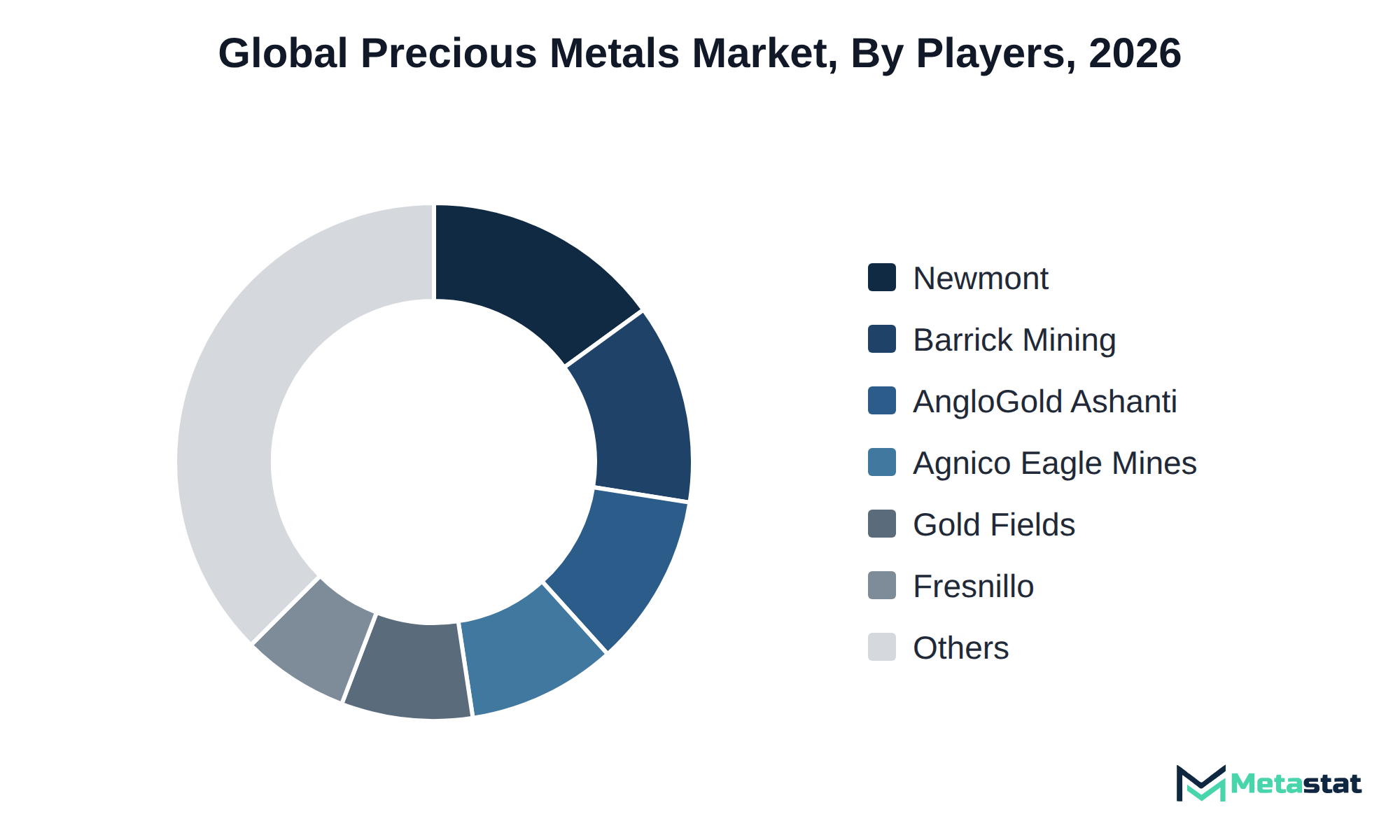
Competition in the Precious Metals market divides along several key dimensions, including metal type, application, and sales channel. Companies including Newmont Corporation and Barrick Mining Corporation focus primarily on gold, reflecting the premium positioning of this metal in the market. Silver producers, including Fresnillo plc and Pan American Silver Corp., target specific applications, particularly in investment and electronics, highlighting the strategic targeting of high-demand sectors.
Buyers prioritize factors including price, certification, and customization when selecting suppliers in the Precious Metals market. For instance, Agnico Eagle Mines Limited emphasizes quality and compliance with industry standards, appealing to buyers seeking certified materials. MKS PAMP focuses on its established reputation and comprehensive service offerings, positioning itself as a reliable partner for both authorized dealers and jewellers. This strategic positioning enhances customer loyalty and reinforces market presence.
This growth relies on several critical developments. Rising interest in recycled secondary supply, with expectations to reach USD 247.9 billion by 2033, supports increased sustainability efforts across industries. The North American region stands out due to its anticipated market value of USD 245.4 billion by 2033, reflecting robust consumer interest and industrial utilization. Key risks include potential economic downturns that could restrict investments in precious metals, particularly in the investment and official reserves segment, which targets a value of USD 239.4 billion by 2033. Market fluctuations or regulatory changes hinder growth prospects, affecting overall demand in the Precious Metals market. Continuous monitoring of these dynamics will be crucial for stakeholders aiming to navigate this evolving landscape successfully.
By Metal Type: Gold, Silver, Platinum, Palladium, Rhodium, Others (Ruthenium, Iridium, Osmium)
By Source Type: Primary Mined Supply, Recycled Secondary Supply
By Application: Jewellery and Watches, Investment and Official Reserves, Electronics and Electrical, Automotive and Catalysts, Chemical and Industrial Processing, Medical and Dental, Others (Aerospace, Energy, Glass)
By Sales Channel: Direct Supply to Fabricators and Industry, Bullion Banks and Commodity Traders, Authorised Dealers and Jewellers, Online Bullion Platforms
The report strategically identifies and profiles the key market players and analyses their core competencies in each sub-segment of the Precious Metals market.
Report Attributes | Details |
Study Period | 2021-2033 |
Base Year | 2025 |
Estimated Year | 2026 |
Forecast Period | 2026-2033 |
Historical Period | 2021-2025 |
Growth Rate | CAGR 7.6% from 2026 to 2033 |
Revenue Unit | USD billion |
Segmentation | By Metal Type, Source Type, Application, Sales Channel, and Region |
By Region | North America (By Metal Type, Source Type, Application, Sales Channel, and Country)
|
Europe (By Metal Type, Source Type, Application, Sales Channel, and Country)
| |
Asia Pacific (By Metal Type, Source Type, Application, Sales Channel, and Country)
| |
South America (By Metal Type, Source Type, Application, Sales Channel, and Country)
| |
Middle East and Africa (By Metal Type, Source Type, Application, Sales Channel, and Country)
|
Find answers to common questions about this report
The Precious Metals market size was valued at USD 514.9 billion in 2025.
The market is projected to grow at a CAGR of 7.6% during the forecast period from 2026 to 2033.
The North America Precious Metals market size is estimated to reach USD 245.4 billion by 2033.
Gold leads the Precious Metals market with a projected value of USD 623.5 billion by 2033. This segment demonstrates the highest growth potential compared to other metal types.
Key drivers for the Precious Metals market include growing investment interest in gold and silver, with individual and institutional buyers seeking safe-haven assets amid economic uncertainties. rising demand for recycled secondary supply, projected to reach USD 247.9 billion by 2033, reflects a shift towards sustainable practices in various industries.
Asia Pacific holds the dominant share of the Precious Metals market, accounting for 46.9 percent in 2025. This region's significant share reflects its extensive industrial activities and demand for precious metals across various applications.
Fluctuations in precious metals prices create uncertainty for investors and industries reliant on these materials. Rising input costs associated with mining operations, energy, and raw materials contribute to margin pressures, impacting overall profitability.
Recycled secondary supply is gaining traction due to the increasing demand for sustainable practices, projected to reach USD 247.9 billion by 2033. The adoption of recycling technologies allows industries to efficiently recover valuable metals while minimizing environmental impact, appealing to buyers in sectors like electronics and automotive.
The Precious Metals market is estimated to reach a valuation of USD 924.8 billion by 2033.
Key players operating in the Precious Metals market include Newmont Corporation, Barrick Mining Corporation, AngloGold Ashanti plc, Agnico Eagle Mines Limited, Gold Fields Limited, and Kinross Gold Corporation.
The analysts below cover Chemicals and Materials research at Metastat Insights.
LEAD ANALYST
Utkarsh Khirodkar is a Lead Market Research Analyst at MetaStat Insight, specializing in market intelligence, technology sector assessments, and competitive strategy.

INDUSTRY CONSULTANT - CHEMICALS & ADVANCED MATERIALS
Chemicals and Materials · Machinery & Equipment · Packaging
Amit Gadhekar Consultant for Chemicals and Materials at MetaStat Insight, directing sector-specific intelligence, research, and strategic consulting across global chemical and processing markets.
Integrating zero-trust access controls across legacy electronic health record systems involves complex compliance overhead. Team produced an analysis that clearly separated identity governance and administration tools from privileged access management platforms. Their evaluation of HIPAA and GDPR compliance features across cloud native solutions gave our architecture group clear baseline criteria. The custom data request regarding biometric authentication adoption in hospital networks was returned promptly with clear documentation.
Evaluating calorific value requirements and air permit compliance across municipal waste facilities requires localized data. Metastat Insight structured their analysis around operational throughput capacity and feedstock composition variations in Latin America and Eastern Europe. Their competitive mapping of sorting equipment vendors helped clarify technology differences between optical separators and heavy media systems. The study provided an objective baseline during our capital expenditure reviews.
Decarbonizing industrial thermal processes hinges on refrigerant regulations and compressor efficiency limits. Metastat Insights delivered a thorough market analysis that evaluated natural refrigerants like CO2 and hydrocarbons against synthetic low-GWP alternatives. The breakdown of utility incentives and grid capacity constraints across key European manufacturing hubs offered valuable perspective. The follow-up conversation with their sector analysts addressed our specific questions on mechanical vapor recompression systems efficiently.
Explore related market intelligence reports worth reading alongside this one.