
LEAD ANALYST
Utkarsh Khirodkar is a Lead Market Research Analyst at MetaStat Insight, specializing in market intelligence, technology sector assessments, and competitive strategy.

Global Natural Rubber Market Size, Share, By Product Type (Ribbed Smoked Sheets (RSS), Technically Specified Natural Rubber (TSR), Concentrated Natural Rubber Latex, Crepe Rubber, Air-Dried Sheets (ADS), Others (Cup Lumps, Skim Rubber)), By Grade (Technically Specified Rubber (TSR 20 and TSR 10), Ribbed Smoked Sheets (RSS 1 and RSS 3), Latex Concentrates (60% Centrifuged High Ammonia), Pale Crepe and Sole Crepe Rubber), By Application (Tyres and Tyre Components, Industrial Rubber Goods, Latex Dipped Goods, Footwear, Adhesives and Sealants, Others (Sporting Goods, Rubberized Textiles)), By Distribution Channel (Direct Sales to Tire OEMs, Direct Sales to Industrial Manufacturers, Rubber Processors and Compounders, Industrial Distributors and Traders, Commodity Exchanges and Auction Markets, Government and Strategic Procurement), Industry Analysis, Growth, Trends, and Forecast, 2026-2033
Report ID
MSI-5810
Published
November, 2026
Pages
279 Pages
Format
Historical
Base year
Forecast
Forecast period
Report Details
Market Valuation: Valued at $32.2 Billion in 2025, projected to reach $48 Billion by 2033 at a 5.1% CAGR.
Dominant Segment: Technically Specified Natural Rubber (TSR) leads the market, driven by its critical applications in high-performance tyres and industrial rubber goods, projected to reach USD 21.1 billion by 2033.
Geographic Lead: The Asia Pacific region dominates the Natural Rubber market, holding 72.4% of the market share, fueled by robust manufacturing capabilities and a growing automotive sector.
What's Inside: The report provides comprehensive coverage of market dynamics, competitive analysis, and forecasts from 2026 to 2033, detailing various product types, grades, applications, and distribution channels.
Emerging Trends: The increasing demand for environmentally friendly materials is reshaping the market, particularly in the tyre manufacturing industry, where natural rubber's superior properties are highly valued.
Supply Chain Dynamics: Pricing strategies and procurement approaches are evolving as manufacturers seek stability in a volatile market, emphasizing long-term contracts and quality assurance.
Choose Your License
Global Natural Rubber Market
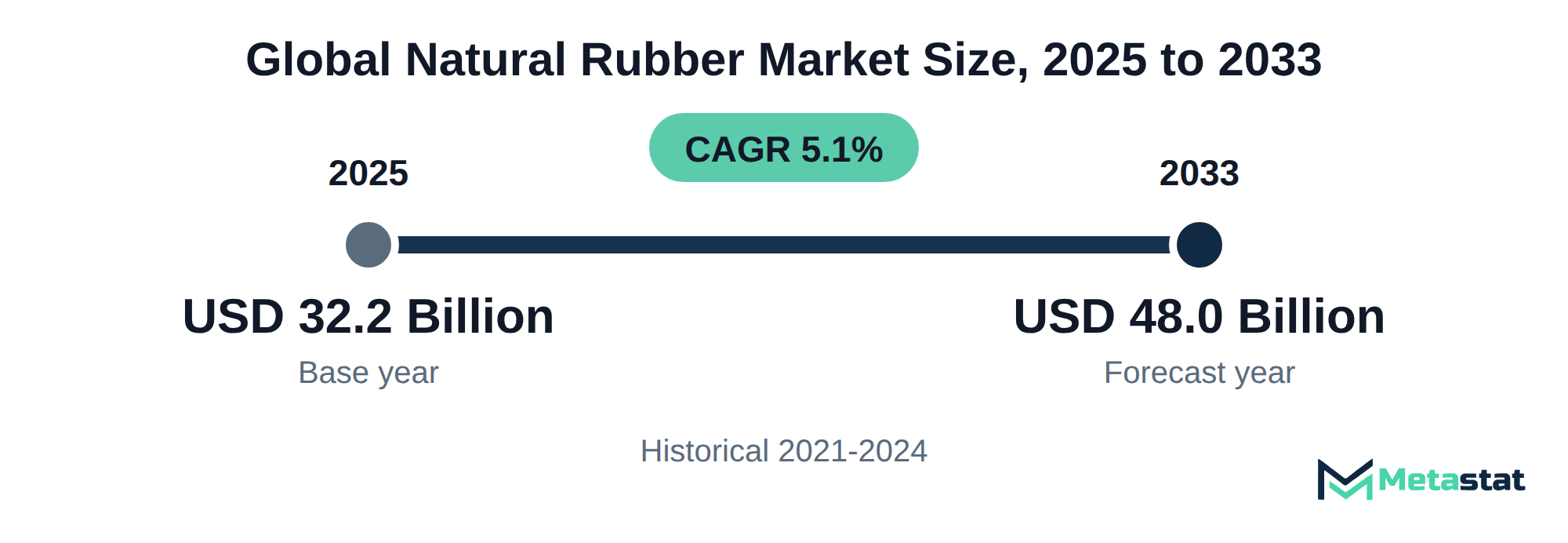
The global Natural Rubber market was valued at USD 32.2 billion in 2025 and is projected to reach USD 48 billion by 2033, growing at a CAGR of 5.1% over the forecast period.
The Natural Rubber market encompasses various product types, grades, applications, and distribution channels that cater to diverse industrial needs. Buyers invest in this market mainly because natural rubber is essential to manufacturing tyres, industrial rubber goods, and footwear. The increasing demand for high-quality natural rubber arises from its superior properties compared to synthetic alternatives, leading to substantial expenditures in sourcing and production.
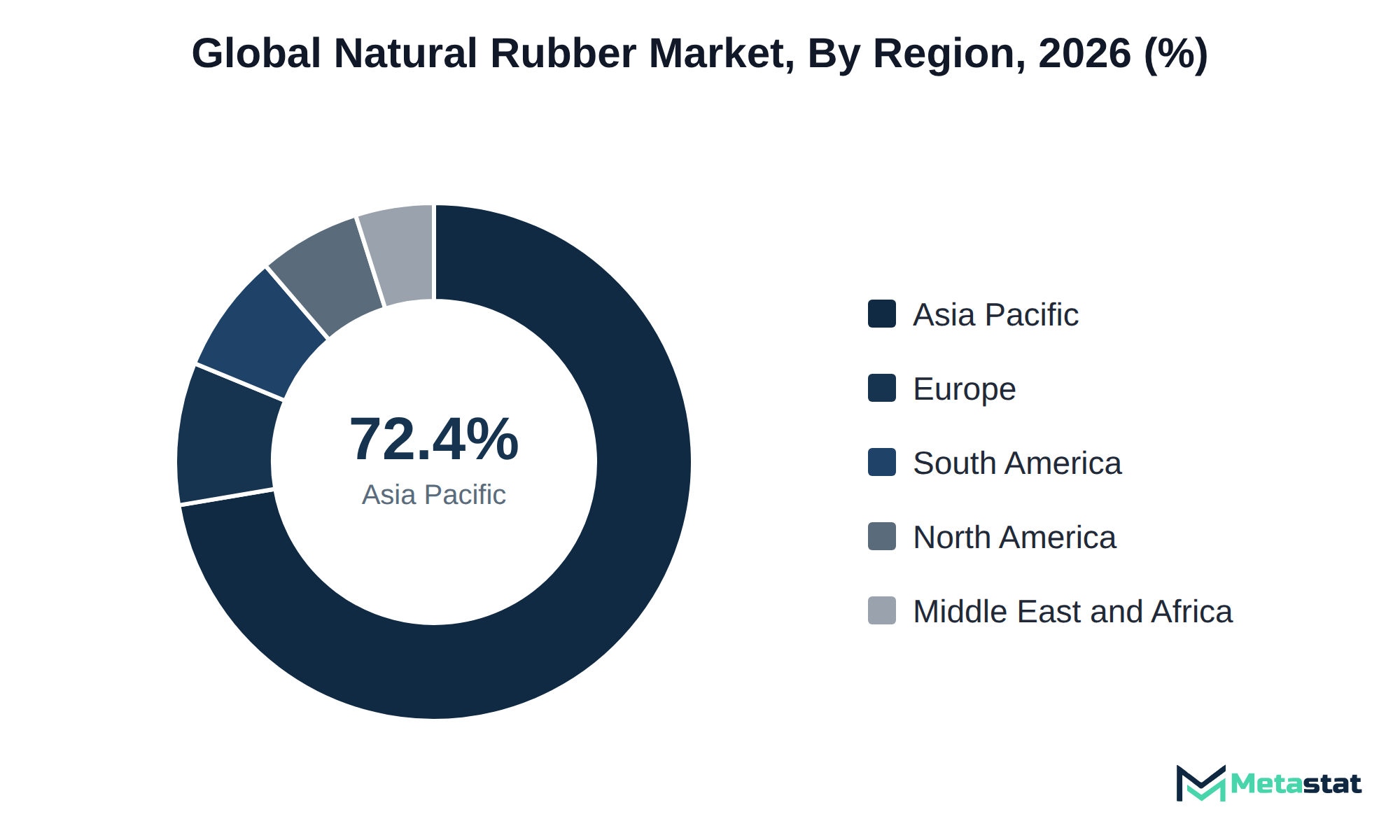
Growth in the market is driven by rising demand for tyres and tyre components, which represent the segment with the most value. The Asia Pacific region dominates, holding 72.4% of the market share, significantly surpassing other regions. North America holds 6.4% of the market in 2025, with the US leading in 2026. This regional preference reflects a strong manufacturing base and a growing automotive sector.
Natural Rubber is used in many applications, and industrial rubber goods production is expected to expand. The forecasted increase in demand aligns with the automotive industry's ongoing advancements and the need for durable, high-performance materials. The Natural Rubber market supports key sectors and contributes to overall economic growth.
The Natural Rubber market includes a variety of segments that fulfill the requirements of multiple industries, including automotive, construction, and consumer goods. Buyers invest in natural rubber products primarily due to their superior properties, including elasticity, durability, and sustainability. The diverse applications of natural rubber ensure its continued relevance across various sectors, prompting companies to seek reliable sources that meet their specific needs.
Growth in the market results from increased demand for environmentally friendly materials, particularly in the tire manufacturing industry. Technically Specified Natural Rubber (TSR) is the highest-value segment of the Natural Rubber market and is used to produce high-performance tires. Asia Pacific accounts for the largest market share, at 72.4% of the total, reflecting strong manufacturing capabilities and high consumption rates in the region.
The rising automotive sector in Asia Pacific significantly drives the expansion of natural rubber consumption, with manufacturers pursuing sustainable alternatives to synthetic materials. This trend establishes a favorable environment for investments in natural rubber production and processing, positioning the market for growth through 2033.
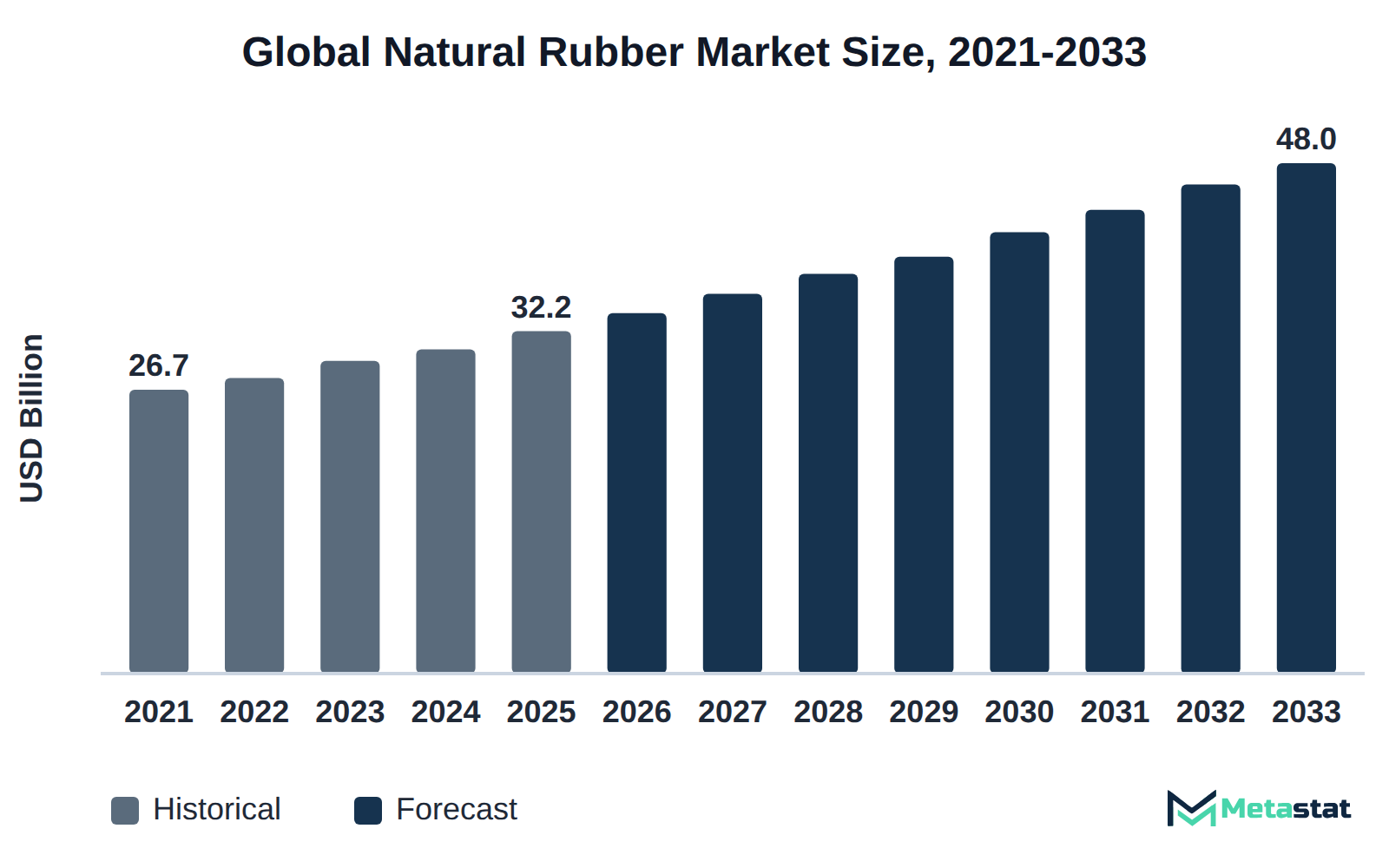
Technically specified natural rubber (TSR) experiences robust adoption in the automotive and industrial manufacturing sectors, driven by its superior performance characteristics. Demand for TSR is projected to reach USD 21.1 billion by 2033, reflecting a significant growth trajectory fueled by its applications in high-performance tyres and industrial rubber goods.
The automotive sector particularly benefits from TSR's enhanced durability and resilience, which contribute to improved safety features and fuel efficiency in vehicles. This improvement stems from the higher tensile strength and elasticity of TSR compared to other natural rubber grades. The shift towards environmentally friendly materials aligns with consumer preferences, prompting manufacturers to integrate TSR into their product lines.
In industrial manufacturing, the versatility of TSR enables its use in various applications, including belts, hoses, and gaskets. The expected increase in production capacities and advancements in processing technologies further enhance the efficiency of TSR, allowing manufacturers to meet the rising demand for quality industrial rubber goods. This makes TSR a core input for producers, improving operations and strengthening their competitive position.
Pricing strategies in the Natural Rubber market reflect the complexities of global sourcing and supply chain dynamics. Buyers adopt various contracting models to manage costs and ensure reliable supply. For instance, direct sales to tire original equipment manufacturers (OEMs) represent a significant distribution channel, projected to rise from USD 8.9 billion in 2026 to USD 12.4 billion by 2033, with a compound annual growth rate (CAGR) of 4.8%. This growth indicates strong demand for stable pricing and contractual agreements tailored to the needs of tire manufacturers.
Different procurement strategies emerge within the Natural Rubber market, driven by buyer requirements and market conditions. Long-term contracts often feature fixed pricing to mitigate the volatility associated with raw material costs, while spot market purchases allow for flexibility in pricing. With Technically Specified Natural Rubber (TSR) expected to reach USD 21.1 billion by 2033, the demand for standardized quality promotes contract negotiations based on grade specifications. Buyers increasingly emphasize quality assurance and supply chain transparency, which influences their purchasing decisions and contract terms.
Understanding these purchasing dynamics informs strategic planning for suppliers and buyers alike. Effective pricing models and contract structures enhance competitive positioning in the Natural Rubber market, ultimately impacting profitability and market share. Suppliers who adapt to these purchasing preferences strengthen relationships with buyers, while buyers benefit from optimized sourcing strategies that align with operational needs.
Latex-based applications play a significant role in the medical and healthcare sectors, driving demand for high-quality natural rubber products. The focus on personal protective equipment (PPE) and medical devices has intensified, leading to notable growth in the use of concentrated natural rubber latex. This segment is projected to reach a value of USD 8.2 billion by 2033, highlighting the increasing significance of this material in the production of gloves, catheters, and various rubber goods.
Healthcare professionals and consumers prioritize products that ensure safety and efficacy. Rising healthcare spending and innovations in latex processing technology have spurred manufacturers to develop advanced products that meet stringent regulatory standards. Consequently, companies in the Natural Rubber market are shifting their strategies to enhance product quality and address the specific needs of these buyer groups. Producers of high-quality, compliant latex-based products are expected to strengthen their market positions and grow revenue.
The rise of electric vehicle (EV) tires and high-performance tires significantly influences natural rubber consumption patterns. In particular, the demand for high-performance tires is expected to increase the natural rubber market, with the segment for tires and tire components projected to rise from USD 23.1 billion in 2026 to USD 32.2 billion by 2033, reflecting a compound annual growth rate (CAGR) of 4.9%. This trend arises from the need for specialized tires that enhance energy efficiency and performance in electric vehicles.
Manufacturers focus on developing tires that incorporate advanced materials, including higher proportions of natural rubber. This shift improves traction and durability while aligning with sustainability initiatives. Consumers increasingly prefer eco-friendly products. The incorporation of natural rubber into tire formulations supports manufacturers in meeting performance standards while addressing environmental concerns. As a result, natural rubber demand is rising with the automotive industry's shift toward electrification and performance enhancement.
Increasing demand for automotive tyres significantly influences natural rubber consumption. The automotive industry, primarily driven by the rising number of vehicles on the road, supports this trend. A shift toward electric and high-performance vehicles further escalates the demand for high-quality natural rubber, which offers superior durability and performance characteristics essential for modern tyres. The tyre segment is projected to reach USD 32.2 billion by 2033, as natural rubber meets the changing needs of car manufacturers. Enhanced performance and sustainability features of natural rubber drive higher spending among automotive manufacturers, impacting both volume and price in the market.
The anticipated growth in tyre production directly correlates with the demand for natural rubber, reinforcing its status as a critical raw material in the automotive sector. Increasing environmental consciousness among consumers prompts manufacturers to seek sustainable materials, positioning natural rubber as a preferred choice. The trend towards electric vehicles and fuel-efficient cars highlights the ongoing shift towards advanced materials, boosting the overall market for natural rubber.
Recent advancements in tyre standards enhance safety and performance requirements, impacting the natural rubber market. Stricter regulations focus on rolling resistance, wet grip, and durability, influencing tyre manufacturers to adopt higher-quality materials, including natural rubber. This trend increases demand for technically specified natural rubber (TSR), known for its superior performance attributes.
The automotive industry, primarily driven by original equipment manufacturers (OEMs), significantly influences this dynamic. Rising consumer expectations for vehicle safety and performance create a ripple effect throughout the supply chain, encouraging investments in high-performance materials. Consequently, tyre manufacturers prioritize incorporating natural rubber into their products to meet regulatory requirements while enhancing their competitive edge.
Manufacturers experience increased production costs due to the need for advanced processing techniques and raw material sourcing. However, the long-term benefits of superior tyre performance and compliance with regulations contribute positively to the market's overall growth. Enhanced tyre standards significantly influence natural rubber adoption across the automotive sector, leading to substantial market expansion.
Price volatility in the natural rubber market influences purchasing decisions among manufacturers and end-users. Significant fluctuations in rubber prices arise from factors including supply chain disruptions and changes in demand, affecting budgets for procurement. Tyre manufacturers, one of the largest consumer segments, confront challenges in maintaining price stability, leading to smaller order quantities or delayed replacement cycles. This hesitation impacts revenue growth for suppliers and manufacturers alike, with uncertainty surrounding future pricing discouraging investment in larger volumes. Because tyre production relies on natural rubber, price stability is needed to sustain demand. Ongoing price fluctuations hinder reliable forecasting, complicating strategic planning for stakeholders across various industries.
Suppliers face significant challenges due to increasing input costs, which directly impact profitability. Fluctuations in the prices of essential raw materials, including natural latex and chemicals used in processing, create margin pressures. Suppliers in the Natural Rubber market respond by optimizing production processes and seeking alternative materials to mitigate costs. Strategic partnerships with raw material providers and investments in efficient processing technologies enhance operational efficiency while reducing reliance on volatile external suppliers. Suppliers explore long-term contracts to stabilize prices and secure consistent supply chains, which helps manage financial risks associated with price volatility. These strategies help suppliers remain competitive and sustain profitability.
The Technically Specified Natural Rubber (TSR) segment presents significant growth potential within the Natural Rubber market, driven by its high-performance characteristics and diverse applications. TSR is projected to reach USD 21.1 billion by 2033, with a compound annual growth rate (CAGR) of 5.3% from 2026. The increasing adoption of TSR in sectors including automotive and industrial manufacturing supports this expansion, driven by its superior elasticity and resilience compared to other rubber types. Buyers in these sectors favor TSR for its ability to enhance product durability and performance, aligning with industry demands for high-quality materials. The market benefits from the growing emphasis on sustainability and eco-friendly products, further fueling the demand for TSR in various applications. Strong demand from the automotive industry, particularly for tyres and tyre components, significantly influences this segment's growth trajectory. TSR therefore helps suppliers meet changing market needs and improve their competitiveness.
The Global Natural Rubber market is segmented based on Product Type, Grade, Application, and Distribution Channel.
Ribbed Smoked Sheets (RSS) segment is valued at USD 9.5 billion in 2026 and is projected to reach USD 12.9 billion by 2033, at a CAGR of 4.4% during the forecast period. This product type primarily serves the automotive industry for tire manufacturing, where it forms a critical component due to its excellent durability and elasticity. The growing demand for high-quality tires drives this segment, reflecting a broader trend towards improved vehicle safety and performance. Compared to other product types, including Technically Specified Natural Rubber (TSR), which exhibits a higher CAGR of 5.3%, RSS grows at a slower rate. Buyers in the automotive sector often prefer RSS for its balance of cost and performance, highlighting a distinct purchasing pattern that influences the overall dynamics of the market.
Technically Specified Natural Rubber (TSR) segment is estimated to reach USD 21.1 billion by 2033, at a CAGR of 5.3% during the forecast period. This type of rubber finds extensive use in the manufacturing of high-performance tyres and various industrial applications, attracting demand from automotive and industrial sectors. Growth in this segment is propelled by the increasing emphasis on quality and performance, particularly in tyre production, where the superior characteristics of TSR significantly enhance tyre durability and safety. Compared to other product types, TSR exhibits a faster growth trajectory, reflecting a CAGR of 5.3%, surpassing growth rates of segments including Ribbed Smoked Sheets (RSS) at 4.4%. The heightened focus on technological advancements in tyre manufacturing processes and material specifications creates a competitive landscape that supports sustained adoption of TSR.
Concentrated Natural Rubber Latex segment is projected to reach USD 8.2 billion by 2033. This type of rubber is extensively applied in various applications, including latex examination gloves, adhesives, and coatings. Industries including healthcare and manufacturing heavily rely on this segment due to its excellent elasticity and resilience. Demand for concentrated natural rubber latex rises primarily from the increasing need for high-quality rubber in medical applications, driven by ongoing health trends and safety regulations. Concentrated Natural Rubber Latex serves distinct market segments, with its specific applications differentiating it from alternatives including ribbed smoked sheets and TSR, which cater to different industrial needs and price points in the market.
Crepe Rubber segment is projected to grow at a CAGR of 4.5% during the forecast period. This type of rubber primarily serves various applications in industrial goods and footwear. Manufacturers use crepe rubber for its flexibility and durability, which suit it to products such as footwear soles and industrial components. Demand for Crepe Rubber is influenced by trends in the footwear industry, where consumers increasingly favor high-quality materials that enhance performance and comfort. Compared to other sub-segments, Crepe Rubber exhibits slower growth, positioning it differently from technically specified natural rubber, which sees higher growth rates due to advanced performance attributes. Crepe Rubber usually commands a lower price point than other products, making it an attractive option for budget-conscious buyers while maintaining essential performance characteristics.
Air-Dried Sheets (ADS) are a type of natural rubber product valued for their unique processing method, which involves drying sheets of rubber in the open air. This segment finds significant applications in manufacturing various rubber goods, particularly in regions with favorable climatic conditions for drying. Industries focusing on lower-cost alternatives to more processed rubber products frequently employ ADS. A key driver for this segment involves rising demand for sustainable and cost-effective materials, reflecting a broader trend toward green manufacturing practices. The market for Air-Dried Sheets differs from other product types, including Ribbed Smoked Sheets, which often command higher prices and are associated with more advanced processing techniques. Consequently, ADS appeal more to cost-sensitive buyers seeking to balance quality and affordability.
Others, including cup lumps and skim rubber, play a role in the production and utilization of natural rubber. These materials find use primarily in industrial applications, where they are favored for their cost-effectiveness. This sub-segment attracts buyers focused on maximizing production efficiency, particularly in rubber processing industries. Demand for these products is influenced by price fluctuations in raw natural rubber, impacting overall production costs. In comparison with other sub-segments, including Technically Specified Natural Rubber (TSR), this segment exhibits slower growth due to its specific niche applications. However, the emphasis on sustainable sources and recycling within the broader natural rubber market provides opportunities to enhance adoption and usage, particularly among environmentally conscious manufacturers.
Technically Specified Rubber (TSR 20 and TSR 10) segment is valued at USD 16.1 billion in 2026 and is projected to reach USD 23.1 billion by 2033, at a CAGR of 5.2% during the forecast period. This segment finds extensive applications in the automotive and industrial sectors, primarily for the manufacturing of high-performance tyres and industrial rubber goods. The growing demand for durable and reliable materials drives interest in this sub-segment, particularly among tyre manufacturers seeking to enhance product quality. Compared to other grades, TSR 20 and TSR 10 exhibit a higher growth rate, driven by their superior properties, leading to increased adoption across various applications. In contrast, grades including Ribbed Smoked Sheets (RSS), while valuable, experience a slower growth trajectory, reflecting differences in application breadth and performance characteristics. This positioning makes the segment more attractive for investment and development.
Ribbed Smoked Sheets (RSS 1 and RSS 3) segment is estimated to reach USD 14.7 billion by 2033, at a CAGR of 4.9% during the forecast period. This segment finds extensive application in the manufacturing of tyres and other rubber goods, primarily catering to the automotive and industrial sectors. The increased demand for high-quality rubber products, driven by rising automotive production rates and the growing emphasis on vehicle safety, drives this segment forward. In contrast to other segments, including Technically Specified Rubber, which exhibits a CAGR of 5.3%, Ribbed Smoked Sheets experience relatively slower growth while maintaining competitive pricing. This characteristic makes them attractive for cost-sensitive buyers seeking reliable materials without sacrificing quality, thereby shaping their purchasing decisions. The dynamics within the segment reflect broader trends within the Natural Rubber market, where performance and cost efficiency remain critical.
Latex Concentrates (60% Centrifuged High Ammonia) segment is projected to reach USD 7.4 billion by 2033. This product finds extensive use in the production of latex-dipped goods, particularly in the medical and industrial sectors, where high performance and consistency are essential. Demand for high-quality latex products drives the growth of this segment, with increasing applications in gloves and other protective wear. The expected CAGR of 5.4% for industrial rubber goods highlights the growing market for Latex Concentrates, contrasting with the slower growth observed in segments like Ribbed Smoked Sheets. Price stability in this segment supports competitiveness against alternatives, making it an attractive option for manufacturers seeking to optimize their product offerings in the Natural Rubber market. Environmental regulations surrounding product safety enhance its appeal, with buyers increasingly preferring materials that comply with stringent health standards.
Pale Crepe and Sole Crepe Rubber segment is projected to grow at a CAGR of 4.7% during the forecast period. This segment finds applications in various products, including footwear and industrial goods, appealing to manufacturers aiming for superior quality and performance. Demand for Pale Crepe rubber is driven primarily by its superior elasticity and strength, attributes that enhance the durability of finished products. Compared to other grades, including Technically Specified Rubber, this segment experiences slower growth, reflecting a more niche market focus. In contrast to Ribbed Smoked Sheets, which achieve a CAGR of 4.9%, Pale Crepe rubber caters to specialists requiring specific performance characteristics, influencing pricing dynamics within the market. The unique properties of this rubber type support its adoption among industries prioritizing quality, leading to steady growth despite overall market fluctuations.
This segment serves critical roles in the automotive industry, primarily for manufacturing vehicle tyres, including truck and bus tyres, and related components. Demand for natural rubber in this segment is propelled by the growing automotive sector, with increased vehicle production leading to higher tyre requirements. Compared to other segments, the Tyres and Tyre Components segment experiences a stronger growth trajectory. For instance, while Industrial Rubber Goods anticipates a CAGR of 5.4%, the tyre segment exhibits slightly lower growth, reflecting unique challenges and opportunities, including evolving consumer preferences for high-performance tyres. The natural rubber market adapts to these dynamics, ensuring a steady supply for this essential application.
Industrial Rubber Goods segment is estimated to reach USD 6.1 billion by 2033, at a CAGR of 5.4% during the forecast period. This segment includes products used in various industrial applications, including seals, gaskets, and belts, primarily serving manufacturers in sectors including automotive, construction, and manufacturing. The demand for industrial rubber goods is influenced by overall growth in industrial production and infrastructure development, which necessitates reliable materials for equipment and machinery. Compared to other segments, including Tyres and Tyre Components, this segment experiences relatively slower growth due to the maturity of certain applications. However, improvements in manufacturing technologies and the push for more durable and sustainable options drive innovation in this area, enhancing the appeal of industrial rubber goods in the market.
Latex Dipped Goods segment is projected to reach USD 4.2 billion by 2033. This segment primarily finds application in the production of medical gloves and industrial safety gloves, along with other dipped products that require flexibility and durability. Demand is driven by the growing healthcare sector, which relies on high-quality latex for protective equipment. Compared to other sub-segments, Latex Dipped Goods experiences moderate growth, supported by a CAGR of 4.2%. Unlike Tyres and Tyre Components, which exhibit higher revenue figures and more rapid growth, this segment attracts specific buyers focused on safety and performance. Quality standards and compliance therefore matter for maintaining a competitive edge in this segment.
This segment primarily serves manufacturers of footwear, catering to various styles and functions, including casual, sports, and formal shoes. Increasing consumer demand for comfortable and durable footwear drives growth in this segment, with an emphasis on sustainable materials. The footwear segment distinguishes itself with a focus on product performance and design, attracting buyers seeking high-quality materials. Compared to other segments, footwear presents a unique blend of aesthetics and functionality, appealing to a diverse customer base. The projected value for this segment highlights its significance within the Natural Rubber market, emphasizing innovation to meet evolving consumer preferences.
Adhesives and Sealants use natural rubber for applications that require flexibility, durability, and adhesion. Industries including construction, automotive, and manufacturing rely on these products for bonding materials in various processes. This segment experiences growth driven by increased construction activities and demand for high-performance adhesives in automotive manufacturing. Compared to other segments, the Adhesives and Sealants sub-segment focuses on niche applications, leading to relatively lower competition but consistent demand from specialized buyers. The market’s emphasis on sustainable and eco-friendly products highlights the importance of natural rubber in formulating adhesives. Innovations in formulations and processing techniques enhance the segment's potential, positioning it favorably amid rising consumer preferences for environmentally friendly solutions.
This segment encompasses applications in sporting goods and rubberized textiles, representing a niche demand. Manufacturers in this area apply natural rubber for products that require flexibility, resilience, and durability, catering primarily to the sporting goods industry and textile manufacturers. The segment experiences growth driven by increasing consumer interest in sports and outdoor activities, leading to higher demand for quality sporting equipment. The rise of eco-conscious consumers drives interest in sustainable materials, including natural rubber, enhancing its appeal in rubberized textiles. Compared to other segments, this application focuses on a specialized market that often commands premium pricing due to the quality of materials required. The growth rate for this segment is expected to be slower than that of industrial rubber goods, which benefits from broader applications and a larger customer base in the Natural Rubber market.
This channel facilitates the distribution of natural rubber directly to tire manufacturers, who apply the material primarily for producing high-performance tires. The increasing demand for fuel-efficient and high-durability tires drives this segment, particularly in regions with robust automotive industries. Compared to other distribution channels, including industrial distributors and traders, Direct Sales to Tire OEMs exhibits a more significant growth trajectory, supported by advancements in tire technology and growing consumer preferences for sustainable products. The market is expected to see continued investment in R&D, enhancing the quality and performance of rubber products, further propelling this segment's expansion.
Direct Sales to Industrial Manufacturers segment is estimated to reach USD 11.4 billion by 2033, at a CAGR of 5.3% during the forecast period. This channel serves industrial manufacturers who require large volumes of natural rubber for various applications, including automotive and machinery components. Demand for this segment is driven by increased industrial production and the expansion of manufacturing capabilities globally. The growth rate in this segment exceeds that of the broader market due to specialized applications and higher quality requirements, resulting in increased pricing power for suppliers. In comparison to other distribution channels, this segment focuses on direct transactions, ensuring a more stable supply chain and better control over product quality. This distinct feature contributes to its faster growth trajectory, particularly with several manufacturers seeking reliable sources for high-quality natural rubber.
Rubber Processors and Compounders segment is expected to reach USD 10 billion by 2033. This segment focuses on converting natural rubber into usable forms for various industries, primarily serving manufacturers of tyres, industrial goods, and latex products. The increasing demand for processed rubber across these industries drives growth, supported by advancements in processing technologies and rising production capacities. Compared to other distribution channels, this segment experiences significant growth due to the increasing reliance on processed materials to meet specific application requirements. The segment's growth rate aligns closely with the overall market, reflecting strong demand for high-quality rubber products that cater to diverse manufacturing needs. In recent years, innovations in processing methods have enhanced the material's performance characteristics, further reinforcing its importance in the natural rubber market.
Industrial Distributors and Traders segment is projected to grow at a CAGR of 4.9% during the forecast period. This segment supplies natural rubber to a variety of industrial clients, including manufacturers of rubber products and components. Growing demand for industrial rubber goods drives the segment, with applications in sectors including automotive, construction, and consumer goods. Companies in this segment typically compete on pricing and product quality, with higher margins compared to other distribution channels. The average price of rubber products often influences sales; fluctuations in raw material costs remain a key factor affecting profitability. Unlike direct sales to tire OEMs, which have a more specialized buyer base, this segment caters to a broader market, reflecting diverse applications and customer needs. The natural rubber market continues to evolve with these dynamics, highlighting the importance of adaptability and competitive pricing strategies.
Commodity Exchanges and Auction Markets facilitate the trading of natural rubber through various platforms, ensuring price transparency and promoting fair competition among buyers and sellers. These markets primarily serve rubber producers, manufacturers, and end-users looking to procure raw materials at competitive rates. Key forces influencing this segment include fluctuations in global demand and supply dynamics, which directly affect commodity pricing. Unlike other distribution channels, this segment experiences slower growth due to reliance on physical trading infrastructure and regulatory standards, which limit the speed of transactions compared to direct sales avenues. In the Natural Rubber market, participants often seek stability and predictability, resulting in varying pricing models compared to direct sales to tire OEMs and industrial manufacturers.
This segment facilitates procurement activities conducted by government bodies and strategic organizations seeking to secure natural rubber supplies for various uses. Typically, applications in this segment include infrastructure development and manufacturing of essential goods. The growth of this segment is driven by initiatives aimed at enhancing domestic production capabilities, leading to increased demand from government programs. Compared to other distribution channels, this segment experiences slower growth due to lengthy procurement processes and regulatory requirements that delay decision-making. Procurement practices in this segment differ, focusing on long-term contracts and strategic partnerships rather than immediate supply needs, which characterize most other segments.
Based on geography, the Global Natural Rubber market is divided into North America, Europe, Asia-Pacific, South America, Middle East, and Africa.
The natural rubber market in North America relies heavily on the automotive and industrial sectors, with significant demand from tire manufacturers and industrial rubber goods producers. The presence of established players in the United States, Canada, and Mexico drives competition and innovation within the market. North America is projected to reach USD 3.1 billion by the end of 2033, reflecting growth in the region. Infrastructure investments, particularly in transportation and manufacturing, enhance the distribution capabilities of natural rubber products. The market benefits from regulations promoting sustainability and eco-friendly materials, aligning with growing environmental awareness among consumers. This focus on sustainability creates market opportunities for suppliers prioritizing environmentally responsible practices.
Europe holds a share of 8.9% in the global Natural Rubber market in 2025. The automotive industry, particularly in Germany and France, drives significant demand for natural rubber due to its essential role in tire manufacturing. Regulatory initiatives aimed at enhancing sustainability in manufacturing processes influence the market landscape. Infrastructure improvements, particularly in transportation and logistics, facilitate the efficient movement of natural rubber across the region. Emerging applications in industrial rubber goods further enhance demand, particularly in the UK, where advancements in technology drive growth. The market is projected to experience steady growth through the forecast period, supported by rising consumption in various applications.
Asia Pacific holds a 72.4% share of the Natural Rubber market in 2025. Demand in this region primarily stems from the tyre manufacturing sector, where countries including China and India lead in both production and consumption. Infrastructure investments supporting the automotive industry play a crucial role in driving this demand, creating opportunities for suppliers. The production capabilities in Southeast Asia, particularly in rubber plantations, contribute to a steady supply of natural rubber, aligning with the increasing requirements from automotive and industrial sectors. The market anticipates growth due to the rising demand for sustainable materials in manufacturing processes, alongside government initiatives aimed at enhancing production efficiency. This landscape positions Asia Pacific as a key driver in the global Natural Rubber market through 2033.
The demand for natural rubber in South America is driven primarily by industries including automotive and footwear. Brazil and Argentina play significant roles in the market, with Brazil emerging as a leading producer. The share of the global market for South America is 7.5% in 2025, highlighting its importance in the overall landscape. Local infrastructure improvements, including investments in transportation and processing facilities, support market growth. The ongoing development of sustainable practices in rubber cultivation enhances the appeal of natural rubber products to environmentally conscious buyers. These factors collectively influence dynamics in the natural rubber market in the region.
The natural rubber market in the Middle East and Africa experiences demand driven by industries including automotive and construction. Saudi Arabia and the UAE stand out with growing investments in infrastructure projects, enhancing the need for rubber in construction materials and components. South Africa's automotive sector represents another key buyer group, leveraging local production capabilities. The region accounts for 4.9% of the global market in 2025. Increased tire manufacturing in these countries significantly influences natural rubber consumption, creating growth opportunities. Market participants focus on enhancing supply chain efficiencies to address regional challenges, aiming to improve procurement strategies. The market dynamics are shaped by a combination of regional infrastructure developments and industrial growth, positioning it for strengthening long-term demand.
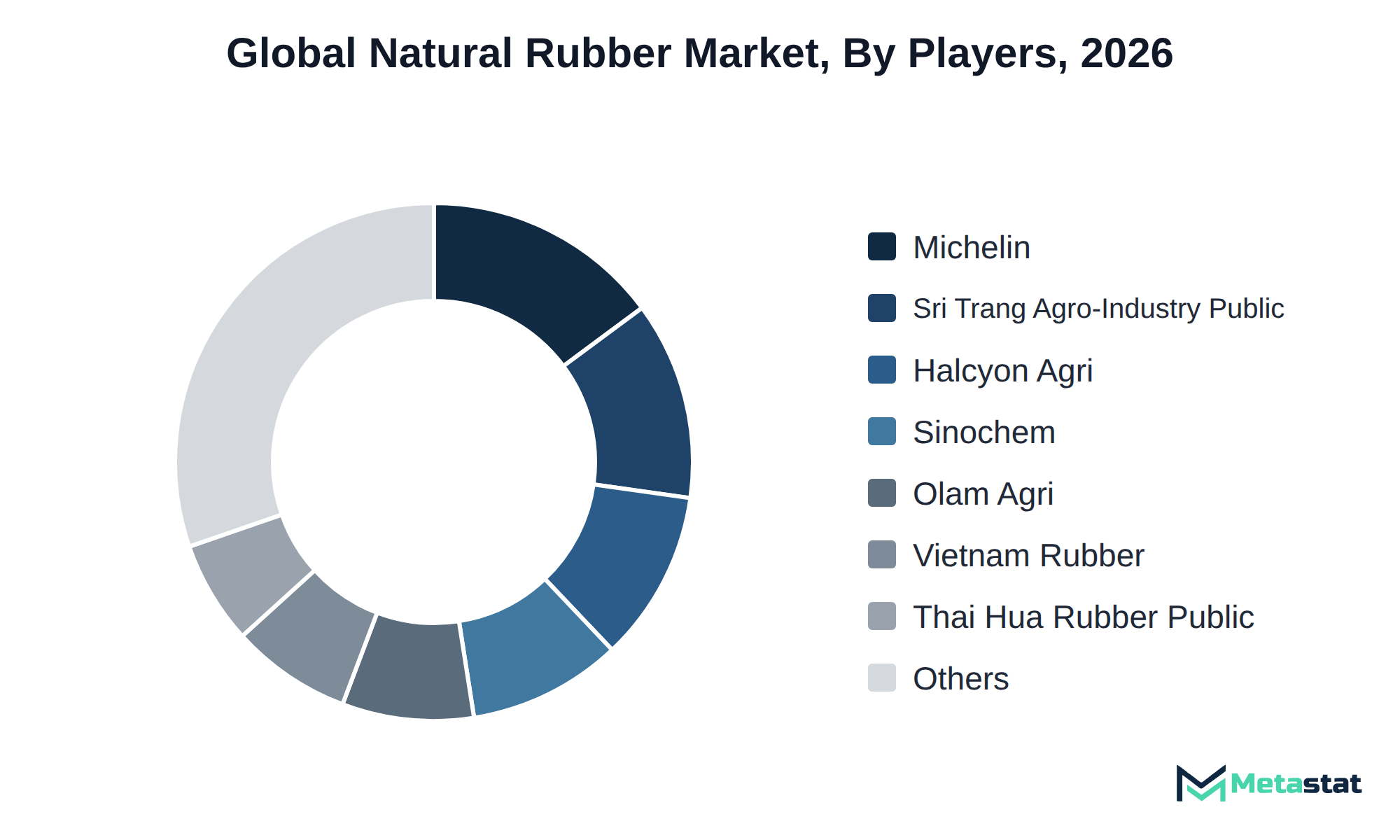
Competition within the Natural Rubber market involves various strategies focused on product differentiation and buyer engagement. Companies compete on factors including pricing, certification, customization, and service quality, which significantly influence purchasing decisions. Buyers prioritize suppliers who demonstrate strong relationships within their ecosystems, ensuring reliable delivery and compliance with industry standards.
Michelin emphasizes innovation and sustainability in its product offerings, aligning with environmental standards. Halcyon Agri Corporation Limited focuses on quality control and diverse product lines, appealing to various applications. Sri Trang Agro-Industry Public Company Limited prioritizes volume production and strategic partnerships to enhance its market position.
Achieving this growth relies on several key developments within the Natural Rubber market. This increase stems from rising global automotive production and the transition toward electric vehicles, which require higher-quality rubber. Second, the Technically Specified Natural Rubber (TSR) segment is expected to contribute significantly, reaching USD 21.1 billion by 2033, propelled by its applications across various industries, including automotive and industrial manufacturing.
However, risks including fluctuations in raw material prices and supply chain disruptions impede market progress. Regions like Asia Pacific, which dominate the market with a 72.4% share, could face challenges from adverse weather conditions affecting rubber plantations. Addressing these risks through effective supply chain management will be crucial for the market to achieve its forecasted growth trajectory.
By Product Type: Ribbed Smoked Sheets (RSS), Technically Specified Natural Rubber (TSR), Concentrated Natural Rubber Latex, Crepe Rubber, Air-Dried Sheets (ADS), Others (Cup Lumps, Skim Rubber)
By Grade: Technically Specified Rubber (TSR 20 and TSR 10), Ribbed Smoked Sheets (RSS 1 and RSS 3), Latex Concentrates (60% Centrifuged High Ammonia), Pale Crepe and Sole Crepe Rubber
By Application: Tyres and Tyre Components, Industrial Rubber Goods, Latex Dipped Goods, Footwear, Adhesives and Sealants, Others (Sporting Goods, Rubberized Textiles)
By Distribution Channel: Direct Sales to Tire OEMs, Direct Sales to Industrial Manufacturers, Rubber Processors and Compounders, Industrial Distributors and Traders, Commodity Exchanges and Auction Markets, Government and Strategic Procurement
The report strategically identifies and profiles the key market players and analyses their core competencies in each sub-segment of the Natural Rubber market.
Report Attributes | Details |
Study Period | 2021-2033 |
Base Year | 2025 |
Estimated Year | 2026 |
Forecast Period | 2026-2033 |
Historical Period | 2021-2025 |
Growth Rate | CAGR 5.1% from 2026 to 2033 |
Revenue Unit | USD billion |
Segmentation | By Product Type, Grade, Application, Distribution Channel, and Region |
By Region | North America (By Product Type, Grade, Application, Distribution Channel, and Country)
|
Europe (By Product Type, Grade, Application, Distribution Channel, and Country)
| |
Asia Pacific (By Product Type, Grade, Application, Distribution Channel, and Country)
| |
South America (By Product Type, Grade, Application, Distribution Channel, and Country)
| |
Middle East and Africa (By Product Type, Grade, Application, Distribution Channel, and Country)
|
Find answers to common questions about this report
The Natural Rubber market size was valued at USD 32.2 billion in 2025.
The market is projected to grow at a CAGR of 5.1% during the forecast period from 2026 to 2033.
The North America Natural Rubber market size is estimated to reach USD 3.1 billion by 2033.
Technically Specified Natural Rubber (TSR) leads the Natural Rubber market with a projected value of USD 21.1 billion by 2033. This segment surpasses others in terms of market share and growth potential.
Increasing demand for tyres significantly influences natural rubber consumption, primarily driven by the automotive industry's growth and the rising number of vehicles on the road. The trend towards electric vehicles and advanced tyre standards further escalates the need for high-quality natural rubber, enhancing performance and sustainability.
Price volatility in the natural rubber market significantly restrains growth, as fluctuations impact manufacturers' budgets and procurement strategies. increasing input costs create margin pressures for suppliers, complicating profitability and operational efficiency.
The increasing emphasis on sustainability and eco-friendly products drives the adoption of Technically Specified Natural Rubber (TSR) across various applications. the automotive industry's demand for high-performance materials enhances the appeal of TSR due to its superior elasticity and resilience.
The Natural Rubber market is estimated to reach a valuation of USD 48 billion by 2033.
Key players operating in the Natural Rubber industry include Michelin, Halcyon Agri Corporation Limited, Sri Trang Agro-Industry Public Company Limited, Hainan Natural Rubber Industry Group Co., Ltd., Olam Agri, and Bridgestone Corporation.
Increasing demand for tyres significantly influences natural rubber consumption, primarily driven by the automotive industry and the rising number of vehicles on the road. The shift towards electric and high-performance vehicles further escalates the need for high-quality natural rubber.
The analysts below cover Chemicals and Materials research at Metastat Insights.
LEAD ANALYST
Utkarsh Khirodkar is a Lead Market Research Analyst at MetaStat Insight, specializing in market intelligence, technology sector assessments, and competitive strategy.

INDUSTRY CONSULTANT - CHEMICALS & ADVANCED MATERIALS
Chemicals and Materials · Machinery & Equipment · Packaging
Amit Gadhekar Consultant for Chemicals and Materials at MetaStat Insight, directing sector-specific intelligence, research, and strategic consulting across global chemical and processing markets.
Evaluating sovereign cloud deployments for core banking platforms demands a clear view of data residency regulations and migration exit strategies. MetaStat Insight delivered an exhaustive review of regional latency tolerances, mainframe decommission milestones, and third-party vendor concentration risk. The regulatory compliance mapping across European and Asian financial jurisdictions gave our team a dependable baseline for multi-cloud infrastructure discussions.
Replacing petrochemical surfactants with bio-based alternatives requires realistic timelines on industrial precision fermentation scaling. The market research broke down commercialization timelines, feedstock sugar price sensitivities, and regional cosmetic ingredient regulatory approvals in Europe and East Asia. That supplier readiness mapping gave our formulations team reliable context when comparing renewable chemical sourcing roadmaps.
Tracking ceramic matrix composite adoption in high-bypass aero engines requires strict attention to material qualification cycles and FAA airworthiness testing milestones. The MetaStat Insight team provided a detailed timeline of silicon carbide fiber manufacturing capacity and commercial foundry lead times. Having clear visibility into upstream thermal barrier coating supply helped us stress-test our long-term component procurement strategy.
Explore related market intelligence reports worth reading alongside this one.